Latest News and Comment from Education

Monday, April 23, 2018

Whistleblower: ECOT used software to get more state money

Whistleblower: ECOT used software to get more state money:

Whistleblower: ECOT used software to get more state money


COLUMBUS: Education regulators are reviewing a whistleblower’s claim that Ohio’s then-largest online charter school intentionally inflated attendance figures tied to its state funding using software it purchased after previous allegations of attendance inflation, the Associated Press has learned.
A former technology employee of the now-shuttered Electronic Classroom for Tomorrow said he told the Ohio Department of Education last year that school officials ordered staff to manipulate student data with software obtained following the state’s demand that it return $60 million in overpayments for the 2015-2016 school year.
The employee spoke to the AP on condition of anonymity for fear of professional repercussions for speaking out. His concerns were first raised in an Aug. 3 email to the state a month before it released its 2017 attendance review of ECOT.
The state challenged ECOT over how it claimed student time using the new software, called ActivTrak, after finding that it duplicated learning hours, according to Education Department spokeswoman Brittany Halpin.
Neil Clark, ECOT’s lobbyist and spokesman throughout last year’s review, dismissed the whistleblower’s allegations.
“I think most of this is made-up, ridiculous attempts to abuse a corpse,” he said. Clark said he no longer works for the school that abruptly closed in January.
Marion Little, the school’s attorney, said Monday that he was unaware of the man’s claims or that the Education Department had interviewed him. Messages were left with other school leaders seeking comment.
The whistleblower email and other department records, obtained by the AP through a public records request, show state officials waited until December to meet with the man about his concerns with the ActivTrak software.
Halpin said, “We appreciated hearing from this individual and will be taking into consideration the information for ECOT’s [next attendance] review.” That review will take place this summer.
In an interview, the whistleblower said that before he left the school last July he was in meetings where officials ordered staff to manipulate student data to reach desired outcomes.
“They would put a model in place, they would look at what it produced, then continue reading: Whistleblower: ECOT used software to get more state money:

Sunday, April 22, 2018

What the Teacher Strikes Mean

What the Teacher Strikes Mean:

What the Teacher Strikes Mean

Image result for What the Teacher Strikes Mean


Around seven years ago, I had a standard wisecrack to explain the standing of workers in the world’s two dominant economies: “China has strikes but no unions; America has unions but no strikes.”
Seven years later, it’s clear we’re becoming more like China every day.
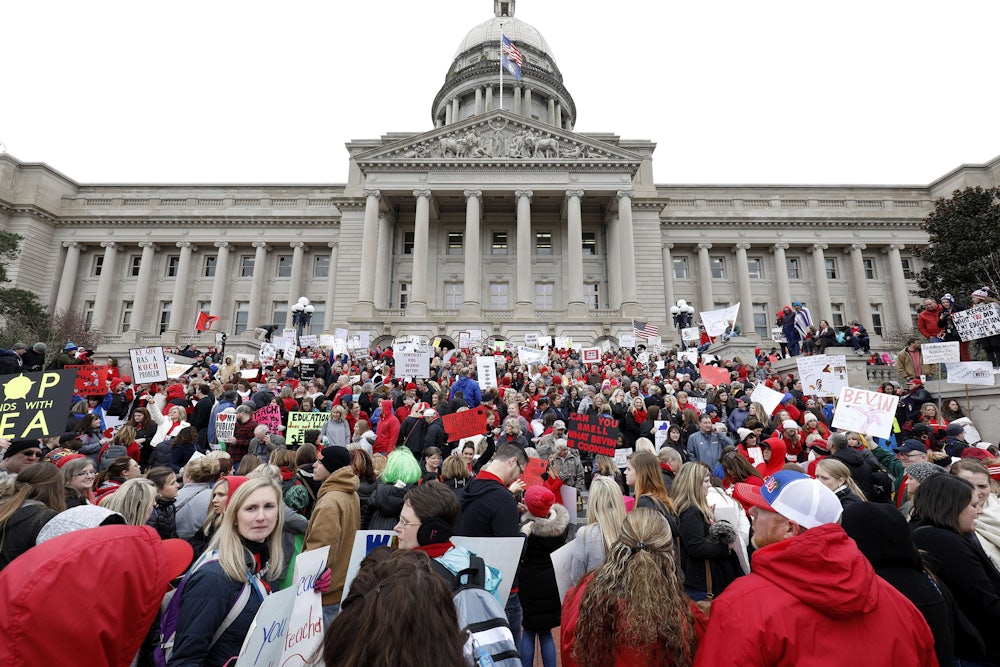
The remarkable upsurge of teachers in Republic-run, largely non-union states that has swept through West Virginia and is now sweeping through Oklahoma and Kentucky, and is poised to descend on Arizona, has returned the mass strike to the United States after decades of relegation to the history books. In each of these states, the teachers unions have something between limited and no legal rights to bargain collectively, and, correspondingly, represent just a hard core of members whose commitment to their union is more a matter of belief than of anticipated reward. And yet, able to mobilize even in non-union terrains through the use of social media, and outraged at their states’ continued opposition to funding public education, the teachers have leapt beyond law and formal organization to press their case.
Union leaders and members have played a key role in these actions, which have ballooned into statewide strikes. But so have rank-and-file teachers who haven’t been members, some of whom established the Facebook pages that they and their co-workers have used to develop their demands, organize their actions, and mobilize their peers. The fact that West Virginia’s teachers refused to go back to work after a preliminary deal was struck, persuading their leaders and colleagues to stay out until the deal was sealed, and then won their demands has clearly prompted their fellow teachers in other states to turn their righteous indignation at their state government’s decade-long starvation of public education into solidaristic militancy.
These actions signal a sea change in more than just labor relations.
These actions signal a sea change in more than just labor relations. They are of a piece with the revolt of the parents in Kansas, where the regressive tax cuts of the Republican governor and legislature had led to nearly a decade of inadequate funding of the state’s schools. Over the past 18 months, the good Republican parents of Kansas ousted so many trickle-down right-wingers in the legislature that the new legislature, overcoming the governor’s vetoes, raised taxes to restore school funding.

Indeed, what the Republican governors and legislators of Oklahoma, Kentucky, and Arizona are now discovering is that, contra the GOP’s Grover Norquist nostrums, their constituents actually don’t want a government so small it can be drowned in a bathtub. They at least want their kids to get an adequate education and want a government that helps them afford medical care and old age.
That’s why the teachers have found their communities supporting them, scaring the bejesus out of their Republican legislators to the point that those legislators have  continue reading: What the Teacher Strikes Mean:

Saturday, April 21, 2018

Why Textbooks Are a Symbol of Teacher Frustration | Oklahoma Watch

Why Textbooks Are a Symbol of Teacher Frustration | Oklahoma Watch:

Why Textbooks Are a Symbol of Teacher Frustration


One of the most iconic images of the teacher walkout and the cuts to education funding that drove the movement was of tattered, duct-taped, antiquated textbooks.
There was the viral image of an Ada girl holding a class reader that apparently was once assigned to country music star Blake Shelton, now 41. And the photo of a crumbling history book from Owasso in which George W. Bush is the current president (the district later said that particular book wasn’t in use).
These images grabbed headlines, likes and retweets, but are not the whole story. There are new textbooks in Oklahoma classrooms. There are also old textbooks in Oklahoma classrooms. Some school districts can more readily invest in new textbooks than others.
But statewide, textbooks have become a symbol of teachers’ frustration.
“Textbooks are tangible,” said Steve Lindley, a spokesman for Putnam City Schools in Oklahoma City. “You can take pictures of them. It’s hard to take pictures of things schools no longer have because there’s no longer money for them.”
A two-year hiatus in textbook funding from the state, in the 2016-17 and 2017-18 school years, led many districts to delay buying new textbooks. While lawmakers said the money was still there, state Superintendent of Public Instruction Joy Hofmeister said the funds were eliminated.
“At a time when educators are implementing new, stronger standards for English language arts and mathematics, districts will be scrambling,” she said in a 2016 written statement.
Updating Textbooks
Schools typically follow a six-year adoption cycle for new textbook purchases, which is set by the Oklahoma State Textbook Committee, a group of parents, teachers and community members appointed by the governor.
The committee reviews all materials and approves the ones that align with state standards. Those titles are placed on a centralized list for districts to use. The committee is reviewing math books and will begin updating language arts and instructional technology later this year. Districts aren’t required to update on the schedule.
The state textbook allocation is distributed to districts based on their student counts.
The funds can only be spent on textbooks and instructional materials. The state has allocated $33 million for textbooks each year since at least 2002, except for the last two years when the line item was “zeroed out,” according to the state Education Department.
Overall spending on textbooks dropped significantly in 2016-17, the latest year for which school spending data is available, from $38 million to $22.7 million. But prior to that year, schools received a dedicated $33 million a year to purchase new textbooks and instructional materials. So how can textbooks in the state be in such poor shape?
Let’s look at the math.
Divide $33 million by the nearly 695,000 public school students in Oklahoma, and it’s an average of $47.50 per student. Textbook costs vary, but most are in the $90 to $100 range.
So $33 million is about one new textbook for every other student.
Districts can, and do, spend other dollars on textbooks, but their ability to do so varies. For instance, many districts sought local bonds during the two-year hiatus, and district leaders said that helped keep pace with textbook replacements.
Of the $22.7 million total spent by schools on textbooks in 2016-17, Tulsa Public Schools accounted for nearly a quarter of that, investing $5.6 million on textbooks that year, compared to $1.2 million the year before. That money came from Tulsa’s 2015 bond, which included $12.5 million for textbooks and materials over six years.
That’s $50 per student per year, which still doesn’t buy a new book for every student.
“Fifty dollars is not enough, just like the amount the state gives us is not enough for each child for all the content areas, so we work really hard to be really responsible with those funds,” said Danielle Neves, executive director of teaching and learning for Tulsa Public Schools.
Tulsa high school student Brianna Davis said she purchased five of her own books this year —one as a graded assignment. Using old textbooks in her advanced classes puts students at a disadvantage.
“It’s especially devastating when you’re taking advanced classes, taking International Baccalaureate classes, and you don’t have the newest version of the books,” Davis said. “We’re usually behind, and it hurts our test scores.”
Oklahoma City Public Schools spent less than $79,000 on textbooks in 2016-17 for continue reading:  Why Textbooks Are a Symbol of Teacher Frustration | Oklahoma Watch:

Why Teachers Are Adopting a More Militant Politics | The New Republic

Why Teachers Are Adopting a More Militant Politics | The New Republic:

A True Labor of Love
Why teachers are adopting a more militant politics

Teachers are expected to do their jobs for the love of it.

For years now, that has meant getting by with tattered, aged textbooks, in buildings that are falling apart, and spending their own money on toilet paper, food, hygiene items, and socks for students, even as their own wages fall and their health insurance premiums spike and pensions are carved away.

It has meant, too, that any action by teachers to improve their working conditions—which, they have stressed since the 2012 Chicago Teachers Union strike, are their students’ learning conditions—is immediately depicted as selfish, uncaring, improper. There is no amount of money that bankers must be happy with, but our culture tells us that workers whose job is not the production of widgets (or toxic financial products) but the care and education of others must accept any sort of misery out of their devotion to their work.

The teacher revolts rippling across the country in the past couple months have seemed out of the blue to many, yet they are only the latest and perhaps unruliest actions taken by educators in the past eight years. What those of us who follow labor closely have been tracking is an ongoing reorientation of teacher unions, away from a myth of professionalism that no longer works when roaches are running over their feet, their students’ bellies are empty, and politicians from both parties are blaming teachers for not being able to be “Superman,” and toward a renewed militancy from the rank-and-file. In doing so, they are turning the myth of the labor of love on its head.

Around the country, reformers have run for office in their unions—most famously in Chicago, with the Caucus of Rank and File Educators (CORE) taking power and precipitating the 2012 strike, but also in Seattle, Los Angeles, Portland, St. Paul, New York, Massachusetts, Puerto Rico, and North Carolina, among others. Teachers have refused to administer standardized tests, built coalitions for street protests and to defeat legislation, held sick-outs, and both threatened to and actually gone on strike. They have pushed back on testing, school closings, charter schools, merit pay, insurance and pension cuts, and won reforms including social services, restorative justice initiatives, and increased funding.

What has been happening in so-called Trump Country—West Virginia, Oklahoma, Kentucky, and Arizona, specifically—in recent months is then deeply connected to the shifts that have come before. Indeed, the visuals of red-clad teachers in capitol  continue reading: Why Teachers Are Adopting a More Militant Politics | The New Republic:


Friday, April 20, 2018

Robert DeNiro pens ‘excuse’ letter for students participating in #NationalSchoolWalkout #MarchForOurLives #NeverAgain - The Washington Post

Robert DeNiro pens ‘excuse’ letter for students participating in National School Walkout - The Washington Post:

Robert DeNiro pens ‘excuse’ letter for students participating in National School Walkout

Image result for Robert DeNiro


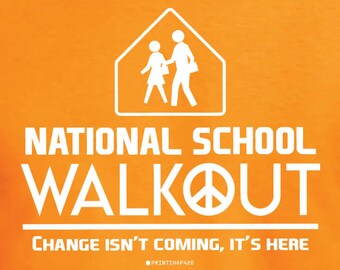
Friday, April 20, is National School Walkout day, when students in schools around the country are expected to walk out to protest what organizers say is inaction by local, state and federal officials to take action to prevent gun violence.
It is the 19th anniversary of the killings of 13 people by two students at Columbine High School in Colorado, and the latest of several massive student-led demonstrations against gun violence since the Feb. 14 killings of 17 people at Marjory Stoneman Douglas High School in Parkland, Fla.
As a gesture to help students who are planning to participate, actor Robert DeNiro has penned an “excuse letter” for anyone in need. CNN confirmed with DeNiro’s representatives that the letter did indeed come from him.


Students in every state are expected to walk out of school at 10 a.m. local time and will gather for 13 seconds of silence to honor the 13 victims at Columbine. After that, students are asked to have discussions about gun violence and solutions, and then participate in events that have been planned by local walkout leaders. Continue reading: Robert DeNiro pens ‘excuse’ letter for students participating in National School Walkout - The Washington Post:
Price Tags - March For Our Lives - https://wp.me/P9J85t-288 via @AMarch4OurLives

The NRA spends $1.05 per student in Florida. Politicians like Florida's Marco Rubio receive NRA blood money. Don't put a price on us.


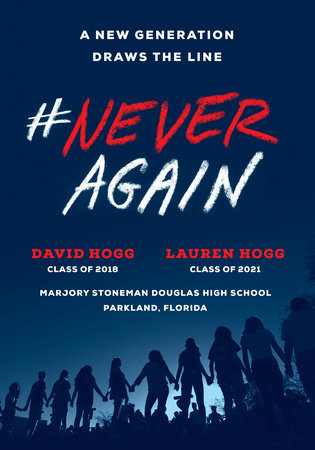
Big Education Ape: #NeverAgain The Book by David Hogg, Lauren Hogg | #NationalSchoolWalkout #MarchForOurLives - http://bigeducationape.blogspot.com/2018/04/neveragain-by-david-hogg-lauren-hogg.html
#NeverAgain by David Hogg and Lauren Hogg

Thursday, April 19, 2018

Majority of teens worry about school shootings, and so do most parents | Pew Research Center

Majority of teens worry about school shootings, and so do most parents | Pew Research Center:
A majority of U.S. teens fear a shooting could happen at their school, and most parents share their concern


In the aftermath of the deadly shooting at a high school in Parkland, Florida, a majority of American teens say they are very or somewhat worried about the possibility of a shooting happening at their school – and most parents of teens share that concern, according to new Pew Research Center surveys of teens ages 13 to 17 and parents with children in the same age range.
Meanwhile, when it comes to what can be done to prevent this kind of violence, far more teens view proposals focused on mental illness, assault-style weapon bans and the use of metal detectors in schools as potentially effective than say the same about allowing teachers and school officials to carry guns in schools.
The surveys of teens and parents were conducted in March and April 2018, following the Feb. 14 shooting at Marjory Stoneman Douglas High School – one of the deadliest mass school shootings in U.S. history. Seventeen people were killed in the attack and more than a dozen others were injured. The surveys also come as the nation prepares to mark the 19th anniversary of the shooting at Columbine High School in Colorado.
Overall, 57% of teens say they are worried about the possibility of a shooting happening at their school, with one-in-four saying they are very worried. About three-in-ten (29%) say they are not too worried about this, and just 13% say they are not at all worried.
Nonwhite teens express a higher level of concern than their white peers. Roughly two-thirds (64%) of nonwhite teens, including 73% of Hispanics, say they are at least somewhat worried about this, compared with 51% of white teens.
School shooting fears differ by gender as well: 64% of girls say they are very or somewhat worried about a shooting happening at their school, compared with 51% of boys.
Parents of teenagers express similar levels of concern as teens themselves, with 63% saying they are at least somewhat worried about the possibility of a shooting happening at their child’s school. And there are similar patterns when it comes to race and gender, with nonwhite parents and mothers expressing more concern. Lower-income parents are particularly worried – in fact, 82% of parents with annual household incomes under $30,000 say they are at least somewhat worried that a shooting could happen at their teen’s school, compared with 64% of those with incomes between $30,000 and $74,999 and 53% of those with incomes of $75,000 or more.
Some policies seen as more effective than others
Against the backdrop of organized school walkoutsand marches calling for new legislation to address gun violence, teens see more value in some proposed measures than others. Asked to assess how effective various measures would be at preventing school shootings, 86% of teens say that preventing people with mental illnesses from purchasing guns and that improving mental health screening and treatment would be effective, including majorities who say each of these proposals would be very effective. Roughly eight-in-ten teens (79%) say that having  Continue reading: Majority of teens worry about school shootings, and so do most parents | Pew Research Center:

Price Tags - March For Our Lives - https://wp.me/P9J85t-288 via @AMarch4OurLives

The NRA spends $1.05 per student in Florida. Politicians like Florida's Marco Rubio receive NRA blood money. Don't put a price on us.

The World’s 50 Greatest Leaders of 2018 | Fortune #NeverAgain #NationalSchoolWalkout #MarchForOurLives

The World’s 50 Greatest Leaders of 2018 | Fortune:

The World’s 50 Greatest Leaders of 2018 
Our annual list of the thinkers, speakers, and doers who are stepping up to meet today’s challenges.


Though it seems unlikely, Tim Cook and Indira Jaising have something in common besides membership in Fortune’s 2018 ranking of the World’s Greatest Leaders. Cook (No. 14) is the wealthy CEO of Apple, the most valuable publicly traded company on earth; Jaising (No. 20) is an Indian lawyer who cofounded an NGO called Lawyers Collective, which promotes human rights issues. Yet they share this trait: Both have multiplied their organizations’ effectiveness by harnessing the power of unbundling. Following their example is a new imperative for the best leaders.
Unbundling means disaggregating enterprises of all kinds, from the smallest startups to entire nations. In business it can mean making a company more valuable by splitting it up, as Hewlett-Packard did and other companies (Honeywell, Pentair, DowDuPont) are doing. Or it can mean increasing value by delegating functions once regarded as necessary parts of the whole; Apple’s outsourcing of complex, high-tech manufacturing, and the staggering capital requirements that go with it, is a dramatic example.
Technology makes unbundling possible and often inevitable. For centuries, greater size made companies, nations, and other enterprises more efficient and effective. Increasingly, it doesn’t. Outsourcing and coordinating manufacturing, distribution, research, and nonemployee workers becomes easy and cheap in the digital era. The most extreme example is the Chinese appliance maker Haier, which is not so much a company as a platform that invites entrepreneurs to become one of thousands of microenterprises within its ecosystem. Crazy? Definitely not. Using this radically unbundled model, Haier has become the world’s largest appliance brand.
I asked the architect of Haier’s model, chairman Zhang Ruimin (on our WGL list in 2014 and 2017), why more business leaders don’t follow his example. “They’re afraid of giving up power,” he replied. Nearly all their incentives encourage empire building. “Bigger firms pay more, way more,” says Kevin Hallock, director of Cornell University’s Institute for Compensation Studies. The same is true among nonprofits and labor unions, he finds. Why would any leader want to unbundle?
This year’s list puts an emphasis on leaders who are navigating this challenge deftly. (That has meant sidelining some perennially worthy figures, from Pope Francis to Jeff Bezos; to see past years’ lists, visit Fortune.com.) At companies, one solution is to evaluate leaders on wealth creation rather than size as conventionally measured. Leaders of mission-driven nonprofits may face fewer disincentives. Indira Jaising’s little NGO punches far above its weight because it can outsource staff and infrastructure; the Internet lets it communicate widely at low cost and enables volunteers to pitch in from around the world.
Click on the names below to jump to their section of the list

THE TOP 10

1. The Students Marjory Stoneman Douglas and other schools
2. Bill and Melinda Gates Cofounders, Gates Foundation
3. The #MeToo Movement
4. Moon Jae-in President, South Korea
5. Kenneth Frazier CEO, Merck
6. Scott Gottlieb FDA commisioner
7. Margarethe Vestager Commissioner for Competition, European Union
8. Larry Fink CEO, BlackRock
9. General Joseph Dunford Chairman, Joint Chiefs of Staff
10. Liu He Vice Premier, China

11-20

11. Mary Barra CEO, General Motors
12. Nick Saban Football coach, University of Alabama
13. Emmanuel Macron President, France
14. Tim Cook CEO, Apple
15. Serena Williams Athlete
16. Isabelle Kocher CEO, Engie
17. Katie Bethell Executive director, PL+US
18. Ryan Coogler Film director
19. Huateng “Pony” Ma CEO, Tencent
20. Indira Jaising Founder, Lawyers Collective

21-30

21. Marc Benioff CEO, Salesforce
22. The Gymnasts and Their Allies
23. Kathleen McLaughlin Chief sustainability officer, Walmart
24. Mukesh Ambani Chairman and managing director, Reliance Industries
25. Mick Cornett Former mayor, Oklahoma City
26. Donald Hopkins Physician, the Carter Center
27. Oprah Winfrey CEO, OWN
28. Mitch Landrieu Mayor, New Orleans
29. Jacinda Ardern Prime Minister, New Zealand
30. Ma Jun Environmentalist, China

31-40

31. West Virginia Teachers
32. Leymah Gbowee President, Gbowee Peace Foundation
33. Jamie Dimon CEO, JPMorgan Chase
34. Michael Sorrell President, Paul Quinn College
35. Reese Witherspoon Actor/producer
36. Daniel Servitje Montull CEO, Grupo Bimbo
37. Izumi Nakamitsu Undersecretary general for disarmament, United Nations
38. Bashar Masri Founder, Rawabi
39. Leila de Lima Senator, Philippines
40. Angela Nyambura Gichaga CEO, Financing Alliance for Health

41-50

41. Timothy Keller Evangelical minister/author, Redeemer City to City
42. Gwynne Shotwell President and chief operating officer, SpaceX
43. Balkrishna Doshi Architect, India
44. Feike Sijbesma CEO, DSM
45. Kelly Chibale Scientist, South Africa
46. Ana BotĆ­n Group executive 
chairman, Banco Santander
47. Dina Meza Journalist, PEN Honduras
48. Ridwan Kamil Mayor, Bandung, Indonesia
49. Amy Gutmann President, University of Pennsylvania
50. Ed Bastian CEO, Delta Air Lines

The fiercest resisters of unbundling are national leaders. They have little to gain and much to lose by leading a smaller country. Yet they may have no choice, eventually. Many services that once were the province of governments—telecom, utilities, even Continue Reading: The World’s 50 Greatest Leaders of 2018 | Fortune:

Obama Profiles Parkland Survivors For TIME's '100 Most Influential' List | HuffPost - https://www.huffingtonpost.com/entry/obama-parkland-survivors_us_5ad8aed2e4b029ebe021cadd on @HuffPostPol

Cameron Kasky, Jaclyn Corin, David Hogg, Emma GonzƔlez and Alex Wind Is on the 2018 TIME 100 List |

Big Education Ape: #NeverAgain The Book by David Hogg, Lauren Hogg | #NationalSchoolWalkout #MarchForOurLives - http://bigeducationape.blogspot.com/2018/04/neveragain-by-david-hogg-lauren-hogg.html
#NeverAgain by David Hogg and Lauren Hogg

Price Tags - March For Our Lives - https://wp.me/P9J85t-288 via @AMarch4OurLives


The NRA spends $1.05 per student in Florida. Politicians like Florida's Marco Rubio receive NRA blood money. Don't put a price on us.

The power Scam behind the search for a new L.A. schools leader

The power game behind the search for a new L.A. schools leader:

The power game behind the search for a new L.A. schools leader


The search for a new Los Angeles schools superintendent is proceeding behind closed doors, but the underlying power politics extend well beyond the room where seven elected Board of Education members are at work.

There now appear to be three finalists since Indianapolis Supt. Lewis Ferebee withdrew from consideration this week. They are, in alphabetical order: former Baltimore Supt. Andres Alonso, former investment banker Austin Beutner and Vivian Ekchian, who is L.A.'s interim superintendent.

Some of the city's power brokers seem to be invested in Beutner, 58, who is himself one of L.A.'s more influential leaders. But they are keeping a low profile, apparently working behind the scenes on his behalf.

The person who gets the job will have to confront the Los Angeles Unified School District's rising pension costs, vastly underfunded retiree health benefits and declining student enrollment, which could push the nation's second-largest school system toward financial crisis. Many schools also perform well below state averages academically.

What happened in closed session Tuesday, and who has the inside track?

The board met in private for about 10 hours. Much of that time was spent on second interviews with Alonso and Beutner. (Ekchian had hers last week.) Deliberation lasted until about 10 p.m. and often got heated, sources said. The meeting recessed with no announcement.

In any scenario, the majority would prefer to avoid a 4-3 vote if one of those four votes belongs to Ref Rodriguez, who faces criminal charges for alleged political money laundering. He has denied wrongdoing, but his reputation has suffered and he could be forced from office if convicted.

Informed speculation suggests that Beutner has the easiest path to a four-vote majority, and the core of that support would come from the four-member board majority elected with major financial backing from charter school advocates. Beutner has tried to avoid polarizing comments on charter-related issues, though he has served on the boards of charter school organizations and contributed to charter-backed candidates for public office.


But his lack of experience in managing schools or school districts could give some board members pause, including those in the charter-backed bloc.

If that bloc holds for Beutner, a fifth vote could come from Richard Vladovic, who has triangulated between opposing district factions without alienating them.

If Beutner cannot get past four votes, the board could turn to Alonso, especially if switching gears could bring him five or six votes.

From 2007 to 2013, Alonso, 60, managed to navigate opposing political forces in Baltimore, forging a respectful relationship with the teachers union while also winning praise from advocates, such as charter backers, who frequently do battle with unions.

In the current climate, the 57-year-old Ekchian, the insider, looks like a fallback choice. She would not be the first L.A. superintendent to ascend this way. Were she to be selected, a 7-0 vote is possible, as a gesture of goodwill.

What happens next?

The board meets Friday at noon. It's possible that the choice is already made and that the delay until Friday is simply to prepare for the announcement or to hash out contract details. Or maybe the debate continues.

How might the new board majority affect the superintendent selection process?

Supt. Michelle King was hired in 2016 by a board that wanted her to win back students who had left the school system for charter schools. These independently operated campuses Continue reading: The power game behind the search for a new L.A. schools leader:


Big Education Ape: Beutner emerges as a top pick for L.A. schools superintendent amid last-minute jockeying - http://bigeducationape.blogspot.com/2018/04/beutner-emerges-as-top-pick-for-la.html