Latest News and Comment from Education

Friday, March 24, 2017

California's Suspensions Are Down, But Racial Disparities Persist By Jonathan D. Glater - Education Law Prof Blog

Education Law Prof Blog:

California's Suspensions Are Down, But Racial Disparities Persist 

By Jonathan D. Glater

Image result for California school Suspensions

While school suspension rates have fallen sharply in recent years in California, the racially disproportionate impact of this form of punishment has persisted.  That is the headline conclusion of the latest report on education in the United States from the Brookings Institution’s Brown Center on Education Policy.  The important and difficult questions are why and what can be done.
The study, one chapter in the final volume of a multiyear series, examined possible relationships between rates of suspension and (1) size of the school, (2) poverty at the school, and (3) share of the student body that is African American, among other variables.  Overall, the rate of suspensions of black students is higher at larger schools than at smaller schools; higher at schools attended by more students receiving free and reduced price meals, and higher the larger the share of the student body that is black.
California presents a useful case study because state lawmakers have acted to reduce use of suspension, defined for purposes of the study as suspension off-campus.  In 2014 the legislature passed Assembly Bill No. 420 (“AB 420”) which prohibited schools from expelling students because they engaged in acts of “willful defiance.”  That catchall term was the most common offense leading to suspension, especially for minority students. 
Rates of suspension were already declining when AB 420 was enacted and such decreases have continued.  Between 2013 and 2015, suspension rates fell by nearly one-third for all students and for each major racial/ethnic group (the categories are white, black, Hispanic and Asian). 
But the rate for black students remains more than triple that of Hispanic students, who constitute the group suspended at the next-highest rate.  In 2015, for every 1,000 black students in California schools, black students received 178 out-of-school suspensions, while the comparable number for Hispanic students was 52; for white students, 44; and for Asian students, 12. 
The report breaks schools into two groups, those with high rates of suspension of African American students, and those with low rates of suspension of African American students, and then examines characteristics of the schools to identify correlates of suspension rates.  In 2015, there were 1,930 schools with high suspension rates, defined as a rate of 5 percent or more, and there were 3,546 schools with low suspension rates, defined as a rate below 5 percent. 
Although there were fewer schools with high rates, those schools imposed 35,424 suspensions, compared to 139 at the low rate schools.  (I am leaving out, although the report discusses them, the schools that did not report Education Law Prof Blog:


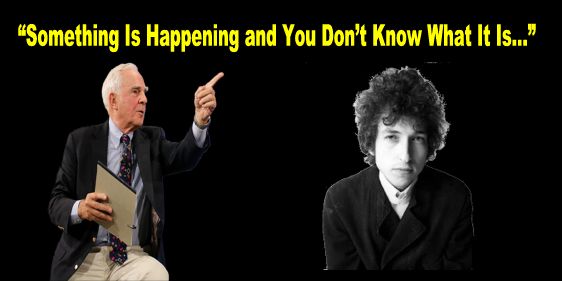
“Something Is Happening and You Don’t Know What It Is…” | janresseger

“Something Is Happening and You Don’t Know What It Is…” | janresseger:

“Something Is Happening and You Don’t Know What It Is…”

After reading John Merrow’s reflection on what is happening in the Trump-DeVos Department of Education, I woke up in the night thinking of Bob Dylan. John Merrow covered education for the PBS NewsHour for decades, and he just visited Washington, D.C., where he talked with old friends and contacts who see significant developments at the U.S. Department of Education.
Merrow describes the movement of education policy in the transition from the Obama to the Trump administration, but he is definitely not depicting a new spirit or a gathering momentum. This is definitely not a “the times are a-changin” moment.
I will, however, give Bob Dylan credit for naming what I think John Merrow has noticed: “Something is happening and you don’t know what it is. Do you, Mr. Jones?”
Here is John Merrow: “In his inaugural address, President Trump told the nation that we have an ‘education system flush with cash but which leaves our young and beautiful students deprived of all knowledge.’ His proposed budget acts on his words, cutting federal education dollars by 13.5% or nearly $9 billion. His Secretary of Education, Betsy DeVos, has called public education a disgrace and a disaster. Openly hostile to traditional public schools (which serve 90% of children) she plans to use the levers of power available to her to support vouchers, home schooling, on-line for-profit charter schools, and other alternatives… However, it’s also chaotic, because Trump’s White House does not trust any of the Cabinet departments and has installed ‘spies’ in all of them, including Education. These Trump loyalists, often called ‘Special Assistants to the Secretary,’ report to the White House, not to the Secretary of the department they’re assigned to. So things have to be beyond weird at 400 Maryland Avenue SW, the home of the Department of Education… I just came from Washington, where some Republicans and Democrats told me that ‘Lamar Alexander is really in charge.’… They seemed to be expressing the hope that Senator Alexander could and would rein in DeVos if she really got crazy. So, it’s bad, but it would be worse if Trump’s anti-public school people had their act together, which they do not.”
In all this John Merrow is able to derive some optimism: “Congress, which finally got out from under the widely-discredited No Child Left Behind Act when it passed the Every Student Succeeds Act, has now revoked regulations issued in the dying days of the Obama Administration.  That gives even more power back to states and districts, who must still file their ESSA accountability plans with the Department…. even though it’s not clear that anyone at the Department will read them, let alone approve them. Trump’s budget cuts federal dollars that have been supporting State Departments of Education, so it’s reasonable to infer that state officials are spending lots of time and energy trying to restore those budget cuts… So, with Washington engaged in in-fighting, and State Departments fighting to keep their feet firmly in the federal trough, who’s paying attention to local school districts?  Could this be a real opportunity for genuine local control?”
I wonder what gives John Merrow quite so much optimism about local control.  Since No Child Left Behind was signed into law in January of 2002, there has definitely been a gross “Something Is Happening and You Don’t Know What It Is…” | janresseger:

Mike Klonsky's SmallTalk Blog: Diane Ravitch and Kevin Coval are our guests today on Hitting Left.

Mike Klonsky's SmallTalk Blog: Diane Ravitch and Kevin Coval are our guests today on Hitting Left.:

Diane Ravitch and Kevin Coval are our guests today on Hitting Left.


Diane Ravitch
First batter up on the Klonsky Brothers, Hitting Left show this morning is ed activist, historian, and author Diane Ravitch. Diane's latest book, "Reign of Error: The Hoax of the Privatization Movement and the Danger to America's Public Schools" is a must read.

You can follow her daily blog here. I do.

She and I will be talking about vouchers, charters, and the Trump/DeVos "choice" offensive which aims at nothing less that putting the final nail in the coffin of public education.

Hitting in the clean-up spot will be in-studio guest, Chicago poet Kevin Coval. He's bringing with him a young Louder Than a Bomb poet.


Kevin Coval
Kevin is the co-founder of LTAB, the world's largest poetry festival, which exploded on the Chicago scene back in 2001 and has grown exponentially since then. He's the is the editor of "The BreakBeat Poets: New American Poetry in the Age of Hip-Hop". His 8th book, “A People’s History of Chicago" came out earlier this month. It's a collection of 77 poems representing the city’s 77 diverse neighborhoods and the people within them.

You can hear it all live on WLPN 105.5 FM Chicago, this morning at 11 a.m. CDT, streaming at lumpenradio.com or listen to the podcast at your leisure on Liberated Syndication.

 Mike Klonsky's SmallTalk Blog: Diane Ravitch and Kevin Coval are our guests today on Hitting Left.:

U.S. Secretary Of Education DeVos Crafts A Policy That Benefits Her Friends

U.S. Secretary Of Education DeVos Crafts A Policy That Benefits Her Friends:

U.S. Secretary Of Education DeVos Crafts A Policy That Benefits Her Friends

 A March 20 Bloomberg News story reveals that Education Secretary Betsy DeVos made a decision regarding student loans that will financially benefit one of her well-heeled friends. This decision will likely set a pattern for her secretariat.

Americans who default on some of their federal student loans are likely to pay more after Education Secretary Betsy DeVos reversed an Obama administration directive limiting some fees. But it turns out the Trump administration decision has some beneficiaries—including the father of a key DeVos lieutenant who just quit.
It is abhorrent that the DeVos-style reformers often accuse traditional public school personnel, including administrators and unions, of protecting adults to the detriment of students. But these so-called reformers are typically involved in public education to turn a profit, which relegates students to the status of pawns.
DeVos is in a position to heap harm on students by lining the pockets of her wealthy friends. She no doubt only runs in billionaire circles.
Who will help expose this chicanery?
—–
William L. Phillis, Ohio Coalition for Equity & Adequacy of School Funding

Louisiana School Boards Assn. Confronts Louisiana’s ESSA State Plan Rush Job | deutsch29

Louisiana School Boards Assn. Confronts Louisiana’s ESSA State Plan Rush Job | deutsch29:

Louisiana School Boards Assn. Confronts Louisiana’s ESSA State Plan Rush Job


On March 13, 2017, US ed sec Betsy DeVos contacted state superintendents to let them know that there are now two possible deadlines for submission of Every Student Succeeds Act (ESSA) state plans: April 03, 2017, or September 18, 2017. There is no penalty for a state’s waiting until September and not rushing to submit by April.
Nevertheless, it seems that Louisiana superintendent John White wants to rush anyway and submit an incomplete ESSA plan that does not have the support of the Louisiana School Boards Association (LSBA).
On March 23, 2017, LSBA Executive Director Scott Richard sent this three-page letter to Louisiana Governor John Bel Edwards, the state board of education (BESE), and White.
LSBA’s letter addresses six primary concerns with the ESSA plan that White wants to send to the US Department of Education (USDOE) in April.
The first concerns the state slicing off an additional 3 percent of ESSA funding and redistributing it in a manner that the state sees fit:
Just as the State is struggling fiscally, local school boards have, year after year, been called upon to provide a higher and higher percentage of the cost of providing public education.  Long gone are the days when the State carried 65% of the fiscal burden, compared to 35% for local districts. Recent financial data shows local school boards carrying about 50% of the costs of providing public education in Louisiana. The proposal to withhold an additional 3% of federal funds from every local school board is, therefore, very troubling.
While local school boards appreciate the notion espoused by Supt. White that the LDOE will redistribute that money, the inevitable fact is the many local school boards, and the children they are tasked with educating, will suffer a net loss of funding through this process.  While a few local school boards or charter schools may benefit, that benefit will be at the expense of every other local school board and charter school.  The LSBA, therefore, objects to the reservation and diversion of federal funds as provided in the LDOE proposal.
The second concern is that school districts are not even aware of how the district Louisiana School Boards Assn. Confronts Louisiana’s ESSA State Plan Rush Job | deutsch29:


What the Dickens is going on? | The Merrow Report

What the Dickens is going on? | The Merrow Report:

What the Dickens is going on?

From one perspective, these are the worst of times for American public education.  In his inaugural address, President Trump told the nation that we have an “education system flush with cash but which leaves our young and beautiful students deprived of all knowledge.” His proposed budget acts on his words, cutting federal education dollars by 13.55, or nearly $9 billion.  His Secretary of Education, Betsy DeVos, has called public education a disgrace and a disaster. Openly hostile to traditional public schools (which serve 90% of children) she plans to use the levers of power available to her to support vouchers, home schooling, on-line for-profit charter schools, and other alternatives.
Basically, it’s open warfare against public education in Washington.
However, it’s also chaotic, because Trump’s White House does not trust any of the Cabinet departments and has installed ‘spies’ in all of them, including Education.  These Trump loyalists, often called ‘Special Assistants to the Secretary,’ report to the White House, not to the Secretary of the department they’re assigned to.  So, things have to be beyond weird at 400 Maryland Avenue SW, the home of the Department of Education.  One can imagine these ‘Special Assistants’ going from office to office, looking over shoulders and grilling confused bureaucrats.  “What do you do?” Why does what you do matter?”  And so on…  I hear that morale is plummeting at the Department.
I just came from Washington, where  some Republicans and Democrats told me that “Lamar Alexander is really in charge.”  Mr. Alexander is the Republican Senator from Tennessee and a former Secretary of Education who, as Chair of the Committee that approved DeVos, pushed through her nomination even though her statements revealed her lack of qualifications and understanding.   They seemed to be expressing the hope that Senator Alexander could and would rein in DeVos if she really got crazy.
So, it’s bad, but it would be worse if Trump’s anti-public school people had their act together, which they do not.
And there’s a brighter side to all this. Congress, which finally got out from under the widely-discredited No Child Left Behind Act when it passed the Every Student Succeeds Act, has now revoked regulations issued in the dying days of the Obama Administration. That gives even more power back to states and districts, who must What the Dickens is going on? | The Merrow Report:


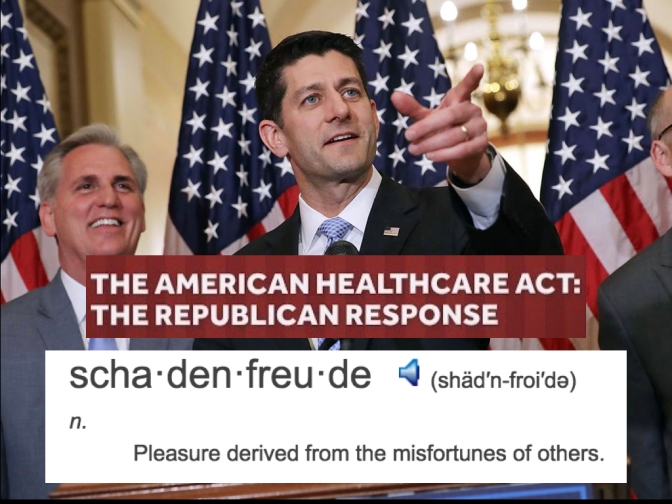
Schadenfreude: Republicans’ American Healthcare Act | Reclaim Reform

Schadenfreude: Republicans’ American Healthcare Act | Reclaim Reform:

Schadenfreude: Republicans’ American Healthcare Act

The American Healthcare Act: The Republican Response (Schadenfreude)


Educator Guides for GLSEN Programs | GLSEN

Educator Guides for GLSEN Programs | GLSEN:

Educator Guides for GLSEN Programs


Planning for Back to School? Looking for ways to support Day of Silence? Interested in being more LGBTQ-inclusive during pride month? You’ve come to the right place!
Check out the guides below for specific tools and tips related to GLSEN programs, days of action and more! Ready to supplement your curriculum? Explore our LGBTQ-Inclusive and Bullying, Bias & Diversity lesson plans.


Thursday, March 23, 2017

Court Brief to Protect Federal Funding for Schools - Year 2017 (CA Dept of Education)

Court Brief to Protect Federal Funding for Schools - Year 2017 (CA Dept of Education):

State Superintendent of Public Instruction Files Court Brief to Protect Federal Funding for Schools


SACRAMENTO — State Superintendent of Public Instruction Tom Torlakson filed a court brief Wednesday supporting Santa Clara County’s request to halt an executive order by President Donald Trump that threatens to stop federal funding for California cities, counties, and possibly public schools.
Torlakson filed a friend of the court brief in the Federal Court’s Ninth District, where Santa Clara County has filed for a preliminary injunction to stop the President’s Executive Order of January 2017.
The injunction request said the order is unconstitutional because it would compel local governments to take an active role in enforcing immigration law and could withhold federal funding from agencies, including schools, which declare themselves “sanctuary jurisdictions.” The order doesn’t clearly define that term.
Torlakson last year urged California school districts to declare themselves “Safe Havens” and reminded parents and their families that state and federal law guarantee that students can attend public school, regardless of immigration status. To date, 57 separate school district boards of directors, representing nearly two million students combined, have adopted such resolutions.
“The Executive Order places schools, schools districts, and county offices of education, who have merely identified themselves as safe havens for undocumented students, in the precarious position of losing large amounts of federal funds without warning, notice, or clear guidance about what is meant by the order,” Torlakson said in the court brief.
California receives more than $8 billion annually in federal funds for kindergarten through twelfth grade education, which then goes to public schools, districts, and county offices of education. Federal funding ranges from help for students in disadvantaged communities to free and reduced cost breakfast and lunch for students from low-income families.
U.S. District Judge William Orrick is scheduled to hold a hearing on the Santa Clara County motion on April 5, 2017.

# # # #
Tom Torlakson — State Superintendent of Public Instruction
Communications Division, Room 5602, 916-319-0818, Fax 916-319-0100


Court Brief to Protect Federal Funding for Schools - Year 2017 (CA Dept of Education):