Latest News and Comment from Education

Thursday, March 23, 2017

Ethnic Studies Courses Break Down Barriers and Benefit Everyone—So Why the Resistance?
 by J. Gabriel Ware — YES! Magazine

Ethnic Studies Courses Break Down Barriers and Benefit Everyone—So Why the Resistance?
 by J. Gabriel Ware — YES! Magazine:

Ethnic Studies Courses Break Down Barriers and Benefit Everyone—So Why the Resistance?


As cities incorporate curricula that deconstruct stereotypes and negative assumptions about race, advocates say everyone wins. Others argue they just promote resentment.

Ethnic Studies Seattle.jpg
Students raise their fists in solidarity with four students on a hunger strike to defend the funding of the San Francisco State University of Ethnic Studies. Photo by Melissa Minton / Flickr.


Last year Mackenzie Martinez, who’s Mexican American, asked her U.S. history teacher about the roles Asian and Hispanic Americans played in the civil rights movement. She was told Hispanic people had no role in the movement because they were not in the U.S at the time. Months later, while reviewing the curriculum of a Los Angeles ethnic studies course, Martinez learned that Hispanics had, in fact, been involved in the civil rights movement.
Now a senior at The Center School in Seattle, Martinez says she feels robbed of her education by not being taught the contributions and history of different groups of people.
“All I ever learned about was Dr. Luther King and Rosa Parks—that’s the extent of my cultural education,” she says. “America is a melting pot, so we shouldn’t have to ignore the other ingredients.”
“America is a melting pot, so we shouldn’t have to ignore the other ingredients.”
The NAACP’s Seattle chapter is working to change that with a resolution that would insert ethnic studies into the city’s public schools. Because Seattle Public Schools faces a debt of $74 million, the proposal doesn’t ask for the creation of new ethnic studies courses, but instead the incorporation of ethnic studies into existing courses—such as history, math, and language and comprehension—by relating course materials to diverse backgrounds.
The support for ethnic studies programs in public schools is spreading throughout the nation. In Texas, Senate Hispanic Caucus Chair Sylvia Garcia, D-Houston, is leading a bill that would require the state’s board of education to develop ethnic studies as elective courses for middle and high school students. A similar proposal in Santa Fe, New Mexico, would ensure that students have the option to take ethnic studies as a social studies elective.
Meanwhile, other cities are already adopting ethnic studies curricula in their public schools. In Portland, Oregon, the school board voted in May to offer high school ethnic studies classes that will focus on the history, culture, and social movements of people of color, immigrants, and LGBTQ communities, starting in 2018. In 2014, Los Angeles, San Francisco, and El Rancho, California, voted to make ethnic studies courses a graduation requirement; last year, a state law was signed requiring the state board of education to create an ethnic studies program for all high schools by 2019. And nearly 12 years ago, Philadelphia implemented an African American history course as a graduation requirement, making it the longest-running ethnic studies program in public schools.

Why the need for ethnic studies courses?

Seattle Public Schools is the largest K-12 school system in Washington, with about 52,000 students in 97 schools. And although more than 40 percent of its students identify as races or ethnicities other than white, the curriculum taught is through a Eurocentric prism.
“I talked to a lot of these students and one of the things they tell me is that they don’t see themselves in the curriculum,” says Rita Green, Seattle/King County NAACP education chair. “We need to add the contributions of all cultures. If students aren’t learning it in schools, [in many cases] they won’t learn it at all.”
The NAACP noted that Seattle has one of the greatest disparities nationally in academic achievement between students of color and white students—particularly between African American and white students. A recent study from Stanford University’s Graduate School of Education found that ethnic studies courses improved the academic performance Ethnic Studies Courses Break Down Barriers and Benefit Everyone—So Why the Resistance?
 by J. Gabriel Ware — YES! Magazine:

Ethnic Studies Now Coalition http://bit.ly/24vIwvP

Kids Who Suffer Hunger In First Years Lag Behind Their Peers In School : The Salt : NPR

Kids Who Suffer Hunger In First Years Lag Behind Their Peers In School : The Salt : NPR:

Kids Who Suffer Hunger In First Years Lag Behind Their Peers In School

Image result for Kids Who Suffer Hunger

Growing up in a hungry household in the first couple of years of life can hurt how well a child performs in school years later, according to a new study.
An estimated 13.1 million children live in homes with insufficient food, according to the most recent figures from the U.S. Department of Agriculture.
Many of those children experience hunger during their first few years of life, or their parents are hungry and stressed out about food during those years – the most crucial time for a child's development.
The new study, published in the latest issue of the journal Child Development, suggests that such early experience of hunger in the family is likely to make those children less ready for kindergarten than their classmates who came from homes with enough to eat. It shows that kids who experienced food insecurity in their first five years of life are more likely to be lagging behind in social, emotional and to some degree, cognitive skills when they begin kindergarten.
And many previous studies have shown "that kids who enter the kindergarten door behind, tend to stay behind. They do not catch up," says Anna Johnson, a psychologist and an author of the new study.
Johnson and her colleague used data from an older study by the U.S. Department of Education conducted between 2000 and 2006, which followed about 10,700 children born in low-income households in 2000. It surveyed the parents of these children on various aspects of their lives, including the quantity and quality of food in their households.
Johnson says surveyors asked parents a range of questions that are part of a standardized USDA measure for food security, like, "In the last 12 months, did you worry your food would run out before you could buy more? In the last 12 months, Kids Who Suffer Hunger In First Years Lag Behind Their Peers In School : The Salt : NPR:
Related image

CURMUDGUCATION: MS: Paving Way for Vouchers

CURMUDGUCATION: MS: Paving Way for Vouchers:

MS: Paving Way for Vouchers

Mississippi has long been considered America's Armpit of Education.

Educational lists? You name it, they've consistently ranked near the bottom. It qualified as news when Nevada beat them for dead last in EdWeek's Quality Counts list in 2016, because that was their first step up in years(and it can be argued that they didn't so much improve as Nevada just became even worse.)


Sharing another excellent investment opportunity

They've tried any number of dumb ideas, from jumping on the bandwagon for failing third graders who don't pass the Big Standardized Test in reading, to fining schools for not observing the Pledge of Allegiance. Plus the occasional attempt to force teachers to be silent on any education related issues at all.

What they haven't tried is actually funding their school system. Mississippi ranks close to the bottom there as well, with a per pupil outlay in the $7K area. Back in 1997, the legislature attempted to address this by passing the Mississippi Adequate Education Program (because when you're working on education, "adequate" is plenty good enough). MAEP laid out a funding formula that the state then promptly ignored. The legislature has only voted four times to fund schools as the MAEP says they should-- and two of those times they took it back mid-year. Last year some folks tried to add some actual teeth to the law, and the legislature promptly buried the referendum in a flurry of bloviating baloney.

But Mississippi's educational finances were not going to be ignored. Instead, the GOP called upon EdBuild and their CEO, our old friend Rebecca Sibilia.

You may remember her as the woman who gleefully observed that bankrupcy is a great way to blow up a district, which is no problem for kids, but a great opportunity for charter operators. Arielle Dreher, who has been doing a bang-up job covering all this for the Jackson Free Press, does a nice job of recapping the EdBuild story--

EdBuild is in its infancy as a company (it started in 2014), and Sibilia came from an education-policy background, first working in the Washington, D.C., education department and then moving to the nonprofit Students First, run by Michelle Rhee. The former chancellor of Washington, D.C., public schools, Rhee was a controversial figure, after firing over 200 teachers in D.C., mainly due to poor performance, she said then.

EdBuild's board of directors includes Derrell Bradford (NYCAN), Angelia Dickens(general counsel for StudentsFirst), Michael Hassi (Exponent Partners), Josh McGee (Manhattan Institute, Arnold Foundation), Henry Moseley (CFO, Washington Convention Center), Hari Sevugan (270 Strategies, former DNC press secretary, and just helped a "national, non-profit education reform group get off the ground), and Stephanie Khunrana (Draper Richards Kaplan Foundation). EdBuild's website
CURMUDGUCATION: MS: Paving Way for Vouchers:


Betsy DeVos’s “School Choice” Fallacy | New Republic

Betsy DeVos’s “School Choice” Fallacy | New Republic:
Betsy DeVos’s “School Choice” Fallacy
“Undermining public education is not a choice,” Senator Patty Murray said in a speech Wednesday, railing against the education secretary's policies.

As Senator Patty Murray tells it, Luke was a middle-school boy who used a private school voucher program to attend Manatee Learning Academy in Bradenton, Florida. He did well at Manatee, but when he tried to switch schools for tenth grade, he realized his credits wouldn’t transfer since Manatee—unbeknownst to him and his family—lacked accreditation.
“For all those glossy voucher program brochures,” Luke’s grandmother Nadell Northrop wrote in a Medium post for the American Federation of Teachers, “nobody running the program bothered to mention that schools taking voucher students didn’t have to be accredited, and their teachers didn’t have to be certified.” And so, instead of repeating a grade, Northrop’s grandson simply dropped out of school altogether.
Luke was a good student,” Murray said Wednesday in a speech at the Center for American Progress. “We failed him.”
Murray’s point, as she also explained in a Wednesday memo to her Senate colleagues, was that Education Secretary Betsy DeVos’s school privatization agenda will hurt lots of students like Luke. And the senator, a Democrat from Washington state and the ranking member on the Health, Education, Labor and Pensions Committee, wants her colleagues to start making this case more aggressively, as DeVos ramps up her advocacy for school vouchers nationwide.
The central appeal of DeVos’s school privatization agenda is the notion of “school choice”—that students trapped in failing public schools, many of whom are minority kids, should have the opportunity to choose a public charter or private school that will, ostensibly, provide them a better education. It’s a powerful narrative for President Donald Trump and Republicans, allowing conservatives to cast their policies as a form of social justice—the free market in service of civil rights.
But Murray pointed out that the path to privatization ultimately hurts the very students it’s intended to help“On its face, providing students with more choices Betsy DeVos’s “School Choice” Fallacy | New Republic:

Supreme Court expands definition of FAPE :: SI&A Cabinet Report :: The Essential Resource for Superintendents and the Cabinet

Supreme Court expands definition of FAPE :: SI&A Cabinet Report :: The Essential Resource for Superintendents and the Cabinet:

Supreme Court expands definition of FAPE

Image result for free appropriate public education

Image result for free appropriate public education

(District of Columbia) In a carefully-worded but unanimous opinion, the U.S. Supreme Court ruled Wednesday that the right of students with disabilities to a “free appropriate public education” requires more than a simple compliance “check list” from schools.
Writing for the court, Chief Justice John Roberts appeared to defer to many elements of a 1982 decision by the high court on a similar question, but took aim on misinterpretations of that ruling by lower courts in more recent cases.
Ironically, the ruling that the high court reversed Wednesday came from the 10th Circuit Court of Appeal—which included Judge Neil Gorsuch, President Trump’s nominee to join the U.S. Supreme Court.
While much of the attention has been focused on the politics of the ruling, which came the same day as Gorsuch’s nomination hearing, the ruling is an important one for schools, parents and SWDs.
Under the prior standard of service, many district administrators were under the impression that the Individuals with Disabilities Education Act didn’t define what level of service satisfies concept of an “appropriate” education. Further, under the existing interpretation of the 1982 ruling, the lower courts had broadly established that individual education plans, known as IEPs, only need to give “some educational benefit,” or a “basic floor of opportunity.”
Not so, said Chief Justice Roberts.
“It cannot be the case that the Act (IDEA) typically aims for grade level advancement for children with disabilities who can be educated in the regular classroom, but is satisfied with barely more than de minimis progress for those who cannot.
“When all is said and done, a student offered an educational program providing ‘merely more than de minimis’ progress from year to year can hardly be said to have been offered an education at all,” the justice wrote.
And in quoting a passage from IDEA itself, he added: “For children with disabilities, receiving instruction that aims so low would be tantamount to ‘sitting idly . . . awaiting the time when they were old enough to ‘drop out.’”
Roberts acknowledged that the 1982 Rowley decision did not try to establish “an overarching Supreme Court expands definition of FAPE :: SI&A Cabinet Report :: The Essential Resource for Superintendents and the Cabinet:


Research Mixed on After-School Programs in Wake of Trump Budget - The Atlantic

Research Mixed on After-School Programs in Wake of Trump Budget - The Atlantic:

Do After-School Programs Positively Impact Children?
Proponents of President Trump’s budget say no. Their evidence may be faulty.


After-school programs are on the chopping block in the Trump administration’s proposed budget, an issue a reporter drew attention to at a recent press conference with the director of the Office of Management and Budget, Mick Mulvaney. In response to a question about the future of these programs, Mulvaney said, “They’re supposed to be educational programs, right? And that’s what they’re supposed to do … There’s no demonstrable evidence they’re helping results, helping kids do better in school.”
Though the exchange with the reporter generated some confusion—a separate conversation about Meals On Wheels, the program that helps feed homebound seniors, became muddled into the after-school-program conversation—the GOP’s budget is clear when it comes to its plans for after-school programs. It proposes cutting 21st Century Learning Centers, which fund comprehensive after-school enrichment for 1.6 million children throughout the country. Nearly three-quarters of participants are low income.

While there are studies that back up Mulvaney’s assertion that these programs don’t help kids improve academically, the evidence is dated, and proponents of the programs argue that they fail to account for some very real benefits.


 Toward the end of the administration of former President Bill Clinton, Mark Dynarski, the founder of Pemberton Research and a nonresident senior fellow at the Brookings Institution, began working with the U.S. Department of Education to assess what kinds of results 21st Century Learning centers achieved. They released three different reports between 2003 and 2005. The results were not encouraging. “The program didn’t affect student outcomes,” Dynarski explained in a Brookings article in 2015. “Except for student behavior, which got worse.”

David Muhlhausen, a research fellow in empirical policy analysis at the Heritage Foundation, also questions the Research Mixed on After-School Programs in Wake of Trump Budget - The Atlantic:

Federal Funding for Libraries, Museums Eliminated in FY2018 Budget – Education Town Hall Forum

Federal Funding for Libraries, Museums Eliminated in FY2018 Budget – Education Town Hall Forum:

Federal Funding for Libraries, Museums Eliminated in FY2018 Budget


The Library of Congress announced, earlier this week, the acquisition of 575,000 images from the Civil Rights Movement. Photographer Bob Adelman volunteered with CORE – the Congress for Racial Equality – in the early 1960s to document protests and became one of the best-known photographers of the movement.
Adelman (1930-2016) summarized his work this way: “My life’s work, in addition to being about race relations, is about the many and diverse social concerns in the great tradition of American documentary photography: poverty, mental illness, alcoholism, inadequate housing, the immigrant experience, prostitution, delinquency, illiteracy and on and on.”
Thanks to an anonymous donor, prints, negatives, and slides from his archives are now housed in the Library’s Prints and Photographs Division. (More at Library of Congress announcementColorLines story.)

Federal Funding Cuts

Meanwhile, it is unclear how the White House’s proposed budget would affect the Library of Congress, the Smithsonian and the National Gallery of Art. It is obvious, however, how other avenues of lifelong learning would be affected.
The White House’s proposed budget would entirely eliminate funding for the following:
  • National Endowment for the Arts ($148 million),
  • National Endowment for the Humanities ($148 million),
  • Corporation for Public Broadcasting ($445 million),
  • Heritage Areas in National Parks (Nat’l Heritage Areas) and
  • the Institute of Museum and Library Services (IMLS, $230 million).
C7VeRCvU8AA4aoAFor 20 years, IMLS has been the primary conduit for over $214 million in annual federal funding to school, tribal, and other libraries around the country. Libraries use the funds to serve a range of needs, including “veterans transitioning to civilian life, small businesses seeking to expand their business online, summer reading programs, resources for blind and hearing-impaired patrons, resume writing and job skills workshops and computer coding courses to teach youth 21st century job skills.”
In response to the White House budget, the American Library Association reminds us that the original search engines were “skilled and engaged librarians” and points out that libraries “aren’t piles of archived books.” Instead, they are “trusted centers for technology, job counseling, retraining, veterans services, entrepreneurship, education, teaching and learning and free inquiry at the cores of communities” around the country.
Many organizations concerned about libraries and literacy, the arts and humanities, encourage those who are represented in Congress to voice concerns about the proposed budget.

Action Links

Library Services and Technology Act (LSTA), through IMLS, is the primary annual funding in the federal budget. Learn more about IMLS and follow #SaveIMLS.
ALA asks supporters of libraries to contact their U.S. Representatives, with this “Dear Appropriator” letter (IAL-Approps-FY18-Letter [PDF]) and other Take Actionlinks
Contact your Member of Congress, if you have one:
  • Call — generally considered more effective than e-mail; reach US Capitol switchboard at 202-224-3121.
  • Write, by going to the House website at house.gov and searching by zip code to find your  representative’s website and contact information. Current need is in the House, but you can also contact your senators by going to http://www.senate.gov.
Federal Funding for Libraries, Museums Eliminated in FY2018 Budget – Education Town Hall Forum:

Words Matter: The Repercussions of What We Say - And Don't Say - to Students

Words Matter: The Repercussions of What We Say - And Don't Say - to Students:

Words Matter: The Repercussions of What We Say – And Don’t Say – to Students

mica pollock schooltalk

In everyday conversation, relying on labels and falling back on “scripts” is an easy but superficial way to talk about something that we may not know that much about (even if we think we do). This can be harmless enough, but it depends on the setting and circumstances. When we communicate with our students, the stakes are very high, says Mica Pollock. Using labels and other uninformed comments about their “groups,” intelligence and communities slows students down. When it’s done right, however, teacher-student communication can be a powerful tool for equity – the focus of Pollock’s new book, “Schooltalk: Rethinking What We Say About – and to – Our Students Every Day.”
In addition to making a strong case for redesigning “schooltalk,” the book is full of tools, resources, and action plans educators to can use to, in Pollock’s words, “match their speech to their values.”  Pollock, director of the Center for Research on Educational Equity, Assessment, and Teaching Excellence at the University of California, San Diego and a former high school teacher, recently spoke with NEA Today
Tell us about the ideas behind “Schooltalk.”
Mica Pollock: Schooltalk is about turning educators’ attention to the consequences of our most everyday, routine language. Every communication about a young person in schools is an action with serious equity implications. What we say shapes how adults think about and treat students, how students feel about themselves and their peers, and who gets which dollars, teachers, daily supports, and opportunities to learn.
If we pay attention to how we talk when we label students, discuss their outcomes, describe their “intelligence” or their communities, or describe their progress, their lives, and the opportunities they have and need, we have a powerful lever for constant equity effort in school. Part of that is responding to classic underinformed or denigrating comments about students’ “groups,” intelligence, or communities, for example.
So it’s about supporting young people whenever we talk. We are in this profession to support young people, right? So we just need to keep asking which schooltalk is Words Matter: The Repercussions of What We Say - And Don't Say - to Students:

Candidates to succeed Jerry Brown to debate CA charter schools | The Sacramento Bee

Candidates to succeed Jerry Brown to debate CA charter schools | The Sacramento Bee:

2018 candidates for governor weigh in on charter schools in California


Welcome to the AM Alert, your morning rundown on California policy and politics. To receive it regularly, please sign up here.
Charter schools in California are an increasingly high-profile player in public education, and the 2018 race for governor could be pivotal in shaping state law regulating the the charter school industry.
Three candidates to succeed Gov. Jerry Brown – Democrats Antonio VillaraigosaJohn Chiang and Delaine Eastin – are expected to weigh in on the “role charter schools play in California’s public education system,” during an education forum today, according to event organizers.
The California Charter Schools Association, an advocacy group sponsoring the event, is seeking legislation to allow more charter schools and change rules governing how charters are authorized. The organization wants to “preserve and grow a thriving and accountable nonprofit charter schools sector by solving issues related to conflict of interest, modernizing California’s authorizing system and expanding facilities options for charters,” officials said in a statement.
Charter schools’ involvement in California’s public education system can be a polarizing issue.
Advocates say the publicly funded, privately run K-12 schools offer more parental choice, increase school accountability, and can boost students’ academic performance. Critics argue charter schools undermine the existing public education system, siphon much-needed tax dollars from districts and exacerbate disparities in schools.
It’s still early in the governor’s race, but today’s forum will offer a glimpse at where the candidates stand on charter schools. It begins at 10:30 a.m. at the Sacramento Convention Center. The event caps a four-day conference in Sacramento hosted by the organization.
Lt. Gov. Gavin Newsom, another Democrat running for governor in 2018, cannot attend due to a prior commitment, organizers said.
HEALTH CARE DEBATE: A series of demonstrations are planned across the state to protest House Republicans’ Obamacare replacement proposal, which could lead to heavy financial losses for California and leave more than 5 million uninsured, according to the state Department of Health Care Services and Insurance Commissioner Dave Jones.
The House is expected debate the American Health Care Act, strongly supported by President Donald Trump, on the 7th anniversary of the Affordable Care Act being signed into law.
The House proposal would cost the state an estimated $6 billion in 2020, rising to $24.3 billion annually by 2027, according to a new analysis by state health officials. The state’s general fund would absorb most of the financial hit. Those who would be most affected are low-income people on Medi-Cal, according to a new study by UC Berkeley’s Center for Labor Research and Education.
A press conference on potential losses for California is set for 11 a.m. at the state Capitol. Meanwhile, those opposed to the Republican proposal are expected to show up and protest in the home districts of California Republicans in the House, including Reps. Jeff DenhamDavid ValadaoDevin NunesSteve KnightEd Royce and Dana Rohrabacher. Organized by the Courage Campaign, a liberal activist network, many are expected to carry signs depicting the “grim reaper,” personifying death.
POLITICAL INFLUENCE: Mercury, a public strategy firm with 17 offices across the globe, is naming four new partners in California today. Tracy Arnold, a public affairs and communications strategist, and lobbyists Paul Bauer and Duncan McFetridge will lead the Sacramento team alongside existing partner and former Assembly Speaker Fabian NúñezGlenn Gritzner will serve as a partner in Los Angeles. All four new partners are current Mercury employees.
BY THE NUMBERS: A record 19,432,609 Californians were registered to vote as of Feb. 10, according to Secretary of State Alex Padilla. The largest share are registered Democrats, which comprise 44.8 percent of voters, compared to 25.9 percent for Republicans. Coming in third are “no party preference” voters, who make up 24.5 percent of the electorate.
The numbers of Democrats and voters without a party preference have both grown sinceCandidates to succeed Jerry Brown to debate CA charter schools | The Sacramento Bee:

Do Private School Vouchers Pose a Threat to Integration?

Do Private School Vouchers Pose a Threat to Integration?:

Do Private School Vouchers Pose a Threat to Integration?
chart


One of the few ways in which Donald Trump’s presidential campaign addressed the issue of education was through a dramatic promise to create a $20 billion school choice program, including private school vouchers or similar initiatives that fund private school tuition.1 While the political future of the $20 billion proposal is unclear, finding ways to use public dollars to fund private school tuition appears to be a top priority for the administration. U.S. Secretary of Education Betsy DeVos has been an advocate for private school voucher programs throughout her career in philanthropy. And President Trump reinforced his intention to expand school choice in his first address to Congress in March 2017, calling for a bipartisan school choice bill that would enable student to attend a “public, private, charter, magnet, religious or home school.”2
There are multiple reasons to question the value of public programs that provide private school tuition—whether through private school vouchers or similar policies, such as tax credit scholarships and education savings accounts.3 Century Foundation senior fellow Richard D. Kahlenberg outlined some of these concerns in a recent report.4 The academic results of private school voucher programs thus far have been disappointing.5 Vouchers could divert limited funds from public schools, reduce students’ civil rights protections, and erode the separation of church and state. Furthermore, private school vouchers could increase school segregation.
Whether or not private school vouchers promote segregation is to some extent an empirical question, and yet, perhaps not surprisingly, opponents and supporters of private school vouchers tend to disagree on the answer. As part of DeVos’ confirmation process, Ranking Member Patty Murray from Washington State submitted a question asking DeVos whether she would support school choice plans that would increase school segregation. DeVos answered byrejecting the premise of the question: “I do not support programs that would lead to increased segregation. Empirical evidence finds school choice programs lead to more integrated schools than their public school counterparts.”6Examining empirical research is crucial for understanding the implications of different types of school choice on school integration, but DeVos did not actually cite specific evidence in her answer, leaving policymakers and the public without data to evaluate her claim.
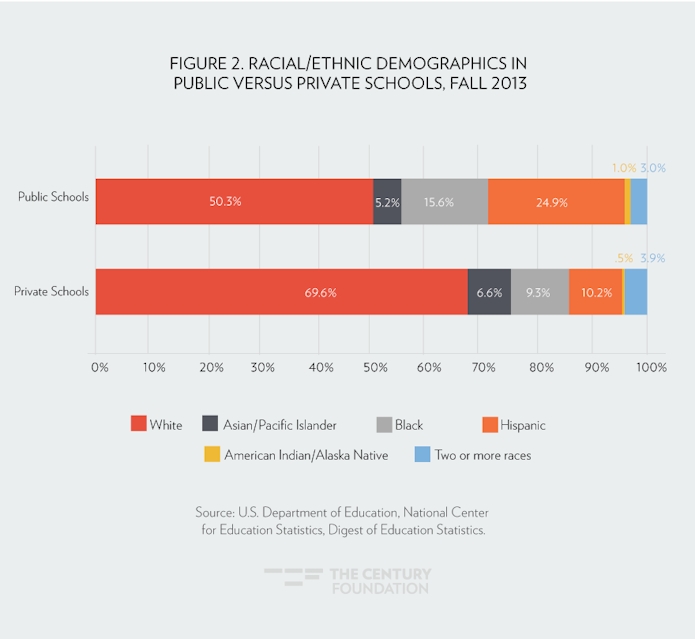
This report attempts to fill that gap by examining the evidence available on the effects of private school vouchers on school integration. Contrary to DeVos’ assertion, this report finds that the effects have been mixed, and that voucher programs on balance are more likely to increase school segregation than to decrease it or leave it at status quo. Although the demographics of students and schools create conditions under which vouchers could increase school integration in some places, there is little evidence that this has happened in practice. The best available data on the impact of school vouchers, tracking the movement of students in two different voucher programs, shows that voucher students by and large did not gain access to integrated schools as a result of the programs. Two-thirds of school transfers in one program and 90 percent of transfers in the other program increased segregation in private schools, public schools, or both sectors. Furthermore, data suggest that there is a strong risk that voucher programs will be used by white families to leave more diverse public schools for predominantly white private schools and by religious families to move to parochial private schools, increasing the separation of students by race/ethnicity and religious background.
This report proceeds in five parts. First, it presents a conceptual framework for understanding the conditions under which private school vouchers would promote integration versus segregation. Second, it reviews what descriptive studies on student and school demographics can tell us about the likely effects of private school vouchers on school integration. Third, it analyzes results from two studies that provide longitudinal data tracking the effects of private school vouchers on segregation in the public schools that students leave as well as the private schools that they attend. Fourth, it reviews the results of international studies on voucher programs. Finally, it provides policy recommendations based on these findings.Do Private School Vouchers Pose a Threat to Integration?:

WHAT YOU SHOULD KNOW

  • On balance, voucher programs are more likely to increase school segregation than to promote integration or maintain the status quo.
  • Although voucher programs that are used by mostly black, Latino, or American Indian students have the potential to increase school integration in some places, there is little evidence that this has happened in practice. The best available data on the impact of school vouchers, tracking the movement of students in two different voucher programs that enrolled mostly black students, shows that voucher students by and large did not see an increase in access to integrated schools as a result of the programs. Two-thirds of school transfers in one program and 90 percent of transfers in the other program increased segregation in private schools, public schools, or both sectors.
  • Data suggest that there is a strong risk that voucher programs will be used by white families to leave more diverse public schools for predominantly white private schools, and by religious families to move to parochial private schools. This is particularly likely in programs with universal eligibility or high income caps.
  • Large-scale voucher programs in Chile, Sweden, the Netherlands, and New Zealand have by and large been found to increase school segregation.
  • If policymakers want to increase school choice and integration at the same time, they should support forms of school choice that have integration built into the design of their program, such as magnet schools and intentionally diverse charter schools.
  • Where public programs to fund private school tuition are in place, policymakers should ensure that these programs are designed with safeguards to prevent them from increasing school segregation.Do Private School Vouchers Pose a Threat to Integration?: