Latest News and Comment from Education

Thursday, March 23, 2017

May Day: Seattle Educators Moving Closer To Strike | PopularResistance.Org

May Day: Seattle Educators Moving Closer To Strike | PopularResistance.Org:

May Day: Seattle Educators Moving Closer To Strike

Dimitry B.

On Monday, March 13, the Seattle Educators Association (SEA) took a big step toward May 1 strike action in voting by an overwhelming majority in favor of a one-day strike at their Representative Assembly. The resolution will now require approval by the union’s full membership.
The vote was a response to more than a decade of unconstitutional underfunding of public education in Washington State. But it was also a part of a series of recent moves by Seattle unions preparing to take action on May Day against the vicious right-wing agenda of Donald Trump. In February, WFSE Local 304, representing workers at Seattle community colleges, passed a resolution supporting strike and protest action on May 1. The elected leadership of UAW 4121, representing graduate student workers at the University of Washington (UW), recently voted to hold a May 1 strike vote of its membership. The Martin Luther King County Labor Council passed a county-wide May Day resolution this week at its monthly delegate meeting at the Seattle Labor Temple.
Socialist Seattle City Councilmember, Kshama Sawant, who called for “100 Days of Resistance” from Trump’s inauguration leading up to May Day, is now calling for the city’s mayor, Ed Murray, to allow all city workers to take May 1 off without retaliation (Washington State law already allows all public employees to take 2 days off each year for reasons of conscience or religion).
All the developments around May 1 action in Seattle are important. But if the SEA membership approves the strike action, it will take things to another level. Because it would represent more than a symbolic resolution or call to action. It would mean 5,000 educators actually going on strike in a powerful defense of public education, and shutting down the Seattle school system for a day.
Educator Kit McCormick spoke about the mood at the SEA Representative Assembly: “What stood out to me is that people want to do something that will change the status quo. We have tried the same thing for years. We’ve been writing our legislators and we’ve been going to Olympia and it’s time to take a bigger step. People are excited about getting out there with a larger group and saying, ‘This will not stand!’”
The Washington State Supreme Court has repeatedly taken action against the State Legislature in Olympia for underfunding education in violation of the state constitution. In the Fall of 2015, Seattle educators went on strike during contract negotiations, demanding full funding for schools, racial equity teams, and cost of living wage increases. While the strike led to SEA winning a number of their demands and electrified working people across the city, public education remains grossly underfunded statewide. And now federally, education is under attack from the Trump administration.
“An injury to one is an injury to all,” said SEA teacher and Socialist Alternative member Justin Vinson. “We’re fed up. For years educators have been fighting to defend our schools and our students against illegal underfunding by the legislature, and now we have the Trump administration and Betsy DeVos setting their sights on major education cuts. But there is a larger principle at stake here as well, with Trump going after our immigrant sisters and brothers, women, Muslims and LGBTQ people. May 1st can be an important turning point by demonstrating that we can use our power as workers to shut down ‘business as usual’ and step up the resistance to Trump.”
May 1, or “May Day,” is historically a day of mass working class action and immigrant rightsMay Day: Seattle Educators Moving Closer To Strike | PopularResistance.Org: 

Jeff Bryant: Words That Hurt Our Public Schools, And Ones That Help

Words That Hurt Our Public Schools, And Ones That Help:

Words That Hurt Our Public Schools, And Ones That Help

Image result for Words That Hurt Our Public Schools, And Ones That Help


[The following is a transcript of a presentation to grantees of the Schott Foundation for Public Education]
I want to start off today with a story about my mom. Trust me, I’ll eventually transition to talking about education. But my mom’s story illustrates how attitudes are affected by media and language.
My mom was born in 1923 on the plains of North Dakota. Her dad, my grandfather was a farmer-rancher. Her mom, my grandmother, ran the house and brought in laundry, sewing, and other work from neighbors.
But then commodity prices fell through the floor and the Great Depression hit. Then my grandfather’s farm blew away in the Dust Bowl. Talk about a perfect storm.
With hardly any income of their own, my grandparents turned to the public sector, the government, for financial assistance. Through what was called the Work Progress Administration, the WPA, created by the Franklin Roosevelt presidential administration, my grandfather got a position operating a grain elevator in eastern Montana.
With a steady source of income, my grandparents could provide for my mom and her three other siblings. Things weren’t always easy. When my mom knocked out a front tooth in a toboggan accident, she had to have a wooden peg fill the empty space until they had a chicken to pay the dentist and they could travel to a town that had a dentist.
Nevertheless, my grandparents, neither who completed more than an elementary school level of education, had access to local public schools for their children, each of whom graduated high school. My mom was the first person, and the first woman, in her extended family to attend community college and then a public state university to earn her degree in nursing education. She was recruited by the US Military to serve in the Nurses Corp training nurses for the frontline troops in World War II.
That job was her ticket out of her small, rural community and led her to move to Dallas, Texas to accept a position in nurse education at a major metropolitan hospital in the late 1940s. It was there that she met the man who would eventually be my father.
Government Is The Problem
By the time I came along, a lot had changed in my parents lives. And by Words That Hurt Our Public Schools, And Ones That Help:


3/23/2017 – The Big Lie Behind Trump’s Education Budget

THIS WEEK: School Choice Pushback … Vouchers Feed White Flight … Schools As Sanctuaries … Student Loan Defaulters Targeted … Words That Hurt Schools

TOP STORY

The Big Lie Behind Trump’s Education Budget

By Jeff Bryant

“Public school supporters are angry at President Trump’s budget proposal, which plans to cut funding to the Department of Education by 13 percent … But the target for their anger should not be just the extent of the cuts but also how the cuts are being pitched to the public … The way the Trump administration is spinning this combination of funding cuts and increases … is that there is some sort of strategically important balance between funding programs for poor kids versus ‘school choice’ schemes, as if the two are equivalents and just different means to the same ends. Nothing could be further from the truth.”
Read more …

NEWS AND VIEWS

School Choice Fight In Iowa May Preview The One Facing Trump

The New York Times

“Few topics in education are more controversial than the idea of diverting public money to private institutions, and Iowa has become a study in the kind of political fights that may be in store for the administration … The pushback has come from groups traditionally opposed to the idea … but also from some conservatives … A Des Moines Register poll of 802 Iowans in February found that 58 percent opposed using public funds to pay for private education, while 35 percent supported the idea.”
Read more …

Trump’s Signature Education Goal Has A Long History With White Flight

The Huffington Post

“President Donald Trump’s proposed budget set aside $250 million for a still-opaque ‘private school choice program’ … Betsy DeVos claimed at her confirmation hearing that school choice programs lead to more integrated schools … The history of school voucher programs is tied up with ideas of white supremacy. To avoid school desegregation … some Southern states created tuition grants to allow white students to attend all-white private schools in the 1960s … White students continue to dominate private school demographics, in part because of this racist history.”
Read more …

How Schools Are Trying to Make Undocumented Kids And Their Parents Feel Safe

Vice

“Schools have been proactive in hopes of alleviating the anxiety of immigrant children, emphasizing that they remain open to everyone … Even in districts that aren’t taking pains to make immigrants feel safe, US law already provides a fair number of protections for undocumented students … But … immigration experts say there are few legal options available to protect undocumented students and parents who are en route to ‘sensitive locations’ like school or church.”
Read more …

Trump Administration Rolls Back Protections For People In Default On Student Loans

The Washington Post

“Days after a report on federal student loans revealed a double-digit rise in defaults, President Trump’s administration revoked federal guidance Thursday that barred student debt collectors from charging high fees on past-due loans … The action does not affect any borrowers whose loans are held by the Education Department, according to the department. It could, however, impact nearly 7 million people with $162 billion in FFEL loans held by guarantee agencies. Nearly half of the total outstanding student debt in default comes from the FFEL program.”
Read more …

Words That Hurt Our Public Schools, And Ones That Help

By Jeff Bryant

“Many, attribute the success of the anti-public movement to the vast wealth of individuals in big business and finance. That wealth helps for sure. But I would argue that they have a weapon more valuable than money: It’s the English language … The war of words on the public sector has had some of its greatest success in the effort to dismantle public education … Let’s look at some of the words used to assault our schools and consider how we can fight back.”
Read more …

Fact-Free History | Blue Cereal Education

Fact-Free History | Blue Cereal Education:

Fact-Free History

Image result for history jesus and the dinosaurs

Happy AdministratorThere’s nothing more terrifying than finding out your district administrators have just returned from a conference somewhere, and they’re excited about something. You know because they suddenly smile too much, and now they want to come talk to your department or hold a special faculty meeting. It’s enough to ruin your entire 17-minute lunch period. 
It’s not because their conferences are always in Vegas or Honolulu or Mount Olympus or some such thing, while teacher workshops are in Moore, or at the Pawhuska Technology and Training Center. No, what’s scary is that they come back all excited about some revolutionary new paradigm-shattering approach to teaching – usually a combination of common sense stuff you’ve been doing for years and a few colorful twists slathered in cutesy rhetoric. They’re sure you’ve never heard of it, and that you’ll be so excited for them to share it with you! 
They’d never send you to these sorts of conferences, of course – they’re so far away and expensive, after all. But they think they’ve come upon the Pedagogical Holy Grail – the one which will replace last year’s Silver Classroom Bullet, which superseded the rather durable Brass Teaching Ring, that of course overthrew the Era of Learning Unobtanium (ELU).
So you wait. 
The details vary from revolution to revolution, but the need to unendingly build on the ruins of whatever was going to save us all last year remains sadly the same. It drives the world of educational trainery like dilithium crystals power the Enterprise, or infantile narcissism fuels the President. The same few themes do come back around eventually, however, like the Merry-Go-Round of the Damned, and you learn to look for them. Dread them. Fight them. And yet, the very predictability in the process forms a dysfunctional sort of affection for them after a while. 
Merry-Go-Damned
My personal favorite is the Periodic Awakening of Fact-Free History. 
It’s a Revelation built on a simple truth – one recently discovered by your building principal or curriculum manager or whoever sits before you, eating your bagels this particular Friday morning. “When we were in school,” they always begin, “History was all about memorizing facts – names, dates, places. So many facts.”
Their distress is evident. Damn those Fact-Free History | Blue Cereal Education:

When School Suspensions Plunge, Is That A Good Thing? : NPR Ed : NPR

When School Suspensions Plunge, Is That A Good Thing? : NPR Ed : NPR:

School Suspensions Have Plunged: We Don't Yet Know If That's Good News

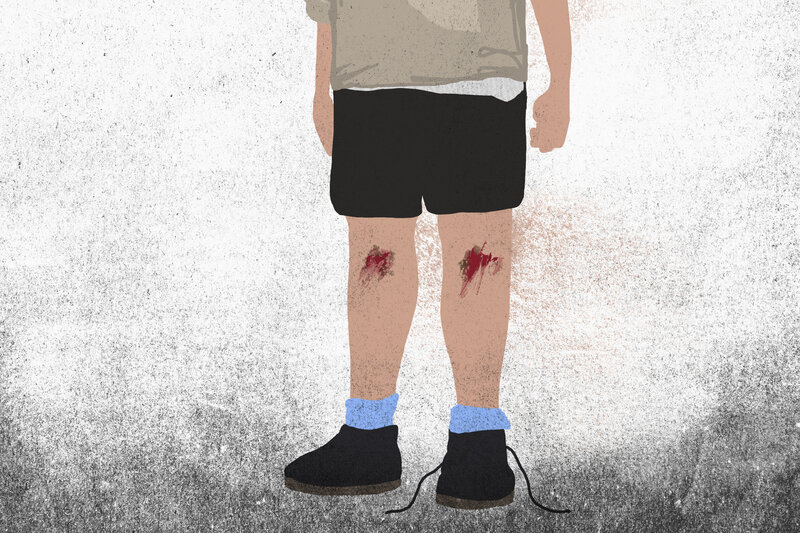
Bloody knees

We are in the midst of a quiet revolution in school discipline.
In the past five years, 27 states have revised their laws with the intention of reducing suspensions and expulsions. And, more than 50 of America's largest school districts have also reformed their discipline policies — changes which collectively affect more than 6.35 million students.
new paper from Max Eden, a senior fellow at the conservative-leaning Manhattan Institute, argues that this is all too much, too soon. In New York City, for example, suspensions have fallen by half since 2011.
Eden's read of the available evidence argues that school climate in the city, on the whole, has gotten worse. "Without making the case that we need to start suspending more students," Eden tells NPR Ed, "the point is that, wow, we really haven't looked into this. We don't know what's going on."
The pressure to stop putting so many students out of class came largely from new data showing blacks and Hispanics are far more likely to be suspended and expelled from school. Students who are suspended are, in turn, far more likely to drop out of high school. And, as police officers have come to be employed directly in schools to enforce "zero-tolerance" discipline, incidents more often result in arrests and even criminal charges, a connection that has become known as the "school-to-prison pipeline."
Neil Gorsuch, the Supreme Court nominee now in hearings, has ruled in at least two such cases, one involving a 9-year-old whose arm was intentionally twisted when he was put in handcuffs, and another a middle schooler arrested for burping in class.


The data has prompted more widespread legal action as well. In 2014, the U.S. Education Department's Office of Civil Rights warned school districts around the country that any discipline policy that has a disparate impact by race, even if it is neutral on its face, can be found to be in violation of the law.
OCR investigated several school districts over discipline policies. Two of them, Oakland and Oklahoma City, agreed in legal settlements to reduce suspensions. Other cities where suspensions have been limited include Los Angeles, Chicago and St. Paul, Minn.
If a disruptive student can't be removed from class, what should be done instead? The prevailing alternative is a set of practices known as "restorative justice." The philosophy behind it could be summed up as: "The kids who are misbehaving are also members of the school community," says Kelly Welch, a criminologist who studies the topic at Villanova When School Suspensions Plunge, Is That A Good Thing? : NPR Ed : NPR:
California's schools suspensions are down, but black students still face higher suspension rates - LA Times - http://www.latimes.com/local/education/la-essential-education-updates-southern-school-suspensions-are-decreasing-1490130793-htmlstory.html on @latimes
Suspension rates for African-American students escalate in middle school | EdSource - https://edsource.org/?p=579086 on @edsource

Study Finds Court Ordered Funding Reforms Produce Five Percent Increase in Graduation Rates - Education Law Prof Blog

Education Law Prof Blog:

Study Finds Court Ordered Funding Reforms Produce Five Percent Increase in Graduation Rates

Image result for education money matters


A new study by Chris Candelaria and Ken Shores adds another major finding in the debate over school funding.  In their paper, Court-Ordered Finance Reforms in the Adequacy Era: Heterogeneous Causal Effects and Sensitivity, they find that school funding remedies have a significant impact on graduation rates in high poverty districts.  In those districts, a ten-percent increase in per-pupil funding "causes a 5.06 percentage point increase in graduation rates."  As I calculate it, that means that if a southeastern state spending about $7,000 per-pupil in a high poverty district bumped funding to $7,700, it would likely bump its graduation rate from 65% to 70%.  In a high school with 1200 students, that means it would graduate 210 students each year rather than 195.
This finding comes on top of Kirabo Jackson and his colleagues' recent finding that a twenty percent increase in per pupil funding, if maintained over the course of students' education careers, results in low income students completing .9 more years of education.  This increased learning wipes out two-thirds of the gap in outcomes between low- and middle-income students. 
Not too shabby for a little extra money.  Incredibly impressive when compared to what data tells us about vouchers and the average charter school.  
These studies should give Congress serious pause when they look over Trump's proposed budget, which would leave funding for low-income students flat, save the $1 billion aimed at prompting school choice, charters, and vouchers.
These studies should also give the public heartburn in the 30 states that, in real dollar terms, continue to fund education at a lower level today than they did before the recession.  As I detail here, many states issued cuts of 10 to 20 percent in education funding during the recession and have still yet to fully replace the funds.  The above studies would strongly suggest these states are driving down student achievement and graduation rates; it will just take a few years for the data to bear it out.Education Law Prof Blog:


What Trump’s Immigration Crackdown Means for Children at School and their Teachers | janresseger

What Trump’s Immigration Crackdown Means for Children at School and their Teachers | janresseger:

What Trump’s Immigration Crackdown Means for Children at School and their Teachers

Related image

Contrary to the widespread popular belief that learning is absorbing a body information and that computers can accomplish the task of pouring in material as well as human teachers, teachers know that knowledge is constructed, primarily through human relationship and the connection between the student and teacher and student and student.
Here is Alfie Kohn explaining learning theory: “Superb teachers strive constantly to imagine how things look from the child’s point of view… (K)nowledge is constructed rather than absorbed: we form beliefs, build theories, make order. We act on the environment rather than just responding to it—and we do it naturally and continually. It’s part of who we are. Learning isn’t a matter of acquiring new information and storing it on top of the information we already have. It’s a matter of coming across something unexpected, something that can’t easily be explained by those theories we’ve already developed. To resolve that conflict, we have to change what we previously believed.  We have to reorganize our way of understanding to accommodate the new reality we’ve just encountered…  Some would call… (the) teacher a ‘facilitator ‘ of learning, but she doesn’t facilitate ‘in the sense of making smooth or easy’; rather, she stimulates learning ‘by making problems more complex, involving, and arousing.’  She artfully complicates the situation, challenging the children to think harder and better.” (The Schools Our Children Deserve, pp. 131-135)
For learning to happen, as Kohn describes it, children need to be intellectually and emotionally present at school in order to learn.  I have been reflecting on what I know about how schools help children learn while I’ve been reading the news reports about President Donald Trump’s immigration crackdown on people who live in the United States without documentation.
Anya Kamenetz describes the new immigration policies in a short piece for National Public Radio: “Under the new directives issued in February by the Trump administration, anyone with deportation orders already issued, and anyone convicted of even a minor crime like a traffic offense, can be targeted for immediate removal.  This is a change from the Obama administration’s policy, when suspected gang members and felons received the highest priority from law enforcement.”  The problem for public schools is that many of the people who risk detainment by Immigration and Customs Enforcement (ICE) and deportation are parents of children in public schools.
Public schools are required to educate all children living in the United States and not to require families to declare their immigration status.  The Associated Press explains: “Under a 1982 U.S. Supreme Court decision, Plyler vs. Doe, K-12 public institutions are not allowed to What Trump’s Immigration Crackdown Means for Children at School and their Teachers | janresseger:
Image result for What Trump’s Immigration Crackdown Means for Children at School and their Teachers

Newsletter #12 – Community and School Struggles Unite! | CLASSROOM STRUGGLE

Newsletter #12 – Community and School Struggles Unite! | CLASSROOM STRUGGLE:

Newsletter #12 – Community and School Struggles Unite!

Welcome to our March 2017 edition of our Newsletter.  In this issue we cover two pressing and current topics: the fight to establish Sanctuary Schools and the struggle against budget cuts.  In the first we discuss a conference that was set up to organize around sanctuary schools.  Since the conference we have also led a workshop on fighting ICE raids and continue organizing against the Trump attacks.  In the second article, we call out the totally unnecessary budget cuts being inflicted on OUSD schools and students.  There is more than enough money to prevent these and restore a much higher level of services (although OUSD schools absolutely need new infusions of cash from the State and corporations and the wealthy).  To find the immediate source of money we need to look no further than the huge expansion in upper admin salaries under Antwan Wilson (see the graph below).  To find out more please read on in the newsletter.
dollar amount salary comparison 2013 2015
Also to get involved in either of these campaigns please reach out to us.  Comment below or email us at classroomstruggle@gmail.com for either campaign.  And if you know more about how budget cuts are affecting a specific school in OUSD please fill out this Google Form so we can collect info on this.  We plan to collect and publish info on all known budget cuts to make the cuts visible and then organize to stop them from affecting schools and essential services!

 CS Newsletter #12 Title Image

March Madness: Poor Children As Casualties Of Trump’s Budget Wars

March Madness: Poor Children As Casualties Of Trump’s Budget Wars:

March Madness: Poor Children As Casualties Of Trump’s Budget Wars

Image result for March Madness: Poor Children

Who would have ever thought that the term March Madness referred to more than just a basketball tournament? With the Trump Administration, however, madness is second nature, regardless of the month on the calendar.
Last week, we found out that March Madness also refers to the Trump budget process and the cruel, vindictive, and mean-spirited nature of the people who are at war with the sick, the poor, the elderly, and kids. All of these constituencies deserve advocacy as they are caught in the ruthless tactics of the unfeeling budget cutters. Please understand, however, that as an educator, I must first put my passion and energy to illuminate the harm this perverted form of March Madness has inflicted on young people.
Sure, the Washington Post headline Trump budget casualty: After-school programs for 1.6 million kids. Most are poor got the attention of many readers. But it was this cartoon by the great Mike Luckovich that jolted me and others into the realization that what we are up against is the Trump War on Kids, and the first casualty in his drawing are the after-school programs that otherwise assist young learners.

Certainly, Big Bird and PBS are in the mix as well, but in particular, it is the program called 21st Century Community Learning Centers that seems to be in the crosshairs of Mick  Mulvaney, Director of the Office of Management and Budget, and his fellow ideologues who intend to kill or starve domestic programs to feed the military, as the cartoon amply demonstrates.
At this point, it is only proper for me to disclose the reasons for my intense interest in this program.
In 2002, I received a call from the U.S. Department of Education inquiring about my availability to serve as a panel chair to direct the reading and scoring of federal grants for the 21st Century Community Learning Centers, a program I was not familiar with at the time. (To this day, I don’t know how someone in Washington got my name or curriculum vitae that prompted the call.)
After receiving some additional information about the 21st Century program and my responsibilities to the Department, I agreed to fly to Chicago and work over a weekend in May with an impressive panel of 15 people from around the country. As it turned out, the work was grueling in that every grant had to be read by multiple readers, scored, and discussed. If the range of the scoring showed wide variance, there was additional reading and discussion so that the scoring reflected a clearer result.
Therein lies the rest of the story. Since I had overall responsibility for one of the panels, I wound up reading about 50 applications, all thick with detail to justify the need for the program in a particular community.
What I read was deeply moving, and that experience remains with me to this March Madness: Poor Children As Casualties Of Trump’s Budget Wars:


Florida Opts Out, NY BAT Enters Ring – Education Town Hall Forum

Florida Opts Out, NY BAT Enters Ring – Education Town Hall Forum:

Florida Opts Out, NY BAT Enters Ring

BUS PROGRAM, EDUCATIONAL ACTIVISM, HIGH STAKES TESTING, NATIONAL ISSUES, TEACHERS AND TEACHING


On the March Education Town Hall BUS, hear from Cindy Hamilton, of Opt Out, on 3rd grade retention and related issues in Florida, and from Christine Pellegrino, NY BAT running for a special seat in the Assembly. Listen live via TuneIn at 11 a.m. Eastern or check back for recording.
The Education Town Hall broadcasts from Historic Anacostia
in Washington, DC, on We Act Radio, Thursdays at 11:00 a.m. Eastern
Listen live via TuneIn.
Shows are archived for convenient listening shortly after broadcast.
After years of weekly broadcasts, the program now focuses one show each month on local issues and one on “the BUS,” organized by BadAss TeachersUnited Opt Out, and SOS March.
Florida Opts Out, NY BAT Enters Ring – Education Town Hall Forum:

The Supreme Court says de minimus ain’t good enough. | Fred Klonsky

The Supreme Court says de minimus ain’t good enough. | Fred Klonsky:

The Supreme Court says de minimus ain’t good enough.

clarence-thomas-9505658-2-402


Even Clarence Thomas told Gorsuch he was wrong.
The United States Supreme Court ruled Wednesday that de minimus ain’t good enough.
The decision in Endrew F. v. Douglas County School District could have far-reaching implications for the 6.5 million students with disabilities in the United States.
The case centered on a child with autism and attention deficit disorder whose parents removed him from public school in fifth grade. He went on to make better progress in a private school. His parents argued that the individualized education plan provided by the public school was inadequate, and they sued to compel the school district to pay his private school tuition.
The Supreme Court today sided with the family, overturning a lower court ruling in the school district’s favor.
The case was about whether public schools have a duty to do more then the bare minimum in providing services to special needs students.
Those of us who have worked with special needs students, even in the more prosperous districts, know that it is a constant battle when fighting for students with needs.
For me, each year the Park Ridge District 64 administration and board, including special education administrators, would cut support services and staff. And every year, even in the years we won, a full trimester would have been wasted waging the fight.
I received a copy of the memo from the Park Ridge District 64 law firm responding to The Supreme Court says de minimus ain’t good enough. | Fred Klonsky:


Anatomy of a Betrayal – Save Maine Schools

Anatomy of a Betrayal – Save Maine Schools:

Anatomy of a Betrayal

becky pringle.png

In 2015, the heads of the National Education Association (NEA), received an invitation from a newly formed group known as “Convergence” to attend a series of meetings sponsored, in part, by the  Chan-Zuckerberg Initiative.
When Becky Pringle, Vice President of the NEA, looked at the list of attendees, she thought to herself, “I don’t think so – and by the way don’t take any pictures or tweet it out or I won’t be sittin’ here next year!”
But within only a few months, the presidents of both major teachers unions had signed their names to a document, along with representatives from Samsung, Microscoft, LEGO, Disney, and a variety of corporate-sponsored foundations, that all but pledges to do away with the very professionals the unions claim to protect.
The document reads like a promotional handbook for the decades long push toward “personalized,” competency-based learning, which puts a child and their electronic device at the “center” of the learning experience, while moving teachers aside in a new role of “facilitator.”
Gisele Huff, a member of Jeb Bush’s Digital Learning Now leadership Anatomy of a Betrayal – Save Maine Schools: