Latest News and Comment from Education

Thursday, December 8, 2016

Let's Talk About Vouchers, Part Three (The Majority Opinion in Zelman) | Blue Cereal Education

Let's Talk About Vouchers, Part Three (The Majority Opinion in Zelman) | Blue Cereal Education:

Let's Talk About Vouchers, Part Three (The Majority Opinion in Zelman)


Voucher BoyWe’ve been looking at Zelman v. Simmons-Harris (2002), the case most often cited when I’m researching vouchers and their constitutionality. 
If you haven’t been with me on this lil’ journey so far, you might want to check out Part One or Part Two of this series. Or you might not. You might decide to consult other bloggers or experienced voices instead – it’s completely your choice. 
And as it turns out, “choice” is central to the Court’s 5-to-4 determination that Ohio’s voucher program was, in fact, constitutional. 
Chief Justice Rehnquist delivered the opinion of the Court. 
The State of Ohio has established a pilot program designed to provide educational choices to families with children who reside in the Cleveland City School District. The question presented is whether this program offends the Establishment Clause of the United States Constitution. We hold that it does not.
It’s worth noting that the question before the Court was about separation of church and state, and involved this specific program. The Court did NOT decide that all voucher programs everywhere were constitutional, and it certainly did not proclaim that they were equitable, justifiable, or in any way a good idea. 
Perhaps most significantly, this decision does nothing to address the question of whether vouchers worked.  
Rehnquist goes on to lay out the severity of the situation in Cleveland and to describe state efforts to address it before getting to the legislation in question. 
It is against this backdrop that Ohio enacted, among other initiatives, its 
Let's Talk About Vouchers, Part Three (The Majority Opinion in Zelman) | Blue Cereal Education:


'Fake News,' Bogus Tweets Raise Stakes for Media Literacy - Education Week

'Fake News,' Bogus Tweets Raise Stakes for Media Literacy - Education Week:

'Fake News,' Bogus Tweets Raise Stakes for Media Literacy


Media literacy is suddenly a front-burner issue for schools, thanks to the recent presidential election, a spate of reports on “fake news,” and new research demonstrating just how ill-equipped young people are to critically evaluate information they encounter online and via social media.
As a result, educators find themselves behind the eight ball, expected to help students negotiate everything from internet hoaxes, to partisan policy advocacy disguised as unbiased news, to a President-elect who has used Twitter to spread baseless claims originating in unfounded conspiracy theories.
The stakes are high, contend the Stanford University researchers behind a widely cited recent study,...'Fake News,' Bogus Tweets Raise Stakes for Media Literacy - Education Week:


 Big Education Ape: Mark Zuckerberg: We will not be able to Stop Fake Education News on Facebook - http://bigeducationape.blogspot.com/2016/12/mark-zuckerberg-we-will-not-be-able-to.html


Mark Zuckerberg: We will not be able to Stop Fake Education News on Facebook


Image result for zuckerberg facebook fake news election

Zuckerberg cites the following reasons:


Schools Missing Big Opportunities to Engage Parents | Gallup

Schools Missing Big Opportunities to Engage Parents | Gallup:

Schools Missing Big Opportunities to Engage Parents


Schools Missing Big Opportunities to Engage Parents


by Tim Hodges and Daniela Yu

STORY HIGHLIGHTS

  • Schools need to conduct parent surveys or research
  • Schools need to proactively communicate study results to parents
  • Parents who don't participate in studies twice as likely to be actively disengaged
Parents play an essential role in school success and student achievement.
Gallup researchers, academic scholars and business practitioners have demonstrated this. A recent Gallup study shows that if parents are fully engaged with their child's school, 94% are very likely to recommend the school to friends or family members.
There's an increasing demand for schools to understand parents' needs and expectations and to build trust and gain the support of parents.
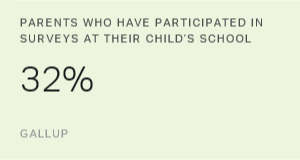
Engaged parents are not only great advocates for their child's school -- they also have ideas that will aid school improvement efforts. Parent engagement is relatively simple to measure, and schools can manage it with reasonable effort. However, Gallup's latest research shows that only one-third (32%) of parents have ever participated in a parent survey or research study conducted by their child's school or on behalf of their child's school.
Parent studies can inform school leaders of both the explicit and implicit expectations of parents. In addition, regular and timely measurement can establish an efficient feedback loop, so schools can quickly identify their strengths and opportunities as well as the effectiveness of their previous efforts.
Finally, parent studies provide an effective channel and framework for school leaders and parents to communicate and build trust with each other. This partnership between parents and schools can increase parents' ownership and responsibility to be more involved with and enthusiastic about the school -- Gallup's definition of engagement.
Communication Needs to Improve
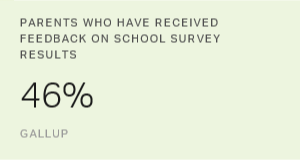
Less than half of parents who have participated in a parent survey (46%) have received communication informing them of the results. This means that more than half of parents never receive any feedback of the study results, despite their participation.
GBJ12082016TD2
While conducting parent surveys can be helpful and informative for school leaders, schools are missing an opportunity to build engagement if administrators keep the results to themselves.
Among parents who have received communication of the results, 71% think the parent survey or research will bring meaningful change to their child's school. Fifty-three percent of parents who have participated in the study but never received communication of the results say the same.
When parents believe the studies will bring meaningful change to a school, they are 2.6 times more likely to be fully engaged parents. Communication of results seems to instill faith and foster goodwill with parents, developing more loyal advocates for the school.
Schools need to communicate their results and change management plans to parents who have participated in studies, but the dissemination of results should not stop there. Gallup research shows that silent parents -- those who do not take advantage of opportunities to participate in the research -- are twice as likely to be actively disengaged with their child's school. Actively disengaged parents are more likely to consider sending their child to another school when they have that option and may be more likely to voice their negativity to others, undermining the reputation of the school.
Gallup research suggests that great schools put in the effort to measure parent engagement on an ongoing basis and make intelligent, data-backed decisions based on the insights from parent surveys. Further, measuring engagement creates opportunities for school leaders and parents to review the study findings and collaborate on a path to school improvement.
Survey Methods
Results are based on a Gallup Panel outbound phone study completed by 1,002 national adults, aged 18 and older, conducted from June 27-July 9, 2016. The sample for this study was weighted to be demographically representative of the U.S. adult population using the latest Population Survey figures. The Gallup Panel is a probability-based longitudinal panel of U.S. adults whom Gallup selects using random-digit-dial phone interviews that cover landlines and cellphones. Gallup also uses address-based sampling methods to recruit Panel members. The Gallup Panel is not an opt-in panel, and Gallup Panel members do not receive incentives for participating. For results based on this sample, the margin of sampling error is ±3 percentage points at the 95% confidence level. Margins of error are higher for subsamples. In addition to sampling error, question wording and practical difficulties in conducting surveys can introduce error or bias into the findings of public opinion polls.


 Schools Missing Big Opportunities to Engage Parents | Gallup:

Specialized burnout: Sacramento schools importing Filipino teachers to plug special education shortage - Sacramento News & Review

Sacramento News & Review - Specialized burnout: Sacramento schools importing Filipino teachers to plug special education shortage - News - Local Stories - December 8, 2016:

Specialized burnout: Sacramento schools importing Filipino teachers to plug special education shortage
Kids, parents suffer as districts scramble to address high turnover


As Sacramento-area schools reel from a nationwide shortage of special education teachers, one local school district is hoping to address the issue by taking its search global.
There are 30,232 special education students enrolled in Sacramento County school districts, according to the California Department of Education. The dearth of instructors to teach them is part of a national trend blamed on high burnout and fewer credentialed professionals in the hiring pool. And parents say it’s the students who rely on consistent classroom attention who stand to lose.
One class at Folsom High School was without a full-time special education teacher two months into the new school year. The array of substitutes brought in to fill the gap until a permanent replacement was hired left Kelly Supple’s son anxious. The 14-year-old has moderate autism and is nonverbal.
Supple, a credentialed special education teacher herself, said that when her son becomes nervous, he acts out by unraveling the threads of his knee socks. Sometimes, she said, he would arrive home from school with his picked-at socks unwound down to his ankles.
Supple said the Folsom-Cordova Unified School District eventually lured a special education teacher with three years of experience to her son’s school by offering a $10,000 signing bonus.
But a nationwide staffing shortage persists. Fifty-one percent of all school districts and 90 percent of high-poverty school districts struggle to attract qualified and credentialed special education teachers to fill these slots, according to the National Coalition on Personnel Shortages in Special Education and Related Services.
At Birch Lane Elementary School, part of the Davis Joint Unified School District, a special education teacher resigned just before the start of the school year. The job is now held by a former substitute teacher after the district failed to find a certified professional to teach moderately to severely disabled students in classroom.
DJUSD is coming up short even though administrators frequent recruitment fairs and nurture relationships with universities that turn out special education teachers. As a result, the district is planning to develop a student-teacher intern program to ease this crunch, according to DJUSD spokeswoman Maria Clayton.
Classroom consolidation is another tactic. DJUSD recently combined Birch Lane’s kindergarten-through-second-grade special education class with Pioneer Elementary’s third-through sixth-grade special education class.


Work ESSA from the ground up, Weingarten urges lawmakers | American Federation of Teachers

Work ESSA from the ground up, Weingarten urges lawmakers | American Federation of Teachers:

Work ESSA from the ground up, Weingarten urges lawmakers 

Weingarten during a SIx plenary session
AFT President Randi Weingarten called on state legislators this month to seize the opportunity behind the federal Every Student Succeeds Act by taking an approach that begins with collaboration and planning in partnership with teachers, school staff, parents, students and community stakeholders.
 Speaking at "ESSA: An Opportunity for States to Shape Education Policy," a plenary panel discussion hosted by the State Innovation Exchange (SiX) at its 2016 National Conference for legislators in Washington, D.C., Weingarten stressed that the only way states can achieve the letter and spirit of the new federal law is to work it from the "ground up"—crafting plans for school accountability, testing and other ESSA-related matters with meaningful input from the community. The rewards for this big-tent approach are enormous, Weingarten added. With community engagement, ESSA can help reset the focus of schooling and place it where it needs to be: on children's well-being, on creating the conditions for powerful learning, on strengthening building-level capacity and on fostering collaboration.

"ESSA enables us to give kids the public schools kids deserve" by doing more than just "tinker with existing policies," Weingarten told state lawmakers at the conference. "We just have to work together to get it done."
SiX is a national resource and strategy center that supports state legislators in advancing and defending progressive policies; that means the organization couldn't be more important when it comes to ESSA, Weingarten noted, because states still hold the primary responsibility for education. Under ESSA, statehouses hold sway on essential conditions in education—ensuring that schools are evaluated on more than just test scores; making real supports available to struggling schools; and, above all, establishing a climate where schools are able to focus on improving teaching and learning.
Communities are counting on state legislators to see to it that all children get a free, high-quality public education. And key to those efforts, Weingarten said, are ESSA and "the $15 billion in Title I funding protected under the law."
Use your position, your voice, your oversight to help communities, parents, teachers and school staff have a voice in the process as well, Weingarten told the audience. That way, we can give kids the excellent public education they deserve.
[Mike Rose, Leilah Mooney Joseph]
- See more at: http://www.aft.org/news/work-essa-ground-weingarten-urges-lawmakers#sthash.TaeCX9ap.dpuf

CURMUDGUCATION: New Test Rules: Old Baloney

CURMUDGUCATION: New Test Rules: Old Baloney:

New Test Rules: Old Baloney


Yesterday, John King unveiled the Department of Education's final rules for testing under the Every Student Succeeds Act, aimed at spinning the continued emphasis on the Big Standardized Tests. Jennifer C. Kerr of the Associated Press signals that she bought the PR and fumbled the story with her very first sentence:

Aiming to reduce test-taking in America's classrooms, the Obama administration released final rules Wednesday to help states and school districts take a new approach to the standardized tests students must take each year.


If the Obama administration has ever done anything that was truly aimed at reducing test-taking, I have apparently forgotten all about it. The Obama administration increased the weight of standardized testing by using Race to the Top and RttT-lite waivers to double down on high stakes for testing. After a few years of realizing that the public was pushing back hard, they tried in both 2014 and 2015 to pretend that they had an "action plan" for cutting back on testing. This included some meaningless suggestions for how much time should be spent on testing, and a recommendation that schools cut back on all the other tests that weren't the Big Standardized Test.

This administration has stayed resolutely in the Cult of Testing, and they have not backed away a single inch in eight years. These new rules are no different.

King gives the AP a big fat slice of baloney right off the bat:

Our final regulations strike a balance by offering states flexibility to eliminate redundant testing and promote innovative assessments, while ensuring assessments continue to contribute to a well-rounded picture of how students and schools are doing.

"Continue" is a great word, since it assumes a fact not in evidence-- that BS Tests have been 
CURMUDGUCATION: New Test Rules: Old Baloney:


Congressional Leadership on Education Will Agree with Philosophy and Policy of DeVos-Trump | janresseger

Congressional Leadership on Education Will Agree with Philosophy and Policy of DeVos-Trump | janresseger:

Congressional Leadership on Education Will Agree with Philosophy and Policy of DeVos-Trump


Our democratic system was designed with checks and balances, but this year as Donald Trump’s presidential term begins, he and his secretary of education will likely be working with a very sympathetic Congress.  With our executive and legislative branches both dominated by conservative Republican majorities, there will be few checks and balances.
When President-elect Trump nominated Betsy DeVos as Secretary of Education, Lamar Alexander (R-Tennessee), the Chair of the Senate Health, Education, Labor and Pensions Committee, indicated his strong support: “Betsy DeVos is an excellent choice. The Senate’s education committee will move swiftly in January to consider her nomination. Betsy has worked for years to improve educational opportunities for all children. As secretary, she will be able to implement the new law fixing No Child Left Behind just as Congress wrote it, reversing the trend to a national school board and restoring to states, governors, school boards, teachers, and parents greater responsibility for improving education in their local communities.”  Alexander has long been a supporter of states’ rights in public education; he led the development of the new Every Student Succeeds Act, which curtails the role of the Secretary of Education to dictate policy to the states.
There is another area in which Betsy DeVos and Lamar Alexander agree. Alexander tried to make federal vouchers—the diversion of tax dollars for students to carry as tuition to private and parochial schools—part of the new Every Student Succeeds Act. He was unable to muster enough support in Congress to get federal vouchers inserted into the bill. We’ll have to watch what happens now that he and President-elect Trump and Trump’s nominee for secretary of education share, as a federal priority, the establishment of a school voucher program.
What about the chair of the House Education and the Workforce Committee? John Kline (R-Minnesota), the current chair, did not run for re-election in November. He is slated to be replaced by Virginia Foxx, a congresswoman from Banner Elk, North Carolina. Here is how Kimberly Hefling describes Foxx for POLITICO: “Virginia Foxx pulled herself up by her own bootstraps and wants every American child to be able to do the same. As the 73-year-old GOP lawmaker and former community college president is poised to assume the leadership of the Congressional Leadership on Education Will Agree with Philosophy and Policy of DeVos-Trump | janresseger:


Will the Past Be Repeated? | The Merrow Report

Will the Past Be Repeated? | The Merrow Report:

Will the Past Be Repeated?


What follows is a journal of response and reflection after a remarkable 4-day journey along what might be called the Civil Rights Trail, from Jackson, Meridian and Philadelphia in Mississippi, and Selma, Montgomery and Birmingham, Alabama. My wife and I and about 40 others made this trip at a time of rising anxiety among minorities and many whites about the increase in hate-related behavior following our recent presidential election.  The question hanging over us: will we allow the past to repeat itself?

 image4-6
J

ACKSON, MISSISSIPPI:  (Our first stop) The Greyhound bus station in downtown Jackson has been restored since the days of the Freedom Riders, who were seeking to desegregate public accommodations (as required by the Supreme Court). It takes a powerful imagination to visualize busloads of Freedom Riders arriving May 24th, 1961, guarded by tight security. In other cities the Freedom Riders had been viciously attacked, their buses burned, and the city of Jackson was determined to avoid violence (fearing for its reputation, not the Civil Rights activists.) And so, on arriving at the Greyhound station, the activists got off the buses and walked into the ‘White Only’ waiting room, where they were immediately arrested, marched into other buses, and taken to jail or directly to Parchman Farm, Mississippi’s notorious maximum security state prison. At their trial (and before convicting them), the judge actually turned his back whenever their defense attorney was speaking. He sentenced 161 Freedom Riders to 60 days in Parchman, although the convictions were eventually overturned. While at Parchman, most were held in isolation. Mississippi’s Governor, Ross Barnett, is supposed to have told prison officials, “Break Will the Past Be Repeated? | The Merrow Report:

Two Moody’s Reports: 2015 Michigan Schools and 2016 Charter School Ratings Criteria | deutsch29

Two Moody’s Reports: 2015 Michigan Schools and 2016 Charter School Ratings Criteria | deutsch29:

Two Moody’s Reports: 2015 Michigan Schools and 2016 Charter School Ratings Criteria

Image result for Charter School Ratings Criteria
Image result for Moody’s Charter School Ratings

In this post, I offer two documents published by Moody’s Investors Service for perusal of any readers who wish to view them.
The first is a 16-page, November 2015 report on the credit weaknesses in numerous Michigan school districts:
I will highlight only one section of the above report; the section is entitled, “Competition from Schools of Choice Benefits Some Districts at the Expense of Others.”  Two issues caught my attention. The first is that the article includes stats from the Mackinac Center, which I wrote about in this March 2016 post, and which has pushed for emergency managers in Michigan and is funded by the Dick and Betsy DeVos Foundation. The second is the final statement of the excerpt about school choice not being “a reliable option” for “maintaining revenue” in struggling school districts:
Competition from Schools of Choice Benefits Some Districts at the Expense of Others
Since its inception in 1996, the state’s Schools of Choice program has provided students with significant flexibility in deciding whether to attend their home district or another. The state has promoted district participation with some funding incentives in the past, though the number of seats available for out-of-district students is at each district’s discretion. The number of students opting for schools outside of the district in which they reside through Schools of Choice has risen on an annual basis over the last decade. Total participation in the program now exceeds 100,000, nearly 8% of total Michigan students enrolled in traditional publicly funded schools. According to a 2013 research study conducted by the Mackinac Center for Public Policy, students in rural districts (9.7%) were more likely to participate in Schools of Choice, than students in suburbs (8.0%), towns (6.7%) or cities (2.8%). Reasons why students in rural districts participate in a higher rate include, closer proximity to neighboring districts in expansive districts or greater programming offerings, while city students are more likely to have access to charters. The relatively high participation rates in Schools of Choice has been cited as an argument for increased consolidation among Michigan traditional school districts. Given the lack of revenue-raising options for individual districts, participation in the program provides a district with an opportunity to increase, or at least maintain, operating revenue via per-pupil state funding levels. In areas with widespread competition for students, such as tri-county metro Detroit, students are more likely to seek attendance at high-performing districts. High-performing districts are more likely to offer a greater variety of services than those districts cutting service levels as a result of deteriorating finances. As such, Schools of Choice may not be a reliable option for financially struggling districts to improve bolster or maintain revenue.
The second Moody’s report in this post is from August 2016. It is Moody’s 21-page, updated “charter school scorecard,” or the updated criteria by which Moody’s rates charter school credit risk:
An excerpt from the report intro:
The charter schools sector is still young and growing, and as such its credit fundamentals are characterized by multiple speculative elements. Given 
Two Moody’s Reports: 2015 Michigan Schools and 2016 Charter School Ratings Criteria | deutsch29:


Principles To Guide The Vetting Of Betsy DeVos

12/8/2016 – Principles To Guide The Vetting Of Betsy DeVos:

Principles To Guide The Vetting Of Betsy DeVos


THIS WEEK: Jeff Sessions Hates Special Ed … Foxx In The House … Where Teacher Turnover Is Worst … New Reality For Colleges … Charters Hijack Public Ed

TOP STORY

Principles To Guide The Vetting Of Betsy DeVos

By Jeff Bryant

“President-elect Donald Trump’s appointment of Betsy DeVos for US Secretary of Education in his administration set off a firestorm of commentary on what her impact might be on furthering ‘school choice’ ventures like charter schools and vouchers that send taxpayer money to private enterprises … For years, proponents for what’s become known as ‘education reform’ have argued that policy debates can be boiled down to the singular concern of … a myopic focus on standardized test scores … But if you care what happens to your tax dollars, you should be concerned about much more than just test score comparisons among different types of schools.”
Read more …

NEWS AND VIEWS

Jeff Sessions Slammed A Law Protecting Schoolchildren With Disabilities

The Huffington Post

“Sen. Jeff Sessions (R-Ala.), president-elect Donald Trump’s pick for attorney general … in May 2000… took to the senate floor to make a lengthy speech on the Individuals with Disabilities Education Act, arguing that federal protections for students with disabilities was a reason U.S. public schools were failing … In the mid 1990s, Sessions fought school equality after a judge ruled on behalf of about 30 of the state’s poor school districts that sought reforms … Sessions added that such federal protections ‘may be the single most irritating problem for teachers throughout America today.’”
Read more …

Meet The Congresswoman Poised To Tear Up Obama’s Education Legacy

Politico

“Virginia Foxx … is poised to assume the leadership of the House Education and the Workforce Committee … would love to dismantle the federal Education Department … Foxx reels off a list of possible targets: The billions doled out annually under Title 1 … She wants to re-examine the role of the Education Department’s Office for Civil Rights … She’d like to reverse a Democratic Congress’ decision to have the Education Department, not banks, issue student loans … Civil rights groups, among others, are aghast.”
Read more …

High-Poverty Schools Often Staffed By Rotating Cast Of Substitutes

The Washington Post

“In the troubled schools that serve some of the nation’s neediest children, it is not uncommon for classrooms to churn with substitutes as teachers leave in large numbers each June, or quit midyear, and principals struggle to fill the positions. The disruption of teachers coming and going and the frequent use of substitutes with varying levels of skill and commitment effectively steal learning time from students who can least afford it … Struggling high-poverty schools are difficult to staff … Such schools often see an exodus of teachers at the end of each year, so their principals are constantly looking for new hires. They tend to employ teachers who are more inexperienced than the hires at affluent schools, and they often are not adequately trained for the intense environments they will face.
Read more …

Colleges Face A New Reality, As The Number Of High School Graduates Will Decline

The Hechinger Report

“The total number of high school graduates will decline in the next two decades, while the percentage of lower-income and nonwhite students will increase … Higher education institutions … [will] need to find new ways of educating a student body increasingly composed of people who are the first in their family to enter college. And because those students tend to have fewer financial resources, colleges may feel pressure to expend more resources to help students handle the costs of college.”
Read more …

Tar Heel Heist: How The Charter School Industry Is Hijacking Public Education

Alternet

Jeff Bryant writes, “In my travels around North Carolina – to the state’s three largest school districts – I ask school board members, legal and education experts, and charter advocates to explain how a state that doesn’t seem to adequately fund its existing public school system can afford to add a competitive new one. Complicating the matter is the presence of a rising new sector of for-profit charter schools, many coming to North Carolina from out of state. Few North Carolinians I talk to can explain how these schools make a profit. And if the schools do, it begs the question of whether it is ethical or legal for private interests to profit from education while many schools in the existing system can’t afford adequate learning materials and instructional staff. These questions are not only important to North Carolinians; they are critical to the rest of the nation. President-elect Donald Trump has pledged to accelerate the growth of charters nationwide with a proposal to create a $20 billion federal block grant for states to offer families more ‘school choice.'”
Read more …
12/8/2016 – Principles To Guide The Vetting Of Betsy DeVos:

Moody's Finds Overall Credit Quality of Charters Ranges from Investment Grade to Speculative, But Expects Sector Growth - Education Law Prof Blog

Education Law Prof Blog:

Moody's Finds Overall Credit Quality of Charters Ranges from Investment Grade to Speculative, But Expects Sector Growth

Image result for eye of a needle


For those who missed it, Moody's released a financial risk assessment of charter schools this fall.  The four passages jumped out at me:
  • The median rating of Moody’s-rated charter schools is Baa3, but the median credit quality of the broader charter school universe is decidedly lower.
  • [C]harter schools across the nation face unique credit challenges. Those challenges have translated into an above average incidence of defaults relative to other tax-exempt credits. The overall credit quality of this sector ranges from low investment-grade into low speculative-grade categories.
  • [W]e expect that the appetite for the education alternatives that this sector offers will continue to expand. Over time, we also expect that charter school credit quality will likely improve, with strengthening in several key areas including: academic performance reporting; the stability and predictability of per-pupil funding for operational and capital needs; available liquidity and reserve levels; transparent and timely disclosure; and leadership and management quality.
Moody's defines a Baa rating as " medium-grade and subject to moderate credit risk and as such may possess certain speculative characteristics."  The additional modifier of 3 "indicates a ranking in the lower end of that generic rating category."  The next step down from that would be a Ba rating which is defined as "speculative and are subject to substantial credit risk."
Read the full report here
Education Law Prof Blog:

Trump Time Capsule #3: Fuming about the “disgusting media” |

Trump Time Capsule #3: Fuming about the “disgusting media” |:

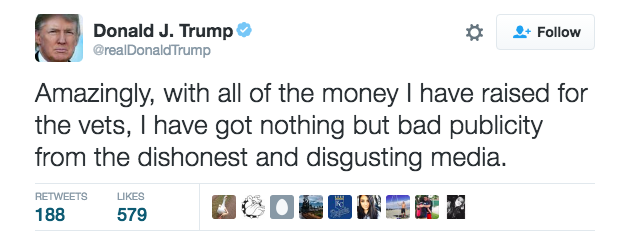
Trump Time Capsule #3: Fuming about the “disgusting media”

trump_angry

Editor’s Note: In the spring of 2016, James Fallows, the senior editor of The Atlantic Monthly magazine, began what he called a series of “time capsules” that could, in the future, provide a key as to what Americans were thinking during the election campaign–as Trump began his march to the presidency. He finished with 152 of the “time capsules” just before the vote. This site will publish one of the capsules every week or so and that should bring us to the doorstep of the 2020 election. 
What follows is the third  “time capsule.” All the material shown, except my introduction, is copyrighted by The Atlantic Monthly and there is no intention here to claim editorial credit for any of it. If you wish to read the entire series in one sitting, go to http://www.theatlantic.com/notes/all/2016/05/the-daily-trump/484064/

Daily Trump #3, May 23, 2016defensive? Who, me?


Temperament, temperament, temperament. Every politician feels this way, and you can imagine Nixon or LBJ fuming this way to their confidants. Bill Clinton too. But the judgment to vent this way directly to millions of followers? Again, it’s Tosh.0. No larger point for now, just recording some of the tally as it mounts up.


UConn’s move to close Connecticut Natural History Museum is insulting, immoral and illegal - Wait What?

UConn’s move to close Connecticut Natural History Museum is insulting, immoral and illegal - Wait What?:

UConn’s move to close Connecticut Natural History Museum is insulting, immoral and illegal

Clothing displayed to show the progressive change from pre-contact to current day Connecticut (in between are colonial and industrial).


Following the news that the University of Connecticut had inappropriately closed its Museum of Natural History, the Wait, What? post read, Arrogance and Hubris at the University of Connecticut
Now, in a story entitled Former legislator questions legality of museum closure, Corey Sipe of the Willimantic Chronicle writes;
STORRS – Questions remain whether the closure of the exhibits at the Connecticut Museum of Natural History at the University of Connecticut was legal.
A former legislator who helped create the statute to establish the museum in the first place claims the closure was illegal, while university officials contend they are still following the law.
Jonathan Pelto, the former state representative for the 54th District from 1985 to 1993, said he helped co-sponsor Senate Bill 341, which later became Public Act 85563, in 1985.
{…]
He was disappointed to hear that the university decided to suddenly close the exhibit space over the summer.
He believes it’s a step backward, as the closure would place components of the collection in different places around campus, which is exactly the situation the museum was in before the law was created.
Pelto said he believes university officials quietly closed the exhibit space knowing it was not following the law.
However, UConn deputy spokesman and manager for special 
UConn’s move to close Connecticut Natural History Museum is insulting, immoral and illegal - Wait What?:


Broad's Billion dollar Babies rack up early fundraising leads in LA Unified school board race | 89.3 KPCC

Charter school allies rack up early fundraising leads in LA Unified school board race | 89.3 KPCC:

Broad's Billion dollar Babies rack up early fundraising leads in LA Unified school board race


The lineup for this spring’s race for three seats on the Los Angeles Unified School Board was all but set on Wednesday, with 15 candidates filing to put their names on the March 7 primary ballot.
The race will pit at least two political heavyweights — teachers unions and charter school advocates — against each other, both in individual races and in a broader debate over the future of the nation's second-largest school district.
Even at this early stage, this year's candidates have raised nearly $400,000 in contributions — driven largely by two candidates allied with charter school interests: incumbent Mónica García and challenger Nick Melvoin.


All above totals current as of Sept. 30, 2016, the most recent campaign finance reporting deadline.

If recent history is any indication, these early contributions will likely be joined by millions of dollars in expenditures by outside political action groups on advertising or consultants. In regular L.A. Unified elections since 2011, these "independent expenditures" have far surpassed contributions to individual candidates' campaigns.
Still, this year's candidates have banked almost twice as much in campaign contributions as they had by this stage of the race four years ago, when these three seats were last up for grabs.
As of Sept. 30, the most recent campaign finance reporting deadline, García had raised more than $132,000. García will face a challenge from Roosevelt High School teacher Lisa Alva in her bid to retain her seat in District Two, which spans much of central and east L.A.
Activist Carl Petersen, attorney Miho Murai and school council boardmember Manny Aldana also filed to add their names to the list of candidates in District Two.
Melvoin hopes to oust incumbent board president Steve Zimmer from his seat, Charter school allies rack up early fundraising leads in LA Unified school board race | 89.3 KPCC: