Latest News and Comment from Education

Sunday, November 6, 2016

Jersey Jazzman: Thoughts On Question 2 and Charter School Expansion

Jersey Jazzman: Thoughts On Question 2 and Charter School Expansion:

Thoughts On Question 2 and Charter School Expansion


As we enter the final days of the election, the debates have intensified -- and not just over whether we should give the nuclear codes to an unqualified, misogynistic, racist maniac...

In Massachusetts, a battle is being waged over Question 2, a proposal to lift a statewide cap on the expansion of charter schools. Like many of the debates over charter expansion and educational "choice," much of the rhetoric revolves around the ostensible "gains" that charter students make compared to students who are in public district schools.

But the Q2 debate is unique: a group of academics, many affiliated with MIT, have been following the expansion of charter schools in and around Boston for years. I can't think of another region where charter schools have been studied so closely using econometric methods. This work has been at the heart of the policy discussion of Q2; it's cited repeatedly in reports about the ballot initiative.

And the economists who conducted this research have been happy to help make the case that their studies support lifting the cap:

As policies are debated, we often have to rely on research that is ill-suited to the task. Its methodology is frequently too weak to form a firm foundation for policy. Or, the population, design, and setting of the research study are so different from the policy in question that the findings cannot be easily extrapolated.
This is not one of those times. We have exactly the research we need to judge whether charter schools should be permitted to expand in Massachusetts. This research exploits random assignment and student-level, longitudinal data to examine the effect of charter schools in Massachusetts. [emphasis]
Do we? Do these studies tell us exactly what we need to know about whether Massachusetts should lift its cap on charter expansion?

Because simply showing that charter school students in Boston get better test scores than similar students in the Boston Public Schools is not, I'm afraid, nearly enough evidence to support lifting the cap. In fact, the more time I spend Jersey Jazzman: Thoughts On Question 2 and Charter School Expansion:

Russ on Reading: Professional Development: Committing to Continuous Improvement

Russ on Reading: Professional Development: Committing to Continuous Improvement:

Professional Development: Committing to Continuous Improvement


My life outside of my home and my family is animated by three passions: teaching, writing, and acting. I have been pursuing each of these passions for more than 50 years. Despite this long pursuit, I will freely confess that I have never taught the perfect lesson, written the perfect book, article, or blog post, or given the perfect stage performance. Perhaps this is because I am a slow learner, but perhaps it is also because my three passions are my three passions precisely because they require a constant pursuit of a perfection that remains tantalizingly beyond my reach.

The one thing I have done is continuously strive to get better. In writing this has meant seeking feedback from other writers, reading what other writers have written, and practicing daily in search of that "just right" sentence that rarely comes. In acting that means seeking opportunities to act, participating in acting workshops, and attending as many shows as possible to watch great actors. As for teaching, trying to get better has meant continuously reading the books and journals of my profession, listening and sharing with colleagues, attending conferences, and seeking out professional development opportunities.

I have always disputed the common assertion that teachers tend to peak in their proficiency after about 4-7 years. It certainly took me four years to 
Russ on Reading: Professional Development: Committing to Continuous Improvement:


Metro Nashville School Board to Discuss Possible Charter Moratorium | deutsch29

Metro Nashville School Board to Discuss Possible Charter Moratorium | deutsch29:

Metro Nashville School Board to Discuss Possible Charter Moratorium

Image result for big education ape Charter Moratorium


As the October 25, 2016, Tennessean reports, it seems that the Metro Nashville school board is considering a moratorium on charter schools.
In August 2016, five of the nine seats on the board were up for re-election; the result was blow to pro-charter candidates hoping to land a seat According to Ballotpedia,only one of the five candidates endorsed by the pro-charter group, Stand for Children, won a seat.
From the October Tennessean:
After years of heated discussions about charter schools, the question is finally on the table: Does the Metro Nashville Public Schools board want a moratorium on charter schools?
The query was posed by board member Will Pinkston after he requested to defer a motion on a policy that would require charter school applications to include specifics on proposed school sites. Pinkston said the policy would only touch on what was really on everyone’s mind — a moratorium. …
The board is expected to discuss the controversial subject during the next school board meeting. Board member Mary Pierce asked for there to be public comment on the subject before a vote is taken.
Pinkston’s reference to a policy on identifying proposed charter school locations stems from concerns about a charter school attempting to open up next door to an existing charter school, as the August 15, 2016, Tennessean notes:
Nashville school board member Will Pinkston says the board should review plans for the Metro Development and Housing Agency to build a new charter school for the Martha O’Bryan Center.
Pinkston on Sunday emailed new Director of Schools Shawn Joseph, board 
Metro Nashville School Board to Discuss Possible Charter Moratorium | deutsch29:


“History proves that the white man is a devil” | the becoming radical

“History proves that the white man is a devil” | the becoming radical:

“History proves that the white man is a devil”

Image result for trump is a devil

The public career and life of Malcolm X are fraught with contradictions and controversy—often complicated by the Nation of Islam and its discredited leader Elijah Muhammad.
Malcolm X’s infamy—as it contrasts with the idealizing and misrepresentation of Martin Luther King Jr. as a passive radical—lies often in his sloganized “By any means necessary” and “History proves that the white man is a devil.”
While Malcolm X himself confronted some of his more controversial and confrontational stances, in 2016, the U.S. is faced with the prescience in what seemed to be hyperbole and racial anger; however, there is much to consider about the evil capacity often behind the face of white men.
Living just across the highways from my neighborhood, Todd Kohlhepp has confessed to vicious murders after police found a woman chained in a storage container for two months.
Kohlhepp represents to a disturbing degree the classic profile of serial killers and sex offenders, central of which is being a white male.
The 20-year-old student, Alec Cook, has been arrested and appeared in court on Thursday, charged with 15 crimes against five women, including sexual assault, strangulation and false imprisonment. His modus operandi, according to police and prosecutors, was to befriend fellow students and eventually entrap and viciously attack them, while keeping notebooks detailing his alleged targets.
Kohlhepp and Cook, white males of relative affluence, are no outliers. Yet, political leaders and the media persist in characterizing for the U.S. public much different images of who to fear: Mexicans, black males, Muslims.
Daily violence—including sexual aggression and assault—is a real threat in a way nearly opposite of these political and media messages; each of us should fear people who look like us, and family, friends, and acquaintances deserve nearly equal scrutiny.
Political race-baiters and the mainstream media rarely stray from the black-on-black crime message, but also always fail to add a key fact: crime is almost entirely intra-racial as the white-on-white crime rate (86%) is nearly identical to the black-on-black crime rate (94%).
Malcolm X’s rhetoric may still seem inflammatory, but James Baldwin’s more measured charges confront the same racial masking and tension:
White Americans find it as difficult as white people elsewhere do to divest themselves of the notion that they are in possession of some intrinsic value that black people need, or want. And this assumption—which, for example, makes the solution to the Negro problem depend on the speed with which Negroes accept and adopt white standards—is revealed in all kinds of striking ways, from Bobby Kennedy’s assurance that a Negro can become President in forty years to the unfortunate tone of warm congratulation with which so many liberals address their Negro equals. It is the Negro, of course, who is presumed to have become equal—an achievement that not only proves the comforting fact that perseverance has no color but also overwhelmingly corroborates the white man’s sense of his own value.
White men control the political and media narratives, and thus, white males are bathed in the compassionate light of the white male gaze of power—everyone else becomes the feared Other.
The hatred spewed by Donald Trump is not solely what should be feared in this context, but that he personifies and speaks to “the white man’s sense of his own value” that seeks to erase that Other, as Astra Taylor reported from a Trump rally in North Carolina:
A few months ago Trump had rallied in Wilmington, North Carolina, the site of America’s only and largely forgotten coup. In 1898, in the waning days of Reconstruction, rioting white supremacists overthrew a multiracial progressive “fusion” government, deposing democratically elected leaders of both races and killing black citizens mercilessly. After that, populism in North 
“History proves that the white man is a devil” | the becoming radical:
 Image result for white man is a devil

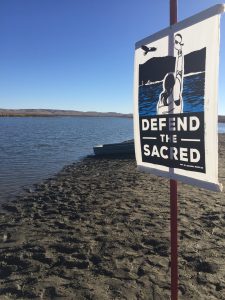
Peggy Robertson - Doing What Teachers Do at Standing Rock | BustED Pencils

The Front Line | BustED Pencils:

The Front Line
img_2576
The front line camp

Today we went to the front line – this is the camp that is closest to the digging of the pipeline –  but the front line has been pushed back – and they are trying to inch their way back to the digging. We visited with women and men that have been there a week and they are waiting for reinforcements who should be arriving soon. Now that I know where the front line is, I can easily see their teepees from Media Hill. We asked them how we could help. They need shin guards (made from hardback books – they promise to return them) and shields ( made from the tops of storage bins). My son is making the shields now. He was given gas mask hoses that he can use to create handles on the shields. We went to the school to pull any hard back books that might not  be in good shape (water logged). The front line has two canoes (or maybe a kayak I can’t remember).  The shields are necessary to deflect the rubber bullets and the bean bags. As I write I’m talking to a young man who was on the front line and he shows us a large bruise on his chest from one of the bean bags. He says they were shooting rubber bullets and bean bags from a boat as  they tried to make a bridge in order to get across Cannonball River and pray. He says that one day, when 140 got arrested, the police shredded his tent, and everyone else’s.
We worked in the school today as well.  We organized books, getting ready for the move to a more spacious spot for the kids – typically 25 or so a day. I’m hoping I can help teach on Monday (once it’s moved) if they need me.
Tomorrow morning there is suppose to be a Sun Dance very early at the bridge. I’m going to get up and head there to see it.  This camp, Oceti Sakowin,  is a place full of kindness, constant music, and friendship. Sam is digging a fire pit for us right now. We haven’t had a shovel and one suddenly appeared allowing Sam to dig the hole. It’s freezing at night. I can’t feel my toes. Today an extra blanket is suddenly inside my tent.
If I need food, there is food. If I need medical assistance, there are medics. Everywhere I turn there is someone to help. I think about the children I taught last year in the Aurora Public Schools and the lack of resources available to them.  Yet, here, we have a group of The Front Line | BustED Pencils:


San Diego Schools Awash in Technology Malpractice | tultican

San Diego Schools Awash in Technology Malpractice | tultican:

San Diego Schools Awash in Technology Malpractice
Image result for technology trash

Every year, school districts in San Diego County are wasting $10’s of millions on technology. This spending binge harms education and is difficult for school boards to oppose. Worst of all children and good pedagogy are being harmed.
ESSA Promotes Technology over Good Pedagogy
When congress passed the new education law (ESSA), the United States Department of Education (USED) was transformed into the nation’s leading education technology sales force. Secretary of Education John King has effectively become a shill for a group of corporations and their “non-profit” foundations working to sell “blended learning”; “competency based education”; “personalized learning”; “linked learning”; etc. These initiatives have at least four things in common; they all profit technology companies; they all are unproven; they all promote unhealthy education practices; and they overturn a student’s right to privacy.
The former governor of West Virginia, Bob Wise, has been leading the Alliance for Excellence in Education since 2005. On their web presence the Alliance lists this group of supporters: Anonymous, AT&T Foundation, Bill & Melinda Gates Foundation, Carnegie Corporation of New York, GE Foundation, James Irvine Foundation, Kern Family Foundation, National Public Education Support Fund, Nellie Mae Education Foundation, State Farm, Stuart Foundation, and William & Flora Hewlett Foundation. For unknown reasons, the biggest dollars appear to come from anonymous. This foundation is just one example, there are hundreds of non-profits like this supported by many of these same groups. They sound well-intentioned but their main motive is monetizing and controlling education in a way that supports corporate desires.
Bob Wise’s organization sponsors Future Ready which says, “The Alliance for Excellent Education leads Future Ready in partnership with the U.S. Department of Education and a vast coalition of both national and regional organizations.” Pictured below are 3 of the 12 rows of sponsors advertised on their web site. It is disturbing that the two major teachers’ unions, American Federation of Teachers and the National Education Association are there along with the national PTA.
future-ready
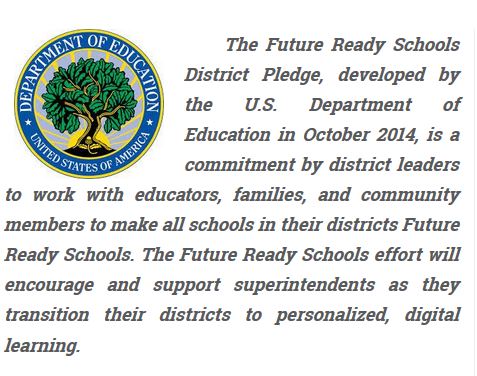
Future Ready asks every superintendent of schools in the United States to take its pledge in exchange for some sort of support. Here is the opening statement for the Future Ready pledge:
future-ready-pledge
Signing up for this pledge is a bit arduous, however, almost every school superintendent in San Diego County has signed it; including Sweetwater’s Karen Janney and San Diego Unified’s Cindy Marten.
Practically speaking, the pledge means giving every child a device capable of providing both their lessons and their assessments. The Future Ready vision is for lessons delivered by software packages from various vendors including Microsoft, Pearson and Google. Students will then be awarded digital badges recorded in their profile in the cloud. The vision is to eliminate school as we know San Diego Schools Awash in Technology Malpractice | tultican:


Elementary-School Students Learn Civics Through Role Play - The Atlantic

Elementary-School Students Learn Civics Through Role Play - The Atlantic:
A Lesson in Democracy for 9-Year-Olds
It’s John Adams vs. Thomas Jefferson on the third-grade campaign trail. Who will win the election of 1800?

Image result for thomas jefferson education quotes
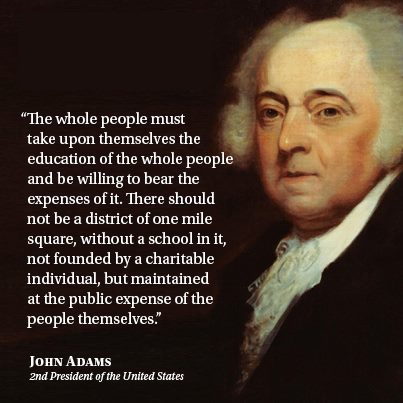
Image result for john adams public schools

Jessica Primus, a spunky 8-year-old with apple cheeks and almond-shaped brown eyes, ran into the kitchen as soon as her mom walked through the door. “Mom, we’ve got to talk.”

Eve Brensike Primus, a criminal-law professor, knew from the intonation in her daughter’s voice that she wanted to discuss her prep for her elementary school’s simulation of the presidential debates. Eve sat down on a stool at the kitchen island and turned to face her daughter.

Jessica took a deep breath and continued. “On the Alien and Sedition Acts and the size and role of government, I think we’re in pretty good shape,” Jessica explained quickly, in staccato. She was referring to the bills denounced by Vice President Thomas Jefferson but signed into law by President John Adams in 1798—one of which made it more difficult for immigrants to become citizens and sanctioned deporting non-citizens who were deemed dangerous. The other restricted speech critical of the federal government. With her hands, Jessica made circles and sliced the air. “But on slavery … I have a problem.”


Jessica’s third-grade class was scheduled to simulate a presidential debate between the candidates of the election of 1800—John Adams and Thomas Jefferson—and she wanted to cover all her bases. Even the odious ones. “Mom, I’m Jefferson—and I own slaves. It’s so … bad.” She hung her head. “How can I justify that?”

Eve had been teaching her law students at the University of Michigan the Socratic Method for more than a decade. Now it was time to apply it to help her daughter think through this challenge. At Jessica’s school, the Hebrew Day School in Ann Arbor, Michigan, presidential debates are taught as something you do, not watch. Election simulation encompasses every step: primaries, campaigning, conventions, debates, elections, and inauguration. And teachers say this technique has proven especially effective during this presidential election cycle. “Turning to the debates of an historical election has allowed my students to think for themselves,” said Laura Pasek, a third- and fourth-grade general-studies teacher. “Rather than recite back what adults think of Trump and Clinton, they’re thinking on their feet about the issues.”

To help Jessica understand the other side of an argument, Eve drew from a modern example. “Remember when you watched [Usain] Bolt run a really hard sprint in the Olympics?”

Jessica nodded.

“What would have happened had he run another sprint right after that?”


“He would have gotten tired—and might have lost!”

Now, her mom nodded. “Given that the United States had just finished a war to gain independence from Great Britain, what would have happened had their politicians pushed to end slavery? … If we’d just finished fighting one war,” she continued, “we wouldn’t have wanted to fight another.”

“And if you’d abolished slavery?” Jessica started to think aloud. “The South would Elementary-School Students Learn Civics Through Role Play - The Atlantic:

The frightening effect of ‘Trump Talk’ on America’s schools - The Washington Post

The frightening effect of ‘Trump Talk’ on America’s schools - The Washington Post:

The frightening effect of ‘Trump Talk’ on America’s schools


report issued in April titled, “The Trump Effect: The Impact of the Presidential Campaign on Our Nation’s Schools,” said that the primary campaign was so divisive that it was having a “profoundly negative effect on children and classrooms.” The report, by the Southern Poverty Law Center’s Teacher Tolerance project said:
It’s producing an alarming level of fear and anxiety among children of color and inflaming racial and ethnic tensions in the classroom. Many students worry about being deported.
Other students have been emboldened by the divisive, often juvenile rhetoric in the campaign. Teachers have noted an increase in bullying, harassment and intimidation of students whose races, religions or nationalities have been the verbal targets of candidates on the campaign trail.
Since the report was issued, concerns about many things that Republican presidential candidate Donald Trump has said about women, Muslims, Mexicans and other people have only heightened, and teachers increasingly find themselves handling the fallout.
In this post, Mica Pollock, a professor of education at the University of California at San Diego, looks at the effect that she calls “Trump Talk” has on students, teachers and school climate, and discusses how educators should respond.
Pollock is the author of several books on race talk in schools, including the forthcoming “Schooltalk: Rethinking What We Say About — and To — Students Every Day.” An anthropologist and design researcher, she is professor of education studies and director of the Center for Research on Educational Equity, Assessment and Teaching Excellence (CREATE) at the University of California at San Diego. As director of the center, Pollock works with colleagues to network the university’s people, resources and opportunities to the diverse K-12 educators, students, and families of the San Diego region, with the particular goal of supporting low-income, underrepresented students toward college and rewarding careers.
By Mica Pollock
Children and youth hear the words adults hear. They hear them on the Internet, over a shoulder and repeated by other kids on the playground or in the classroom. And words matter. They shape what young people think about themselves, each other, adults and their country.
From Donald Trump, the Republican candidate for president, young people have heard distorting claims about Mexicans as rapists to deport and distrust, of Muslims as violent anti-Americans who should be banned from entry to the United States, of African Americans as people living in hellish inner cities, of women as people to grope without permission, and of The frightening effect of ‘Trump Talk’ on America’s schools - The Washington Post:


California bilingual education could be a game changer | ASU Now: Access, Excellence, Impact

California bilingual education could be a game changer | ASU Now: Access, Excellence, Impact:

California bilingual education could be a game changer

Image result for yes on 58 california

On Tuesday, California voters will decide on the fate of bilingual education. The passage of Proposition 58 would overturn a 1998 initiative that eliminated most bilingual education in California, providing students with additional learning opportunities. Its impact would touch not only California but could influence policy in Arizona and other Southwestern states with significant immigrant populations.
Pablo RamĆ­rez, an assistant professor of teacher preparation at Arizona State University’s Mary Lou Fulton Teachers College and a former California elementary and secondary teacher, researches English-language learners in the public school system. He offers his take on what the passage of Proposition 58 would mean for California and other states.
Question: How would you describe bilingual education?
Answer: In general terms, it is classroom instruction that teaches and values two languages. Further, bilingual education promotes cultural awareness and bi-cognitve development in the bilingual student.
Q: What is the benefit of incorporating more than one language in the classroom?
A: The use and integration of two languages provides students with multiple opportunities for learning. So students are able to strengthen their Spanish and English by having opportunities to engage in meaningful literacy activities that promote cultural awareness and bicultural identity.
Q: Are there drawbacks from teaching more than one language in the classroom?
A: The only drawbacks that exist are related to bilingual programs’ underdevelopment. If bilingual programs do not receive funding for curriculum and instruction and teacher preparation, the program is not able to grow, and unfortunately, this impacts students.
Q: Why does this issue continue to trigger so much controversy?
A: Folks continue to believe that being bilingual is going against U.S. values and traditions. This is a sort of notion of not being American. This truly stems from racist ideology that exists in society.
Q: Some teaching professionals emphasize that English-language learning and dual-language learning are not just about language proficiency, but expanding the ability of non-English speakers to succeed in math, science and other subjects. Can you explain this?
A: Students in dual-language classrooms have the opportunity to learn about math and science in both languages.  This supports students who are Spanish speakers because they have access to rich academic content. For English-speaking students, they have opportunity to practice and reinforce Spanish skills while learning math and science. So dual language, if instructed the correct way, provides access to content to various type of language learners.
Q: How would California’s passage of Proposition 58 affect states such as Arizona, New Mexico and Texas, all of which have significant Latino populations? And how would it impact the United States more generally?
A: If Proposition 58 passes, it completely rejects the all-English movement in California. This means that more schools would be able to provide dual-language learning or other forms of bilingual education to more students.  So, Latino and Latina students will benefit tremendously across the state.
Arizona will be impacted because it will begin to trigger conversations about the role of dual-language learning and bilingual education in schools. This could potentially make the state reconsider the all-English language policies (Proposition 203, passed in 2000) that exist.
New Mexico and Texas would also benefit. Both states have a strong bilingual-education presence, and so their programs would also begin to grow and expand if they modified some of their language policies.California bilingual education could be a game changer | ASU Now: Access, Excellence, Impact:


Trump-Clinton? Charter Schools Are the Big Issue on Massachusetts’ Ballot - The New York Times #NOon2

Trump-Clinton? Charter Schools Are the Big Issue on Massachusetts’ Ballot - The New York Times:

Trump-Clinton? Charter Schools Are the Big Issue on Massachusetts’ Ballot


BOSTON — The television ads are relentless, fueled by a historic surge of campaign spending. Fliers are clogging mailboxes. Both sides are knocking on doors across the state.
But in deep blue Massachusetts, the contentious campaigning is not for president but for a ballot question on whether to expand charter schools.
The pitched battle in this state, known as a bellwether on education policy, reflects the passions that charter schools arouse nationwide, particularly regarding a central part of the debate: If they offer children in lagging traditional public schools an alternative path to a quality education, do they also undermine those schools and the children in them?
Because Massachusetts’s charter schools rank among the nation’s best, advocates say a yes vote to allow more of them would send a strong signal that they have a crucial role to play in improving student learning and closing the achievement gap between white and black students.
But opponents say a no vote would show that even in a state where charter schools have been successful, most voters believe the schools — privately run but publicly financed — undermine traditional public schools, drain resources and perpetuate inequities, and should be curtailed.
“What happens in Massachusetts will send shock waves throughout the United States either way,” said Parag Pathak, a professor at M.I.T.’s Sloan School of Management, who studies education.
“If the voters reject more urban charters here,” he said, “then it’s not clear what more the charter movement can do to convince opponents and skeptics.”
Question 2 on the ballot asks whether the state should be allowed to approve up to 12 new charter schools or larger enrollments at existing charters each year, not to exceed 1 percent of the statewide public school enrollment.
The measure would affect nine communities that have either reached their caps on charter enrollment or have room for only one more charter school: Boston, Chelsea, Everett, Fall River, Holyoke, Lawrence, Lowell, Springfield and Worcester. All have long waiting lists.
It would not affect 96 percent of the state’s school districts, yet strategists say voters in those districts — largely in suburbs with good public schools — could determine the outcome Tuesday.
Earlier this year, the charter proposal appeared to be nonpartisan and headed for passage. But in recent weeks, as the ad war has heated up, the Trump-Clinton? Charter Schools Are the Big Issue on Massachusetts’ Ballot - The New York Times: