Latest News and Comment from Education

Sunday, October 16, 2016

Use edtech to maximize student knowlege, skills and performance, not measure it | Johnathan Chase

Use edtech to maximize student knowlege, skills and performance, not measure it | Johnathan Chase | LinkedIn:

Use edtech to maximize student knowlege, skills and performance, not measure it

Use edtech to maximize student knowlege, skills and performance, not measure it
With the Common Core’s emphasis on data-driven instruction there is a misguided focus on using technology to deliver content and collect data rather than cultivate learning and stimulate cognitive development.
Using education technology isn’t so much about students mastering a device or procedure so much as it is about mastering themselves first.
Students acquire essential academic, social, and emotional skills as they persist through vigorous and non-routine learning activities rather than proceeding through personalized learning modules and standardized digital assessments.
Students will not learn how to actively engage in collaborative learning or establish and maintain healthy relationships with people, if they are trained to be passive learners who spend most of their time relating to a device that delivers "personalized" content that is adapted to them. 
Teacher, blogger and author Mercedes Schneider blogged about Race To The Top funding that targeted school district data collection efforts and preparation for the online Common Core assessments. Schneider found that applicants for RTTT funds agreed to
"Use technology to the maximum extent appropriate to develop, administer, and Use edtech to maximize student knowlege, skills and performance, not measure it | Johnathan Chase | LinkedIn:


Teacher: I like to engage my fifth-graders in presidential elections. ‘But not this year. I just can’t!’ - The Washington Post

Teacher: I like to engage my fifth-graders in presidential elections. ‘But not this year. I just can’t!’ - The Washington Post:

Teacher: I like to engage my fifth-graders in presidential elections. ‘But not this year. I just can’t!


Election years offer teachers rich opportunities to bring students into the electoral process in real time. But “not this year,” according to Ralph Ratto, an elementary school teacher from Long Island and president of his local teachers union. In this post, Ratto explains why this race between Republican presidential nominee Donald Trump and Democratic presidential nominee Hillary Clinton is different — and what he is doing with his fifth-grade students that is different from past election years. A version of this appeared on Ratto’s blog, Opine I Will. He tweets at @rratto.
By Ralph Ratto
Nine- and 10-year-old children are a curious bunch. They are on the cusp of adolescence and are just beginning to get a grasp on the outside world. Their minds are like sponges, soaking up everything that is around them. This is a very special time in their lives where they have opinions based on their own schema.
As a fifth-grade teacher, I have always looked forward to election season to introduce the concept of opinions, fact and fiction. I particularly enjoyed introducing my young students to presidential campaigns, the Electoral College and the importance of debate in our democratic process.
Not this year.
In the past, my students looked at candidates, discussed their campaigns, looked at the issues and debated themselves. We always had mock elections, and looking at the results was often an interesting exercise. My students usually began by parroting what was heard at home or they would disagree with what they heard at home. I encouraged them to read the news and watch news channels.
We often discussed the different viewpoints presented. We read opinion pieces and discussed that opinions were worthless unless backed up with real facts. I also encouraged them to watch the debates and be prepared to discuss them the next day in class. Yes, we did that in fifth grade!
Not this year!
How can I? This year I cannot discuss the issues with children. In addition, I am faced with Teacher: I like to engage my fifth-graders in presidential elections. ‘But not this year. I just can’t!’ - The Washington Post:


#BlackLivesMatterAtSchool FAQ: Answering why hundreds of Seattle educators are wearing “Black Lives Matter” shirts to school | I AM AN EDUCATOR

#BlackLivesMatterAtSchool FAQ: Answering why hundreds of Seattle educators are wearing “Black Lives Matter” shirts to school | I AM AN EDUCATOR:

#BlackLivesMatterAtSchool FAQ: Answering why hundreds of Seattle educators are wearing “Black Lives Matter” shirts to school

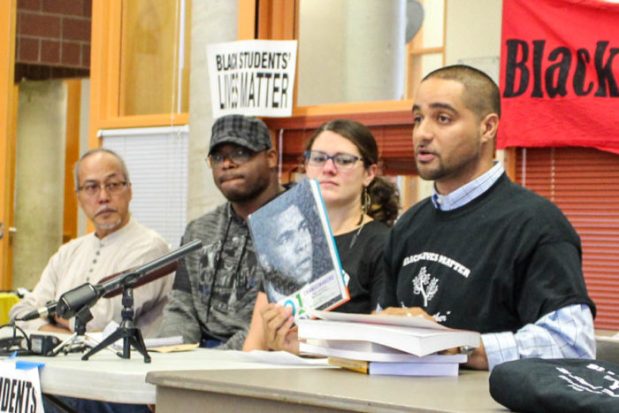
pressconf_seattle_school_black_lives_matter_shirts-1-700x467
#BlackLivesMatterAtSchool press conference.  Teachers pictured (from left to right) Rogelio Rigor, Donte Felder, Sarah Arvey, and Jesse Hagopian. (Photo by Benice Buhain)
On October 19th, 2016 hundreds of Seattle teachers, counselors, paraprofessionals, nurses, instructional assistants, librarians, and other educators will be wearing Black Lives Matter shirts to school in an unprecedented action, “Black Lives Matter At School.”  Already, some 2,000 shirts have been ordered and many of these educators will also be teaching lessons that day about institutional racism.  Educators at Washington Middle School and other educators from the Social Equality Educators have compiled this list of answers to frequently asked questions about this unprecedented action.

October 19th—#BlackLivesMatterAtSchool FAQ

Q: How did the October 19th Black Lives Matter At School event get organized?
A: In mid-September, two Seattle elementary schools decided to have African-American men from their communities welcome students to school with greetings and high-fives. Teachers planned to wear Black Lives Matter t-shirts. One school, John Muir, received a bomb threat from someone opposing the event. Although consideration was given to canceling due to safety concerns, the event was held anyway without any problems. In an act of solidarity, a few days later the Seattle Education Association (SEA) Representative Assembly passed a resolution unanimously supporting the schools and their actions, and encouraging all schools to participate in a day of solidarity on Wednesday, October 19:
Whereas the SEA promotes equity and supports anti-racist work in our schools; and,
Whereas we want to act in solidarity with our members and the community at John Muir who received threats based on their decision to wear Black Lives Matter t- shirts as part of an event with “Black Men United to Change the Narrative”; and,
Whereas the SEA and SPS promote Race and Equity teams to address institutionalized racism in our schools and offer a space for dialogue among school staff; and,
Therefore be it resolved that the SEA Representative Assembly endorse and participate in an action wearing Black Lives Matter t-shirts on Wednesday, October 19,2016 with the intent of showing solidarity, promoting anti-racist practices in our schools, and creating dialogue in our schools and communities.
On October 8, the Seattle Public Schools noted the event on its website, and stated:
During our #CloseTheGaps kick-off week, Seattle Education Association is promoting October 
#BlackLivesMatterAtSchool FAQ: Answering why hundreds of Seattle educators are wearing “Black Lives Matter” shirts to school | I AM AN EDUCATOR:


Parents Working With School Districts To Make Public Schools Work

Parents Working With School Districts To Make Public Schools Work:

Parents Working With School Districts To Make Public Schools Work

Group of Diverse Various Occupations People Meeting

For our team and the members of our group, gifted education is not about speeding through school or having Ivy League kids. It is about our children receiving an education that causes them to work hard, overcome obstacles, and fail and recover. It is about finding friends who understand them and are OK with their quirks. It is about not being ashamed to ask for differentiation for our kids.
–Joshua Raymond, Michigan Parent and Gifted Student Activist
Stories where parents work with public school administrators and teachers to create new programs to fill a need for children are always lovely. I think it reflects the kind of democratic public school system we should all seek.
Joshua Raymond has often commented on posts I have written about gifted education. We don’t always agree about minor points, but we have a mutual respect for one another.
Joshua led a group of parents in Metro Detroit to create new programming for the Parents Working With School Districts To Make Public Schools Work:
Image result for big education ape parent power

Randi Weingarten: The silver lining of Trump's corrosive campaign | Huffington Post

The silver lining of Trump's corrosive campaign | Huffington Post:

The silver lining of Trump’s corrosive campaign


What could possibly be the silver lining of the presidential bid of a candidate whose comments and actions are degrading, undemocratic, bigoted and just plain cruel?
How could there be an upside to a campaign that makes one wonder whether it’s safe for children to watch the evening news or even presidential debates?
Frankly, Donald Trump’s candidacy is so offensive, so frightening and so unprecedented in the United States that it compels us to a much-needed collective focus on decency and civic engagement—a renewal of civitas.
In my lifetime, I have seen plenty of elections in which the candidates attacked each other. But I have never seen a candidate for president undermine the bedrock principles of our constitutional democracy.
Donald Trump has incited his supporters to use violence against peaceful protesters. He has called for a ban on members of an entire religion from entering the United States. He has disparaged African-Americans, Mexicans and the disabled. He has said he would jail his political opponent and led his supporters in chants of “Lock her up.”
When his campaign has faltered, he has raised the unfounded specter that the election could be rigged against him.
This election is not just about politics and policies, but about human decency.
Trump has denigrated women, boasted about repeatedly sexually assaulting women, and hurled vicious verbal attacks against women who report they were assaulted by him. First lady Michelle Obama spoke for many Americans when she gave a speech last week reminding voters that this election is not just about politicsThe silver lining of Trump's corrosive campaign | Huffington Post: 


John Thompson: Let's All Unite Behind the NAACP's Call for a Charter School Moratorium | Huffington Post

Let's All Unite Behind the NAACP's Call for a Charter School Moratorium | Huffington Post:

Let’s All Unite Behind the NAACP’s Call for a Charter School Moratorium


The good news is that the NAACP is calling for a moratorium on the expansion of charter schools. The bad news is that the call is not universally seen for what it is - a balanced effort to deescalate the education civil war which is disproportionately hurting poor children of color.

In a rational and humane era of school improvement, there wouldn’t be complete agreement on the NAACP position, but advocates for choice would recognize the need to slow the growth of charters. They might be offering substitute wording for the resolution, and working with representatives of traditional public schools, teachers, and unions to craft an agreement on ways to minimize the inherent harm done by charters, while building on the good that some charters have provided.
The NAACP voted for the following:
We are calling for a moratorium on the expansion of the charter schools at least until such time as:
(1) Charter schools are subject to the same transparency and accountability standards as public schools
(2) Public funds are not diverted to charter schools at the expense of the public school system
(3) Charter schools cease expelling students that public schools have a duty to educate and
(4) Cease to perpetuate de facto segregation of the highest performing children from those whose aspirations may be high but whose talents are not yet as obvious.


Non-educators might be perplexed about the anger that this resolution generated. As Mercedes Schneider notes, the Business Insider compares the “charter school-CMO relationship to the subprime mortgage crisis ‘bubble.’” Moreover, the Office of Inspector General (OIG) “found that 22 of the 33 charter schools in our review had 36 examples of internal control weaknesses related to the charter schools’ relationships with their CMOs (concerning conflicts of interest, related-party Let's All Unite Behind the NAACP's Call for a Charter School Moratorium | Huffington Post:


Teaching Advanced Placement U.S. History at Los Altos High School: Technology Integration | Larry Cuban on School Reform and Classroom Practice

Teaching Advanced Placement U.S. History at Los Altos High School: Technology Integration | Larry Cuban on School Reform and Classroom Practice:

Teaching Advanced Placement U.S. History at Los Altos High School: Technology Integration

I observed Gabriel Stewart’s 90-minute class on September 15, 2016. Stewart, wearing a maroon polo shirt over a muscled upper body with dark slacks, is a 19 year veteran teacher* at Los Altos High School** (and baseball coach). In this lesson, he had set aside this period to give a 75-item multiple choice test on early 19th century political and social changes during the first half of the class and then do a practice Document-Based Question in the remaining 45 minutes. The AP course is geared to the spring exam. Stewart alerts students often during this class about the importance of being aware of time in answering questions and knowing basic knowledge of the period under study. The text for the course is American Pageant by Thomas Bailey and David Kennedy.
The furniture arrangement is five rows of desks facing the front white board and teacher’s desk in one corner. Bulletin boards are filled with newspaper articles, maps, announcements and photos. On one side of the room bulletin board sheets of paper carried previous AP classes’ records in passing the AP exam (getting a three or higher).
gabe-lahs
During the test, students filled in a Scantron sheet recording their answers to such questions as
9. John C. Calhoun’s “South Carolina Exposition” was an argument for:
a. Secession.
b. Protective tariffs.
c. Majority rule.
d. States rights
23. As a cure for the panic of 1837, the Whigs recommended all of the following measures except:
a. Expanded bank credit
b. Higher tariffs
c. Subsidies for internal improvements
d. The “Divorce” bill.


CURMUDGUCATION: ICYMI: Goodies for the week (10/16) + The NAACP: Ignorant Dupes?

CURMUDGUCATION: ICYMI: Goodies for the week (10/16):

ICYMI: Goodies for the week (10/16)


Here's some reading for the day. remember to share the stuff you like; only you can prevent good writing from vanishing into the white noise of the interwebs.

Before We Create Opportunity School Districts.. 

A Georgia teacher talks about what Opportunity District threats look like on the ground, and what would be a better way to serve the students.

Independent Reading: A Research Based Defense 

This practice has been around forever. When I first started teaching it was Middle School Sustained Silent Reading, shortened to MSSR by the school and called Misssery by the students. But look-- we've finally got some research to back it up.

The Nine Types of People Ruining Your School Email 

A fun article. You should send it to everyone on your staff.

California's Charter Mess

Third in a series of four pieces by Carol Burris showing just how big a mess California's charter biz has become

VAM-based Chaos in Florida

How just one district is being upended and trashed by Florida's mandatory VAM-based baloney.

Fed-up Philly Teachers Jumping Ship

Philadelphia continues to find ways to drive teachers away-- and it's working.

The Battle of Hastings: What's Behind the Netflix CEO's Fight To Charterize Public Schools

A more in-depth look at Reed Hastings and his goal of doing away with public education

Pruning Teacher Education

John Merrow takes a look at the USED's new rules for evaluating and shutting down teacher education programs.

To Write or Not To Write

I consider this a question on the order of  "To eat or not to eat," but somehow there are teachers of writing in the world who don't write themselves. This essay answers that problem.

What My Students Have Led Me To Believe 

Finally, from Emily Kaplan, a great way to kick off the week.

CURMUDGUCATION: ICYMI: Goodies for the week (10/16):


The NAACP: Ignorant Dupes?
They probably had their press releases ready. Despite the full-court lobbying, the charter fans had to have an idea which way the wind was blowing. And so when the NAACP announced the official, full-throated adoption of the call for a 


Big Education Ape: Catch up with CURMUDGUCATION: There Are More Important Things - http://bigeducationape.blogspot.com/2016/10/catch-up-with-curmudgucation-there-are.html


Russ on Reading: Independent Reading: A Research Based Defense

Russ on Reading: Independent Reading: A Research Based Defense:

Independent Reading: A Research Based Defense


Independent Reading, sometimes called SSR, DEAR or SQUIRT, is an instructional strategy where students are given time in class to read self-selected books. An instructional strategy which has been around since the 1970s, it has two goals:


  1. Provide students with time to practice the reading strategies they have learned through classroom instruction in a real reading situation and, therefore, improve reading achievement.
  2. Promote positive attitudes towards reading in the hopes of making reading a life-long habit for children.

Recently, literacy guru, Tim Shanahan, has reiterated his opposition to Independent Reading (SSR, DEAR) as an in the classroom instructional strategy. You can read his two most recent blogs on the topic here and here.Shanahan's opposition is based on the following:


  1. A lack of empirical research to support the practice for improving reading achievement.
  2. Independent reading violates what we know about motivational activities and, therefore, will not create lifelong readers.
It is important to note here that Shanahan's opposition to independent reading is not new. He was a prominent member of the National Reading Panel(NRP) study, the precursor of the Reading First initiative, that concluded that "even though encouraging students to read more is Russ on Reading: Independent Reading: A Research Based Defense:


NAACP Ratifies Charter School Moratorium Resolution. Will USDOE Rise to the Occasion? | deutsch29

NAACP Ratifies Charter School Moratorium Resolution. Will USDOE Rise to the Occasion? | deutsch29:

NAACP Ratifies Charter School Moratorium Resolution. Will USDOE Rise to the Occasion?


On July 29, 2016, the National Association for the Advancement of Colored People (NAACP) voted on a resolution calling for a charter school moratorium at its 2016 national convention.
On October 15, 2016, the charter moratorium resolution was officially ratified by the national NAACP. Below is the text of the NAACP charter moratorium press release:
FOR IMMEDIATE RELEASE 
October 15, 2016
Statement Regarding the NAACP’s Resolution on a Moratorium on Charter Schools
CINCINNATI – Members of the National Association for the Advancement of Colored People (NAACP) Board of Directors ratified a resolution Saturday adopted by delegates at its 2016 107th National Convention calling for a moratorium on charter school expansion and for the strengthening of oversight in governance and practice.
“The NAACP has been in the forefront of the struggle for and a staunch advocate of free, high-quality, fully and equitably-funded public education for all children,” said Roslyn M. Brock, Chairman of the National NAACP Board of Directors. “We are dedicated to eliminating the severe racial inequities that continue to plague the education system.”
The National Board’s decision to ratify this resolution reaffirms prior resolutions regarding charter schools and the importance of public education, and is one of 47 resolutions adopted today by the Board of Directors. The National Board’s decision to ratify supports its 2014 Resolution, ‘School Privatization Threat to Public Education’, in which the NAACP opposes privatization of public schools and public subsidizing or funding of for-profit or charter schools. Additionally, in 1998 the Association adopted a resolution which unequivocally opposed the establishment and granting of charter schools which are not subject to the same accountability and standardization of qualifications/certification of teachers as public schools and divert already-limited funds from public schools.
We are calling for a moratorium on the expansion of the charter schools 
NAACP Ratifies Charter School Moratorium Resolution. Will USDOE Rise to the Occasion? | deutsch29:


What Should Be the First Educational Initiative of the HRC Administration? | Ed In The Apple

What Should Be the First Educational Initiative of the HRC Administration? | Ed In The Apple:

What Should Be the First Educational Initiative of the HRC Administration?


Woke up this morning and checked out my phone: emails, tweets (a different world!), and, scanned the NY Times online. Every day the Times have a graphic, the percentages predicting the presidential election outcome. In July Hillary was in the mid-eighties and by mid-September had dipped to the mid-seventies. This morning Hillary hit 89% – the highest Times election prediction.
The Nate Silver fivethirtyeight blog  predicts Clinton 86.4% and 341 electoral votes (270 needed for victory), and, in the popular vote Clinton leads 49% to 42%.
The Third Presidential Debate will take on Wednesday, October 19th in Las Vegas; Chris Wallace of Fox will be the moderator. The tenor of the debates will not change.
Trump has “legitimatized” racism, misogamy and homophobia, voters may think and not use the “N” word, don’t worry, Trump is the surrogate. For the Trump camp the hope is in the lessons from the Brixit and the Columbia plebiscites, the polls predicted “yes” votes and the “no” prevailed in both cases. Are there Trump votes outside of the reach of the pollsters? Trump will be Trump, hoping that the lesson from Brixit prevails.
With pollsters predicting a big Hillary victory will Trump voters throw in the towel and not bother voting, and/or, will the Hillary voters, anticipating a big Hillary win will also not bother to vote?
Hopefully, I’ll feel relieved on November 9th
A couple of weeks after the election HRC, (G-d willing!!) will begin nominating cabinet members. Who will be the Secretary of Education?  I can give you a list of who will NOT be nominated; I have no idea of the nominee.
The first hundred days are crucial for incoming presidents: setting the tone for the presidency. Bill Clinton chose health care reform and stumbled badly. His presidency never achieved the accomplishments he anticipated.  While Hillary may regain the Senate it is unlikely the Democrats will also seize the House. The Republicans have been successful in thwarting Obama, with relatively little voter negativity.  Plus, history shows that midterm elections usually favor the “out” party. In 2010 and 2014 the Republicans thrashed the Democrats in the midterm elections. HRC will have a two year window to convince the nation that she was the “right” choice.
Reducing poverty and supporting the middle class is at the heart of the HRC agenda; however they are heavy lifts (See Brookings Institute paper here)
… graduating from high school, belonging to a family with at least one full-time worker, and having children while married and after age 21—correlated closely with economic success. We call this the “success sequence.” Individuals who follow it almost never live in poverty.
What can Hillary do in the field of education that does not require legislation or will be bipartisan?
For example: the college student debt crisis is acknowledged by both parties; however, the parties sharply disagree on the path.
How do we help students complete high school with the skills needed to pursue their goals? Raising graduation rates will require not just new kinds of high schools, but investment in children at all stages of life: home visiting, early childhood education, and new efforts in the primary grades.Home visiting programs improve parenting and connect families to adequate medical care. The effects continue well into adolescence. Similarly, research suggests that low cost interventions like providing parents with books and texting them reminders to read to their children, can have substantial effects on child literacy skills.
All of the interventions listed above cost dollars and a Republican Congress will not support the legislation. In addition, the policies are local, policies that have to be adopted at the state and local levels. The Obama/Duncan efforts alienated teachers and communities; once again, big, bad Washington telling us what to do and how to do it. The best decisions are usually made by teachers and school leaders supported by superintendents and the education hierarchy. Sadly Washington, or Albany or Tweed issue ukases, the troops salute, and very little changes. Race to the Top, 4.4 billion dollars, over $700 million to New York State: is there any evidence that the dollars changed outcomes?
I would suggest a major initiative: Career and Technical Education, former What Should Be the First Educational Initiative of the HRC Administration? | Ed In The Apple:


Assuming First-Generation Students Are Low-Income is False - The Atlantic

Assuming First-Generation Students Are Low-Income is False - The Atlantic:

The Cost of Being First

Conflating “first-generation” and “low-income” students is inaccurate and isolating.

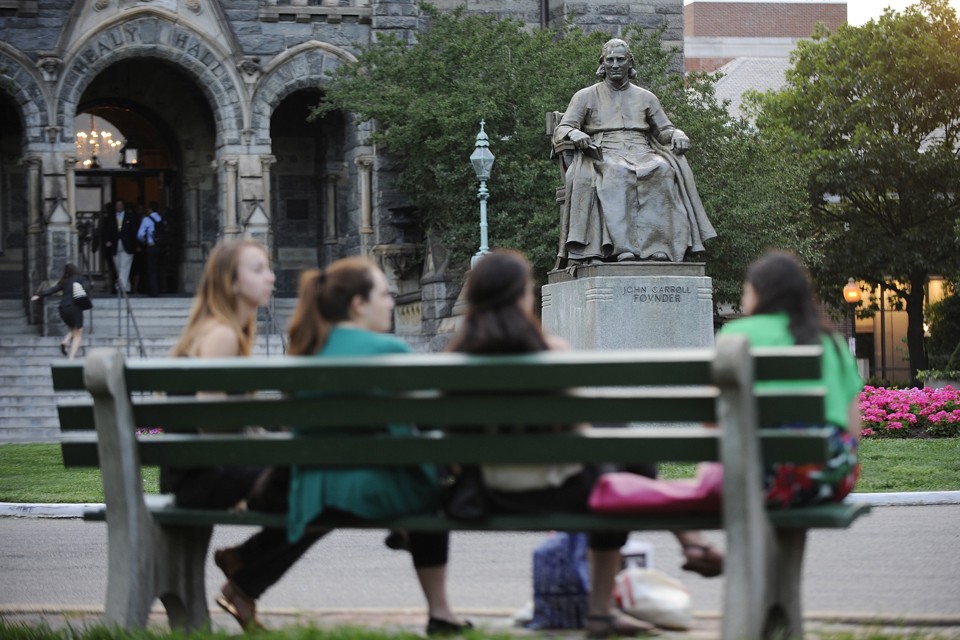
Students sit on a bench in front of a statute of the university founder John Carroll at Georgetown University.
Students at Georgetown University created the Alliance for Low-Income First-Generation Narrative.Jonathan Ernst / Reuters


 When Chris was accepted into the Georgetown’s School of Foreign Service, he didn’t think of himself as a first-generation college student. Acknowledging his first-generation identity and how it influenced his path came years later, but the label assigned by his college is only a part of Chris’s individual story.

His parents, both Vietnamese refugees who had not gone to college, raised him in south Florida. Chris, who did not want to use his last name, knew he’d earned a golden admission ticket, but he didn’t know that getting in was only half the struggle. He hadn’t considered how his parents’ lack of higher education might influence his own college studies. “I did homework with my classmates for the first time and I found myself getting defensive about what little knowledge of college I had coming in,” Chris said, describing the anxiety and distress he experienced studying, taking tests, and meeting classmates. “I was playing pretend the moment I had my first meaningful conversation with someone, and I consequently felt lost the next year and a half.”


More schools are focusing on supporting students like Chris. But in their goal to increase access to higher education, schools label young people in ways thatisolate rather than include them—particularly where colleges and the support systems they develop for these students automatically equate being first generation with being low income, as many studies suggest.


As a sociologist, Celine-Marie Pascale, a professor and the associate dean for undergraduate studies at American University, where I also teach, is concerned with the language and attitudes that develop around culture, knowledge, and power. When Pascale was a first-generation graduate student, 17 years after earning her undergraduate degree, she was awarded a scholarship and asked to visit donors. “I was incredibly grateful, of course; I could not have gone to school without it. But I became weary of going to events and representing the poor student they were saving. It felt demeaning,” she said.


The labels aren’t always intentional, and they aren’t always bad. Colleges anticipate and define student categories—like low-income, first-generation, and minority—mostly based on voluntary Common Application data provided before a student ever arrives on campus. While students aren’t required to disclose their parents’ educational backgrounds—and many don’t—self-identified first-generation students are often linked to or assumed to have economic disadvantage. Students may also choose not to disclose their first-generation status; professors and classmates won’t know unless they claim the label. But Assuming First-Generation Students Are Low-Income is False - The Atlantic:


School takeover plan draws fire Deal didn’t seem to didn’t... | www.myajc.com

School takeover plan draws fire Deal didn’t seem to didn’t... | www.myajc.com:

School takeover plan draws fire Deal didn’t seem to didn’t foresee


Is the governor running scared on his Opportunity School District?
An infusion of outside cash, withering TV ads and a rising revolt among schools boards has given Nathan Deal something he didn’t expect in his campaign to amend the constitution to enable state takeover — a street fight.
With its rosy ballot language — Should the state intervene in chronically failing public schools to improve student performance? — the governor’s legacy legislation seemed a slam dunk. The OSD requires a fundamental change to the Georgia constitution because it transfers control from elected school boards to a governor-appointed superintendent who holds sole authority to run the schools, close them or turn them over to independent management.
Deal’s recent lobbying on behalf of the OSD suggests he may be worried about a survey showing a divided electorate. Along with a new business-oriented video in which he equates the Opportunity district to more job opportunities, a heartfelt Deal also stars in a new TV commercial urging Georgians to vote “yes” for the sake of children in failing schools.
Outside money is underwriting the slick ads on both sides. The pro-OSD campaign is being bankrolled by a group organized by Deal supporters, which has received donations from 50Can, an education advocacy group that merged with Michelle Rhee’s StudentsFirst in March, while the National Education Association is the top funder for opposition efforts.
Deal invited African-American ministers to the Governor’s Mansion to tout the benefits of the OSD to black students. In his account of the meeting, the Rev. Chester Ellis of St. Paul Missionary Baptist Church in Savannah, said, “I thanked the governor for inviting me, but I told him before I left that there are too many uncertainties and too many unanswered questions to go before my congregation and say we should support this. I’m not comfortable with the governor’s answers or his solutions.”
Attacks on the OSD are coming from unexpected places — some Georgia conservatives. Mary Kay Bacallao, a former GOP candidate for state school chief and a former Fayette County school board member, is recommending School takeover plan draws fire Deal didn’t seem to didn’t... | www.myajc.com:


Tennessee pro-charter school PACs' spending up

Tennessee pro-charter school PACs' spending up:

Tennessee pro-charter school PACs' spending up


NASHVILLE – Three political action committees advocating expansion of charter schools and school vouchers have pushed their spending in Tennessee political campaigns to near the $2 million mark and are poised to pass it, according to new financial disclosures filed last week.
PACs representing Stand For Children, the Tennessee Federation for Children and Tennessee Campaign for Achievement Now – previously known in the state as Tennessee StudentsFirst – collectively reported spending more than $1.2 million in July disclosures. In the new reports, covering the period of July 25-Oct. 1, show additional spending of $584,000 – most in late attack advertising prior to the Aug. 4 elections.
Tennessee Campaign for Achievement Now, also known as TennesseeCAN, reported $300,000 in spending by the PAC set up to replace one operated by StudentsFirst following a merger earlier this year with another group. The group reported spending just $18,000 in its July PAC report, which came amid what a spokesman called “restructuring” after the merger. Most of the money spent came from the group’s national organization, known as 50CAN.
The Tennessee Federation for Children, also drawing most of its funding from a national parent organization, reported new spending of $148,000 on top of $361,000 reported in July.
Stand for Children, which operates two PACs in the state, disclosed new spending of just over $143,000 for the two combined – almost all on “independent expenditure” attack advertising in state legislative primaries or local school board elections. The groups had reported about $830,000 spent as of July 25.
Stand for Children is facing an investigation by the Registry of Election after complaints were filed contending its spending in Nashville school board races was illegally coordinated with candidates. A hearing on the complaint, originally scheduled for last week, has been postponed until December.
The success of spending by the groups varied widely. All the candidates supported by Stand for Children in Nashville school board races lost to candidates who came under attack.
In state legislative primaries, the standout spending was by Tennessee Federation for Children in advertising attacking state Rep. Curry Todd, R-Collierville, who lost on Aug. 4. The group had earlier reported spending $109,363 in opposing Todd and disclosed last week another $23,714 in the new report for a total of about $133,000 – an apparent record for a single PAC against a single legislator. Todd was charged with misdemeanor theft during the campaign for allegedly stealing an opponent’s campaign signs and is awaiting trial.
On the other hand, the Federation PAC spent more than $90,000 – including more than $10,000 not previously reported -- opposing state Rep. Gary Hicks, R-Rogersville, who won his Aug. 4 primary.
All three organizations bill themselves as advocates for “school choice” education reforms, though the Federation focuses on promotion of school vouchers in its legislative lobbying and Stand for Children on expansion of charter schools. StudentsFirst has backed legislation on both matters in the past.
The Tennessee Education Association, which opposes school vouchers and charter school expansion, reported spending of $66,272 during the most recent period. TEA, also known as the teachers union, in July had reported about $121,000 in spending.
Some other gleanings from the disclosures filed last week:
  • The state Republican party reported a cash-on-hand balance of $224,042 in its state campaign spending account as of Oct. 1. The state Democratic party reported a balance of $128,926. Both parties reported little spending on state activities in the most recent disclosure period, though both sent funds to their separate accounts set up to provide funding in federal elections.
  • House Speaker Beth Harwell reported raising $117,512 during the period for her reelection campaign and now has an account balance of $1,110,745. Her opponent in the Nov. 8 election, Democrat Chris Moth, reported raising $14,063 and loaning his campaign $50,000. He had previously loaned the campaign another $50,000. Moth’s cash-on-hand balance was reported at $97,426. Harwell also has a separate PAC account. She reported raising $51,500 for Harwell PAC in the latest disclosure and now has a cash balance of $779,928 there.Tennessee pro-charter school PACs' spending up: