Latest News and Comment from Education

Tuesday, October 11, 2016

Native American Colleges Have Abandoned The Student Loan System - BuzzFeed News

Native American Colleges Have Abandoned The Student Loan System - BuzzFeed News:

Native American Colleges Have Abandoned The Student Loan System

With graduates defaulting on their loans at sky-high rates, the vast majority of America’s 32 tribal colleges have stopped their students from borrowing.
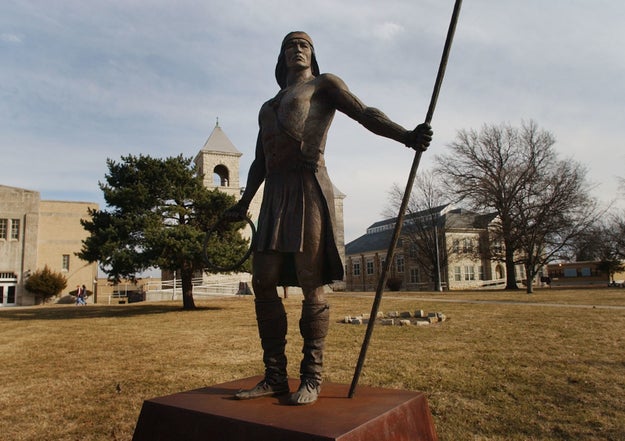
The campus of Haskell Indian Nations University in Lawrence, Kansas. Orlin Wagner / AP
By the time United Tribes Technical College was named the fourth-worst school in the country for student loan defaults last week, the tribal school had already made it impossible for students to borrow money from the federal government. For United Tribes Tech, cutting off the student loan spigot was a last resort — the only way to save itself from government penalties that would bring financial ruin.
But it also meant that of America’s 32 tribal colleges — schools controlled by Native American tribes — only three now allow federal loans for their students. It’s a particularly striking situation, because tribal colleges, which are funded by the federal government, serve some of the country’s neediest students.
Nationwide, 90% of community colleges offer federal student loans to students. And advocacy groups have decried the other 10% for denying their students the ability to borrow.
But the vast majority of tribal colleges have cut off access to the loans. That’s in part because colleges fear the consequences of too many students defaulting on their loans, said Carrie Billy, the president of the American Indian Higher Education Consortium, a lobbying group.
But Billy told BuzzFeed News that most tribal schools also firmly believe their students are better off without federal loans of any kind — so much so that they have decided not even to make them an option.
“We completely disagree with that idea that students are worse off without [access to] federal loans,” Billy said. “Particularly when you look at the demographics of our students — students who have lived with generational poverty, unemployment, who have no experience with credit — that’s a recipe for disaster when it comes to loans. Tribal colleges will do everything they can to make their students graduate debt-free.
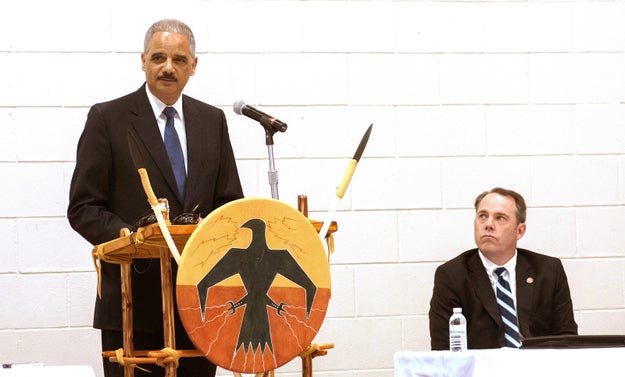
Former Attorney General Eric Holder speaking at United Tribes Technical College in 2014. Kevin Cederstrom / AP
Tribal colleges, like community colleges, are relatively inexpensive — around $6,000 a year, low enough that a $5,750 annual Pell Grant will cover most of the cost of tuition. But community college students sometimes borrow money to help pay for living costs and expenses like textbooks. That option isn’t available for tribal college students.
Those students often face staggering obstacles that make them more less likely to repay student debt, Billy said. Eighty-three percent of them are reliant on Pell Grants, which are only given to low-income students, compared to just 40% of college students nationally. Many tribal college students have little to no experience with borrowing money or credit. They’re also mostly first-generation college students.
Instead of offering loans, tribal colleges try to fill the gap themselves, by providing Native American Colleges Have Abandoned The Student Loan System - BuzzFeed News:


The Diane Silvers Ravitch ’60 Lecture: “The Inconvenient Truth About American Education Reform”

Wellesley College:

The Diane Silvers Ravitch ’60 Lecture

“The Inconvenient Truth About American Education Reform”

Thursday, October 13, 2016 - 7:30pm
Diana Chapman Walsh Alumnae Hall Auditorium (201)

Read more at http://www.wellesley.edu/event/node/92301#4qsPwTob4WiM5Tgi.99


Wellesley College’s Department of Education is proud to welcome Pasi Sahlberg for the Diane Silvers Ravitch Class of ’60 lecture on current issues in public education. His talk, entitled “The Inconvenient Truth About American Education Reform,” will address some of the problematic and unintended consequences of approaches to reform in the American education system.
Sahlberg is a Finnish educator and scholar. He worked as a teacher, teacher educator, and policy adviser in Finland and was actively engaged in planning and implementing education reforms in Finland in the 1990s. His research interests include international education policies, educational change, teacher education, and classroom teaching and learning. In this lecture, Sahlberg will discuss the critical importance of teacher professionalism, collective autonomy, and trust, and argue that the most important educational ideas behind Finland’s success are borrowed from American public schools.
In addition to his popular Finnish Lessons 2.0: What Can the World Learn from Educational Change in Finland? (2015), Finnish Lessons (2011), and other books, he has published more than one hundred articles in journals, research periodicals and magazines around the world. Some of the most read ones include “The Fourth Way of Finland” (2011), “Rethinking Accountability in a Knowledge Society” (2010), “Creativity and innovation through lifelong learning” (2009), and “Education Reform for Raising Economic Competitiveness” (2006).
Sahlberg received a Master of Science (Mathematics) in 1984 from University of Turku and PhD from the University of Jyvaskylä in 1996. He has served the World Bank in Washington, D.C., the European Commission and the OECD as an external expert advising foreign governments in more than 50 countries around the world.
Generously supported by The Diane Silvers Ravitch Fund for Public Education, this event is free and open to the public.

Read more at http://www.wellesley.edu/event/node/92301#4qsPwTob4WiM5Tgi.99


Why For-Profit Education Fails - The Atlantic

Why For-Profit Education Fails - The Atlantic:

Why For-Profit Education Fails
Moguls’ good intentions too often betray them.


Earlier this year, LeapFrog Enterprises, the educational-entertainment business, sold itself for $1 a share. The deal came several months after LeapFrog received a warning from the New York Stock Exchange that it would be delisted if the value of its stock did not improve, a disappointing end to the public life of a company that had the best-performing IPO of 2002.
LeapFrog was one of the very last remaining of the dozens of investments made by Michael Milken through his ambitiously named Knowledge Universe. Founded in 1996 by Milken and his brother, Lowell, with the software giant Oracle’s CEO, Larry Ellison, as a silent partner, Knowledge Universe aspired to transform education. Its founders intended it to become, in Milken’s phrase, “the pre-eminent for-profit education and training company,” serving the world’s needs “from cradle to grave.”

Knowledge Universe businesses included early-childhood learning centers, for-profit K–12 schools, online M.B.A. programs, IT-training services for working professionals, and more. Milken’s penchant for secrecy makes a comprehensive assessment impossible—most of the businesses were privately held and some were sold to private buyers for undisclosed sums. But of the companies about which there is public information, most, like LeapFrog, ended badly. Education remains untransformed.

Milken was far from alone in the belief that education could be revolutionized through radical new business models. In 2012, the media mogul Rupert Murdoch and the former New York City schools chancellor Joel Klein established the Amplify division within News Corp. At the time of his initial investment, Murdoch described K–12 education as “a $500 billion sector in the U.S. alone that is waiting desperately to be transformed.” Their idea was to overturn the way children were taught in public schools by integrating technology into the classroom. Although inspirational, the idea entailed competing with a series of multibillion-dollar global leaders in educational hardware, software, and curriculum development. After several years and more than $1 billion, with no serious prospect of ever turning a profit, Murdoch and Klein sold their venture for scrap value to Laurene Powell Jobs, Steve Jobs’s widow, last year.


Indeed, over the past couple of decades, a veritable who’s who of investors and entrepreneurs has seen an opportunity to apply market discipline or new technology to a sector that often seems to shun both on principle. Yet as attractive and intuitive as these opportunities seemed, those who pursued them have, with Why For-Profit Education Fails - The Atlantic:


How Racism Contributes to the Achievement Gap - The Atlantic

How Racism Contributes to the Achievement Gap - The Atlantic:

How the Stress of Racism Affects Learning

A new study shows that the pressures associated with discrimination contribute to the achievement gap.

The stress of discrimination can affect the achievement of students of color.


For 15-year-old Zion Agostini, the start of each school day is a new occasion to navigate a minefield of racial profiling. From an early age, walking home from elementary school with his older brother, Agostini took note of the differential treatment police gave to black people in his community: “I [saw] people get stopped … get harassed … get arrested for minor offenses.” Almost a decade later, Agostini said he now faces the same treatment as a sophomore at Nelson Mandela School for Social Justice in Brooklyn's Bedford-Stuyvesant neighborhood. “Me being a black male, I'm more likely to be stopped and frisked by a cop. Then, [I’m] going to school with more cops … [messing] with me at 7 in the morning.”

The strain of these interactions is heightened by the daily routine of passing through a metal detector, emptying pockets, and removing clothing that frequently makes him late to his first-period class. “The fact is now I’m [tardy] because I’m being scanned four times because of the metal in my necklace or my keys. I missed whatever [the teacher] was explaining … a lot goes on in [chemistry], and because of that I'm behind.” All of this combined takes a toll on his schoolwork, he said. “It does make it extremely hard to focus on the classwork … You're upset, or sad, or just emotional about what just happened. It takes a while to settle.”
recent study from Northwestern University corroborates Agostini’s experience, suggesting that the stress of racial discrimination may partly explain the persistent gaps in academic performance between some nonwhite students, mainly black and Latino youth, and their white counterparts. The team of researchers found that the physiological response to race-based stressors—be it perceived racial prejudice, or the drive to outperform negative stereotypes—leads the body to pump out more stress hormones in adolescents from traditionally marginalized groups. This biological reaction to race-based stress is compounded by the psychological response to discrimination or the coping mechanisms youngsters develop to lessen the distress. What emerges is a picture of black and Latino students whose concentration, motivation, and, ultimately, learning is impaired by unintended and overt racism.

Emma Adam, a professor of human development and social policy at Northwestern and the study’s senior author, said prior research had established racial differences in levels of cortisol—a hormone that increases when the body is stressed—between black and white youth, and linked this to the impact of discrimination. In the current research review, she and her co-authors set out to connect the dots. “We had observed these [dissimilarities] and knew that sleep and stress hormones have strong implications for cognition … we also knew that there was a strong racial gap in academic attainment.”
Two sources of stress encountered by black and Latino students and examined in the report are perceived discrimination—the perception that you will be treated differently or unfairly because of your race—and stereotype threat, the stress of confirming negative expectations about your racial or ethnic group. According to the paper, among this population of students, perceived discrimination from teachers was “related to lower grades, less academic motivation … and less How Racism Contributes to the Achievement Gap - The Atlantic:

Literacy lawsuit draws questions, call for investment

Literacy lawsuit draws questions, call for investment:

Literacy lawsuit draws questions, call for investment


The U.S. Constitution does not explicitly guarantee the right to education, and the nation’s highest court so far has not weighed in.
But U.S. District Judge Stephen J. Murphy III in Detroit is being asked to open the door to the concept of a constitutional right to literacy — which could one day put the matter before the U.S. Supreme Court for the first time.
Legal and academic opinions differ over the central argument in the case of seven Detroit schoolchildren who are suing the state.
The lawsuit, filed last month, alleges decades of state disinvestment in the city’s schools have denied schoolchildren access to the most basic building block of education: literacy.
U.S. Secretary of Education John King Jr. says Michigan has not properly invested in Detroit’s schoolchildren but declined to tell The Detroit News whether he thinks literacy is a federal right.
“It is clear that the state over the years has not made any of the kind of investment and commitment to the kids of Detroit that’s needed,” said King, who was in Detroit on Friday. “And that is our responsibility across levels of government — local, state and federal. And the future of our economy and our democracy depend on that.”
King noted federal law is designed to focus federal resources on closing those gaps between urban students and others.
“We’ve got to do a much better job as adults to ensure that every child in Detroit is getting that kind of quality education that they should,” he said.
Richard Primus, a constitutional law expert and professor at University of Michigan Law School, said the federal case in Detroit has a chance to change the law and the Literacy lawsuit draws questions, call for investment:


More Evidence that State School Ratings Don’t Reflect School Quality | janresseger

More Evidence that State School Ratings Don’t Reflect School Quality | janresseger:

More Evidence that State School Ratings Don’t Reflect School Quality

Image result for school ratings the scarlet letter
In Ohio, school districts are on the ballot with local property tax levies in this turbulent November election season. Here are the conditions under which our school districts—including the Cleveland school district this fall—find themselves on the ballot:
  • Ohio has a statewide tax rollback embedded in the state constitution.  When property values appreciate, the state effectively rolls back the local millage to keep the district’s revenue collection from any levy equal to the amount generated on the date the levy first passed. Even in these times when values are not appreciating significantly, our tax freeze ensures that school districts have to be on the ballot every few years just to stay even.
  • The state has also imposed a test-based accountability system that generates school district grades—the state report cards that copy Jeb Bush’s plan in Florida and that award letter grades to school districts based on standardized test scores.
  • These grades essentially force school superintendents to promise that test scores will rise—a sort of quid pro quo for citizens’ willingness to invest in the levies. While some voters will always support school taxes as a public obligation, the school districts that cannot quickly raise scores are perceived as reneging on these promises—encouraging some voters to vote against school levies as a punishment for superintendents, principals and teachers who can’t seem to raise the test scores.
  • There are also the state tax cuts—to business taxes and estate taxes and income taxes over the past decade—that increase every school district’s reliance on local property taxes.
  • And finally, in Cleveland, the public schools—individually graded by the state with the same letter grades—compete actively with charter schools that now receive some of the local levy dollars under a so-called “portfolio school reform” plan. The stakes are high because the closure of so-called “failing” schools hangs as a looming threat.
It is in this context that in Sunday’s Plain Dealer, Patrick O’Donnell reported extensively on Sean Reardon’s recent research that correlates standardized test scores with the aggregate family income of the students in a school district. (See Reardon’s papers here and here.)  O’Donnell summarizes Reardon’s findings: “Students in the affluent Aurora and Bay Village schools are typically two years ahead of students from across the country. Meanwhile, students in the Cleveland and East Cleveland schools are about two years behind.  Just don’t pat yourself on the back for high scores or hurl insults at the struggling urban districts. You’re all just fitting, almost exactly, a national pattern.” O’Donnell continues: “Just within Cuyahoga County, there is a 5.1-grade learning gap in between the lowest-scoring district for the years More Evidence that State School Ratings Don’t Reflect School Quality | janresseger:


In illegal move, Malloy administration misleads public (again) on budget deficit - Wait What?

In illegal move, Malloy administration misleads public (again) on budget deficit - Wait What?:

In illegal move, Malloy administration misleads public (again) on budget deficit


State law requires that on the 20th of every month, the Governor’s administration MUST inform the State Comptroller about any known budget deficit.  The State Comptroller, in turn, uses that information to help guide his mandated monthly report that is issued on the first of each month.
In October, Malloy’s budget division told State Comptroller Kevin Lembo that the budget was in balance, but as it turns out, that was a lie.
As Keith Phaneuf at the CT Mirror is reporting today;
Gov. Dannel P. Malloy’s administration last month warned dozens of state agency heads of a significant shortfall in the current budget — but continues to officially report that finances remain in balance.
The $133 million revenue shortfall disclosed to agency heads on Sept. 6 was excluded 14 days later from the last official monthly budget forecast submitted to Comptroller Kevin P. Lembo.
Malloy’s top budget chief told Malloy’s commissioners that there was a deficit, yet day later, sought to mislead Lembo about the problem.  Lembo, in turn, provided the public with a report that wasn’t accurate.
Early last summer Governor Malloy and the Democratic members of the ConnecticutIn illegal move, Malloy administration misleads public (again) on budget deficit - Wait What?: 

Why Are Education Activists Walking to Albany? | Daniel Katz, Ph.D.

Why Are Education Activists Walking to Albany? | Daniel Katz, Ph.D.:

Why Are Education Activists Walking to Albany?

Image result for Why Are Education Activists Walking to Albany?

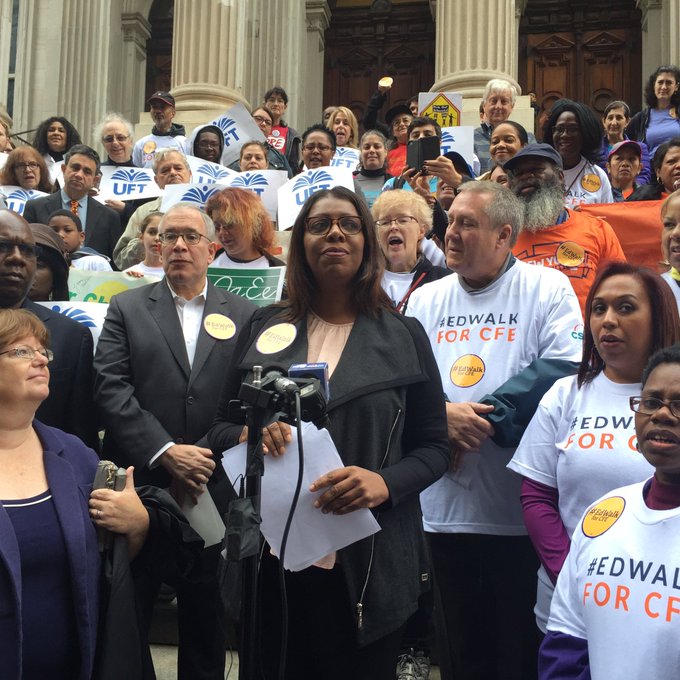
For more than a week, a small but determined group of public school advocates, have undertaken an ambitious and heartfelt journey: a walk of 150 miles from New York City to Albany to deliver a message.  That message?  Pay up.  After ten years of delays, excuses, cuts, and broken promises, it is past time for lawmakers and the governor to fully fund the Campaign for Fiscal Equity settlement that was decided in 2006.  That landmark ruling, itself the result of 13 years of advocacy and litigation, found that the state was failing its obligation to provide schools with the resources they needed for all children to have a “sound basic education.”  Between 2007 and 2009, the state worked out a new foundational aid formula and committed to increasing school aid across the state by 5.5 billion dollars a year.
Today, Albany remains $3.9 billion short of that goal.  Every year.  Ten years after the court ruled that increased aid was necessary.  So activists are walking from the steps of Tweed Courthouse in New York City to Albany to deliver the bill:
Albany has not always been so stubbornly unwilling to pay the Campaign for Fiscal Equity (CFE) settlement.  In fact, immediately after the settlement, Albany rewrote the aid formula and began to phase in the additional money, increasing state aid to schools by 2.3 billion dollars.  Unfortunately, twin crises for education in the Empire State struck nearly simultaneously.  The first was the Great Recession which narrowed state tax revenues and threw the budget out of balance.  This was unavoidable given the nature of the fiscal crisis across the entire country.  The second crisis was the election of Governor Andrew Cuomo in 2010.  This was probably avoidable although it was an open question at the time about just how horrible the governor would be.
Beginning with Governor Cuomo’s predecessor, Governor David Patterson, New York embarked on a two year budget overhaul aimed at reducing state spending by $5 billion in only two years without considering tax increases.  State aid to education took an immediate hit both in the total amount allocated and in the form of an accounting gimmick called the Gap Elimination Adjustment.  Using the GEA, Albany could announce a school aid budget but then take some of that money back from communities if state revenues were too low.  According to theNew York State School Boards Association, by the 2014 school year, this policy, continued by Governor Andrew Cuomo, had cost the state’s schools over $8.5 billion of total aid, or more than $3 million per district per year.  Additionally, Governor Cuomo pushed through a property tax cap early in his first term that has squeezed districts from the other side,  limiting the revenue they can raise locally.  While state aid to school has crept up over time, it was only in this year’s budget address that he suggested ending the GEA by increasing state aid over a Why Are Education Activists Walking to Albany? | Daniel Katz, Ph.D.:

Student Member Application Memo - State Board of Education (CA Dept of Education)

Student Member Application Memo - State Board of Education (CA Dept of Education):

REQUEST FOR APPLICATIONS FOR THE 2017-18 STATE BOARD OF EDUCATION STUDENT MEMBER


The California State Board of Education (SBE) is accepting applications for the 2017–18 Student Board Member position. Any student who is a California resident and enrolled in a public high school, will be a senior in good standing in the 2017–18 school year, and will be available to attend a statewide student leader conference October 30 – November 2, 2016 in Sacramento, is eligible to apply.
The estimated time required for the Student Member will be at least two consecutive school days every other month to attend regular State Board meetings, usually in Sacramento; a one-day orientation; sufficient time to study the agenda materials in advance of the meetings which may include consultation with board staff for background information related to agenda issues; additional time for handling other Board-related business; and time to attend selected advisory group meetings, student meetings, workshops, and conferences.
All transportation costs will be paid by the SBE. Lodging and meal costs will be paid in the amount allowed by state regulations. The State Board’s Student Member receives a $100 stipend for each day’s service on official business.
For more information, including the 2017–18 Student SBE Member application, please visit Student Member Application Web page, or contact the SBE by email at sbe@cde.ca.gov or by telephone at 916-319-0827.
Complete applications must be received by the SBE by 5:00 p.m., Thursday, October 13, 2016.
Student Member Application Memo - State Board of Education (CA Dept of Education):