Latest News and Comment from Education

Wednesday, August 24, 2016

Chief Privacy Officer Finally Appointed; Parents and Advocates Await Next Steps to Protect Student Data  | Class Size Matters

Chief Privacy Officer Finally Appointed; Parents and Advocates Await Next Steps to Protect Student Data  | Class Size Matters Chief Privacy Officer Finally Appointed; Parents and Advocates Await Next Steps to Protect Student Data  | A clearinghouse for information on class size & the proven benefits of smaller classes:

Chief Privacy Officer Finally Appointed; Parents and Advocates Await Next Steps to Protect Student Data 


For more information: Leonie Haimson, leonie@classsizematters.org, 917-435-9329
Chief Privacy Officer Finally Appointed; Parents and Advocates Await Next Steps to Protect Student Data 
The long overdue appointment announced today by the NY State Education Department of a Chief Privacy Officer, Temitope Akinyemi, is an important step forward to begin to enforce the New York student privacy law that was originally passed on March 31, 2014 as part of the state budget, along with the banning of the plan to share personal student data with inBloom Inc.
Parents are relieved that more than two years following the July 29, 2014 deadline set by this law, the NY State Education Department has finally appointed a permanent Chief Privacy Officer.  Yet by that date, the CPO was also supposed to have developed an expanded Parent Bill of Privacy Rights, with the input of parents and other stakeholders.  Instead, NYSED hurriedly posted a Bill of Rights two years ago that is incomplete as to existing federal and state privacy laws – as pointed out by a letter to then-Commissioner John King in August 2014.
Said Leonie Haimson, Executive Director of Class Size Matters and co-chair of the national organization, the Parent Coalition for Student Privacy: “Now that the CPO is appointed, Ms. Akinyemi should immediately begin to reach out to parents through public hearings to improve and expand upon the Parent Bill of Rights, to gain their input so that their children’s privacy and safety can be secured. Parents have already waited too long for this to occur.”
Parents and advocates also urge Ms. Akinyemi to appoint a Data Stakeholder Advisory Panel to oversee the state’s collection and disclosure of personal student data.  According to a federal grantprovided to NYSED in 2009, this Panel was supposed to “provide active and ongoing review by local constituents,” but still does not yet exist – seven years later.
Added Ms. Haimson, “Only with robust citizen oversight can we be assured that children’s personal information will be safeguarded with appropriate restrictions and protections. We recently learned that the NYSED has decided to reverse their earlier decision to put the personal data of all public school students in the State Archives, potentially forever; but this decision should never have been made in Chief Privacy Officer Finally Appointed; Parents and Advocates Await Next Steps to Protect Student Data  | Class Size Matters Chief Privacy Officer Finally Appointed; Parents and Advocates Await Next Steps to Protect Student Data  | A clearinghouse for information on class size & the proven benefits of smaller classes:

Florida Teacher to School Board: Why My Daughter Will Not Take the State Tests | Diane Ravitch's blog

Florida Teacher to School Board: Why My Daughter Will Not Take the State Tests | Diane Ravitch's blog:

Florida Teacher to School Board: Why My Daughter Will Not Take the State Tests


Andy Goldstein addressed the school board of Palm Beach County, where he teaches, at a recent meeting:
Why My Wife and I Are Opting Out Our Daughter From Third-Grade High-Stakes Testing
Transcript of the original text:
Good evening. My name is Andy Goldstein. I’m a teacher at Omni Middle School and the proud parent of an eight-year-old daughter who attends one of our public elementary schools.
It seems like it was just yesterday when my daughter entered kindergarten. At that time, I talked about her at our August School Board meeting in 2013.
I said that my hopes and dreams for my daughter were that she would develop a lifelong love for learning that would serve her well as she learned to construct a life that would serve her and serve others as well.
I told this board that my wife and I were not particularly interested in having her be seen as a data point for others to make money from.
Now, three short years later, which seem to have gone by in the blink of an eye, she is entering third grade.
Tonight, I’m speaking as a parent, who also is a teacher.
In Florida, third grade is the beginning of high-stakes, standardized testing for our children.
What are the high-stakes?
• Our children, on the basis of one test, will receive a number, a 1, 2, 3, 4, or 5, which, will serve to define them.
Some students, may do well learning throughout the year, but do not test well and may receive a 1, a one being the lowest possible score.
Some may come from disadvantaged backgrounds and will receive a 1.
Some may be special needs students, who receive a 1.
These numbers work to define our students as to whom they are. “I’m a one. I’m a Failure.”
This high-stakes testing policy, mandated by state law, works to stigmatize our students and they grow up with a limiting self-concept of who they are and what they are capable of doing and becoming.
• On the basis of this one high-stakes test, some schools—those Florida Teacher to School Board: Why My Daughter Will Not Take the State Tests | Diane Ravitch's blog:

CURMUDGUCATION: Voting with Their Feet

CURMUDGUCATION: Voting with Their Feet:

Voting with Their Feet


One feature of "unleashing the power of the free market" in education is supposed to be a sort of regulation by the market's infamous invisible hand. Customers will "vote with their feet," driving the bad actors out of business.


In this country, there will always be an argument to be had about how well this really works. It's one of the dances of freedom and commerce that we have regularly. Is it okay to let Americans vote with their feet for grossly fat and unhealthy processed fast food? And are consumers moving the invisible hand based on their own honest desires, or are these hand-moving consumers themselves being moved by the not-so-invisible hand of marketing? And just how involved should the big fat heavy hand of government be in any of this? These are difficult and complicated questions, and I bring them up only to note that the idea that we just open a free market and the invisible hand sorts out the choices and-- voila!!-- quality!!-- well, that vision is a gross oversimplification and not very much like what actually happens at all.

We can already see the many ways in which the bipedal plebiscite is not working for education.

Exhibit A is the cyber charter industry. Let me first insert the disclaimer that for a small, select group of students, cyber school is an excellent solution. Having said that, the cyber charter industry at large is a huge failure, so huge that even the rest of the charter industry is calling for them to shape up. Cyber charters are a disaster, a waste of student time and taxpayer money. And yet, even though virtually every even-sort-of-responsible-voice in the education field has condemned cybers, the army of foot-voters have not yet put them out of business.

Why not? I can only offer theories based on anecdotal evidence. One is that people are voting with their feet, with cyber students either dropping out or returning to public school, often behind their peers. "I'm always excited to have a former cyber student in my class because I know they will be really on top of the material," said no teacher ever. However, so far, cyber marketing and aggressive recruiting keep new bodies signing up. Schools are made to be a churn and burn market-- you are always losing "customers," so your focus has to be on recruiting.

I think it's also safe to say that a certain amount of the education market is filled with customers 
CURMUDGUCATION: Voting with Their Feet:


Report from a First Time Union Delegate Badass Teachers Association

Badass Teachers Association:

Report from a First Time Union Delegate

By:  Chris Willems


“We are fighting a battle of immense proportions that threatens to destroy all we and others in the labor movement have worked for.  This battle is ultimately over who holds power in our economy and our democracy.  It is a battle to reclaim the promise of America.”                   -AFT CT Resolution on Member Engagement


I am a science teacher in New Haven, CT and am thrilled to have an active role as a national delegate within our local union #933, the New Haven Federation of Teachers.  Eric Maroney and I are first-time delegates, and our responsibilities include attending state and national conventions as the representative voices of our brothers and sisters in the New Haven Federation of Teachers.  It has been a fascinating and energizing experience.  I am going to share an update on what I learned this summer, and I challenge you to engage in the dialogue.
On Saturday May 21, 2016, AFT CT hosted the annual business convention at the Aqua Turf in Plantsville, CT.  Our business involved recognizing affiliates who represented the approximately 30,000 AFT CT members in attendance, approving the minutes from the last convention, amending our constitution, and passing resolutions.
The theme “Reclaiming our Solidarity” rippled through the presentations and celebrations.  AFL-CIO President Lori Pelletier spoke of how firefighters have aligned with paraprofessionals to strengthen local unions. I was inspired by the stories Lori told and began to think about ways in which our own union can partner with others in the New Haven community to benefit those we serve.
On a more sobering note, we were reminded to prepare for more legal cases targeting labor unions for elimination.  A Supreme Court case from this past spring that many of our members may have heard about in the national press, Friedrichs v. California Teachers Association, would likely have been decided against unions had Justice Badass Teachers Association:

CA Charter Operator Recruits Foreign Students, Charges Them Tuition, and More… | deutsch29

CA Charter Operator Recruits Foreign Students, Charges Them Tuition, and More… | deutsch29:

CA Charter Operator Recruits Foreign Students, Charges Them Tuition, and More…


California-based Tri-Valley Learning Corporation (TVLC) is the center of a complex investigation that was apparently prompted when in February 2016, two foreign exchange students were apparently moved from one TVLC school to another without parental consent.
According to the July 08, 2016, East Bay Times, CA Superintendent of Public Instruction Tom Torlakson went to the school campus from which the students went missing, in Livermore, California. Torlakson’s visit led to investigation of TVLC by the district attorney.
As the East Bay Times continues:
Although the District Attorney’s Office can’t discuss exactly what is being investigated, assistant district attorney Annie Esposito said the case is complicated and involves many pieces.
The missing students sparked a domino affect, leading to allegations of fiscal mismanagement, lack of transparency and not following state education code. …
Charters operate independently with their own boards, and are not allowed to charge tuition because they receive state funds.
Yet, TVLC charged $15,300 in tuition and $16,000 in housing per year to the 60 foreign students it recruited. The company argued the charges were legal reimbursements for expenses related to its exchange program. …
Chris Van Schaack, assistant superintendent of the Livermore Unified School District, said he hopes the corporation can clean up its mess, because the charter schools provide an alternative to students who do not want to be in bigger schools.
Apparently several hundred TVLC parents decided that those bigger, district schools are preferable to TVLC chaos and confusion. As the Mercury News reports on August 22, 2016:
LIVERMORE — On the first day of school, more than 500 new students swarmed into Livermore public schools, the vast majority fleeing the city’s two embattled charter schools in light of a litany of accusations ranging from fiscal mismanagement to criminal wrongdoing.
The Livermore Valley Joint Unified School District got nearly double the 
CA Charter Operator Recruits Foreign Students, Charges Them Tuition, and More… | deutsch29:

TBFURMAN: If You Teach In A Concept School

TBFURMAN: If You Teach In A Concept School:

If You Teach In A Concept School


If you are a teacher at a Concept School here in Illinois (CMSA, Horizon Science-Belmont, Horizon Science-McKinley Park, Horizon Science-Southwest), the the following statements are incontrovertibly true for a person in your situation:

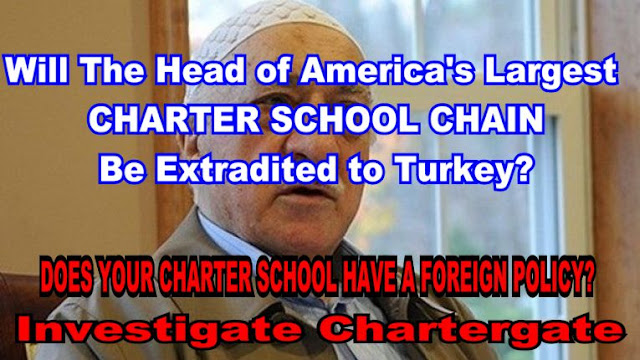
The people running your school, and the CMO managing your school, are deeply connected to the upper echelons of the Gulen Movement. Your school exists as a revenue stream for the Gulen Movement, which appears to be permanently resettling here in the States during this post-failed coup period in Turkey. The Gulenists have been here in small numbers since before Fethullah Gulen himself arrived, and their numbers have grown rapidly since then.

Your school is an economic engine for them; the school receives a great deal of tax money, and all of this money is available for the Movement. Unlike a normal public school, it is basically impossible to determine who receives the money a charter school spends, particularly the portion that goes directly to the CMO. The schools generate business for Gulen-linked contractors, and the whole thing snowballs into a walled-off economy that brings in more and more of the Gulenists from Turkey. This, of course, is all in addition to the real estate deals and financing deals that make charter investors wealthy.

It's all for the Movement, minus whatever paltry salary they are paying you to be the American face of it all.

The Turkish men managing your school all know this to be true, and the Turkish men working in your schools on H-1B visas know it to be true. The American teachers are not part of the equation, other than as cover.

It is almost certain that the Turkish men working in your schools are kicking back part of their salary as a tithe to the Gulen Movement; the extent to which they are true believers, or simply people taking advantage of a job opportunity in the States, probably varies. But they are understand very clearly what is going on.

The people running your school will probably tell you that the Gulen Movement is a selfless, peaceful social movement and that they have no connection to it, although some of them may possibly at one time or another, have been vaguely inspired by Gulen. None of these assertions are true. The Gulen Movement is a complex, often malevolent political-religious force, deeply involved in human rights abuses in Turkey. They have an aggressive and massively successful public relations campaign here in the States, and they have fooled or confused a great many lawmakers and policymakers. The people running your school are the true believers.

Your charter school is in almost all respects just like any other charter school, except for all of the above. They need you to do the basic chores of teaching, coaching, and supervising kids, and they don't expect you to be aware of or even concerned about what is really going on. Your school is not a fake school; it's a regular charter school run by people who run 
TBFURMAN: If You Teach In A Concept School:


Big Education Ape: Killing Ed | Charter Schools, Corruption, and the Gülen Movement in America - http://bigeducationape.blogspot.com/2016/04/killing-ed-charter-schools-corruption.html

LA Unified doesn't often revoke charters – but it's asking tough questions of one now | 89.3 KPCC

LA Unified doesn't often revoke charters – but it's asking tough questions of one now | 89.3 KPCC:

LA Unified doesn't often revoke charters – but it's asking tough questions of one now


Members of the Los Angeles Unified School Board will give El Camino Real Charter High School leaders one month to answer serious questions about its financial management practices, including allegations staff members used school credit cards for personal expenditures.
The "Notice of Violations" board members issued on Tuesday is the first step toward yanking the Woodland Hills school's charter.
But it takes three steps to revoke a charter's founding document, and recent history suggests the process does not often make to that conclusion.
Since August 2013, LAUSD Board of Education agendas show board members have considered taking the second step — issuing a "Notice of Intent to Revoke" — with six schools.
And it's taken the third and final step of revoking a school's charter even more rarely. Of the six schools who have received those notices, five are still open today.
"Everybody breathe," said board member Mónica García during Tuesday's meeting, which featured testimony from frustrated El Camino teachers, board members and officials.
El Camino supporters see the board's action Tuesday as a serious escalation. Janelle Ruley, an attorney representing the charter school's governing board, accused the district's charter schools division with "moving the goalposts" and setting unclear targets for El Camino to remain in compliance.
"The charter school responded timely and fully to all requests that were made," Ruley said. "It made policy changes and it made other changes requested by the charter schools division. El Camino truly believed that it had done what the charter schools division had asked and satisfied those concerns."
But district officials said further digging revealed more problems at El Camino. The Notice of Violations the board passed Tuesday identified numerous uses of school credit cards that district officials found problematic, including charges for airfare, hotel and dinners by principal David Fehte.
In May, the L.A. Daily News reported "Fehte acknowledged charging El Camino for personal travel and, after the Daily News inquired, said he reimbursed the public school."
A review of board actions since 2013 show schools can rebound from district revocation proceedings.
"It all depends on the charter school’s actions," said board president Steve Zimmer. "There is nothing that is even before us that will result in closure of El Camino or taking over El Camino."
In 2013, L.A. Unified moved to revoke the charter of Gifted Academy of Mathematics and Entrepreneurial Studies, or "GAMES."
But the district suspended revocation proceedings after GAMES leaders agreed to "make significant organizational changes, including reconstituting its governing LA Unified doesn't often revoke charters – but it's asking tough questions of one now | 89.3 KPCC:

Seattle Schools Community Forum: State's Response on McCleary Question from Supreme Court

Seattle Schools Community Forum: State's Response on McCleary Question from Supreme Court:

State's Response on McCleary Question from Supreme Court


This is my summary and I use only partial quotes from the State's response.  Its tone is respectful and I think that is because of our Attorney General Bob Ferguson.  I suspect if they had left it to some members of the legislature that I would not have the same tone.

 What the State says.    

In ESH13 2261 (Laws of 2009, ch. 548), the State established a framework for comprehensive reform of basic education and its funding methodology.SHB 2776 (Laws of 2010, ch. 236) quantified the policy aspects of those reforms by establishing specific formula enhancements and specific deadlines for implementing them, but SHB 2776 did not address compensation. The plan enacted in E2SSB 6195 (Laws of 2016, ch. 3) fills that gap by establishing specific steps and timelines for determining the compensation allocation levels necessary to implement the State's program of basic education and for taking legislative action to end reliance on local tax levies to fund that program. 


Read together, E2SSB 6195 and SHB 2776 constitute a complete plan for implementing the education reforms the State enacted in ESHB 2261. (Editor's note: by my count they say this no less than 3 times in this brief.)


- Because the State has satisfied the requirements in the Court's January 2014 Order, there is no basis for continuing to hold the State in contempt and levying a daily sanction. The Court should dissolve the contempt order and terminate the daily sanction. 
 
Yes, that is the first order of business (at least for the State.) 
 
They go on to answer the Court's questions;
 
What remains to be done to timely achieve constitutional compliance? 
The State says there are three things:
- implementation of 2017-2018 K-3 class size reductions. 
- adjust state expenditures for basic education under the prototypical school funding model to account for inflation, student enrollment and other variables.
- determine its cost to fully fund salaries needed for school districts to recruit and retain staff to implement the State's statutory program of basic education and provide that funding. 
 
How much is it expected to cost? 
The current estimated cost to the state to fully fund the program of basic education identified by ESHB 2261 and the implementation program established by SHB 2776 is approximately $19.7 billion for the 2017-19 biennium.

The estimated cost to the State to fully fund salaries needed for school 
Seattle Schools Community Forum: State's Response on McCleary Question from Supreme Court:


Detroit's University Yes charter drops high school

Detroit's University Yes charter drops high school:

Detroit's University Yes charter drops high school


Aleka Simmons, 17, was excited about her senior year at University Yes Academy until this week, when she found out that the Detroit charter school is going to close its high school.
Now, two weeks before the start of the school year, she and other students are scrambling to find new places to learn.
"I'm just mad because they really put us in a tough position," she said. "It's our senior year. We're supposed to have fun and stuff, and now we're stressing about where we're going to go. I've been with the same friends since seventh grade."
Ralph Bland, CEO of New Paradigm for Education, a charter management company that runs University Yes, told parents and senior students at a meeting Monday that efforts to find a new building had been unsuccessful, Aleka's mother, Caprice Simmons, told the Free Press. Simmons said the current building has become increasingly crowded in recent years as University Yes added grades.
"There were some space issues," Bland told the Free Press. "To properly educate students, spacing has to be right." New Paradigm has been managing the school since mid-July.
The closure will impact more than 300 students.
Bland did not directly answer questions about the timing of the announcement. He stressed that officials will help students find new schools.
University Yes opened in 2010 with only sixth grade, said Bill DiSessa, spokesman for the Michigan Department of Education. By 2015-16, it had grown to be a K-11 school with 911 students. Twelfth grade was supposed to be added this year.
Caprice Simmons said University Yes had so many students last year that some teachers were sharing rooms or holding classes in the gymnasium or auditorium.
"That building was definitely not big enough to hold K-12," she said. "But we should have known long before two weeks before school starting."
Officials at Bay Mills Community College, which authorizes University Yes, said they agreed with the decision. They did not answer specific questions about the closure.
"Our staff has discussed this matter in detail with members of the Board of UYA, as well as representatives of the school's new educational services provider, New Paradigm," Mariah Wanic, the college's special assistant to the president in charge of charter schools, said in a statement. "As a result of those discussions, in addition to its own assessment of the administration and educational programming at UYA, BMCC concurred in the decision."
Bland said school officials will not only help with new school placements but Detroit's University Yes charter drops high school:

ESSA's Disputed Funding Rule: Comparing Older, Newer Education Dept. Language - Politics K-12 - Education Week

ESSA's Disputed Funding Rule: Comparing Older, Newer Education Dept. Language - Politics K-12 - Education Week:

ESSA's Disputed Funding Rule: Comparing Older, Newer Education Dept. Language

ESSA_900x500.jpg

We've covered a lot of the vinegary debate over spending rules for the Every Student Succeeds Act that are due out pretty soon. But here's one other thing for you to consider: U.S. Department of Education guidance distributed to states in July 2015 about how federal money should be used as a supplement for school budgets..
That guidance is some of the most recent language we have from the Education Department about the issue, before the Every Student Succeeds Act passed last December. It's another window into the department's thinking on the subject. And like other facets of this issue, it highlights the big debate over the extent to which federal funds can and should be used as leverage for creating greater equity between wealthy schools and their disadvantaged counterparts.
Quick refresher: When ESSA passed, the department was tasked by Congress to work with a team of district, state, and other K-12 representatives and create rules for the requirement that federal money be used in addition to state and local cash. Those negotiations this spring, however, failed to produce a consensus plan, leaving it to the department to craft its own set of draft rules.
So what happens when we compare what the guidance says (and doesn't say) to the plans the department pitched during negotiated rulemaking? What has the department said constitutes an equitable distribution of funds by a district? And what additional questions does this comparison raise about what the department will propose for regulating federal dollars? 
Before we examine those differences, remember that the 2015 guidance on this complicated issue dealt with federal education law before ESSA passed, and it dealt with schoolwide Title I programs, instead of "targeted" programs for specific groups of students. And, finally, keep in mind the 2015 guidance does not have the same legal force as regulations.

Formula for Success

Let's focus on the department's controversial plan, made during the spring negotiations, to require that districts' state and local per-pupil spending in Title I schools (those with relatively large shares of low-income students) be the same as the average in non-Title I schools, in order for them to show they're using federal dollars under ESSA.
For your reference, here's the language in the pre-ESSA federal education law highlighted by 2015 guidance:
2015GuidanceSNS.PNG
And here's ESSA language on how federal funds must be used by states and districts in relation to state and local money: 
ESSAStatutoryLanguage.png
The 2015 guidance gives two examples for how schools can show they're distributing non-federal funds in a way that's equitable. 
The First Example: A weighted per-student funding formula that assigns a base amount per student, plus additional money for certain types of students:
ESSAGuidanceWeighted.PNG
That distribution would have to cover all schools, regardless of whether any particular school received any Title I aid.
Why is this significant? As you might recall, during negotiations over how ESSA should regulate the supplemental nature of federal money, local officials complained that the proposals this past spring from the Education Department would disrupt weighted per-student funding formulas. Their complaint was that the department's proposal this past spring to create greater equalization of spending between Title I and non-Title I schools would render many such formulas unusable.
The Second Example: The guidance also uses a sample school funding method based on staffing and supplies:
ESSAGuidanceStaffing.PNG
Note the language at the bottom that the "assumptions" above would have to be used by a district for "all of its schools" regardless of their Title I status. Many districts create budgets based on staff allocations for schools. And some negotiators brought up this budgeting method as another way to argue that the department's proposed per-pupil spending rule wouldn't allow them to budget this way.
So, in short, here's a key difference between the guidance and the proposals from negotiated rulemaking: The guidance does not say that districts must compare total state and local spending between different types of schools. But the department's 2016 proposals in negotiated rulemaking say exactly this. 
The department responded to these concern by singling out weighted per-student formulas, or budgets based on staffing allocations, as acceptable in its proposal for the last round of negotiated rulemaking—but only as long as state and district per-pupil funding in a districts' Title I schools was equal to the average state and local spending per student in non-Title I schools.
The 2015 guidance, in its general language, does refer to a reliance on a "equitable distribution" of state and local resources. But does that mean equal spending outcomes between schools, or that one equitable method of distributing money is used for all schools? That's a key question in this debate. And remember: the formulas I highlighted above are just examples the department laid out in 2015 of equitable distribution of state and local funds.

Methods Versus Outcomes

Looking for a counterpoint to all of this? The supporters of the department's proposals on this issue, like the Leadership Conference on Civil and Human Rights, say that districts with state and local spending gaps between relatively advantaged and disadvantaged schools are, by definition, violating the requirement that their federal funds not supplant state and local cash.
ESSA_button.jpgAs the Leadership Conference's Liz King put it earlier this year, the only real "flexibility" in such a scenario means that disadvantaged schools are getting shortchanged. And U.S. Secretary of Education John B. King Jr. has repeatedly argued before Congress and elsewhere that in order for federal dollars to be truly supplemental, those sorts of gaps must be closed
The guidance does caution that federal Title I funds can't be considered supplemental if they are used as "part of the basic level of education funding." In other words, if federal dollars are relied upon by schools to provide a basic education program, they're not following the requirement. In early negotiations over ESSA regulations this spring, the department proposed requiring districts to show they were providing a basic education program with state and local dollars, but after objections, it dropped that language.
We've reached out to the Education Department for its thoughts on comparing the 2015 guidance with its negotiated rulemaking proposals, and we'll update this post if we hear back.
Here are a few other questions the guidance and this past spring's department proposals raise as we look ahead to the draft rules:
  • Will the department continue to stick by its guns and require much greater equalization of per-pupil spending between rich and poor schools?
  • Will there be specific examples of spending approaches, such as weighted per-student formulas, that the department will specify as acceptable in the rules?
  • Will the department give districts some flexibility in terms of when they have to abide by new rules, such as that controversial per-pupil spending comparison? 
  • How will the department handle ongoing concerns that such a per-pupil spending rule would lead many districts to lump many low-income students together in one school?
  • And will the rules attempt to address worries from teachers' unions that the per-pupil spending rule would undermine many locally bargained contracts?

Don't miss another Politics K-12 post. Sign up here to get news alerts in your email inbox.

The Local Control Funding Formula Is Under Scrutiny in California - The Atlantic

The Local Control Funding Formula Is Under Scrutiny in California - The Atlantic:

Why School Funding Will Always Be Imperfect

In 2013, California passed a law that was widely anticipated to better distribute resources to children in need. Now, critics say it's only making things worse.


In 2013, California passed an unusual law that aimed to revolutionize how school districts receive state funding. The Local Control Funding Formula, or LCFF, gives school districts the autonomy to decide which programs and services to spend state funding on. And it’s far more than another boring funding provision: Its primary goal was to ensure equity by devising a complex recipe of budgeting mechanisms, in part by giving additional money to districts based on their numbers of high-needs students—English learners, low-income children, and foster youth. The law’s passage marked the first time in four decades that California underwent such a dramatic shift in school finance.


“The LCFF—it’s kind of a first. It’s trying to do something equitable in funding,” said Sarah Omojola, a statewide education-rights advocate for Public Counsel, a Los Angeles-based pro bono law firm. Before the law was put into place, it was pretty much a mystery as to how the districts got their money; there were different grants, different sources, and no explicit measures aimed to equally distributing resources. “It was very confusing,” Omojola said.


But the new law doesn’t mean that funding has gotten any less mysterious. Nor does it mean that vulnerable California youth have received an infusion of resources to meet their needs. In some cases, it threatens to make student funding even more unequal. In allowing for “a lot of flexibility,” the law is also prone to unintended consequences—namely, school districts statewide are taking advantage of its broad room for interpretation. An Education Trust-West study of 40 district spending plans found that many districts aren’t accounting for all of the money they’ve been allocated or annually improving services for vulnerable youth, as required. Several districts lump expenditures together or spend the money they didn’t use for high-needs students during a school year on other services. (State finance and education department officials declined to be interviewed for this piece.)


High-needs students make up the fastest growing segment of U.S. children today, which means maintaining a skilled workforce and robust economy is largely dependent on their academic success. The federal No Child Left Behind Act aimed to narrow achievement disparities between these students and their peers but came up short largely because of its focus on standardized testing and the fact that public schools are just as—if not more—segregated now as they were decades ago. California is in a special position to create equity for these youth because it educates about one in eight U.S. students, and supporters of school-finance reform there predict that the state may inspire others to adopt similar legislation. That’s unlikely to happen, however, if the Golden State fails to demonstrate that school districts will use the new resources to better serve underprivileged youth.


Many of California’s school districts have upheld the spirit of the law—targeting money toward children in need. Santa Rosa High School District, for example, The Local Control Funding Formula Is Under Scrutiny in California - The Atlantic:

John Oliver on charter schools’ corruption and inefficiency (VIDEO).

John Oliver on charter schools’ corruption and inefficiency (VIDEO).:

Attention, Class! John Oliver Is Here to Explain Everything Wrong With Charter Schools


Charter schools are the one thing that just about everyone, regardless of political ideology, can agree on: These taxpayer-funded, privately run schools have been praised by President Obama, Donald Trump, George W. Bush, Bernie Sanders—heck, even Pitbull is a fan. But John Oliver is not on board. The Last Week Tonight host spent most of Sunday night’s show breaking down all the ways that the charter school system, while admirable in principle, can and does go terribly wrong.
The U.S. currently has 6,700 charter schools across 42 states, plus the District of Columbia. Slate has previously explained why for-profit charter schools tend to fail—establishing high-quality education isn’t the same as running a business. But as Oliver lays out the problems with Ohio’s once absurdly lax charter law and Pennsylvania’s repeated problems with charter school fraud, he also reminds us that the real victim in all this isn’t the taxpayer—it’s the students: “The problem with letting the free market decide when it comes to kids is that kids change faster than the market. And by the time it’s obvious a school is failing, futures may have been ruined.”
That won’t stop Oliver from wanting to open his very own charter school, though. And he knows just what to call it: The John Oliver Academy for Nervous Boys.John Oliver on charter schools’ corruption and inefficiency (VIDEO).:

New York politicians maneuver to support charter schools - World Socialist Web Site

New York politicians maneuver to support charter schools - World Socialist Web Site:

New York politicians maneuver to support charter schools


A letter from New York State Senate leader John Flanagan, a Republican, to Governor Andrew Cuomo, a Democrat, has drawn attention to the continued maneuvers within the political establishment to promote corporate interests in education.
The communication, dated June 20 but only made public by the New York Times nearly two months later, reveals that charter school advocates were able to have last-minute changes made to education legislation, under which they are now seeking a waiver from school district regulations for these publicly funded but privately-managed schools.
Flanagan urged Cuomo to have the State University of New York Charter Schools Institute (SUNY-CSI) exempt charter schools that establish pre-k (pre-kindergarten) classes from local New York City regulations.
The Governor appoints a majority of the SUNY trustees, giving him effective control over the Charter Schools Institute. Based on his past support for privatizing public education there is every indication that Cuomo will agree with Flanagan.
Legislation was passed in 2015 by a strong bi-partisan vote that allowed charter networks to seek authorization to set up new schools through a more charter-friendly SUNY-CSI in preference to the State Board of Regents. Neither the CSI nor the Board has slowed the proliferation of charter schools.
The 2015 legislation also doubled the limit on new charter schools to be opened from 25 to 50 in New York City, above the existing 183 city charters, as well as increased the number of non-certified teachers that charters may hire.
A few hours before the state legislature ended its session in June, a vague provision was added by the Republican-controlled Senate leadership that New York politicians maneuver to support charter schools - World Socialist Web Site: