Latest News and Comment from Education

Tuesday, August 23, 2016

Between The World and John Deasy - LA Progressive

Between The World and John Deasy - LA Progressive:

Between The World and John Deasy

John Deasy Ta-Nehisi Coates Letter


Dear Professor Ta-Nehisi Coates:
I am writing in response to an open letter that was recently addressed to you asking for your attention and admiration. It was written by the disgraced former superintendent of Los Angeles Unified School District, John Deasy.
I realize, Mr. Coates, that you are not reading this article. I doubt that you read John Deasy’s either. John Deasy did not write it for you. The obsequious screed addressed to you was really for himself and the sponsors of his next “private-public” agenda: Alternative Juvenile Prisons.
So, I will address the same people whom John Deasy was addressing by similarly using you as my pseudo-conduit (NOTE: My exploitation of your name and works is at least honest). I hope you won’t mind being the vehicle for my Public Service Announcement.
John Deasy’s address to you was published in The 74, one of the primary voices of the extremely well-funded Education Reform Movement. Its founder, Campbell Brown, has accrued a number of Republican and wealthy Neo-Liberal Democrats to push their education agenda through its editorial advocacy. John Deasy is one of the stars of this movement.
Professor Coates, as an admirer of your landmark book and your other writings as well (hearty shout out to the new Black Panther comic!), I would like to give you an opposing viewpoint on John Deasy and provide an alternative insight into his selfish, education political agenda.
First off, you should know that I taught in AP English, Philosophy and Film in a high school in LAUSD for over twenty years. I am a National Board Certified Teacher who uses literature and film as a way of expanding the world for my students to inform their own political and cultural consciousness. I am most proud of the fact that so many of my former students have gone on to college and adult life politically engaged, working in areas to promote social justice.

Looking back, the leadership of John Deasy at LAUSD was one of the most arrogantly destructive eras of my pedagogical lifetime.

Looking back, the leadership of John Deasy at LAUSD was one of the most arrogantly destructive eras of my pedagogical lifetime. His tenure at LAUSD was marked by a raging autocratic management style where he took unilateral actions to further the corporate education agenda of Big Business—all justified under a mask of civil rights “urgency.” Indeed “Dr.” Deasy is as adept as the Koch Brothers at appropriating the words of Dr. Martin Luther King to propel the interests of his benefactors, and in the process his own.
This is old news for those of us in LA. But for the uninitiated: Deasy’scurriculum vitae has always defined his policies. It is a Who’s Who of America’s most powerful entrepreneurs.
John Deasy is a man who has enjoyed a whole lifetime of white privilege and the patronage of very wealthy benefactors who have assisted him in every step of his education career. Their names are familiar to all of us: Gates. Annenberg. Broad. There’s hardly a billionaire to whom John Deasy hasn’t offered his services, and been rewarded handsomely.
John Deasy first came to prominence by attending the University of Louisville graduate school of education. He was invited to study there by a professor named Robert Felner.
Deasy’s and Felner’s careers overlapped in Rhode Island, where Felner served as director of the University of Rhode Island’s School of Education from 1996 to 2003 and Deasy served as a local school superintendent from 1996 to 2001.
A year after taking over as superintendent of the Santa Monica-Malibu Unified School District in 2001, Deasy recommended that his school system pay $125,000 for a survey performed by the National Center on Public Education and Social Policy, run by Felner. The survey was later Between The World and John Deasy - LA Progressive:

CURMUDGUCATION: Can We Filter Out Bad Teachers? + Let The Vergara Whining Begin

CURMUDGUCATION:

CURMUDGUCATION:  Can We Filter Out Bad Teachers? + Let The Vergara Whining Begin


Can We Filter Out Bad Teachers?
Last February, Chad Aldeman and Ashley LiBetti Mitchel, working at Bellwether Partners (a right-tilted reformy-favoring thinky tank) released a report that asked the question "Is it possible to ensure teachers are ready on day one?" and answered that question in the title: " No Guarantees. " Now Aldeman is back with a look at some specific tools for filtering out the chaff, rai
Why Are Teachers Burning Out?
It has been half a year since Campbell Brown took over the LA School Repor t, but the site still occasionally publishes something that's not bunk. Reader Bill Spangler brought this next piece to my attention, and it's worth a look. " Why Teachers Are Burning Out " is the second in a five-part series about teacher turnover. The first piece in the series looked at how high the LA turnover
Let The Vergara Whining Begin
Vergara is dead (probably, mostly). The California lawsuit brought by gabillionaire anti-union, pro-charter reformsters has finally had a well-deserved stake driven through its non-existent heart. When the appeals court shot it down, the determined that while one might imagine that in some imaginary alternative universe without tenure laws, students might get better teachers, the statutes do not a
John Oliver on Charter Schools
I hope you've seen this by now. But if you haven't, or you just lost the link, or you were going to get around to it someday, then watch it now. Oliver does not address the philosophy behind charters, the types of charter malpractice like No Excuses, or the ways that charters leech money from public schools. But boy does he nail the corruption, the lack of oversight, and the distinction-without-a-

CURMUDGUCATION:

Mike Klonsky's SmallTalk Blog: The voice of corporate-style school reform

Mike Klonsky's SmallTalk Blog: The voice of corporate-style school reform:

The voice of corporate-style school reform

Peter Cunningham (right) flack for corporate reformers like Arne Duncan & Eli Broad
Last week, I got into a twitter spat with former Asst. Sec. of Education Peter Cunningham over the issue of school desegregation. He claims that in his heart he's for it, but that it's a lost cause. Better to stop wasting money and energy on fighting segregation and poverty and just focus on creating new "good schools", argues Cunningham.

He accuses me of fighting "yesterday's battles". I'll cop to that, I suppose. Then claims that I'm an agent of the status quo. That's funny.

He's a teachers union basher and part of the "no excuses" crowd who claims we're just using issues of racism and poverty as excuses to keep from working hard on school reform.

He even wrote a major piece on the topic, "Is School Integration Necessary?, published in U.S. News & World Report.

I maintain that concentrated poverty and racial segregation are at the very root of our country's school problems and that it's impossible to build "good schools", charter or public, apart from Mike Klonsky's SmallTalk Blog: The voice of corporate-style school reform:

Schools Matter: Understanding KIPP Model Charter Schools: Part 6

Schools Matter: Understanding KIPP Model Charter Schools: Part 6:

Understanding KIPP Model Charter Schools: Part 6

Get 20% Off w/code: RLEGEN16


 Part 5 is here (earlier excerpts can be accessed by googling the title above).


If you are a new teacher in a "no excuses" school, you may be discovering a level of Hell that you previously did not know existed.  In the excerpt below from my book, former teachers and teachers begin to recount some of their experiences in KIPP Model schools.  I would say, enjoy, but that is not the right admonition.  Rather, read a bit, and go outside and look at the sky, then continue.

-->
Chapter 6
The KIPP Teaching Experience
It’s like you’re being used up and thrown out.  –1160
. . . looking back on it, it just seems crazy that people are willing to do the things that KIPP requires of them without a second thought. You know, you have to have blind obedience, if that makes sense. –1184
         As noted elsewhere in this book, KIPP teachers are at-will employees, which means that the teacher or KIPP can terminate the contract at any time without notice.  While this arrangement provides a tangible motivator for teachers to try to keep up with KIPP’s expectations, it also allows KIPP to quickly replace teachers who are not producing measurable results in the form of test scores. 
This arrangement, in turn, creates higher stress levels among teachers who are already under intense pressure, and the ability to fire teachers at-will creates a negative energy that runs counter to KIPP’s advertised face of positivity and widespread “joy factor.”  Teachers report that job insecurity was a major stressor, which creates negative energy from knowing that termination might come without warning:  “I think that KIPP is kind of fueled by negative energy in some ways. You know, it’s easier to try to scare people into doing things than to motivate them or encourage them. And I think that was kind of the attitude that I ran into a lot is, you know, you’re an at-will employee, so if you don’t like it, you can go somewhere else.”
Another teacher noted that his lowest points at KIPP were related to his anxiety about job insecurity, which caused him to lose sleep:  “. . . a part of the culture among staff at this particular school, and I think at most KIPP schools, because there’s no contract, there’s this idea of you could go at any time.  You could not be re-hired next year.  You could be let go with absolutely no notice.  I felt that pressure a lot, to the point where I was losing sleep.”
         Another teacher who had worked in public schools before coming to KIPP talked about the downside of KIPP’s system of at-will teacher contracts:
. . . public schools aren’t all perfect. . . . I’m not a wholesale believer in everything that the union has done, because I’ve seen a lot of ineffective teachers get tenure and things like that.  And I’ve seen a lot of teachers not be protected when they should have been. But I believe that there is a reason for the protections that teachers have. And at KIPP, there is no such thing. You know, you're an at-will employee all the time [and] there’s no guarantee that, if you’ve been there for five years, that year six, they’re going to even ask you to come back. And they don’t have to give you any notice.

The Teaching Day
         Teachers in KIPP Model schools have long days that range from 10 to 14 hours.  It is not uncommon for teachers to arrive at school between 5 and 6 AM and to leave after 6 or 7 PM, and all KIPP teachers are on call Monday through Friday until 9 or 10 PM for homework tutoring or questions.  Some KIPP schools have Saturday school for a half-day, but most have Saturday school every other week. “And then,” as one teacher said, “there’s the lesson planning and grading” to be done as well. 
Most teachers arrive well before 7:00, in order to get their photocopies done before the children begin to arrive at 7:05.  School leaders make the rounds checking to see if rooms are ready.  At 7:20, children are signaled with a series of hand motions to line up for breakfast, and they are marched silently in single file to the cafeteria.  Children return to the classroom for “advisory” at 7:50, where they find the morning work on the board or they are handed a worksheet that may or may not be relevant to the curriculum. 
During this time of silent work, teachers check homework folders to make sure all homework has been completed correctly and that the proper paycheck deductions for sloppy or missing work and credits for correct work are made for each child.  With as many as 30 students in advisory with four subjects, each requiring written work every night, this task rarely gets completed with complete accuracy in the time allotted.  At 8:40, children get the readying hand signals once more and are silently marched to their first class. 
One teacher explained the students’ transitioning in this way:
They would move into transition, which was always a stressful time.  It’s mean to be very routinized.  They have a thing called one, two, three dismissal, where they’re given about 20 seconds to pack up.  Not about 20 seconds; it is an exact 20 seconds.  Give them 20 seconds to pack, then they have one, two, three dismissal, where the teacher raises one finger and that indicates that all students should be tracking them. 
When all students are tracking the teacher, the teacher raises the second finger, which shows that all the kids can stand.  On three, the students go to line order, which is a very specific, students line up single file.  They’re meant to have out an independent reading book at all times during this time so that during transition while they’re waiting in line, while they’re walking, they’re reading.  Everything is done completely silent.  The students line up and then leave the classroom, file out single file to their next class.
Between 8:40 AM and 4:40 PM, teachers have a plan period and a half-hour for lunch, during which time most teachers remain on duty while trying to eat.  Because lining up and marching has to be performed perfectly or it must be done again, lunch usually lasts less than the thirty minutes allotted in the schedule.  Throughout the day, teachers carry clipboards and spend their time maintaining total compliance and teaching content. 
Following the minute details of management, demerit, and punishment plans takes up considerable chunks of class time.  One teacher described the “demerit clipboard” this way:
And I really struggled with this demerit clipboard, because there was a whole, you know, each type of different demerit had a different number from one to nine. And you had to note it in a certain way. And you had to put your initials. And you had to put it next to the student’s name. So finding all of this on a clipboard that’s legal size with 30 kids on it, while you're in the middle of a lesson on the spot, so you [must] remember to record it—it can interrupt your whole lesson and derail it. I mean, some teachers can just do it quickly. At [another charter school where she taught previously], they have a barcode scanner and they just literally scanned the student’s name and the kind of demerit. And they do it instantly. I joked that they should just put the barcodes on the kids’ foreheads, you know?
The after school KIPP teacher experience looks something like this: At 4:40 students begin to get ready for home, and at 4:45 KIPP teachers march their students to the buses.  The teachers board the buses with the students to make sure everyone is settled with something to read.  Teachers leave the buses and are instructed to wave until the buses are out of sight. Teachers then walk back to the building, where they tutor children until 5:45, except on Mondays and Wednesdays, when professional development meetings last until 8PM. 
Afterwards, teachers compile data for exit tickets that provide “concrete data” that children have learned what was expected of them that day. Then teachers organize their classrooms, prepare lessons for the next day (which must be typed later and turned in to the school leader each Friday), and make sure the independent worksheets are ready for the next morning.  By 8 or 9 PM, it’s time to head home to fix dinner and grade papers.
“Trying to put your finger on every potential leak”
         One teacher, who compared his 80-100 hour weeks at a KIPP school to “sprinting a Schools Matter: Understanding KIPP Model Charter Schools: Part 6:

Hillary Clinton walks tightrope on education - CBS News

Hillary Clinton walks tightrope on education - CBS News:

Hillary Clinton walks tightrope on education


 The Democratic Party consists of two opposing groups when it comes to K-12 education policy -- the teachers’ unions and the reformists, who loudly disagree on issues concerning teacher accountability and school choice.

And Hillary Clinton is trying to walk a tightrope between the two.
The teachers’ unions want loosened teacher accountability measures and increased regulations of charter schools, while reformists support the opposite. In the past eight years, President Obama and former education secretary Arne Duncan have aligned themselves much more closely with the reformist agenda, creating a tenuous climate for Hillary Clinton as she balances each group’s support and continuing Obama’s legacy. 
After endorsing Clinton and then Obama in 2008, the teachers’ unions have been very vocally opposed to Duncan’s and Obama’s education agenda. The rift was so large that the National Education Association (NEA), one of the largest teachers’ unions in the country, called for Duncan’s resignation. Obama’s choice for Duncan’s replacement, the reformist John King, who previously founded a charter school network and advocated for strong teacher evaluation and accountability measures in New York, was not well-received by the teachers’ unions.
Randi Weingarten, the president of the American Federation of Teachers (AFT), is reportedly on the short list for Secretary of Education, should Clinton be elected. If she were to choose Weingarten, this would signal a pivot away from Obama’s education legacy.
The precariousness of the situation is exemplified by the vague language Clinton uses to describe her K-12 education policies. She has said a lot about making college more affordable but given few details on how exactly to prepare students for college. She provides many specifics regarding early childhood educationcomputer science investments, and the school to prison pipeline, but leaves out hot button issues such as teacher accountability and school choice.
A union official said on background that it would be surprising if Clinton ever directly addresses some of these highly charged issues at all because there is no political upside.  
On the question of why controversial education issues were missing from Clinton’s plans, Randi Weingarten of the AFT said in a phone interview, “What has happened is the corporate reform side, they have had ten years to make their theory work and they have over-promised and under-delivered…She is very smart about how much it takes to get to these visions. In this instance, she knows that you have to work together with people and end the education wars.”
The campaign provided a vaguely-worded statement when pressed for specifics on K-12 plans:
“Hillary Clinton has made K-12 education a staple of her campaign, and as president, will continue to work to ensure that every child receives a world class education, regardless of their zip code…That’s why she’s supported by the AFT, NEA, educators, students, and parents across the country.”
When pressed for more specifics than this statement on K-12 policy, the campaign sent two speech transcripts to the two major teachers’ unions, the NEA and AFT, and their press release about Clinton’s support of the education bill passed in 2015.
Weingarten went on to say that Clinton has said she will implement the education policies outlined in the Democratic platform developed in Orlando, Florida on July 21, 2016.
The 2016 Democratic platform opposes high-stakes testing, accountability tied to that testing, and does not mention expansion of charter schools. On the other hand, Duncan’s and Obama’s main education initiative, called Race to the Top, incentivized states to adopt measures like linking test scores to teacher evaluations and tenure and expanding school choice through charter schools. Clinton has supported charter schools in the past but surprised some when she criticized them in the fall.
It’s unclear whether the Clinton campaign or the teachers’ unions will unveil Hillary Clinton walks tightrope on education - CBS News:

The 50 Most Segregating School Borders In America : NPR Ed : NPR

The 50 Most Segregating School Borders In America : NPR Ed : NPR:

The 50 Most Segregating School Borders In America

Borders.

The grass is greener ... if you're a student in Detroit, looking across your school district's boundary with the neighboring Grosse Pointe public schools.
Nearly half of Detroit's students live in poverty; that means a family of four lives on roughly $24,000 a year — or less.
In Grosse Pointe, a narrow stretch of real estate nestled between Detroit and Lake St. Clair, just 7 percent of students live at or below the poverty line.
To recap, that's 49 percent vs. 7 percent. Neighbors.
Which is why a new report from the nonprofit EdBuild ranks the Detroit-Grosse Pointe boundary as "the most segregating school district border in the country."
The report, called Fault Lines, doesn't stop there.
"What we did is built an algorithm that identified all 33,500 school district borders in the country ... and compared their school-aged child poverty rates," says Rebecca Sibilia, the founder and CEO of EdBuild.
From this comparison Sibilia's team compiled a list of the 50 most segregating school boundaries in the nation — in short, the district borders with the largest difference in child poverty rates from one side to the other. In this case, "segregating" is being used to talk specifically about class, not race, though the two often overlap, especially in America's large, urban school systems.
Rounding out the Top 3 on the Fault Lines list are the Birmingham City School District in Alabama, and ... the Birmingham City School District in Alabama.
In fact, of Birmingham's 13 school district boundaries, six landed on EdBuild's list of the 50 most segregating. That's because the poverty rate of Birmingham's students is 49 percent, while the district is surrounded by several far smaller, far more affluent districts: Vestavia Hills (6 percent child poverty), Mountain Brook (7 percent), Trussville (10 percent), the list goes on.
Birmingham's district lines weren't always a story of haves and have nots, at least not this glaring. Most of the affluent districts now bordering the city's schools were once part of the larger Jefferson County School District. But, over the years, they have seceded, using their considerable property tax wealth to create new mini-districts.
Interestingly, Birmingham stands out not only because of its multiple appearances but because Alabama is the only Southern state on the list (unless you count Kentucky or Missouri). One reason for this, says Sibilia, is that in much of the South, county borders do double-duty as school district borders, "and so there is less opportunity for intentional segregation."
In fact, Sibilia says, she and her team "were shocked. We honestly believed we were going to see a lot of this in the South and very little in the North."
Instead, the vast majority of states on EdBuild's list were Northern, with segregating The 50 Most Segregating School Borders In America : NPR Ed : NPR:

Judge halts school board elections in Ferguson-Florissant, saying they're stacked against black voters | Education | stltoday.com

Judge halts school board elections in Ferguson-Florissant, saying they're stacked against black voters | Education | stltoday.com:

Judge halts school board elections in Ferguson-Florissant, saying they're stacked against black voters

A federal judge has barred the Ferguson-Florissant School District from conducting school board elections, ruling that the current political process is stacked against African-American voters.
U.S. District Judge Rodney W. Sippel said that while he does not see evidence of intentional discrimination, there is a more subtle “complex interaction” of political processes that deter black voters from electing the candidates of their choice.
“Rather, it is my finding that the cumulative effects of historical discrimination, current political practices, and the socioeconomic conditions present in the District impact the ability of African-Americans in (the school system) to participate equally in Board elections,” the judge concluded in a 119-page ruling issued Monday.
The Ferguson-Florissant district serves about 11,200 students in parts of 11 municipalities. About 80 percent of those students are black, and 12 percent are white. District residents are nearly evenly split between black and white.
The ruling states that the election system is in violation of the federal Voting Rights Act of 1965.
“As a result, the Court enjoins Defendants from conducting any elections for the District’s Board until a new system may be properly implemented,” the judge ruled.
The ruling calls for a status conference on Friday to discuss a “remedies briefing schedule” to further address the matter. The court’s decision applies only to the Ferguson-Florissant district.
Julie Ebenstein, the ACLU attorney who argued the case, said one possible remedy would be to do away with or curtail the use of at-large elections, in which candidates for school board must win the support of voters across the entire school system. Such a system may be stacked against blacks.
Imagine, she said, a district with 10 open school board seats. If 70 percent of voters are white and 30 percent are black, and people vote along racial lines, it’s possible that nearly all the seats on the board could be filled by white candidates.
Ebenstein said a possible approach may be to also have candidates run in specific geographic areas of the school district. That way, she said, black candidates might be more likely to prevail in areas with a higher concentration of black voters.

Voting patterns

All other school districts in the state, except Kansas City, have at-large school board elections, said Missouri School Boards Association spokesman Brent Ghan.
While the ruling could lead to other voting methods in Ferguson-Florissant, Missouri law would have to change in order to alter Judge halts school board elections in Ferguson-Florissant, saying they're stacked against black voters | Education | stltoday.com:

Corporal Punishment: Inside the Education Week Analysis - Inside School Research - Education Week

Corporal Punishment: Inside the Education Week Analysis - Inside School Research - Education Week:

Corporal Punishment: Inside the Education Week Analysis

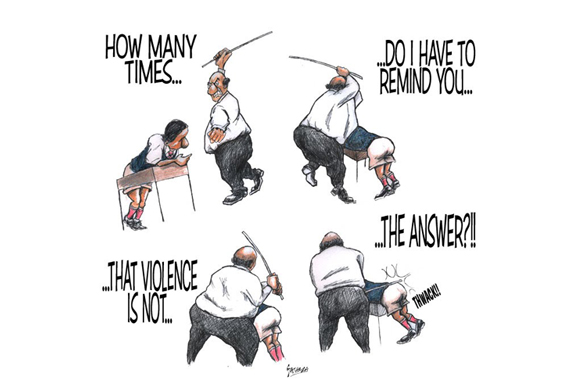
Corporal punishment remains much more widespread in U.S. schools than you might think. In a new investigation, Education Week found more than 109,000 students experienced physical discipline in 2013-14. Here's how we approached the analysis.

What is corporal punishment?

According to the U.S. Department of Education's office for civil rights, corporal punishment refers to paddling, spanking or other forms of physical discipline imposed on a student. The OCR does not break down corporal punishment data by implement, and we found no consensus on which instruments are used at different grade levels.

Where did you get the data on corporal punishment?

The Education Week Research Center used newly released 2013-14 data from the Education Department's Civil Rights Data Collection. We focused our analysis on data related to overall school characteristics, corporal punishment, and enrollment. While the Education Department collected data on preschool corporal punishment from some districts this year, it did not release these data, so our analysis is limited to kindergarten through 12th grade. 
For some school and district comparisons, we also used data on locations and poverty levels from the Education Department's Common Core of Data for 2013-14

What is the Civil Rights Data Collection? 

Every two years since 1968, the Education Department has collected information on demographics and educational opportunities for students of different genders, races, English-proficiency levels, and disabilities. Every public school in the country is required to respond to the survey. These data are used both for enforcement of federal civil rights laws and for research to improve education for these students. 
The data we analyzed are from the 2013-14 school years; the Education Department is collecting 2015-16 data now. You can find more information on the Civil Rights Data Collection on our Frequently Asked Questions page. 

How did you analyze corporal punishment in schools?

We focused our research on more than 4,000 schools where there was at least one documented occurrence of corporal punishment. This analysis did not include juvenile justice facilities.
We also compared schools that reported using corporal punishment to schools where corporal punishment does not occur. The study examined results by school location, poverty levels, and racial demographics.
We analyzed data for students in general education and those receiving services under the Individuals with Disabilities Education Act, focusing on racial and grade-level comparisons.

There's newer or different information on corporal punishment available from my state, district, or school. Why not use that?

We used 2013-14 data because it's the most recent data that allow us to conduct a comparative examination of corporal punishment across the nation as a whole.

How did you determine whether state laws ban or permit corporal punishment?

The Civil Rights Data Collection does not include information on state laws related to corporal punishment in schools. So the Education Week Research Center reviewed statutes and regulations to determine whether states ban or permit corporal punishment for the 2016-17 school year. Based on a detailed methodology, research center staff located information independently from publicly accessible records. Education department officials in each state were asked to review the final data and supply any corrections or changes that could be supported by additional evidence.

Related:
Corporal Punishment: Inside the Education Week Analysis - Inside School Research - Education Week:


DPS kickbacks were spent to help schoolkids? No way, feds say

DPS kickbacks were spent to help schoolkids? No way, feds say:

DPS kickbacks were spent to help schoolkids? No way, feds say


One by one, the Detroit principals confessed to stealing – but said they did it for the kids.
One said she took kickbacks from a crooked vendor but spent it on field trips and class decorations. Another admitted the same, saying half of her kickbacks helped her school. A third also admitted taking kickbacks, but not as much as the government claims.
All of it’s hogwash, says the government, which after months of keeping quiet is starting to disclose what 12 principals did with the kickbacks they received for helping vendor Norman Shy scam $2.3 million from Detroit Public Schools.  They spent the money on themselves – on everything from cruises and jewelry to furniture and furs – say prosecutors, who are discrediting the principals' altruistic claims just weeks before they are to be sentenced.
In new court documents filed Monday, the federal government lambasted ex-Detroit principal Clara Smith,  saying she spent  her kickbacks from Shy on a Royal Caribbean Cruise, airline flights, El-mar Furs, a trip to Caesars Hotel and Casino in Las Vegas and on Art Van furniture. It was the first such disclosure by prosecutors, who have secured 13 guilty pleas in five months.
At Smith's plea hearing, she told the judge that she accepted $194,000 in kickbacks from Shy because she  "fell from the grace of God," and insisted that she didn't spend it on herself.  Rather, Smith claimed that she spent her kickbacks on classroom decorations, field trips to Washington and Chicago, and school clothes for her students.
Prosecutors tell a different story, saying Smith went out of her way to hide her crime by asking Shy to write checks to her husband, her daughter and to various stores so that the kickbacks would go undetected.
"Smith spent the kickbacks she received on herself," wrote Assistant U.S. Attorneys J. Michael Buckley and Frances Lee Carlson, arguing Smith was "motivated by what she personally stood to gain, instead of what was best for her students."
And even if she did spend some of the money on her students, Buckley wrote, that's "irrelevant."
"Her alleged charity was only made possible by fraud committed against taxpayers and the Detroit Public School system,"  Buckley wrote in the filing. "Charity involves giving away one's own money, not money that belongs to others."
Buckley urged the court to sentence Smith to 37-46 months in prison.
► Detroit Public Schools principal: Kickbacks spent on jewelry, perfume
Smith, 67, of Detroit, who was principal at Thirkell Elementary-Middle School, will be sentenced Sept. 14. She is among 14 individuals charged in March with helping Shy run a years-long kickback scheme that involved billing DPS for $2.3 million in school supplies that were rarely delivered.
It worked like this: The principals signed off on Shy's phony invoices. When he got paid, he kicked back money to them. Of the 14 charged, 13 have pleaded guilty, including Shy, the central figure in the case who  faces up to seven years in prison when he is sentenced next month. He also has to pay back $2.3 million in restitution to DPS.
Monday's court filings indicate the government wants to make sure that Smith and the other DPS officials don't get probation on altruistic grounds, as several have claimed they used the money on the kids.
For example, Gerlma Johnson, former principal at Charles Drew Academy and Earhart Elementary-Middle School,  pleaded guilty in May to accepting about $22,000 in kickbacks from Shy. But at least half of the kickbacks were spent on the schools, DPS kickbacks were spent to help schoolkids? No way, feds say: