Latest News and Comment from Education

Tuesday, August 16, 2016

Teachers are experiencing the biggest pay gap since 1979 - Business Insider
Teachers are experiencing the biggest pay gap since 1979 - Business Insider:

Teachers are experiencing the biggest pay gap since 1979


The pay gap between public school teachers and workers in comparable professions is at the widest point ever, with wages for educators falling woefully behind.
Teachers earned 17 percent less than other college graduates in 2015, according to a new research report from The Economic Policy Institute. That’s the largest gap since 1979, when teachers’ weekly wages were 5.5 percent less than those of college graduates.
The analysis adjusted for education, age, gender, marital status, geographic region and race/ethnicity. When benefits including insurance and pensions were factored in, the gap was still 11.1 percent.
The findings come as the number of teachers in the U.S. is falling due to high turnover among new and mid-career teachers, a large volume of retirements and fewer people choosing teaching careers.
“At the same time, many factors are increasing the demand for teachers, including shrinking class sizes, the desire to improve diversity, and the need to meet high standards,” the report said. “In short, the demand for teachers is escalating, while simultaneously the supply of teachers is faltering.”
The pay gap is biggest for teachers between 35 and 44 years old, who earn 21.7 percent less than their peers in other lines of work; male teachers (24.5 percent less); and non-union teachers (25.5 percent less). Male teachers have always experienced a huge pay gap, even in 1979 when they earned 22.1 percent less than comparable workers.
Female teachers and the most experienced educators have seen wages go from being in their favor to negative territory. In 1979, female teachers earned 4.2 percent than similar female workers, while teachers aged 45 to 54 received 1.9 percent more in wages than comparable workers. In 2015, female teachers earned 13.9 percent less, and older teachers get 17.8 percent less.
Compared to workers in general, teachers don’t fare as well as they used to, either. In 1996, teachers earned $231 more a week than the average for workers across all levels of education, including those without college degrees. By 2015, the difference was only $59 because the average weekly wage for teachers fell during that time while the pay for all workers increased.
“It is good news that teachers are able to bargain a total compensation package — as it seems they may have forgone wage increases for benefits recently,” the report said, noting that teacher wages have stagnated since the mid-1990s. “This makes the wage gap, on its own, critically Teachers are experiencing the biggest pay gap since 1979 - Business Insider:


CPS students rally against 'racist and discriminatory' layoffs | Chicago Sun-Times

CPS students rally against 'racist and discriminatory' layoffs | Chicago Sun-Times:

CPS students rally against ‘racist and discriminatory’ layoffs

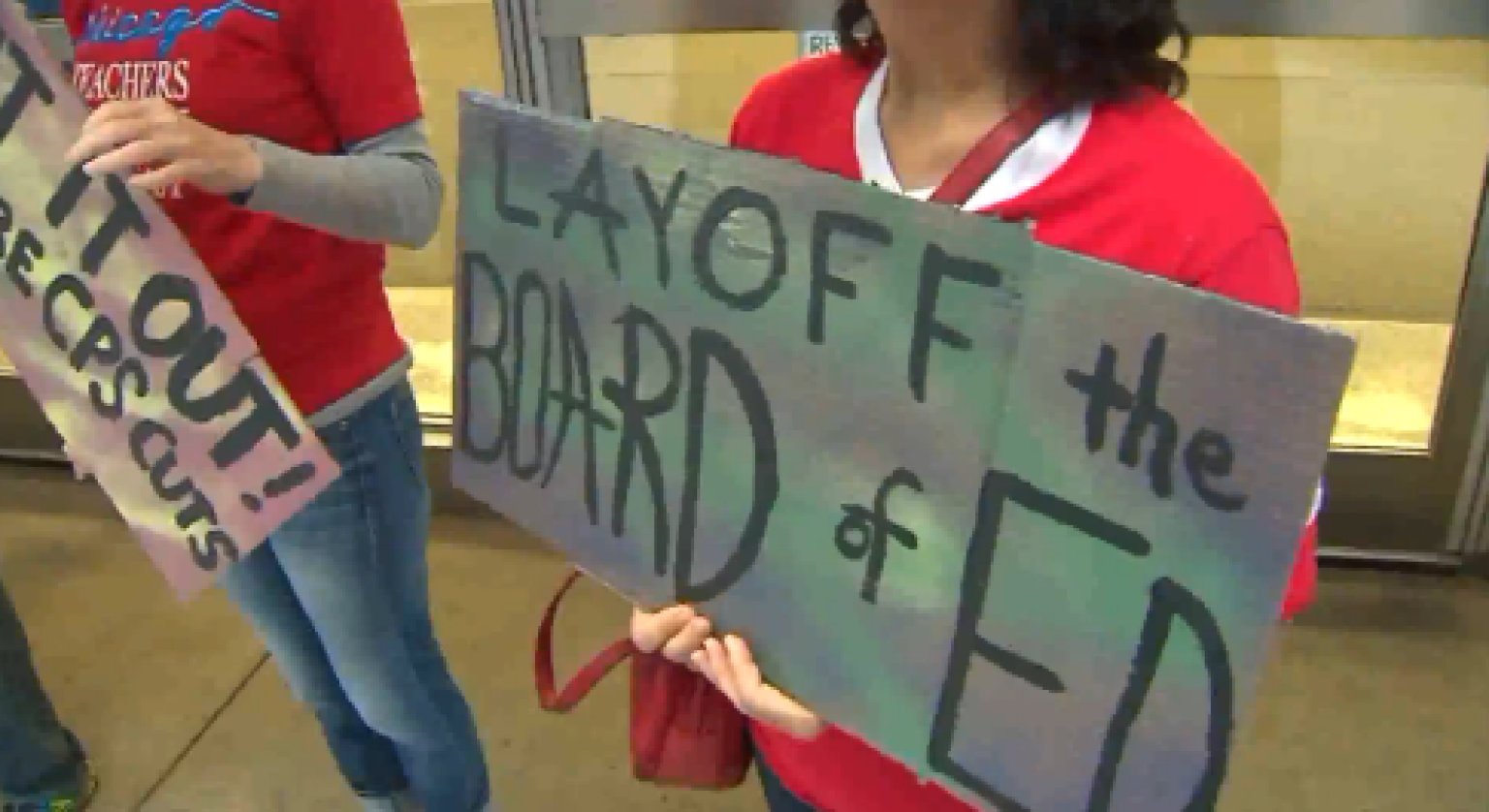
A small group of Chicago Public Schools students gathered in front of the Thompson Center on Monday, Aug. 15, 2016, to protest the firings of CPS teachers and staff. | Lou Foglia/Sun-Times

Chicago Public Schools students protested Monday the “racist and discriminatory” firing of district teachers and staff, which they said disproportionately affect low-income schools.


At a rally held outside the Thompson Center, about a dozen young protesters called for quality education and funding to be provided in all schools. The district fired 508 teachers and 521 support staff earlier this month.
Sabah Hussain and George Vassilatos, the rally organizers from the Chicago Student Union group, criticized the district’s cuts for contributing to “systematic oppression.”
Hussain, a senior at Lane Tech, said CPS “targets marginalized communities” and “justifies perpetuating the cycle of poverty under the guise of lack of resources.” The 17-year-old urged the district to find alternatives to layoffs for reducing the district’s $1.1 billion deficit, such as re-allocating surplus money in tax increment financing funds; taxing corporations on LaSalle Street; and cooperating with the Chicago Teachers Union.
Vassilatos, a senior at Whitney Young, reiterated a list of demands for the city and CPS, including a moratorium on charter expansion, an end to “racist and neighborhood-based budget cuts,” and an elected board of education.
“Education is the strongest tool against systematic oppression and systematic disenfranchisement of our communities, yet Rahm Emanuel and Forrest Claypool continue to close schools, fire teachers and refuse to engage in meaningful dialogue with CTU and the people of Chicago,” said 17-year-old Vassilatos.
A small group of Chicago Public Schools students gathered in front of the Thompson Center on Monday, Aug. 15, 2016, to protest the firings of several CPS teachers and staff.
Chicago Public Schools students concluded the rally by chanting, “People over profits” and “They say cut back, we say fight back.” | Lou Foglia/ Sun-Times
August Greenberg, who also attends Whitney Young, said after the rally that his selective enrollment school hasn’t had more than a couple of layoffs but all students should feel more of an obligation to fight for equal funding.
“The schools that are affected the most are the low-income schools, the schools on the South and West Sides. The students in those schools don’t have other places to go,” said the 16-year-old. “I do feel cuts in my school, but not the way that those people do, and those are the people I’m fighting for.”
CPS has said the majority of those teachers and staff laid off would be rehired in different CPS students rally against 'racist and discriminatory' layoffs | Chicago Sun-Times:

How schools that obsess about standardized tests ruin them as measures of success - Vox

How schools that obsess about standardized tests ruin them as measures of success - Vox:

How schools that obsess about standardized tests ruin them as measures of success


The video changed everything. The surreptitious recording of a teacher berating a first-grader for failing to explain a math problem correctly, ripping up her paper, and then inexplicably telling the subdued child to go sit in the "calm down chair" went viral and jump-started a long-running national debate over the "no excuses" charter school model — a pedagogical approach marked by heavy workloads, rigid zero-tolerance discipline, and a relentless focus on metrics, particularly standardized tests.
The Success Academy Charter Schools are arguably the best-known institutions that follow this model. The storyline its proponents push is that no-excuses schools may be tough but they prepare students well: They represent a kind of educational tough love.
In real life, though, the data seems to show that Success Academy thrives by a combination of kicking out poorly performing students and training the remainder to perform well on tests that kids at other schools don’t really care about — or don’t care as much about.
Other critics have focused on how Success Academy focuses on excluding students who are not likely to perform well on tests — an option public schools don’t have. A parent of a kindergartener with a speech disability complained to the New York Daily News that the academy tried to force her son back into the public schools by framing his frustration in class as a disciplinary problem and repeatedly suspending him. The New York Timesrevealed that one principal at a Success Academy school had a list of low-performing students labeled "Got to Go."

The statistical problem with test score obsession

When a school uses selection and attrition policies that effectively filter out many of the extremely poor, students speaking English as a second language, and the learning disabled, that clearly calls into question test score advantages that such a school might have over an ordinary public school.
But the problems run even deeper than most critics realize: A look at the data combined with some basic principles of social science suggests that the practices of no-excuses charters are undermining the very foundation of data-based education reform.
As statisticians with experience teaching at the high school and college level, we recognize a familiar problem: A test that overshadows the ultimate outcomes it is intended to measure turns into an invalid test.
Back in the old Soviet Union, factories would produce masses of unusable products as a result of competition to meet unrealistic production quotas. Analogously, many charter schools, under pressure to deliver unrealistic gains in test scores, are contorting themselves to get the numbers they've promised. They're being rewarded for doing so. But that monomaniacal focus on test scores undermines the correlation between test scores and academic accomplishment that originally existed.
Thus, when there is a policy of teachers berating poorly performing students, it’s not tough love in the service of preparing students for future academic success. Rather, it’s consistent with a metrics-driven strategy that’s about looking good but not necessarily performing well.
In short, a statistical perspective can help reveal how behavior that seems like an How schools that obsess about standardized tests ruin them as measures of success - Vox:
 

Counting 'Proficient' Students Creates Bad Accountability - On California - Education Week

Counting 'Proficient' Students Creates Bad Accountability - On California - Education Week:

Counting 'Proficient' Students Creates Bad Accountability


Consider two California schools. Both schools have 40 percent of students scoring proficient on state tests.  Because both schools are well short of the state's accountability targets, they are subject to intervention.  According to the accountability classifications used under No Child Left Behind and those proposed for the new federal Every Student Succeeds Act, these two schools look exactly the same.
Two Schools Chart.jpgBut a glance under the hood shows that the two schools are not at all the same. School A has performance that looks like the following: 20% below basic, 40% basic, 20% proficient, 20% advanced. School B has performance of 40% below basic, 20% basic, 40% proficient, 0% advanced.  In terms of average achievement levels, School B is clearly worse off than School A.  If the goal of an accountability system is to target resources and support to the lowest-performing schools, it would be a mistake to treat these two schools the same.
NCLB All Over Again
Yet that is exactly what NCLB did through its Adequate Yearly Progress calculation, and which the draft regulations of ESSA would continue.  All that mattered for school performance was the proportion of students in a school at or above the state-defined proficiency threshold. Research showed that this design led to negative unintended consequences:
  • It encouraged schools to focus their energies on students just below this proficiency cut score, since improving student achievement for already-proficient (or very-far-below-proficient) students would not help the schools' accountability ratings.
  • It is statistically a very poor measure of school performance because the relative rankings depend heavily on where the proficiency score is set.
  • It is a very poor measure of achievement gaps—actual changes in achievement gaps can sometimes be opposite to changes identified by comparing proficiency rates, again because of where proficiency levels are set and the distribution of student achievement.
There are more arguments about the problems of this accountability policy design, which I detail in the letter I wrote to the US Department of Education. (It was signed by nearly 100 scholars and practitioners, including former presidents of the American Educational Research Association, former Commissioners of The National Center for Educational Statistics and the Institute of Education Sciences, and more than a dozen K-12 educators and school district data and accountability officers. The letter was also covered by news media herehere, and here.)
There's Time To Fix This
Fortunately, there is a window of opportunity for the U.S. Department of Education to address these issues in ESSA through its regulation process. The regulations being developed by the Department will have profound consequences for the kinds of accountability policies that are actually written and implemented under ESSA.
Based on the research evidence, I argue in the letter that the Department should interpret the law to allow states to use alternative measures of performance.  In particular, I recommend one of two options:
  1. The simple average of students' scores on the assessment (what's known as average scale scores).
  2. A "proficiency index" that gives schools credit for performance all along the achievement distribution (for instance, 0 points for far below basic, 25 for below basic, 50 for basic, 75 for proficient, and 100 for advanced).
In the letter I recommend the first approach because it uses the most information available in the assessment data. However, both approaches would be far superior to rating schools according to the percent of students who achieved at least a "proficient" score.
So how would this work for our two example schools? In either of the two approaches sketched above, School A would come out on top of School B, as it should. For instance, using the proficiency index described above, School A would score a 65 and School B would score a 50 on the 0-to-100 scale, a dramatic difference reflecting the fact that the students in School A are higher-achieving on average than those in school B. An average scale score approach would even more precisely reflect the performance of kids in each school.
Why am I so concerned about such a seemingly esoteric design feature of accountability policy?
Incentives Matter
In short, incentives matter. Educators understandably pay attention to the design of accountability systems. Given the stakes involved, which can sometimes include reconstituting schools, it is not surprising that educators would shape their instructional responses based on the incentives of the policy even if they are educationally unsound.  Given the once-in-a-generation opportunity that a new federal law offers, it's important for its accountability policies to encourage good practices, not bad ones.
The letter, however, did not describe my ideal accountability system, which would be one based heavily on student achievement growth. That kind of policy would encourage schools to focus on growing ALL students, and it would be much fairer to schools that serve large proportions of low income and other historically underserved students. Unfortunately, such a policy would not be allowable under ESSA as I read the statute.
I sincerely hope that the Department takes my letter seriously, because such a simple change could have profound effects on the incentives in ESSA. Others have written letters that make the same or similar points, so there will be ample voices behind these policy changes. Regardless, it is encouraging that so many researchers, educators, and advocates are interested in improving accountability policy for the next generation.

Morgan Polikoff is associate professor of education at the University of Southern California. His areas of expertise include K-12 education policy; Common Core standards; assessment policy; alignment among instruction, standards and assessments, and the measurement of classroom instruction. He blogs at https://morganpolikoff.com, and this article was adapted from his earlier post.Counting 'Proficient' Students Creates Bad Accountability - On California - Education Week:


Michigan to take aggressive action, Close Poor Kid's Schools

Michigan to take aggressive action, close failing schools:

Michigan to take aggressive action, close failing schools


Michigan’s School Reform Office plans to make aggressive moves this coming school year to rid the state of failing schools — putting chronically low-performing schools on notice that they might be closed by next June.
The number of schools expected to be shuttered isn’t known, said Natasha Baker, the director of the State School Reform Office. In 2014, more than 100 Michigan were ranked in the bottom 5%, but Baker cautioned against assuming that the state would close that many schools. She said that even the most aggressive school reformers have never attempted to close that many schools at one time.
“It is nowhere near 100 schools,” Baker said. “There has never been 100 school closings, and we certainly aren’t going to start that practice in Michigan.”
Baker said the aggressive action — first reported Monday by Chalkbeat Detroit — is needed because the state can’t continue to allow schools to fail year after year. She said the schools that would be identified for closure have failed for as many as 10 years.
“Why now? If not now, when?” Baker asked. “How long does a child who does not control what situation they’re born into not have access to a high-performing schools?”
But it’s a move that’s sure to create controversy. Though the reform office has had the ability to close schools since 2010, this would be the first time it would do so. And it’s planning to use the results of the state’s tough new exam to make decisions about which schools will close — despite assurances educators had been given by the Michigan Department of Education that those results would not be used for high-stakes decisions until 2017.
There are some caveats in the closures, though. Schools wouldn’t close if there are no high-performing options for the kids who are displaced.
“When I say 'quality,' it’s not relative,” Baker said. “Quality means the school is not at risk of being a priority school.”
She said she’s working on alternative plans for schools that would close in areas where  there isn’t a high-performing option.
“I’m not at liberty to share the ideas because they’re controversial,” she said. “We hope to roll that out publicly in the coming weeks.”
Schools will learn by the end of 2016 whether they’re slated for closure, Michigan to take aggressive action, close failing schools:

Why Have School? Blood and Money Versus Reason

Why Have School? Blood and Money Versus Reason:

Why Have School? Blood and Money Versus Reason


 Innocently enough, schools now begin to open for the 2016-2017 school year.

It is not, however, an innocent time.

To address the current electoral spectacle alone: the consolidation of fascism via the inseparable bonds of imperialism and opportunism–sums it up for me.

Such is the context of the routine: buying school clothes, fun lunch-boxes, the anticipation of new friends, the anxiety of new teachers–and old–administrators counting bodies to match facilities, and much more.

Even so, as schools open throughout the US, one typically ignored question needs to be asked in every classroom: Why have school? Why are we here?

Let’s step back a moment in order to put school in its proper, social, perspective.

Schools are the centripetal organizing point of de-industrialized North American life, and much of life elsewhere.

Evidence: School workers, not industrial workers, are by far the most unionized people in the USA, nearly four million union members.

School unions are slowly losing members, a snail’s pace, while industrial unions collapse, evaporate, because, in part, industry evaporates, and because industrial union leaders abandoned the heart of unionism–the contradictory interests of workers and employers. The American Federation of Teachers and National Education Associations’ top officials did the same.

Nearly all of the 15 million youth in grades nine to twelve today will be draft-eligible in the next five years. And almost every one of them is registered.

What is going on in schools?

The demagogue, Obama, invaded US schools with his Race to the Top (RaTT) project personified by Chicago’s education huckster Arne Duncan. The RaTT sped what was already happening in capital’s schools and adds a few factors for spice.

The RaTT’s predecessor, a bi-partisan project touted by Democrats and Republicans alike called the No Child Left Behind Act had at least these key factors:

1/ The development of a regimented national curriculum to promote patriotism; and illusions–we can all make it–Obama as proof.

2/ High stakes standardized tests to promote segregation and ignorance through a falsified pretense of scientific backing; and;

3/ The militarization of schools–at every level, in every social class. In World War One, a U.S. general called for schools to become “Human munition factories.”

The RaTT made logical extensions:

1/ Sharpened demands for a national curriculum, now buttressed by the “Common Core,” in more subjects (beyond literacy and math);

2/ Merit pay based on student test scores;

3/ Attacks on all forms of tenure (made palatable to the public because they know through experience that there is no shortage of incompetents in schools);

4/ Layoffs, hits on pay and benefits, increases in class size;

5/ Tuition hikes driving youth out of college with razor-like precision, plunging others into lifetimes of debt, effects Why Have School? Blood and Money Versus Reason:

Charter school ballot question divides Democrats - The Boston Globe

Charter school ballot question divides Democrats - The Boston Globe:

Ballot question on charter schools divides Democrats

Charter Schools - Dividing Communities since 1991

A ballot proposal to expand charter schools across the state could drive a further wedge between Democratic Party factions when state committee members gather Tuesday night in Lawrence.
Pro-teachers union members of the state committee have been working to line up support for a resolution putting the party on record in opposition to a November ballot question boosting the number of charter schools, a thorny political question for those working to pacify blocs within the party. It was unclear late Monday whether leading party officials would permit the resolution to come to a vote.
“The charter school issue shows a genuine disagreement within the party, that there’s no consensus,” said one party insider, speaking on condition of anonymity to discuss internal Democratic dynamics. “And both sides are really intractable. The notion of a middle ground on charter schools within the Democratic Party, or among the people that are going to be showing up to this meeting, it just doesn’t exist.”
Charter schools have long been a contentious issue among Democrats, forcing activists to take sides between two traditional party constituencies: minority and low-income families versus teachers unions.


If passed, the ballot measure, Question 2, would lift the statutory cap on the number of charter schools in the state. It is strongly opposed by teachers’ unions, who argue that charters drain money from traditional public schools. Proponents say it could boost opportunities for students in struggling communities.
A Suffolk University poll in May found that half of the state’s voters supported lifting the cap on charters in districts with the poorest test scores, with 33 percent opposed.
Governor Charlie Baker, a Republican, is the measure’s leading proponent, standing last month in a midsummer downpour outside the State House in support of the ballot initiative. Two of Baker’s top political advisers, expected to play senior roles if he runs for a second term, are helping steer the procharter effort.
“This is one of those issues where the Republicans can use divisions within the Democratic Party to their benefit,” said Stonehill College political scientist Peter Ubertaccio. “I think there’s no downside to what the governor is attempting to do.”
A spokeswoman for state Democratic Party chair Thomas McGee, a Lynn state senator, said McGee was not available for comment.
The state party confab comes as national Democrats are working to heal fissures opened during the grueling presidential primary between the nominee, Hillary Clinton, and US Senator Bernie Sanders.
In Massachusetts and nationally, top Democrats have shown an uneasiness with education policy and charter schools. Clinton was booed last month during a national teachers union conference after making remarks seemingly supportive of charter schools.
Depending on its wording, the resolution, if adopted, probably would put Massachusetts Democrats in a more stridently anticharter stance than the national party.
The meeting comes as Massachusetts Democrats grope their way through the type of power vacuum they have not experienced since before Deval Patrick, himself a charter supporter, was elected governor in 2006. No Democrat has emerged as the prime challenger to Baker and, party insiders say, even the behind-the-scenes power-brokering can at times seem rudderless.
Bill Dooling, a committee member from Holliston and Vietnam veteran who campaigned for John F. Kerry’s 2004 presidential bid, circulated an e-mail to members last month ripping a procharters Charter school ballot question divides Democrats - The Boston Globe:
 Don't Be Fooled -  Vote for Real Democrats

Voucher vs No Voucher | journalreview.com

Voucher vs No Voucher | News | journalreview.com:

Voucher vs No Voucher

Superintendents disappointed in state’s voucher system

Voucher vs No Voucher


After a successful first week of classes at the three Montgomery County school corporations, superintendents still found disappointment with the publication of a recent report on the Indiana voucher program. 
A record $53 million of tax dollars was used to finance private and religious school tuition in the 2015-16 school year. The cost of the program was detailed in the Choice Scholarship Annual Report released by the Office of School Finance of the Indiana Department of Education in July.
Local superintendents see public schools being shorted funding in an effort to finance public schools. Montgomery County tax dollars continue to be a part of the money sent to the private and religious schools even though there are none of those types of schools in the county.
When state legislators set up the school voucher system, they did it under the pretense that it would help low-income families send their children to private schools. Now it appears, according to the report, that is not happening, but the cost of the voucher program continues to rise.
South Montgomery School Corporation Superintendent Dr. Shawn Greiner said the playing field is not equal between those who can afford private schools compared to those who cannot.
“I do not support spending public tax dollars on private school vouchers, most particularly in instances where private schools’ tuition charges are more than the voucher itself,” Greiner said “In these situations, private schools are creating a situation where those families with means have an advantage over those without. Public education is free, regardless of a child’s family circumstances. When public money supports private education rather than the public education system, this can and often does hurt low-income families by undermining the public schools that those families rely on.”
Republican legislators expanded the voucher system in 2013 when they changed eligibility rules which enabled private school students, who were already attending the private schools, to obtain a voucher. Adding the additional students caused the fiscal cost to Indiana to increase dramatically.
In 2011 through 2013, the state actually saved a total of $9.1 million because students were leaving public schools to attend private schools. Not having to finance the students who chose a private school from their public school saved the state money.
However, when the state legislators opened the vouchers to existing private school students, the cost to Indiana through vouchers ballooned to $53.2 million in the 2015-16 school year. In fact, $53 million is more money than what the state paid for summer school ($18 million), preschool ($10 million), technology ($3 million), English language learners ($10 million) and Gifted and Talented programs ($12 million) all added together.
Crawfordsville Superintendent Scott Bowling said the increase in state education funding is a serious problem to all of the state’s public schools and has caused an accountability problem in the use of tax dollars since private schools are not as accountable to the state as public schools are.
“Public education is the foundation of what has made this country great,” Bowling said. “Indiana’s voucher program hurts that foundation by creating hundreds of individual school districts that are not accountable to the public and not accessible to everyone.”
Public school advocate Vic Smith explained the total cost of the voucher program since its inception in the 2013-14 school year is $131.5 million. He sees that money as funds taken away from public schools. 
North Montgomery Superintendent Colleen Moran said the voucher system has not been good for public Voucher vs No Voucher | News | journalreview.com:

Monday, August 15, 2016

Trump is an object lesson in the problems of machine learning / Boing Boing

Trump is an object lesson in the problems of machine learning / Boing Boing:

Trump is an object lesson in the problems of machine learning


Trump's algorithm is to say semi-random things until his crowd roars its approval, then he iteratively modifies those statements, seeking more and more approval, until he maxes out and tries a new tack.
This is one of the core strategies of machine-learning: random-walking to find a promising path, hill-climbing to optimize it, then de-optimizing in order to ensure that you haven't plateaued at a local maximum (think of how an ant tries various directions to find a food source, then lays down a chemical trail that other ants reinforce as they follow it, but some will diverge randomly so that other, richer/closer food sources aren't bypassed).
It also betrays one of the core problems with machine learning: bias in the sample-set. The people that Trump relies upon to give him his success feedback are the people who show up for Trump rallies, who are the most extreme, least-representative group of potential Trump voters. The more Trump optimizes for this limited group, the more he de-optimizes for the rest of the world.
Biased training data is a huge (ahem, yuge) problem for machine-learning. Cities that use data from racist frisking practices to determine who the police should stop end up producing algorithmic racism; court systems that use racist sentencing records to train a model that makes sentencing recommendations get algorithmic racism, too.
Trump is a salesman -- he says whatever he thinks his audience wants to hear. That's why he's contradicted every position he's ever espoused. He randomwalked into a strategy of saying things that an underserved, vocal group of bigots wanted to hear, and they fed back their approval and he's been death-spiraling ever since.
Cathy "Weapons of Math Destruction" O'Neil explains what this means for machine learning in our political and policy spheres.


The reason I bring this up: first of all, it’s a great way of understanding how machine learning algorithms can give us stuff we absolutely don’t want, even though they fundamentally lack prior agendas. Happens all the time, in ways similar to the Donald.
Second, some people actually think there will soon be algorithms that control us, operating “through sound decisions of pure rationality” and that we will no longer have use for politicians at all.
And look, I can understand why people are sick of politicians, and would love them to be replaced with rational decision-making robots. But that scenario means one of three things:
1. Controlling robots simply get trained by the people’s will and do 
Trump is an object lesson in the problems of machine learning / Boing Boing:


CURMUDGUCATION: Resolve To See

CURMUDGUCATION: Resolve To See:

Resolve To See


For the next couple of weeks, as the beginning of my school year approaches. I'm going to write to renew my resolve to keep focus in my practice. This is one of that series of posts.

I'm not sure that anybody has it harder in school than the invisible kids.

Bullied students are a subset of the invisible students. Bullied students are seen-but-not-really. They are seen for the one characteristic for which they are singled out and mistreated, but rarely seen as actual complete fully human beings.

There are also the students who are completely invisible. Unseen, unknown, just passing through the halls of the school. Their presence and their absence make the same impression on the people around them.

There's a sad but fair argument to be made that all of this invisibility is practice for the adult version, for entering the grown-up world where we talk past or at each other and simply reduce other people to just one or two characteristics, treating our fellow humans as if they are cartoon versions of human beings. We reduce the people we disagree with to gnarled caricatures. We reduce the people we don't mind being around to flat masks, one or two simple characteristics that we can quickly reference before we move on. And we reduce people that we don't want to bother with to nothing at all. Not even ignored, because you can only ignore something that you acknowledge is there. Just invisible.
I suspect it's easier for us to slip into that mode in school because we deal with a relatively narrow slice of humanity. I teach teenagers, and while there are some things that have changed over the decades, teenagers remain for the most part pretty teenagery. On top of that, certain physical and CURMUDGUCATION: Resolve To See:

Mike Klonsky's SmallTalk Blog: Peter Cunningham's reform apologia: 'Fighting segregation and poverty too expensive'.

Mike Klonsky's SmallTalk Blog: Peter Cunningham's reform apologia: 'Fighting segregation and poverty too expensive'.:

Peter Cunningham's reform apologia: 'Fighting segregation and poverty too expensive'.

Sign reads: "We want equal & segregated schools"
Peter Cunningham's latest apologia for school segregation, in U.S. News & World Report, is basically a defense of current reform policies that have been shown to re-segregate schools. It represents more than just the opinion of a lone education gadfly. Cunningham is paid millions to speak for some of the most powerful and wealthiest among those who influence national ed policy.

It's run up the flag pole at a time when corporate-style "reform" has come under attack fromcivil rights groups and teacher unions, and appear to be losing their cachet, even within the Democratic Party establishment.

Cunningham tries to come off as a tormented soul, torn between his personal and "pragmatic" side, the latter arguing that ending poverty and integration are just too "politically difficult and financially expensive" and therefore, instead of spending hundreds of billions more to reduce poverty and reduce segregation, we should just "double down on our efforts to improve schools."

At a recent DFER-sponsored forum at the DNC, Cunningham laid out his anti-deseg line in an obvious attempt to influence Clinton's education agenda. He answered a question about school integration this way:

"Maybe the fight's not worth it. It's a good thing; we all think integration is good. But it's been a long fight, we've had middling success. At the same time, we have lots and lots of schools filled with kids of one race, one background, that are doing great. 
There nothing original in Cunningham's comments. If they strike you as a throwback to Plessy v. Ferguson and the separate-but-equal doctrine, you're definitely on to something. As we Mike Klonsky's SmallTalk Blog: Peter Cunningham's reform apologia: 'Fighting segregation and poverty too expensive'.:

Chinese International Students Affect Asian American Students in Complicated Ways - The Atlantic

Chinese International Students Affect Asian American Students in Complicated Ways - The Atlantic:

The Burden of Being Asian American on Campus

The arrival of Chinese international students comes at a cost to some.

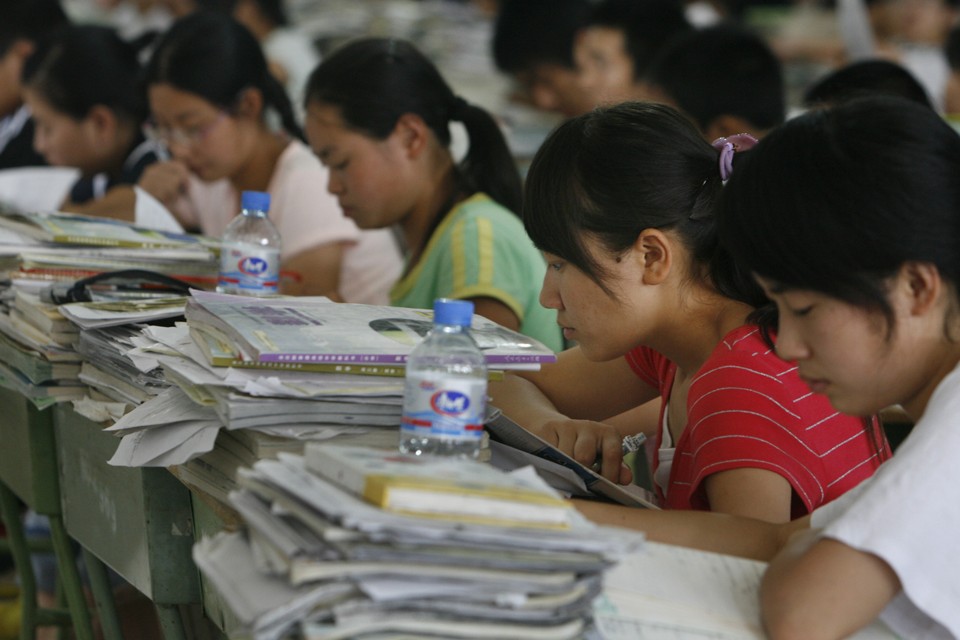
Students prepare for a college entrance exam in China's Sichuan province.Claro Cortes / Reuters

When my father was a graduate student at Loyola University in Chicago, two distinct things marked his day: the “L” and instant noodles. It was 1998 in a studio apartment in Rogers Park below the Red Line. Every night, the sounds of the train woke him up. Every morning, he got up after a restless night and made himself some ramen. After those three years, he never wanted to look at instant noodles again.

At that time, it was almost unheard of for Chinese students to go to the United States for undergraduate study. Instead, everyone suffered through the dreadedgaokao, the Chinese college-entrance examination. For four consecutive days in June, thousands of Chinese high schoolers sat in stuffy classrooms with no air conditioning, sweating and exerting themselves in subjects like mathematics, physics, and English to get one single score high enough to earn a coveted spot at a top university. Most students who did go abroad were graduate students, and many of them stayed in the new country.
The scene today is a little different. The majority of students in China do still take the exam. They study for years in preparation and wait for weeks afterward in anticipation of receiving a number that determines their future. Students are accepted to a college based on how highly they ranked the school and the single weighted score, which they may not even know before submitting their preferences. The convoluted and capricious ranking system may allot them a spot at their last-choice college.
Many, however, now have the option of bypassing that system, with exceptional talent or a significant amount of money. Some apply to a foreign-language school where students can apply to universities abroad instead of taking the gaokao. Others test their way into “experimental” classes at top public high schools, which are fiercely competitive but have high success rates of getting students into Western universities. Those with more disposable income can skip Chinese high school altogether and attend a private boarding school abroad, such as Andover or Exeter in New England. Students from wealthier families usually have a better chance of going abroad because they can hire tutors, take test-prep courses, and afford the high tuition of American private high schools and universities.
In recent years, the number of Chinese nationals studying abroad has increased dramatically, surpassing India, South Korea, and other countries in the number of students sent overseas. According to the Institute of International Education, China was the top sender of students to the United States in 2015, with 304,040 Chinese International Students Affect Asian American Students in Complicated Ways - The Atlantic:

Poor data collection leaves policy makers uninformed :: SI&A Cabinet Report

Poor data collection leaves policy makers uninformed :: SI&A Cabinet Report :: The Essential Resource for Superintendents and the Cabinet:

Poor data collection leaves policy makers uninformed

Poor data collection leaves policy makers uninformed

(District of Columbia) After 85 percent of districts in Florida and Texas reported zero instances of bullying in the most recent Civil Rights Data Collection Survey, federal officials announced late last week that they were revisiting how data is being collected–a problem experts say has been long-standing and all too common.
The department’s national survey of school climate factors, teacher quality and rigorous course access should help districts and state policy makers address apparent problem areas. When the data collected is not representative of reality, however, it cannot provide directions for school improvement.
 “It’s been a struggle for us to get meaningful statistics from this survey because the data is so incomplete,” Victor Leung, staff attorney at the ACLU of Southern California, said in an interview. “I’m sure there are different causes for inaccuracies in different districts. I think sometimes it might be because a district does not want to release data that looks bad, and other times it’s just very poor data collection on behalf of the districts–and that I actually think is quite common.”
Improved transparency, a cornerstone of the Every Student Succeeds Act, requires schools report to parents, the community and lawmakers various aspects that impact students. This includes the number of teachers assigned to classes they are not credentialed to teach, students’ access to college-readiness and career education courses, and instances of violence or bullying on campus.
Lawmakers and school boards alike often rely on what has been commonly referred to as “valid and reliable data” to inform new policy recommendations. The Civil Rights survey results released in June, however, suggest at least some areas of data collection are still unreliable.
Schools across the country have made significant shifts to address issues like bullying in recent years, for example, through implementation of anti-bullying measures, social emotional learning, LGBT-friendly policies and restorative justice practices that allow students to find common ground through mediation. It is unlikely, though, that such behavior has been completely eradicated.
Advocates for various student groups say there is more to be done to address inequity in the classroom or in disciplinary policy, which is unlikely to be accomplished without proper data to help schools identify problems.
Leung, who is currently working on a report regarding police presence in schools in California, said plenty or errors can be found in that data as well.
In some cases, ACLU researchers have found a “zero” marked in the column detailing the number of police on campus, when it is known that the school has many officers present, he said. Other times, a district will have clearly put “one” down every column–similar to a student answering “C” for every question on a quiz.
The Education Department has acknowledged that, because the data is self-reported, there are likely errors to be found. In fact, an update posted to the survey results page last week claims the Department was “alerted to errors in data the state of Florida submitted on behalf of its school districts,” and is working to make corrections. Florida is one of the states that reported no occurrences of bullying in 85 percent of its districts.
“This is self-reported data from school districts, and while we know it’s not perfect, it’s the best national data available on issues of equity in schools,” Dorie Nolt, spokesperson for the Department of Education, said in an email. “We continue to look for ways and work with school districts to improve the accuracy of the data.”
Some districts, especially those which are smaller or more rural, do not have procedures for collecting data and simply do not keep it, Leung said.
“If they don’t keep the data, I guess there’s no way they can report it,” he said.Poor data collection leaves policy makers uninformed :: SI&A Cabinet Report :: The Essential Resource for Superintendents and the Cabinet:

Chicago Public Schools Just Laid Off More Than 1,000 Teachers. Here's What It's Like to Be One of Them | Alternet

Chicago Public Schools Just Laid Off More Than 1,000 Teachers. Here's What It's Like to Be One of Them | Alternet:

Chicago Public Schools Just Laid Off More Than 1,000 Teachers. Here's What It's Like to Be One of Them

School boards and district leadership designed the layoff process to minimize their own responsibility.


 I got my official layoff call at 8:28pm last Friday night.

I was one of more than 1,000 Chicago Public School District educators laid off this summer. It is the third time in six years I’ve been fired.
My principal left a cryptic message during the afternoon (I had been expecting the call since June). She tried her best:
“I’m sorry to have to make this call. They asked me to read a script, but I think that’s inhumane, so I’m just going to tell you.”
I immediately messaged those students (my former students? my forever students?) who had requested I inform them as soon as I knew. In the Chicago Public Schools, when inhumane decisions are inflicted on students and communities, there are a hundred protocols but there’s no plan in place to support the students who are the victims of those decisions.
As I’ve written before, the unelected school board and district leadership have designed the layoff process to minimize their own responsibility. Students (especially those of color) often end up blaming themselves or thinking their teachers chose to leave. I spent the evening talking to students online, receiving love and support from friends and internet acquaintances and sharing mutual support with my partner, Erin. All weekend, we did the mutual care work and, this being my third layoff, it felt almost horrifically normal. We went through the motions of surviving the indefensible.
I found myself doing some consoling of my friends and acquaintances. People asked how something like this could happen again to me. They were “shocked.” They “couldn’t believe my bad luck. Some asked what they could do to help.
Most tried to exceptionalize me, “Don’t worry you are a great teacher, you’ll find something better!” as if it would console me, as if seeing myself as more deserving would somehow protect me.
I want to be clear: Our friends were acting in love—in many ways it was salvation in a time of need—but it still felt wrong. I had to tell them that there were no Chicago Public Schools Just Laid Off More Than 1,000 Teachers. Here's What It's Like to Be One of Them | Alternet: