Latest News and Comment from Education

Monday, August 15, 2016

Segregated Schools May Not Be That Bad | US News Opinion

Segregated Schools May Not Be That Bad | US News Opinion:

Is School Integration Necessary?

Integration is expensive and takes money away from other necessary improvements.


 I recently moderated a panel during the Democratic National Convention in Philadelphia sponsored by Democrats for Education Reform, featuring a civil rights attorney, an advocate for criminal justice reform, a Colorado state legislator and a charter school leader.

The topic was education "intersectionality" – which is essentially how issues outside the classroom affect performance inside the classroom. During the discussion, a member of the audience raised the issue of segregation and I said something that has gotten some attention on social media:
"Maybe the fight's not worth it. It's a good thing; we all think integration is good. But it's been a long fight, we've had middling success. At the same time, we have lots and lots of schools filled with kids of one race, one background, that are doing great. It's a good question."


The context for my comment was how politics, demographics and racism impede integration. America tried to integrate schools back in the 1960's and 1970's, but many white families fled cities for mostly white suburbs. Some cities, like Boston, tried busing but the negative reaction from parents was swift and severe. Few places do it today.
Some cities created magnet schools that students test into, with the explicit goal of creating a handful of racially diverse schools. Today in Chicago, magnet schools have managed to keep the white public school population at about nine percent in a city that is more than one third white. And many have pointed out the downside of magnet schools – intellectual segregation – because they pull stronger students out of neighborhood schools.
Today, 62 years after the United States Supreme Court ruled that segregated schools violate the Constitution, American public schools remain deeply segregated by race. One study concludes they are more segregated today than they were 40 years ago.
Housing patterns that drive school attendance boundaries in cities all across America are also segregated by both race and income. In most communities, efforts to integrate schools have largely been abandoned.
L'Heureux Lewis-McCoy, a Black sociologist from New York and the author of a 2014 book on educational inequality in the suburbs, further suggests that, even in somewhat integrated schools, classes and social networks are often segregated.
Also, for the first time in history, more than half of America's public school students are non-white and for the first time in history, more than half of America's public school children are also poor or near-poor. So, in a school system that is blacker, browner andSegregated Schools May Not Be That Bad | US News Opinion: 

Did Civic Unrest in Ferguson, Missouri, Impact Student Achievement? | US News

Did Civic Unrest in Ferguson, Missouri, Impact Student Achievement? | US News:

Does Civic Unrest Impact Student Achievement?

A new research paper explores the relationship between protests in Ferguson, Missouri, and lowered student test scores.

Demonstrators, marking the one-year anniversary of the shooting of Michael Brown, confront police during a protest along West Florrisant Street on August 11, 2015 in Ferguson, Missouri. Brown was shot and killed by a Ferguson police officer on August 9, 2014. His death sparked months of sometimes violent protests in Ferguson and drew nationwide focus on police treatment of black suspects.
Demonstrators, marking the one-year anniversary of the shooting of Michael Brown, confront police during a protest on Aug. 11, 2015 in Ferguson, Missouri. (SCOTT OLSON/GETTY IMAGES)

For students in and around Ferguson, Missouri, the start of the 2014-2015 school year was unlike any other, occurring amid a period of protests and violence following the death of Michael Brown, an unarmed black teenager shot by white police officer Darren Wilson.
Now, a new research paper published by The Institute for the Study of Labor and highlighted by the Brookings Institution, a Washington think tank, explores whether stress caused by the civic unrest could explain a drop in academic achievement and a spike in chronic absenteeism that occurred among Ferguson-area students that year, especially among students of color and poor students.
The authors, Seth Gershenson, an assistant professor in American University's School of Public Affairs, and Michael Hayes, an assistant professor at Rutgers University-Camden, compared the performance of students in the Ferguson region to that of students from the broader St. Louis area from 2010 to 2015.
Student achievement, while lower in Ferguson than St. Louis, held constant from 2010 through 2014. But there was a significant change in Ferguson-area schools in 2015, the researchers found. Specifically, the proportion of high-needs students scoring at or above basic in math and reading dropped by 11 and 7 percentage points, respectively, with the effects largely seen among elementary school students.

THE BROOKINGS INSTITUTION

"Together, these facts suggest that something, likely the sporadic, intense bouts of civic unrest, affected student performance in Ferguson-area schools in 2015 but did not affect other schools in the St. Louis area," Gershenson and Hayes wrote in a Brookings post on their findings. They argue that disruptions to learning and reduced student achievement are one potential cost of protest movements.
The rate of chronic absence in Ferguson-area elementary schools also increased by about 5 percent, the researchers note in their paper, which likely played a role in poorer student Did Civic Unrest in Ferguson, Missouri, Impact Student Achievement? | US News:

Some schools get state money, deny gay enrollment | The Charlotte Observer

Some schools get state money, deny gay enrollment | The Charlotte Observer:

Some schools get state money, deny gay enrollment


At least four faith-based private schools in Mecklenburg County receive taxpayer money through a state voucher program while sections of their handbooks prohibit lesbian, gay, bisexual or transgender students from enrolling.
The schools are within state law. It prohibits discrimination in nonpublic schools based on race, gender and national origin, but does not address sexual orientation or gender identity.
The vouchers, known as Opportunity Scholarships, offer up to $4,200 per year to students from low-income families for private school tuition. The scholarships are paid through the state’s general fund.
More than 400 schools participate in the voucher program, according to the Opportunity Scholarship website. About 50 of those are in Mecklenburg County.
Many have written policies against discrimination, but don’t address gender identity or sexual orientation. Four schools – Bible Baptist Christian in Matthews, Charlotte United Christian in south Charlotte, Lake Norman Christian and Northside Christian in north Charlotte – note in their handbooks that they reserve the right to refuse admission to a student who identifies as lesbian, gay, bisexual or transgender.
The Bible Baptist handbook states: “The school reserves the right, within its sole discretion, to refuse admission of an applicant or to discontinue enrollment of a current student. This includes, but is not limited to, living in, condoning or supporting any form of sexual immorality (or) practicing or promoting a homosexual lifestyle or alternative gender identity.”
An official at Bible Baptist said the school would respond to questions only in writing, but did not respond to emailed questions this week. Officials at Charlotte United Christian and Northside Christian declined comment.
The Lake Norman handbook states: “Moral misconduct includes, but is not limited to, promiscuity, homosexual behavior, sexual orientation other than heterosexual, transgender identity, or any other violation of the unique roles of male and female.”
Wes Johnston, head of Lake Norman Christian School, said “there are certain things that the Christian church has stood for over the years. ... We don’t discriminate. We discriminate scripturally, if that’s a thing to say.”
N.C. Rep. Paul Stam, a Republican from Apex who sponsored the voucher program in the state legislature, said the program does not discriminate.
“Parents choose where to send children. And parents are free to choose whatever school they want within the hundreds of possibilities,” he said.
But Chris Fitzsimon, co-founder of the liberal-leaning N.C. Policy Watch, questioned the voucher program in a Policy Watch article last month.
“We’re asking taxpayers in North Carolina to support schools that they’re not eligible to attend,” he said an interview. “Why in the world should tax dollars be paid by people who don’t have access to the school?”

$25 million going to vouchers

This year almost $25 million was allotted for the voucher program. The budget passed thisSome schools get state money, deny gay enrollment | The Charlotte Observer:


Read more here: http://www.charlotteobserver.com/news/local/article95390197.html#storylink=cpy

Cutting teacher pay using the logic of an eight-year old. | Fred Klonsky

Cutting teacher pay using the logic of an eight-year old. | Fred Klonsky:

Cutting teacher pay using the logic of an eight-year old.


Our house has been empty of small children for a long time now. My own children are grown and are gone with only short visits home during the summer.
I am about to start the fifth year of my retirement and so my contact with little kids is limited to my volunteer ukulele time at a local public school.
But kid logic? I hear it every day coming from Rahm and the CPS board.
My grandkids are visiting this week. Like any good parents their parents have them on a routine and schedule at home. But routines and schedules fall all apart when families are on the road. Last night my grandson tried to argue that he was entitled to his 45 minutes of the TV time that he gets after dinner even though we had just come home from a larger family gathering and it was very late and way past his bed time.
He’s eight and his sense of fairness doesn’t extend to the larger picture. Since he always get that 45 minutes, it wasn’t fair.
Listening to Rahm, Claypool and the CPS board explain why they are demanding a 7% pay cut from the Chicago Teachers Union is like listening to Cutting teacher pay using the logic of an eight-year old. | Fred Klonsky:
 

.@Facebook Censorship and Jail – Cloaking Inequity

.@Facebook Censorship and Jail – Cloaking Inequity:

.@Facebook Censorship and Jail


Facebook just deleted my profile photo. A cartoon which I thought was quite humorous and already had more than 100 likes.
Screen Shot 2016-08-15 at 6.54.28 AM
I wish I had the photoshop talent/exactatude to make such a cool and funny image, but the credit for designing it goes to Susan D. More Facebook censorship on behalf of the corporate education reformers.
We discussed the coordinated Facebook censorship of Teach For America posts in the first ten minutes of the Truth For American episode with Diane Ravitch that was taped LIVE at the Network For Public Education Conference.
I suspect the same education reformer internet black ops is responsible.
Oh, and Facebook also blocked me from posting.
Please Facebook Like, Tweet, etc below and/or reblog to share this discussion with others.
Want to know about Cloaking Inequity’s freshly pressed conversations about educational policy? Click the “Follow blog by email” button on this page.
Twitter: @ProfessorJVH
Click here for Vitae.
 .@Facebook Censorship and Jail – Cloaking Inequity:


Big Education Ape: Oh Crap! I guess these are NOT OK to post on Facebook :


Microaggressions in School Culture | The Jose Vilson

Microaggressions in School Culture | The Jose Vilson:

Microaggressions in School Culture

28813221545_cb52316b41

I’m well aware that my role as an administrator took me directly out of conversations in the teacher’s lounge. My friends, who watched me take on this new role, joked that I’d “gone to the dark side.” Teachers and administrators are often pitted against one another in the education world and it’s never to the betterment of what’s good for students. Yet, it’s a part of the culture we rarely discuss in terms of being constructive in creating collegiality and professionalism.
That’s where we get stuck with microaggressions in school culture.
During my first ten years in the classroom I recall feeling like nothing I did could please the superiors in charge of evaluating me. Many novice teachers have felt like we had to fake it until we made it, but that comes naturally with any career in the beginning.
The first time I stood up to an administrator they had just embarrassed me in front of my classroom by belittling me and saying I didn’t have any control over the kids. The fact that they had free time while we waited to be called down to an assembly seemed to escape him and said all this while speaking to the entire class from the speaker system set up in the office.
Horrified, I turned toward my class and put my finger to my lips to signify I needed them to be silent. They complied quickly and many of them felt I had been wronged by the looks of confusion on their faces. After confronting that assistant principal, a job I would have some 10 years later Microaggressions in School Culture | The Jose Vilson:

Schools Matter: Keeping Readers Ignorant to Protect Diane

Schools Matter: Keeping Readers Ignorant to Protect Diane:

Keeping Readers Ignorant to Protect Diane

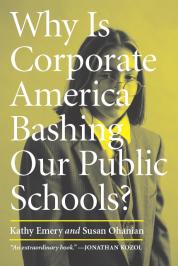
Emery and Ohanian

From reading Diane Ravitch, it is hard to tell how much our neoliberal matron of anti-reformy complaining does or does not know about the real threat that competency based education (CBE) or "personalized learning" represents to public schools, children, and teachers. 

For even while it is an advertised fact that corporate education deformers are initiating a plan to digitally teacher proof schools and to have children's learning paths determined by computer algorithms, Ravitch seems puzzled about what's really going on. 

Based on her latest post, she seems to think that CBE is just a "very problematic concept" that sort of sounds like computer-assisted instruction (CAI) of yesteryear.  While, then, minimizing the threat to face-to-face learning that CBE represents, she ignores the fact that the ESSA, which she supports, has major stimulus money for states to initiate competency based programs in public schools.  She does not mention that. 

One has to wonder if she is aware that her son's company could profit handsomely from some of those millions in federal seed money for turning children in alienated computer-compliant drones.

What is clear is that the Ravitch team is always alert for any comment at her blog that could indicate Ravitch's lack of understanding of an issue or any comment that would question her real commitment to the public education system that she claims to support. 

Below is one of those comment from a reader of Ravitch's blog that did not get published.   

https://dianeravitch.net/2016/08/13/report-from-the-rio-olympics-personalized-learning-will-make-every-student-a-winner/


Digital learning is designed to segue into algorithm-driven workforce development. Schools Matter: Keeping Readers Ignorant to Protect Diane:

More Social-Emotional Learning Hype

More Social-Emotional Learning Hype:

More Social-Emotional Learning Hype

Child sitting in a room corner

Helping children with their emotions is something teachers have done for years. Certainly, assisting children and teens with appropriate, caring behavior is an important task. And, yes, there are ways to help children feel good about who they are and what they can contribute to the world.
Of course educators should address a child’s feelings and their emotional well-being. Schools should be beautiful settings with lovely activities that tell a child the adults and their community care about them.
But all of the new Social-Emotional Learning (SEL) hype is, unfortunately, simply an afterthought to Common Core. And it doesn’t work when you say, “Oops, we forgot to consider a child’s feelings, so, yep, let’s add some checklists and objectives and we will be good to go.”
It doesn’t work that way.
Last week I wrote about the relatively new social-emotional learning hype that is sweeping the states. SEL4MA is short for Social Emotional Learning (SEL) for Massachusetts, and they began following me on Twitter. I love that they did, because they present all kinds of issues to write about. But it is frightening too.
Like the fact that the two reasons they give for the need to work with children’s SEL are:
  1. Increase academic achievement (up 11% universally and 17% for at-risk More Social-Emotional Learning Hype:

Author Matt de la PeƱa: Diverse Books Empower Students

Author Matt de la PeƱa: Diverse Books Empower Students:

Author Matt de la PeƱa: Diverse Books Empower Students

Matt de la PeƱa

Matt de la PeƱa was a racially confused, working class kid who grew up to write books about racially confused, working class kids, but the universality and humanity of his characters will speak to young readers from any background. De la PeƱa is the first Hispanic winner of the 2016 Newbery Medal for his picture book Last Stop on Market Street, the author of several award-winning Young Adult (YA) novels, and this summer was honored with the National Council of Teachers of English Intellectual Freedom Award for his work to stand up to censorship after his YA novel Mexican WhiteBoy was banned from Tucson, Arizona, schools (along with several other Hispanic authors) when they terminated the district’s Mexican American Studies programs.
NEA Today spoke with de la PeƱa about what motivates his writing and inspires his characters.
What parts of you appear in your characters?
Matt de la PeƱa: I steal from myself all the time. I think my own racial confusion is always present. And the guilt I feel about not being as Mexican as my uncles and cousins. I found grace in a sport [basketball] when I was young, and I explore that idea a lot. But the part of me I mine the most is the pride I’ve always felt about growing up working class.
It seems we’ve finally entered an era where diverse books are sought out and celebrated. Why is that important?
MDLP: I do sense that things are changing. “Diverse books” are getting a little more attention from both consumers and award committees. But the most vital change is happening before the book even exists. Publishers seem to be making a concerted effort to highlight diverse titles. They’re even putting money behind them in some cases. It’s important for diverse reader, of course, but it’s also important for the viability of the book business. The country is changing. The demographics are shifting. We better get out in front of this shift is we want our business to remain viable. Otherwise smart young “diverse” readers and writers will take their interests elsewhere, as they should.
 What do you hope to contribute to the diverse books movement and ultimately to your readers?
MDLP: To be honest, I don’t come at it with a thought-out plan. When I sit down to write every new book, I’m focused on the same thing. I’m trying to explore some idea that personally interests me using characters that speak to me. I’m really interested in the mixed-race experience (as I’m mixed race myself). And I’m fascinated by working class stories (as I’m from a working class world). It’s only after the book comes out, and I get a sense of the response, that I begin to understand the work’s possible contribution. Mostly I just adore telling stories, and it just so happens that the stories I gravitate toward are relevant to readers who don’t often see themselves in books.
How can reading – especially books with diverse characters – transform the lives of young people?
MDLP: If you’re growing up in a homogenous, white neighborhood, exposure to Author Matt de la PeƱa: Diverse Books Empower Students:

The Eternal Narcissism of White Privilege | the becoming radical

The Eternal Narcissism of White Privilege | the becoming radical:

The Eternal Narcissism of White Privilege


The nomination of Donald Trump by the Republican Party has spawned a growing body of punditry seeking ways to explain Trump’s rise without directly addressing racism, bigotry, and xenophobia.
The explanation du jour cautions critics of Trump supporters, arguing that Trump is attractive to working-class whites who have legitimate fears.
Works such as Hillbilly Elegy by J.D. Vance have become representative of the serious reconsideration of the angry white voter, as Vance proclaims:
The simple answer is that these people–my people–are really struggling, and there hasn’t been a single political candidate who speaks to those struggles in a long time.  Donald Trump at least tries.
However, as a redneck son of the self-defeating South, I immediately had a different reaction to Vance and the scramble to attend to the eternal narcissism of white privilege:
The four-year-old Joel frets about his mother: “She’s not looking at me. No one ever looks at me.”
The histrionics of working class whites, to me, sound like arrested development, spurred by the longdeferred political and social recognition about racism prompted by the #BlackLivesMatter movement.
The consequences of white privilege include that privilege is both ever-present and thus invisible—much as we says that fish don’t understand water.
And thus, while working-class whites have suffered because of disaster capitalism and the vast majority of the policies implemented by the Republican machine they support, the narcissism of privilege among working-class whites in the U.S. blinds them from two powerful and damning facts:
  1. White privilege buoys all whites in comparison to black and brown people in terms of socioeconomic opportunity and wealth as well as shielding whites from the negative consequences of the U.S. judicial system and policing. Just as two examples, whites who dropped out of high school have the same employment opportunities as blacks with some college, and blacks constitute only about 12% of the U.S. population, but mass incarceration impacts 2207/100,000 blacks compared to 380/100,000 whites.
  2. Working-class whites have supported Republicans for ideological reasons linked to religious and racial bigotry—while disregarding how that commitment has been self-defeating to their own interests. As Neil Gross explains: “Union decline [as a subset of many economic factors, I want to add] has left the [white] working class politically and economically vulnerable, and it’s this vulnerability Mr. Trump has been able to exploit.”
This “O, crap!” moment for working-class whites isn’t without merit, but it comes with the same sort of false The Eternal Narcissism of White Privilege | the becoming radical:

Politicians Shift Blame to Chicago Teachers for a School Funding and Pension Crisis | janresseger

Politicians Shift Blame to Chicago Teachers for a School Funding and Pension Crisis | janresseger:

Politicians Shift Blame to Chicago Teachers for a School Funding and Pension Crisis


It is really, really hard to parse out the problems in the Chicago Public Schools less than a month from the beginning of the school year. What is clear is that all the years of financial shenanigans in the school district’s management including long-running borrowing from the teachers’ pension fund to pay for the district’s operating expenses, and the budget crisis in Illinois as Governor Bruce Rauner made the state go through last fiscal year without a budget, and the rapid expansion of a charter school sector that has sucked even more students (and state aid) out of neighborhood schools in a school district with an already declining population—all this—is falling on the backs of school teachers. They have been working without a contract for a year and they want a reasonable raise.  And 500 of them just got laid off because school budgets have been cut across the board.
Here is Chicago Sun-Times’ reporter Andy Grimm summarizing the problem: “The financial woes of the Chicago Public schools ha(ve) provided the city’s principals with a deep pool of experienced applicants for teaching jobs.  CPS last week sent layoff notices to 500 teachers as principals across the cash-strapped district cut their budgets for the (2016-2017) school year. Another 500-plus non-teaching staff were also laid off. Social studies teacher Robert DiPrima carried a sheaf of resumes—and a heavy heart—to a CPS job fair…. His talks with principals were encouraging, but DiPrima still was shocked at being cut from the faculty at Jane Addams Elementary after 16 years at the South Side school… District officials have said they expect many of the teachers who lost jobs at one school will find new spots among the 1,000 teacher vacancies expected across the district… The budget crunch in CPS makes DiPrima wonder if, despite his master’s degree and National Board certification, his experience wouldn’t be a liability when budget-conscious principals are weighing him against younger candidates who are lower on the CPS pay scale.”
Part of all this, of course, is a threat to make the Chicago Teachers Union agree to a contract with teachers’ accepting a major sacrifice to keep the district afloat. The union and the district are in the midst of contract negotiations. Juan Perez, writing for the Chicago Tribune, explained the implicit threat last week: “Chicago Public Schools CEO Forrest Claypool on Tuesday warned that cuts to the classroom would be necessary if teachers don’t agree to Politicians Shift Blame to Chicago Teachers for a School Funding and Pension Crisis | janresseger:

What Real School Choice Would Look Like – And Why What They’re Selling Isn’t It | gadflyonthewallblog

What Real School Choice Would Look Like – And Why What They’re Selling Isn’t It | gadflyonthewallblog:

What Real School Choice Would Look Like – And Why What They’re Selling Isn’t It

pathdoc_Shuttertock_decision - Edited
I can’t hear the words “School Choice” without thinking of Inigo Montoya from the classic film “The Princess Bride.”
I hear Mandy Patinkin’s voice saying, “You keep using that word. I do not think it means what you think it means.”
Because just like the constant cries of “Inconceivable!” from Sicilian boss Vizzini (portrayed by the inimitable Wallace Shawn), policymakers seem a bit confused.
You would expect School Choice to mean that parents would get to choose the school their children attend. However, the policy being pushed by corporate education reformers has nothing to do with that.
It’s about allowing schools to choose students, not the other way around.
Want your child to attend a charter school? Great! In many cases he needs to meet the requirements of admission – good grades, well behaved, no learning disabilities – otherwise they boot him back to the traditional public school he came from.

NYC Public School Parents: On Tuesday, will CAP convince on testing? Will CCS rehabilitate its image? Doubtful at best

NYC Public School Parents: On Tuesday, will CAP convince on testing? Will CCS rehabilitate its image? Doubtful at best:

On Tuesday, will CAP convince on testing? Will CCS rehabilitate its image? Doubtful at best

City and State just announced their annual Education Forum, to take place on next Tuesday, August 16.  It has the usual cast of corporate types and establishment figures, but still there are some surprises.

The panel on "Standards and Testing: What works, What Doesn’t' doesn't include any representatives from anti-Common Core and opt-out groups.  The historic success of their grassroots movement caused the Governor and other NY officials to switch positions on high-stakes testing,  and led to 250,000 students opting out of the the state exams this year.

Instead, along with Betty Rosa, the Chancellor of the Regents, and Commissioner Elia, the panel features representatives of Gates-funded groups that are relentless promoters of the Common Core and high-stakes testing that parents have already rejected in huge numbers: the Urban League and the Center for American Progress.  (The National Urban League has received $1.3 million dollars from Gates since 2015; theNew York Urban League nearly $500,000 since 2014.  The Center for American Progress  has received $4.5 million  in Gates funds for its K12 advocacy since 2010.)

The discussion is supposed to center on CAP's "Testing Bill of Rights" which was released with much fanfare last March, but has since sunk like a stone.  Not surprisingly, it does not include the right to opt out of excessive, unreliable or flawed tests.

CAP along with City and State had planned a press conference in NYC on March 24, right before the testing season, but the event was mysteriously cancelled at the last minute. It was supposed to be co-hosted by another bunch of NY Gates-funded groups including Educators 4 Excellence ($4M) and High Achievement NY (which doesn't disclose the source of its funding, but has admitted the bulk of it comes from Gates.).

Instead, a press call was hurriedly scheduled with Governor Markell of Delaware and the President of the National PTA -- another Gates-funded organization, "to focus on the right of teachers, parents, and students to high-quality tests that accurately assess student learning and help teachers understand how to improve instruction" -- none of which is true of NY exams, of course, or likely any of the other Common Core tests around the country.

The day before the press call, CAP also released  a very unfunny video onUnfunny or Die, satirizing clueless parents who throw away all their daughter's books and put tinfoil on her head -- supposedly to protect her against the Common Core.   This condescending video was widely criticized from the rightand the left, and justly sank like a stone as well. As Peter Greene put it, "anyone who is familiar with Common Core or the criticism of it knows that CAP isn't just taking shots at a straw man, but a picture of a straw man pinned to the straw lapel of a straw suit being worn by a straw man." 


in an interview in the the Washington Post, Melinda Gates  said they will continue to "stay the course" but acknowledged the fight to save the Common Core and high- stakes testing will now devolve to the states.  She said their Foundation will have to focus more on "community buy-in".  Apparently not satisfied with the lack of success of all the other organizations the Foundation funds in NY,  last week yet another pro-Common Core organization was launched with Gates money: a NY chapter of the DC-centered Education Trust (EdTrust has received over $2.8 million from Gates in 2016 alone).

One has to wonder how much CAP (or really Gates) paid for their prominent position in this forum, to try to re-introduce their lemon of a NYC Public School Parents: On Tuesday, will CAP convince on testing? Will CCS rehabilitate its image? Doubtful at best: