Latest News and Comment from Education

Monday, August 15, 2016

New LGBTQ school joins battle for trans rights in America - CBS News

New LGBTQ school joins battle for trans rights in America - CBS News:

New LGBTQ school joins battle for trans rights in America


 ATLANTA -- Josh Farabee's 14th birthday fell on the same day as his first day at a brand new school. For him it was a double celebration.

"For me, the Pride School is kind of like a safe haven," Farabee told CBS News on a recent sunny afternoon at his home in East Atlanta. "I don't have to worry about what names people may call me or what people would pull in the bathroom. It feels very much like a gift, like finally something amazing in the world."


screen-shot-2016-08-12-at-1-09-59-pm.png
Josh Farabee at home in East Atlanta.
 CBS NEWS


Pride School Atlanta is the first LGBTQ+ affirming school in the South. Spearheaded by Christian Zsilavets, an openly transgender educator, it will join just a handful of such schools in the U.S. specifically designed as safe spaces for LGBTQ+ youth. It's based on the "Free School" model and Zsilavets told CBS News he's particularly focused on transgender students.
"I firmly believe that bringing trans rights to the forefront -- that we're totally ready for it," said Zsilavets, the director and co-founder of Pride School Atlanta. "Now we can start taking care of our trans youth especially."
"We have created a school where everybody gets to be themselves!" Zsilavetz announced to a classroom-full of incoming students and parents.
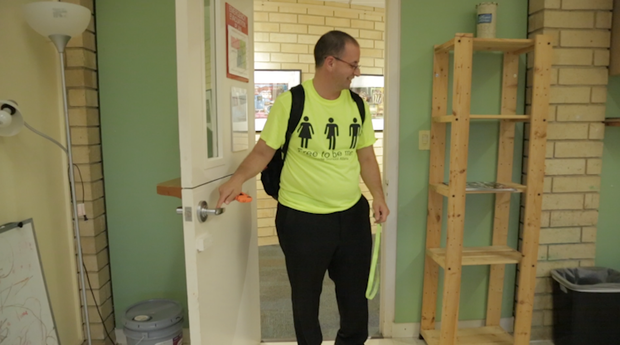

screen-shot-2016-08-12-at-1-10-38-pm.png
Christian Zsilavets opening up a classroom on the first day of Pride school.
 CBS NEWS


Farabee was born as female and named Sabrina. In February 2016, he changed his name and his pronouns after coming out to his parents, mother Stacia and step-father Jason Oberweis. His biological father transitioned from male to female in 2011.
"I don't think gender is finite," said Farabee. "To me it's how I feel most comfortable as."
"The full acronym is LGBTQQIAA," added Farabee. "It stands for lesbian, gay, bisexual, trans, queer, questioning, intersex, ally -- and agender. Or asexual. I think it's like both."
With a multi-colored pixie cut and full face expertly-applied makeup, Farabee's five-foot-one slender frame solidifies an outwardly feminine appearance. He said he often gets called a girl and "she."
"I understand -- I look like a girl," he smiled. "I'm not really trying to "make myself" look like a boy, except for wearing baggy jeans and a binder, sometimes, to flatten my chest."


screen-shot-2016-08-12-at-1-14-17-pm.png
Farabee holding up a binder that he wears to flatten his chest.
 CBS NEWS


As yet, there is no data on how many trans students are enrolled in U.S. schools, or the specific risks they may face. According to a June 2016 report by the Williams Institute, about 1.4 million adults in the U.S. identify as transgender -- double a widely-used previous estimate.
The same week Farabee started at Pride School, the CDC released the first nationally representative study on the health risks of the estimated 1.3 million U.S. lesbian, gay, and bisexual (LGB) high school students.
"I was bullied in school for a few years," said Farabee. "Most of my friends that are New LGBTQ school joins battle for trans rights in America - CBS News:

Harvard and Other Schools Are Abandoning Traditional Teacher-Preparation Programs - The Atlantic

Harvard Combats a Teacher Shortage By Easing Students Into the Classroom - The Atlantic:

Harvard's New Approach to America's Teacher Deficit

The school hopes reshaping how young people enter classrooms will keep them there longer.


When Kia Turner began college, she didn’t plan on a career as a public-school teacher. “I came into college thinking I was going to go into corporate law,” said 22-year-old Turner, who graduated from Harvard this spring. But after working at an after-school program, “I kind of realized I wanted to spend my time working for kids.”

So instead of heading to law school this fall, she’ll be teaching constitutional law to a group of 10th graders at Brooklyn’s Urban Assembly School for Law and Justice, one of eight recent Harvard graduates who will step into New York City classrooms as part of a teacher-preparation program launching this year.


That program, Harvard Teacher Fellows, is an attempt to reshape the way young teachers are trained to enter high-needs schools, and to avoid the pitfalls associated with asking inexperienced teachers to quickly take on the responsibilities of seasoned educators.


While there are similar teacher-preparation models around the country that offer individualized support as new teachers learn the ropes—often called residencies—the fellowship’s leaders hope it could be replicated across the country, potentially offering education schools a way to reinvent themselves as enrollment slides. “Nationwide, we’re in a teacher shortage, especially quality teachers,” said Eric Shed, the program’s director. “We really want to impact the field of teacher preparation.”


The fellowship is different from university models that include some student teaching, and programs like Teach For America (TFA), largely because fellows are eased into the profession and given significant mentorship and support as they acclimate to the classroom, according to Shed. During their first year, for instance, they are only expected to teach two or three classes each day after completing seven months of initial training and coursework. Once the training ends, fellows are expected to stay in high-needs classrooms for four to seven years.
TFA, by contrast, was launched in 1989, and offers five weeks of training and requests a two-year commitment from teachers. TFA has been criticized in the past for contributing to high teacher turnover at struggling schools, although theorganization has said its members have access to coaches and online support—and most of its alumni stay in the field.
Shed believes Harvard’s additional training and longer teaching commitment set it apart from other programs. He added that fellows are only sent to schools “where the administration [and] school culture is one that really supports and grows teachers.”
Harvard’s approach is supported by research that shows similar models may boost student outcomes and reduce teacher turnover, which can be a critical problem at Harvard Combats a Teacher Shortage By Easing Students Into the Classroom - The Atlantic:

Why Did Black Lives Matter and the NAACP Call for an End to More Charter Schools? | Mother Jones

Why Did Black Lives Matter and the NAACP Call for an End to More Charter Schools? | Mother Jones:

Why Did Black Lives Matter and the NAACP Call for an End to More Charter Schools?

"It's time to pause and take stock."

Students in a writing class at KIPP Memphis Collegiate Middle School in Memphis Alan Spearman/AP
A few weeks ago, the Movement for Black Lives, the network that also includes Black Lives Matter organizers, released its first-ever policy agenda. Among the organization's six demands and dozens of policy recommendations was a bold education-related stance: a moratorium on both charter schools and public school closures. Charters, the agenda argues, represent a shift of public funds and control over to private entities. Along with "an end to the privatization of education," the Movement for Black Lives organizers are demanding increased investments in traditional community schools and the health and social services they provide.
The statement came several weeks after another civil rights titan, the NAACP, also passed a resolution, calling for a freeze on the growth of charter schools. The NAACP had equated charters with privatization in previous resolutions, but this year's statement—which will not become policy until the National Board meeting in the fall—represents the strongest anti-charter language to date, according toJulian Vasquez Heilig, a professor of education leadership and education chair of the NAACP's California State Conference. "The NAACP is really concerned about unregulated growth of charter schools, and says it's time to pause and take stock," says Vasquez Heilig, who posted a copy of the resolution on his blog.
Such policy positions come at a time when parents, legislators, and philanthropists across the country—from Boston to Philadelphia to Los Angeles—are embroiled in fierce debates over the role of charters, particularly in poor, urban areas where most of these schools have been growing. Since 2000, the number of charters more thantripled, from about 1.7 percent to 6.2 percent of public schools.
Charter proponents—including prominent black educators like Secretary of Education John King Jr., Geoffrey Canada, and Steve Perry—argue that legislators need to continue this momentum for "choice" and competition among schools, citing the high test scores and college acceptance letters that many charter schools deliver. "We should not have artificial barriers to the growth of charters that are good," King told reporters at the recent annual National Association of Black Journalists–National Association of Hispanic Journalists convention, adding that "charters should be a part of the public school landscape and can be a driver of opportunity for kids."
Skeptics counter that charter schools contribute to racial and socioeconomic segregation, and that high percentages of charter school students in poor, urban districts can also contribute to the fiscal stress and the downward spiral of the traditional schools. Throughout the country, Vasquez Heilig noted, state charter laws vary dramatically: Some charter schools find ways to exclude disadvantaged children; others are created with explicit commitment to serve the most disadvantaged students. Vasquez Heilig argued that a moratorium would allow the public to investigate current practices, and promote those that work the best.
"It's time to pause and investigate: Should there be so many entities that are allowed to open them?" he said. "If you are not an educator, should you be allowed to open a charter school? Is there a due process for parents who feel that their kids were pushed out? How do charters schools make decisions about firing and hiring? How do they spend public money?"
Here are some of the most significant concerns charter school critics have cited over the years:
Some charter schools practice "skimming." There is growing evidence that some charters accept only the least difficult (and that means the least expensive to educate) students. Earlier this month, a report by the ACLU Foundation of Southern California and the public interest law firm Public Advocates found that 1 in 5 California charter schools practice restrictive admissions requirements or other exclusionary practices—even though charter schools are required by law to admit all students who wish to attend. Some of these practices included denying Why Did Black Lives Matter and the NAACP Call for an End to More Charter Schools? | Mother Jones:

California’s warring education factions dueling over federal rules | The Sacramento Bee

California’s warring education factions dueling over federal rules | The Sacramento Bee:

California’s warring education factions dueling over federal rules


 The newest front in California’s perpetual war over the direction of its public schools is in Washington, D.C.

State education officials have been battling a coalition of civil rights and education-reform groups over holding local schools accountable for academic outcomes.
The state Board of Education is on the verge of approving a “multiple measures” system that downplays academic testing, but critics say it’s too obtuse to be a meaningful tool for parents and the public.
The federal Every Student Succeeds Actlooms over California’s wrangling.
When the ESSA was passed last year, state officials hailed it as a complementary move away from top-down judgments toward more flexibility and local control. They talked confidently about designing a single accountability system that would meet federal and state standards.
However, ESSA still required schools to be ranked and the lowest-performing 5 percent of schools to be identified. The draft regulations issued by the U.S. Department of Education bolster that mandate, requiring states to “assign a comprehensive, summative rating for each school to provide a clear picture of its overall standing.”
Suddenly, state officials were disenchanted with what was coming from Washington, characterizing it as continuing the punitive attitude of the discarded No Child Left Behind program.
Conversely, however, the “equity coalition” of groups critical of multiple measures saw in the proposed federal rules elements of what they had been trying, unsuccessfully, to get the state to include.
This month, in a 10-page letter, Board of Education President Michael Kirst and Tom Torlakson, the state superintendent of schools, spelled out unhappiness with the federal rules, saying they “will derail the significant progress being made in our state towardsCalifornia’s warring education factions dueling over federal rules | The Sacramento Bee:

Read more here: http://www.sacbee.com/news/politics-government/politics-columns-blogs/dan-walters/article95206222.html#storylink=cpy

Half of Latino population doesn't have high school diploma - Appeal-Democrat: News

Half of Latino population doesn't have high school diploma - Appeal-Democrat: News:

Half of Latino population doesn't have high school diploma


Nearly half of Yuba City's Latino population had less than a high school education in 2014, according to a report published by national nonprofit Jobs for the Future.
The data, sourced from American Community Survey (part of the U.S. Census Bureau), showed the state average in 2014 for those with less than a high school education was 19.3 percent, and the rate of the local Latino population was 47.4 percent.
The second highest came from the Asian population (which also includes those of Indian descent) with 29.1 percent, and the white population with 8.4 percent.
"We have a major issue and need to identify opportunities to improve educational attainment in our minority communities," said Darin Gale, economic growth manager for Yuba City, in an email. The workforce development report that included the statistics included recommendations to create career pathways that feed into the local agribusiness and health care sectors.
Nancy Aaberg, superintendent of the Yuba City Unified School District, said the district utilizes a two-fold approach in supporting its English-learning students, who make up about one in five students in the district.
"The state has a much better program designed for English-learners ... but it took a long time to develop," Aaberg said.
That program comes in two parts: The first is a designated portion, which can be replaced with an elective class, in which teachers with specialized training give a formal lesson in the English language, including grammar and syntax.
The second part is integrated, where the students apply what they've learned back in their general classrooms. Aaberg said all of the district's teachers are certified in English language development in the integrated part of the day. Each school has a number of teachers who are certified for the designated part. Aaberg said the approach is to help students "really interact with the academic language."
'Fear in these statistics'
Francisco Reveles, the new superintendent of the Yuba County Office of Education, said the Latino statistic is changing, but it's a work in progress.
"It's more than a language barrier," Reveles said. "You have to look at it from a macro perspective." Reveles recalled his childhood in Texas, being the quarterback of his high school football team and valedictorian and then going home to a shower of a bucket and a can.
"It's a constellation of factors," Reveles said. He pointed to inadequate housing, unemployment, unsafe living conditions, access to equal opportunities with education and careers and children having major responsibilities at home.
"There's fear in these statistics," Reveles said. "It reflects a survival way of looking at the world."
He said to change that outlook from survival to success, schools need a curriculum that is culturally relevant: students must have stronger literacy levels earlier on; and schools must raise educational dialogue to put college on students' agendas early on.
"It's a collective responsibility," he said, though that doesn't mean to issue blame. "It's not a lack of aspiration."
Aaberg said that while it is easier for elementary school teachers to get to know their students' parents because the classroom size is smaller, parents of middle and high schoolers are also receptive and active.
"Parents of Hispanic children are very supportive of their education and very supportive of the work we do," Aaberg said. "We are very fortunate for our parent community."
Although Reveles stressed the importance of parental involvement with their children, he echoed Aaberg's sentiment.
"I'm encouraged by the caring I've seen here by educators ... and parents," he said.
Aaberg pointed to a flaw in the statistic, saying the age of those represented would be more telling of the change in school district programs.


"The good news is graduation rates are up and drop out rates are down," Aaberg said. "The graduation rates at both of our high schools are above 95 percent. Twenty percent of those students are English language learners."Half of Latino population doesn't have high school diploma - Appeal-Democrat: News:
 Resources

Sutter County One Stop
Offers an Adult Education program to improve reading or math skills, in addition to preparation for the General Educational Development test or to complete an adult high school diploma. It also offers English as a Second Language classes that funnel into the regular Adult Ed classes. One Stop also provides career technical training. For more information, go to its website: sutteronestop.com.
Yuba Community College
Yuba Community College also offers a wide variety of ESL classes ranging in skill. See every course they offer at: tinyurl.com/htl2r65.
Alliance for Hispanic Advancement
This group of community members help provide scholarships to Hispanic students, as well as a wide range of activities and programs to combat issues faced by the local Latino community. For more information, go to its website:tinyurl.com/jpcmufg or visit its Facebook page.Half of Latino population doesn't have high school diploma - Appeal-Democrat: News:

Sunday, August 14, 2016

Tim Farley: The Soft Bigotry of Low Expectations? — Medium

The Soft Bigotry of Low Expectations? — Medium:

The Soft Bigotry of Low Expectations?

The Wall Street Journal just published an article titled, “Clinton Abandons the Middle on Education.” The author, Mr. Peterson, is a senior editor at Education Next and he is a professor at Harvard University. Peterson makes the case that Hillary Clinton’s education policy plan is more in alignment with teacher union leaders as opposed to rank and file teachers and to Democrats themselves. He writes that “the party also promises that it will end the ‘test and punish version of accountability,’ and that the platform “includes a full paragraph of ideas” to regulate charter schools. Somehow, Mr. Peterson took the phrase, “recognize and honor all the professionals who work in public schools…” from the Democratic platform and parlayed that into: “suggesting that every teacher does a terrific job.” It’s odd, because I took the time to read the Democratic platform on education and nowhere does it state or imply “every teacher does a terrific job.”

Education Next conducted a survey of 700 teachers and 3,500 “other Americans,” with the results to be published next week. Using the results of this survey, Mr. Peterson seems intent on driving a wedge between “platform-committee Democrats” and “rank-and-file adherents,” citing that 80% of the R & F supported “all students be tested in math and reading each year.” Apparently Republicans had similar results in this survey. As an educational leader, I like surveys to help inform my decision-making to foster a better learning environment for my students. However, I do not like surveys that seem to have a political agenda. Just think if you were one of the survey participants (one of the 3,500 Americans). When asked if students should be tested in math and reading each year, would you answer no? Of course not. What if the survey question read as follows: “Do you think that ALL students (without regard for disability) should take high stakes tests in math and reading each year and any student who does not meet academic benchmarks will be retained for that academic year?” For some Florida third graders, this was a reality. Several students were going to be retained (not promoted to 4th grade) because their parents chose to “opt them out” of the state tests. Thanks to some parents who sued the school district, the school district administration changed their minds and are now allowing the third graders to move on to fourth grade.
The hit job from Mr. Peterson continues by stating that “57% of Democrats nationwide said they supported ‘basing part of the salaries of teachers on how much their students learn.’” One would think that the percentage seems a The Soft Bigotry of Low Expectations? — Medium:


Op-Ed: Privatizing public school custodians and facility management - NJ Spotlight

Op-Ed: Privatizing public school custodians and facility management - NJ Spotlight:

OP-ED: PRIVATIZING PUBLIC SCHOOL CUSTODIANS AND FACILITY MANAGEMENT

NJ school districts would be wise to think twice about privatization, which often means substantial hidden costs and reduced performance


 “As hard as you work?” Teachers couldn’t believe that Yule Bush, a dedicated veteran custodian in the Camden Public Schools, was being handed a pink slip. Often the first to enter the building and the last to leave, he is beloved by the students and teachers of Sumner Elementary School, an aging school built during the Coolidge administration in 1926. His expertise, hard work, and knowledge of Sumner was recently acknowledged by a student in a tear-jerking note who “admired the good work I do, keeping the school clean and smelling good,” according to Bush.

Unfortunately, Bush is not alone. He and his hardworking colleagues in Camden and other cities are losing their jobs as more and more districts choose to privatize school custodial staff. School districts in New Jersey as diverse as Clifton, Woodstown, Lacey, and Paterson are privatizing school custodial-staff members at alarming rates. As members of the Healthy Schools Now coalition, we are concerned about the impact of school privatization on school facility quality, as well as the social costs of this troubling trend. The proper investment in custodial staff will ensure adherence to the following sound advice of colonial activist and Founding Father Benjamin Franklin, “An ounce of prevention is worth a pound of cure.”
With the average age of New Jersey’s public schools at more than 50 years old and with many schools dating back to the turn of the 20th century, we are concerned that custodian privatization will have negative ramifications for the quality of our school facilities. All too often, custodial privatization is a euphemism for the wholesale replacement of knowledgeable and dedicated veteran staff members like Bush with lesser-paid temporary workers who don’t understand the unique challenges of addressing the significant facility issues of New Jersey’s aging public schools.
According to noted education scholar Walter Farrell, privatization leads to lower quality services, accountability problems, and hidden costs; most importantly, the financial benefits remain unproven. According to the Great Lakes Center for Education Research & Practice, custodial privatization processes suffer from loopholes in contracts, misleading cost-benefit analyses, indirect costs, and unrealistic introductory rates.
Due to the inexperience of the privatized school custodial staff and its lack of appropriate staffing, President Clarice Berry of the Chicago Principals Association, testified before a Chicago City Council committee that she was “terrified” of what would happen when the snow began. According to the Chicago Tribune, parents claim that the unsanitary bathroom conditions, overflowing garbage cans and soiled napping cots are the result of inadequate custodial care following the Chicago Board of Education’s decision to award multimillion-dollar custodial management contracts to two firms, Aramark and SodexoMAGIC.
Procurement and finance records obtained by the WBEZ 91.5 FM radio station show that Aramark billed the district nearly $22 million over the amount budgeted for the first 11 months of its three-year contract.
The magnitude of the custodian’s significance increases tremendously in buildings Op-Ed: Privatizing public school custodians and facility management - NJ Spotlight:

DFER’s Shavar Jeffries Cowers from Debating Cal State’s Julian Heilig | deutsch29

DFER’s Shavar Jeffries Cowers from Debating Cal State’s Julian Heilig | deutsch29:

DFER’s Shavar Jeffries Cowers from Debating Cal State’s Julian Heilig


On July 29, 2016, Cal State Sacramento professor and NAACP education chair,Julian Heilig, posted that the NAACP drafted a new resolution in which it called for a moratorium on charter schools.
By way of a follow up, on August 08, 2016, I posted the NAACP’s charter school resolution history, which reflects the organization’s growing concerns with problems associated with federally-enabled charter school proliferation. The 2016 resolution is the most detailed regarding the NAACP’s concerns about charters, including charter contribution to increased segregation; focus on punitive discipline practices; violation of parent and student rights, and fiscal mismanagement exacerbated by public funding directed by privately-appointed charter boards.
The above are serious concerns, thus prompting the NAACP to encourage a moratorium on privately-managed charter schools even as it also encouraged both state and local legislation to “ensure that parents have access to charter school advisory boards” and “executive action to strengthen local governance and transparency of charter schools, and, in doing so… protect students and families from exploitative governance practices.”
In its resolution, the NAACP notes that it is not alone regarding its concerns about charter schools and the resulting call for a moratorium on charters (which happen to be a federal funding favorite beginning with No Child Left Behind, NCLB):
…The NAACP shares the concerns of the Journey for Justice Alliance, and alliance of 38 organizations of Black and Brown parents and students in 23 states, which has joined with 175 other national local grassroots community, youth, and civil rights organizations calling for a moratorium on the Federal Charter schools program, which has pumped over $3 billion into new charter schools, many of which have already closed or have failed the students drawn to them by the illusive promise of quality.
On August 03, 2016, the corporate-reform organization, Democrats for Education Reform (DFER) president Shavar Jeffries released the following statement dismissing the NAACP et al.’s detailed concerns about charters and the resulting call for moratorium on associated federal dollars:
The public charter school moratorium put forward at this year’s NAACP convention does a disservice to communities of color, particularly the parents and caregivers who seek the best school options available to prepare their children for the demands of the 21st century. This moratorium would contravene the NAACP’s historic legacy as a champion for expanding opportunity for families of color. In communities of color throughout our country, public charter schools are providing pathways to college and careers 
DFER’s Shavar Jeffries Cowers from Debating Cal State’s Julian Heilig | deutsch29:


Amid teacher shortage, Fresno Unified recruits educators from Starbucks to Mexico | Fresno Bee

Amid teacher shortage, Fresno Unified recruits educators from Starbucks to Mexico | Fresno Bee:

Amid teacher shortage, Fresno Unified recruits educators from Starbucks to Mexico


More than 300 new teachers will join the Fresno Unified School District this year, some who have been recruited while waiting tables or bagging groceries, others who have been recruited from as far as Mexico.
As of Aug. 8 – one week before Monday’s start of the school year – nearly 50 Fresno Unified classrooms were still without a teacher, in part due to California’s teacher shortage. Fresno Unified is now recruiting far and wide, tapping into programs that allow alternative teaching certifications and admittedly getting creative.
“We’ve recruited from the dog park, from The Cheesecake Factory and Starbucks. Wherever we go, we recruit constantly,” said Cyndy Quintana, human relations administrator for the district. “There is a teacher shortage, but Fresno Unified is alive and well and being creative. Everyday is an interview.”

Crossing borders

In the past year, Quintana has traveled up and down the state and flown to New York, Texas and New Mexico in search of teachers to bring to Fresno Unified – California’s fourth-largest school district. And she has good selling points: You can afford to live here on a teacher’s salary, unlike educators struggling to make ends meet in the Bay Area. Yosemite National Park is within a reasonable drive, she tells them. And a beach isn’t too far away, either.
Quintana has become a walking, talking billboard for the city of Fresno, and is willing to do what it takes to fill classrooms. This summer, she had three teachers from Mexico living in her home to help them get on their feet. She recently traveled to Mexico to recruit and came back with five new teachers – the first time the district has tapped that country for educators in 20 years.
The teachers were hired as part of a California Department of Education program that helps districts find qualified candidates from other countries and fronts the costs to sponsor them, while also assisting incoming teachers with their work visas and other paperwork.
Lucero Escareno, 28, is from Coahuila, Mexico, and taught there for six years. She starts at Sunset Elementary School this week, a bilingual school in Fresno, and sees her own learning experiences during her first trip to the United States as a connection with her future students.
“I think it’s going to be a real challenge. As you can see, I’m struggling right now with my English, so maybe those students are also struggling,” she said. “I’m here to help them andAmid teacher shortage, Fresno Unified recruits educators from Starbucks to Mexico | Fresno Bee:


CURMUDGUCATION: Resolve To Listen

CURMUDGUCATION: Resolve To Listen:

Resolve To Listen


For the next couple of weeks, as the beginning of my school year approaches. I'm going to write to renew my resolve to keep focus in my practice. This is one of that series of posts.

It is easy to stop listening.

Oh, it's easy to act like you're listening, to look like you're listening. People take management classes on how to fake listening (not that it's described in those terms), to pretend to listen ads a way to get "buy-in," to get people to imagine that they had something to do with what ultimately happened.

And it's easy to slip into the habit of just letting others' words wash over you as you wait for the chance to say what you want to say. It's really easy to do that in a classroom if you actually have a plan for what you intend to say today. You can actually become impatient with students who are still talking while you are anxious watching the clock and thinking about the Three Important Aspects of American Critical Realism that you planned to talk about before that bell rings in just seven minutes and forty-seven seconds and dammit, Pat, just stop talking so I can start talking!

And there's more to listening than just the pedagogical and instructional parts. There are the interruptions, the times between class, the moments that seem off the wall. They can seem random, annoying, disruptive, and yet they mostly are encrypted versions of messages that students are either unwilling or unable to deliver more directly. I can slap a student down and silence them 
CURMUDGUCATION: Resolve To Listen:

Seattle Schools Community Forum: 100 Black Parents Announces Event

Seattle Schools Community Forum: 100 Black Parents Announces Event:

100 Black Parents Announces Event

What's Next for Black Students at GHS? 

A Talk With Ted Howard.
Parents of African American students at Garfield High School will be meeting with Principal Ted Howard to present a proactive platform of goals and expectations for the 2016-17 school year. 

This platform will be a living, guiding document that will be a tool to enhance the Black Student Experience at Garfield.

THURSDAY, AUGUST 18TH
6PM

1634 19th Avenue, Seattle, WA 98122

SHARE THIS EMAIL TO OTHER GHS PARENTS OF AFRICAN AMERICAN STUDENTS

INVITE OTHER PARENTS ON FACEBOOK HERE:

https://www.facebook.com/events/543164659224000/


This meeting is specific to GARFIELD HS PARENTS, However, if you're a parent of an African American Student at another Seattle Public High School you are welcome to attend as the platform that we are asking for at Garfield will be something that we can replicate at other schools. 

PLEASE SHARE.
Seattle Schools Community Forum: 100 Black Parents Announces Event:


ATTORNEY KATHLEEN CARROLL'S 6 YEAR LITIGATION AND VICTORY GIVES INSIGHT INTO RAFE ESQUITH'S CASE AGAINST LAUSD - Perdaily.com

ATTORNEY KATHLEEN CARROLL'S 6 YEAR LITIGATION AND VICTORY GIVES INSIGHT INTO RAFE ESQUITH'S CASE AGAINST LAUSD - Perdaily.com:

ATTORNEY KATHLEEN CARROLL'S 6 YEAR LITIGATION AND VICTORY GIVES INSIGHT INTO RAFE ESQUITH'S CASE AGAINST LAUSD


California Teacher Credentialing's (CTC) six-year outrageous targeting, harassing, fabricating of "evidence," and firing of their Attorney Kathleen Carroll for having been a whistleblower against CTC nepotism and endemic corruption has all the same elements of targeted LAUSD teacher Rafe Esquith et al case under similar circumstance. The only question is whether the Mark Geragos firm under lead attorney Ben Meiselas has the wherewithal to hang in their for at least the 6 years it will take to vindicate their client against an LAUSD that is willing to spend whatever amount of the taxpayers' money necessary to assure that they will never be held accountable.

Although Esquith recently won the first round against LAUSD in their attempt to get his lawsuit thrown out of court on 7/13/16, the purposefully protracted and obscenely expensive nature of judicial proceedings- with strong sanctions for their non-fulfillment- are clearly designed to assure that justice not only will be delayed, but there is a strong possibility that it ultimately might just ATTORNEY KATHLEEN CARROLL'S 6 YEAR LITIGATION AND VICTORY GIVES INSIGHT INTO RAFE ESQUITH'S CASE AGAINST LAUSD - Perdaily.com:

Shavar Jeffries of DFER Cancels Debate with Julian Vasquez Heilig | Diane Ravitch's blog

Shavar Jeffries of DFER Cancels Debate with Julian Vasquez Heilig | Diane Ravitch's blog:

Shavar Jeffries of DFER Cancels Debate with Julian Vasquez Heilig


Julian Vasquez Heilig is a noted scholar of subjects such as democratic governance, social justice, inequity, and Teach for America. He has recently debated leading figures in the corporate reform movement, including Howard Fuller and Steve Perry. (Both debates will be posted here.)
He thought that Shavar Jeffries, the president of Democrats for Education Reform, agreed to debate him. But suddenly, Jeffries tweeted that he would not debate Heilig because Heilig is “not serious.”
Shavar Jeffries said that Heilig’s blog “Cloaking Inequity” could have been written by a sixth-grader.
You can follow their tweets:
@ProfessorJVH for Heilig
and
@shavarjeffries for Jeffries, who ran unsuccessfully for Mayor of Newark and now leads the hedge fund managers’ group DFER.
 Shavar Jeffries of DFER Cancels Debate with Julian Vasquez Heilig | Diane Ravitch's blog:

Why American Schools Are Even More Unequal Than We Thought - The New York Times

Why American Schools Are Even More Unequal Than We Thought - The New York Times:

Why American Schools Are Even More Unequal Than We Thought

Koren Shadmi

Education is deeply unequal in the United States, with students in poor districts performing at levels several grades below those of children in richer areas.
Yet the problem is actually much worse than these statistics show, because schools, districts and even the federal government have been using a crude yardstick for economic hardship.
A closer look reveals that the standard measure of economic disadvantage — whether a child is eligible for a free or reduced-price lunch in school — masks the magnitude of the learning gap between the richest and poorest children.
Nearly half of students nationwide are eligible for a subsidized meal in school. Children whose families earn less than 185 percent of the poverty threshold are eligible for a reduced-price lunch, while those below 130 percent get a free lunch. For a family of four, the cutoffs are $32,000 for a free lunch and $45,000 for a reduced-price one. By way of comparison, median household income in the United States was about $54,000 in 2014.
Eligibility for subsidized school meals is clearly a blunt indicator of economic status. But that is the measure that policy makers, educators and researchers rely on when they gauge gaps in academic achievement in schools, districts and states.
The National Assessment of Educational Progress, often called the Nation’s Report Card, publishes student scores by eligibility for subsidized meals. Under the federal No Child Left Behind Act and its successor, the Every Student Succeeds Act, districts have reported scores separately for disadvantaged children, with eligibility for subsidized meals serving as the standard measure of disadvantage.
With Katherine Michelmore, a postdoctoral researcher at the University of Michigan, I have analyzed data held by the Michigan Consortium for Educational Research and found that this measure substantially understates the achievement gap.
In Michigan, as in the rest of the country, about half of eighth graders in public schools receive a free or reduced-price lunch. But when we look more closely, we see that just 14 percent have been eligible for subsidized meals Why American Schools Are Even More Unequal Than We Thought - The New York Times: