Latest News and Comment from Education

Thursday, June 2, 2016

Failing the Test: Charter School Powerbrokers - CAPITAL & MAIN
Failing the Test: Charter School Powerbrokers - CAPITAL & MAIN:

Failing the Test: Charter School Powerbrokers

Photo by Pandora Young
The Billion Dollar Investment
Charter proponents, most notably the Walton Family Foundation, contribute large amounts of money to expand charter schools in select cities around the nation. The foundation says it has invested more than $385 million in new charter schools over the past two decades and, earlier this year, announced that it plans to give $1 billion over five years to support charters and school-choice initiatives.
In announcing its $1 billion strategic plan to support new and existing charter schools, the foundation has said the money would go to four initiatives – investing in cities, supporting the school-choice movement, innovation and research. It identified 13 cities nationwide where it said it can have the biggest impact, including Los Angeles and Oakland. Los Angeles already has more charter schools than any other school district in the United States and Oakland has the highest percentage of charters for any district in California.

See More Stories in Capital & Main’s Charter School Series


If funders like Eli Broad or the Walton Family Foundation were truly committed to education equality,” says John Rogers, an education professor at the University of California, Los Angeles, “they could have taken steps to simply support reducing class size or after-school [activities] or summer programs that would provide more educational opportunity, rather than try to invest in strategies to undermine the capacities of a school district. The primary aim is to dismantle the school district as a whole and replace it with a new way of doing public education.”
Gary Miron, a professor of education at Western Michigan University, agrees. “They believe in privatization,” he says. Miron co-authored a critical study, sponsored last year by the National Education Policy Center, that focused on the charter industry’s funding policies.
Philanthropists, says Kevin Welner, director of the National Education Policy Center, “like charters in part because they decrease the publicness of public schools.”
But why do so many charter advocates embrace privatization?
I don’t think it’s about the money,” says Kevin Welner, director of the National Education Policy Center at the University of Colorado at Boulder. “They like charters in part because they decrease the publicness of public schools. They want a system much more based on market forces because they don’t trust democracy.”
Netflix founder and prominent charter advocate Reed Hastings seemed to confirm this view when, during a 2014 convention of the California Charter Schools Association, he decried publicly elected school boards for their alleged lack of stability in governance. He then praised the closed-governance charter model of private boards whose “board members pick new board members.”
But should the private sector be in charge of public education?
No,” says Welner. “The public sector should be in charge of public education. Public education should be under democratic control.”
Welner is not alone in his view.
The radical agenda of the Walton family,” says a damning report issued last year by the American Federation of Failing the Test: Charter School Powerbrokers - CAPITAL & MAIN:


Big Education Ape: Failing the Test: Charter Schools’ Winners and Losers - CAPITAL & MAIN - http://bigeducationape.blogspot.com/2016/06/failing-test-charter-schools-winners.html
05rosalb


Big Education Ape: UPDATE: Failing the Test: A New Series Examines Charter Schools - CAPITAL & MAIN -http://go.shr.lc/1t3PT0f

Failing the Test

The LA Times Editorial—A Distraction

The LA Times Editorial—A Distraction:

The LA Times Editorial—A Distraction

ginger tabby cat distracted by treats
There’s so much bad news about public schools. When one article makes you want to pop the cork and dance in the streets, it is easy to get excited.
Don’t. The tables haven’t really been turned.
The LA Times Editorial criticizes the Gates Foundation for their poor philanthropic use of billions of dollars spent on school reforms.
They disparage them for failing in three areas:
  1. Small Schools
  2. Teacher Effectiveness
  3. Common Core
They just now figured this all out?
We’ve been here before. Remember the 2006 Business Week article “Bill Gates Gets Schooled” by Jay Greene and William J. Symonds?
That article described how difficult Gates found it to break up schools. But they still did their damage.
Then there was the American Enterprise’s criticism of the Gates Foundation and their failed involvement with the Philadelphia School of the Future. The school threw away books, along with the library, and was an abysmal disaster.
A few weeks later the school wasThe LA Times Editorial—A Distraction

6/2/2016 – Trump University Shows Why For-Profit Motives Don’t Belong In Education

6/2/2016 – Trump University Shows Why For-Profit Motives Don’t Belong In Education:

Trump University Shows Why For-Profit Motives Don’t Belong In Education


THIS WEEK: Charter School Fail … School Conditions Worsen … Poor Kids Shortchanged … College Favors The Rich … Education Is Rigged

TOP STORY

Trump University Shows Why For-Profit Motives Don’t Belong In Education

By Jeff Bryant

“Sure, Trump University is an outrage. But the lesson to learn goes beyond Trump himself and his alleged crookedness. What’s also likely true is that this egregious institution is yet another example of how profit making and education are a bad mix for all except the few who are able to bank the results.”
Read more …

NEWS AND VIEWS

Failing the Test: Charter Schools’ Winners and Losers

Capital & Main

“Some highly motivated students benefit from charters while others do worse; that the growth of charters places a huge financial burden on traditional public schools that send them into a tailspin and that charters may increase racial and economic segregation… Traditional public schools often go into a steep slide once charters enroll a substantial percentage of motivated students with engaged parents. As a result, traditional public schools are left with a disproportionately high percentage of children with disciplinary problems, as well as with severely disabled students, who are expensive to educate … The problem is made worse by the fact that “charter schools discriminate against kids with special needs’ … Even if many charters perform well, there is an overarching problem with a system that entrusts much of its public education to private institutions.”
Read more …

Title I: Rich School Districts Get Millions Meant For Poor Kids

U.S. News & World Report

“Title I, the largest federal K-12 program … can shortchange school districts with high concentrations of poverty, and benefit larger districts and big urban areas instead of poorer, rural districts and small cities … It also shortchanges smaller high-poverty urban districts, like Flint, Michigan … Changing the formula requires congressional action, which nearly everyone agrees is years away.”
Read more …

A Popular College Investment Promised Students A Career, But Didn’t Pay Off

The Washington Post

“Students who sought vocational certificates at for-profit colleges made an average of $900 less annually after attending the schools than they did before … For-profit college industry swindled students by pressuring them into racking up tens of thousands of dollars in debt while adding comparatively little value to their careers … The average tuition for certificate students at for-profit colleges was $8,118, compared to $712 for community college.”
Read more …

Policies To Help Students Pay For College Continue To Shift Toward Favoring The Rich

The Hechinger Report

“Some government, university and private programs to help Americans pay for college have become more likely to benefit wealthier students than even the most academically talented lower-income ones … The proportion of wealthier students earning degrees continues to rise, while the proportion of lower-income degree recipients is falling … The new movement by states to underwrite public universities based on such things as their graduation rates … Even this well-intentioned scheme, called income-based repayment, tends to favor wealthier students.”
Read more …

The Education System Is Rigged Against Low-Income Students, Even In Kindergarten

The Huffington Post

“Students born into poverty enter kindergarten at a disadvantage to more affluent peers. As they advance through the grades, they receive lower test scores. They’re more likely to drop out and less likely to enter higher education. The all-too-familiar cycle … is getting worse… The impact of educational disparities between affluent and low-income students, as well as between white students and students of color, loom large … Still, interventions that boost positive learning approaches appear promising.”
Read more …
6/2/2016 – Trump University Shows Why For-Profit Motives Don’t Belong In Education:

Step-by-step Privatization and Profit: ESSA Delivers Schools to Wall Street with a Bow on Top

educationalchemy | Authored by Morna McDermott-A blog dedicated to democracy, public education, and the power of the imagination to fight corporate greed–if the truth sounds crazy it is because we have become too accustomed to falsehoods:

Step-by-step Privatization and Profit: ESSA Delivers Schools to Wall Street with a Bow on Top


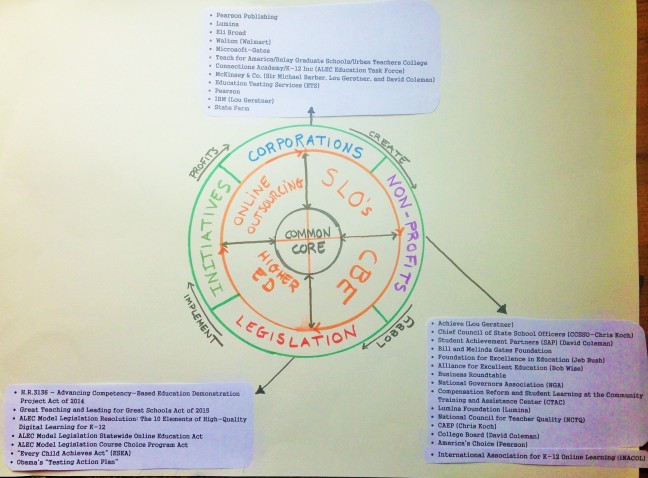
ccsschart2REV


Social impact bond projects are very definitely privatisation. PFI/PPP projects have effectively privatised the design, finance, construction and maintenance of much public infrastructure. Now social impact bond projects potentially privatise the design, finance, service delivery, management, monitoring and evaluation of early intervention and prevention policies.”
Step One- Curriculum: Common Core standards created one set of standards (modules) (originating from a global agenda circa 1985) For a full history of support for this outline click the link.
According to a promotional flyer created by the Bill and Melinda Gates Foundation:
“Education leaders have long talked about setting rigorous standards and allowing students more or less time as needed to demonstrate mastery of subjects and skills. This has been more a promise than a reality, but we believe it’s possible with the convergence of the Common Core State Standards, the work on new standards-based assessments, the development of new data systems, and the rapid growth of technology-enabled learning experiences.” 
So that…
Step Two-Testing: There can be one consistent numerical metric by which to measure student outcomes (PARCC)
So that…

Federally Mandated Test-and-Punish Didn’t Go Away with NCLB | janresseger

Federally Mandated Test-and-Punish Didn’t Go Away with NCLB | janresseger:

Federally Mandated Test-and-Punish Didn’t Go Away with NCLB


 As you very likely remember, No Child Left Behind, the much hated 2002 version of the federal education law—the one Jonathan Kozol once called “the federal testing law”— was reauthorized last December. Now instead we have the Every Student Succeeds Act (ESSA).  There is widespread agreement that nearly fifteen years’ of test-based accountability has failed to raise overall student achievement; flat and declining scores on the National Assessment of Education Progress confirm that failure. Neither has the annual testing and disaggregation of scores resulted in the diminishing of achievement gaps. But the federal government doesn’t shift direction so easily.  Here is a quick update on what is happening as the rules that will implement the new law are being developed.

There is one bright spot: In the new law, Congress eliminated any federal mandate to tie teacher evaluation to students’ standardized test scores.  The U.S. Department of Education had made it a requirement that states applying for federal waivers from the worst punishments of NCLB could qualify for waivers only if they agreed to pass state laws to tie teacher evaluation to what have been called Value Added Measures—VAM algorithims that try to calculate the amount of learning each teacher “adds” to the overall education of each student.  The American Statistical Association, the American Educational Research Association and a number of academic researchers have demonstrated that VAM scores not only fail to measure many qualities of excellent teachers, but also are inaccurate and unstable from year to year.  It is possible that Congress listened to the experts—more likely that it listened on this one issue at least to the National Education Association and the American Federation of Teachers and many others who pointed to obviously flawed low VAM ratings for many award-winning teachers and to the collapse of morale among teachers across the United States.
While Congress eliminated the federal push to evaluate teachers by students’ scores, it could not undo the teacher-evaluation laws passed in recent years across the states to qualify for federal waivers. Hawaii, at least, has now begun to undo the damage, according to a mid-May report from the Hawaii Tribune-Herald: “Educators in Hawaii just became a little more Federally Mandated Test-and-Punish Didn’t Go Away with NCLB | janresseger:

State officials find LA Unified shortchanged students | EdSource

State officials find LA Unified shortchanged students | EdSource:

State officials find LA Unified shortchanged students


In a ruling with statewide implications and financial repercussions for the state’s largest school district, the California Department of Education has determined that Los Angeles Unified has shortchanged low-income students, English learners and foster children by hundreds of millions of dollars they should have received through the state’s new funding system.
The department stated in a May 27 report that L.A. Unified improperly attributed $450 million in benefits for special education students as also contributing to meeting the requirements of the Local Control Funding Formula, which is weighted to provide additional services for children in greatest need. The department found that by counting the same expenditure twice, the district spent less than required on high-needs students. As a remedy, the state has ordered the district to revise its 2016-17 spending plan, known as the Local Control Accountability Plan, or LCAP, to add additional services and programs for the district’s high-needs students.
“We applaud the department for issuing its straightforward legal ruling and ordering L.A. Unified to comply with the law under the Local Control Funding Formula,” John Affeldt, managing partner of the nonprofit law firm Public Advocates, said in a statement. “We look forward to seeing the district halt this illegal practice and invest more fully in its low-income students, English learners and foster youth.”
In a statement late this afternoon, L.A. Unified said it intends to challenge the decision, “which we believe is an incorrect interpretation of the Local Control Funding Formula. If the decision is allowed to stand, it would seriously undermine the district’s ability to continue providing our deserving students with the effective instruction and support services they need to succeed.State officials find LA Unified shortchanged students | EdSource:


More public money for the 1% - less resources for the rest of Connecticut’s public school students - Wait What?

More public money for the 1% - less resources for the rest of Connecticut’s public school students - Wait What?:

More public money for the 1% – less resources for the rest of Connecticut’s public school students


Governor Dannel Malloy, with the support of Democratic legislators, has made the deepest cuts in state history to Connecticut’s public schools.  Already inadequately funded, Connecticut’s elected officials are now truly undermining the opportunity for every Connecticut child to get the education the need and deserve.
However, Connecticut’s fiscal crisis isn’t stopping Malloy’s political appointees on the State Board of Education from shoveling even more public funds to the privately owned and operated companies that run Connecticut’s charter schools – entities that refuse to educate their fair share of students with special education requirements or those who need extra help becoming proficient in the English Language (ELL students.)
At yesterday’s State Board of Education meeting (June 1, 2016)), Governor Malloy’s appointees voted to allocate even more funding for charter schools, while pretending their primary responsibility to adequately fund public schools wasn’t being undermined by Malloy’s actions.
In Charter school enrollment set to rise, the CT Mirror reported that the State Board of Education was moving forward with a proposal from Malloy’s Commissioner of Education to allow charter schools to increase enrollment at charter schools next fall, noting;
While the enrollment increase will cost the state an additional $4.1 million next year, funding for traditional public schools is being cut by $51.7 million and for regional magnet schools, opened to help desegregate city schools, by $15.4 million.
In recommending that 14 of Connecticut’s 23 charter schools be allowed to enroll another 401 students, Education Commissioner Dianna Wentzell wrote the publicly funded schools had a “demonstrated record of achievement.”
However, Wentzell isn’t telling the truth.  The reality is that many Connecticut charter More public money for the 1% - less resources for the rest of Connecticut’s public school students - Wait What?:

Will Malloy and Dems cover up new state budget deficit until after the November election? - Wait What? - http://go.shr.lc/1t46gtI


Education May Never Be “Great Equalizer,” But Must Model Equity – the becoming radical

Education May Never Be “Great Equalizer,” But Must Model Equity – the becoming radical:

Education May Never Be “Great Equalizer,” But Must Model Equity


Model and actress, Emily Ratajkowski gained fame from a misogynistic and exploitive music video, but has since emerged as a complicated and important feminist voice confronting the sexualizing of women and body shaming.
Ratajkowski’s Instagram account mainly offers personal and professional photographs of Ratajkowski in various states of undress, but she is also prone to using that platform for the occasional political message.
Recently, she posted a grainy photo of crudely taped note challenging dress codes in schools for discriminating against females; as the note states, “INSTEAD OF SHAMING GIRLS FOR THEIR BODIES, TEACH BOYS THAT GIRLS ARE NOT SEXUAL OBJECTS.”
I shared this on social media myself, and encountered a number of not surprising responses—many of which where the typical “but” offered by men when sexism is exposed.
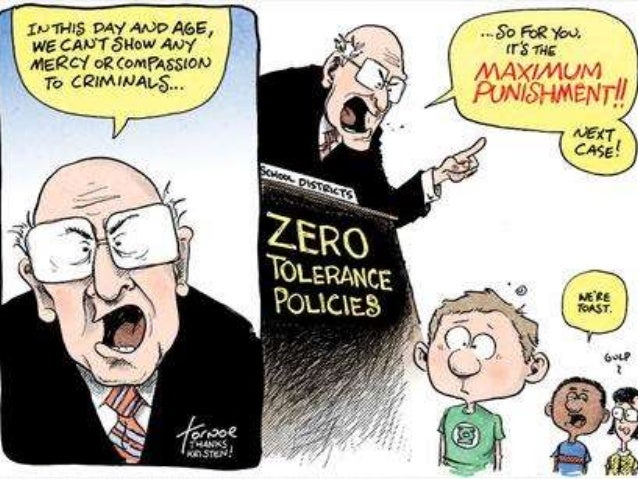
The central message of the note posted by Ratajkowski is both well documented [1] and urgent in terms of the essential inequity found in many traditional school policies such as dress codes and disciplinary guidelines and outcomes: Dress codes are sexist and school discipline (notably suspension and expulsion) is racist—paralleling the same inequities in U.S. society.
School dress codes and discipline policies, then, represent the tragic failure of claiming that Education May Never Be “Great Equalizer,” But Must Model Equity – the becoming radical:
 

High school suspensions cost the country $35 billion annually, report estimates | 89.3 KPCC

High school suspensions cost the country $35 billion annually, report estimates | 89.3 KPCC:

High school suspensions cost the country $35 billion annually, report estimates

When students get suspended from school for a few days, they may not be the only ones who miss out.
report released today by UCLA's Civil Rights Project tries for the first time to quantify the full social cost of so-called "exclusionary discipline."
The authors calculate that suspensions in just one year of school — 10th grade — contributed to 67,000 students eventually dropping out of high school. And that, they conclude, generates total costs to the nation of more than $35 billion.
Russell Rumberger, a co-author of the study and a professor emeritus at the University of California, Santa Barbara, says that number is conservative. "That's just for a single year."
This study used a two-step process to put a price tag on school suspensions, by calculating:
1) The likelihood that a suspended student will leave school altogether.
2) The cost to society when people drop out of high school.
The second step, from dropouts to money, is pretty well established:
  • People who don't earn a high school diploma on time tend to earn less money, which means they pay less in taxes.
  • They are less likely to have health insurance. Which means less access to prevention, and eventually worse health. They'll need more care — with a higher share of the cost paid for by taxpayers.
  • They are more likely to have trouble with the law, which costs taxpayers in the form of court and prison costs.
  • And they rely on public assistance at higher rates.
In California, for example, it's been estimated that the average high school dropout generates $168,880 in losses to federal, state and local governments over the course of a lifetime.
That first step, calculating how likely a suspended student is to drop out, requires a little more explanation.
In the U.S., only 71 percent of 10th-graders who were suspended at least once in the 2001-2002 school year graduated from high school two years later, the UCLA report High school suspensions cost the country $35 billion annually, report estimates | 89.3 KPCC:


CURMUDGUCATION: How To Blackmail a Teacher

CURMUDGUCATION: How To Blackmail a Teacher:

How To Blackmail a Teacher


This is not a post about some reformster program or educational policy. This is about just how low someone can go. This is about one of the worst websites I have ever come across.

TeacherComplaint.com is a site that looks clunky, but makes an offer that seems appealing:

TeacherComplaints.com - A Unique Web Site which allows Students & Parents to take control of what goes on in school!

Do you feel that your child is treated unfairly in class? Do you feel that your child gets to much home work? - Do you feel that your teacher doesn't understand your child / student? Do you feel that the school staff could care less about your problems, feel neglected? - Here, You can give an in depth report of how a school and teacher uses his/ her classroom and how they treat you as a parent and student.. Why Rate A Teacher or school (which can be maniputalted) When you can File A Teacher Complaint!

They claim to have been mentioned on major news networks. Ed Week took a look at it back in 2011; it has been around since 2009 ("This site has officially went online today- March 11, 2009"). It ranks around 368,000 on alexa.

So why am I picking on a site that exists to give students and parents a voice, which provides them with a chance to speak up about injustice they see at school? Isn't that a good thing, even if it is a site that is rife with spelling and usage errors? Certainly lots and lots of folks are using it-- with new complaints posted as recently as yesterday. Why am I calling this the worst thing ever.

The answer can be found in this paragraph on the site, which gives us a better picture of the business model involved:

To bad teachers who have made a big mistake in the teaching profession, we recognize that you CURMUDGUCATION: How To Blackmail a Teacher:


Failing the Test: Charter Schools’ Winners and Losers - CAPITAL & MAIN

Failing the Test: Charter Schools’ Winners and Losers - CAPITAL & MAIN:

Failing the Test: Charter Schools’ Winners and Losers

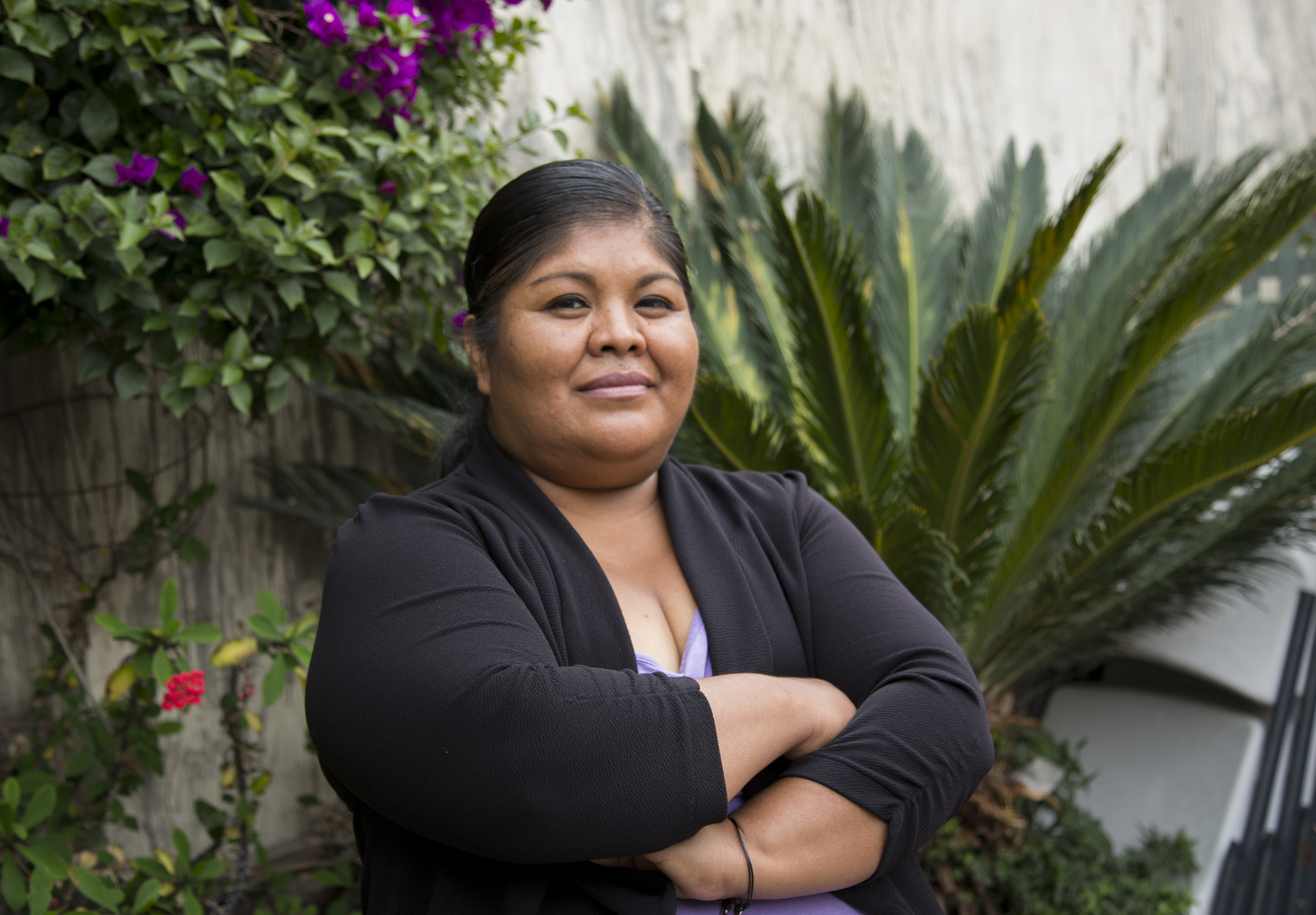
05rosalb
Rosalba Naranjo (Photo by Pandora Young)
At first, Rosalba Naranjo was thrilled that her two daughters were attending Richard Merkin Middle School, a charter school located near downtown Los Angeles. After all, the Pico Union neighborhood school, which is operated by Alliance College-Ready Public Schools, offered relatively small class sizes and the promise of a good education. And her son, who is now in high school, had previously attended the school.

See More Stories in Capital & Main’s Charter School Series

Naranjo, a 42-year-old Mexican immigrant, was looking forward to being involved in her daughters’ education and playing a role in the school community. But when she became concerned over several issues, including what she described as a high teacher-turnover rate, she says the school wasn’t interested in hearing from her and other parents.

Research Shows That Charter Schools:
  • Place huge financial burdens on traditional public schools
  • Increase racial and economic segregation
  • In L.A., enroll a smaller percentage of children with severe disabilities than do L.A.’s public schools
Over time I’ve come to find out that we as parents don’t have any participation in the schools,” Naranjo says in Spanish, speaking through an interpreter during an interview with Capital & Main. “When they talk about charter schools they always say they are the best and that they want what’s best of our kids and are here to help us. It makes me feel very sad because my daughters aren’t getting the kind of help I want and it’s a challenge. I’ve tried to be involved – at this school, they don’t allow that to happen.” (Capital & Main repeatedly asked Alliance Schools to respond to this article but received no reply.)
Among other things, Naranjo says that she has been warned not to ask questions in front of other parents and has been pressured to take a stand against a campaign by teachers for unionization. To be sure, Naranjo has positive things to say about the school. “The education is good a lot of the time, from what I can tell,” she says. “But sometimes I do feel there is not enough being done – and we are not allowed to ask questions about that to administrators.”
Naranjo’s claims are typical of those made by other parents against charter schools at a time when philanthropist Eli Broad, the Walton family and many others are seeking to dramatically increase the number of charters operating in Los Angeles.
The issue exploded publicly last September after the Los Angeles Times obtained a copy of a 44-page memo that outlined a proposal spearheaded by the Eli and Edythe Broad Foundation, under which one-half of all Los Angeles Unified School District students would be enrolled in charter schools within eight years. Currently, about 16 percent of the students in LAUSD attend charters. The proposal notes that since 2004, the Broad Foundation has invested more than $75 million to support Los Angeles charter schools. This funding has helped fuel the growth of several large charter operators, including Alliance, which is the largest provider of charter schools in Los Angeles, with 27 charter high schools and middle schools serving about 12,000 public school students.
Charter school supporters, such as Broad and the California Charter Schools Association (CCSA), argue that the schools provide a superior education and give opportunities to children in poor neighborhoods. For that reason, they say, it makes sense to increase the number of charters in Los Angeles and elsewhere.
If you have schools doing really well that are making an impact on student learning, you should expand them,” Jason Mandell, a Los Angeles-based spokesman for the CCSA, says in an interview. “People are desperate for schools that are helping kids learn. I would encourage all of us to not forget the reason we are here – which is student learning.”
However, interviews with educators, charter school proponents and opponents, and a review of respected academic studies, show that some highly motivated students benefit from charters while others do worse; that the growth of charters places a huge financial burden on traditional public schools that send them into a tailspin and that charters may increase racial and economic segregationFurthermore, the percentage of total LAUSD charter school students with severe disabilities is less than one-third the percentage of students with disabilities in LAUSD public schools.

Charter schools are inherently a ‘some kids,’ model says Steve Zimmer, who was elected to the Los Angeles United School District (LAUSD) Board of Education in 2009 after 17 years as a high school teacher and counselor, referring to his belief that certain children do well in charters and others do not. “There’s no doubt that some kids have been served well by charters. I think there is an inflation of outcome celebration with charter schools, but I also want to give credit where credit is due, there has been some very good instructional quality and instructional outcome from some of our charter partners.”Failing the Test: Charter Schools’ Winners and Losers - CAPITAL & MAIN:
Big Education Ape: UPDATE: Failing the Test: A New Series Examines Charter Schools - CAPITAL & MAIN - http://go.shr.lc/1t3PT0f
Failing the Test

Success Academy Charter Schools Cancels Pre-K Program for the Fall - WSJ

Success Academy Charter Schools Cancels Pre-K Program for the Fall - WSJ:

Success Academy Charter Schools Cancels Pre-K Program for the Fall
Charter at odds with City Hall over program contract


After months of fighting with City Hall about a prekindergarten contract, Success Academy Charter Schools said Wednesday it was canceling its pre-K program for the fall.
For nearly a year the charter’s founder, Eva Moskowitz, has refused to sign a contract that New York City requires of providers who participate in its public pre-K program. She says it aims to exert too much control over her curriculum, daily schedule and field trips.
City officials have said that every other pre-K provider, including charter schools, signed the same basic contract, and doing so was a clear condition of joining the initiative. Expanding public preschool has been a key part of Mayor Bill de Blasio’s agenda.
Ms. Moskowitz has said the charter oversight body at the State University of New York is the proper authority over her network. State Education Commissioner MaryEllen Elia ruled in the city’s favor in February, saying pre-K is a state-funded grant program, rather than part of the K-12 levels overseen by SUNY.
Ms. Moskowitz appealed to the state Supreme Court earlier this year, but said Wednesday that the court’s decision would come too late to open doors in August, and families of admitted children must scramble to find alternatives.
“It is unbelievably sad to tell parents and teachers that the courts won’t rescue our pre-K program from the mayor’s war on Success in time to open next year,” she said in a news release.
“The state upheld our important standards to ensure all programs are high quality,” Department of Education spokeswoman Devora Kaye said.
Success Academy started a prekindergarten program for 72 children in four classrooms last August, and planned to expand slightly for the next school year. A spokesman said about 3,000 children entered an admissions lottery for about 100 seats for the coming year.
Ms. Moskowitz and Mr. de Blasio have clashed repeatedly over the city’s obligation to provide space for charters and other issues. She said she hopes for a court victory so she can reopen prekindergarten classes in August 2017.
A spokesman said she is still seeking $720,000 reimbursement from the city for the current school year.Success Academy Charter Schools Cancels Pre-K Program for the Fall - WSJ:
Write to Leslie Brody at leslie.brody@wsj.com

Common Core: A Worm in the Apple for the Teacher, Pt. II | Welcome to Our Time Press

Common Core: A Worm in the Apple for the Teacher, Pt. II | Welcome to Our Time Press:

Common Core: A Worm in the Apple for the Teacher, Pt. II

Pg2_common-core-image1

The week of May 23, 2016 was an eventful one in the world of education.  Columbia Professor Celia Oyler was e-mailed questions from the upcoming fourth-grade reading assessment, scheduled for May 23, 2016 – June 10, 2016, from an anonymous teacher who also gave a critique of the questions.  Professor Oyler posted the e-mail on her blog.  Her readers, in turn, posted it on other blogs and Tweeted it. The forwarding caught on like wildfire wherein there were far too many unknown people who have seen the questions and the critique to render the assessment useless.
Less than one year after the New York Common Core Task Force moderated public comments, MaryEllen Elia, New York State Education Department Commissioner, did her own listening tour throughout the state.  During her stop in Staten Island, May 23, 2016, she told the press the New York Common Core Curriculum Standards needed to be revamped.  The revising “will be done in two committees, one for English Language Arts and the other for mathematics, to include school leaders, educators, parents, students, business leaders and community officials”.  The Board of Regents will then vote on the revised standards.  Afterwards, one year will be dedicated to incorporate the new standards into the curriculum by training teachers.
Even Governor Andrew Cuomo admitted to rushing the institution of New York Common Core Standards in 2010. Cuomo agreed to the examinations being shortened; students taking as much time as they need to finish the assessment, and will include “more age-appropriate questions”.
So other New Yorkers must thank the anonymous teacher and Professor Oyler for influencing the governor and NYSED Commissioner to overhaul New York Common Core State Standards’ assessment questions to ensure age-appropriateness.  Further the some 200,000 parents across New York who opted out of the assessment for grades 3 – 8 need to be acknowledged for standing up to the system.
Tameka Mingo, a teacher at a public school in Bedford-Stuyvesant, probably is breathing easier.  Ms. Mingo teaches grades third through fifth.  She explained that “Common Core is a set of standards divided by grade level to set expectations for what students should know in each content area”.  She said, “The ultimate goal is to be prepared for college, more so, and career [upon high school graduation]”.  So New York Common Core “is creating a pathway to college”.
Her college education did not prepare her to teach New York Common Core State Standards.  Rather, she learned New York State Performance Standards which Mingo sees similarities between the two; however, “Common Core wants the children to think deeper”.
“The opposition to it is the testing.  It is more complex,” asserts this educator.  For many people, Common Core is more high-stake testing that brings on high anxiety in the pupils and in their parents.
Imagine going to school Monday through Friday; September through June each year where a student comes to class, participates in lessons, does homework, completes projects and takes quizzes and tests.  All of this knowledge acquisition and effort may be dashed if the student’s performance on the assessment, administered over 13 school days, is low.  That young person may have to redo the grade.  Mingo said, “There is no more social promotion”.  So having high social emotional intelligence will not pass a student onto the next grade level.  For some corners, laying to rest social promotion is a blessing.
When a family opts out of the assessment, the school must create a portfolio to evidence what progress a student made in a subject matter.  With sufficient consideration into lesson planning for the school year, the portfolio will be strong evidence Common Core: A Worm in the Apple for the Teacher, Pt. II | Welcome to Our Time Press:


 A Worm in the Apple for the Teacher | Welcome to Our Time Press - http://go.shr.lc/1t3Lcn4

A Worm in the Apple for the Teacher