Latest News and Comment from Education

Sunday, April 24, 2016

Race and the Standardized Testing Wars - The New York Times

Race and the Standardized Testing Wars - The New York Times:
Race and the Standardized Testing Wars

WHEN the parents of more than 200,000 pupils in the third through eighth grades in New York chose to have their children sit out standardized state tests last spring, major civil rights organizations were quick to condemn their decision, along with similar movements in Colorado, Washington and New Jersey.
Reliable testing results, they argued, broken down by race, income and disability status, were critical in holding schools accountable for providing equal education for all. By refusing to have their children participate, the parents were “inadvertently making a choice to undermine efforts to improve schools for every child,” according to a statement by the groups.
Because the families opting out were disproportionately white and middle class, testing proponents dismissed them as coddled suburbanites, while insisting that urban parents, who had graver concerns about the quality of their children’s schools, were supportive of the tests. Earlier this year, proponents of testing began using the hashtag #OptOutSoWhite — a spin on the #OscarsSoWhite social-media campaign — to suggest that testing opposition was a form of white privilege.
Yet as testing season unfolds this year, the debate is becoming murkier. More minority educators, parents and students are criticizing the tests, opening a rift with civil rights groups and black and Hispanic educators who support testing, like Secretary of Education John B. King Jr.
Their complaints are wide-ranging. They argue that the focus on testing has forced struggling schools to cut back on enriching programs like field trips and arts education. Some view testing as part of a larger agenda, driven by test companies and opponents of teachers’ unions, that seeks to wring profits from education while closing public schools and replacing them with non-unionized charter schools. Others say that the tests are damaging to students’ self-esteem, because students interpret low scores as proof that they are inferior and destined to fail.
Some even suspect that part of the tests’ purpose is to identify future Race and the Standardized Testing Wars - The New York Times:


Ravitch stands up for beleaguered public schools | News & Observer

Ravitch stands up for beleaguered public schools | News & Observer:

Ravitch stands up for beleaguered public schools

Click on picture to Listen to Diane Ravitch


 Diane Ravitch, the well-known historian of education and fierce defender of public schools, came to Raleigh last week with a mix of reluctance and dismay.

The group she co-founded in 2013, the Network for Public Education (NPE), held its national conference at the Raleigh Convention Center April 16-17. She wanted to cancel the gathering of 500 people as part of the growing protest against HB2, but doing so on such short notice would have cost the group its deposits and many participants coming from around the nation would have lost their airfares.
The dilemma gave Ravitch a direct sense of how North Carolina’s Republican-led legislature can cause headaches. She’s been hearing for years about the Republican leadership’s denigration of teachers and the legislature’s agenda for education – expanded charters, vouchers, schools graded A to F – that is exactly what she thinks shouldn’t be done to improve public schools.
“The legislature seems to be systematically pulling apart the education system,” she said. “I get email from people in North Carolina all the time telling me about egregious acts.”
NPE wanted to lend support to North Carolina teachers and other public school advocates here, but the group didn’t expect to arrive just as the legislature and governor ignited a national controversy not about how schools should run their classrooms, but about how they should police their bathrooms.
“When we picked North Carolina it was because it was in trouble,” she said. “Now things are even worse.”
A prolific writer of books on education and the keeper of the widely read Diane Ravitch’s blog, Ravitch, 77, is one of a dwindling number of prominent leaders who are unapologetic advocates for public schools. She sees the once unquestioned commitment to public schools dissolving. Conservatives are pushing to privatize public education and divert more tax dollars to private schools, she said, but that approach will narrow opportunity and increase inequality.
She helped form NPE, she said, “to support public education and students and teachers in the fight against privatization and high-stakes testing, both of which are very harmful to teachers and students.”
Ravitch, a research professor of education at New York University, has the fervor of a convert. She started out taking a conservative approach, stressing testing and teacher accountability. She served as an assistant secretary of education in George H.W. Bush’s administration and was an early supporter of charter schools and No Child Left Behind.
Now she said she is disillusioned about charter schools and opposed to vouchers and extensive testing. She thinks schools would improve if politicians stopped excoriating teachers and started appreciating what public schools achieve despite the increasing demands, inadequate funding and the social ills that are funneled into the classroom. InRavitch stands up for beleaguered public schools | News & Observer:
Big Education Ape: Educators at Raleigh NPE conference condemn HB2 | News & Observer #NPE16NChttp://bit.ly/1Snl9lP
Live From Raleigh, North Carolina: NPE’s 3rd Annual National Conference Complete interactive schedule http://bit.ly/20LAehc
Big Education Ape: Video: Saturday at NPE’s 3rd Annual National Conference #NPE16NC http://bit.ly/1SnHj7f
Big Education Ape: Karran Harper Royal and Jesse Hagopian at the NPE National Conference on Vimeo http://bit.ly/1YDW2JM
Big Education Ape: Anthony Cody Interviews Mary Cathryn Ricker, AFT VP and Becky Pringle, NEA VP #NPE16NC http://bit.ly/23QZRPn
Big Education Ape: Opt-Out Conscientious Objectors #NPE16NC http://bit.ly/1MGcTuK

Read more here: http://www.newsobserver.com/opinion/opn-columns-blogs/ned-barnett/article73581122.html#storylink=cpy

Friday, April 22, 2016

'Fragmented' School Districts: A Complicated and Controversial Issue

'Fragmented' School Districts: A Complicated and Controversial Issue:

'Fragmented' School Districts: A Complicated and Controversial Issue

In much of the country, school districts survive even when they have few students. In an era of budget cutbacks, these districts are prime targets for consolidation.

 
Cook County, Ill., has nearly 150 elementary and high school districts. Students in the Pittsburgh metro area are assigned to 105 different local districts. More than 500 districts are scattered across Oklahoma, with fewer than 1,300 students enrolled in each.
Numbers such as these have long drawn the ire of policymakers, and in an era of budget cutbacks, “fragmented” school districts serve as prime targets for consolidation. At the beginning of this year, lawmakers in Indiana, Kansas, Mississippi, Pennsylvania and Oklahoma all introduced legislation aimed at merging school districts or combining their administrative duties. But such proposals frequently are met with fierce opposition from parents and teachers.
School districts with very small enrollments are actually quite common across the country. A Governing analysis of federal data from the 2013-2014 school year found that a third of all local districts were made up of only one or two public schools. Nearly half of all districts nationally -- 46 percent -- serve fewer than 1,000 students. While many of these districts are in rural or outlying areas, 2,050 are in metro areas.
EnrollmentDistrictsShare of Total
Less than 1K5,82746.1%
1,000 to <2,0002,35018.6%
2,000 to <5,0002,55920.2%
5,000-10,0001,0338.2%
More than 10,0008756.9%
Number of SchoolsDistrictsShare of Total
1 to 24,22733.4%
3 to 43,66929.0%
5 to 61,73313.7%
7 to 88416.7%
9 to 105374.2%
More than 101,63712.9%
The crux of the pro-consolidation argument is that merging smaller districts will allow for deploying limited resources more efficiently.
The most high-profile recent consolidation fight has played out in Oklahoma, which faces a severe budget shortfall stemming from lower oil revenues. One proposal would consolidate most of the state’s K-8 districts that have earned “D” or “F” ratings with nearby independent districts. State Rep. Lee Denney, the bill’s sponsor, says she wants to cut overhead costs and enable districts to offer a greater variety of subjects -- particularly in math, science and foreign languages -- to better prepare students for college. “In Oklahoma, our rural cities often think we’re trying to take away their community and sense of pride,” 'Fragmented' School Districts: A Complicated and Controversial Issue:

Parent Voices on the Impact of Race, Poverty and Cultural Bias on Educational Opportunity: a Call to Action #NPE16NC

Parent Voices on the Impact of Race, Poverty and Cultural Bias on Educational Opportunity: a Call to Action on Vimeo:

Parent Voices on the Impact of Race, Poverty and Cultural Bias on Educational Opportunity: a Call to Action


Local Successes in the Face of Relentless Privatization Efforts

T-E-S-T,NOT P-L-A-Y is a Four Letter Word: Putting the Young Child and the Teacher at the Center of Education Reform


T-E-S-T,NOT P-L-A-Y is a Four Letter Word: Putting the Young Child and the Teacher at the Center of Education Reform from Schoolhouse Live on Vimeo.


Schoolhouse Live’s Videos on Vimeo http://bit.ly/23QZi8f
 Vincent Precht http://bit.ly/1GwPEPv


 LIVE STREAM FOOTAGE FROM THE NETWORK FOR PUBLIC EDUCATION 


Pearson’s Quest to Cover the Planet in Company-Run Schools | WIRED

Pearson’s Quest to Cover the Planet in Company-Run Schools | WIRED:
Pearson’s Quest to Cover the Planet in Company-Run Schools


 For decades, the major landmark of Balut, Tondo, a densely populated slum squeezed against Manila’s North Harbor, was a monumental pile of often-smoldering trash nicknamed Smokey Mountain. “It used to be sort of pretty, actually,” says Nellie Cruz, a lifelong resident. She points to the spot, now bulldozed, across a reeking, garbage-strewn canal from where we stand with her 13-year-old son, Aki.
The scene is humble, yes, but Nellie, a single mother, isn’t destitute or desperate. She’s a modern, upwardly mobile megacity dweller, the kind you’re equally likely to meet in Shanghai or SĆ£o Paulo, except with better English skills—the legacy of the Philippines’ history as a US colony and one key to its current economic growth.
Both Nellie and Aki carry iPhones, for example, though the devices were given to them by Nellie’s sister, a nurse, who lives in the San Francisco Bay Area. The Cruzes’ immaculate, doll-size family compound has a caged rooster in the front yard, Christian inspirational wall decals, and a strong Wi-Fi signal. In contrast to the screen-time panic among US parents, Nellie is OK with her only child spending time in his attic bedroom, gaming and browsing science pages on Facebook, rather than out on the street exposed to the pounding sun, the omnipresent filth, and the drug gangs on the corner.
The same protective but ambitious impulses were at work when it came to choosing a school for Aki. He attended Catholic institutions when he was younger. Then Nellie lost her job in marketing. So for sixth grade, Aki went off to public school.
“There were 58 students in one classroom,” he tells me. “Only some of us, the Section 1s”—top performers—“got to sit in the classroom. The others studied in the corridor.” Nellie didn’t like her quiet, polite child having to mix it up with kids “from all walks of life,” as she puts it.
So for seventh grade they found a new option at the other end of the street from the public school, housed in a former umbrella factory. The sign outside reads “APEC Schools: Affordable World Class Education From Ayala and Pearson.”
APEC isn’t just new to Tondo or Manila. It’s a different kind of school altogether: one that’s part of a for-profit chain and relatively low-cost at $2 a day, what you might pay for a monthly smartphone bill here. The chain is a fast-growing joint venture between Ayala, one of the Philippines’ biggest conglomerates, and Pearson, the largest education company in the world.
In the US, Pearson is best known as a major crafter of the Common Core tests used in many states. It also markets learning software, powers online college programs, and runs computer-based exams like the GMAT and the GED. In fact, Nellie already knew the name Pearson from the tests and prep her sister took to get into nursing school.
But the company has its eye on much, much more. Investment firm GSV Advisors recently estimated the annual global outlay on education at $5.5 trillion and growing rapidly. Let that number sink in for a second—it’s a doozy. The figure is nearly on par with the global health care industry, but there is no Big Pharma yet in education. Most of that money circulates within government bureaucracies.
Pearson would like to become education’s first major conglomerate, serving as the largest private provider of standardized tests, software, materials, and now the schools themselves.
To this end, the company is testing academic, financial, and technological models for fully privatized education on the world’s poor. It’s pursuing this strategy through a venture called the Pearson Affordable Learning Fund. Pearson allocated the fund an initial $15 million in 2012 and another $50 million in January 2015. Students in developing countries vastly outnumber those in wealthy nations, constituting a larger market for the company than students in the West. Here in the US, Pearson pursues its privatization agenda through charter schools that are run for profit but funded by taxpayers. It’s hard to imagine the company won’t apply what it learns from its global experiments as it continues to expand its offerings stateside.
The low-cost schools in the Philippines are one of Pearson’s 11 equity investments in programs across Asia and Africa serving more than 360,000 students. Two of the most prominent, the Omega Schools in Ghana and Bridge International Academies based in Kenya, have hundreds of campuses charging as little as $6 a month. They locate in cheaply rented spaces, hire younger, less-experienced teachers, and train and pay them less than instructors at government-run schools. The company argues that by using a curriculum reflecting its expertise, plus digital technology—computers, tablets, software—it can deliver a more standardized, higher-quality education at a lower cost per student. All Pearson-backed schools agree to test students frequently and use software and analytics to track outcomes.
Not every Pearson-backed chain will succeed, but the Pearson’s Quest to Cover the Planet in Company-Run Schools | WIRED:


How Undocumented Students Are Turned Away From Public Schools - NEA Today

How Undocumented Students Are Turned Away From Public Schools - NEA Today:

How Undocumented Students Are Turned Away From Public Schools

undocumented students public schools
In the landmark 1982 decision in Plyler v Doe, the U.S. Supreme Court ruled all children are entitled to a public education, regardless of citizenship or immigration status. The fact that this is established law hasn’t stopped some states and school districts from imposing numerous obstacles that have prevented many undocumented students living in the United States (approximately 750,000) from registering for school. The scope of the efforts to block this fundamental right is the focus of a new report published by the Georgetown University Law Center’s Human Rights Institute and the Women’s Refugee Commission.
“U.S. law is clear on this point – no child in the United States should be excluded from public education,” said Mikaela Harris, a Georgetown Law student and co-author ofEnsuring Every Undocumented Student Succeeds, “What we found is that that doesn’t always play out in practice.”
The researchers spent one year examining the practices and policies in school districts in Georgia, New York, but most closely in North Carolina and Texas. They interviewed government and school officials and families with undocumented children to determine how some communities, according to the report, “have barred immigrant children from enrolling or meaningfully participating in school by creating intentional and unintentional barriers.”  In some schools, students are turned away outright; in others, they are “discouraged” from enrolling.
But, as one social service provider told the researchers, “there is a fine line between discouraging and denying enrollment.”
The recent Immigration and Customs Enforcement’s (ICE) raids to detain and deport families who crossed the border in 2014 has fostered a climate of fear and anxiety that has prevented many children from even attempting the school enrollment process.
The families who do make this effort routinely face a wall of obstacles, ranging from delays over complicated paperwork to being turned away from classrooms as the result of a districts’ arbitrary – and usually erroneous – interpretations of residency rules and state laws. Meanwhile, a lack of translation and interpretation services leave families helpless and uninformed about the enrollment process.
The researchers interviewed “Juan,” a 16-year-old who fled violence in Honduras to travel alone to Texas. Attempting to enroll, he was initially turned away by the school principal, who believed Juan would not pass the state test. Fortunately, the teenager had a community advocate by his side who could speak on his behalf. Juan was soon admitted, although he quickly discovered that the school was ill-equipped to provide the kind of one-on-one support he desperately needed.
Support Immigrant and Refugee Students: How are the raids and current immigration policies affecting your school community? Take the pledge and share your story.
The reluctance to enroll undocumented students out of concern that they will drag down the school’s performance on statewide standardized tests is prevalent in some of the communities profiled in the report. One 17 year-old student recounted to the researchers that she was told that she could not start school until How Undocumented Students Are Turned Away From Public Schools - NEA Today:


Public Schools Belong to the People—Not Just Mayors, CEOs, or the President

Public Schools Belong to the People—Not Just Mayors, CEOs, or the President:

Public Schools Belong to the People—Not Just Mayors, CEOs, or the President

Business man holding a card with you're fired text
In Chicago, Troy LaRaviere has been fired from his principal position at Blaine Elementary School, partly because he sided with parents against high-stakes testing. Those who fondly regarded the outspoken administrator were stunned to learn of his ousting by mail. LaRaviere has been critical of Mayor Rahm Emanuel and others in the school system.
I’d like to know why parents were not given some say into such a drastic firing decision. Why weren’t they included in the discussion concerning his behavior? Was it because all the parents would have cheered for LaRaviere?
LaRaviere recently stood alongside and in support of Sen. Bernie Sanders with parents and students, before the Illinois Democratic primary. Sanders has condemned LaRaviere’s removal.
Troy LaRaviere is also running to take over the Chicago Principals and Administrators Association labor group. Here you can read more about why this might be a concern for school reformers who are becoming increasingly more unpopular.
Troy LaRaviere has spoken out against the establishment and on behalf of children. He  read more: Public Schools Belong to the People—Not Just Mayors, CEOs, or the President:


Mr. Duncan's Sad Legacy - Rick Hess Straight Up - Education Week

Mr. Duncan's Sad Legacy - Rick Hess Straight Up - Education Week:
Mr. Duncan's Sad Legacy

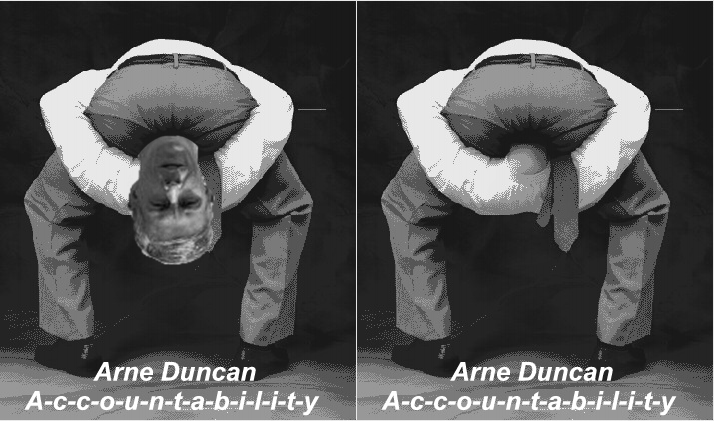
On Monday, former Secretary of Education Arne Duncan returned to Washington DC to speak at a Georgetown University conference. Trailing a wake of failed initiatives and toxic politics, Duncan once more leapt at the chance to impugn the motives of those who disagree with him on questions of education policy. Eager to justify his refusal to feel unduly bound by federal law, Duncan said of the lawmakers who wrote the Every Student Succeeds Act, "Without naming names of senators, how many times do you hear them talk about kids . . . about African-American kids, and Latino kids, and special needs kids and English-language learners?" He said, "We can have honest debate on lots of things but where is your heart coming from? What's your true motivation? I doubt the motivations of some."
Well. One thing I've learned during a quarter-century in education is that there is no value in attacking one another's motives. It's a dead end and a recipe for destructive division. Indeed, the notion that we should only engage those whose motives pass a litmus test shows a disturbing ignorance about how democratic government works. Free nations rest upon the capacity of reasonable people to disagree about important things. Serious people understand that debates over federal education policy reflect honest disagreement about what government can do, should do, and how to go about it—and not just who cares about kids. If you don't accept that, the rationale for democratic government crumples. If you're sure you are good and your opponents are evil, then your obligation is to impose your will—the law be damned.
That brings us back to Mr. Duncan. While I deplore much of what he did during his tenure at the Education Department and think he did some real harm while in office, I observed upon his departure last fall that, "I grant his sincerity, even as I profoundly disagree with much that he did . . . He strikes me as a good man who took on a demanding job and did it in the best way he knew how. By all accounts, he was good to his colleagues and subordinates, and a beacon of personal integrity. That counts for a lot." 
Mr. Duncan never granted that same courtesy or respect to those who disagreed with him. Taken with his own virtue, Duncan has blithely treated all but his yes-men and fellow travelers with disdain. As Secretary, in 2013, Duncan told the American Society of Newspaper Editors that concerns about the Common Core were solely the product of a lunatic "fringe." He famously belittled the concerns of "white suburban moms" for fearing the Common Core because it would reveal that "their child isn't as brilliant as they thought they were." He dismissed Republican concerns about Obama's preschool proposals as "morally indefensible" and tantamount "education malpractice"—and then later expressed bewilderment at his trouble drumming up GOP support. He insisted he had no choice but to issue waivers from No Child Left Behind because Congress wouldn't do its job, and then did his best to sabotage Congress's efforts to reauthorize the law.
Those convinced that they really care and uniquely get it can find it easy to dismiss any disagreement or concern as a sign that others just don't. It doesn't help that Duncan spent the better part of a decade surrounded by sycophants who seemingly shared his belief that he possessed a singular concern for the nation's kids—and courtiers who were only too happy to sing his praises in pursuit of access or funding, as long as he shared their priorities.
Fast forward to Monday, when Duncan was asked if he would apologize for having asserted, on his way out of office, that the Every Student Succeeds Act wouldn't limit the Department of Education in practice because, "Candidly, our lawyers are much smarter than many of the folks who were working on this bill." In his response, Duncan was initially scornful, saying, "My one sentence is that important? Are you kidding me?" He then flippantly allowed, "I'm happy to apologize, happy to do whatever, you know." Finally, he added, "Let's get to work." One cannot help but reflect how much more compelling Duncan's "apology" would have been had he not simultaneously announced that some of those he wants to work with are unnamed bigots of suspect motivation.
While in office, aided by billions of stimulus dollars, his NCLB "waivers," and some off-the-leash lawyers, Duncan operated more like a Chicago pol than the U.S. Secretary of Education. He sabotaged trust in the executive branch's commitment to the law of the land and the Constitution. He helped turn teacher evaluation and common standards from sensible ideas into rushed, clumsy, and divisive litmus tests. He brought the snippy partisanship of Chicago to America's educational conversation and casually cast aspersions on the judgment or motives of those who disagreed with him.
Since 2009, Arne Duncan has done more than anyone to inject into education the distrust, divisiveness, and indecency of contemporary American politics. He came to office backed by bipartisan goodwill—at Duncan's confirmation hearing, Senator Lamar Alexander said that president-elect Obama had "made several distinguished Cabinet appointments" but "I think you are the best" of them—and cavalierly did his best to fracture it. He politicized nearly all that he touched. He shows no understanding of any of this, much less any hint of remorse. I am through granting him the presumption of goodwill that he denies to others.  
In Shakespeare's Macbeth, when reporting that Cawdor died with honor, Malcolm observes, "Nothing in his life became him like the leaving it." It's too bad that Mr. Duncan didn't figure this out regarding his own departure from public office. Instead of magnanimity, reflection, or statesmanship, he's opted for bluster and braggadocio. As for Mr. Duncan's belated and insincere "apology," he can keep it. He's done enough harm. I can only hope that, at long last, he will take his certitude and self-righteous meanness back to the streets of Chicago.Mr. Duncan's Sad Legacy - Rick Hess Straight Up - Education Week:


Thursday, April 21, 2016

BATS: Cultural Competence in the Classroom and Beyond #NPE16NC

BATS: Cultural Competence in the Classroom and Beyond on Vimeo:

BATS: Cultural Competence in the Classroom and Beyond


 BATS: Cultural Competence in the Classroom and Beyond on Vimeo:


Schoolhouse Live’s Videos on Vimeo http://bit.ly/23QZi8f
 Vincent Precht http://bit.ly/1GwPEPv


 LIVE STREAM FOOTAGE FROM THE NETWORK FOR PUBLIC EDUCATION 
NATIONAL CONFERENCE MORE ARCHIVAL FOOTAGE TO COME!

Big Education Ape: Educators at Raleigh NPE conference condemn HB2 | News & Observer #NPE16NChttp://bit.ly/1Snl9lP
Live From Raleigh, North Carolina: NPE’s 3rd Annual National Conference Complete interactive schedule http://bit.ly/20LAehc
Big Education Ape: Video: Saturday at NPE’s 3rd Annual National Conference #NPE16NC http://bit.ly/1SnHj7f
Big Education Ape: Karran Harper Royal and Jesse Hagopian at the NPE National Conference on Vimeo http://bit.ly/1YDW2JM
Big Education Ape: Anthony Cody Interviews Mary Cathryn Ricker, AFT VP and Becky Pringle, NEA VP #NPE16NC http://bit.ly/23QZRPn
Big Education Ape: Opt-Out Conscientious Objectors #NPE16NC http://bit.ly/1MGcTuK

What’s Next in the Education Reform Wars? A Spirited Conversation between Jennifer Berkshire (EduShyster) and Peter Cunningham #NPE16NC

What’s Next in the Education Reform Wars? A Spirited Conversation between Jennifer Berkshire (EduShyster) and Peter Cunningham, on Vimeo:

What’s Next in the Education Reform Wars? A Spirited Conversation between Jennifer Berkshire (EduShyster) and Peter Cunningham,


What’s Next in the Education Reform Wars? A Spirited Conversation between Jennifer Berkshire (EduShyster) and Peter Cunningham, on Vimeo:


Schoolhouse Live’s Videos on Vimeo http://bit.ly/23QZi8f
 Vincent Precht http://bit.ly/1GwPEPv


 LIVE STREAM FOOTAGE FROM THE NETWORK FOR PUBLIC EDUCATION 
NATIONAL CONFERENCE MORE ARCHIVAL FOOTAGE TO COME!

Big Education Ape: Educators at Raleigh NPE conference condemn HB2 | News & Observer #NPE16NChttp://bit.ly/1Snl9lP
Live From Raleigh, North Carolina: NPE’s 3rd Annual National Conference Complete interactive schedule http://bit.ly/20LAehc
Big Education Ape: Video: Saturday at NPE’s 3rd Annual National Conference #NPE16NC http://bit.ly/1SnHj7f
Big Education Ape: Karran Harper Royal and Jesse Hagopian at the NPE National Conference on Vimeo http://bit.ly/1YDW2JM
Big Education Ape: Anthony Cody Interviews Mary Cathryn Ricker, AFT VP and Becky Pringle, NEA VP #NPE16NC http://bit.ly/23QZRPn
Big Education Ape: Opt-Out Conscientious Objectors #NPE16NC http://bit.ly/1MGcTuK

Teachers Talk Back: Teacher Evaluation Report #NPE16NC

Teachers Talk Back: Teacher Evaluation Report on Vimeo:

Teachers Talk Back: Teacher Evaluation Report

Teachers Talk Back: Teacher Evaluation Report on Vimeo:


Schoolhouse Live’s Videos on Vimeo http://bit.ly/23QZi8f
 Vincent Precht http://bit.ly/1GwPEPv


 LIVE STREAM FOOTAGE FROM THE NETWORK FOR PUBLIC EDUCATION 
NATIONAL CONFERENCE MORE ARCHIVAL FOOTAGE TO COME!


Big Education Ape: Educators at Raleigh NPE conference condemn HB2 | News & Observer #NPE16NChttp://bit.ly/1Snl9lP
Live From Raleigh, North Carolina: NPE’s 3rd Annual National Conference Complete interactive schedule http://bit.ly/20LAehc
Big Education Ape: Video: Saturday at NPE’s 3rd Annual National Conference #NPE16NC http://bit.ly/1SnHj7f
Big Education Ape: Karran Harper Royal and Jesse Hagopian at the NPE National Conference on Vimeo http://bit.ly/1YDW2JM
Big Education Ape: Anthony Cody Interviews Mary Cathryn Ricker, AFT VP and Becky Pringle, NEA VP #NPE16NC http://bit.ly/23QZRPn
Big Education Ape: Opt-Out Conscientious Objectors #NPE16NC http://bit.ly/1MGcTuK

Outspoken CPS principal known as Emanuel critic ousted from Lakeview school - Chicago Tribune

Outspoken CPS principal known as Emanuel critic ousted from Lakeview school - Chicago Tribune:
Outspoken CPS principal known as Emanuel critic ousted from Lakeview school

 An outspoken Chicago Public Schools principal was ousted from his Lakeview school on Wednesday, as school officials investigated unspecified "alleged acts of misconduct."
Troy LaRaviere, principal of Blaine Elementary School, has established a reputation as a frequent public critic of Mayor Rahm Emanuel and the school system. LaRaviere has also opposed the controversial Partnership for Assessment of Readiness for College and Careers exam — known as PARCC.
Those actions led the Chicago Board of Education to discipline LaRaviere last summer, when the board approved a "warning resolution" that censured LaRaviere and laid ground for his dismissal if he didn't change his conduct.
"CPS has removed Troy LaRaviere because of alleged acts of misconduct, including violations of a previous Warning Resolution passed by the Board of Education," district spokeswoman Emily Bittner said in a statement. "A hearing will be held to determine his employment status."
The school board's action was partly linked to LaRaviere's opposition to the standardized test, and a confrontation the principal had with former interim CPS CEO and school board Vice President Jesse Ruiz. It also came months after LaRaviere served as an education adviser and supporter of Cook County Commissioner Jesus "Chuy" Garcia, who launched an unsuccessful bid to unseat Mayor Rahm Emanuel.
The district said LaRaviere has been removed from the school, and that he will receive a "pre-suspension hearing" to determine if there is basis to suspend him without pay pending a hearing with the Illinois State Board of Education.
In messages to the Tribune, LaRaviere said CPS notified him of his job status in a letter on Wednesday but that "no reason was provided" for his removal.
"I got the letter right after they attempted to shut down a meeting I was scheduled to have with principals at a (South Side) elementary school," LaRaviere told the Tribune. "They said it was 'an illegal meeting' because they thought it was regarding the privatization of engineers through an Emanuel campaign contributor."
LaRaviere referred to a recent CPS plan to respond to complaints about unclean buildings by doubling the size of a maintenance program run by a firm partly controlled by formerNBA superstar Earvin "Magic" Johnson, a financial supporter of Emanuel. The district plans to expand the maintenance program across the city, which would affect hundreds of building engineers covered by a CPS labor contract that expires in June. Read More: Outspoken CPS principal known as Emanuel critic ousted from Lakeview school - Chicago Tribune:

Students have no ‘right’ to quality education, state court rules - SFGate

Students have no ‘right’ to quality education, state court rules - SFGate:
Students have no ‘right’ to quality education, state court rules


A divided state appeals court ruled Wednesday that California’s anemic level of school funding does not violate students’ constitutional right to an education of “some quality” because no such right exists.
The 2-1 decision by the First District Court of Appeal in San Francisco upheld a judge’s dismissal of a suit filed by some of the state’s major participants in public education — school boards and administrators, the California Teachers Association and State PTA, and nine school districts, including San Francisco and Alameda. The plaintiffs argued that a state that trails nearly every other state in per-pupil spending, staffing and student achievement violates California’s 1879 constitutional guarantee of a school system that encourages “the promotion of intellectual ... improvement.”
Similar suits have been filed in other states, and a majority have been successful, with courts in at least six states finding that their school finance systems violated students’ rights. Last year, the Washington state Supreme Court held its Legislature in contempt for failing to increase funding and imposed a fine of $100,000 a day, which is still in effect.
But the San Francisco court said the right to a public education, guaranteed by the California Constitution, does not include a right to any particular level of educational quality or funding.
An education of “some quality,” the standard asserted by the plaintiffs in the suit, is “good public policy,” Justice Martin Jenkins said in the majority opinion. But he said the state Constitution’s provisions “leave the difficult and policy-laden questions associated with educational adequacy and funding to the legislative branch,” not the courts.
The state Supreme Court first declared education to be a fundamental right in a 1971 ruling that struck down a statewide school financing system based on unequal local property taxes. But Jenkins, quoting that ruling, said the high court had found no constitutional requirement for the Legislature to fund schools “at some magic level to produce either an adequate-quality educational program or a high-quality educational program.”
In dissent, Justice Stuart Pollak said the constitutional mandate of a public school system “implies the need to maintain public schools at some minimum level of competence” — just like a criminal defendant’s constitutional right to a lawyer includes a right of effective legal representation. He said the courts could simply find that the current system falls short of the constitutional standard and leave the solution to lawmakers, with judicial oversight.
Pollak cited the plaintiffs’ evidence that California, in recent years, ranked 47th in the nation in per-pupil spending, 47th or lower in school staffing, and near the bottom in reading and math tests and high school graduation rates. The state, with more than 6 million public school students, plunged from the top to the bottom of national ranking after passage of the Proposition 13 property tax cut in 1978 and subsequent reductions in state spending.
The plaintiffs will ask the state Supreme Court to review the case, said attorney John Affeldt of the nonprofit Public Advocates. He said the court has already determined that the right to an education should enable students to graduate with the knowledge and skills needed to participate in the economy and democracy, and should take up the case “to enforce the right to a quality education.”
The ruling comes six days after an appellate court in Los Angeles upheld state laws on teacher tenure and seniority, overturning a judge’s ruling that found the laws saddled poor and minority students with incompetent teachers and violated the right to educational equality. The plaintiffs plan to appeal that ruling to the state Supreme Court.
Bob Egelko is a San Francisco Chronicle staff writer. Email: begelko@sfchronicle.com Twitter: @egelko
View the decision at http://bit.ly/schoolsruling.