Latest News and Comment from Education

Monday, March 7, 2016

Black Lives Matter wants to 'shut down' Como High

Black Lives Matter wants to 'shut down' Como High:

Black Lives Matter wants to ‘shut down’ Como high school

Black Lives Matter St. Paul is preparing to “shut down” Como Park Senior High School unless a teacher is fired for Facebook comments criticizing the school district’s discipline practices.
Organizer Rashad Turner said the group met Friday evening to plan its protest of Theo Olson, a special-education teacher at Como.
On Wednesday, Turner posted screenshots of comments Olson posted last week on a Facebook page for people who support the local teachers union. The comment thread that included Olson’s remarks has been deleted.
In one post, Olson suggested Como is “enabling student misconduct” in a misguided attempt to keep students in school and out of the criminal justice system:
“Anyone care to explain to me the school-to-prison pipeline my colleagues and I have somehow created, or perpetuated, or not done enough to interrupt?” he wrote. “Because if you can’t prove it, and campaigns you’ve waged to deconstruct adult authority in my building by enabling student misconduct, you seriously owe us real teachers an apology. Actually, an apology won’t cut it.”
Turner also challenged another post in which Olson appeared to respond to Superintendent Valeria Silva’s stated goal of setting districtwide rules for phone rules in schools:
“Phones and iPad devices, used for social media and gaming. There have always been rules for ‘devices,’ and defined levels of misconduct,” Olson wrote. “Since we now have no backup, no functional location to send kids who won’t quit gaming, setting up fights, selling drugs, whoring trains, or cyber bullying, we’re screwed, just design our own classroom rules. Hopefully tomorrow’s settlement will begin to fix this.”
In an interview Friday, Turner characterized Olson’s remarks as “sweeping generalizations about black students.”
He said the teacher’s comments present a “perfect opportunity” for the city’s Black Lives Matter chapter to turn its activism toward St. Paul Public Schools, which has far higher rates of suspensions for black and American Indian students than for their peers.
“If all students can’t learn, they can’t be valued in the building, then no one needs to be in that building learning,” he said of Como.
Responding on Turner’s personal Facebook page, Olson offered to speak with Turner and explain his views. Olson said he supports Black Lives Matter and that he marched with the group last fall.
“I care deeply for all my students. Otherwise, why would I do it? We have a lot in common,” he wrote.
Olson went on to say that rather than putting students on a path to prison, he sees himself as “a link of the school to opportunity and freedom pipeline.”
Turner said he has no desire to speak with Olson.
Olson did not return messages for this story.
School district spokeswoman Toya Stewart Downey said in an email that the district is “aware of Mr. Olson’s comments on social media and will determine if followup is necessary.”Black Lives Matter wants to 'shut down' Como High:
Turner said activists will meet with school district leaders on Monday.
Theo Olson is a special-education teacher at Como Park Senior High School in St. Paul. (Screenshots from Facebook)

RELATED ARTICLES


 Black Lives Matter wants to 'shut down' Como High:

Idaho superintendents tell foundation to stop lying about public schools - The Washington Post

Idaho superintendents tell foundation to stop lying about public schools - The Washington Post:

Idaho superintendents tell foundation to stop lying about public schools


 For years now, private foundations run by the very, very wealthy have been pouring money into their pet school reform efforts, many of them taking the view that traditional public education is broken and that it should be privatized. Education activists have called out these foundations, but now, in Idaho, it’s the school superintendents who are are speaking out.

They are taking on the J.A. and Kathryn Albertson Family Foundation, which consistently portrays traditional public schools in a negative light and pushes for alternatives, and their public statements underscore growing opposition around the country to school reform efforts that support the the privatization of  public education.
Don Coberly, superintendent of the Boise School District, led the public opposition to the foundation’s “Don’t Fail Idaho” campaign with a February update to district staff that says in part (you can read the full statement below):
Over the last few weeks you may have heard or seen the latest advertisements from the J.A and Kathryn Albertson Foundation’s “Don’t Fail Idaho” campaign. Perhaps the most controversial claim is that four out of five Idaho students are not prepared for life after high school. There are four facts we want you to understand about this campaign:
  1. It promotes an agenda that is designed to undermine public schools.
  2. It is highly inaccurate.
  3. It offers no real solutions to increasing post-secondary readiness.
  4. It is a disservice to the work you do every day for the youth of this district.
Undermining public schools
Why would someone want to undermine public education in Idaho? The motive is quite clear. At a recent Downtown Rotary Club meeting, the executive director of the Albertson Foundation stated that the goal of the Foundation is to increase charter school seats by 20,000 in the next few years. That will only happen if Idahoans lose faith in their public schools.
In addition, Coberly and all seven members of the Boise School District trustees board signed a joint statement that said in part:
Let’s be clear; this campaign promotes an agenda designed to undermine public schools. It is highly inaccurate. It offers no real solutions to increasing post-secondary readiness. It is a disservice to the work public school teachers, parents, and students do every day.
Then 13 Idaho superintendents signed a joint statement saying in part:
In recent weeks, many of your readers may have seen an advertisement presented by the “Don’t Fail Idaho” campaign which dramatically drops four Idaho students in the middle of the 
Idaho superintendents tell foundation to stop lying about public schools - The Washington Post:

Donald Trump's Education Plan: Several Experts Fearful, Curious ... and Baffled - Politics K-12 - Education Week

Donald Trump's Education Plan: Several Experts Fearful, Curious ... and Baffled - Politics K-12 - Education Week:

Donald Trump's Education Plan: Several Experts Fearful, Curious ... and Baffled

Politics K-12


 Donald Trump's thoughts about education policy are mostly a black box. We know he doesn't like the Common Core State Standards. And he thinks American students produce lousy test scores. But the real estate developer hasn't weighed in with a comprehensive plan for public schools, or talked in much detail about education, since becoming a contender for the Republican presidential nomination.

So when education policy mavens and advocates contemplate a Donald Trump administration and its impact on K-12, what do they see? In many cases, they're confused or uncertain about what a Trump-led U.S. Department of Education would do, or not do, if it even survives. But in some cases they have clear concerns, or other thoughts about how he might significantly alter what's been happening with federal education policy. 
(The Trump campaign did not respond to requests for comment about his education policy platform.)
Below, you can read some of their answers to questions that touch on the federal government's broader role in public schools. 

On Trump's general outlook on education policy and the U.S. Department of Education: 

Thumbnail image for TrumpVideo2.PNG

Chad Aldeman, Bellwether Education Partners: [OnTrump's recent praise of local school boards] "I found that pretty interesting. There aren't that many national politicians who are going to go on the record praising school boards." 
Carmel Martin, Center for American Progress: "The philiosohy that guides Donald Trump is opportunism. That makes him very unpredictable. ... He basically has no plan. He hasn't really laid out anything of substance in the education space."
Michael Petrilli, Thomas B. Fordham Institute: "There's good reason to think that neither he nor any other president would do much on K-12 education, at least in his first term." 
Luis Torres, League of United Latin American Citizens: "He may make it harder for the department to exercise its authority to conduct oversight. So that's a worry for us."

On whether Trump would try to follow through on his anti-common-core pledge and introduce a bill in Congress to ban the standards:

Aldeman"It would be heavily ironic if there were a big federal government push to get rid of common core. .... My hunch is that he would just not advocate for it. He's obviously on record not supporting it. That might be enough for him to check that box."
Kim Anderson, National Education Association: "In part, Mr. Trump's assertion with respect to common core is a little misplaced, because the Common Core State Standards did not originate with the federal government. It reflects a lack of understanding of where those standards came from."
Rick Hess, American Enterprise Institute: "I'm not sure he knows what the federal role is, or could be. I think a lot of it would end up depending on who he appointed in the administration, and what they were inclined to do. Frankly, at this point there's not a lot that Washington can do to take on the common core, beyond the bully bulpit, and try to harass the states that are using the common core." [Hess also writes a blog for edweek.org]electionslug_2016_126x126.jpg
Andy Smarick, Bellwether: "Is it really his view that the federal government should tell [states] that they shouldn't use common core? That is a big-government-empowering posture."

On how a Trump administration would impact the transition to the Every Student Succeeds Act

Janel George, NAACP-Legal Defense Fund: [Speaking generally of the shift to ESSA regardless of who is elected president] "To be honest, when we're looking at January 2017, we're looking pretty far down the line. There is so much that will take place to implement the law in the interim, we know that the 2016-17 school year will really be a transition year. ... For effective implementation, there has to be clarity provided to states and districts soon."
Petrilli: "I think you're going to see the Obama administration race to get any kind of regulation done that they can, in order to provide clarity."
Smarick: "I'm pretty confident that he doesn't know what ESSA is. ... It depends on who he decides to hire in the White House and who his secretary would be. If he decided to pick [former Indiana Gov.] Mitch Daniels or [former Florida Gov.] Jeb Bush as education secretary, that would tell us a lot. If he decided to pick [former Louisiana Gov.] Bobby Jindal as education secretary, that would tell us a lot."
Image: Screen capture from a Donald Trump campaign video about education, posted on Facebook Feb. 27, 2016

Don't miss another Politics K-12 post. Sign up here to get news alerts in your email inbox.

Spring state testing season brings changes, unknowns and pushback - Chicago Tribune

Spring state testing season brings changes, unknowns and pushback - Chicago Tribune:

Spring state testing season brings changes, unknowns and pushback


 e spring state testing season launches this week in Illinois, amid unknowns, dramatic changes for students and continued pushback by parents who don't want their kids tested.

The lengthy PARCC exams that debuted last year will be streamlined, a nod to families concerned about so much testing.
And for the first time since 2000, a new online science exam is scheduled for fifth- and eighth-graders as well as high school students in biology classes — though educators say they don't know all the details and are still absorbing the state's new standards for what kids should know in science.
Meanwhile, all signs point to no free college entrance exam statewide this spring for public high school juniors, who have been taking the state-paid ACT test since 2001.


Illinois is switching to the College Board's SAT exam, but it doesn't have the money yet to administer the test given the state's budget crisis, Illinois State Board of Education officials said.
The College Board is working to give the SAT statewide in 2016-17, but that means a year would go by without the free exam for all juniors, though a new state law requires a college entrance exam be given annually.
For this school year, more than 160 school districts across Illinois have signed on to give the ACT to their juniors in March and April, at district expense, according to ACT spokesman Ed Colby.


Chicago Public Schools in January sent a letter to parents saying the district will administer the ACT to all juniors this spring. And districts from Hinsdale to Winnetka will be testing their juniors.
But that leaves out more than 300 districts that include high schools which haven't arranged to give their juniors the exam. The test has been popular because students can use the scores for college admissions applications.
The Glenbrook high schools in north Cook County's Township High School District 225 won't be covering the cost of the ACT, saying the vast majority of their students already take the exam at their own expense. The district is getting the word out to low-income students to make sure they apply for testing fee waivers, said assistant superintendent Rosanne Williamson.
In downstate districts, schools are letting parents know that the ACT won't be free this spring.
"We are continuing to support the ACT as far as encouraging students to take it ... but as far as the district paying for it globally, we are not," said Debbie Ballard, a guidance counselor at Southwestern High School, about 50 miles north of St. Louis. The school set aside money to help students who don't qualify for fee waivers but would still struggle to Spring state testing season brings changes, unknowns and pushback - Chicago Tribune:

Solving the Mystery of the Schools by Diane Ravitch | The New York Review of Books

Solving the Mystery of the Schools by Diane Ravitch | The New York Review of Books:

Solving the Mystery of the Schools

Diane Ravitch


Mission High: One School, How Experts Tried to Fail It, and the Students and Teachers Who Made It Triumph

by Kristina Rizga
Nation Books, 295 pp., $26.99

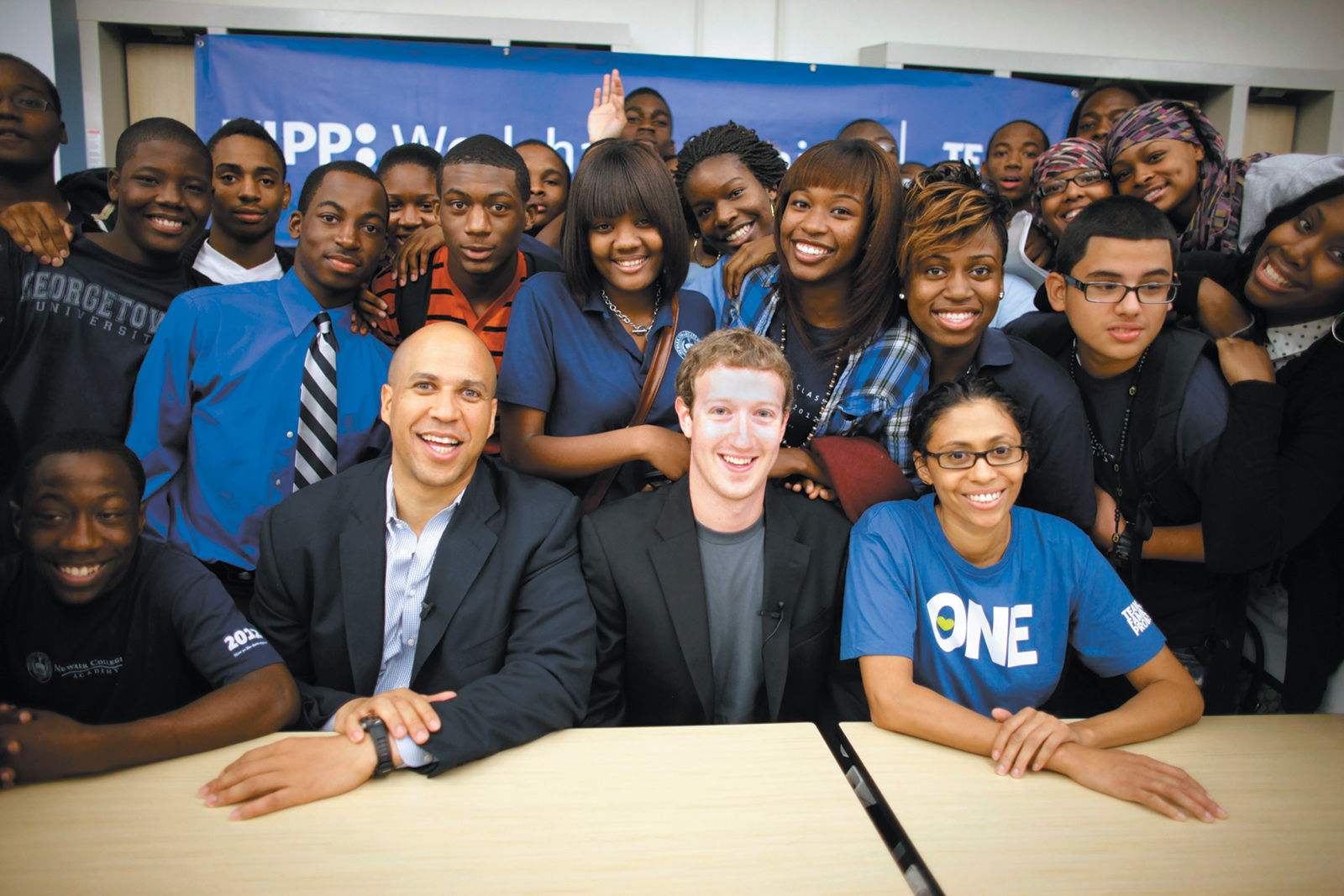
Cory Booker, then mayor of Newark, and Facebook CEO Mark Zuckerberg with eleventh-grade math students at the KIPP Newark Collegiate Academy, a charter school, September 2010
In recent years, American public education has been swamped by bad ideas and policies. Our national leaders, most of whom were educated at elite universities and should know better, have turned our most important domestic duty into a quest for higher scores on standardized tests. While it is true that students must do well on standardized tests to enter universities, few of the better universities judge students’ knowledge and ability solely by such flimsy measures. Thus it is puzzling why public officials have made test scores the purpose of education.
The heavy reliance on standardized tests in schools began with the passage of George W. Bush’s No Child Left Behind legislation in 2001. The law mandated that every child in every school would take standardized tests in reading and math from grades three through eight and would achieve “proficiency” by the year 2014. No excuses. Even children who could not read English and children with significant cognitive handicaps would be expected to reach “proficiency.” Every state was left to define “proficiency” as it wished.
The punishments for not achieving higher test scores every year were increasingly onerous. A school that fell behind in the first year would be required to hire tutors. In the second year, it would have to offer its students the choice to move to a different school. By the end of five years, if it was not on track to achieve 100 percent proficiency, the school might be handed over to a private manager, turned into a charter school, taken over by the state, or closed. In fact, there was no evidence that any of these sanctions would lead to better schools or higher test scores, but no matter.
With these sanctions in mind, schools made intense efforts to prepare children to take the all-important tests. In some places, like Atlanta, Washington, D.C., and El Paso, Texas, teachers, principals, and superintendents cheated, changing the scores to save their jobs or their schools. Schools across the nation spent more time and money on preparing materials to help students pass tests and reduced the time for the arts, science, history, physical education, and even recess. Some states, such as New York and Illinois, manipulated the passing scores on the tests by lowering the definition of proficiency needed in order to demonstrate progress.
After Bush left office and was replaced by Barack Obama, the obsession with testing grew even more intense. Congress gave Secretary of Education Arne Duncan $5 billion in economic stimulus funds to encourage education reforms. Duncan released a plan in 2009 called Race to the Top, pledging that American students would be “racing to the top” of the international tables of comparative scores if they followed his policies.
In order to be eligible to compete for a share of that money at a time of deep economic distress, states had to adopt Duncan’s strategies. They had to expand the number of privately managed charter schools in the state; they had to agree to adopt “college-and-career-ready standards” (which were the not-yet-completed Common Core State Standards). They had to agree, moreover, to evaluate teachers in relation to the rise or fall of the test scores of their students; and they had to agree to “turn around” schools with low test scores by firing the principal, or firing all or half of the staff, or doing something equally drastic.
The standardized tests immediately became more important than ever. Some states introduced standardized testing as early as kindergarten to begin getting children ready for the big standardized tests that would consume their time in school from grades three through eight. The competition among the states was keen; everyone needed more money. Forty-six states and the District of Columbia changed their laws to make themselves eligible for Race to the Top funding; only eighteen states and D.C. won the money.
Duncan endorsed the premise of the No Child Left Behind Act that standardized tests are the best measure of student achievement; but he was upset that the fifty states each had its own standards and tests. Thus when several Washington-based groups (the National Governors Association, Achieve, the Council of Chief State School Officers, and Student Achievement Partners) began work on national standards, Duncan cheered them on. Federal law bars any federal official from seeking to influence or control curriculum or instruction, and Duncan drew a fine line between his outspoken advocacy for the Common Core standards and his funding of Race to the Top. However, he did allocate $360 million to two consortiums of testing experts to prepare new tests for the Common Core State Standards.
As it happened, the Bill and Melinda Gates Foundation spent at least $200 million to pay for the writing and distribution of the standards. It also awarded millions of dollars to practically every influential national education organization to encourage them to support the standards, including the two major teachers’ unions, think tanks on the right and left, and civil rights organizations. Advocates for the standards claimed that they would make America globally competitive and would close the gaping test score gaps between white and Asian students on one hand, and African-American and Latino students on the other.
They didn’t know that this was true because the standards had been just written and never tried out, but they dutifully carried this message to the mass media and the public. Before long, a public backlash developed against both the Common Core standards and testing, in large measure because they were imposed with Solving the Mystery of the Schools by Diane Ravitch | The New York Review of Books:

Ohio Lawmakers Consider Weakening Charter-School Reform | WKSU

Ohio Lawmakers Consider Weakening Charter-School Reform | WKSU:

Ohio Lawmakers Consider Weakening Charter-School Reform


 Just months after state lawmakers passed a sweeping reform of Ohio’s charter school system, they could soon be considering a proposal that could weaken one of the measures.

The House might consider a provision that would delay the requirement for online charter schools to report attendance, which was added into the bipartisan charter-school reform measure approved last year. The idea is to give e-schools more time to implement the changes. But Chad Aldis with the Fordham Institute, a pro-charter school group, was a big advocate for the increased oversight and opposes the delay.
“That legislators will understand that this truly would be a step backward. And if they did this, it could actually put in jeopardy many of the reforms and the long-term effectiveness of the reforms.”
Aldis noted that it will be a challenge for e-schools to develop a system to take attendance but believes it can be done.Ohio Lawmakers Consider Weakening Charter-School Reform | WKSU:

Chicago's War With its Teachers Union Is the Sign of a Bigger Problem - Fortune

Chicago's War With its Teachers Union Is the Sign of a Bigger Problem - Fortune:

Why Chicago's Fight With Teachers Is the Sign of a Much Bigger Problem

Chicago public schools want concessions to patch a busted budget, and teachers are angry.

Simmering tensions at Chicago public schools rose a notch last week with the announcement that school employees would have to take three unpaid days off this school year.
Chicago Public Schools CEO Forrest Claypool said that the move to lop off one day in March and two days in June is an effort to “chip away at our budget gap” and would save $30 million.
Karen Lewis, Chicago Teachers Union president, responded that adding the unpaid days to a 7% giveback on teacher pension contributions the school district is already requesting in contract negotiations would make for an 8.6% pay cut overall.
And so the Chicago Teachers Union, the third largest in the country, said the system’s move “all but assures” that teachers will go on strike, perhaps as soon as April 1.
The Chicago fracas is emblematic of the grim state of public school/teacher relations across the U.S., a relationship that resembles the exhausted late rounds of a heavyweight boxing match.
Public school teachers’ unions, once able to guarantee their members ever rising wages but now weakened by years of attacks from elected officials, are fighting a rearguard battle with financially insolvent school systems—battered by sagging funding and higher enrollments—to retain pay and benefits won long ago.
The Chicago school system, which employs 37,400 workers, is facing a $1 billion shortfall—larger than most school districts, but far from unique. Major school systems across the country are being rocked by budget gaps and other problems.
In September 2012, Chicago teachers took to the picket lines for a week in a standoff over job security and teacher evaluations. The start of the current school year in Seattle was delayed last fall because of a weeklong teachers’ strike over wages. And this January, Detroit teachers staged a “sick-out” over class sizes; absences were extensive enough to force the school system to close two-thirds of the city’s public schools.
While strikes like these are widely criticized for hindering children’s education and inconveniencing working parents, they can work. In Seattle, teachers won a 14.3% pay raise over three years, as well as other concessions including more input over standardized tests. And in the 2012 strike in Chicago, after 350,000 students stayed at home and delayed the start of the school year, the teachers won some concessions.
But today, that dynamic is changing. Fewer workers are unionized than in the past, and governors like Wisconsin’s Scott Walker are laboring to lower the levels even further, Chicago's War With its Teachers Union Is the Sign of a Bigger Problem - Fortune:

Overwhelming Majority of Voters Want To Rein In Charter Schools

Overwhelming Majority of Voters Want To Rein In Charter Schools:

Overwhelming Majority of Voters Want To Rein In Charter Schools

 A new nationwide poll shows the American people overwhelmingly agree that public education should not exist to enrich and profit the charter school privatization movement and they are demanding strong regulatory laws to “rein in documented fiscal malfeasance by private charter schools.”

As Founding Father Thomas Jefferson said on various occasions,  “a well-educated” populace is crucial to a strong and lasting democracy. As important as the government educating the populace was to Jefferson, he would have railed against the Republican poloy of using government-funded public education to enrich corporations.
Now, a new nationwide poll shows the American people overwhelmingly agree that public education should not exist to enrich and profit the charter school privatization movement and they are demanding strong regulatory laws to “rein in documented fiscal malfeasance by private charter schools.”
The poll, conducted by GBA Strategies, revealed that overwhelmingly Americans on both sides of the political spectrum “embrace proposals to reform the way charter schools are authorized and managed.” The poll was commissioned by two advocates for democracy, In the Public Interest and the Center for Popular Democracy, who have spent several years researching and documenting the “massive fiscal malfeasance” being perpetrated by private charter school operators across the nation.
According to the report on the poll’s results,
The public overwhelmingly supports strong initiatives to strengthen charter school accountability and transparency, improve teacher training and qualifications, prevent fraud, serve high-need students and ensure that neighborhood public schools are not adversely affected.”
The report also noted that there were surprisingly huge bipartisan majorities, including the majority of charter school supporters, demanding stronger government oversight, a shift in academic priorities, and robust efforts to make charter schools as accountable as public schools; “especially in today’s increasingly privatized ‘charter school industry’ run by corporate education franchises.”
The poll reaffirmed, according to education experts, that the public wants more experimentation in traditional public schools to accommodate “all students.” That was, after all, the initial concept of having charter schools and something the dominant corporate charter industry opposes vehemently. It is why “overwhelming majorities want greater regulation of the charter movement destroying traditional public schools by siphoning away precious taxpayer funds to profit corporations.
It has taken over a decade, but the public is finally sick of “the charter industry’s lack of accountability, systemic underperformance, harsh admission policies, and poorly or untrained teachers; all characteristics of the charter school privatization movement.” Voters particularly like the concept of “schools that integrate a dynamic curriculum with after-school and summer enrichment programs. Other ideas for innovating public school options, such as specialty curricula, also generate significant support.”
The term “specialty curricula” means a return to providing occupational courses in various industries that public schools once offered as a matter of course. It is true that America needs a robust college-educated population, but there is also a great need for occupational training in fields students can put to use without spending thousands of dollars for specialty private school courses offered by corporate-run scam outfits. It may come as a shock, but not every student aspires to be a corporate MBA, Wall Street financial advisor, doctor, lawyer, or astrophysicist.
It was encouraging, from an educator’s perspective, that the poll also revealed “that over two-thirds of voters give traditional public schools and public school teachers very high ratings, with twice as many voters saying schools in their neighborhoods are getting better, not worse.”  Despite what Republicans, and some absurd Democrats, habitually claim about the public’s hatred of public school teachers, “three-quarters of voters viewed public school teachers favorably; only 9 percent had unfavorable views.” The nine percent are certainly ardent Fox News viewers and the GOP’s religiously-driven “school choice” adherents.
It is remarkable that on the issue of “school choice,” the issue that ALEC, the Kochs, corporations and Republicans promote like a religion “ranks dead last on the American public’s list of education concerns.” Remember, the ‘school choice’ narrative is the primary tenet of, and reason, the GOP Overwhelming Majority of Voters Want To Rein In Charter Schools:

Advocates voice 'grave concern' over LAUSD's review process for new charter schools | 89.3 KPCC

Advocates voice 'grave concern' over LAUSD's review process for new charter schools | 89.3 KPCC:

Advocates voice 'grave concern' over LAUSD's review process for new charter schools


 Charter school leaders are rallying behind applicants who hope to open a new charter high school, intensifying their accusation that Los Angeles Unified School District officials are playing politics with charter applications.

Leaders of 30 L.A. charter networks have signed a letter questioning district staff's recommendation that school board members deny a petition from Westside Innovative School House, or "WISH," to open a high school in the Westchester neighborhood, according to a draft of the letter KPCC has obtained.
The letter's signatories hold up WISH — which already runs an elementary and middle school nearby — as a model charter operator, writing that the denial recommendation "reinforces our grave concern that the credibility of the district’s charter petition review process is being undermined."
L.A. Unified staff said their denial is justified, saying WISH's existing charters are losing money and that its middle school has failed to meet agreed-upon enrollment targets.
But to charter advocates, it's more evidence to support their claim that L.A. Unified — concerned that a massive push to double the number of students enrolled in Los Angeles charter schools could hurt the district's finances — is beginning to unfairly deny applications to open new charter schools.
"One of the main attacks by charter opponents is that charter schools don’t serve students with special needs and they don't serve students with moderate to severe needs," said the California Charter Schools Association's Sarah Angel. "And here we have WISH trying to open a high school to serve all students, including those with moderate to severe needs, and the district is trying to find every small reason to recommend denial them."
Tuesday's session of the L.A. Unified school board could end up looking a lot like last month's meeting, where charter advocates, staff and board members debated the fate of four charter petitions at length.
The board accepted staff's recommendation to approve a charter application for Arts in Action Community Middle School. But they went against the staff's recommendations to approve El Camino Real K-8, and to reject charter applications from Partnership to Uplift Communities (PUC).
WISH's application is up for a board vote on Tuesday. The operator's elementary and middle schools are built around "full inclusion," which means all kids of all abilities Advocates voice 'grave concern' over LAUSD's review process for new charter schools | 89.3 KPCC:
Charter Schools - Dividing Communities since 1991

Sunday, March 6, 2016

The Strange Future of the Teaching Profession – Save Maine Schools

The Strange Future of the Teaching Profession – Save Maine Schools:

The Strange Future of the Teaching Profession

kick-out
In 1991, just after stepping into his new role as secretary of education, Lamar Alexander envisioned a system of public educationwhere school districts would not have an “exclusive monopoly” to operate public schools.   Instead, a public school “could be redefined as a school that receives public funds and is “accountable to public authority,” and “could be operated by public entities such as the Smithsonian Institution, by private nonprofit organizations, or by businesses.”
Twenty-five years later, it appears that Alexander’s dream is closer than ever to becoming reality.
As billionaires like Mark Zuckerberg of Facebook, Reed Hastings of Netflix and Bill Gates of Microsoft invest millions of dollars into “personalized learning” experiments, corporate-sponsored bills are rapidly popping up across the country to move states toward competency-based education models that investors hope will allow learning to happen “anytime, anywhere.”
Organizations like the Center for the Future of Museums are now predicting the end of neighborhood schools:
Screen shot 2016-03-06 at 4.06.12 PM
The U.S. Department of Education in collaboration with The After-School Corporation describe a system in which students are “no longer tethered to school buildings or schedules,” but are instead free to tote data backpacks from The Strange Future of the Teaching Profession – Save Maine Schools: