Latest News and Comment from Education

Tuesday, March 1, 2016

Revised and Available: De-testing and De-grading Schools (Peter Lang USA, 2016) – the becoming radical

Revised and Available: De-testing and De-grading Schools (Peter Lang USA, 2016) – the becoming radical:

Revised and Available: De-testing and De-grading Schools (Peter Lang USA, 2016)


 Co-edited with Bower, J. (2016). De-testing and de-grading schools: Authentic alternatives to accountability and standardization. Revised ed. New York, NY: Peter Lang USA.
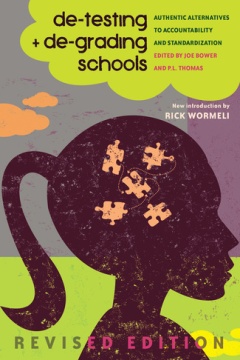
313058_cover
Book synopsis
A century of education and education reform, along with more than three decades of high-stakes testing and accountability, reveals a disturbing paradox: education has a steadfast commitment to testing and grading. This commitment persists despite ample research, theory, and philosophy revealing the corrosive consequences of both testing and grading in an education system designed to support human agency and democratic principles. This revised edited volume brings together a collection of updated and new essays that confronts the failure of testing and grading. The book explores the historical failure of testing and grading; the theoretical and philosophical arguments against testing and grading; the negative influence of tests and grades on social justice, race, class, and gender; and the role that they play in perpetuating a deficit perspective of children. The chapters fall under two broad sections. Part I, Degrading Learning, Detesting Education: The Failure of High-Stake Accountability in Education, includes essays on the historical, theoretical, and philosophical arguments against testing and grading. Part II, De-Grading and De-Testing in a Time of High-Stakes Education Reform, presents practical experiments in de-testing and de-grading classrooms for authentic learning experiences.
Contents: Rick Wormeli: An Unexamined Pedagogy Harms – Lisa Guisbond/Monty Neill/Bob Schaeffer: NCLB’s Lost Decade for Educational Progress: What Can We Learn from This Policy Failure? – Fernando F. Padró/ Michael F. Hawke/Laurie M. Hawke: Assessment and Quality: Policy-Steering and the Making of a Deus ex Machina – Anthony Cody: Technocratic Groupthink Inflates the Testing Bubble – Lawrence Baines/Rhonda Goolsby-Smith: America’s Obsessive-Assessment Disorder – Julie A. Gorlewski/David A. Gorlewski: Solidarity and Critical Dialogue: Interrupting the Degradation of Teacher Preparation – Morna McDermott: Feeding the World = Reading the World: Let Them Eat Tests – Richard Mora: Bubble in B for Boredom – Brian R. Beabout/Andre M. Perry: Reconciling Student Outcomes and Community Self-Reliance in Modern School Reform Contexts – David L. Bolton/John M. Elmore: The Role of Assessment in Empowering/Disempowering Students in the Critical Pedagogy Classroom – Christian Z. Goering: «How Long Does This Have to Be?»: Confronting the Standardization of Writing Instruction with Teachers in National Writing Project Invitational Summer Institutes – Joe Bower: Telling Time with a Broken Clock: Moving Beyond Standardized Testing – John L. Hoben: The Grading Mousetrap: Narcissism, Abjection, and the Politics of Self-Harm – Arnold Dodge/Ruth Powers Silverberg/Katie Zahedi: Leadership Denied: Principal as Compliance Officer – Hadley J. Ferguson: Journey into Ungrading – Jennifer Magee/Mark Dziedzic: An Oath to Stop Degrading Students: A Story of De-grading an Elementary Classroom – P. L. Thomas: De-grading Writing Instruction: Closing the «Considerable Gap» – Brian Rhode: One Week, Many Thoughts – Lisa William-White: Striving Toward Authentic Teaching for Social Justice: Additional Considerations – P. L. Thomas: Yes, to Be Clear, I Am Anti-testing, Anti-grading.Revised and Available: De-testing and De-grading Schools (Peter Lang USA, 2016) – the becoming radical:

On welfare and in juvie – dual clients get lost :: SI&A Cabinet Report

On welfare and in juvie – dual clients get lost :: SI&A Cabinet Report :: The Essential Resource for Superintendents and the Cabinet:

On welfare and in juvie – dual clients get lost

On welfare and in juvie – dual clients get lost
(Calif.) County systems responsible for tracking youth involved in both the child welfare and juvenile justice systems are unable to accurately identify these children and keep tabs on their academic progress, according to a recent survey.
Of the six counties included in the California State Auditor’s report released last week, five were unable to identify the total number of youth considered dually-involved. In addition to each county employing a different method of tracking, there was also a lack of integration between the welfare and juvenile systems within each county.
“These systems don’t have the proper data infrastructure to both share vital information with each other and know what is happening with a young person, like whether or not they are succeeding, and what that young person needs because of this fundamental lack of coordination and tracking,” said Patricia Soung, senior staff attorney and policy associate at Children’s Defense Fund – California. “It’s not just a lack of data, but a lack of partnership between these agencies and systems that shape the day-to-day life of a youth.”
Many dually-involved young people often do not receive the services they are entitled to, such as counseling or gang prevention efforts, because each system assumes the other is providing them, Soung said in an interview.
Research has long suggested that children involved in the child welfare system often have lower achievement levels in school, and are more likely to struggle with homelessness, behavioral health disorders, unemployment and criminal justice involvement in their early adult years. Those involved in both the child welfare and juvenile justice systems tend to have even worse outcomes, according to the auditor’s report.
In 2005, the Legislature established the statewide Child Welfare Services/Case Management System database to provide welfare services and probation agencies a common place to document and track children involved with both systems. The report, however, found that information regarding case histories, demographics, services delivered, and placement and contact information was often incomplete or inaccurate.
Currently, counties determine how to track dually-involved children, as well as their outcomes, at On welfare and in juvie – dual clients get lost :: SI&A Cabinet Report :: The Essential Resource for Superintendents and the Cabinet:

Part 3–From the Classroom: Teachers Integrating Technology | Larry Cuban on School Reform and Classroom Practice

Part 3–From the Classroom: Teachers Integrating Technology | Larry Cuban on School Reform and Classroom Practice:

Part 3–From the Classroom: Teachers Integrating Technology

Among the courses that Will Colglazier teaches at Aragon High School in San Mateo Union High School District is Advanced Placement U.S. history. He also teaches a social studies methods course at Stanford University every Tuesday–“That is a long,long day,” he says. Colglazier has been profiled in various publications (see herehere, and here) and I have done a post about a class I observed last year. So why do even another post on Colglazier?
For my project on looking at best cases of technology integration at the classroom, school, and district levels I went to Dominic Bigue, coordinator of technology for SMUHSD. He identified teachers, including Colglazier, who were making technology integral to their lessons and were willing to have me visit their classrooms. Of those he identified, I have already described lessons of English teacher Sarah Press (Hillsdale High School) and Spanish teacher Nicole Elenz-Martin (also at Aragon). Today, I focus on Colglazier’s Advanced Placement U.S. history class that I observed February 19, 2016.
Aragon’s hillside campus has just over 1400 students of whom 70 percent are minority.  Twenty-four percent of the students are eligible for free and reduced-price lunches (common measure of poverty). Nearly 98 percent graduate. Of those graduating, 44 percent attend community college and 54 percent enter four-year colleges and universities.
The lesson I observed was about Pearl Harbor (1941), particularly historical documents that argued for and against the conspiracy theory surrounding Part 3–From the Classroom: Teachers Integrating Technology | Larry Cuban on School Reform and Classroom Practice:

Very Important Warning for Connecticut High School Juniors and their parents - Wait What?

Very Important Warning for Connecticut High School Juniors and their parents - Wait What?:

Very Important Warning for Connecticut High School Juniors and their parents


Last spring Governor Dannel Malloy and the Connecticut General Assembly passed legislation mandating that the 40,000+ high school juniors who attend Connecticut’s public schools must take the NEW SAT – Tomorrow – March 2, 2016, despite the fact that the NEW SAT has not been publicly released, has not been statistically validated and includes a significant number of questions that are related to content that most high school juniors have not been taught.
Like the Common Core SBAC testing scheme that is being inflicted upon children in grades 3-8, the NEW SAT has been “aligned to the Common Core” and is intentionally designed to fail a large number of students.
After considering the issues involved I have opted my daughter out of the NEW SAT and she will be using tomorrow to learn rather than serve as a guinea pig for the testing industry and the Connecticut State Department of Education.
One thing is extremely clear.
The attempt to force Connecticut’s 11th graders to take the NEW SAT is not about helping students, improving graduating rates or expanding the number of people who go to college.
Instead, the new “mandate” is part of the broader corporate education reform agenda that is successfully diverting scarce public funds away from teacher-student instruction to private companies.
The College Board, the conglomerate that owns the SAT, collects nearly $1 Billion a year Very Important Warning for Connecticut High School Juniors and their parents - Wait What?:

Schools Matter: Mathews Reviews His Own Book

Schools Matter: Mathews Reviews His Own Book:
Mathews Reviews His Own Book

When Jay Mathews rushed out a response to his WaPo editors before my book was even on sale, I wasn't surprised that he would disparaging in his assessment of this, or any, book that provides a critique of the segregated corporate KIPP schools.  

What did surprise me, however, is that he would post a picture of his own book, which was published six years ago as a exuberant paean to the "founders," Feinberg and Levin, as they are referred to by their acolytes.  At the end of Part 2 of his review, published yesterday, he invites the reader to read his book, as well as mine, and decide for yourself who is right and who is wrong.  The problem with this proposal is that the two books, with a couple of exceptions that Mathews seizes upon, cover very different terrain and ask very different questions.  

In fact, Jay's book asks no questions at all but, rather, sets out to tell us how, in a wooden sort of fairy tale fashion, how "two inspired teachers created the most promising schools in America." Mathews would have us believe that this sprouting and kudzu paced growth of KIPP resulted from two young geniuses inspired by a "magical" teacher godmother who sprinkled her fairy dust on them and gave them her blessing. 

The facts, however, are a bit more complicated and prosaic.  KIPP sprang from the corporate conceptual ground provided by Teach for America and its market-centered and publicly-fed neoliberal agenda, and it was fertilized and manicured by tons of tax-sheltered cash provided initially by renowned conservative GAP founder, Donald Fisher.  It did not hurt, either, that KIPP was asked to do a skit at the 2000 National Republican Convention.

As for the godmother teacher in Jay's fairy tale, Harriet Ball, her ideas were harvested by the KIPP machine, and she was left unpaid for her intellectual property.  

The questions that I ask in the preface of Work Hard, Be Hard: Journeys through "No Excuses" Teachingare below (from the Preface): 


As an antidote to the KIPP Foundation’s marketing and public relations outreach, which 
Schools Matter: Mathews Reviews His Own Book:
 Horn (2016)
Work Hard, Be Hard: Journeys through "No Excuses" Teaching

With A Brooklyn Accent: Letter to Fordham Admissions Director Urging that Students Who Opt Out of Tests Be Given Serioius Consideration

With A Brooklyn Accent: Letter to Fordham Admissions Director Urging that Students Who Opt Out of Tests Be Given Serioius Consideration:
Letter to Fordham Admissions Director Urging that Students Who Opt Out of Tests Be Given Serioius Consideration


March 1, 2016

Dr. Patricia Peek
Director of Admissions
Fordham University


Dear Dr Peek
As a faculty member at Fordham for 45 years, and as a scholar following trends in education policy, I want to call your attention to the possibility that young people who are refusing standardized tests as a matter of principle may eventually be a significant group among future applicants to Fordham University.
Last year, in New York State alone, more than 220,000 students refused to take Common Core aligned tests and the movement this is part of –Opt Out- is growing in every part of the country. Participants in this movement believe that standardization and excessive testing are undermining critical thinking, an appreciation of literature and the arts, and student and teacher autonomy in favor of a one size fits all model of pedagogy that aligns learning to standards imposed from above. As a faculty member who teaches History courses, I see some of the damage imposed by this model in the form of student confusion when I ask for critical commentary on course tests and assign independent research projects instead of short answer tests. And I am not alone in this perception. Many of my colleagues also complain of students who resist being asked to read entire books or do independent research projects. In short, the kind of testing and pedagogy that is prompting test resistance at the K-12 level is also creating problems for students at the college level, at least in Humanities courses.
My main point is this. I strongly urge Fordham to allow applicants to the school to refuse to take the SAT- which is now Common Core aligned- and submit applications where they are judged solely on grades, recommendations, persuasive essays and submission of independent work. Many such students will be highly gifted, principled young people, who have taken a moral position on one of the great issues of the day. Fordham will not only be taking a stance for creative pedagogy by adopting such a policy, it will encourage applications from talented students who have a great deal to contribute to our University community.
I am available to meet with you in person if you would like to discuss this issue in greater depth
Sincerely
Mark D Naison
Professor of African American Studies and History
Founder and Director
Bronx African American History Project
Please feel free to use this letter, with appropriate adaptations, at other universities.
With A Brooklyn Accent: Letter to Fordham Admissions Director Urging that Students Who Opt Out of Tests Be Given Serioius Consideration:

Another Disaster of the Accountability Era? State Takeovers of High-Poverty, Majority-Minority Schools | Alternet

Another Disaster of the Accountability Era? State Takeovers of High-Poverty, Majority-Minority Schools | Alternet:
Another Disaster of the Accountability Era? State Takeovers of High-Poverty, Majority-Minority Schools
These takeovers often include reconstituting schools as charters, replacing entire faculties and administrations.


 Louisiana and my home state of South Carolina both share a historical struggle with high-poverty, racial minority public schools. In recent years, however, New Orleans has become a model for a drastic form of education reform, in which the state takes over schools and entire districts from local control.

These takeovers often include reconstituting schools as charters, replacing entire faculties and administrations, and even handing over operations to private entities — which is precisely what is now being proposed in Charleston, SC, where education and poverty were given close examination via the 2006 documentary Corridor of Shame: Neglect of South Carolina's Rural Schools.
In that film, South Carolina novelist Pat Conroy narrated his own experience teaching in a high-poverty, majority-black school on a coastal SC island. The experience, Conroy explains, “shook me to the core”; the extreme poverty and failure of formal education Conroy witnessed during the late 1960s to early '70s included children who had no lived experiences beyond the coastal islands they inhabited and literacy skills that suggested their futures would be dim.
By the 1980s, my home state had made a decision about how to treat education inequality: South Carolina became one of the first states to adopt high-stakes accountability for education reform, and in effect, committed to the belief that in-school only reform could overcome the negative consequences of poverty and racism.
Unsurprisingly, nothing changed. By1993, high-poverty districts were suing the state over inequitable education funding — the very suit that is the basis of the documentary Conroy participated in.
It took over two decades for the courts to rule finally in favor of those districts, Another Disaster of the Accountability Era? State Takeovers of High-Poverty, Majority-Minority Schools | Alternet:

Analysis: Districts in Most States May Lose Title I Money Under Obama Budget - Politics K-12 - Education Week

Analysis: Districts in Most States May Lose Title I Money Under Obama Budget - Politics K-12 - Education Week:
Analysis: Districts in Most States May Lose Title I Money Under Obama Budget


 Districts in more than 30 states could stand to lose a small portion of their Title I funding if Congress adopts the president's fiscal year 2017 proposal for the program without any changes, according to an unpublished analysis by the Congressional Research Service obtained by Politics K-12.

Districts in Michigan could stand to lose the most, according to the report—more than $10 million out of $495 million in Title I funding overall currently. Other states facing losses include Mississippi, which could lose nearly $5 million out of $186 million in Title I funding overall, according to the analysis. Other potential cuts are smaller, relatively speaking. Alaska districts could lose about $40,000.
The report could provide fuel for advocates for districts that have expressed dismay that the FY 2017, which would go into effect largely during the 2017-18 school year (the first year that the new Every Student Succeeds Act will be in place), would essentially level-fund the main federal K-12 program for disadvantaged students, Title I.
Some wonky background: Under the president's budget, which was released in February, Title I would get about $15.4 billion, or roughly $450 million more than current levels. That probably sounds like a big increase. But it isn't, because ESSA eliminated the Title I School Improvement Grant program, which is currently funded at $450 million. That money would simply be folded into the new proposed total for Title I.
So where do these potential cuts come from? Even though it eliminated the school improvement program, ESSA sought to provide other resources for improving struggling schools by upping the amount of Title I funding states must set aside for that purpose, from 4 percent to 7 percent. But, crucially, for just one year, it suspends a requirement that districts be "held harmless," meaning that for the 2017-18 school year—and for that year—districts can receive less Title I funding than they did the previous year, to make room for the state set-aside. The report assumes all states are currently taking the full 4 percent set-aside.
What's more, ESSA allows state education departments to hold back up to 3 percent of Title Analysis: Districts in Most States May Lose Title I Money Under Obama Budget - Politics K-12 - Education Week:I 

Citing free speech, California school lets students wear anti-gay stickers - Yahoo News

Citing free speech, California school lets students wear anti-gay stickers - Yahoo News:

Citing free speech, California school lets students wear anti-gay stickers

The line between free speech and hate speech is blurry, but finding it is offering an educational opportunity to one California community.


 A thorny scene playing out in southern California has one small community scrambling to find the elusive line between free speech and hate speech.

The big question is whether students at Shadow Hills High School in Indio can wear anti-gay stickers that portray a small rainbow inside a circle with a line through it. So far, administrators and lawyers have decided that students have as much right to wear anti-gay stickers on their school ID badges as they do to wear stickers supporting gay rights, as long as they don’t harass students who are lesbian, gay, bisexual, or transgender (LGBT).
“If at any point students are interrupting class time to express their beliefs, they are to be sent to the discipline office with a referral for disruption,” said an email statement of the anti-gay students, sent to staff Wednesday by school administrators, according to a report from the Desert Sun.
“We all have a right to freedom of speech, but students also have a right to be educated without fear. This has always been our policy, and we will continue to enforce it," the e-mail said.
The US Supreme Court in 1969 ruled in Tinker v. Des Moines that students do not "shed their constitutional rights to freedom of speech or expression at the schoolhouse gate."
Whether the stickers are hate speech, harassment, or just simply inappropriate, some educators consider the dilemma facing its community to draw the boundaries between hate speech and harassment to be a perfect opportunity for education, with many calling for the school to offer sensitivity training to students.
"It's not just dealing with the five or six kids. It's trying to change the culture to help the students feel emboldened to say to their classmates 'Hey, that's not OK. That's not appropriate,' " David Parsons, a Spanish and advanced placement (AP) literature teacher at Shadow Hills told the Sun.
The stickers started showing up a couple of weeks ago on students’ ID badges and on social media, and even on the classroom window of the school’s Gay Straight Alliance coordinator, reports the Sun. This has unnerved some students and staff, who say they feel targeted.
"Yes, there is freedom of speech established by Tinker, but at least in my view, it's a hate crime because a group was targeted," Amy Oberman, an AP US history teacher at Shadow Hills told the Sun.
"I'm Jewish, and if that had been a little swastika on my window, what's the difference?" she asked.
But as long as there is no bullying accompanying the free speech, the anti-gay stickers can stay. Administrators say this is not a decision that they made lightly; they agonized over the case before siding with free speech.
"Sometimes people can be uncomfortable because of an opinion, but that doesn't mean it's bullying," said Laura Fisher, assistant superintendent of personnel services for the Desert Sands Unified School District.  "We truly spent hours discussing this."
Some students that support gay rights are taking the opportunity to show their support for the LGBT cause.
"Shadow Hills High School has been able to come together and try and educate those discriminating,” said Michelle Bachman, a senior at Shadow Hills and vice president of the Gay Straight Alliance. “Instead of having anti-gay stickers in our lanyards, we have made heart stickers with rainbows to display our support and love."Citing free speech, California school lets students wear anti-gay stickers - Yahoo News:

Gov. Inslee signs K-12 finance bill to answer Supreme Court | The News Tribune

Gov. Inslee signs K-12 finance bill to answer Supreme Court | The News Tribune:

Gov. Inslee signs K-12 finance bill to answer Supreme Court

Joined by Democratic and Republican lawmakers, Gov. Jay Inslee signs a bill that sets out a plan for finishing the Legislature's work of reforming the way the state of Washington pays for K-12 education, Monday, Feb. 29, 2016, in Olympia, Wash. It is designed to answer the Supreme Court's ruling in 2012 that Washington's school funding was not adequate or uniform.
Joined by Democratic and Republican lawmakers, Gov. Jay Inslee signs a bill that sets out a plan for finishing the Legislature's work of reforming the way the state of Washington pays for K-12 education, Monday, Feb. 29, 2016, in Olympia, Wash. It is designed to answer the Supreme Court's ruling in 2012 that Washington's school funding was not adequate or uniform. Rachel La Corte AP Photo

Read more here: http://www.thenewstribune.com/latest-news/article63211217.html#storylink=cpy


Gov. Jay Inslee on Monday signed a bill that sets out a plan for finishing the Legislature's work of reforming the way the state of Washington pays for K-12 education.
The measure is the first bill the governor has signed this legislative session. It is designed to answer the Supreme Court's 2012 ruling — and its orders in the case since then — in the so-called McCleary decision that Washington's school funding was not adequate or uniform.
Inslee said he expected the measure would satisfy the court, which has held the state in contempt over the Legislature's failure to make a plan for resolving the remaining issues over paying the full costs of basic education, while ending its overreliance on local tax levies.
"It does advance a significant recognition by the Legislature that they need to act and have a full intention to act," Inslee said after the bill signing ceremony.
The government commended lawmakers for coming up with a bipartisan compromise on this issue, even though some were reluctant to do so.
"This wasn't easy. The Legislators worked hard on this for months," Inslee said, adding that the part won't be easy either. "The next step before us is arguably the most complex and I'm confident the Legislature is up to the task."
The measure would establish a task force to find the state dollars needed to replace some local levy spending and instructs the 2017 Legislature to finish the work.
It also instructs the task force to make recommendations on teacher pay and asks for clarification on how local levies are being used today. The measure directs the task force to determine whether more legislation is needed to ensure all-day kindergarten and lower K-3 class sizes are possible in every elementary school in the state.Gov. Inslee signs K-12 finance bill to answer Supreme Court | The News Tribune:

Read more here: http://www.thenewstribune.com/latest-news/article63211217.html#storylink=cpy


The Struggle to Unionize Within LA’s Biggest Charter Chain | The Nation

The Struggle to Unionize Within LA’s Biggest Charter Chain | The Nation:
The Struggle to Unionize Within LA’s Biggest Charter Chain
And the lengths that Alliance College-Ready Public Schools will go to stop it.


 Last spring, seventy teachers announced their plans to form a union at Los Angeles’s largest charter school chain, Alliance College-Ready Public Schools.The news could not have come at a worse time for the city’s business community, led by the Broad Foundation, whose unprecedented plan to make the district 50 percent charter was leaked a few months later. Alliance College-Ready, led by the Broad Foundation’s former managing director, was to be at the center of these plans.

A union breakthrough into the city’s largest charter operator, just as this 260 charter school expansion was supposed to begin, however, would fundamentally undermine the Los Angeles boosters’ union-free vision for the nation’s largest ever charter school district.
Almost immediately after the announcement, Alliance’s private management organization began crafting plans to counter the campaign. Only a month after the drive launched last spring, an internal memo was leaked, advising administrators on how to discourage staff from unionization, noting candidly, “the goal is no unionization”. 

Documents, obtained by The Nation, show that Alliance’s leadership has not only made efforts to discourage pro-union teachers, but also to pit parentsagainst these teachers. Emails from last May, for example, show that Alliance coached paid alumni students, hired through the California Charter Schools Association, to phonebank parents with an anti-union script and collect parent signatures against the union. The documents also show that Alliance has been working with top political consultants to mobilize “parent captains and parent supporters” against the union campaign.
According to one version of the anti-union script as of May 2015, former Alliance students were paid to call parents and read the following: “Having a teachers’ union would be a big change for the Alliance.  It would end the independence that the Alliance has to make decisions on behalf of kids. And – I don’t know about your kids – but I chose to go to the Alliance because of the small class sizes, great teachers, and personalized attention. [Add any other reasons you chose to attend the Alliance.]” (emphasis original)


And though many teachers have cited large class size and over testing as their reasons for supporting the union drive, the script continues, “If UTLA unionized at the Alliance, UTLA would get involved in decisions about those things – like how to evaluate teachers and how much learning time kids get. Even class sizes – and a lot more – would need to be approved by UTLA.”After finishing the script and asking parents to sign an anti-union petition, the The Struggle to Unionize Within LA’s Biggest Charter Chain | The Nation:


Teachers union endorses testing opt-out movement - Houston Chronicle

Teachers union endorses testing opt-out movement - Houston Chronicle:

Teachers union endorses testing opt-out movement

The Houston Federation of Teachers has endorsed parents' right to opt their children out of standardized exams, joining a national movement against high-stakes testing.
The union, in a resolution released Monday, called the Houston Independent School District "ground zero for the over reliance on and inappropriate use of standardized tests." The nation's seventh-largest district uses students' exam results to evaluate teachers and to decide who receives performance pay. The bonus program, however, may come to an end in early 2017 amid a looming budget shortfall.
Texas law does not recognize opting out as an option for students. The Texas Education Code states, "A parent is not entitled to remove the parent's child from a class or other school activity to avoid a test or to prevent the child from taking a subject for an entire semester."
Several dozen parents in the Houston area opted their children out of state testing last year, according to advocates.
The Houston teachers' union, which has about 6,100 members, said in the resolution that it recognizes the right of parents to opt their children out of "high-stakes testing, test prep and test related activities."
In addition, the union vowed to "directly support" parents who keep their children from testing if union members at the school sanction the movement. Zeph Capo, president of the Houston Federation of Teachers, said the union wants to be sure school staff and communities are on board given the potential consequences. For example, if too many students stay home, it could affect a teacher's job evaluation, particularly if the children are high-performing.
Union officials may support parents by helping them organize, Capo said, perhaps lobbying lawmakers to pass a bill allowing for an opt-out option.
The Houston school board passed a policy in late 2015 that made clear the district did not endorse opting out, but said students who do not take the tests "will not be subject to negative consequences or disciplinary action."
Texas public school students must pass state exams to graduate from high school, though lawmakers recently allowed for Teachers union endorses testing opt-out movement - Houston Chronicle:

Standardized Tests Are a New Glass Ceiling | The Nation

Standardized Tests Are a New Glass Ceiling | The Nation:

Standardized Tests Are a New Glass Ceiling

Women do better in class and worse on tests—and there are consequences.

HackerAnnieZhang
(by Annie Zhang)
Hardly a week goes by without a panel, conference, or
 symposium on luring women into STEM (science, technology, engineering, and mathematics) careers. Even the president has joined in: “We’ve got half the population that is way underrepresented in those fields.” He has his numbers right. Women currently receive less than a fifth of all bachelor’s degrees in physics, computer science, and engineering. In the last national count, only 8,851 women had majored in mathematics and statistics.

We’ve heard most of the reasons, not least hostility in laboratories. But a more central cause became apparent as I began researching the teaching and testing of mathematics. Standardized testing in math, where women do significantly worse than men, is setting women back before they even begin college. Since mathematics is the first hurdle for STEM fields, women are unlikely to sign on if they’ve already been told that they don’t measure up. We know that the problem is the test. It’s not the students, because girls and women are getting better grades than boys and men in high-school and college mathematics courses. Without changing our methods for measuring ability, we stand little chance of changing the gender imbalance among our scientists and engineers.
The importance we assign to standardized tests is eclipsing that of assessments by sentient teachers. Each year, more weight is given to scores disgorged by the ACT and the SAT, backstopped by the GRE, MCAT, and LSAT, not to mention standardized Common Core tests, which are given over to firms like Pearson and McGraw-Hill. Computer-awarded scores are touted as objective, whereas grades bestowed by teachers are seen as subjective, if not tainted by biases. (An ACT study intimated that the principal victims of prejudice were Standardized Tests Are a New Glass Ceiling | The Nation:

Thank You, Melissa Harris-Perry | The Nation

Thank You, Melissa Harris-Perry | The Nation:

Thank You, Melissa Harris-Perry

The most diverse, intellectually bracing show on network news was treated as expendable, and its host would not have it. She and her show will be sorely missed.

Melissa Harris-Perry
This weekend, a show that mattered to its audience as few programs on the vanilla ice-milk buffet that passes for news do, The Melissa Harris-Perry Show on MSNBC, was canceled, and its a tragic as well as angering turn of events. “Ties were severed,” as an MSNBC executive put it, after Melissa, who I am proud to count as a colleague, sent an email to her staff explaining why she would not be hosting her show this past weekend after several weeks of having the program pre-empted for election coverage. The “scorching” email, now public, is being cherry-picked in articles, particularly the part where Melissa wrote, “I will not be used as a tool for their purposes. I am not a token, mammy, or little brown bobble head.”
I want to encourage people to read it in its entirety, because that one section does not do justice to what she is trying to communicate. The part that stands out to me is when she writes,
MSNBC would like me to appear for four inconsequential hours to read news that they deem relevant without returning to our team any of the editorial control and authority that makes MHP Show distinctive. While MSNBC may believe that I am worthless, I know better. I know who I am. I know why MHP Show is unique and valuable. I will not sell short myself or this show. I am not hungry for empty airtime. I care only about substantive, meaningful, and autonomous work. When we can do that, I will return—not a moment earlier. I am deeply sorry for the ways that this decision makes life harder for all of you. You mean more to me than you can imagine.
Instead of responding to these concerns, network executives chose to simply kill the show, citing the email as “destructive to our relationship. A nameless exec, speaking to The Washington Post, called her a “challenging and unpredictable personality.” It is certainly true that Melissa fought for her vision of what she wanted the show to be, but it is difficult to imagine that a white, male host would be attacked so personally and called “challenging and unpredictable” for exhibiting similar behavior. It also speaks volumes that such adjectives—“challenging,” “unpredictable”—would be seen as insults in the modern news media world, instead of high praise.
I suppose “challenging and unpredictable” mean decisions like the one she made for what we now know was her final show: a show based around the treatment of homeless people in San Francisco during Super Bowl week and the impact of BeyoncĆ©’s Formation video, instead of ever more election Thank You, Melissa Harris-Perry | The Nation: