Latest News and Comment from Education

Thursday, February 25, 2016

Trailer for KILLING ED. — THe FABULOUs FULCRUm

Trailer for KILLING ED. — THe FABULOUs FULCRUm:


Trailer for KILLING ED.


 FEBRUARY 24, 2016

Today America gets its first lesson in the Gülen charter schools scandal with the first trailer, website, and theatrical NYC premiere announced for KILLING ED—a new documentary film from Visual Truth Projects and award-winning director Mark S. Hall that uncovers a shocking fact: that over 150 publicly funded, privately owned charter schools in America are in fact a “Trojan horse” introducing a variety of abuses. Hall, who previously directed SUSHI: THE GLOBAL CATCH (2012), uses KILLING ED to expose the largest charter school network in the country as an operation of members of the Gülen Movement—masterminded by reclusive leader and Turkish cleric-in-exile, Fethullah Gülen who lives in seclusion in the Poconos of Pennsylvania—which receives over $500,000,000 a year directly from American tax payers.

The forthcoming documentary exposes how the group has gained political power and financial reward in the USA through a lack of transparency and regulation in the ever-growing charter school movement that has become a part of America’s education system. A two-minute trailer for KILLING ED—released broadly today—juxtaposes interviews with education advocates and Gülen school teachers against footage of Bill Gates, Lieutenant Governor of Texas Dan Patrick, Dr. Diane Ravitch (Research Professor of Education at NYU), and others with scenes of conflict in Turkey— unraveling a sophisticated business front which presents itself as a benevolent enterprise and discounts any criticism as “Islamophobic”. But the trailer tells a different story, taking a turn at :45, when Noel Hammatt, a former board member of the East Baton Rouge school district, says “I’ve never known a school to be raided by the Federal Bureau of Investigation. This is a first.”

Hall remarks, “People deserve to know the truth. I went in without a specific viewpoint, independent and without affiliation to any foundation, party or group, so that the truth could be told in a pure form.” He continues, “My hope is that KILLING ED will enlighten a nation with a shocking first-hand look inside these troubled, publicly funded institutions. In doing so, the film reveals the motivations of the leader at the helm—and all those in the film that seek to protect us from the unchecked infiltration of our children, politicians, tax coffers, and communities.”

A Shocking Realization
What started as due diligence for a non-profit ended up being a five-year trek to uncover the “worst case scenario” of the privatization of education, which has emerged as a result of the often misunderstood charter school model. Director/Producer Mark S. Hall visited 24 charter schools around the US (19 of which were Gülen-affiliated). He conducted 44 interviews with politicians, experts, parents, teachers, charter advocates, Turkish-Americans and Turkish journalists. Ultimately, he interviewed former followers of Gülen to discover the origin of the “Gülen Movement” and discovering, shockingly, the apparent destination of many millions of American tax dollars annually.

Originally, charter schools were intended to educate students who were having difficulty learning and had dropped out of traditional public schools. Freedom from many of the regulations required for public schools was given to those who wanted to develop new ways of teaching within the public education system. However, a lack of oversight and regulation, generally, has led to the “worst case scenario” of a little-known but rapidly growing Islamic movement using public funds for anti-democratic activities such as purchasing influence, oppression of female teachers, as well as gender pay and religious discrimination and - as the film outlines - the apparent funneling of these public school dollars for its startling political objectives in the nation of Turkey.

Screenings
KILLING ED will have its premiere in New York City at the Cinema Village (Cinema Village, 22 East 12th Street, New York, NY 10003) March 25 – 31, 2016. Other screenings are in the works across the country and individuals and groups can book a screening for their community or organization via the Tugg.com platform. Digital/DVD/BluRay release dates will be announced in March.
[more]
Factoids about Gülen Schools
• 60,000+ students
• 150+ schools in U.S. (with 12 new schools applied for)
• Over 1,200 schools worldwide
• $500M+ in taxpayer-funded revenue each year
• FBI investigations in four states
• Congressional investigation into Gülen-paid Turkey trips for politicians
• Over 5,000 Turkish employees on H1-B visas
• Operated by followers of Turkish Islamic cleric, Fethullah Gülen
• Gülen Movement named a ‘terrorist organization’ by Turkish government
• Movement’s charters support other follower's businesses (catering, buses, construction, school furniture, curriculum, etc.)
Follow here:

California Summer Sunshine Award Recipients - Summer Meal Programs (CA Dept of Education)

California Summer Sunshine Award Recipients - Summer Meal Programs (CA Dept of Education):

California Summer Sunshine Award Recipients

An annual listing of the California Summer Sunshine Award winners


Congratulations California Annual Summer Sunshine Award Recipients!

In 2015 the USDA awarded six California-based organizations the Western Region Summer Sunshine Award for efforts to end hunger and improve nutrition in California.
The winners include:
  • California Summer Meal Coalition, recognized for Outstanding Partners.
    Key achievements: collaborating with the California Department of Education, the California Library Association, and the California State Library to establish “Lunch at the Library” in 99 libraries (up from 2014 with 64 libraries), serving nearly 100,000 meals.
  • Conejo Valley Unified School District, recognized for Bringing the Farm to Summer Meals.
    Key achievements: integrating local foods into the summer meal programs and promoting healthy eating through nutrition education, taste testing, and cooking demonstrations. Conejo Valley Unified School District sourced all produce from local farmers, serving two schools and 10 housing sites.
  • Lakeside Union School District, recognized for Strategies to Promote Meal Quality, Nutrition Education, and Wellness. 
    Key achievements: serving high-quality, kid-friendly menu items and involving parents to increase participation in summer meals. The school district collaborated with local partners to offer family barbecues, salad bars, and kid-friendly breakfast offerings.
  • Pasadena Unified School District, recognized for Successful and Innovative Community Partnerships.Key achievements: working with community partners to tailor program strategies in menu planning and marketing efforts. Pasadena Unified School District’s program “Fuel Up for Summer Fun” had a 26 percent increase over the previous year.
  • Riverside Unified School District, recognized for Strategies to Promote Meal Quality, Nutrition Education, and Wellness. 
    Key achievements: incorporating fresh, local produce into summer meals and offering enrichment activities for children. Riverside Unified School District networked with local partners to implement healthy food promotion, food tastings, and physical activities at sites.
  • West Contra Costa Unified School District, recognized for Successful and Innovative Community Partnerships.
    Key achievements: partnering with Contra Costa Food Bank to distribute fresh produce to needy families at more than 10 summer meal sites. West Contra Costa Unified School District served 323,577 nutritious summer meals and snacks at 71 sites in low-income neighborhoods.
Questions:   Nutrition Services Division | sfsp@cde.ca.gov | 916-322-8323
 California Summer Sunshine Award Recipients - Summer Meal Programs (CA Dept of Education):

Boston #ReclaimOurSchools Walk-in | Schott Foundation for Public Education

Boston #ReclaimOurSchools Walk-in | Schott Foundation for Public Education:

Boston #ReclaimOurSchools Walk-in 


On February 17th, Boston parents, teachers, and students participated in nationwide walk-ins to #ReclaimOurSchools. Organized by the Alliance to Reclaim our Schools, these walk-ins were a show of community support for public schools and a demand for fully funded, high-quality, and equitable education. 40,000 people participated in the walk-ins across the country, which took place in over 30 cities. Boston schools were on break, but there was still great turnout at the statehouse as hundreds rallied to protest proposed school budget cuts and raising the charter cap. Schools being closed gave Boston Public Schools (BPS) students an opportunity to participate, and they spoke eloquently about the problems facing their schools alongside their teachers and representatives from the Massachusetts Educational Justice Alliance (MEJA), who organized the event.

The protest started at Boston’s City Hall, where organizers spoke about their support for students and fears for their schools under the proposed cuts. A frequent concern expressed by both students and teachers was a concern that if the cuts went through, their schools would be forced to discontinue valuable electives and arts classes. As one BPS student said: “We’re going to lose computer science, we’re going to lose arts classes, just because of a budget cut.”


What Defines a Public School? - Bridging Differences - Education Week

What Defines a Public School? - Bridging Differences - Education Week:

What Defines a Public School? 

Deborah Meier continues her conversation with Harry Boyte. To read their full exchange, please visit here.
Dear Harry and friends,
I can't locate your Tuesday letter! So for a moment let me revert to an earlier issue: What does it mean to be a "public" school?
Since most authority for schooling rests with states, this obviously will vary by state. But what would you propose for either the state or the federal government with regard to defining a tax-funded public school versus "other" kinds of schooling?
I think the Constitution says that they shouldn't advocate a particular religious view. That's a start. What else? I'd add that they should be governed by a public body that does not stand to have any conflicting material stake in the schools operations. That's common practice with most not-for-profit boards. But maybe we'd like to argue that such governing bodies must demonstrate that they represent the community being served in some form or other. Maybe a certain percentage of its seats should be filled by its constituents: parents and teachers. What about the larger public, whose future partially rests on the education of future citizens and/or whose taxes pay for the school?
I'd like to find a definition that strongly nudges schools to be able to defend their governing structure in terms of democratic principles: of, for, and by the people. But which people? Answer: at least those most directly affected, plus ...
No institution plays a greater role in sustaining the democratic idea than the ones that educate our children for 12 or more years of their lives. Where else might they witness democracy in practice? Can they learn it through the best of textbooks? Or does it need something more?
Democracy is both too important and too "messy" to learn about without constant and self-conscious reflection-in-practice. So much of what it means rests on context, past history, equality of power in a particular circumstance, and a balancing of individual interests and the "common good." It makes it hard to define, much less teach abstractly. In comparative government courses we learn about different forms of government, but do we discuss which is "better"—and why? Young people, and their teachers and families and neighbors, have the opportunity, however, to explore this together as they govern their schools together. Our children are apprentices in such schools, gradually joining in the act of self-governance. But what they learn about governance in most of our private, charter, and public schools can hardly be called an apprenticeship in democratic skills and habits.
Yet, surely, there needs to be some restrictions on the local powers that be, restrictions that rest on our understanding of the Constitution and its implications, as well as common sense. What should those be? And who should set them?
As we contemplate the elections of fall 2016, maybe this should be on the table. Maybe the "political revolution" that Sanders argues for is in part a rethinking of what it means to raise the next generation of citizens together.

John King Confirmation Quandary | deutsch29

John King Confirmation Quandary | deutsch29:

John King Confirmation Quandary

john king
John King
On February 11, 2016, President Obama announced his intention to formally nominate acting US secretary of education, John King, for the official position of US secretary of education. In October 2015, when Obama announced that King would replace Arne Duncan, Obama indicated that he would not formally nominate King because Obama did not want to wrangle with trying to convince a newly Republican-majority Senate to confirm his choice.
However, in February 2016, it seems that the Republican-majority Senate is eager to confirm King as the next Us secretary of education. On February 22, 2016, Senator Lamar Alexander– one of the chief architects of the newly-reauthorized Elementary and Secondary Education Act (ESEA), called the Every Student Succeeds Act (ESSA)– seems especially eager to formally confirm a US secretary of education– even if it is King:
While Tennessee Senator Lamar Alexander is one of the Republicans trying to slow-walk a new Supreme Court justice following the death of Antonin Scalia, he’s in a hurry to confirm a new education secretary.
He says John King wouldn’t be his choice. But Alexander says the country also needs someone in charge right now.
“Especially during this year when we’re going to be implementing the law that fixed No Child Left Behind, it’s important to have in place a secretary that is 
John King Confirmation Quandary | deutsch29:

All Hail King?: We Act Radio @EdTownHall – Cloaking Inequity

All Hail King?: We Act Radio @EdTownHall – Cloaking Inequity:

All Hail King?: We Act Radio @EdTownHall


 Today on the B.U.S. Thursday program LIVE on We Act Radio Education Town Hall we discussed the bare inequality facing US children, NPE’s recent national report card which is sparking national discussion and John King’s Secretary of Education confirmation hearing.

Screen Shot 2016-02-25 at 9.52.32 AM
B= Badass Teachers
U= United Opt Out
S= Save our Schools
The Education Town Hall with Thomas Byrd is the premiere Live Wire show on We Act Radio, broadcasting from Historic Anacostia in Washington DC. It facilitates effective, community-supported approaches to education — in DC and beyond — and fosters strategic, transformational actions.
cropped-cropped-wareth61The weekly radio forum brings together public officials, advocates, students, parents, and educators to share resources and concerns. The Town Hall blog extends discussion. Participation is encouraged.
Host Thomas K Byrd is a product of DC Public Schools and a long-time education advocate in the District of Columbia.
Virginia Spatz, freelance writer/activist, serves as feature reporter. Other Education Town Hall voices: http://educationtownhall.org/voices/.
Blog posts I mentioned during the show:

Why Most State Education Report Cards are Like Cookies Without the SugarAll Hail King?: We Act Radio @EdTownHall – Cloaking Inequity:

Malloy’s Strategy on Common Core SBAC Test - Look busy and make sh*t up - Wait What?

Malloy’s Strategy on Common Core SBAC Test - Look busy and make sh*t up - Wait What?:
Malloy’s Strategy on Common Core SBAC Test – Look busy and make sh*t up


Governor Dannel Malloy’s press office just issued a “major announcement” concerning the Governor’s position on the unfair, inappropriate and discriminatory Common Core Smarter Balanced Assessment Consortium (SBAC) test.
No, Malloy and his administration are NOT making the Common Core SBAC testing scheme less unfair.
No, Malloy and his administration are NOT making the Common Core SBAC testing scheme less inappropriate.
No, Malloy and his administration are NOT making the Common Core SBAC testing scheme less discriminatory.
Yes, Malloy and his administration ARE STILL trying to force students to take a test that is designed to fail a  significant percentage of Connecticut’s children because it includes content that have not be taught.
Yes, Malloy and his administration ARE STILL using the SBAC test to label children and inaccurately “rank” the quality of education in Connecticut’s schools and school districts.
Yes, Malloy and his administration ARE STILL using the SBAC test as part of a massive Malloy’s Strategy on Common Core SBAC Test - Look busy and make sh*t up - Wait What?:

Another Common Core disaster: Corporate-education reformer John King is exactly the wrong man to be secretary of education - Salon.com

Another Common Core disaster: Corporate-education reformer John King is exactly the wrong man to be secretary of education - Salon.com:

Another Common Core disaster: Corporate-education reformer John King is exactly the wrong man to be secretary of education

John King's policies hurt schools, students and communities. Why is Obama letting him run education policy?

On Thursday, the U.S. Senate Committee on Health, Education, Labor, and Pensions will hold a confirmation hearing for John King Jr., President Obama’s nominee for the position of secretary of education. King has served as the acting education secretary since the beginning of the year after Arne Duncan, who had fulfilled a seven-year tenure, stepped down.
King has been one of the most influential and loathed figures of the corporate school-reform movement in recent years. A growing body of research and evidence has suggested that the policies he has peddled throughout his career have been ineffective and destructive to communities, educators and students, especially to the population he claims to be working on behalf of: poor African-American and Hispanic children. The committee should reject his nomination and call on President Obama to nominate a serious candidate who supports equitable, progressive public education for all.
In 1999, King co-founded Roxbury Prep, a “no excuses” Boston charter middle school that educates mostly poor African-American and Hispanic students. The school features a regimented learning environment. Students who fail to follow the dress code are not permitted to attend class. A 2004 U.S. Department of Education report explained, “Students are required to be in line and silent in the halls when passing from one class to the next. In class they are expected to be focused and on task.” It was King, as the New York Times reported, who implemented many of these structures as co-director.
What resulted from these authoritarian practices was an out-of-school suspension rate that was one of the highest in Massachusetts. In the 2003-2004 school year, King’s final year at the school, Roxbury Prep had a 55.9 percent suspension rate, compared with a statewide 5.9 percent rate. These figures have remained very high. In the 2014-2015 school year, the school had a 40 percent suspension rate, compared with a statewide 2.9 percent rate, giving it the highest suspension rate in the state. In 2014, the Obama administration implored schools to jettison zero tolerance policies, so it seems odd that King would be tapped to fill a role that requires him to renounce and lobby against his long-standing beliefs.
In 2011, King was named the education commissioner of New York state. He oversaw the rocky implementation of the Common Core standards. The standards, which are currently adopted by 43 states (and falling by the day), dictate what children must know and be able to do in each grade level from kindergarten through 12th grade. Bankrolled by the Gates Foundation, they were crafted by the National Governors Association in partnership with Achieve Inc. States were then bribed by the Obama administration with Race to the Top initiative monies to enact them, dovetailing with a time when school budgets were being heavily slashed due to the economic recession.

No More Kings Reject John King's Nomination for US Sec. of Education


No More Kings Reject John King's Nomination for US Sec. of Education


Big Education Ape: BATS ARE ASKING EVERYONE TO STOP THE CONFIRMATION OF JOHN KING: Badass Teachers Association http://bit.ly/1POb10N


Big Education Ape: U.S. Senate set to confirm John King as Ed Secretary-Feb 25-Say NO – Missouri Education Watchdog http://bit.ly/217aLmf

Big Education Ape: Reject John King as Secretary of Education – Call now! | Jolyn's Education Corner http://bit.ly/1oVMSg0

Big Education Ape: John King: More of the Same (or Worse) - Network For Public Education http://bit.ly/1XP1J80

Big Education Ape: CURMUDGUCATION: Yes! Make King Secretary of Ed! http://bit.ly/1RXzVhm

Big Education Ape: Three key things to know about Obama’s new education chief - The Washington Post http://bit.ly/1VAjG8X

Big Education Ape: Senate Will Consider Confirming John King, but He’s Unlikely to Repair Arne Duncan’s Damage | ja... http://bit.ly/1Qwavli

Big Education Ape: John King Quizzed on Charters, Teachers, Spending at House Budget Hearing - Politics K-12 - Educ... http://bit.ly/1mY3mmv

Big Education Ape: Obama nominee to get 'prompt and fair' hearing Thursday | OregonLive.com http://bit.ly/21rYvti

Big Education Ape: With A Brooklyn Accent: The Obama Administration- and the Democratic Party's- War On Teachers: http://bit.ly/1XP1Sbr

Big Education Ape: Senate Hearing Today to Nominate John King as Secretary of Education. Another Bipartisan Disaste... http://bit.ly/1XP1Tw2

Big Education Ape: Search results for john king http://bit.ly/1XP1V74


What are these Michigan legislators thinking? - The Washington Post

What are these Michigan legislators thinking? - The Washington Post:

What are these Michigan legislators thinking?


 The biggest news in Michigan in recent months has been the severe crisis over the lead-contaminated water in Flint that has poisoned residents, but the Detroit public school district has generated some of its own.

Detroit teachers have been staging a series of sickouts to call attention to the appalling conditions of the public schools, and the teachers union recently filed a lawsuit which says  that  conditions inside the schools are so unhealthy that the rights of students — who are predominately African American and poor — are being violated.
Darnell Earley, who was appointed emergency manager of the Detroit public schools by Gov. Rick Snyder a year ago (after Earley served as the emergency manager of Flint) is stepping down at the end of the month, and there is a package of school “reform” bills introduced by Republicans in the state House which, among other things, would cut educators’ collective bargaining rights, reduce retirement benefits for new teachers and link teacher pay to questionable performance standards.
The bills are supposedly meant to improve the troubled Detroit school district, but “supposedly” is the key word here, at least according to the editorial board of the Detroit Free Press, which wrote an editorial as blistering as any I can remember reading. The editorial aims its vitriol at  House Republicans in Michigan, but disregard toward the well-being of children is common among some school reformers around the country who have long ignored the conditions in which kids live and attend school while pushing standardized test-based “accountability” systems to improve student achievement. This is the kind of thinking that has driven school reform for years.
The newspaper’s editorial board chief, Stephen Henderson, gave meWhat are these Michigan legislators thinking? - The Washington Post:
 

CURMUDGUCATION: Vergara II: Here We Go Again

CURMUDGUCATION: Vergara II: Here We Go Again:

Vergara II: Here We Go Again


Today, while Acting Pretend Secretary of Education John King is being interviewed in DC for the job he already has, across the country lawyers will be teeing up in an LA appeals court over the attemptto roll back one of the most bogus court decisions in education.

Hard to believe that Vergara vs. California is a few years old at this point. The case was originally filed in 2012 and decided in 2014. Launched by Students Matter, a reformster group created and run by David Welch, a rich guy who thinks that CEO-style school leaders shouldn't have to deal with any union-created restrictions on their executive freedom. Welch rounded up nine show-pony defendants, a large pile of money, and went to work overturning tenure and LIFO rules.

Education Post is celebrating the occasion by running a piece by one of the "plaintiffs" (the use of recruited sock puppet plaintiffs by well-financed legal activists is not restricted to any side of any issue, but it remains an odious practice, both in the fake cases that it generates and in its callous use of live human beings as prop for high-priced lawyerly plays) to talk about why he wanted the case to happen.

What I wanted when I first stepped foot in the courtroom two years ago—and still want today—is to see that vision of an awesome teacher in every classroom in California’s public schools become a reality. I want all California kids, regardless of where they live, how much money their parents make, or the color of their skin, to have the quality education they deserve.

The writer also talks about how great teachers have been a great and positive influence, noting that 
CURMUDGUCATION: Vergara II: Here We Go Again:


Look! Something Shiny! New Improved! Test | Live Long and Prosper

Look! Something Shiny! | Live Long and Prosper:

Look! Something Shiny!

Look, it’s a shiny New Improved! Test guaranteed to distract you from the dirty, faded, ISTEP+ test that cost the state billion$ and never really worked.
The ISTEP+ is gone (or at least, it will be…soon…um, maybe), and the supermajority in the state legislature, composed almost exclusively of non-educators, will choose which standardized student achievement test to misuse next.
Hours of work, funded by taxpayer dollars, will result in the students of Indianaagain being threatened by taking a new standardized test developed to measure student achievement.
When the New Improved! Test is put in place everyone will be happy, school children will smile, (no more throwing up on test booklets!) teachers and administrators will breathe a collective sigh of relief, and “reformers” can continue working toward their goal of privatizing education in Indiana.
But there’s a blemish beneath the surface of the shiny New Improved! Test.
It will be misused, just like ISTEP+ was misused.
The New Improved! Test will immediately be misused in at least four ways.
  • It will be misused to grade the state’s K-12 schools and school corporations using a flawed A to F grading scale. Student achievement tests are developed to measure student achievement, not schools.Look! Something Shiny! | Live Long and Prosper:

National “Broader, BOLDER Approach to Education” Campaign Re-Launches This Week | janresseger

National “Broader, BOLDER Approach to Education” Campaign Re-Launches This Week | janresseger:

National “Broader, BOLDER Approach to Education” Campaign Re-Launches This Week

On Tuesday afternoon, a group of educators and key policy experts gathered in Washington, D.C. to re-launch a campaign for holistic education and social policy reform to surround America’s poorest children and their families with the kind of educational opportunities their middle class peers take for granted. Seizing the occasion of the passage of the federal Every Student Succeeds Act to replace No Child Left Behind, advocates for expanding opportunity in America’s public schools have relaunched the Broader, BOLDER Approach to Education, a campaign designed to push public policy away from blaming teachers and toward constructing a policy framework to support children and schools in poor and marginalized communities.
Broader, BOLDER’s new mission statement proclaims: “The Broader, BOLDER Approach to Education is grounded in the understanding that the kinds of educational opportunities—both within and outside of schools—that help well-off children thrive are the same opportunities that would most benefit children who lack access to them… Achievement gaps in test scores are not the root problem, but important symptoms of the underlying problems facing our schools…. Since poverty manifests itself in various ways and places in children’s educational trajectories, BBA addresses them at each stage….”
In a column published by Valerie Strauss in the Washington Post, Elaine Weiss, the campaign’s national coordinator, explains why the relaunch of the Broader, BOLDER Agenda is designed to coincide with the recent passage of a new federal education law: “ESSA (the Every Student Succeeds Act) claws back some of the most problematic federal accountability requirements, and it emphasizes the need for social and emotional, as well as traditional academic, measures of success.  It also sets aside new money for investments in quality pre-kindergarten and for wraparound supports that help provide disadvantaged students equal opportunities to learn.  That said, ESSA comes nowhere near evening the education playing field…. ESSA fails to put forth a coherent strategy to address the high levels of poverty, (and) racial and National “Broader, BOLDER Approach to Education” Campaign Re-Launches This Week | janresseger:

Washington’s Charter School Battle—Let’s Set the Record Straight | Seattle Education

Washington’s Charter School Battle—Let’s Set the Record Straight | Seattle Education:

Washington’s Charter School Battle—Let’s Set the Record Straight

keeping-it-real-col
Originally posted in The Progressive.
Washington State has been ground zero in the fight over charter schools this past year, and misinformation abounds.
Over the last several years Bill Gates and the Waltons of Walmart poured millions of dollars into Washington to establish charter schools in the state.
Last fall the Washington State Supreme Court decided that those charter schools are unconstitutional, due to a lack of public oversight while using taxpayer dollars. The same organizations backed by Bill Gates including the League of Education Voters (LEV),Stand for Children (SFC) and the Washington State Charter Schools Association along with Democrats for Education Reform (DFER) founded by hedge fund managers, began funneling money to state legislators tobring bills to the floor that will circumvent public oversight of these charter schools.
Why all the flurry of activity over charter schools in our state? It’s the money, of course.
Charter school operators, owners and CEO’s stand to gain millions by taking Federal, state and district money to run their schools, whether they meet standards set by school district guidelines or not.
Many of these charter schools will take state money allocated for each student and then, particularly if they are special education students or students with behavioral issues, or Washington’s Charter School Battle—Let’s Set the Record Straight | Seattle Education:

Seattle Schools Community Forum: Charters and McCleary: A Round-Up

Seattle Schools Community Forum: Charters and McCleary: A Round-Up:

Charters and McCleary: A Round-Up


 From Cascadia Weekly:

YOU HAD ONE JOB: With fewer than 20 days left in their short legislative session, a nearly paralyzed state House and Senate in Olympia passed watered-down education funding plans on razor-thin margins divided along extremely partisan lines hours before a cutoff deadline that would have stalled the bills in their houses of origin.

SB 6195 passed the senate by a vote of 26-23. The bill was modeled after House Bill 2633, which passed that chamber in January on a vote 64-34. The bills were reconciled, and approved by a second vote of the House last week, 66-31. They move on to the governor’s desk for signature.

Critics called the final product “a plan to make a plan.”

The reconciled bills are toothless, and do little more than continue to study a problem the dimensions of which are well understood. They kick the can of McCleary down the road to 2017 and are likely insufficient to end the Supreme Court sanction.
That's a damn fine summary.  But wait, there's more. 

I have been recording here the number of newspapers of record who have written editorials of disappointment - among them, the Seattle Times and now the Tri-City Herald.  

Referring to OSPI, the Tri-City Herald gave us this handy list:
His office recently released a list of past studies on education 

Changes coming to LCAP, pressure for more continues :: SI&A Cabinet Report :: The Essential Resource for Superintendents and the Cabinet

Changes coming to LCAP, pressure for more continues :: SI&A Cabinet Report :: The Essential Resource for Superintendents and the Cabinet:

Changes coming to LCAP, pressure for more continues

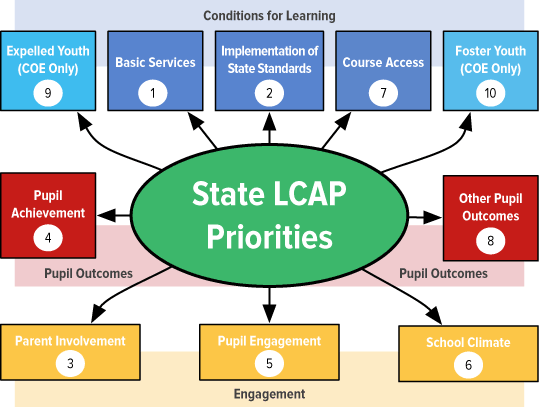
(Calif.) Based on public feedback – and increasing legislative pressure – the Brown administration says it will take action to simplify and make clearer the disclosure mechanism designed to reveal how school districts are using state funds to improve educational outcomes for California’s six million K-12 students.
Changes to the Local Control Accountability Plan template could include requiring a greater breakdown of expenditures, especially around spending on programs and services for English learners, poorer children and foster youth.
“There’s a great deal of inconsistency around how much of a local education agency’s overall budget is reflected in the LCAP,” California State Board of Education president Mike Kirst told the Senate Education Committee Wednesday morning. “[SBE] will be considering proposed revisions at its May meeting to simplify the LCAP template, not for this school year but for the 2017-18 school year, with expected final adoption in September.”
Under Gov. Jerry Brown’s Local Control Funding Formula, LCAPs are intended to be drivers of parent and community input into district spending decisions as well as reliable and transparent indicators of school performance.
The components of the plan have remained somewhat in flux as parents and civil rights advocacy groups have maintained that they still lack full inclusion, aren’t specific enough in detailing how dollars benefit disadvantaged students and are too complex to be easily understood.
Some school districts have taken issue with the heft of the requirement and say the plans are overly bureaucratic.
The pressure to address those concerns and start showing results intensified this week as several legislators wanted proof that billions in additional tax payer dollars provided to schools is producing better student outcomes.
“Now that we’ve added $13 billion to the schools, people are demanding results and patience isn’t really a word they want to hear in return,” said Sen. Marty Block, D-San Diego. “When will we know if taxpayers getting their money’s worth? Do we even know what that means and, if we do, when will we have an answer statewide?  Give me a date.”
Sen. Richard Pan, D-Sacramento, addressed an issue that was also raised Tuesday during an Assembly education budget hearing: The question of why state education officials aren’t collecting district data that would give a statewide perspective of how the money is being used to meet state goals.
“What are we doing to look at how schools are distributing their resources?” Pan asked. “The fact is, [districts] should already have that information because they should be providing that to their local Changes coming to LCAP, pressure for more continues :: SI&A Cabinet Report :: The Essential Resource for Superintendents and the Cabinet: