Latest News and Comment from Education

Wednesday, February 24, 2016

Childhood lost: Schooling a workforce. – Missouri Education Watchdog

Childhood lost: Schooling a workforce. – Missouri Education Watchdog:

Childhood lost: Schooling a workforce.

3rs
When did we shift our focus to the new 3Rs ?
With recess becoming a thing of the past in many states, a federal push for year round school and extended school days,  workforce readiness data badges starting in preschool, and children having to choose college or career paths before many even go to their first boy-girl dance, what are we doing to our children?  Can we even call them Our Children?  They have become the workforce product that business insiders see as human capitol for a global economy.
Where has childhood gone?
workforce every state
(Click this link for an interactive webpage to see YOUR STATE workforce initiatives such as ICAP, aligning standards, social-emotional behavioral metrics, Career Pathways, and Engagement metrics.)
Workforce Readiness in grade school
While of course every parent wants their child to have a successful future and begin thinking about, exploring options before graduating high school, the push for children to begin a workforce or college pathway has never been greater.  This pressure for a child to decide his or her workforce future has literally transformed education. Nearly every state is in lock step, passing legislation, creating and aligning workforce-education pathways.  Why is that? Well, it has A LOT to do with data and it is part of a well-planned, multi-year progression. Remember Marc Tucker? Marc was the mastermind of the “wholly restructured school system”.  Creating national standards for academics and standards for workforce (and national assessments for both), turning schools into workforce apprenticeship training programs,  and combining community college and high school, were all part of Marc’s plan.
 .
What is an Individual Career and Academic Plan (ICAP) and how does it fit with workforce pathways?
ICAP, or similarly named in other states, is a plan to guide students in grades 9-12, (or younger), as they explore the postsecondary career and educational opportunities available to them, aligning course work and curriculum, applying to postsecondary education institutions, securing Childhood lost: Schooling a workforce. – Missouri Education Watchdog:

Mike Klonsky's SmallTalk Blog: Standing up for Kim Foxx

Mike Klonsky's SmallTalk Blog: Standing up for Kim Foxx:

Standing up for Kim Foxx

The Chicago Teachers Union (CTU) has never endorsed anyone running for states attorney before. Until yesterday, that is. That's when the 30,000-member union endorsed Kim Foxx, running against current SA Anita Alvarez and gambling industry shill, Dona More.


 And why wouldn't they? When Alvarez, began covering up cases of police misconduct, including the murder of 16-year-old Laquan McDonald, the election became a critical one for teachers. The school-to-prison pipeline, facilitated over the past few years by Alvarez, is an affront to all educators.
"We have never endorsed in a state's attorney's race, but we are at a turning point in Chicago," CTU President Karen Lewis said in a statement, issued after a morning news conference to announce the endorsement was canceled. "This race is critical to everyone that cares about the future of our children. Kim Foxx is (the) only candidate with a real plan to invest in our next generation that will help end the school-to-prison pipeline." (Tribune)
 To get an idea of where Alvarez backers are coming from, read their pro-pipeline comments Mike Klonsky's SmallTalk Blog: Standing up for Kim Foxx:


Feds move to reduce over-representation in special ed :: SI&A Cabinet Report :: The Essential Resource for Superintendents and the Cabinet

Feds move to reduce over-representation in special ed :: SI&A Cabinet Report :: The Essential Resource for Superintendents and the Cabinet:

Feds move to reduce over-representation in special ed

Feds move to reduce over-representation in special ed
(District of Columbia) A long-standing policy allowing states to decide how to evaluate the over-representation of racial and ethnic minority groups in special education would be reversed under a new rule proposed Tuesday by federal regulators.
The proposal would require all states to follow the same standardized approach in determining if “disproportionality” exists at specific schools or districts. The new regulations would also clarify ambiguities in existing rules aimed at discouraging disciplinary sanctions disproportionately applied to special education students.
“When we see students in any racial or ethnic group identify with disabilities at vastly higher rates than their peers, we owe it to these students to pause, step back, and rethink how we are ensuring the students get the timely and appropriate services,” said acting U.S. Education Secretary John King in a conference call with reporters.
“To be clear, this effort is not about reducing the number of children who are identified as having a disability,” he said. “It's a matter of making sure the right services are getting to the right children in the right way and making certain students’ needs are properly addressed.”
As part of the 2004 reauthorization of IDEA, Congress adopted requirements that school districts take actions aimed at addressing the issue of racial or ethnic overrepresentation in special education. Specifically, districts identifying with “significant disproportionality” are required to spend 15 percent of their IDEA-Part B funds to provide early intervention services to school age children who need additional academic and behavioral support.
The proposed rule is the result of a study conducted in 2013 by the U.S. Government Accountability Office that concluded giving states control over the definition of “significant disproportionality” diminished the federal government's ability to ensure there isn't overrepresentation of certain subgroups in special education.
The report concluded that about 2 percent of all school districts in the U.S. were found to have high enough rates of disproportionality to set aside funds for early intervention services in an effort to address over representation issues.
As described by department officials this week, the rule would require states to adopt a “risk ratio” method to compare racial and ethnic groups to evaluate over-placement when compared to the Feds move to reduce over-representation in special ed :: SI&A Cabinet Report :: The Essential Resource for Superintendents and the Cabinet:


From the Classroom: Teachers Integrating Technology (Part 1) | Larry Cuban on School Reform and Classroom Practice

From the Classroom: Teachers Integrating Technology (Part 1) | Larry Cuban on School Reform and Classroom Practice:

From the Classroom: Teachers Integrating Technology (Part 1)

Just as an expert restaurant chef makes use of all of the techniques–from frying, to baking to poaching to molecular cooking with liquid nitrogen– [and] tools–from paring knives to rolling pins to food processors to steam ovens [and] ingredients that [she] has at her … disposal, [that chef] has the requisite deep knowledge, skills and experience to know what to use with what as well as how and when to use them. An expert [teacher] also makes use of all of the techniques–different pedagogies and approaches to instruction and learning from lecture to computer supported collaborative learning to games/simulations, etc. [and] tools–books, whiteboards, computers, mobile devices, wet labs, and ingredients–content domain, adjunct questions, feedback, learning objectives, etc., [that teacher] has the requisite deep … pedagogical content, and technological … knowledge and skills and experience to know what to use with what as well as how and when to use them.
Professor Paul Kirschner at Open University of the Netherlands
Analogies between teachers and chefs or orchestra conductors or staff sergeants or master performers stud the literature describing effective teachers. I happen to like the different analogies because they get at how particular teachers combine the art and science of teaching, the evanescent and abiding, the simple and complex into daily lessons. When it occurs, it is a pleasure to see. And so it was when I observed three teachers in the San Mateo Union High School District in northern California a few weeks ago. The teachers invited me into their classes and gave me permission to use their names. These three posts describe the lessons I saw where teachers were like chefs (readers can choose another From the Classroom: Teachers Integrating Technology (Part 1) | Larry Cuban on School Reform and Classroom Practice:


The big trouble in Indiana public schools, as explained by a troubled educator - The Washington Post

The big trouble in Indiana public schools, as explained by a troubled educator - The Washington Post:

The big trouble in Indiana public schools, as explained by a troubled educator


Hoosier School Heist TV is Doug Martin's channel featuring videos of his book tour across Indiana speaking on the corporate takeover of public education. Order Hoosier School Heist at http://hoosierschoolheist.com/.
Follow Hoosier School Heist on Facebook: https://www.facebook.com/HoosierSchoolHeist
Tweet with Doug Martin at: https://twitter.com/DougMartinED


 For quite some time now education policy-making in the state of Indiana has been nothing short of a mess. Republican lawmakers have long been at odds with the state’s elected superintendent of public instruction, Glenda Ritz, whose recently unveiled legislative agenda for the Indiana Department of Education reveals some of the many problems plaguing the state’s public education system.

Here are some of the issues as explained by Ritz in her budget message:
“First, we need to hold our schools harmless from the 2015 ISTEP+ as Indiana transitioned to new, more rigorous, college and career ready standards and a more rigorous assessment at the same time. Indiana’s schools, educators and communities simply cannot be blamed for mandated changes in standards and assessment….
“Second, it is clear that Indiana needs to reform our costly, lengthy, pass/fail, high-stakes assessment system. Simply put, we need to move on from ISTEP+. Recently, the federal government reformed No Child Left Behind and gave states more control over their assessment systems. While annual student assessments are still required, the federal mandate has undergone substantial changes. Indiana must reclaim control over its assessment system and move towards a streamlined, student-centered assessment that provides students, families and educators with quick feedback about how a student is performing and how they have grown over the course of a school year.
“Third, we absolutely must take steps to stem the teacher shortage that is affecting schools and communities throughout the state. Over the last six years, Indiana has seen a 30 percent decrease in the number of individuals receiving their initial license and we must take action ensure that every child has access to excellent educators.”
Ritz, not surprisingly, accuses the Republican governor, Mike Pence, of failing to support public education. Meanwhile, many Indiana teachers feel under siege from evaluation systems that use student test scores and other things, The big trouble in Indiana public schools, as explained by a troubled educator - The Washington Post:

Cerf slimes the Newark Teachers Union |

Cerf slimes the Newark Teachers Union |:
Cerf slimes the Newark Teachers Union


 Newark’s state-appointed school superintendent Christopher Cerf set out last night to smear–and maybe destroy–the Newark Teachers Union (NTU), contending its leaders had “taken the fifth” to keep information away from a judge. The lawyer representing the union immediately denounced what Cerf said, contending his statement was “absolutely, utterly and, probably, knowingly, false.”

Cerf’s comments came after a long and raucous meeting during which the school board ended years of resistance to state control and–under apparent pressure from Newark Mayor Ras Baraka– supported  the superintendent’s controversial plan to transfer 12 properties to the Newark Housing Authority.
The political victory may have gone to Cerf’s head because he ended the meeting with his attack on the union and an entity–the Supplemental Fringe Benefit Fund (SFBF), a joint union/management operation–that has been dispensing health benefits to NTU members for 45 years.
Cerf, clearly out to destroy the fund and the union’s influence on benefits, unilaterally announced last month that he would end the contract between the fund and a service provider, GPP,  it chose and give it to Benecard, a politically-connected firm founded by Doug Forrester, a Republican candidate for governor and US senator. The firm was recommended by another politically-connected Cerf slimes the Newark Teachers Union |:

Detroit Scam - Getting Rid of Democracy to Destabilize Detroit's Public Schools

Dropbox - Detroit Scan - Mar 13, 2015, 4-06 PM.pdf:

 Detroit Scam - Getting Rid of Democracy to Destabilize Detroit's Public Schools


Today, we were asked to provide these documents to people who wanted to see them. They are emails between Tonya Allen, the Emergency Manager and other high ranking DPS officials and east coast think tanks obtained in discovery in a court case. We thought we should just share with everyone. Learn what they wanted and how they intended to get it. It may make you cry. So many children have suffered because of these plans. Some highlights are the plan to make DPS so bad that students are pushed out to suburban schools and charters, to remove the democratically elected board, an early letter from Steve Wasko telling Allen her plan was disingenuous at best. One might also notice the documents are riddled with hundreds of grammatical errors. Very interesting.
Private Emails and Documents Between Tonya Allen, Robert Bobb, Barbara Byrd Bennet, Charters:
Go here: https://goo.gl/YO9Jcs

Local Control Funding Formula Guide | EdSource

Local Control Funding Formula Guide | EdSource:

Welcome to the Local Control Funding Formula Guide


 Welcome to an updated guide to the most sweeping changes in more than a quarter-century affecting how California schools are governed and funded: the Local Control Funding Formula. This guide will take a look at the law two-plus years into its implementation and will offer:

We welcome your comments and suggestions. Send them to edsource@edsource.org.

Local Control Funding Formula Guide | EdSource:

With A Brooklyn Accent: Elite Academia's Dirty Little Secret

With A Brooklyn Accent: Elite Academia's Dirty Little Secret:

Elite Academia's Dirty Little Secret

One of the ironies of my life in the academy is that virtually none of the practices that have made me most successful as a teacher- particularly the intensive individual attention I give my students both when I have them and after they have graduated- have been used to develop institutional practices at my own university or any where else. I have been treated extremely well at Fordham, and given much respect for my scholarship and teaching, but faculty here are NOT encouraged to spend as much time with their students as I do, much less their alumni, out of fear that it might get in the way of their scholarship. And if that is true at Fordham, you can imagine what it is at Yale or the other Ivies. I have received many horror stories from graduate students at these august institutions whose professors hold on to their work for months, never answer their emails, and give them only the most perfunctory attention even after they have been awarded prestigious fellowships to attend these institutions. In a million years i would never treat one of my students, with that kind of disrespect. Yes disrespect, neglect, unanswered emails, papers returned without real comments, are par for the course in many of our high prestige institutions.


I would never exchange my life for one of those professors, even though With A Brooklyn Accent: Elite Academia's Dirty Little Secret:

What's the Matter with Detroit Schools, Pt II: Charter Conversion "Solution" Fails - Teacher in a Strange Land - Education Week Teacher

What's the Matter with Detroit Schools, Pt II: Charter Conversion "Solution" Fails - Teacher in a Strange Land - Education Week Teacher:

What's the Matter With Detroit Schools, Pt II: Charter Conversion 'Solution' Fails

In 2013, Catherine Ferguson Academy, a celebrated school for teen mothers, created as part of the Detroit Public School system, was struggling to stay alive. It closed for good in 2014.
The charter management operation (CMO) that believed it could save Catherine Ferguson could not. It's just another disappointment for a district that's been governed by four Emergency Managers in six years. Another important program that could not be maintained.
Now, in 2016, it makes reading this piece from 2013 all the more poignant.
School closing protests--a first-world ed-problem, if there ever was one--are everywhere these days. In crumbling rust-belt urban centers and leafy suburbs, we're closing, consolidating, belt-tightening. It's hard to argue with population migration--Detroit lost a quarter of its citizens in the last decade--or for keeping every beloved neighborhood school open if half the classrooms are empty. But--"economic efficiency" isn't the only reason that schools are targeted for closing. We all know this.
I just visited a famous almost-closed school in Detroit: Catherine Ferguson Academy. The name may be familiar from MSNBC's coverage on the Rachel Maddow Show in April, 2011. CFA is a unique and innovative school for teen mothers, where students worked an urban farm, complete with animals, right on the playground. The storyline was good--the girls stayed in school, and most of them went on to two- and four-year colleges. But it cost money to provide care and education for the students' infants and toddlers. The school--measured by our new, "value-added" national yardstick, the resources necessary to raise test scores--was not "efficient," and was slated to close.
With TV cameras rolling (another feature of first-world "reform"), the students and some teachers staged a sit-in. Imagine the dramatic footage of pregnant girls being forcibly removed, while passionately defending the school they loved--the school that made it possible for them to achieve, and hope. At the 11th hour, a for-profit charter organization stepped in and "saved" Catherine Ferguson.
The founding principal, Asenath Andrews, began our site visit last week by telling us how she was persuaded by a patron, back in the mid-80s, to create a better way to educate teen moms in Detroit. Her benefactor was highly placed in Detroit Public Schools, and had the upper-level connections to keep a pet project going and funded in the increasingly unstable DPS system. She believed Andrews was just the person who could re-invent schooling for pregnant girls in Detroit, and threw her weight behind getting a school established.
Over more than two decades, Andrews and her staff crafted new ways to educate girls previously considered thowaways. There were special considerations for the students--summer school at a college campus for the girls and their children, early childhood education for infants and toddlers, even international travel. The fact is: CFA invested--in the best sense of the word--in teen mothers. And did so using the resources of a public school system.
Asenath Andrews is a fierce and compelling master educator. She told us she often did things without asking first (a practice with which I have some personal empathy). She took risks, seeking outside funding when she wanted something special for her girls. She developed unique curriculum with the (unionized) teachers she inherited, and kept stretching the boundaries of conventional public schooling. She worked through roadblocks and threats that a large, monolithic district kept throwing in her way. Andrews told us: I've been called a visionary, but I'm not. I just listened to pregnant girls talk about their hopes and their needs.
Catherine Ferguson Academy got a lot of recognition. They were highlighted on Oprah, and there was a feature-length documentary, "Grown in Detroit." The girls were going on to college, writing books, preparing for optimistic futures. At the very least, they were graduating high school with the skills and intention to support their children.
And now? After the charter conversion? Well, things have changed. Enrollment has dropped, precipitously. The bus driver who dropped us off at CFA thought the school had closed--perhaps because students (with their babies and tots) are now responsible for getting themselves to school, mostly using public transportation.
The charter management operator also inaugurated the Big Picture school model. I'm a fan of Big Picture, but it's a very different way to approach high school than the personally-tailored curriculum Andrews and her staff had developed over time. And there's been pushback from the students.That's the thing about empowering teenagers: they assume they have the right to tell you how they want to be educated.
So there's the micro-question: What does it take to keep something successful and amazing going--providing the same critical services, contributing to the value of the Detroit community and students' lives? Do you do whatever it takes, and deal with the consequences as they come?
Then there are the macro-questions: When resources from a public system build something wonderfully useful, addressing a social need with persistence and imagination, what do you lose when you turn over control and management to a private company? What strings are attached when you supplement public monies with private funding?
Or this: What are the ultimate outcomes of scrapping publicly funded education in favor of relying on luck, connections and philanthropy?
Asking those questions didn't seem polite at our visit. I know you don't sacrifice the people you love for a principle, and I deeply admired the work that Asenath Andrews did.
As we were leaving, one of the teachers in our group made a haunting comment: "I keep wondering where the babies and toddlers who started their educational lives here at Catherine Ferguson will go, when they're first graders in Detroit. Will just-right charters step up and fill the bill? Or will they go to public schools with jam-packed classrooms, scripted learning and constant turnover?"
Excellent questions.

Detroit Public Schools House legislation is an insult

DPS House legislation is an insult:

DPS House legislation is an insult

What is the state House of Representatives thinking?
Wait, that one's too easy. The House is thinking that because Detroit Public Schools' needs are so urgent -- the state's largest school district could run out of cash in April if the Legislature doesn't act on a reform plan mulled by Gov. Rick Snyder for almost a year -- this is a fine time to tie a raft of noxious, anti-union, anti-Detroit addenda to a reform package the Legislature must pass in order to keep the district's doors open.
So we'll ask a different question: Are the Republican leaders of the state House of Representatives so craven, so insensible to the fact that their work affectschildren, that they'd risk the futures of the 47,000 souls enrolled in DPS with a slate of ideologically driven "reforms" sure to divide any vote along party lines?
Sadly, we know the answer to that.
The House's DPS reform bills sticks to the "old company, new company" model advanced by Snyder. The old company would keep DPS's name, elected school board and operating millage, and exist solely to pay off the district's debt, while the new company would receive the district's per-pupil allowance and an additional state subsidy, and would educate Detroit's children.
But changes larded on by Republican lawmakers mean this legislation would essentially create a school district in Detroit with lower standards than any district in the state.
By gutting some provisions of the state law that requires collective bargaining for some portions of teacher contracts, by allowing the new district to hire teachers with "alternate" certification, by tying teacher pay and benefits to nebulously defined performance standards, the bills' sponsors are saying that Detroit's children, of all the children in the state, deserve less. Much less. Detroit kids, it seems, don't deserve the same quality of education as kids in West Bloomfield or Grosse Pointe.
The state Senate introduced its own DPS reform package earlier this month, sponsored by state Sen. Geoff Hansen, R-Hart, who had worked closely with Snyder. That plan wasn't perfect: An education commission that would have had oversight over both charter and traditional public schools was stripped out of the plan.
Neither plan has won the approval of Detroit lawmakers. Nor should they.
Why is Detroit different than any other district in the state? We can hear the chorus of response: Because of Detroit's track record. Because of its history of financial ruin. Because DPS is failing.
It is an undisputed fact that the district has spent the bulk of this century under the guidance of a state-appointed emergency manager. The state bears both moral and legal responsibility for the district's hefty debts -- much of the district's short-term debt, after all, was incurred during that period. State intervention is predicated on the state's constitutional responsibility to provide an adequate education for every Michigan child. State intervention came with a promise to fix DPS. But state intervention, indisputably, made the problem worse.
The "reforms" added to the House plan bring the district no closer to academic or financial health. And if this is the kind of disdain Detroit can expect from the Legislature, then all hope may be lost.
Here's our challenge to the lawmakers championing these plans: If these reforms are destined to ensure excellence, pass them statewide.
Yeah, that's what we thought.DPS House legislation is an insult:

Ohio Fails to Move Forward to Oversee Charter School Sponsors | janresseger

Ohio Fails to Move Forward to Oversee Charter School Sponsors | janresseger:

Ohio Fails to Move Forward to Oversee Charter School Sponsors

After years of delay and the waste of millions of public tax dollars awarded to poorly operated charter schools, finally early last October, the Ohio legislature passed a bill to regulate charter schools.  Here is how the Cleveland Plain Dealer‘s Patrick O’Donnell described the new law’s provisions that include, “changes designed to distance the often-cozy relationships between for profit charter school operating companies and the school boards that govern the schools.”  The big charter management companies that have had “sweeps” contracts that forward over 90 percent of the schools’ operating budgets to the management company without reporting about how the money is used will now be required “to provide more information to the public about how they spend tax dollars they are paid to run the schools.”  And there is a new “White Hat” rule designed to correct the situation that arose last month when “an Ohio Supreme Court ruling… allowed prominent for-profit charter operator White Hat Management to keep desks and computers it bought for schools using tax dollars, even after the schools closed.  The court let White Hat keep the property because its contract with the school allowed it.  The new provision blocks any such agreement and requires that leftover assets from closed schools, after bills are paid, go to the Ohio Department of Education to distribute to school districts.”
What was left out of Ohio’s new charter school regulations was any way for the state to regulate the sponsors that have proliferated in a state that permits non-profits to collect oversight fees for charter schools they approve and agree to oversee.  Too many of these organizations have been neglecting their responsibility as sponsors at the same time they have been collecting so-called “walking-around-money” for the job they have persistently neglected to perform. David Hansen who was Ohio’s former chief of school choice designed a plan to evaluate charter authorizers by the test scores of the students in the schools the sponsors oversee, but he quietly left out the huge, notorious on-line charters from his rating system. The  on-line academies are politically powerful, and Hansen was forced to resign last July after it was widely reported in the state’s newspapers that he had favored the politically connected.  Richard Ross, until January when he retired as Ohio’s Superintendent of Public Instruction, spent several months last fall developing a new rating system for charter Ohio Fails to Move Forward to Oversee Charter School Sponsors | janresseger:

Russ on Reading: Accountability in Public Schools: The Three-Legged Stool

Russ on Reading: Accountability in Public Schools: The Three-Legged Stool:

Accountability in Public Schools: The Three-Legged Stool

My uncle was a dairy farmer in North Carolina. In the fifties, before automation hit the dairy industry, I used to watch him drag his old, wooden, three-legged stool from cow to cow and deftly milk each cow with a steady, rhythmic motion, as streams of milk splashed into his milking can. Occasionally, he would allow his "city kid" nephew to sit on the stool and give it a try. In many ways that stool - sturdy, steady and reliable- was the foundation on which my uncle's business was built.

The educational age of accountability, which Hoffman and Pearson in the book Research-Based Practices for Teaching the Common Core (2015), identify as beginning in about 1985, was built on a three-legged foundation as well. The original formulation of accountability called for


  • Holding students accountable for learning content and processes
  • Holding teachers accountable for student learning
  • Holding states and policymakers accountable for providing the resources that would create the opportunity to learn (Hoffman and Pearson, 2015).
Early on in the accountability movement there seemed to be a recognition that there was aquid pro quo to requiring student and teacher accountability. If students and teachers were to be held accountable, then the states must provide the resources to achieve the desired Russ on Reading: Accountability in Public Schools: The Three-Legged Stool:

The Court of Appeals is about to hear arguments on how to deal with ineffective teachers - LA Times

The Court of Appeals is about to hear arguments on how to deal with ineffective teachers - LA Times:
Landmark teacher tenure fight resumes in California court


One of the highest-stakes battles in education is about to resume Thursday in a Los Angeles courtroom as teacher unions and their allies try to win back job protections that were tossed out in a landmark 2014 ruling. 

An appeals court will weigh the ruling by L.A. Superior Court Judge Rolf M. Treu that sent shockwaves through California and the rest of the country by striking down the tenure and seniority system that had long protected public school teachers. The ruling is on hold pending the appeal.
In Vergara vs. California, Treu sided with the plaintiffs: nine public school students, who argued that the rules protecting teachers’ jobs endangered their constitutionally guaranteed right to a public education.
Treu found that teachers earn strong job protections too quickly -- within two years. And he found the process for firing them “to be so complex, time consuming and expensive as to make an effective, efficient yet fair dismissal of a grossly ineffective teacher illusory.” He also threw out rules under which teachers are laid off based on a seniority system, rather than on performance.
The judge also accepted the argument that these rules favored by teachers unions disproportionately harmed minority students -- a status quo that, he said, “shocked the conscience.”
Unions and their allies challenged the evidence presented in court, noting, for example, that an instructor named in testimony as an example of a bad teacher had been honored as teacher of the year in her school system.
They also argued that taking away job protections would do little to improve the teacher corps and might dissuade talented teachers from entering or remaining in the profession.
The case quickly made California the center of a national debate over how to protect students from ineffective teachers and how they should be defined.
Former U.S. Secretary of Education Arne Duncan hailed the decision.
American Federation of Teachers President Randi Weingarten decried the decision, saying it stripped “the hundreds of thousands of teachers who are doing a good job of any right to The Court of Appeals is about to hear arguments on how to deal with ineffective teachers - LA Times:

Juvenile incarceration is way more expensive than tuition at a private university - Yahoo Finance

Juvenile incarceration is way more expensive than tuition at a private university - Yahoo Finance:

Juvenile incarceration is way more expensive than tuition at a private university


 Putting kids in jail is expensive.

The annual cost of youth incarceration for a single individual is $112,555, according to the annual report of the Council of Economic Advisers.
That's about 3.5 times the average tuition and fees at a four-year, non-profit private university ($32,405), and almost five times the average cost of tuition and fees at a four-year public university for an out-of-state student ($23,893), according to the report's data.
The cost of incarceration is also more than 11.5 times the average for a year of Head Start ($9,770), and about nine times the cost of an average year of public school ($12,508).
View photo
.
juvenile incarceration
(Council of Economic Advisers) 
The huge expense of juvenile incarceration suggests that investment in early and upper level education is beneficial to society as a whole as well as to individual children.
"Underinvestment in children’s health and human capital in their earliest years can become more costly for society later in children’s lives," the CEA's report notes.
"Societal efforts that attempt to intervene later in life, for example through remedial education or the juvenile justice system, tend to be less cost-effective than interventions that help children get, and stay, on the right track in the first place," the authors continued.
The CEA report goes on to note that there is evidence that suggests investments in early childhood education may reduce involvement with the criminal justice system and lower the social costs of crime and incarceration.
These improvements in children’s development could also reduce the need for special education placements and remedial education. Some of the early childhood investments like Head Start, which offer access to health services, have also helped improve the health of participants, according to the report.
Early investment in children also makes good fiscal sense on the revenue side of the ledger as well. The CEA writes (emphasis ours):
"Finally, public investments in young children, such as preschool, public health care, and income transfers, have been shown to improve children's long-term earnings potential .... When the children who receive these investments grow up, they pay more in taxes and are less likely to receive public assistance. As a result, making these early investments would actually increase revenue and reduce government expenditure over time."

Tuesday, February 23, 2016

Newark’s school wars are over: Cerf and Baraka win, the people lose |

Newark’s school wars are over: Cerf and Baraka win, the people lose |:
Newark’s school wars are over: Cerf and Baraka win, the people lose


 Years of  resistance to the state masters of Newark’s schools collapsed last night in a stunning show of the political power of the new alliance between state-appointed superintendent Christopher Cerf and Ras Baraka, the mayor whose election was due almost solely to his opposition to state control and his support from employee unions. The elected school board voted 6-2 to approve Cerf’s giveaway to the city of millions of dollars in school property–a plan endorsed by the mayor.

Board members who, for years, had nothing good to say about Cerf and who, just last week, criticized the property plan, supported Cerf. They included members like Marques Aquil-Lewis, Phil Seelinger,  Crystal Fonseca and board chair Ariagna Perello,  men and women who had demanded Cerf’s resignation more than once.
The vote came late in the meeting and was accompanied by jeers of activists who cried “sell-out” and “conflict” as the board, with its new and ill-fitting political stripes, first beat back an effort to table the transfer of property–and then voted to approve it.
The only two board members to vote against the transfer were Antoinette Baskerville-Richardson and Donald Jackson. Dashay Carter, who had spoken sharply against the plan at an earlier meeting, abstained. She is an employee of the Newark Housing Authority and said she had a “conflict.”
And that’s at the core of this ignominious defeat of what had once been a brave band of board members who resisted the state’s control for years–four of the board members work for City Hall or one of its agencies. As long as Baraka was at odds with Cerf or his predecessor, Cami Anderson, the board was free to vote its Newark’s school wars are over: Cerf and Baraka win, the people lose |:

Linda Darling-Hammond: What California can do to address teacher shortages | EdSource

What California can do to address teacher shortages | EdSource:

What California can do to address teacher shortages

Linda Darling-Hammond
he following is the first in a series of commentaries on the emerging teacher shortage in California. This one focuses on what the state of California can do to address the shortage.  
Make no mistake, the teacher shortage is real. The Learning Policy Institute’s recent report “Addressing California’s Emerging Teacher Shortage: An Analysis of Sources and Solutions” found that, after sharp declines in teacher education enrollments over the last decade, recent hiring increases left many districts scrambling to find teachers. As districts began to restore teaching positions eliminated during the Great Recession, credentials issued to new teachers were at an historic low.As California has embarked on an ambitious journey to raise standards for student learning and rethink nearly every aspect of its educational system, one of the state’s most pressing challenges is hiring and retaining well-prepared, high-quality teachers who can teach the challenging new skills our society demands. This is especially true when the state faces teacher shortages like those emerging now.
As a result, the number of teachers hired in 2015 without having completed – or sometimes even begun – their preparation soared, reaching one-third of all new credentials issued in the state. Although shortages are occurring across a range of subject areas, the problem is most acute in mathematics, science and special education. In special education, barely half (52 percent) of new teachers are fully prepared. Bilingual teachers and those with training to teach English language acquisition are also in short supply. A small increase in individuals entering preparation this year was nowhere close to the level of demand, and, further, was not in the fields that have the greatest need.And nearby states, also experiencing shortages, were luring away many of these teachers with promises of good salaries and lower housing costs.
As was true in previous eras of shortage, the dearth of qualified teachers is felt most acutely in schools serving more low-income and minority students. According to California’s educator equity plan, in 2013-14, twice as many students in high-minority as in low-minority schools were being taught by a teacher who had not completed – or even enrolled in – a preparation program.
Demand is projected to grow further as districts continue to recover from the recession and seek to replace the programs and positions they eliminated, as they also cope with attrition, which averages about 8 percent of all teachers annually. This includes inevitable retirements – fully one-third of California teachers are over 50 and 10 percent are over 60 years old – but most attrition is due to younger teachers leaving. The reasons range from economic concerns to dissatisfaction with teaching conditions, such as large classes, lack of materials, accountability pressures, lack of administrative supports and lack of public appreciation.
To meet the projected demand, the number of new teachers entering the classroom would need to nearly double – something that is unlikely to happen What California can do to address teacher shortages | EdSource:
Patrick Shields
 Patrick Shields

The Illinois Retired Teachers Association (IRTA) visits Florida retired teachers | Reclaim Reform

The Illinois Retired Teachers Association (IRTA) visits Florida retired teachers | Reclaim Reform:

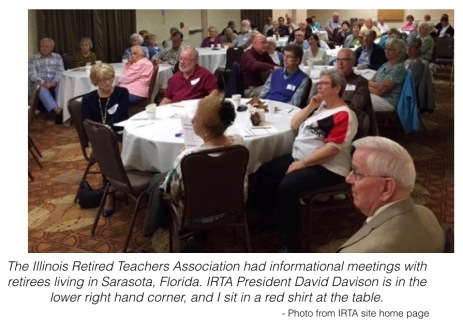
The Illinois Retired Teachers Association (IRTA) visits Florida retired teachers


The Little Giant that began the legal suit to the Illinois Supreme Court that successfully defended the constitutional rights of retired Illinois teachers’ pensions met with those retirees who presently live in Florida. I attended the Sarasota meeting in mid-February, and was pleased to hear their repeated promise. “We will go back to court in the event that any of our benefits are threatened,” stated IRTA President David Davison.

 Illinois Retired Teachers Association in Florida.001 copy


While the Illinois Education Association, NEA/IEA, had pushed hard to support SB2404, which would have surrendered some of our constitutionally protected rights and benefits, our little non-union affiliated IRTA hired lawyers to take the case to the Illinois Supreme Court rather than agreeing to diminish our incomes without a challenge. At the time, Illinois had a Democratic governor and a super-majority Democratic House and Senate. Corruption and attacks on teacher pensions have no political party affiliations.
The NEA/IEA then joined with the other We Are One Illinois (WAOI) coalition of unions to support the challenge to active and retired teachers’ income. Together we won.
IRTA Executive Director Jim Bachman elucidated the ongoing plans to actively support political candidates who support teachers and their The Illinois Retired Teachers Association (IRTA) visits Florida retired teachers | Reclaim Reform:

Why LAUSD's projected graduation rate shot up nine points in one month | 89.3 KPCC

Why LAUSD's projected graduation rate shot up nine points in one month | 89.3 KPCC:

Why LAUSD's projected graduation rate shot up nine points in one month

File photo: At the end of the fall semester, barely half of Los Angeles Unified high school seniors were on-track for graduation. By Feb. 18, that number had jumped to 63 percent.
File photo: At the end of the fall semester, barely half of Los Angeles Unified high school seniors were on-track for graduation. By Feb. 18, that number had jumped to 63 percent. CRYSTAL MARIE LOPEZ/FLICKR

When second semester classes came to an end in January, barely half of the 32,000 seniors in Los Angeles Unified high schools were on-track to graduate at the end of this year.
Now, six weeks later, 63 percent of L.A. Unified seniors are on-track to earn diplomas, a district memo shows — and another 17 percent are only one or two courses behind.
But what looked like a sudden shift in the numbers is the result of what district officials described Tuesday as part of a year-long, district-wide effort to ensure off-track high school seniors earn the credits they need to get their diplomas.
Specifically, the updated numbers include for the first time students who made up credits during the fall semester. Some even finished their credit recovery work over winter break, said L.A. Unified Chief Academic Officer Frances Gipson.
But only 43 percent of this year’s seniors are currently on-track to graduate with a C average or better — a bar students must clear to be eligible for admission at University of California or California State University campuses.
Superintendent Michelle King has set a goal that 100 percent of L.A. Unified Why LAUSD's projected graduation rate shot up nine points in one month | 89.3 KPCC: