Tuesday, February 9, 2016

Mike Klonsky's SmallTalk Blog: Changing face of the city, schools and politics

Mike Klonsky's SmallTalk Blog: Changing face of the city, schools and politics:

Changing face of the city, schools and politics

Here's what has replaced public housing in Rahmville.  2 Bedrooms In Cabrini-Green's New High Rise Start At $3,200 A Month. The units boast such amenities as Nest Thermostats, floor-to-ceiling glass windows and exposed concrete ceilings. The building's shared spaces include a rooftop with a chef's kitchen and two dog runs.

Selective -enrollment high schools are ubiquitous in Lincoln Park and Rahm keeps trying to build more despite a shrinking population in that area. Many of Chicago's wealthiest neighborhoods are dramatically below their peak populations. Selective enrollment magnets, originally created as a result of a court-ordered desegregation mandate, are now used like charter schools,  to promote racial and class resegregation.

And now, a lifetime ban and possible heavy fines imposed on families who try and "cheat" their way in. That doesn't apply of course, to the clout-heavy or to wealthy suburbanites, like Bruce Rauner, whose kid didn't meet entrance requirements at Payton, but got in through the back door after Rauner made a phone call to Arne Duncan.

According to Chicagoist,

...a goldmine for developers who have planned new, luxury high rises for the Near North Side area not far from where the dilapidated public housing towers once stood.
With Chicago in the midst of a housing crisis we can't help but see the promises of these luxury developments coinciding with the displacement of Chicago's working class and the hastening demise of its affordability for anyone making less than $72,000 a year (that's how much you'd have to make to reasonably afford a studio apartment at $1,825 a month, based on this popular rental formula).
Change in Chicago's population
Former Cabrini residents got a housing voucher, amounting to a one-way ticket out of their neighborhood and in many cases out of town. Waiting lists for subsidized housing vouchers in Illinois are closed. Nearly 82,000 households use housing vouchers, commonly known Mike Klonsky's SmallTalk Blog: Changing face of the city, schools and politics:


Democrats Malloy and Wyman stab state employees in the back – again – and again. - Wait What?

Democrats Malloy and Wyman stab state employees in the back – again – and again. - Wait What?:
Democrats Malloy and Wyman stab state employees in the back – again – and again.


When they were running for re-election, Governor Dannel Malloy and Lt. Governor Nancy Wyman were all smiles as they accepted the political endorsements from Connecticut’s state employee unions and the Connecticut AFL-CIO.
When Malloy and Wyman wanted the unions to fork over money to help pay for their re-election campaign, union leaders stepped up big time.
Using hard-earned money collected from their members, AFSCME dumped $1.2 million into the Super PAC that was set up to support Malloy and Wyman’s effort to spend four more years in office.  The American Federation of Teachers (AFT) added $600,000 and SEIU donated $550,000 to the same political committee.
In addition, when Malloy and Wyman wanted campaign donations funneled into a special account run by the Democratic State Central Committee, the various unions came up with over $160,000.
And not a complaint was heard when unions’ political operation kicked into high gear, providing the votes that Malloy and Wyman needed to get the second term in office that they so desperately wanted.
Even after the 2014 election, Team Malloy/Wyman kept their proverbial hand out, looking to the unions to cough up even more of their members’ money.  According to the latest campaign finance reports, the state employee unions have donated in excess of $42,000 to Democrats Malloy and Wyman stab state employees in the back – again – and again. - Wait What?:

What Kids Need From Grown-Ups (But Aren't Getting) : NPR Ed : NPR

What Kids Need From Grown-Ups (But Aren't Getting) : NPR Ed : NPR:

What Kids Need From Grown-Ups (But Aren't Getting)

Student playing with paper and pencil instead of sitting in box like other children
Annelise Capossela for NPR
Erika Christakis' new book, The Importance Of Being Little, is an impassioned plea for educators and parents to put down the worksheets and flash cards. Ditch the tired craft projects (yes you, Thanksgiving Handprint Turkey) and exotic vocabulary lessons, and double-down on one, simple word:
Play.
That's because, she writes, "the distinction between early education and official school seems to be disappearing." If kindergarten is the new first grade, Christakis argues, preschool is quickly becoming the new kindergarten. And that is "a real threat to our society's future."
If the name sounds familiar, that's likely because Christakis made headlines last October, writing an email that stirred angry protests at Yale, where she is a lecturer at the Yale Child Study Center.
The Importance of Being Little
What Preschoolers Really Need from Grownups
Hardcover, 376 pages
purchase
When a campus committee sent students a memo urging restraint in choosing Halloween costumes and asking them to avoid anything that "disrespects, alienates or ridicules segments of our population based on race, nationality, religious belief or gender expression," Christakis wrote a memo of her own. She lauded the committee's goals of trying to encourage tolerance and foster community but wondered if the responsibility of deciding what is offensive should fall to students, not their administrators.
"Have we lost faith in young people's capacity – in your capacity – to exercise self-censure, through social norming, and also in your capacity to ignore or reject things that trouble you?" Christakis wrote.
Many Yale students accused Christakis of being racially insensitive and called for her ouster. In December, she stepped down from her teaching duties, telling The Washington Post, "I worry that the current climate at Yale is not, in my view, conducive to the civil dialogue and open inquiry required to solve our urgent societal problems."
What does Christakis' role in the heated debate over racial insensitivity and free speech on campus have to do with her views on preschool? Surprisingly, a lot. I spoke with Christakis about her new book and the turmoil at Yale. Here's an edited version of our conversation.
What is this phenomenon that you call "the preschool paradox?"
It is the reality that science is confirming on a daily basis: that children are hardwired to learn in many settings and are really very capable, very strong, very intelligent on What Kids Need From Grown-Ups (But Aren't Getting) : NPR Ed : NPR:

Here’s What College Cost 200 Years Ago - Yahoo Finance

Here’s What College Cost 200 Years Ago - Yahoo Finance:

Here’s What College Cost 200 Years Ago

If you were heading off to college in 1816, you wouldn’t have had to worry about buying extra-long sheets, renting a mini-fridge, or packing a spare iPhone charger. You would, however, need to load up on candles and oil—the electric light bulb still being some 60 years in the future.
Plus, if you planned to hire a servant or bring one from home, as some 19th century collegians apparently did, you’d have to budget for his or her wages too.
Such was the cost of college 200 years ago, based on published figures for Harvard.
The breakdown, as reported in Charles Franklin Thwing’s History of Higher of Education in America(1906), included:
ItemAnnual cost
in 1816-17
In 2016
dollars
Room and board$117$1,631
Instruction$57.50$802
Textbooks$15$209
Clothes$200$2,788
Laundress$24$335
Candles, oil$10$139
Servant$20$279
Pocket money$52$725
Vacations$60$836
Misc.$45$627
TOTALS$600.50$8,371
A year at Harvard runs a lot more than $8,371 these days, of course. The estimated cost of attendance for 2015-2016 is $64,400 to $69,600. On the other hand, because the university covers 100% of demonstrated need, it’s likely that a fair number of students and families pay considerably less than their fellow alumni of two centuries ago.
* Translation into today’s dollars is based on this formula published by the Federal Reserve Board of Minneapolis.
 Here’s What College Cost 200 Years Ago - Yahoo Finance:

Did a War on Teachers Lead to New Shortages? - Rick Hess Straight Up - Education Week

Did a War on Teachers Lead to New Shortages? - Rick Hess Straight Up - Education Week:

Did a War on Teachers Lead to New Shortages?


Note: Joshua Cowen is Associate Professor of Education Policy in the College of Education at Michigan State University and you can follow him on Twitter at @joshcowenMSU. Katharine Strunk is Associate Professor of Education and Policy in the Rossier School of Education and the Sol Price School of Public Policy at the University of Southern California.
Thanks for having me, Rick; long-time listener, first-time caller. I'm going to sound off this week about school choice and teacher quality. To kick things off today I've asked my friend and collaborator Katharine Strunk from the University of Southern California to help me think through some pressing questions on teacher-related reforms and teacher shortages. So, off we go:
After years of struggling with budget cuts, public school districts are finally emerging from recession-induced constraints on expenditures. Until very recently, news headlines from across the country bemoaned school districts being forced to resort to extensive teacher layoffs. But now we hear the happy news that districts are hiring again and we need teachers. WE NEED TEACHERS, except now there are none to be had! Suddenly, it seems we are in the midst of a massive teacher shortage. (See here to read the sounding of the alarm by The New York Times.) How can this be?
How can this be? This is a good question, and one that has a lot of folks speculating about potential causes. Today we want to think about just a few of them, and we want to start with the one getting the most press: Teachers are unhappy, they're leaving the classroom, and it's all because of all the reforms we've layered on public schools and teachers in the last decade or so. In fact, google the words "war on teachers," and the search results display news items, blog posts, speeches and other commentary on the high-profile policy reforms to the teaching profession taking place across the country. The line of thinking tying these changes to teacher shortages goes like this: the shortages "are resulting amid school reform initiatives that have evaluated teachers by standardized test scores, and/or reduced collective bargaining rights, and/or forced teachers to administer a mountain of standardized tests to students and teach to the test, and/or suffered inadequate funding."
Despite the fact that many reforms have only recently occurred, and continue to develop alongside other major changes to the education landscape—the federal Every Student Succeeds Act (ESSA), for example—stories abound of their impact on teachers and teaching. Many come from teachers themselves, some of whom have aired what amount to public resignation letters explaining why they no longer can work in public schools.
These are compelling individual testimonies, but on the whole can we really say that the teacher shortage is happening in large part because policymakers have made the teaching profession untenable?
The answer: we don't really know. To be sure, some teachers are leaving for these reasons, as the posts above show. But as policy analysts, we need to consider other possibilities at the same time. For example, one explanation is that the teaching workforce has grown steadily older over the last few years, in part because younger people may be finding other work, but also because the structure of teacher pay and compensation remains heavily back-loaded in favor of later-career teachers. Older teachers will retire sooner than their younger colleagues, perhaps at rates that exceed our ability to hire more.
The economy may also be to blame. Over the last five or more years, teachers experienced serious threats to their job stability due to increased numbers of Reductions in Force and layoffs during theGreat Recession. This likely makes teaching a less attractive profession to teachers who value stability.
It's also important to realize that the shortage has been percolating for a very long time and may have actually been mitigated by the economic downturn and reduced hiring rates. For instance, a recent report shows that in California, teacher preparation programs have been producing steadily fewer teachers since 2002, well before the current "anti-teacher" policies were introduced, and barely after the No Child Left Behind Act went into effect. Fewer people seem to be choosing a teaching career. Enrollment at teacher preparation programs has fallen... over at least the past decade.
Which leads to a more basic question: Is the teacher shortage even new? Today, it's the scale andlocation of the teacher shortages that are pressing. Until recently—over the past two decades, at least—teacher shortages have been most common in disadvantaged schools. Indeed, among the most consistent predictors of a teacher's exit have been the demographic characteristics of students in the school he or she teaches. Unfortunately, low-income, minority students and students with special needs tend to lose their teachers more frequently, with the most effective teachers who leave moving to more advantaged areas. These students have experienced teacher shortages for a long time. It just hasn't been front page news. Even today, there are real teacher shortages, but not everywhere, and not for every subject. The simple truth is that in many parts of the country, we don't have enough teachers to teach many of the kids who need them the most, and we haven't for a very long time.
But there is some sunshine through the clouds: more than a million-and-a-half new teachers are slated to enter the field in the next few years, and although some observers have worried about declining quality as much as quantity, it's possible that many of those new teachers are some of our best and brightest. A few months ago, a new study found that the academic ability of new teachers has steadily increased since 1999. And over the summer, another paper showed that teachers hired during the Great Recession were actually more effective than those hired earlier.
None of this is to suggest that teacher-related policy reforms have had no impact on individual teacher decisions to exit public schools or avoid the profession in the first place. The point is that we have yet to fully understand the extent to which this is true, much less what we can do about it. But we can use the data researchers, states and districts are gathering to help us uncover the causes of current trends in the teacher labor force and, importantly, to help design solutions. And then we can use evidence rather than anecdote in discussions of where to go next.

In Education "Reform" Nothing Means What You Think It Does

In Education "Reform" Nothing Means What You Think It Does:

In Education "Reform" Nothing Means What You Think It Does

In the world of Education reform, nothing means what you think it will. We learned that the hard way with No Child Left Behind. I mean, of course we don't want a child left behind! Why would we want a child left behind? Sign the bill! Stamp the approval! All kids succeed!
But it didn't really pan out that way. Instead it was more like, no school left unpunished. As the clock wound down to the point where ALL schools were supposedly passing ALL kids or else ALL would be failing, a feat that educational experts new from the beginning was impossible, we abandoned NCLB and moved to Race to the Top. Again, who doesn't want to be on top? Who wants their state, their kids, their neighborhood to be on a school that is losing? No one! Let's all Race to the Top.
Amidst the many demands states were expected to comply with in order to receive race to the top funding, was merit pay. When normal working Americans hear the words merit pay, they often equate it to bonuses. But at least in the state of Georgia, merit pay actually means you get to keep 100% of the paycheck you already get if you do really well. And accountability doesn't mean making sure everyone is doing what they are supposed to, it just means more testing. Accountability, in education reform world always and only means tests.
A few months back,President Obama killed NCLB forever by signing the "Every Student Succeeds Act" and again, who wouldn't want that? Of course we want every student to succeed. Especially teachers, no teacher goes into her job every day thinking "how can I get one more kid to fail." But like the other education reform speak, this will not bring us what it promises. Among many troubling aspects of this bill is the point that only 1 percent of students will be allowed to take an alternative to the mandated standardized tests. So, by definition of the bill every student will succeed by not allowing most students with protected accommodations use those accommodations in order to pass the class. This make no sense and is troublesome to most teachers, but especially those teaching special ed.
One big part of the Every Student Succeeds Act is a push for "personalized learning," in fact personalized learning is so hot right now billionaire Mark Zuckerberg has agreed to invest billions of dollars into the initiative. But much like No Child Left Behind, Race to the Top, and Merit Pay didn't actually mean that. Personalized learning is simply not what you imagine.
You imagine a classroom full of students independently working on things that interest them. They feel special and noticed and cared for. They understand how what they are learning will apply to them later. That sounds awesome and that isn't personalized learning in education reform. Nope, not even close. When people talk about personalized learning, what they are actually talking about are pre-packaged, pre-scripted modules that a kid must get through. Perhaps, they test out of the first two, or do them in a different order but they all land on the same test and take it. Maybe they do it at a different pace, but that doesn't mean this is personalized.
Why would they do this? Well, we stopped buying textbooks. The textbook In Education "Reform" Nothing Means What You Think It Does:

Charter schools say L.A. Unified is unfairly scrutinizing their campuses - LA Times

Charter schools say L.A. Unified is unfairly scrutinizing their campuses - LA Times:
Charter schools say L.A. Unified is unfairly scrutinizing their campuses


 price Young thought the worst was behind her, that her group's charter schools would be free to grow after straightening out the poor financial record-keeping that prompted a recent state audit.

She was wrong.
The school district still found fault with her organization's petitions to open new campuses. District officials told her to expect rejection.
Young's group, Magnolia Public Schools, eventually abandoned the effort.


Her experience is becoming more common as the Los Angeles Unified School District's administrators and board of education become increasingly resistant to greenlighting new charter schools.
Charter supporters say the district is unfairly scrutinizing their independently run campuses because it sees them as a threat.
At Tuesday's board meeting, members are poised to reject two new charters — this in addition to the three charter petitions that Young withdrew from consideration.
Since July 1, L.A. Unified has denied six petitions and approved five others, according to figures from the California Charter Schools Assn.
That's less than a 50% approval rate. Two years ago it was 89% and last year it was 77%, according to the association.
In a letter emailed to the board Monday, leaders of charter groups accused the district of obstructing their efforts to improve public education:
"We are concerned that this district is looking for reasons to prevent new charter schools from opening, even those proposed by the most respected, successful charter operators. Issues that in the past were seen as minor or correctable are now elevated to significant issues that somehow warrant denial."
Twenty-one charter organizations, enrolling 56,000 students, signed the letter, which continued:
"Given the measurable drop in approvals for new petitions, the inconsistent and non-transparent review processes, and the backroom pressure to abandon our efforts to grow, we all feel it is appropriate to bring these concerns into the light of day."
The school district has not analyzed its approval rate, said Jose Cole-Gutierrez, head of the charter-school division, and he denied any wrongdoing or change in policy.
"The process has remained the same, and the findings are there for the board and the public to review," he said. "Our office continues to be focused on quality for students and putting students first."
Charters' rapid growth — to about 101,000 students in L.A. — is responsible for about half of a precipitous drop in district enrollment and the funding that comes with it.
Charter operators said that families who want to take advantage of charters should not be thwarted. The charter association also points to regulations indicating that charters can't be blocked because of harm to the district budget.
The issue with Magnolia included problems with signatures on the petition and under-enrollment at some ofCharter schools say L.A. Unified is unfairly scrutinizing their campuses - LA Times:

'Sunshine' questions loom over Philadelphia School Reform Commission resolution — NewsWorks

'Sunshine' questions loom over Philadelphia School Reform Commission resolution — NewsWorks:

'Sunshine' questions loom over Philadelphia School Reform Commission resolution

The School Reform Commission is under fire for its handling of a surprise resolution. (Bastiaan Slabbers
The Philadelphia School Reform Commission is facing widespread questions about whether it acted illegally when it quickly passed a new resolution during its January meeting.
Critics allege the body violated the state's government transparency laws.
Late into January's five hour SRC meeting, Commissioner Sylvia Simms introduced a surprise motion. The text of the resolution was not given to the public beforehand, and the body did not invite public comment on that specific resolution before voting.
Simms' resolution, which immediately passed, resuscitated the idea of converting Germantown's Wister Elementary to a charter school.  Technically, the resolution invited a full application from Mastery Charter Schools to take over Wister.
Superintendent William Hite had pitched conversion of Wister in October, butrescinded his recommendation in early January based on evidence of test score growth at the school.
Those who opposed the conversion felt blindsided by the surprise resolution. Many who otherwise would have come to testify against it say they stayed home because they were assured by the superintendent that conversion was no longer a possibility.
"I do wish I was there, so when she stood up and said what she said, I could have interrupted her and said, 'How dare you?'" said Wister parent Kenya Nation Holmes.
Was it legal?
Pennsylvania's Sunshine Act does not require governmental agencies to publish resolution agendas prior to meetings. The SRC typically does so anyway weeks in advance.
But the sunshine law does mandate that the public needs a chance to weigh in on an action before a vote, which Philadelphia City Council President Darrell Clarke says did not happen in this case.
"I believe that is clearly a violation of the Sunshine Act, both in terms of law and in terms of the spirit of the law," said Clarke.
To Clarke, the move is more evidence that the unelected, state-controlled body should be dissolved. "It is clearly time for it to go away," he said.
Criticism does not end with Clarke. Mayor Jim Kenney said he was "shocked" by the board's course of action, and Councilwoman Helen Gym believes there should be a formal investigation.
The Alliance for Philadelphia Public Schools says the circumstances of the vote should nullify its outcome. Co-founder Lisa Haver says this latest action continues a trend. In October 2014, the SRC voted to cancel its contract with the teachers union without first hearing public comment.
"It really tells people that the SRC does not play by the rules. There's no other governmental body which is allowed to introduce a bill and vote on it one minute later," said Haver.
School district general counsel Michael Davis disagrees with the criticism in this case. He argues that the SRC got plenty of public input on the idea — even if it came before the formal resolution was authored.
"There was abundant public comment from parents on both sides of that issue for weeks, maybe months before the meeting," he said.
That argument falls on deaf ears to parents like Holmes, who feel misdirected and railroaded by a move they say sets a worrisome precedent.
"An idea is just that: an idea. You still need a resolution. You still need something written down on paper. You still need to be official," said Holmes. "They change the rules as they go along, because they make them up. How can I keep up with your rules if everytime you change them to fit your ideas?"
Much of the criticism for the SRC in this case comes from those who tend to oppose the expansion of charter schools, but even outside, neutral observers question the SRC's action and the district's legal justification.
"As a matter of best practice, in this case if somebody had come to us and said, 'Here's the issue. What do you recommend?' We certainly would have recommended 'Sunshine' questions loom over Philadelphia School Reform Commission resolution — NewsWorks:

NAAPID: the day to welcome black parents to the table | MinnPost

NAAPID: the day to welcome black parents to the table | MinnPost:

NAAPID: the day to welcome black parents to the table


 Staff at Bridge View School celebrating National African American Parent Involvement Day in 2015.
I love National African American Parent Involvement Day (NAAPID)! Each year when it comes near and I start to see the emails and invitations I mark it on calendar and get excited. Why?
Raising my 14-year-old alone is tricky. Malachi (my eighth-grader) is smart, funny, has charisma and simply owns who he is becoming as a brown person. NAAPID is my day each year to walk into his school environment, celebrate being a brown parent, and champion our educational goals.
This year NAAPID didn’t quite go as I expected. My son’s school officials decided to get more bang for their buck (they wanted as many parents to attend as possible) and hold it on Tuesday (Feb. 9), instead of today, its nationally recognized day. They also decided to call it National Parent Involvement Day (NPID). For the record, NPID is nationally recognized on the third Thursday of November, not on NAAPID.

Its purpose is important

It was a wake-up call to me to realize as a parent that schools across this state are scared of welcoming the day that is NAAPID and because of fear want to either reschedule the day and/or call it NPID. This erases both the importance of welcoming black parents to educational institutions that have historically and traditionally not been welcoming places to nonwhite parents and students.
NAAPID is important. I make it a practice and honor the holiday by showing up. For conferences, games, events and/or meetings I show up. As a black parent I show up. Every single instance that I show up I’m showing up as a black parent on white domains and fields. Our educational systems are racist and segregated. NAAPID is the one day where that gets reversed and where black parents are welcomed with open arms.
But in honoring National African American Parent Involvement Day it reiterates that it is a day that should be recognized and not re-named. Black parents should be invited, welcomed and heralded for our all we do to present and raise our children. Our children's lives matter and this day should matter.

A day for black voices to be heard

NAAPID isn’t a day to try to maximize parent involvement. It’s also not a day to try to get NAAPID: the day to welcome black parents to the table | MinnPost:

Cato: Which States Snag The Most K-12 Cash From Everyone Else?

Which States Snag The Most K-12 Cash From Everyone Else?:

Which States Snag The Most K-12 Cash From Everyone Else?

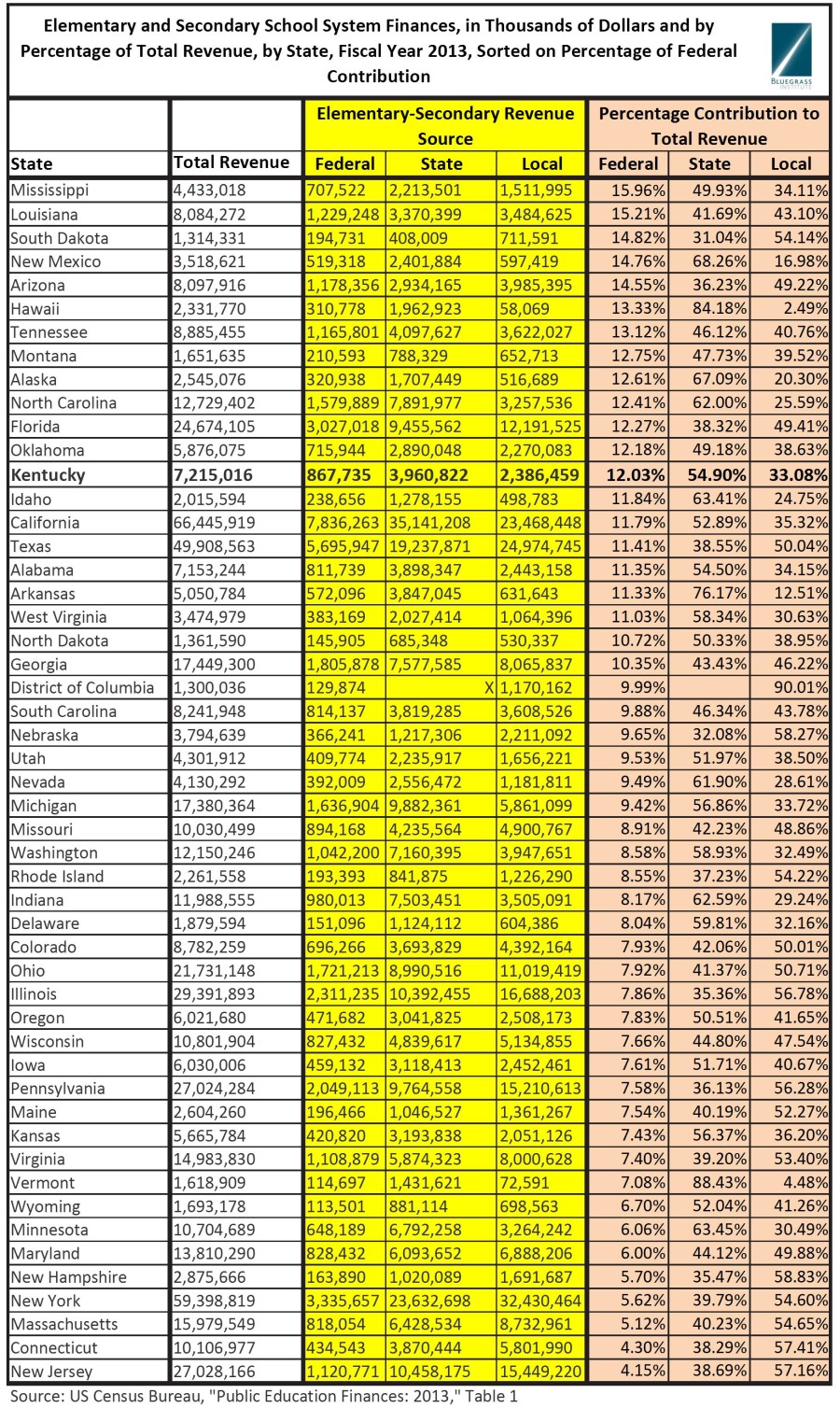
Mississippi, Louisiana, South Dakota, New Mexico, and Arizona must love U.S. taxpayers for sending them so much K-12 money for lackluster education.


The five states with the biggest appetite for federal K-12 cash are Mississippi, Louisiana, South Dakota, New Mexico, and Arizona, according to an analysis of new federal data by a Kentucky researcher. Congress just approved another increase in education spending above and beyond five decades of exploding K-12 spending despite flatlined student results and research showing spending above a basic minimum has no effect on student achievement.
Richard Innes’s chart below shows how much each state spends on each student each year (minus capital costs such as school bonds, which can be extensive), and ranks states according to what proportion of that spending comes from the whole country’s taxpayers via the federal government. Looks like Mississippi taxpayers should be super grateful to the rest of us, to say the least. But they’re not the only ones. Find your state below.
spending
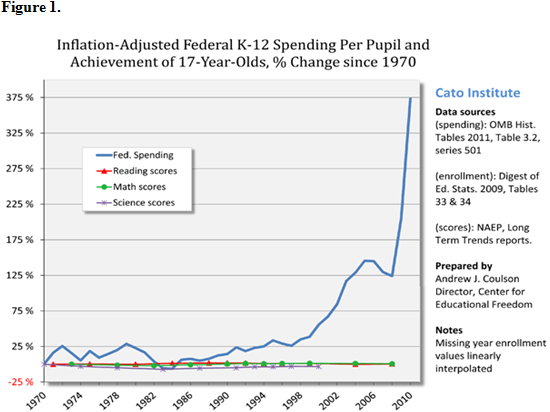
The Cato Institute chart below depicts the massive increase in federal education spending against an utter lack of improvement among American students. This is one of many pieces of evidence showing that big influxes of federal cash don’t help students learn more. The top five states binging on everyone else’s K-12 money also help confirm this reality, as national test results show their students at or below average. Mississippi, Louisiana, and New Mexico are among the five worst performers of all states, and Arizona and South Dakota are merely average.
mccluskey-testimony-pic1-big
A large chunk of federal money goes directly to state-level bureaucrats, giving them a big reason to support higher federal education spending. As Rep. Scott Garrett of New Jersey points out (perhaps not coincidentally because New Jersey is the biggest education tax loser), the Congressional Budget Office says federal mandates cause 41 percent of state-level administrative costs despite supplying just 7 percent of the average state’s education funding.
In other words, federal requirements cost approximately six times as much as federal money supplies, if you only calculate state-level costs. A number of state studies conducted in the wake of No Child Left Behind found that federal regulations cost local taxpayers even more than they do state taxpayers.  Yet state leaders keep demanding federal money even though in the end it costs them more than rejecting it. A new federal study found teachers reporting paperwork takes them an hour or two every Which States Snag The Most K-12 Cash From Everyone Else?:

School district deems teachers' union proposal inappropriate | Sacramento News - KCRA Home

School district deems teachers' union proposal inappropriate | Sacramento News - KCRA Home:

School district deems teachers' union proposal inappropriate

Natomas Teachers Association calls claims 'utterly false'


NATOMAS, Calif. (KCRA) —The Natomas Unified School District (NUSD) claims a contract proposal from Natomas Teachers Association (NTA) union includes provisions that allow teachers to bring weapons to school and have inappropriate relationships with students without getting fired.

 The school district said parents should have received an email update last week about contract negotiations with NTA .

Several families with students enrolled in the NUSD said they never saw the email.
"Absolutely outrageous. Wow, I can't believe this. Do you have an extra copy of this?" parent Chaz Morris said when seeing the document for the first time Monday night.
One line in the document said, "If a teacher engages in an inappropriate relationship with a student, they cannot be fired."
Another line said, "If a teacher brings a weapon on campus, they cannot be fired."
"We are shocked, disappointed and offended," NTA president Phil Cox said. "It's utterly false. The intent of the proposal that we submitted was to give the district tools to deal with teachers that may step outside the lines of professionalism."
Cox said the group presented a proposal to the school district on a new item that would address professional rights, academic freedom and complaint procedures.
"There was no discussion," he said.
Instead, Cox said Natomas Unified released its own response.
"We stand by the accuracy of that document," Natomas Unified spokesperson Jim Sanders said. He added that they don't support the NTA proposal.
"We can't accept this. You read it for yourself, you form your own opinion," Sanders said.
"They released this document with their own understanding," Cox said.
The school district sent out with another email to parents with the NTA's entire proposal attached.
"I think it's only fair if you see both sides, you know, so you know what's going on on both edges of the table," Morris said.
Natomas Unified said it plans to file an unfair labor practice charge.
NTA said it's considering legal action, which is currently under review by the California Teachers Association.
Parents are encouraged to attend board meetings and offer their opinions.
The next board meeting is scheduled for Wednesday, Feb. 10 at 7 p.m.School district deems teachers' union proposal inappropriate | Sacramento News - KCRA Home:

Swearing an Oath -- Part 2: The Kristallnacht of American Public Education

Swearing an Oath -- Part 2: The Kristallnacht of American Public Education:
Swearing an Oath -- Part 2: The Kristallnacht of American Public Education


 As the second possibility, suppose that before or during their gubernatorial campaigns, our governors came out with a full-throated endorsement of charter schools. Why would these sworn protectors-to-be of public education do something as provocative as this, unless to signal the charter school industry that a new age was dawning?

Charter schools would now have a friend in the statehouse where they could look forward to doing business together as public schools closed and charter schools opened in a new dispensation of school reform. And, of course, a healthy campaign contribution would not go unnoticed.
Their election to office would also signal the opening salvo across the bow of public education that Captain Charter School Himself was coming aboard, me Hearties, to shiver the timbers of public schools by scuttling their entire fleet. These new charter-friendly governors would usher in a dynasty of Jolly Roger freebooters, profiteers, and privatizers to loot the state treasury in recompense for "services rendered," with the hope of more "reciprocal favors" to come.
Given this unambiguous show of support for charters, how could our governors have the chutzpah to swear an oath to protect public schools, as this would pose a crisis of conscience, not to speak of a conflict of interest akin to setting a fox to guarding a hen house?

State legislators also deserve a dishonorable mention as the governors' enablers in granting charters to whoever applied to open a school. These politicians have never been known to deny a charter to even the most unworthy of applicants, especially when lobbyists come bearing gifts of hundred dollar bills stuffed in brown paper bags. Charters are Big Business in many a statehouse, as lawmakers line up by the dozens at the feeding trough.
***
But perhaps I rash judge these honorable men, and so are they all, all honorable men, by doing them a rank injustice. Perhaps the political class in this country no longer takes seriously its oath of office. Perhaps this new breed dismisses an oath as a superannuated relic from a faraway past before the Age of Corporations with their public-be-damned and predatory practices that do more harm to America than any enemy abroad.
Perhaps they regard these oaths as political theater that must be endured as lending a fig leaf of legitimacy to sanctify the greed and corruption of these privatized times. This should be hardly surprising when governors, legislators, and even some Supreme Court justices debase their high office by protecting these corporations whose interests they serve.
However, this is by far not the end of this saga. Despite the thousands of public-school closings, none of these governors has offered one scintilla of proof to justify the need for these closures, as if closing them were reason enough.
We've seen them scapegoat, demonize, and vilify teachers, but insults and name-calling aren't evidence. These governors employ that old legal maxim that "when you don't have a case, just abuse your opponent!" But the question remains: where is the evidence to warrant these closures?
***
Accusations aren't proof, and if America's once-proud tradition of investigative reporting weren't now dead, these unjustified closings would have been one of the most sensational news stories in modern times. "Governors Perjure Themselves That They'll Protect Public Schools." "Governors Conspire to Destroy Public Education." "Governors Refuse to Give Reasons for Public School Closures." Reporters would have shouted these headlines from the rooftops because, by Swearing an Oath -- Part 2: The Kristallnacht of American Public Education: