Latest News and Comment from Education

Wednesday, January 6, 2016

The Camden Enrollment System has a Thumb on the Scale | Blue Jersey

The Camden Enrollment System has a Thumb on the Scale | Blue Jersey:

The Camden Enrollment System has a Thumb on the Scale


This post is cross-posted from the Local Knowledge Blog. Promoted by Rosi.
I’ve been playing a lot of basketball over break. As a former D1 basketball player, that comes with some reflection about my own competitive nature. But it’s also come with some curiosity about how this “competition” narrative really works within our Camden education system. With the new Camden Enrollment System opening up, the district is facing a distinct challenge. It’s created a new system (relatively – similar to universal enrollment that emphasizes competition in New Orleans or Newark) that pits schools against one another in the attempt to attract students. The stakes are high, because there are obviously more schools and seats approved than will be needed, meaning down the line those schools that struggle to attract students will close. In the midst of this, the District has a difficult choice to make. Is it an advocate and representative for the Camden School District schools which are engaged in this competition? Or is it a referee, leaving these schools to compete on their own? And if it’s a referee, can it keep its thumb off the scale?
Thumb on Scale Illustration by Greg Groesch/The Washington Times I’ve been watching this competition up close. As a Camden resident, I’m routinely getting fliers offering open houses from charter schools (none from our traditional public schools — I’ll come back to that). My social media accounts are targets for ads of the same, with some offering small gift cards for attendance (but none from the School District, or individual district schools).
CCCS Wawa Gift Card
To the District’s credit, they’ve acknowledged that district schools are at a disadvantage when it comes to this competition and allocated a small amount of money for schools to create a recruitment video and increase social media presence. I expected to hear some frustration at this, but at one school I asked I heard excitement — they felt for so long they were unable to trumpet their accomplishments that they appreciated these resources to do so, even if they felt disappointment that the district wasn’t standing up for them directly and ultimately feel the district will promote an expansion of charters and Renaissance schools.
Therein lie the bigger, systematic questions about the District’s role in a competitive enrollment system. It’s clear from the public relations of schools in the charter and Renaissance sector that their entire organizations are built to promote and support their product. It’s equally clear that this is not what the Camden School District does with district schools. It is impossible to imagine a charter management organization standing up at a public meeting and promoting that a renaissance school be turned over to the district. But last spring the Camden School District had no problem standing up and advising parents that the best option was to convert Camden District Schools into Renaissance Schools.
This is at the heart of the “false competition” between schools in Camden. On one side are charters which advocate, and sometimes exaggerate, their prowess. They are fierce about protecting their schools and expanding their models. The Camden School District is not. The higher level district staff largely comes from the reform community which is skeptical of traditional public schools. Teachers, principals and administrators at schools don’t have an infrastructure behind them to promote their accomplishments and attract students. Instead, they have an organization behind them controlled by a state office that prefers charters and Renaissance schools to traditional public schools. In another universe, one that The Camden Enrollment System has a Thumb on the Scale | Blue Jersey:

Why Philanthropy Hurts Rather Than Helps Some of the World's Worst Problems | The Progressive

Why Philanthropy Hurts Rather Than Helps Some of the World's Worst Problems | The Progressive:

Why Philanthropy Hurts Rather Than Helps Some of the World's Worst Problems


 In America today, big time philanthropists are often lauded for helping to even the playing field for those less fortunate. Every week, millionaires flock from TED conferences to "idea festivals" sharing viral new presentations on how to solve the world's biggest problems (give village children computers, think positive thoughts etc.). But this acceptance of the philanthropic order was not always the case. In the era of Carnegie and Rockefeller, for instance, many distrusted these philanthropic barons, arguing they had no right to horde would-be tax dollars for their own pet causes, especially since these "donations" came from the toil of the workers beneath them.

In her new book No Such Thing As A Free Gift: The Gates Foundation and the Price of Philanthropy Linsey McGoey reasserts this challenge to the legitimacy of philanthropy in today's new  era of philanthropic superstars. McGoey’s book investigates the Gates Foundation’s interventions in US K-12 education and global health, raising serious concerns about the extent to which the massive philanthropic sector depletes funding for traditional social services and prioritizes the agendas of unelected foundation leaders.
As institutions like the Gates Foundation take increasingly leading roles in policymaking and governance, McGoey argues, the line between traditional notions of charity and top-down consolidation of power becomes unclear; and with this largely unchecked influence, philanthro-capitalists, like Bill Gates, have pushed countries across the world to accept market based solutions for crises like education inequity and disease proliferation—despite evidence that these problems are often rooted in actions taken by those philanthro-capitalists themselves.
No Such Thing As A Free Gift asks, what is the place of such philanthropy in a democratic society? The answer seems to be “none at all.”
You start the book by putting the rise of today's "philanthrocapitalists," like Bill Gates, into historical context. Could you explain what philanthrocapitalism is and what is actually new about it? How do the Bill Gateses of today compare to the Carnegies and Rockefellers of old?
The term philanthrocapitalism was coined by Matthew Bishop, an editor at the Economist and expanded in a 2008 book co-written with Michael Green. They define the term in two key ways: First, they argue that philanthropy is becoming more business-like
- See more at: http://www.progressive.org/news/2016/01/188490/why-philanthropy-hurts-rather-helps-some-worlds-worst-problems#sthash.IKISpLLb.dpuf

CURMUDGUCATION: Superintendents: Federal Failure

CURMUDGUCATION: Superintendents: Federal Failure:

Superintendents: Federal Failure


Gallup does an occasional survey of school superintendents, and the results from the November 2015 survey are interesting. They used a list of 11,750 superintendents, and weighted the responses from the 1,255 who actually got back to them to correct for for region and setting of schools. You can read the whole report (it's brief, with lots of tables) right here, but let me touch on some highlights for you.

Superintendents are pretty sure that parents just don't understand.

On a scale of 1 to 5, with 5 being total agreement and 1 being complete notional rejection, superintendents mostly rejected the statement "Parents in my school district understand how our school is evaluated by our state's school accountability system." Only 16% of superintendents gave a 4 or 5 for that one, with 52% opting for 1 or 2. 71% said that parents need more information.

Likewise, on 32% gave parents a 4 or 5 for understanding the academic model and curriculum of the district.

Test Prep Tyranny

Two thirds of the superintendents said that their schools are spending more classroom time getting 
CURMUDGUCATION: Superintendents: Federal Failure:


More Playtime! How Kids Succeed with Recess Four Times a Day at School | MindShift | KQED News

More Playtime! How Kids Succeed with Recess Four Times a Day at School | MindShift | KQED News:

More Playtime! How Kids Succeed with Recess Four Times a Day at School

Recess at Eagle Mountain Elementary School in Fort Worth, Texas, looks much like recess anyplace else. Some kids run and squeal, others swing, while a half-dozen of their peers are bunched up on the slide.

Journey Orebaugh, a 6-year-old in an off-white princess dress, is playing family.

“You just get a bunch of people and just act like who you want to be,” she says. Journey likes to play the mom.

But in one sense, recess at Eagle Mountain is different. Journey gets more opportunities to role-play than many of her peers, because recess happens a lot here — four times a day, 15 minutes a pop for kindergartners and first-graders.

That’s much more time on the playground than most public school kids get in the U.S. Over the past couple of decades, trends show schools have cut recess time to make room for tests and test prep.

Ask Journey why she and her friends get so much more recess time and she giggles. “Lucky,” she says.

But ask the adults and they’ll tell you it’s because Eagle Mountain is part of a project in which the school day is modeled after the Finnish school system, which consistently scores at or near the top in international education rankings. The project’s designer is Texas Christian University kinesiologist Debbie Rhea.

“I went over there to find out where they’ve come in the last 20 to 25 years. Yes, their test scores are good, but they are also healthy in many regards,” she says.

The biggest difference Rhea noticed was that students in Finland get much more recess than American kids do. “So, I came back with the idea to bring recess back to the schools. Not just one recess, but multiple recesses.”

This year Eagle Mountain Elementary started tripling recess time, from 20 minutes to an hour. The program also focuses on character development –things like empathy and positive behavior.

Rhea is working with a handful of local schools already. More will join next year in Texas, California and Oklahoma.

Teachers at Eagle Mountain say they’ve seen a huge transformation in their students. They say kids are less distracted, they make more eye contact and they tattle less.

And then there are the pencils.

“You know why I was sharpening them? Because they were grinding on them, they were breaking them, they were chewing on them. They’re not More Playtime! How Kids Succeed with Recess Four Times a Day at School | MindShift | KQED News:


A worthwhile opportunity for public high schools - The Washington Post

A worthwhile opportunity for public high schools - The Washington Post:

A worthwhile opportunity for public high schools

A project called Schools of Opportunity was launched by two veteran educators last year as a pilot effort last year to honor high schools that work hard to offer all students a chance to succeed. Unlike other rating and ranking efforts that use of student standardized test scores and data points, the Schools of Opportunity project recognizes public high schools that seek to close opportunity gaps through practices “that build on students’ strengths” — not by obsessing on the scores. Seventeen schools were selected, and this blog spotlighted each winner.
Now, the project has gone national for the 2015-16 school year. Applications are welcome from public high schools in every state; you can find out how tosubmit one at the website, here, and in the post below.
The people behind the project are Carol Burris and Kevin Welner. Burris is  a former New York high school principal who is now executive director of the non-profit Network for Public Education Fund. A frequent contributor to The Answer Sheet, she was named the 2010 Educator of the Year by the School Administrators Association of New York State, and in 2013, the same organization named her the New York State High School Principal of the Year. Welner is a professor at the University of Colorado Boulder’s School of Education who specializes in educational policy and law. He is director of theNational Education Policy Center at UC Boulder, which produces high-quality peer-reviewed research to inform education policy.
In this post, Burris and Welner fully explain the project and how to enter.

By Kevin Welner and Carol Burris
If you’re an educator at a public high school that closes opportunity gaps, please set aside a couple hours between now and January 20th to nominate your school for recognition as a “School of Opportunity.” The application itself is very straightforward and can be completed online. Any public school anywhere in the United States is eligible if it includes the high school grades and serves at least 10% students eligible for free or reduced priced meals.
The Schools of Opportunity project is a way to provide much-deserved recognition to schools, teachers and leaders. It is also a way to illustrate and highlight the use of sensible, research-based approaches that provide rich opportunities to learn. Finally, it’s a way to point policy makers toward an A worthwhile opportunity for public high schools - The Washington Post:

Ed Law Prof Blog: Charter School Study Offers New Findings on Student Achievement, Student Enrollment, and Teachers

Education Law Prof Blog: Charter School Study Offers New Findings on Student Achievement, Student Enrollment, and Teachers | National Education Policy Center:

Education Law Prof Blog: Charter School Study Offers New Findings on Student Achievement, Student Enrollment, and Teachers

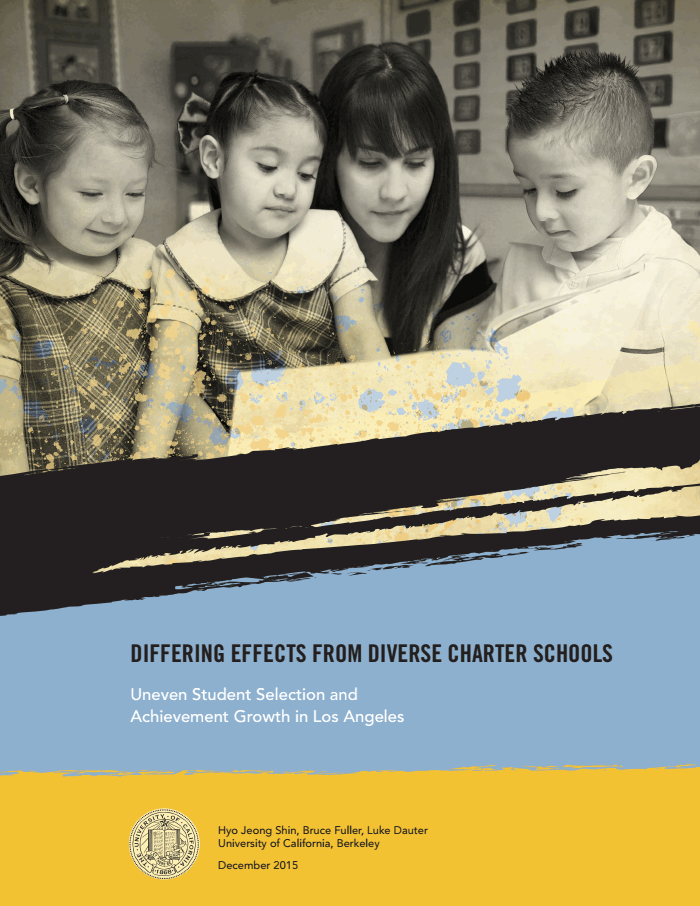
A new study by researchers at the University of California, Differing Effects from Diverse Charter Schools: Uneven Student Selection and Achievement Growth in Los Angeles, offers interesting and complex new findings about how charter schools differ from traditional public schools, particularly in regard to the students and teachers they attract. Their breakthrough appears to be a function of distinguishing start-up charter schools from conversion charter schools. This allows them a new baseline against which to make comparisons:
Their major findings include:
  • [in elementary school], conversion charters attracted pupils with considerably higher ELA and math scores, 0.34 SD and 0.32 SD higher at baseline than the respective means for TPS peers. 
  • Conversion charters served a much lower share of Latino pupils, compared with the mean TPS (55% versus 77%), and a much lower percentage of children eligible for subsidized lunches (50% versus 84%). In short, conversion charter schools fill niches in economically better-off parts of LAUSD. Differences were similar when comparing students among charter and TPS middle schools.
  • The organizational niches filled by start-up and conversion charters emerge even more vividly when turning to high schools . . . . The 28 start-up charter high schools enrolled pupils with significantly higher test scores at baseline. The mean ELA score for these students was 0.40 SD higher than TPS peers on average.
  • These sectors also varied in terms of the kinds of teachers each attracted and retained. Many conversions essentially inherited their teaching staff after winning their independent status, while gaining discretion to attract the preferred mix of new teachers in the future. Table 3, beginning with elementary schools, shows that start-up charters employed much lower shares of tenured teachers or those with full credentials, although charter elementary schools tended to employ a higher share of teachers with masters degrees, compared with TPS peers. Just 19% of elementary teachers at start-up charters Charter schools in Los Angeles had tenure at baseline, compared with 63% employed by conversion charters and 86% at TPS campuses. These differences are reflected in the mean years of teaching experience: 4.8 years Education Law Prof Blog: Charter School Study Offers New Findings on Student Achievement, Student Enrollment, and Teachers | National Education Policy Center:

The Crucial Debate the Education Writers Association Refuses to Hold - Living in Dialogue

The Crucial Debate the Education Writers Association Refuses to Hold - Living in Dialogue:

The Crucial Debate the Education Writers Association Refuses to Hold 

By Anthony Cody.
Education professor Paul Thomas has raised a powerful challenge to the state of education journalism in two recent posts. The first post tackles an article by New York Times reporter Motoko Rich, focused on the latest supposed crisis in education, that not enough high schoolers graduate “college and career ready.” Thomas provides a clear refutation of many of the faulty premises on which Rich bases her story, pointing out that similar wails regarding our schools have been heard for the past hundred years, with no evidence to support them. He writes:
The nebulous relationship between the quality of education in the U.S. and the fragility of the U.S. economy simply has never existed. Throughout the past century, no one has ever found any direct or clear positive correlation between measures of educational quality in the U.S. and the strength of the U.S. economy.
Thomas goes on to point out that most reporters covering education issues have scant direct experience in the field, and tend to rely on the often flawed “expertise” of think tank sources, most of whom also lack relevant experience in public schools. He states:
Mainstream media appear fatally wed to only one version of the U.S. public education story: crisis.
And thus, journalists reach out to the same know-nothings (political leaders, political appointees, think-tank talking heads) and reproduce the same stories over and over and over.
After Thomas tweeted his critique, a reporter at the Hechinger Report, Nichole Dobo, responded, challenging the idea that education journalism suffers because writers lack experience in the field. SheThe Crucial Debate the Education Writers Association Refuses to Hold - Living in Dialogue: 


Test prep: 'Feed the teacher, or he will eat the kids' - NonDoc

Test prep: 'Feed the teacher, or he will eat the kids' - NonDoc:

Test prep: ‘Feed the teacher, or he will eat the kids’

teacher
My first introduction to test prep was as a rookie teacher in 1992. Five educators with advanced degrees grew frustrated when analyzing a test question about what Alexander the Great founded on the Nile River. Did he build a library, a university or a museum? How in the world could we turn such distinctions into a meaningful learning experience?
From 1993 to 1994, my students’ test scores increased more than those of any other teacher in our history department. The biggest reason was that a student we can call “T” had scored a 1 percentile on the previous year’s test under a different teacher, but under me he had scored in the 99th percentile. Perhaps I was that much of a better teacher, or maybe I just needed to ask T why he improved so much. The previous year, T said, he was drunk when taking the test. This year, he was high on marijuana.
In the late 1990s, despite my misgivings, I tried to commit fully to the new End of Instruction (EOI) tests and turn the graduation exams into a constructive learning opportunity. I sought to teach in a holistic manner, without raising students’ stress levels or giving into teach-to-the-test philosophies.
The only enduring benefit of such an experience is that my files from that year are full of candid notes about the resulting classes. My notes are especially enlightening about the issue of testing and remediation for students without background knowledge.

History as more than multiple-choice

Our wonderful junior-level U.S. history class loved learning, but tempers flared as we approached the test. My students had low levels of basic skills, but they loved mastering college preparatory concepts. Students had not studied the American Revolution since 8th grade, so we reconstructed a series of time lines. Even with frequent repetition, few juniors could remember within a hundred years the dates of the War for Independence. During the last practice test — which also dealt with world geography — students were Test prep: 'Feed the teacher, or he will eat the kids' - NonDoc:


Did a Challenging Class Doom this National Board Portfolio Entry? - Living in Dialogue

Did a Challenging Class Doom this National Board Portfolio Entry? - Living in Dialogue:

Did a Challenging Class Doom this National Board Portfolio Entry?


By John Thompson.
As explained in the first post of this three part series,  since my book, A Teacher’s Tale has been released, I’ve been rereading the manuscript’s first draft and some of its original sources.  Mostly, I did so to revisit the stories of students that were edited out, but I also reread accounts of my National Board (NBPTS) teacher certification.  I received good scores on lessons similar to those of many suburban teachers, but rock bottom grades on equally good or better lessons for hardcore inner city classes. Even so, I believe the National Board process was great and it left a record of the best and the worst of my school’s “Year from Hell” in 1998-1999. (All names are pseudonyms)
NBPTS required two videos of class instruction. One video featured an Economics class for students who failed those subjects in 9th grade or who recently moved into the district. (Few people who move into our school are moving up the social ladder.)  I loved this class because both groups of students brought an unusually high number of fascinating (though often tragic) experiences to class discussions.
This class was Survivors 404. After one day Ester, who had just transferred from a standard “read the chapter and answer the questions” class but who would become a star of the video, was so frightened by our format that she asked to transfer, but her classmates talked her out of it. When viewing the video, it would be easy to fall in love with one exceptionally mature class leader.  She had shot her father.  One of the sweetest kids had been forced to stab her stepfather.
The only drawback to teaching this class was the emotional toll. The empty seats in the video testified to the Did a Challenging Class Doom this National Board Portfolio Entry? - Living in Dialogue:

CURMUDGUCATION: The Core vs. Content

CURMUDGUCATION: The Core vs. Content:

The Core vs. Content


Since the Core first popped its tiny head out of its crinkly shell, advocates have insisted that CCSS ELA standards, demand rich content. Meanwhile, I have become increasingly convinced that the demands for rich content and the assertions that rich content must be part of Core implementation rise up precisely because the Core actually has a giant gaping hole where rich content should be.

In other words, rich content Core-o-philes are like guys looking at an automobile with no wheels saying, "Well, obviously the makers of this car intend for us to put on wheels." It's not that the wheels are in evidence; it's that their absence is an obvious fatal flaw. Or to put it another way, surely the emperor must mean for us to buy him some clothes.

But the longer the Core sticks around out in the field, the more obvious it becomes that the Core is anti-content-- particularly once you throw in the Core-based standards-measuring Big Standardized Tests.

Consider this article, written by someone whose intent is to show us how the Core is perfectly swell, even as it explains that part of the swellness is how it "eases literary classics to the sidelines."

Consider some of these quotes:

“It is true that the days for ‘Moby Dick’ or ‘Great Expectations’ might be numbered, but the question that teachers have to ask themselves is ‘What is the purpose of reading this text?’" said Mark Gardner, a high school English teacher in Clarke County, Washington.

“While it may seem like sacrilege, there are many goals that can be achieved by digging deeply into a series of well-curated selections of a text rather than all of it, and then relying on teacher lecture, lessons or even Sparknotes to fill in the gaps,” Gardner said in an interview.

 As an AP English and composition teacher in Montgomery County, Maryland, Ambereen Khan-Baker has included political cartoons and shorter, more complex texts while cutting out
CURMUDGUCATION: The Core vs. Content:

After 20 Years: The Disastrous Impact of Welfare Reform | janresseger

After 20 Years: The Disastrous Impact of Welfare Reform | janresseger:

After 20 Years: The Disastrous Impact of Welfare Reform


A couple of months ago, speaking to a large, diverse audience in Cleveland, Ohio, Jonathan Kozol joked that as a Jew, when he has the opportunity to address church audiences, he takes great pleasure in reminding Christians about the meaning of the words of Jesus.  On a hot summer night in 1999, when Kozol presented the keynote at a United Church of Christ General Synod—taking his text from John,  21: 15-17—here is what he preached: “When Jesus said to Simon Peter, ‘If you love me, feed my sheep,’ he didn’t say, ‘only the sheep who dwell in the green pastures.’  He didn’t say, ‘only the sheep whose mothers please us by acceptable behavior.’ He didn’t say, ‘only the sheep whose fathers have good jobs and mothers come to PTA.’  He didn’t say, ‘only the sheep whose parents make smart choices.’  He didn’t say, ‘only the sheep who have two parents in the pen.’  He just said, ‘If you love me feed my sheep.'”
Kozol was, of course, speaking about welfare reform, the then three-year-old law that “ended welfare as we know it,” replaced Aid to Families with Dependent Children (AFDC) with Temporary Assistance for Needy Families (TANF), and redesigned public assistance as a program to shape the behavior of poor parents.  TANF conditioned welfare on parents’ willingness and ability to secure work outside the home, but it neglected to consider the needs of America’s poorest children.
As welfare reform reaches its 20th birthday in 2016, here is how Peter Edelman evaluates what he describes as “The War on the Poor”: “The welfare reform of the 1990s left millions of Americans near destitution… We should know by now that Temporary Assistance for Needy Families or TANF—the so-called ‘welfare reform’ enacted in 1996—is a failure.  For every 100 families in poverty in 1996, 68 received cash assistance.  Now it’s only 23 in 100.  Less than 1 percent of our population—just 3.1 million people—receives TANF now.  Cash assistance has After 20 Years: The Disastrous Impact of Welfare Reform | janresseger:


Russ on Reading: The Homework Problem

Russ on Reading: The Homework Problem:

The Homework Problem

         Homework! Oh homework!                                I hate you! You stink!                                I wish I could wash you away in the sink.                                        (from Homework, Oh Homework, by Jack Prelutsky)


Sunday’s New York Times carried an article by Vicki Abeles, producer director of the documentary Race to Nowhere,entitled Is the Drive for Success Making Our Children Sick? The article discusses the negative impact on students, both privileged and poor, of the drive for academic success. This opinion piece followed on the heels of an article earlier in the week that reported on the efforts of the West Windsor-Plainsboro School District in New Jersey to deal with the issue of student stress. The Superintendent of the West Windsor Schools, David Aderhold, reported to parents that the schools were in crisis due to the overwhelming feelings of stress students were experiencing. Among many other causes, both articles cited homework as one of the major stressors and both articles suggested that controlling the amount of homework could help in reducing that stress.

Homework is as much a part of the American school culture as the three-ring binder, the text book and the football team. Since seemingly the beginning of time, teachers have assigned homework and students have complained about it. Watch any Our Gang comedy from the 1930’s and you will see that children have always gone to extraordinary lengths to avoid homework. But whether the concern is over-stressed kids or homework resistant kids, homework keeps being assigned, keeps being completed or avoided or copied by kids and keeps being expected by parents. Should it be?

Teachers I have spoken to have argued that homework is necessary for reinforcement of information taught in school, or to prepare for a lesson that is to be given the next day, or to extend learning that has taken place in class or because there is not enough time to cover all the material during class. Some teachers have told me that it is important to assign homework to elementary students so they are prepared for the homework they will get in middle and high school. Other teachers have told me they assign homework because parents expect it.

I must say that I don’t find any of those reasons to be compelling ones for assigning homework, but what does the research say? Do students really Russ on Reading: The Homework Problem:


Kids And Screen Time: A Peek At Upcoming Guidance : NPR Ed : NPR

Kids And Screen Time: A Peek At Upcoming Guidance : NPR Ed : NPR:

Kids And Screen Time: A Peek At Upcoming Guidance

Here's a stark fact: Most American children spend more time consuming electronic media than they do in school.

Phone Face
Rose Jaffe for NPR


 According to Common Sense Media, tweens log 4 1/2 hours of screen time a day, seven days a week, 52 weeks a year. For teens, it's even higher: nearly seven hours a day. And that doesn't include time spent using devices for school or in school.

From babies with iPads to Chromebooks in classrooms, digital devices seem more ubiquitous every year. And one of the hottest issues today in both parenting and education circles is the proper role of electronic media in children's lives.
There's research to support both the benefits and dangers of digital media for developing minds. Plenty of questions remain unanswered.
But those of us raising and teaching children can't afford to wait years for the final evidence to come in. That's why the American Academy of Pediatrics plans to update its guidelines on media use later this year. Current recommendations are to avoid all screens for children under 2, and to allow a maximum of two hours per day of high-quality material for older children.
I spoke with David Hill, chairman of the AAP Council on Communications and Media and a member of the AAP Children, Adolescents and Media Leadership Working Group, to hear about the upcoming recommendations and to get some advice on how to use screens wisely.
Why new screen time recommendations now?
The American Academy of Pediatrics routinely updates all of its recommendations to ensure that they reflect the most current data. We are hoping to expedite the process for these particular recommendations in light of the fast-changing landscape of children's media use. We understand that, as the technologies available to parents evolve, they are looking for guidance that reflect their current realities. Our goal is to release these new policy statements in October of 2016.
What are the intentions behind the new guidelines?
The intentions of all of our policy statements are the same: to translate the best available data on child health and development into recommendations that help Kids And Screen Time: A Peek At Upcoming Guidance : NPR Ed : NPR:

Is it Research – or Propaganda? | Seattle Education

Is it Research – or Propaganda? | Seattle Education:

Is it Research – or Propaganda?

AAEAAQAAAAAAAAMFAAAAJDAyYTM0YTMzLWQ3YjMtNDYxMy1iNTI5LWZhN2M1ZGRiNDNmYg
This article was published four years ago on this site but needs to see the light of day again.
-Dora Taylor
There’s a lot of brand new education research coming out nowadays, and it’s telling our policymakers that privatization is good for education. Class sizes are going up? That’s okay, because research shows that class size has little impact on student learning. Charter schools are competing with your neighborhood schools? Hey, many of them outperform public schools!
And this is good research. Great research. In fact, it’s the best research money can buy. Big money, I mean. Corporate money.
How do they buy it? Through right-wing think tanks. Corporations fund think tanks, and the think tanks employ researchers, and then the researchers wrangle leadership roles in strategically placed research centers, which – like schools – are being privatized.
This article takes a quick look at a few right-wing think tanks and how they’re steering education policy in just one city – Seattle, Washington. If you want to delve deeper into the topic of think tank propaganda, visit sourcewatch.org or rightwingwatch.org.

What Are Think Tanks?

Think tanks are organizations that produce propaganda posing as legitimate research for the benefit of their funders – generally, corporations and billionaires. Some of them were founded decades ago by pro-corporate leaders in partnership with millionaires and corporations. They were created for a specific purpose, such as to battle the “communist menace” after World War II or to help out the tobacco industry. Other think tanks have been founded more recently, by people such as the Koch Brothers.
This article will touch on just three: the American Enterprise Institute, the Hoover Institution, and the Fordham Institute.

American Enterprise Institute

The American Enterprise Institute is a pro-business, conservative think tank that puts profits before people. It was founded in 1943 by a combination of thinkers, business leaders, and finance leaders.
It has a rather spotty past — in the 1980s, it mounted a propaganda campaign for the tobacco industry, and in 2007, it came under fire for bribing scientists to disseminate information that undermined legitimate research on global warning.

A serious rant about homework - The Washington Post

A serious rant about homework - The Washington Post:

A serious rant about homework

It’s one of those perennial subjects that causes consternation in homes and schools across America, decade after decade: homework. In this post, a former teacher and mother offers her serious rant about homework her children are getting. Blaine is now a full-time practicing attorney in New Jersey, and she has written several popular posts, including “Pearson’s wrong answer–and why it matters in the high-stakes testing era” and “You think you know what teachers do. Right? Wrong.” This post first appeared on herparentingthecore blog.
By Sarah Blaine
My family is fortunate to live on one of those old fashioned blocks that is truly a neighborhood.  There are about a dozen families on our street with elementary school aged children, and during their free time, the children run in a pack around the block with the big ones looking out for the little ones.  Their games are incredibly creative: I’ve seen these kids write a script to film a movie, engage in elaborate games of “family” and sword-fighting, climb trees to fantastic heights, and design amazing obstacle courses.  They have their arguments and spats, but overall the culture we’ve watched them create is one in which everyone — from the child with autism to the nerdiest of the nerdy — is accepted.  My girls are glad to have a street full of brothers they know will have their backs.
What I cherish more than anything about this neighborhood is that the kids are able to run around independently.  There are adults around in the afternoon — a combination of parents and babysitters — but once their homework is done, the kids are pretty much on their own until dinner time.  This year, however, my older daughter has not been able to join the gang much at all after school.  That’s not because I over-schedule her: after school she has a half-hour trumpet lesson once a week and religious school on Wednesdays, but rather because homework has become a monster, devouring childhood.
My kids’ schools have a late start (late bell is at 9:20 a.m.) and a late finish (they don’t get off the bus home until about 4 p.m.).  We are an all-choice school district, so many kids on the street have significantly earlier schedules, which admittedly compounds the problem.
E leaves for school at 8:15 three mornings a week because the school band A serious rant about homework - The Washington Post:


Dear Journalists Covering Education, Let Me Explain | the becoming radical

Dear Journalists Covering Education, Let Me Explain | the becoming radical:

Dear Journalists Covering Education, Let Me Explain


In my Twitter timeline, I saw a post praising a recent New York Times article on graduation rates and the devalued high school diploma. Since I had written a blog criticizing the many (and typical) flaws in the piece, I nudged Stephanie Banchero and Nichole Dobo to reconsider.
Dobo was gracious enough to respond [1], but Twitter really doesn’t afford the space to make my case as well as both the topic and Dobo deserve so I want here to lay out better just exactly why so many of us in education are routinely frustrated with how media cover education.
Let me start by reemphasizing why educators have moved from frustrated to exasperated in terms of media coverage of public education.
In the mid-1800s as public schools became a more compelling option for education in the U.S., Catholic schools initiated scathing attacks on public schools—not for educational, but for market reasons.
The history of vilifying public education in the U.S. has replicated that pattern until today—although the negative drumbeat has intensified significantly over the past three decades of high-stakes accountability (which is mostly a political, not an educational, venture).
Therefore, most political and media commentary on public education is misguided. Yes, most.
The problem for educators is not that public education is without flaws and is being unfairly Dear Journalists Covering Education, Let Me Explain | the becoming radical:

Federal sanctions on failing schools don’t die easy :: SI&A Cabinet Report

Federal sanctions on failing schools don’t die easy :: SI&A Cabinet Report :: The Essential Resource for Superintendents and the Cabinet:

Federal sanctions on failing schools don’t die easy


(Calif.) A key component of the nation’s new education law adopted last month did away with federal sanctions imposed on schools designated as “failing” as defined by the prior regime.
But officials at the California Department of Education have recommended that local educational agencies identified as needing Program Improvement under the No Child Left Behind Act must continue to meet all of the old obligations through August, 2016.
It is unclear what legal footing was used to draw this conclusion, and certainly policy makers in other states might interpret the law far differently. But what is clear are the fiscal ramifications on schools if the policy is upheld by the California State Board of Education next week.
One corrective action, for instance, calls for supplemental tutoring – a service that has cost California districts more than $500 million over the past three years and shown “little evidence” of improving performances, according to a press release issued last year by state schools chief Tom Torlakson after the state lost an appeal for a federal waiver from the mandate.
Two other requirements are also costly – offering free transportation services to students who want to attend a school that hasn’t been designated as needing Program Improvement; and a set aside of as much as 10 percent of a district’s Title I allocation for teacher training.
School officials in California and in other states have repeatedly cited the prescribed NCLB spending as a key reason for participating in a waiver program offered by the Obama administration beginning in 2011.
Still, fighting the question now might be more trouble than it’s worth given that the sanctions would go away in 2016-17.
“I think there’s general consensus that we need to follow along with NCLB through the end of the school year,” said Teri Burns, legislative advocate for the California School Boards Association. “I’m guessing that no one at the state is going to dig too deep to ensure compliance because we are clearly going to be going in another direction, but if there’s blatant disregard that might provoke some response.”
Launched in 2001 with high hopes and bipartisan Congressional support, NCLB came under almost universal criticism largely because of unrealistic performance goals that required all students – including subgroups like English learners and students with disabilities – to test proficient in reading and math.
Schools and districts that couldn’t meet the benchmarks were designated as needing Program Federal sanctions on failing schools don’t die easy :: SI&A Cabinet Report :: The Essential Resource for Superintendents and the Cabinet:


CT Charter Schools collect $100 million+ from taxpayers despite discriminating and abusing children - Wait What?

CT Charter Schools collect $100 million+ from taxpayers despite discriminating and abusing children - Wait What?:

CT Charter Schools collect $100 million+ from taxpayers despite discriminating and abusing children


Hidden by the holidays, Governor Dannel Malloy and Lt. Governor Nancy Wyman trotted out their budget chief, Ben Barnes, last week to quietly announce another $93 million in state budget cuts, many of which were targeted at the most critical services and vulnerable citizens in Connecticut.
As CT Newsjunkie reported in Malloy Administration Identifies Savings, But Not Everyone Is Pleased, the Malloy/Wyman administration’s latest cuts target municipal aid, mental health care, services for the developmentally and intellectually disabled, and healthcare services.
The most despicable cut may very well be Malloy’s expanded effort to refuse group home placements for citizens and their families who are in crisis.
However, while vital programs are cut, the companies that own Connecticut’s twenty-three (23) charter schools will be given more than $100 million in scarce public funds this year even though these privately owned, but publicly funded, schools refuse to educate their fair share of students who require special education services and students who need additional help with the English Language.  Furthermore, the “no-excuses” discipline strategies used by Achievement First, Inc. and other charter schools are nothing short of child abuse.
If a Connecticut public school consistently abused children or discriminated against Latinos and other English Language Learners or students with special needs, investigations would be conducted, people would lose their jobs and local boards of education would be sued.  But that simply isn’t the case when it comes to the charter school industry – thanks to their special relationship with the Malloy/Wyman administration.
While Governor Dannel Malloy receives accolades for his “Second Chance” initiative, the CT Charter Schools collect $100 million+ from taxpayers despite discriminating and abusing children - Wait What?: