Latest News and Comment from Education

Saturday, December 5, 2015

Why Should We Trust Tech Billionaires Like Mark Zuckerberg With the Future of Education? - Yahoo News
Why Should We Trust Tech Billionaires Like Mark Zuckerberg With the Future of Education? - Yahoo News:

Why Should We Trust Tech Billionaires Like Mark Zuckerberg With the Future of Education?

Why Should We Trust Tech Billionaires Like Mark Zuckerberg With the Future of Education?


The "Pass the Mic" series showcases voices, perspectives and ideas that spark interesting conversations. 

Steve JobsBill Gates, Eric SchmidtRupert Murdoch, and now Mark Zuckerberg have all announced their solutions to what's wrong with public schools. And they all support companies that promise to fix these schools. They are clever folks who know how to program computers, market products, entertain, advertise and make money. But they don't necessarily know to educate effective and responsible citizens.
Why should we trust these rich Silicon Valley entrepreneurs to influence educational policy?
Tech titans like Mark Zuckerberg, who has pledged most of his fortune to advancements in science and education, realize, as many responsible educators do, that the schools of today are not serving their students or the society very well. Schools are stuck in a 19th-century paradigm that prepares young people for a simple industrial economy and a static political community that no longer exist. These men suspect, as many responsible educators do, that the kinds of technologies that made them rich could contribute to a new form of schooling that better fits today's students, today's economy and today's political community.
But the solutions they choose to promote and fund seldom work. 
They treat public education as if it were just another commercial enterprise.
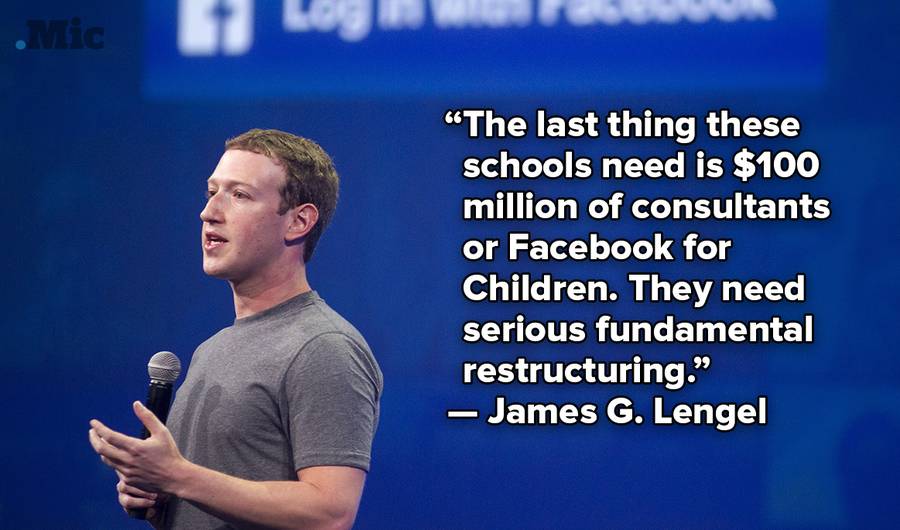
Witness the meager effects of Zuckerberg's $100 million gift to Newark schools, described in The Prize: Who's in Charge of America's Schools? by Dale Russakoff. 
Witness, as we have in our visits to schools all over the world, the thousands of now-vacant school computer labs once funded by Microsoft and Gates. 
Witness the failure of Murdoch's Amplify, which just wrote off half a billion dollars that was supposed to revolutionize education through personalized learning. 
Witness the exposure of Google's education platform as a ruse to market information gleaned from students' profiles. 
Witness the sad failure of online charter schools to serve their students. 
View gallery
.
Why Should We Trust Tech Billionaires Like Mark Zuckerberg With the Future of Education?
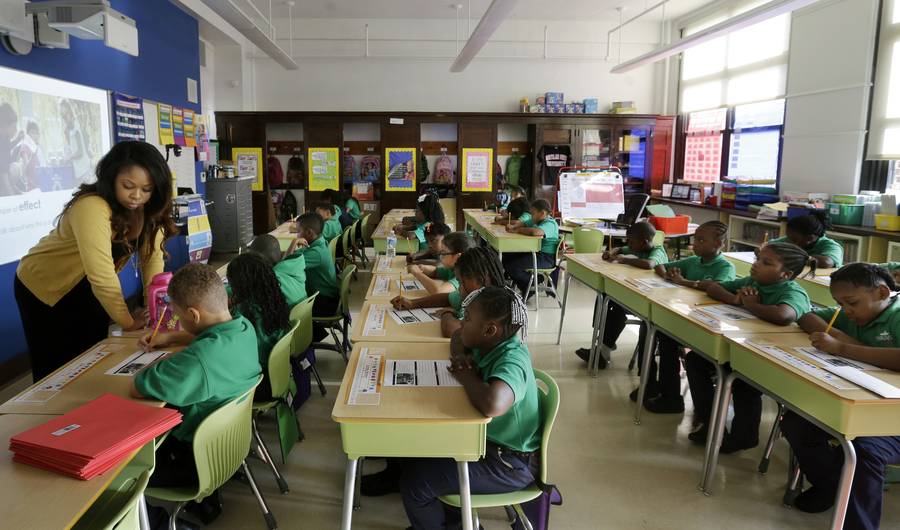
Students at KIPP Thrive Academy, a charter school in Newark, New Jersey Source: Mel Evans/AP
Why don't these initiatives work? For one, they fail to recognize why schools exist. They treat public education as if it were just another commercial enterprise. And they fail to listen to the folks who are truly interested in educating young people for effective citizenship.
That's what the public schools in the USA are supposed to do, and have done pretty well for the last two centuries: educate young people to be contributing workers, participating citizens and good neighbors. In some ways, these social purposes are exactly the opposite of the kinds of personalized learning that Zuckerberg and the others call for. 
Where technology isolates, good schools socialize. Silicon Valley tells students, Technology will tell you how you learn best, where you need to focus and what to do next. But good schools tell their students, Caring adults will help you learn most effectively and ensure that you are headed in the right direction
Schools' mission today is, more than ever, to counteract the selfish personalization made possible by new media and technologies. We don't need any more centripetal forces moving our young people into separate affinity groups or lonesome personal spaces. Since Google and Facebook make their millions by selling personalized entertainment and advertising, it's only Why Should We Trust Tech Billionaires Like Mark Zuckerberg With the Future of Education? - Yahoo News:

Getting Cored: It’s official: US schools are teaching less fiction

It’s official: US schools are teaching less fiction - Quartz:

Getting Cored: It’s official: US schools are teaching less fiction

Kids love stories. Teachers love reading and teaching stories to students. But tough new curriculum standards in the US mean fiction, the primary way teachers teach reading, is falling out of favor in the classroom.

Tom Loveless, a researcher with the Brookings Institution’s Brown Center for Education Policy, dug into recent national education data, which included teacher surveys about what kinds of texts they use in the classroom. They are using less fiction, he found.

Here’s how the data broke down in 4th grade:

save image


“Fiction has long dominated reading instruction,” he wrote on the Brown Center Chalkboard. “That dominance appears to be waning.”

“I am more persuaded that Common Core influenced the recent shift towards nonfiction than I am that Common Core has significantly affected student achievement—for either good or ill,” Loveless wrote.

Stories are a critical way for children to learn, says Daniel Willingham, a professor of psychology at the University of Virginia who studies the application of cognitive psychology to kindergarten to secondary education. Kids learn most when things have meaning; good stories touch on universal themes like love, war, and death to create meaning. He writes:

Research from the last 30 years shows that stories are indeed special. Stories are easy to comprehend and easy to remember, and that’s true not just because people pay close attention to stories; there is something inherent in the story format that makes them easy to understand and remember.

Mark Bauerlein, a professor at Emory College, and Sandra Stotsky a professor at the University of Arkansas wrote a white paper (pdf) about how the ELA standards were putting college readiness at risk. “We are not aware of any research showing that college readiness depends on any percentage of informational reading in the English class, 50 percent of any other proportions. To the contrary, the relevant information we can locate prompts us to look elsewhere for reasons why large numbers of high school students in this country fail to respond successfully to the challenges of higher education.”It’s official: US schools are teaching less fiction - Quartz:


Washington Charter Schools Find Another Source Of Public Money | KUOW News and Information

Washington Charter Schools Find Another Source Of Public Money | KUOW News and Information:

Washington Charter Schools Find Another Source Of Public Money


The Charter School Approval Flea Flicker 


Washington state’s charter schools are about to lose state funding, so they’re exploring an option that might allow them to stay open.
Charter schools that could find host public school districts could contract as Alternative Learning Experience providers for the districts – even if that host district is across the state. School districts in Washington already offer these alternative programs, typically online learning.
Washington State Charter Schools Association spokeswoman Maggie Meyers said that becoming alternative programs could be a stop-gap measure for charters after they lose funding later this month.
"The ALE pathway allows charters to remain public and open while the Legislature works on a permanent fix," Meyers said. Her organization has been working with the state schools office in Olympia to ensure the funding model would apply.
Charters have a prospective host in the tiny Mary Walker School District north of Spokane.
The superintendent there, Kevin Jacka, knows the state's charter schools well. Jacka had been a part of the Washington State Charter Schools Commission until he resigned on Tuesday.
Jacka gave no reason for stepping down in his resignation letter, although Joshua Halsey, the commission’s executive director, said other commissioners plan to do the same after the agency wraps up its work.
Dierk Meierbachtol, of the state schools office, said the state has been working with charters to keep their doors open – despite Superintendent Randy Dorn's longtime opposition to publicly-funded, privately-run schools. They want to keep the charter schools open rather than disrupt student learning by shutting them midyear.
"We want them to continue to be able to go to school with their peers, get the support that they’re currently getting from their teachers, and be confident that that’s going to last through the end of this school year," Meierbachtol said.
No agreements have been formalized to allow charters to join school districts.
The state Supreme Court ruled in September that charter schools are unconstitutional because they are governed by appointed, rather than elected, boards.
A final court ruling to cut off funding to the schools is expected by Dec. 10.
Charters and their supporters have examined many ways to remain open, at least until the end of the school year, including by becoming private schools.Washington Charter Schools Find Another Source Of Public Money | KUOW News and Information:

Charter schools start last-minute radio campaign to avoid bad grades for report cards and sponsor evaluations | cleveland.com

Charter schools start last-minute radio campaign to avoid bad grades for report cards and sponsor evaluations | cleveland.com:

Charter schools start last-minute radio campaign to avoid bad grades for report cards and sponsor evaluations


COLUMBUS, Ohio -- Some charter schools have started a radio ad campaign to renew their call for "immediate" changes to state report cards that would boost grades for schools with poor or transient students.
The schools already lobbied state legislators for the change last summer and fall -- all without a public hearing -- before the legislature decided they had to study the issue carefully first.
But the ads ask listeners to call state legislative leaders and ask them to make the changes "immediately," before the already mandated study is done, according to several people who have heard the ads.
The charter school group paying for them, theOhio Coalition for Quality Education, did not return messages and requests for copies of the ads this week.
The schools want the state to quickly adopt a school rating system used in California known as the "Similar-Students Measure (SSM)" that adjusts grades for schools and districts based on the socioeconomic challenges facing students. Those include student disabilities, poverty, limited English-speaking ability and mobility, or how long kids stay at a school before moving.
If adopted, the measure would lift ratings of many urban and struggling districts over suburban schools that don't have the same challenges. It also would mean better grades for many charter schools that are located in urban areas.
The coalition has been pressing for the change since the summer, along with representatives of the Electronic Classroom of Tomorrow (ECOT), the online school that is its largest member. With 15,000 students, ECOT is the largest charter in Ohio and is larger than any school district in Cuyahoga County other than Cleveland.
Through Ohio's online schools are not that different demographically from districts statewide, ECOT officials say their students are different. The proposed measure, according to data shared with legislators this summer, would show ECOT far exceeding low expectations and scoring well.
It is unclear if the schools want the change to occur in time for the state's much-delayed report cards for the 2014-15 school year, which will be released at the end of February. But that's what observers believe.
There are two reasons that change would help some schools, particularly ECOT, which is under fire from several directions for its low grades.
Though no school can face penalties from the state for bad grades, because the legislature has granted them a "safe harbor" during changes in state tests, bad grades could block schools from some benefits.
The state this year started a $25 million facilities fund for charter schools that is open only to highly-rated schools. The state also has recently won federal grants of up to $71 million to add and expand high-performing charter schools in the state. Higher grades for challenged schools will make them better candidates for grant money.
The report cards' grades will also matter in the state's new ratings of charter school oversight agencies, known as "sponsors" or "authorizers."
The state had to toss out some of these ratings earlier this year because ODE left out the F grades of online schools, in violation of state law. The new rating plan, which was unveiled late last month and will be presented to the state school Charter schools start last-minute radio campaign to avoid bad grades for report cards and sponsor evaluations | cleveland.com:

School Voucher Proponents ask U.S. Supreme Court to Prohibit “No Aid to Religion” Protections | Baptist Joint Committee for Religious Liberty

School Voucher Proponents ask U.S. Supreme Court to Prohibit “No Aid to Religion” Protections | Baptist Joint Committee for Religious Liberty:

School Voucher Proponents ask U.S. Supreme Court to Prohibit “No Aid to Religion” Protections


Advocates of school vouchers are asking the United States Supreme Court to hold that provisions of state constitutions that prohibit public funds from aiding religion violate the U.S. Constitution. Several state constitutions contain such taxpayer protections, which guarantee a stricter separation of church and state at the state level than is required by the First Amendment on the federal level.
Earlier this year, the Colorado Supreme Court ruled a voucher system in Douglas County is unlawful because it violates the “no aid to religion” mandate in Colorado’s constitution. (The Baptist Joint Committee filed a brief in that case urging the court to reject the voucher program.) Now, school voucher proponents are asking the U.S. Supreme Court to overturn the Douglas County decision on the ground that “no aid” provisions are unlawfully discriminatory.
The Education Week blog Charters and Choice notes that the four organizations pushing for Supreme Court review believe that if “no aid to religion” provisions are found unconstitutional, it would “clear the way for school vouchers in all 50 states.” That would be a very unwelcome outcome. School vouchers are unpopular, are a drain from public school resources, and don’t generally yield lasting academic improvement.
They also send taxpayer funds to support religious education, which many state constitutions like Colorado’s explicitly forbid. States should be free to enact that restriction in furtherance of religious liberty goals.
For more on “no aid to religion” provisions, see Holly Hollman’s column discussing the BJC’s brief in the Colorado case.School Voucher Proponents ask U.S. Supreme Court to Prohibit “No Aid to Religion” Protections | Baptist Joint Committee for Religious Liberty: