Latest News and Comment from Education

Tuesday, September 8, 2015

The new charter school scheme: This is how GOP and privatizers have bled Pennsylvania schools - Salon.com

The new charter school scheme: This is how GOP and privatizers have bled Pennsylvania schools - Salon.com:

The new charter school scheme: This is how GOP and privatizers have bled Pennsylvania schools

Teachers work for free in a school district bled by charter schools and state government neglect


The new charter school scheme: This is how GOP and privatizers have bled Pennsylvania schools


As schools across Pennsylvania open their doors for the new school year, there’s one district in the state where teachers will be hard at work even though they’re not likely to get paid.
The teachers are actually already on the job, having reported for work a week early as originally expected. But when the district’s administration announced it could not meet a scheduled payroll on September 9, a week after classes start, the teachers – along with janitors, nurses, and other school personnel – held an impromptu meeting and voted to temporarily forego pay.
The teachers are employed by the financially strapped school district of Chester Upland, located about 20 miles west of Philadelphia. Years of deliberate under-funding by the state, coupled with policies that favor the rapid expansion of publicly funded but privately operated charter schools, are bleeding the district. The dedication of committed and caring educators seems to be one of the few forces binding the shattered school community together.
“We aren’t broken,” says Dariah Jackson, one of the teachers working for no pay tells Salon in a phone interview. Jackson, a Special Education and Life Skills Support teacher in grades 3-5, says, “I’m in my classroom, as are my colleagues, ready for the students to walk through the door next week.”
When asked how long is “temporary” in their resolve to work with no pay, Jackson says, “No one has set a time limit for now. We have to be here for our students. They need a place to go.”
But while Jackson and her colleagues show their determination to meet the needs of the students, there are forces acting in Chester Upland, and across Pennsylvania, focused on anything but that.
School Breakage 101
“Chester Upland is broke,” explains Wythe Keever, spokesman for the Pennsylvania State Education Association. “Actually, they’re a lot worse off than broke,” he tells Salon. “They have an operating budget deficit in excess of $20 million that is expected by the end of the year to go beyond $40 million.”
“The school district is in danger of not existing,” says Jeff Sheridan, a spokesman for Pennsylvania Gov. Tom Wolf, in a report by Lyndsey Layton of The Washington Post.
What’s not helping for sure is an ongoing imbroglio over Pennsylvania’s state budget. Legislators and Wolf have been unable to come to an agreement on the state’s fiscal responsibilities, delaying budget completion for over 50 days. What’s the fight about?Education funding. The newly elected Democratic governor insists on increasing school funding and correcting unfair distributions – particularly those that go toonline “cyber” charter schools – while an entrenched Republican legislature continues to exhibit reluctance to adequately and fairly fund the state’s schools.
So school districts across the state are having to dig deeper into their own local resources to fund the reopening of schools. Districts like Chester Upland, that are heavily reliant on state aid, simply don’t have coffers to dig into.
But there are also long term “structural problems,” explains Keever.
As Layton recounts in her report, “Chester Upland’s financial problems date to 1994, when it was first classified by the state as being in ‘economic distress.” The district has been in and out of state receivership since.
“A similar financial collapse occurred in the district in 2012,” Layton continues, “and The new charter school scheme: This is how GOP and privatizers have bled Pennsylvania schools - Salon.com:

Article: Battle Scarred Schools | OpEdNews

Article: Battle Scarred Schools | OpEdNews:

Battle Scarred Schools


Elmwood Classroom with whiteboard material covering old blackboards
(image by Carl Petersen)   DMCA


-Martin Luther King, Jr.


It had been years since my sister and I had been back to the neighborhood where we grew up, but last month we had the chance. In New York for a family reunion, we took an afternoon to roam Rockland County for a trip back in time. We already knew that our childhood home had been bulldozed long ago as had the Nanuet Mall where we had spent many weekends as teenagers, so these would be visits to addresses rather than childhood shrines. However, the schools we attended are still standing, so these held the possibility of giving us physical connections to our youth. As we pulled up to Elmwood Elementary School, eagerness quickly turned to shock. My sister turned to my mother and asked, "How could you have sent us to such a dump?"


I know that my education was better than reflected in the current state of the district's facilities. While it is often true that the past is often looked at through rose colored glasses, this was not one of those times. In our day, Dr. Lillian Glogau ruled that school with an iron fist and would never have tolerated the abandoned state of the baseball field. What happened to the school yard full of playground equipment? The domes, slides, tunnels, see-saws and even the "big cheese" have all disappeared to be replaced by a few paved handball courts and one climbing apparatus. How is that possibly enough for a school full of children eager to blow off pent up energy on a spring day? When I think of the hours I spent looking out the Article: Battle Scarred Schools | OpEdNews:
 Carl Petersen

#FightForDyett Chicago's Hunger Strike for Dyett High Passes Day 22 - Living in Dialogue

Chicago's Hunger Strike for Dyett High Passes Day 22 - Living in Dialogue:

Chicago's Hunger Strike for Dyett High Passes Day 22


By Michelle Gunderson.
We sit under the trees at Dyett High School yet again on Sunday night. The Dyett 12 hunger strikers sit in a tight circle while a crowd of over a hundred of Chicago’s activists listen in. I know almost every face in this crowd. They are people who understand struggle and know what the word solidarity truly means.
It is day 22 of a hunger strike to re-open Dyett High School as an open enrollment school that is community supported and community sustained.
The activists are here to see what the hunger strikers are asking and to have their guidance in how to support them.
Last Thursday Rahm Emanuel, the mayor of Chicago, held a press conference to announce that a compromise had been made. Dyett High School would open as an open enrollment high school with an arts focus and a technology component. To many people this seemed as if the struggle was over. No one wants anyone hurt in this process, and many were hoping that the hunger strike had come to a victorious conclusion.
This was a decision, though, that was made without the hunger strikers or anyone affiliated with the Coalition for the Revitalization of Dyett High School.
As Dr. Robert Jones, one of the hunger strikers stated, “A group of folk I had never seen before were standing up at the Chicago Public Schools office telling us what our children’s school would be like.”
To be fair, no one has ever had a school closing reversed in Chicago. In addition, the hunger strikers were able to ward off the opening of a charter school or a contract school. These are tremendous wins.
But as Jitu Brown, one of the hunger strikers said, “Don’t give us crumbs and tell us it’s a cake.”
The hunger strikers make their decisions collectively, and they are continuing the hunger strike based on Chicago's Hunger Strike for Dyett High Passes Day 22 - Living in Dialogue:

Cerf, Christie’s man in Newark, tells principals to spend only 25 percent of approved budgets. | Bob Braun's Ledger

Cerf, Christie’s man in Newark, tells principals to spend only 25 percent of approved budgets. | Bob Braun's Ledger:

Cerf, Christie’s man in Newark, tells principals to spend only 25 percent of approved budgets.

The joke's on Newark--public schools can spend only 25 percent of their approved budgets.
The joke’s on Newark–public schools can spend only 25 percent of their approved budgets.


Newark’s public schools face an unprecedented financial crisis because of an edict from the state-controlled administration ordering all principals to freeze spending at 25 percent of their current budgets.
“It’s just not a cut of a few thousand or even tens of thousands of dollars for each school—right now, it’s a 75 percent cut in spending,” said a source close to the Newark school board who spoke anonymously because the source is not authorized to speak for the board.
This site reported earlier that a $15 million budget shortfall caused by the state administration would be made up of cuts ranging up to $400,000 or more per school. The cuts were confirmed by principals and by Newark Teachers Union President John Abeigon who cited the impact for a number of schools.
But the Newark school board source said the reductions in funds available to individual schools could be far worse. “I’m afraid they could be devastating,” the source said.
The reductions were ordered by Christopher Cerf, a charter school proponent and private business entrepreneur who once served as state education commissioner under Gov. Chris Christie. As commissioner, Cerf hired Cami Anderson, the state schools superintendent in Newark from 2011 until June of this year. Christie then fired Anderson and brought Cerf in as superintendent. He was then working for Amplify, a contractor with the Newark schools, and served as a member of the board of directors of the National Alliance of Public Charter Schools.
Charter schools will not be affected by the cuts. In fact, Newark’s charter schools Cerf, Christie’s man in Newark, tells principals to spend only 25 percent of approved budgets. | Bob Braun's Ledger:

Parents Across America Washington: Statement on the Supreme Court decision that charter schools are unconstitutional | Seattle Education

Parents Across America Washington: Statement on the Supreme Court decision that charter schools are unconstitutional | Seattle Education:

Parents Across America Washington: Statement on the Supreme Court decision that charter schools are unconstitutional


PAA


As Parents Across America Washington stated 3 years ago, the initiative and subsequent law is unconstitutional for the reasons stated in December, 2012. The State Supreme  Court decision of September 4, 2015 supports our interpretation and position.
Parents Across America of Washington, the local chapters of the national organization dedicated to the preservation of public education,  agree with the ruling that charter schools are not Common Schools per the Washington State Constitution on multiple counts.
  • 1.   The charter school law establishes a charter school commission comprised of politically appointed members with no election by, or accountability to, the general public. It  allocates authorization and accountability for charter schools to this commission, circumventing state-mandated oversight of our public schools by the Office of Superintendent of Public Instruction and local school boards and yet paid for by tax dollars. The creation of such a commission is in violation of state law which requires public oversight of all public schools. (See: Article III, Section 22, Superintendent of Public Instruction, Duties and Salary“The superintendent of public instruction shall have supervision over all matters pertaining to public schools, and shall perform such specific duties as may be prescribed by law.”)
  • 2.       Charter schools do not meet the definition of “common schools.” Since 1909, a “common school” has been defined as “one that is common to all children of proper age and capacity, free, and subject to, and under the control of, the qualified voters, of a school district.” Sch. Dist. No. 20, Spokane County v. Bryan, 51 Wn. 498, 99 P. 28 (1909). The state constitution also mandates a “general and uniform system of public schools.” Instead,  the charter school initiative would create an unequal subset of schools that would be granted exclusive rights and resources not accorded all schools and all children. These schools would be exempt from public oversight, violating state law that requires all public schools to be “common schools” and part of a “uniform system.” Subsequently, if charter schools are not “common,” then they do not qualify for state funding as stipulated in Article IX, Section 2, which states: “the entire revenue derived from the common school fund and the state tax for common schools shall be exclusively applied to the support of the common schools.”
  • 3.       The charter school law also violates state law as recognized by the McCleary decision of January 5, 2012 (McCleary v. State of Washington), which maintains that the state has a constitutionally mandated (Article IX, section 1) “paramount duty” to fully fund all of its public schools. I-1240 would divert funding from common schools to specific schools with unique rights, creating inequity, and further diluting already inadequate resources from our public (“common”) schools, which is in violation of this law.
As the extremely close election demonstrated (50.7 – 49.3%, despite the enormous financial advantage of the “Yes” campaign, which outspent both “No” campaigns by a margin of 17-1), clearly charter schools remain a divisive, controversial and unpopular concept in Washington State.  (See:http://vote.wa.gov/results/current/Initiative-Measure-No-1240-Concerns-creation-of-a-public-charter-school-system.html  Also: Map of votes for/against I-1240 http://seattletimes.wpengine.netdna-cdn.com/politicsnorthwest/files/2012/12/2012Initiative1240Precincts1.pdf)
Parents Across America of Washington finds the charter school law to be an extremely flawed, unconstitutional and undemocratic proposal which circumvents genuine public oversight, and is full of troubling loopholes and opportunities to divert public funding away from our existing schools to private enterprises for proposed outcomes that statistically are no better than existing public schools 83 percent of the time (See: CREDO Report by Stanford University’s Center for Research on Education Outcomes:http://credo.stanford.edu/reports/National_Release.pdf).
Therefore, as parents with children in Washington State public schools who will be affected by this unconstitutional law, and as supporters of public education, we agree with the Supreme Court of the State of Washington’s decision that charter schools are not “common schools” per the state constitution and therefore charter schools cannot receive public funding.
If there is a special session to be called by Governor Inslee, it should be to fund our public schools per the McCleary Act. Our state legislators are in contempt of court for not addressing the budgetary requirements set out by in the McCleary Act and once again closed the legislative session without producing a solution.
Sincerely,
Parents Across America, Washington State (Puget Sound, Tacoma, Spokane and Tri-Cities chapters).

Bill Gates has spent $440M to push charter schools: Here is the list of recipients | Seattle Education

Bill Gates has spent $440M to push charter schools: Here is the list of recipients | Seattle Education:

Bill Gates has spent $440M to push charter schools: Here is the list of recipients


Male Hand Holding Stack of Cash Over Clouds and Sky


To follow is a list of organizations and schools that have received grants from the Bill and Melinda Gates Foundation. The organizations and schools with figures shown relate to charter school promotional activity in Seattle and surrounding areas. For the amounts given to all other recipients, go to Google docs.
Stand for Children: $9,000,000 +/- (I got tired of counting and recounting)
Aspire
National Council of La Raza : $6,752,627
Community & Parents for Public Schools of Seattle (CPPS): $159,440 (per the Bill and Melinda Gates Foundation website , “Purpose: to develop a strategic plan for building a dynamic parent network that can embrace and catalyze change within Seattle Public Schools”, meaning integrating charter schools into Seattle, particularly in the minority communities.)
University of Minnesota
New York Charter School Resource Center Inc
Chicago Charter School Foundation
Thurgood Marshall Scholarship Fund
St. HOPE Academy
Local Initiatives Support Corporation
Thomas B. Fordham Institute: $747,639
New Schools Fund dba New Schools Venture Fund: $25,365,500
Progressive Policy Institute
University of Washington Foundation: $1,089,761 (Lot of papers and “studies” Bill Gates has spent $440M to push charter schools: Here is the list of recipients | Seattle Education:

CURMUDGUCATION: No Zip Code Tyranny + Don't Fix Your Building

CURMUDGUCATION: No Zip Code Tyranny:

No Zip Code Tyranny


A John Hopkins researcher says that the wealthy do not choose choice.

The conclusion comes from research by Julia Burdick-Will who has a joint appointment in Sociology and the School of Education. "Neighbors but not Classmates" has just been published, and while the conclusions we can draw from it are pretty narrow, it offers an interesting tidbit of anti-conventional wisdom.

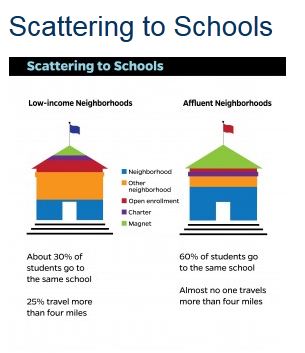
Burdick-Will took a look at 24,000 rising ninth graders in Chicago. In neighborhoods with median income over $75,000, the students attended one of two or three schools. In neighborhoods with median income under $25,000, students were divied up among around thirteen different schools. This chart from the news release about the report pretty well gets the idea:


I find the travel distance most notable-- the more wealthy students get to stay close to home. The non-wealthy get to tromp all over the city. The average travel distance in wealthy neighborhoods was 1.7 miles, and in non-wealthy neighborhoods it was 2.7.

Burdick-Will gets in a couple of good quotes:

We think of children in poor neighborhoods as ‘stuck.’ But they’re not stuck in one geographic place. They’re stuck navigating a complicated and far-flung school system.

I see a couple of caveats for this report. One is that we're only looking at one high school grade, and only in Chicago. The much larger one is that we're looking at 2009. On the one hand, the landscape may have changed in some significant ways in the six years since then. On the other hand, as CURMUDGUCATION: No Zip Code Tyranny:


Don't Fix Your Building


Up a floor from the publishing offices of the Journal of Obvious Conclusions, we find the Journal of Dumb Questions, which probably wants dibs on this working paper from the National Bureau of Economic Research-- "Investing in Schools: Capital Spending, Facility Conditions, and StudentAchievement."

I should probably be less hard on these guys-- after all, they are economists. And this is exactly the kind of stupid question we'll waste time on as long as we think the purpose of schools is to "raise student achievement" (aka "get higher test scores").

Here's the premise:

Public investments in repairs, modernization, and construction of schools cost billions. However, little is known about the nature of school facility investments, whether it actually changes the physical condition of public schools, and the subsequent causal impacts on student achievement. 

Yup. The roof in your school may be leaking, the bathrooms may be crumbling, and the heaters might not work, but before you go throwing a lot of money at the problems, let's ask the important question-- will fixing any of those things raise test scores?

The answer is, apparently, no. Now, I don't know how you pretend to research this. I could buy the paper on-line, but I can think of almost anything that might be a better use of my money (though I guess spending it on school improvement would not be on that list). The suggestion of the summary seems to be that they studied only schools that underwent big capital spending programs and looked to see if their students suddenly got better test scores. In related research, studies show that food 

Don't Fix Your Building

Schooling in the Ownership Society: Whatever happened to the Zuckerberg's $100M 'gift' to Newark schools?

Schooling in the Ownership Society: Whatever happened to the Zuckerberg's $100M 'gift' to Newark schools?:

Whatever happened to the Zuckerberg's $100M 'gift' to Newark schools?


The Hechinger Report carries an interview today, with journalist Dale Russakoff, author of “The Prize: Who’s in Charge of America’s Schools?” The book tells the story of Facebook billionaire Mark Zuckerberg's $100 million "gift" to Newark Public Schools five years ago.


HR wants to know how the money was spent? A question I've been asking since 2011. Despite a lawsuit brought by the ACLU, we still don't even know exactly how that money was spent except that it was used to create a couple of new privately-run charter schools and that about a third of it was used to pay crony political and educational consultants and contractors through a slush fund set up by former mayor Corey Booker and Gov. Christie. We also know that it provided a nice tax break for Zuckerberg.


Most telling part of the interview is when HR asks Russakoff about former superintendent Cami Anderson’s One Newark plan. She responds:

There are tremendous numbers of parents and teachers in Newark who felt that the schools needed radical change, but there was no acknowledgement that those people should be playing a role in this One Newark process. I asked Cami Anderson about the lack of communication and she said the One Newark plan is, as she kept calling it, 16-dimensional chess, which was a way of saying it’s incredibly Schooling in the Ownership Society: Whatever happened to the Zuckerberg's $100M 'gift' to Newark schools?:

Letter to Fordham Snake Oil Peddlers Part 1 » Missouri Education Watchdog

Letter to Fordham Snake Oil Peddlers Part 1 » Missouri Education Watchdog:

Letter to Fordham Snake Oil Peddlers Part 1


Gretchen Logue wrote about the Recent op ed piece by Mike Petrilli and Robert Pondiscio, president and vice president for external affairs respectively of the Thomas B. Fordham Institute, which appeared in the Post Dispatch about the poor performance of our students on the SBAC test given this past spring. The same piece, with minor changes, appeared simultaneously in Connecticut and West Virginia. Not only did the op ed in Missouri contain easily verified factual errors, it continued to spout the unproven promises of Common Core and the associated standardized test. It sounded very much like the pamphlet sent by snake oil salesmen at the turn of the last century to Missouri’s own Mark Twain who railed against their false promises. Today’s guest post is by Dr. Mary Byrne  Ed.D. who compares the work of Petrilli and Pondiscio to the snake oil promises and provides Missouri’s present day response.

Part 1 of 2

Screen Shot 2015-09-07 at 9.11.20 AMhttp://www.lettersofnote.com/2010/01/youre-idiot-of-33rd-degree.html
“Snake Oil Salesman.” The phrase conjures up images of seedy profiteers trying to exploit an unsuspecting public by selling it fake cures. Mark Twain had harsh words for a snake oil peddler when enraged by the peddler’s attempt to sell bogus medicine to Twain by way of a letter and leaflet delivered to his home. According to the literature, the peddler’s “Elixir of Life” could cure such ailments as meningitis (which had killed Twain’s daughter in 1896) and diphtheria (which killed his 19-month-old son). A furious Twain dictated a letter of response to his secretary, which he then signed. What is a “snake oil salesman”? Why is peddling snake oil such a terrible thing?
A “snake oil salesman” is somebody that sells an item that claims to have some miraculous powers. This product is usually accompanied by a tremendous amount of hype. In an attempt to help push their products, the “snake oil salesman” will usually utilize planted accomplices who will claim that the product actually works. Snake oil salesmen take advantage of struggling people willing to pay whatever they have to find a cure for their chronic problems. The snake oil peddlers know their promises of relief aren’t supported with well-designed research, but, pilot studies and longitudinal research will interfere with the agenda of salesman’s corporate and foundation sponsors. The “suckers” are not only cheated out of their money, but they forgo opportunities for authentic, locally developed solutions to their schools’ specific ailments. In other words, parents and taxpayers pay “opportunity cost” as well as financial costs. Hucksters hock hope. Twain lashed out at the peddler because he was grieved by genuine pain that the snake oil salesman disingenuously promised to relieve.
Mark Twain’s letter of fury unleashed on a snake oil salesman for fraudulent advertising conjures up similar images when thinking about Mike Petrilli and Robert Pondiscio’s “Missouri: Don’t shoot the messenger.” Petrilli and Pondiscio are the president and vice president for external affairs respectively of the Thomas B. Fordham Institute, a non-governmental organization frequently referred to as a conservative think tank. Why are Petrilli and Pondiscio likened to snake oil salesmen? Because they are using earned media to generate a tremendous amount of hype and push their untested, never-been-validated products – the Common Core State Standards and tests aligned to them. The Common Core peddlers repackaged a product discredited decades ago  (slides 35- 44) with some new-fangled, untested software still under development; and banked (figuratively and literally) on the naivetĆ© of a new generation of parents. Wanting relief from the fear that their children are being handicapped (a golf term) in a global race to the top (the top of what has not been clearly established), parents and other taxpayers are Letter to Fordham Snake Oil Peddlers Part 1 » Missouri Education Watchdog:


When Will I Love Charters? | Peter Greene

When Will I Love Charters? | Peter Greene:

When Will I Love Charters?


I'm probably a liberal. Or at least liberalish. I've never worried too much about what political label I'm supposed to wear. But I feel liberal enough to respond to Jonathan Alter's piece in the Daily Beast, "Why Liberals Should Learn To Love Charter Schools."
If you want to read a fact-based takedown of Alter's piece with a clear explanation of why he's wrong about pretty much everything, I recommend Mercedes Schneider's piece.
But for my part, I'm going to address the question implied by Alter's piece-- what would it take for me to love charter schools? After all, I'm not categorically opposed to them on principle. My aunt ran a "free school" in Connecticut decades ago, and it was pretty cool. I have a friend whose son has been seriously assisted by cyber school, and I know a few other similar stories. I think it's possible that charter schools could be an okay thing. But the charter systems we have now in this country are so very, very terrible I can't even like them a little, let alone love them.
So when will I love charter schools?
I will love them when they're fully accountable.
Public schools have to account for every dollar spent, every student who falls under their jurisdiction. Charter schools are only "public" when it's time to be paid. The rest of the time they are non-transparent and non-accountable. We have charter scandals over and over and over and over again in which somebody just makes off with a pile of money, or isn't really providing services they claim to be, or doesn't really have a plan in place. This is bananas!
We're learning that in the New Orleans Wide World O'Charters, nobody is accountable for the students. A school can purge a child from its records by essentially saying, "Yeah, she went somewhere" without even having to confirm what happened to the student. In New Orleans, there are thousands of students missing-- school authorities literally do not know where those children are.
Charter schools will be accountable when they are just as transparent and just as accountable as public schools. Financial records completely open to the public. All meetings of governing bodies completely open to the public. And run by people who must answer to the public and whose first responsibility is not to the nominal owners of the school, but to the actual owners of the school-- the people who pay the bills and fund the charter-- the taxpayers.
I will love them when they're fully funded.
The biggest, hugest lie about charter schools is that they don't add any costs to the total funding numbers for education. If you believe this, then you must also believe that if your household budget is getting tight, the best solution is to buy a second house.
I would have the greatest affection for a politician or policymaker or thinky tank When Will I Love Charters? | Peter Greene:

Teachers Aren’t Dumb - The New York Times

Teachers Aren’t Dumb - The New York Times:

Teachers Aren’t Dumb


ONE of my colleagues at the University of Virginia, a world authority on how culture influences personality, almost didn’t become a professor. He wanted to teach high school, but went for his Ph.D. because it seemed easier; he thought he would fail the exacting admissions test for teacher candidates. Perhaps I should mention that my colleague is from Japan.
When I tell this story to Americans, they usually nod knowingly, because it confirms their beliefs about the quality of teachers in both countries.
Most Americans think that teaching is a natural talent, not the product of training, and that smart people are the ones with the talent. So some policy makers have concluded that the way to improve schooling is to lure top-scoring graduates into teaching (as Japan does) instead of scraping the bottom of the academic barrel (as America supposedly does). Arne Duncan, the secretary of education, invoked this idea in a speech last year.
But the problem in American education is not dumb teachers. The problem is dumb teacher training.
It’s true that the average SAT score of high school students who plan to become teachers is below the national average. But planning to teach doesn’t guarantee that you’ll succeed in college, pass the certification test and be hired. The median SAT score for those who actually do end up teaching is about the national mean for other college graduates. (There is some variation, depending on teaching specialty.)
Teachers are smart enough, but you need more than smarts to teach well. You need to know your subject and you need to know how to help children learn it. That’s where research on American teachers raises concerns.
Consider reading. In 2000, a national panel of experts concluded that reading teachers need explicit knowledge of language features that most people know only implicitly: syntax, morphology (how the roots of words can combine with one another or with prefixes or suffixes) and phonological awareness (the ability to hear parts of spoken language like syllables and individual speech sounds). Yet many undergraduates preparing to teach, fresh from their coursework in reading instruction, don’t know these concepts. In one study, 42 percent could not correctly define “phonological awareness.”
Of greater concern, those who educate future teachers don’t know them either. Emily Binks-Cantrell of Texas A&M University and her colleagues tested 66 professors of reading instruction for their knowledge of literacy concepts. When asked to identify the number of phonemes in a word, they were correct 62 percent of the time. They struggled more with morphemes, correctly identifying them 27 percent of the time.
Mediocre teacher preparation extends to mathematics. An international study of new middle school teachers showed that Americans scored worse on a math test than teachers in countries where kids excelled, like Singapore and Poland. William Schmidt of Michigan State University identified the common-sense explanation: American teachers take fewer math classes. Instead, they take more courses in general pedagogy — coursework, that is, on theories of instruction, theories of child development and the like.
Teachers themselves know that their training focuses too much on high-level theory and not enough on nuts-and-bolts matters of teaching. In a 2012 survey, that was their top complaint about their training. The same survey showed that most thought the current system of training should be Teachers Aren’t Dumb - The New York Times:

Sacramento City Council ethics reform is a must | The Sacramento Bee

Sacramento City Council ethics reform is a must | The Sacramento Bee:

Sacramento City Council ethics reform is a must


As Sacramento’s elected officials hem and haw, a local watchdog group has set the bar on transparency and ethics reform.
After holding public forums with the League of Women Voters, Eye on Sacramento is calling for four major changes at City Hall:
▪ An open government ordinance that guarantees and increases public access and accountability. It includes keeping all city emails for at least 10 years, requiring ad hoc City Council committees to meet in public and adding an independent city auditor, not one appointed by the council.
▪ city ethics code, including strict rules on nepotism, conflicts of interest and sexual harassment, plus a cap on donations made to charities at the behest of elected officials. That would hamstring Mayor Kevin Johnson, who has persuaded donors to contribute huge sums to charities of his choice.
▪ An independent ethics commission, likely appointed by retired judges, to enforce the code and state ethics laws. It would have the power to subpoena records, compel witnesses to testify under oath and to fine and censure officials, or even seek to kick them out of office.
▪ An independent redistricting commission to draw City Council districts. There should be no doubt this is needed for the 2020 Census after the fiasco after the 2010 count. The council appointed a citizens committee, but ignored its maps and approved its own.
These are reasonable ideas deserving of serious consideration by a City Council committee, which was appointed by the mayor and is supposed to issue its report later this month.
We don’t know exactly what the council panel has in mind because it has been meeting in private – which is amazingly hypocritical.
The mayor’s spokesman assures us the council’s recommendations will reflect all citizens’ values, not just those of a special interest group. Eye on Sacramento’s proposals should not be dismissed lightly.
If the council does not approve reforms, Eye on Sacramento is prepared to go to the ballot in 2016. It would be far better if council members and the group’s leaders can agree on a plan. Whether in office or outside City Hall, everyone should want a more open and ethical government.Sacramento City Council ethics reform is a must | The Sacramento Bee:


Read more here: http://www.sacbee.com/opinion/editorials/article34326018.html#storylink=cpy

“Right-to-Work” Threat in Public Sector: Friedrichs v. California Teachers Association | Socialist Alternative

“Right-to-Work” Threat in Public Sector: Friedrichs v. California Teachers Association | Socialist Alternative:

For a Mass Mobilization to Stop This Attack and Rebuild Labor!


Workers protest in March 2015 inside the state capitol in Madison, Wisconsin, a state which has pioneered so-called ?right-to-work? legislation widely seen as an attack on unions. Photograph: Amber Arnold/AP


In late June, while millions celebrated the U.S. Supreme Court’s ruling on marriage equality, the Court also agreed to hear Friedrichs v. California Teachers’ Association (CTA), a potentially ominous development for public sector unions and unions generally.
If the Supreme Court were to uphold Friedrichs, it would effectively mean that the entire public sector in the U.S. would go “right to work.” The case revolves around the question of “agency” or “fair share” fees which non-union members in many unionized workplaces are required to pay instead of dues because they benefit from the union contract. For unions, the consequences of losing the right to collect agency fees are, in the immediate sense, the potential for significantly reduced income, which means a reduced ability to represent members. Many individuals might stop paying dues on the basis that benefits are now “free.” There would also be a blow to workplace solidarity, with union members paying their dues and working alongside others paying nothing and getting a free ride.
The threat of Friedrichs comes on top of a whole series of attacks on union rights by corporate America and its political servants over recent years. This offensive has been concentrated in the public sector, in part because it retains a much higher union density than the private sector. Teachers’ unions have been particularly targeted under the cover of “education reform.”
Earlier this year, under its odious Governor Scott Walker, Wisconsin became the 25th state to adopt “right-to-work” legislation for the workforce as a whole. Historically, “right-to-work” states were concentrated in the “anti-union” South. Four years ago, Walker had already forced through – despite mass opposition – legislation severely restricting collective bargaining in the public sector. The results are instructive for the potential effects of Friedrichs. AFSCME has lost two-thirds of its membership in Wisconsin, while the Wisconsin Education Association has lost 30%. Even beforeFriedrichs, therefore, we had reached a tipping point.

Is This the End for Public Sector Unions?

There has been a range of responses to the threat of Friedrichs, as well as a lot of commentary, some of it a bit apocalyptic. Of course, we can’t be sure what the response of the Supreme Court will be in this case or how far it will go in its ruling. But remember that this is the “1% court” that allowed unlimited corporate money into the political process in the Citizens United decision. And other recent rulings, such as Harris v. Quinn – which removed the right of unions to have fair share in the home health care sector – are not promising.
Photo: Jobs With Justice / Flickr
Some have argued that a defeat in the Friedrichscase could force public sector unions to pay more attention to the needs of their members and be more democratic in order to motivate them to remain members and pay dues. It is also pointed out that fair share did not exist in the public sector until 1975, when the Supreme Court ruled it was legal. The key public sector unions were built, and won recognition and contracts in many workplaces in the 1960s and early ‘70s, without this protection.
This is all true, but the gains of the ‘60s and ‘70s were achieved by an ascendant labor movement. There have been profound changes in the past 40 years. The American labor movement began a “Right-to-Work” Threat in Public Sector: Friedrichs v. California Teachers Association | Socialist Alternative: