Latest News and Comment from Education

Tuesday, September 8, 2015

What Wisconsin & Arizona Should Teach Us about School Vouchers | Nonprofit Quarterly

What Wisconsin & Arizona Should Teach Us about School Vouchers | Nonprofit Quarterly:

What Wisconsin & Arizona Should Teach Us about School Vouchers


Long before the second Bush administration launched “No Child Left Behind,” individual states were creating policies to use market forces as a driver toward stronger public education systems. While much attention has been given to the growth of charter schools, they have not been the only strategy put to use. Numerous states have turned to vouchers and tuition tax credits for students they saw as trapped in low-performing schools. In theory, vouchers and tax credits would be particularly helpful to low-income families desiring access to private schools previously only available to the wealthy. In practice, it appears they work quite differently. We are learning that creating an educational marketplace is not cheap, and that not all programs are effective.
Wisconsin was among the first states to implement a voucher program over 25 years ago. A program originally designed to give a limited number of low-income families in Milwaukee the opportunity to attend well-performing private schools, year by year it has been expanded to include tens of thousands of lower- and middle-class households statewide, with little oversight of the quality of the schools they choose to attend. Molly Beck, reporting for Madison.com, captured the challenge in a recent article:
The state will spend $258 million in the 2016–17 school year on private school vouchers, a new estimate shows. At the same time, the amount of state aid sent to public schools will be reduced by $83 million to offset the voucher spending, for a net cost to the state of $175 million, according to an analysis drafted by the nonpartisan Legislative Fiscal Bureau in response to a request from Senate Minority Leader Jennifer Shilling (D-La Crosse), who opposes vouchers. The amount spent each year on vouchers will have increased by 77 percent next school year over 2011 levels…
The Center for Media and Democracy provided more detail on the growth of Wisconsin’s voucher program.
Governor Scott Walker’s 2011–2013 budget slashed funding for K-12 education by $792 million—the biggest cut to education in Wisconsin's history. That Walker budget also removed the enrollment cap on the Milwaukee school voucher (or “parental choice”) program, which allows K-12 students to attend private and religious schools on taxpayer money, much of which is taken from the public school district. The program currently enrolls 26,000 students at an annual cost to the state of $191 million (an average of $7,300 per child) funneled to private and for-profit schools each year, taking $61 million of that directly from the already struggling Milwaukee Public Schools. Walker has also launched new voucher programs for Racine and statewide that now enroll about 3,000 students and cost another $20 million a year.
And although the stated objective of vouchers was to allow public school students access to better schools, in Wisconsin, those benefitting have mostly been families already paying private school tuitions. Last year, the Milwaukee-Wisconsin Journal Sentinelreported that “Seventy-five percent of eligible students who applied for taxpayer-funded subsidies to attend private and religious schools this fall in the statewide voucher program already attend private schools, according to data released Tuesday…Rep. Gordon Hintz (D-Oshkosh) said the original justification of the voucher program was to give students attending struggling public schools the opportunity to attend private schools. Instead it has created a system in which taxpayers are paying for private education, he said.”
With similar goals, Arizona began a voucher-like program of tax credits 18 years ago. TheArizona Republic recently took a look at how this effort has performed.
Its architects, who promised the program would primarily benefit special-needs and low-income students, have watched it grow far larger than they ever imagined. A program that legislative budget staff in 1997 estimated would cost $4.5 million a year now tops $140 million. And that doesn’t include $50 million in tax credits handed out separately for public-school extracurricular activities… Despite its explosive growth, the program has failed to keep its promise of primarily aiding special-needs and low-income students, and of expanding school choice. Meanwhile, as it grows, critics say, it is further depleting funding for public schools…Only about 3 percent of the money is designated specifically for special-needs students. And 32 percent of the scholarship money given through the individual tax-
What Wisconsin & Arizona Should Teach Us about School Vouchers | Nonprofit Quarterly:


What the new SAT scores reveal about modern school reform - The Washington Post

What the new SAT scores reveal about modern school reform - The Washington Post:

What the new SAT scores reveal about modern school reform


The newly released scores on the SAT college admissions test turned out to be the lowest since the exam was redesigned in 2005. My Post colleague Nick Anderson wrote in this story that the “test results show that gains in reading and math in elementary grades haven’t led to broad improvement in high schools.” So what does this all mean? Here’s a post looking at the issue, by Carol Burris, who retired this year as an award-winning principal at a New York high school. She is the author of numerous articles, books and blog posts (including on The Answer Sheet) about the botched school reform efforts in her state.

By Carol Burris
SAT scores for the Class of 2015 were the lowest since the test was revised and re-normed in 2005. The score drop in one year was 7 points — a drop thatInside Higher Ed characterized as significant.
The College Board began publishing SAT reports in 1972. This year’s reading score is the lowest average score ever published. Math scores have not been this low since 1999. And Inside Higher Ed describes the achievement gap as “large and growing.” All groups’ scores, with the exception of Asian students, are declining.
Across news reports, the reaction to the drop in scores was remarkably the same. Every story I saw included information provided by the College Board that subtly implied that the drop was due to the “largest number ever” of test takers, combined with an increase in the proportion of students who applied for fee waivers. The College Board also reported that the test takers are the “most diverse group ever.”
Let’s take a closer look at those claims.
It is true that 2015 saw the largest number of SAT test takers. By comparing the College Board’s 2014 College Bound Senior report with its 2015 report, it appears that 26,126 more seniors took the test. It should be noted that the College Board rounded its 2015 figure up by about 1479 students in the press report, while rounding down their 2014 figure by 2,395 students, thus making the increase seem larger than it is.
That 26,126 increase included an additional 4,532 seniors who described themselves as “citizens of another country.”   The SAT has become increasingly popular among international students who take it in order to attend college in the United States. Between 2006 and 2014, the number of international students taking the SAT has doubled. According to theInternational Business Times, more than 300,000 students in 175 nations took the SAT in 2014. And those students are hardly dragging down the scores—the average SAT composite score for all test takers in 2015 was 1490. The average score for “citizens of another country scores” was 1576.
More important than the total number of test takers, however, is whether or What the new SAT scores reveal about modern school reform - The Washington Post:

A Door-to-Door Push to Get Parents Involved at Struggling Schools - The New York Times

A Door-to-Door Push to Get Parents Involved at Struggling Schools - The New York Times:

A Door-to-Door Push to Get Parents Involved at Struggling Schools


Tameka Carter, left, and Bliss Requa-Trautz, went building to building in the Edenwald housing projects in the Bronx, knocking on doors of families with children in Public School 112. Credit Karsten Moran for The New York Times


At Public School 298 in Brooklyn, where the principal invites parents to visit classrooms once a month, typically fewer than 10 percent of them will.
The New Millennium Business Academy Middle School in the Bronx spent much of the summer trying to track down the families of incoming sixth graders to invite them to an orientation. Just over half of the families turned up, which the principal considered a victory.
At DeWitt Clinton High School in the Bronx, attendance at parent association meetings was so paltry that the school began raffling off Thanksgiving turkeys and supermarket gift cards to entice people to come.
With the second full school year of his administration beginning on Wednesday, Mayor Bill de Blasio is already under pressure to show improvement at these schools, which are among 62 low-performing schools targeted by the state for possible takeover. One of the keys to transforming them, his administration believes, is to get parents to show up more by turning schools into one-stop community centers offering services like medical and dental clinics, adult courses and counseling.
Photo
Mayor Bill de Blasio and his schools chancellor, Carmen FariƱa, at the lectern, during a news conference in Manhattan on Aug. 12. Ms. FariƱa has made parent engagement a key component of public schools’ annual ratings. CreditMichael Appleton for The New York Times
It is a marked contrast to the Bloomberg administration, which was more focused on trying to identify weak teachers, principals and even whole schools and then replacing them.
The de Blasio administration believes so strongly in its own approach that it spent a million dollars in recent months to train parents in organizing techniques and to hire people to knock on the doors of roughly 35,000 parents of students at struggling schools, to tell them about the changes and urge them to take a bigger role.
“Bringing families into their child’s education is essential,” Mr. de Blasio’s schools chancellor, Carmen FariƱa, said. “Study after study shows that family engagement improves student performance and attendance.”
So on a hot afternoon in late August, one of the outreach workers, Tameka Carter, a single mother of four from Brooklyn who said she had always been active in her children’s schools, went from building to building in the Edenwald housing project in the Bronx, knocking on doors of families with children in Public School 112.
When Ms. Carter did find the parents who were listed on her clipboard, typically mothers, they listened as she explained what it meant that their child’s school was becoming a “community school.”
She asked them to rate, on a scale of one to five, how much they would value potential new programs, like medical services, tutoring or summer activities. One of the questions asked how they would value “an opportunity for parents to sit at the decision-making table,” which left one parent perplexed.
“Meaning?” Maria Pena, a 31-year-old mother of three, asked.
Ms. Carter explained that she could “sit at the table” with P.S. 112’s A Door-to-Door Push to Get Parents Involved at Struggling Schools - The New York Times:

The surprising conservative roots of the Common Core: How conservatives gave rise to ‘Obamacore’ | Brookings Institution

The surprising conservative roots of the Common Core: How conservatives gave rise to ‘Obamacore’ | Brookings Institution:

The surprising conservative roots of the Common Core: How conservatives gave rise to ‘Obamacore’


When Jeb Bush announced he was exploring a run for President, TIME warned that Bush was “going to have to win over the Republican conservative base, which hates Common Core with the fire of a thousand suns.” In case conservative loathing of the Common Core ran the risk of being understated, theWashington Post weighed in with an analysis statingthat “The conservative base hates—hates, hates, hates—the Common Core education standards.”
That media shorthand vastly oversimplifies not just the debate among conservatives over the Common Core but the rich, conservative roots of the standards themselves. As I show in a new Brookings paper, the Common Core State Standards (CCSS) embody conservative principles in setting goals for student learning that date back to Ronald Reagan. In fact, compared to his predecessors in the Reagan and George H.W. Bush administrations, U.S. Secretary of Education Arne Duncan has substantially shrunk the federal role in advocating for anything resembling a model national curriculum, national standards, and national assessments. Implementation of the Common Core standards is still proceeding in more than 40 states in no small measure due to the fact that the Obama administration did not repeat the federal overreach of their GOP predecessors by funding the development of national standards and model curriculum.
The conservative roots of the Common Core are little known today. Even among reporters who cover the education beat, few are familiar with, and even fewer have written about, the47-page secondary school model curriculum guide and the 62-page elementary school curriculum guide that William Bennett, Ronald Reagan’s secretary of education, wrote and the Education Department published in 1987 and 1988. Nor have reporters recounted, except in passing, the sweeping, self-described “crusade” that Senator Lamar Alexander launched to promote national standards and voluntary national assessments when he was secretary of education in the elder Bush’s administration.
George H.W. Bush’s America 2000 plan, which Lamar Alexander personally helped to craft, was a remarkably ambitious reform program that makes Barack Obama and Arne Duncan’s efforts to encourage voluntary state adoption of the Common Core standards look timid.  Unlike the Obama administration and Secretary Duncan, Secretary Alexander supported the development of voluntary national standards developed with federal funding, for seven subject areas (English language arts, science, history, geography, arts, civics, and foreign The surprising conservative roots of the Common Core: How conservatives gave rise to ‘Obamacore’ | Brookings Institution:

Washington Court Strikes Down Public Funding for Charter Schools

Washington Court Strikes Down Public Funding for Charter Schools:

Washington Court Strikes Down Public Funding for Charter Schools

The state's high court rules that because charter schools are not public institutions, they don't qualify for taxpayer money.


One of the more grotesque attacks on the concept of an American political commonwealth has been the steady – and, sadly, bipartisan – assault on the concept of public education. Whether it comes from uber-wealthy, oft-liberal dilettantes like Bill Gates at the elementary and secondary levels, from outright grifters like Michelle Rhee at almost every level, charter-school messianics like Secretary of Education Arne Duncan, slumping goons like Chris Christie, or opportunistic weasels like Scott Walker, the very idea of public education is fighting a war on a hundred fronts against a hundred enemies, many of them camouflaged as "reform." At the end of last week, the Supreme Court of the state of Washington gave every one of these people, and everybody behind them, as resounding a kick in the ass as any court ever has delivered to anyone anywhere.
In a 6-3 ruling issued late Friday afternoon, the high court said that the privately operated, publicly funded charter schools do not qualify as common schools under Washington's Constitution and thus cannot receive public funding. The decision, which came nearly a year after oral arguments in the case and just after eight new charter schools opened, did not specify what will happen to the schools or the students who attend them. Instead, the justices sent the case back to King County Superior Court "for an appropriate order."
The Court fairly well demolished any notion that charter schools in Washington qualified in any way as public institutions to be financed with public money. It also quite pointedly made its case that the lack of democratic transparency and accountability was a big part of why the charters were not public schools.
In the lead opinion, Chief Justice Barbara Madsen said the case wasn't about the merits of charter schools, simply whether they were eligible for public funds. Citing state Supreme Court precedent from 1909, she said they are not eligible because they are not under the control of local voters. Washington charters are run by private nonprofit organizations that appoint their own boards. Most, including Tacoma's charters, are also under the oversight of the appointed Washington State Charter School Commission.
MORE FROM ESQUIRE


OUT ON THE WEEKEND: LSU GETS POLITICALLY CORRECT


DONALD TRUMP JOINS GEORGE W. BUSH IN THE FOREIGN P…


MORNING JOE EXTENDED TO FOUR HOURS IN DYSTOPIAN PR…


THE TOM BRADY DECISION IS A WIN FOR ANYONE WITH A …
(On Diane Ravitch's invaluable blog, Peter Greene has a simple solution for the charter-school panjandrums – submit to the authority of an elected local school board. Yeah, that'll happen.)
Because it happened on Friday of a holiday weekend in which Donald Trump is still running for president, this was a huge story that got buried in the news cycle, but it remains a signifying decision in the fight against the school "reformers." This latest attempt was the result of the fourth statewide referendum on charter schools. This latest one squeaked through in 2012 because the pro-charter side brought in all the pros from Dover – Gates, the inexcusable Jeff Bezos, Ms. Rhee and her consort, Kevin Johnson. There is now great scrambling among the masters of the universe because public accountability and democratic institutions can be so damned…inconvenient. (Not that they're done. There are higher courts.) Public education should be conducted in public schools. Period. Good on the Washington Supremes for reinforcing this simple truth.Washington Court Strikes Down Public Funding for Charter Schools:

How the Billionaire Kingpins of School Privatization Got Stopped in Their Own Back Yard

How the Billionaire Kingpins of School Privatization Got Stopped in Their Own Back Yard:

How the Billionaire Kingpins of School Privatization Got Stopped in Their Own Back Yard


The debate over public schools in Arkansas has been, for decades, ongoing and often fraught. In 1957, the Arkansas school year began with white mobs viciously attacking nine black teenagers as they attempted to desegregate Little Rock's Central High following Brown vs. Board of Education, shining a national spotlight on the state and forcing President Eisenhower to send in the 101st Airborne Division. This past January, nearly 60 years after Arkansas' first desegregation efforts, the state board of education dissolved Little Rock's democratically elected local school board, the most racially inclusive and representative of its majority-black constituency in nearly a decade. In making the decision, the state overruled widespread public outcry to take control of the largest school district in the state. Two months later, Walton Family Foundation-backed lobbyists launched a brazen legislative push to allow for broader privatization - or put bluntly, "charterization" - of schools across Arkansas. It was a move many believed revealed a carefully orchestrated effort, begun months prior, to undermine the state's public school system, destroy its teachers unions and turn public funds into private profits. 
Anyone with even a passing interest in public education knows how this story normally ends; one need only look to places like Philadelphia, where Walton dollars have helped launch an explosion of charters, or New Orleans and Detroit, where Walton funds have contributed to a system in which a majority of K-12 students now attend charter schools. Though it is not the only big-money contributor to the education reform movement (the Bill & Melinda Gates Foundation is a key player, as are countless millionaire hedge funders, investment bankers and other titans of finance), no single entity has poured more money into the push for "school choice" than the Walton Family Foundation. As a recent report from In the Public Interest and the American Federation of Teachers notes, "the foundation has kick-started more than 1,500 schools, approximately one out of four charters in the country. Over the last five years [WFF] has spent between $63 million and $73 million annually to fuel new charter openings."
But this March, Arkansas proved the exception to the ubiquity of Walton rule. Following the introduction of House Bill 1733, which would have vastly expanded the potential for privatization of Arkansas' public school districts, a collection of grassroots groups, urban and rural school advocates, educators, parents, and other passionate individuals committed to public education mobilized. Recognizing they were out-spent, the collective out-organized the Walton lobby, killing the bill before it even passed out of committee.The bill's defeat was made all the more significant by the fact that it occurred in the Waltons' own backyard. Like the family business, Walmart, the Walton dynasty's philanthropic arm is headquartered in Arkansas. The Waltons loom so large in the state, in politics, banking, education, and of course, big-box retailing, one former Arkansas educator and public school parent told me that when HB1733 appeared, she imagined every public interaction would soon involve a Walton-backed entity. "Before long, you'll be able to drop your kids off at a Walton charter school and then get your groceries at one of those Walmart Neighborhood Markets."
In an era in which Walton money is, state by state and district by district, changing one of our most vital public institutions into a guaranteed investment scheme for the rich and powerful and popularizing the neoliberal notion that our schools are so irreparably broken they can only be saved by a new competition-based, market-driven education system, the defeat of HB1733 deserves an up-close look. It's the rare story of a win that, for reasons both practical and symbolic, should get the attention of everyone who values the institution of public education.
Let's Talk About Charters
Charter schools - once hailed as a panacea for every ill plaguing our overburdened, underfunded public school system - have proliferated throughout the United States over the last 20 years, thanks to promises of an epic education system turnaround. There are now more than 6,400 public charter schools in 43 states, funded by How the Billionaire Kingpins of School Privatization Got Stopped in Their Own Back Yard:

Marie Corfield: Debunking Reformy Logic One Tweet At A Time Part 2

Marie Corfield: Debunking Reformy Logic One Tweet At A Time Part 2:

Debunking Reformy Logic One Tweet At A Time Part 2


As I reported in Part 1 of this 3-part series, I recently got into a Twitter debate with Laura Waters, Derrell Bradford and Ryan Hill which turned into an all-day affair, with Save Our Schools NJ, Jersey Jazzman and a few other pro-public education advocates chiming in. It was a 3-pronged discussion focusing on:

  1. Waters' continuous, illogical reasoning (Part 1)
  2. Hill's assertions that:
    - charter schools are underfunded compared to district schools
    - every child should have choice but only when that choice is a charter school
  3. Bradford's assertions that:
    - I'm a teacher, therefore I am not an expert on public education
    - I'm a white, suburban woman so I should "say nothing"
Today's post brings you...


Part 2: Ryan Hill: "All You Need Is [Choice]"

My exchange with Ryan Hill, founder and executive director of TEAM/KIPP charter schools, centered on school choice and funding. My beef isn't with whether charter schools are better or worse than TPS. That's not an either-or argument because recent research has shown that some are better; some are worse; many are about the same. 

What I have a problem with is 'charter school choice' being sold as the miracle cure when there is no proof whatsoever that market-driven reforms benefit all students. And if we're going to call charter schools 'public', then we have to talk about all students because traditional public schools educate all of them and charters simply do not. 


False Advertising: Charters don't do 'more with less'

During the exchange, Hill pulled out the 'charters do more with less' talking point, and even mentioned Zuckerberg's $100 million donation to NPS Marie Corfield: Debunking Reformy Logic One Tweet At A Time Part 2:

Monday, September 7, 2015

Charter School Operators Deserve the Blame for Rushing to Open Charters Before Court Ruled | HorsesAss.Org

Charter School Operators Deserve the Blame for Rushing to Open Charters Before Court Ruled | HorsesAss.Org:

Charter School Operators Deserve the Blame for Rushing to Open Charters Before Court Ruled


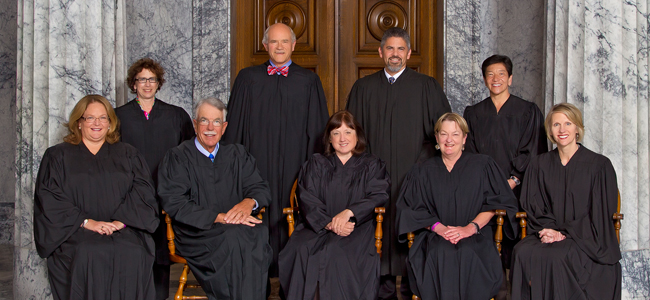
SupremeCourtJustices2014


Oh, please.
I have sympathy for the families who were duped into enrolling their children in charter schools before the court ruled today that they are unconstitutional, but I’ve absolutely no sympathy for the argument that the justices are somehow to blame. The court’s job is to interpret the constitution, and on this issue both the Washington State Constitution and 100 years of legal precedent are rather clear. It was never a sure thing that the court would rule Initiative 1240 unconstitutional because court rulings almost never are, but it was always more likely than not.
Article IX, Section 2 of the constitution plainly reads: “the entire revenue derived from the common school fund and the state tax for common schools shall be exclusively applied to the support of the common schools.” Clear enough. The whole case hinged on the legal definition of “common schools,” and since School District No. 20 v. Bryan in 1909 it has always been this:
a common school, within the meaning of our constitution, is one that is common to all children of proper age and capacity, free, and subject to and under the control of the qualified voters of the school district. The complete control of the schools is a most important feature, for it carries with it the right of the voters, through their chosen agents, to select qualified teachers, with powers to discharge them if they are incompetent.
Charters, with their unelected appointed boards, totally outside the control of voters, clearly do not meetBryan’s definition of common schools. I supposed the court could have engaged in judicial activism by futzing the issue for the sake of political expediency. Or perhaps it could have overturned the clear precedent established in Bryan. But there was no good reason to expect that the court would.
If I had to bet money I would have bet that I-1240 would be ruled unconstitutional, at least in part. And anybody with any experience reading the law could have at least foreseen this possibility. Hell, a lower court had already ruled as much!
And yet, charter school operators rushed to start up chartersbefore the court released its opinion—perhaps betting that the Charter School Operators Deserve the Blame for Rushing to Open Charters Before Court Ruled | HorsesAss.Org:

Students' return to school is marred by renewed segregation across US | Education | The Guardian

Students' return to school is marred by renewed segregation across US | Education | The Guardian:

Students' return to school is marred by renewed segregation across US

Experts say a ‘substantial majority’ of black and Latino students attend schools segregated by race and poverty, which are linked to poorer education


Millions of students around the US have started autumn with familiar rituals: waiting for absent teachers, flipping through outdated books and watching their peers fall behind in strained, segregated schools that experts warn represent a slow-burning crisis neglected by leaders.
Little has changed since a 2014 report concluded that 60 years after the supreme court declared segregation unconstitutional, major regions of the US have turned away from integration toward deeper inequality, said Gary Orfield, a UCLA professor and co-author of that paper.
The “substantial majority” of black and Latino students are in schools segregated by race and poverty, Orfield said. Such students are being primed by struggling schools for “a downward spiral” in a society that increasingly demands college diplomas.
“If you get in a really poor-performing high school, you probably were in a weak elementary school,” Orfield said.
“Let’s say your family’s poor, and then your chances of going to a really great state university are basically nonexistent. It’s deeply unhealthy for a place where a majority of people are non-white.
“If this is sustainable then it’s incompatible with democracy, and spells disaster for the long run.”
According to the report, black people are most segregated in the north-eastern US, especially in New York, where 65% of black students go to school almost exclusively without white peers.
In the western US, Latinos still largely lack access to mostly white schools, the report adds. In California, where white people are a minority, the average Latino student in a public school has only one to two white classmates.
In the south, where courts and officials worked hardest to desegregate schools and dismantle unconstitutional policies, integration has best endured.
When the civil rights act was passed in 1968, 78% of black students in the south went to intensely segregated schools. By 1991, only 26% of black students were in similar schools, the lowest rate in the US.
But following successive court decisions to roll back desegregation orders, that number has increased to 34%, still the lowest in the US but part of a national retreat toward segregation.
Today, two out of five black and Latino children go to a school that is less than 10% white, said Genevieve Siegel-Hawley, a professor at Virginia Commonwealth University.
Siegel-Hawley stressed the consequences of the situation, noting the large body Students' return to school is marred by renewed segregation across US | Education | The Guardian:

Data Wars in New Orleans | The Progressive

Data Wars in New Orleans | The Progressive:

Data Wars in New Orleans

Has "reform" helped the students of New Orleans? Does the data show that school effectiveness has improved following Katrina? Is the conversion of the city's school district into a "portfolio" system a model for the rest of the nation?

If you listen to the reformsters, the answer is an unequivocal "Of course!" Not only that: anyone who questions the narrative of undeniable success in New Orleans is guilty, in the words of Campbell Brown, of "denigrat[ing] hard work & progress of LA teachers, parents & KIDS."

As if the constant droning about the "failure" of American education found at Brown's website isn't the same level of denigration. Way to elevate the conversation, Campbell...

The certainty of the reformy side in the rightness of their beliefs is, of course, a core feature of their movement. I will concede that there are those on the opposite side who rush to condemn any evidence that favors things like charter schools or merit pay or school reconstitution.

But the reformsters always seem to forget that the burden of proof is on them. That doesn't mean that every argument against reformy policies has to be rebutted beyond any doubt; it does mean, however, that reasonable critiques should be engaged beyond simple mockery.

Take Peter Cook, for example, striking back at Andrea Gabor's NY Times op-ed, which questioned the awesomeness of reform in NOLA:
While conceding that proficiency, high school graduation, and college entry rates have all risen in New Orleans over the past ten years (no small matters), Gabor
- See more at: http://www.progressive.org/news/2015/09/188293/data-wars-new-orleans#sthash.vJmdTdE4.dpuf

Third Circuit Finds Teacher's Blog Comments About Students Not Protected By First Amendment Issue - Constitutional Law Prof Blog

Constitutional Law Prof Blog:

Third Circuit Finds Teacher's Blog Comments About Students Not Protected By First Amendment Issue

800px-Anker_Die_Dorfschule_von_1848_1896


In its opinion in Munroe v. Central Bucks School District, a divided panel of the Third Circuit found that a public school teacher's blog posts about students did not "rise to the level of constitutionally protected expression" under the First Amendment and thus they could be the basis of her termination.  Agreeing with the district judge, the majority thus concluded that the balancing test of  Pickering v. Board of Education (1968) was not satisfied.
The majority's opinion, authored by Judge Robert Cowen and joined by Judge Jane A. Restani of the United States Court of International Trade, sitting by designation, details the offending blog posts including one in which Munroe stated she was "blogging AT work," (capitalization in original), and offered alternative "canned" comments for student evaluations including:  "Sneaking, complaining, jerkoff"; "Whiny, simpering grade-grubber with an unrealistically high perception of own ability level"; and "Am concerned that your kid is going to come in one day and open fire on the school. (Wish I was kidding.)"  
Later posts were equally unflattering about students and teaching.  And while the blog was originally subscribed to by a handful of people, some posts circulated and attracted the interest of the press.  Termination was contemplated, Munroe took a scheduled maternity leave, and also did her own interviews with the press. 
The majority's opinion "reluctantly" concludes that Munroe's speech implicated a matter of public concern, but then diminishes any public concern, and then reinstates it and states that: 
Given our assessment of the interests of Munroe and the public in her speech, Defendants were not required to make an especially vigorous showing of actual or potential disruption in this case. However, even if we were to assume arguendo that her speech “possesses the highest value,”  we would still conclude that Defendants met their burden. Simply put, “Plaintiff’s speech, in both effect and tone, was sufficiently disruptive so as to diminish any legitimate interest in its expression, and thus her expression was not protected.”
Interestingly, the majority also seems to hold teachers to a higher standard - - - despite the fact that Pickering itself involved a school teacher.  While recognizing that the parents objecting to Munroe's speech cannot constitutionally be a "heckler's veto" to protected speech, the court states:
However, there is a special (perhaps even unique) relationship that exists between a public school teacher (or other educators, like a guidance counselor), on the one hand, and his or her students and their parents, on the other hand. Simply put, neither parents nor students could be considered as outsiders seeking to “heckle” an educator into silence—“‘rather they are participants in public education, without whose cooperation public education as a practical matter cannot function.’”
 This notion could seriously erode teachers' First Amendment rights.   
 The dissent of Judge Thomas Ambro from the affirmance of summary judgment in favor of the defendant school district concludes:
In short, I have no doubt the School District was well aware that firing Munroe for her blog posts and media tour would land it in constitutional hot water. More than enough evidence suggests that firing her on performance grounds was a pretext for its real reason—she had spoken out to friends on a blog, it became public, School District officials were upset and proposed her termination, they decided to wait, the once- sterling evaluations of Munroe immediately became negative, and she was fired. The bottom line: too many signs suggest this was all a set-up that a jury needs to sort out.
A petition for en banc review is presumably forthcoming.Constitutional Law Prof Blog: