Latest News and Comment from Education

Monday, September 7, 2015

2nd NPE Interview with #FightForDyett Hunger Striker Jitu Brown – The Network For Public Education

2nd NPE Interview with #FightForDyett Hunger Striker Jitu Brown – The Network For Public Education:

2nd NPE Interview with #FightForDyett Hunger Striker Jitu Brown


Jitu at USDOE for mp3

Audio Player


Partial Transcript:

“This privatization of Dyett calls into question the intention of the privatization movement. It’s really colonialism. It is removing the right of people to control the institutions that affect their lives. Our communities are defined by outside forces. And so the people, the interests that closed all those schools – Rahm Emanuel is not the leader of that. He’s just the trigger, he is the initiator of it.
They view our children through a lens that is based on profits and based on racism. They don’t see our children and see the genius and the strength that children growing up in the inner city have to have; or the resilience they have to have; the creativity that we have to have; the how to make something out of nothing that we have to have; the endurance that we have to have; the ability to reconcile unbelievable conditions and still look up and see the sun and smile.
That lens is a lens that loves our children.
But to see our children and to see inmates, to see our children and to see people that are less than you, or less than anyone else, has driven a lot of the policies that have us on a hunger strike for twenty days.
For Chicago Public Schools to have charlatans standing up there, talking about the new Dyett High School, has only fueled our resolve. And so we are very confident that we are going to win this fight, and we want this to energize people around the country to say that we don’t have to play by the privatizer’s rule, or the dominant culture’s rule.
They know we are going to do sit ins. We have to be willing to fight for our children. Peacefully, but we have to be able to use every resource within our abilities to say you’ve crossed the line.
Not one more child – not one more child.”
Jitu Brown – September 5, 2015
Day 20 of the #FightForDyett hunger strike
Interviewed by NPE Executive Director Robin Hiller
State of Education/1030 KVOI Arizona Radio


2nd NPE Interview with #FightForDyett Hunger Striker Jitu Brown – The Network For Public Education:

Where the US spends its money…and it’s not on education | Seattle Education

Where the US spends its money…and it’s not on education | Seattle Education:

Where the US spends its money…and it’s not on education


empire


We have neglected our schools financially to the point where they have become easily privatized.
Republican legislators in Washington State have continually fought against funding public schools adequately, particularly Ross Hunter, who recently moved over to the state’s Office of Early Learning (more on that later), and Representative Chad Magendanz, a big proponent of charter schools.
Nationally, our representatives in DC have ignored the financial requirements of funding public schools, what the real costs are, and instead are using our money to pay forendless, devastating and destructive wars that do not benefit our youth in any way, our communities, our disappearing middle class or our crumbling infrastructure.
To get a better perspective on what the priorities are of our elected officials, check out this article from the Business Insider:
As the US military continues to try to disengage from the Middle East and draw down, the country’s defense budget continues to fall.
In 2015, the US’ estimated military budget is expected to be $601 billion, down from $610 billion spent in 2014. However, even with the budgetary drawdown, the US still far outspends the next six highest spending nations. 
The following graphic shows the immensity of the US’ defense budget on the world Where the US spends its money…and it’s not on education | Seattle Education:

CURMUDGUCATION: River To Classroom

CURMUDGUCATION: River To Classroom:

River To Classroom


I've finished off my first two weeks with students, and as usual I'm pushing back against a combination of general chaos, the inertia that has to be overcome to get students moving again, and my own sense of urgency about What Must Be Done (in the time I don't have to do it).

So it's this time of year that I particularly appreciate my kayak.

I live in a small town, and my back yard butts right up against a river. I will throw in some pictures of the view at the end here so that you can be appropriately jealous. I'm also a short walk from a rails-to-trail bike path, but it's kayaking on the river that I find head-clearing.

Because I put in and take out in my back yard, and because I'm not crazy about physically and psychologically punishing myself, I always start by heading upriver. And at this time of year, every stroke reminds me of teaching and the work that I'm starting again.

I've done the trip a hundred times over now, and yet every trip is different. It's different both because, of course, the waters in a river are always new, so the river is never the same in that kind of deep thinky kind of way. But the river is also never the same from year to year in more specific ways-- sand bars appear and disappear, trees rise further above or collapse into the water. And the river changes from day to day as well, levels rising and dropping with the weather. This passage may be deep enough to move through today, but next week the water may be too low and the rough bottom bed will bar the way.

Because my small journey will be affected by the river and the weather and the wind, it's pointless to plan in any exactlingly careful way. Certainly the path is predictable in a general sort of way. I know I'm going that way, upriver. But hug the right bank, tack across the center, pass up the left bank and slip up in the quiet space below the island--?  I can't predict any of the steps with accuracy until I'm there, on the river. I may have a rough idea, and then change it when I see a barrier of 
CURMUDGUCATION: River To Classroom:


Why Dyett Still Matters

First, just in case you missed it in the PR flurry-- no, the Dyett hunger strikers did not "win," and yes, the hunger strike is still going on.

The twelve parents and community members who began going without solid foods over three weeks ago are still standing up for the same issues they were standing up for when this began. The Chicago school system, run by the mayor and not by any sort of elected school board, would like to close the school and replace it with one more privatized education. Or maybe they would really just like to replace it with a nice parking lot for the Coming Someday Obama Presidential Library.

What they don't want to do is listen to the community. So last week they announced that Dyett would stay open as a "compromise" school in a process that would continue to lock out community voices (which was aptly symbolized at the big press conference when the strikers were literally locked outside). This is a loose definition of "compromise," like a mugger who says, "Well, if you don't want to give me all your money, let's compromise and you can just give me most of your money."

The hope was that the public would listen as far as "Dyett will remain open..." and then just stop paying attention, which is the kind of cynical bullshit that gives Chicago politics a bad name. But it was at least marginally successful for five or ten minutes. Supporters were posting links to the news and tagging them "Victory." Eric Zorn, who unleashed a Trib column's worth of asshattery on the strikers, followed up with a non-retraction retraction that declared the strikers victorious and advising them to enjoy their big win and go home, which pretty well exemplified the reaction that Chicago Big Cheeses were angling for.

In retrospect, it seems likely that school chief's hint earlier that Dyett wasn't even necessary was a bargaining tactic, a set-up so that taking the school away from the community instead of flat-out 

Why Dyett Still Matters

Schools Matter: FIRE fascists save campus kooks' Howard Roark devotional cult

Schools Matter: FIRE fascists save campus kooks' Howard Roark devotional cult:

FIRE fascists save campus kooks' Howard Roark devotional cult

“There are two novels that can change a bookish fourteen-year old’s life: The Lord of the Rings and Atlas Shrugged. One is a childish fantasy that often engenders a lifelong obsession with its unbelievable heroes, leading to an emotionally stunted, socially crippled adulthood, unable to deal with the real world. The other, of course, involves orcs.” — John Rogers


Any wonder why Foundation for Individual Rights in Education (FIRE) staffers consistently conflate hate speech with free speech? Note the glaring lack of diversity—may be a melanin deficiency issue, no?

Any wonder why Foundation for Individual Rights in Education (FIRE) staffers consistently conflate hate speech with free speech? Note the glaring lack of diversity—may be a melanin deficiency issue, no?


Write about education and other public policy issues long enough and you'll end up on everyone's press release (PR) list. To be sure I receive PR from right-of-center organizations like Center for American Progress (CAP) and National Council on Teacher Quality (NCTQ), all the way to fringe-right outfits like the Friedman Foundation for Educational Choice. Unlike "reporters" employed by the corporate media, I occasionally call the contact persons on the PR and ask fairly innocuous questions like "is the study you mention in your PR actually juried research, or is this just a policy paper?" The response is inevitably the latter, and I've documented such encounters with CAP and NCTQ in previous Schools Matter installments. Too bad "journalists" from organs like the Broad Foundation Newslett… uh, I mean the Los Angeles Times don't question these groups' PR before publishing their misinformation uncritically to the public.
One of the more lamentable groups sending me PR is the Foundation for Individual Rights in Education (FIRE). Somewhere on the political scale between Randian libertarians and unapologetic fascists, FIRE champions the "rights" of bigots, racists, nativists, misogynists, and other assorted reactionaries to spew various forms of hate speech unabated on college campuses across the nation. Their press releases typically celebrate victories over policies that would prevent exercising of oppressions over those whose educational experience is stifled by said oppressions. FIRE sends press releases celebrating calls to eliminate co-ed mandates, gushing defenses of rape culture, and apologetics for arch-reactionaries Karl Rove and war criminalCondoleezza Rice.
Late August FIRE sent me a PR that simultaneously caused me to retch and laugh — they were able to rescue the Ayn Rand Cult, I mean Club, at The University of California, Davis (UC Davis). The near vomiting experience is natural for any educated person having to hear Rand's name or of her associated "works." The laughing reaction came from the notion that any college Schools Matter: FIRE fascists save campus kooks' Howard Roark devotional cult:

Late Friday surprise: Supreme Court says charter schools initiative is unconstitutional - Strange Bedfellows

Late Friday surprise: Supreme Court says charter schools initiative is unconstitutional - Strange Bedfellows — Politics News:

Supreme Court says charter schools initiative is unconstitutional


The Washington State Supreme Court, in a late Friday surprise, delivered a ruling that the state’s voter-passed, billionaire-backed charter school initiative is unconstitutional.
The high court’s 6-3 ruling found that the independently organized schools do not pass muster as common public schools and therefore cannot receive public funding.
Melinda and Bill Gates (STRDEL / AFP/Getty Images)
Bill and Melinda Gates: $3 million in support for 2012 charter schools initiative, just ruled unconstitutional by the state Supreme Court.
“We hold that provisions of Initiative 1240 that designate and treat charter schools as common schools violate article IX, Section 2 of our state Constitution and are void,” Chief Justice Barbara Madsen wrote in the majority opinion.
“This includes the Act’s funding provision, which attempts to tap into and shift a portion of moneys allocated for common schools to the new charter schools authorized by the Act. Because the provisions designating and funding charter schools as common schools are integral to the Act, such void provisions are not severable …”
In short, I-1240 goes down, although supporters said last night they would weigh legal options.
The ruling was greeted with surprise.  The state has nine charter schools set to operate this fall in Seattle, Spokane, Tacoma, Kent and Highline.
“We need to understand what this means for the children who would start at the three impacted schools in Seattle,” Mayor Ed Murray said via Facebook upon learning of the ruling.
John Zilavy, a Seattle parent, lamented on his Facebook page that the court’s ruling puts in “serious jeopardy” an educational took that “seems to be working.”
“Our experience so far with the new Summit Sierra Charter School in the International District is that it has really found a way to make both teachning and learning more effective for a diverse group of students,” Zilavy wrote.
I-1240 passed by a 1 percent margin in 2012, after charter schools had previously been rejected three times by Washington voters.  Ninety-eight percent of its $10 million-plus war chest came from just 21 individuals.  Bill Gates put up $3 million, Wal-Mart heiress Alice Walton gave $1.7 million, Vulcan Inc. (Paul Allen’s development company) was good for $1.6 million, and liberal entrepreneur Nick Hanauer donated $1 million. The father of Amazon CEO Jeff Bezos gave $500,000.
The state’s influential teachers’ unions opposed I-1240, as did low-income groups, arguing that charter schools would skim money and take talented students from the public school system.  The court challenge to the initiative was brought by the Late Friday surprise: Supreme Court says charter schools initiative is unconstitutional - Strange Bedfellows — Politics News:


Last Week Tonight with John Oliver: Back To School (Web Exclusive)


Last Week Tonight with John Oliver: Back To School (Web Exclusive)


John Oliver gives students a crash course in everything they will learn — or not learn — in school this year.

Connect with Last Week Tonight online...
Subscribe to the Last Week Tonight YouTube channel for more almost news as it almost happens: www.youtube.com/user/LastWeekTonight

Find Last Week Tonight on Facebook like your mom would:
http://Facebook.com/LastWeekTonight

Follow us on Twitter for news about jokes and jokes about news:
http://Twitter.com/LastWeekTonight

Visit our official site for all that other stuff at once:
http://www.hbo.com/lastweektonight

Dyett Hunger Strike - Living in Dialogue

Dyett Hunger Strike - Living in Dialogue:

Dyett Hunger Strike


Filmmaker Bill Baykan documents the Dyett hunger strike in Chicago.


School choice that goes too far - The Washington Post

School choice that goes too far - The Washington Post:

School choice that goes too far


SOME PARENTS of students who attend private and parochial schools in Nevada are debating whether to pull their children out of their current schools and have them attend public schools for 100 days. It is not that they are dissatisfied; instead, the temporary switch would make the students eligible to return to the private schools with their costs underwritten by public tax dollars. That such an opportunity exists goes to the heart of what is wrong with Nevada’s new voucher program. By subsidizing families who do not need aid, the state wastes public money that would be better directed to low-income students in academically struggling schools.
Republicans who control both the legislature and the governor’s mansion in Nevada passed the unprecedented voucher program, which will allow all parents of public school students — no matter their income — to use state funding earmarked for their children to pay for a private education, including even home schooling. The money — about $5,000 annually per student — would be deposited into an education savings account that can be used for state-approved expenses, with unspent money allowed to roll over and be saved to pay for college tuition. The only requirement is enrollment for 100 consecutive days in a public school; some parents see even that as too onerous and are pushing for workarounds that would allow children in private and parochial schools to qualify.
The law is being challenged in court on grounds the state constitution bans use of public funds for sectarian purposes. Its supporters meanwhile hail it as the ultimate in school choice, allowing education funding to follow students to the schools that work best for them. We believe in school choice, and we have strongly supported the federally funded voucher program that helps poor, mostly minority children in the District attend private or parochial schools. But a universal voucher program that gives precious education funding (Nevada is among the nation’s worst when it comes to support for education) to middle- and high-income families who on their own would choose and can afford private education is neither sensible nor sustainable.
There is also the worry the program could worsen the existing gap between poor and well-off students. Low-income students will get a slightly higher subsidy, and a separate tax credit program provides additional resources, but it is unclear if that will be enough to help them get into competitive, high-quality private schools. If they do not, they may well be faced with attending under-resourced public schools or private schools with cut-rate tuition and quality. That is not much of a choice.

New institute in Palo Alto aims to help shape state, national K-12 policy | EdSource

New institute in Palo Alto aims to help shape state, national K-12 policy | EdSource:

New institute in Palo Alto aims to help shape state, national K-12 policy


SOURCE: CALIFORNIA COMMISSION ON TEACHER CREDENTIALING WEBCAST
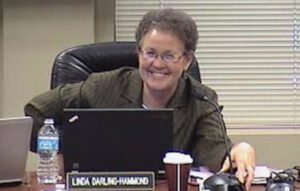
Linda Darling-Hammond shares a light moment during a meeting of the California Commission on Teacher Credentialing.
A prominent scholar from Stanford University will direct a new education institute in Palo Alto whose mission is to influence K-12 policies in both California and the nation.
Linda Darling-Hammond, an emeritus professor at the Stanford University Graduate School of Education, is the president and CEO of the Learning Policy Institute, which formallyannounced its opening Wednesday. Along with headquarters in the San Francisco Bay Area, the institute has an office in Washington, D.C., an initial budget of $5 million and a staff of 30 that may grow to 50 within a year.
The new position will take most of Darling-Hammond’s time, although she will continue to teach occasionally as an emeritus professor at Stanford and to serve as chair of the California Commission on Teacher Credentialing. Patrick Shields, who managed research at SRI Education for two decades with a focus on California’s teaching force, will be the new institute’s executive director.
The San Francisco-based Sandler Foundation is the lead funder with the Atlantic Philanthropies, the S.D. Bechtel, Jr. Foundation, the Ford Foundation, the William and Flora Hewlett Foundation and the Stuart Foundation also providing initial support for the institute.
The institute has opened during a critical period for education policy nationwide and in California. Along with implementing the Common Core State Standards, California is transitioning to a new school accountability system and a financing system that targets substantially more money to high-needs students and shifts control over spending from the state to local school districts.
In Washington, Republicans and Democrats are struggling with aspects of the rewrite of the No Child Left Behind law. But their overall compromise would return more authority over education policy and accountability to the states. That will make it all the more important, Darling-Hammond said, for communities “to know what works and act based on that knowledge. States and the federal government need to be in the knowledge-sharing business,” and the institute will be a forum and conduit for that information, she said.
Independent and nonpartisan, the Learning Policy Institute will differ from most research institutions, Darling-Hammond said, in that it will combine original and existing research to focus on “pressing policy questions” and then will translate the findings so that federal, state and local policymakers and practitioners can adopt the recommendations and bring them to scale. A large focus of  the institute’s work will be on California, she said.
She said the institute’s policy agenda will include:
  • Examining effective designs for new schools with structures, curriculum and types of learning that young people will need to thrive in a “radically different, knowledge-based world economy.”
  • Sharing early education programs with strong outcomes so that they can be brought to scale. There is an emerging bipartisan recognition nationally of the importance of early education, she said.
  • Making recommendations and sharing research on how to attract, train and effectively retain the next generation of teachers; California and other states are already experiencing a diminishing supply of prospective teachers.
  • Helping to shape an “equity agenda” that draws attention to the United States’ high rates of child poverty and homelessness and unequal school funding and staffing, compared with other industrialized nations.
The timing may be right for a new institute focusing on these issues and for Darling-Hammond. An early education adviser to President New institute in Palo Alto aims to help shape state, national K-12 policy | EdSource:

ELECT LEE BARRIOS

ELECT LEE BARRIOS:


      My 2011 Campaign Video
        My dedication, determination and direction have not changed!
Lee Barrios, a retired middle school teacher from Abita Springs and an outspoken critic of state education reforms, is announcing her candidacy for the Louisiana Board of Elementary and Secondary Education.

Barrios is seeking the 1st District seat held by James Garvey.

The district covers most of East Jefferson; small parts of West Jefferson, and all of St. Tammany Parish.

"My position has always been to preserve the locally elected governance structure of the school system, advocate for full and equitable funding, demand accountability for educators at all levels based on appropriate methods of evaluation ... and end the one-size-fits-all high-stakes standardized test as a PUNITIVE and flawed measure of learning," Barrios said in a statement.

Barrios, 68, served as vice president of the St. Tammany Association for Gifted and Talented, is a founding member of the Coalition for Louisiana Public Education, was on the Governing Board of Save Our Schools National, and is a founding and active member of the Parent Coalition for Student Privacy. She spent 17 years teaching gifted students, first at Slidell High School and then at Mandeville Junior High in St. Tammany Parish.

Barrios has three children and six grandchildren. She received a bachelor's in English and journalism education and a master's in secondary education from Southeastern Louisiana University. She was a National Board Certified Teacher. ELECT LEE BARRIOS:


What's next after No Child Left Behind? Melissa Cropper, Ohio Federation of Teachers | cleveland.com

What's next after No Child Left Behind? Melissa Cropper, Ohio Federation of Teachers | cleveland.com:

What's next after No Child Left Behind? Melissa Cropper, Ohio Federation of Teachers


Guest columnist Melissa Cropper is President of the Ohio Federation of Teachers, a labor union representing 20,000 members who provide quality public education and public services to Ohio children, their families and our communities. OFT is the state affiliate of the American Federation of Teachers, which represents 1.6 million members nationwide.
Standardized testing in public schools became the creature that kept growing and taking over everything in its path. Educators, parents, students and others concerned about its effect on actual teaching and learning led a revolt—with hundreds of thousands of parents across the country even opting their children out of taking the tests.
Melissa Cropper-2.jpg
Melissa Cropper is president of the Ohio Federation of Teachers.
Congress listened, and it may soon be putting up a "going out of business sign" when it comes to the federal government telling states how to hold educators accountable to identify struggling schools and determine which interventions can be used to help those schools turn around.
So what does this mean for all stakeholders after years of federal mandates under the No Child Left Behind (NCLB) Act and Race to the Top grants to states? Both houses of Congress have now passed bills to overhaul NCLB. Because of some major differences between the bills, House and Senate conferees will have to reconcile those differences before seeking President Obama's signature.
Given its content and overwhelming bipartisan support, we hope that conferees will use the Senate bill as the foundation of a final agreement. The good news for our students, schools, educators and parents is that both the Senate and House heard the cries of discontent over the testing obsession and the misuse of high-stakes testing. Both bills stop the secretary of education from closing schools or dictating teacher evaluations and reset accountability by eliminating the test-and-punish policies that have narrowed the curriculum but not the achievement gap.
This means—if the final bill follows suit—that Ohio will be able to set our own accountability system and will no longer need to follow NCLB's rigid "adequate yearly progress" formula. This has real potential to return joy and flexibility to teaching and learning. But to make new policies meaningful, educators and parents must be partners with school leaders when developing a new accountability system.
The key difference between the Senate and House bills is over equity. Only the Senate bill protects the ESEA's original intent to mitigate the effects of poverty by targeting What's next after No Child Left Behind? Melissa Cropper, Ohio Federation of Teachers | cleveland.com:

Ohio Governor Kasich's Corrupt Corporate Charter Schools Are A National Joke

Ohio Governor Kasich's Corrupt Corporate Charter Schools Are A National Joke:

Ohio Governor Kasich’s Corrupt Corporate Charter Schools Are A National Joke


It surprises no-one, not even the racist and religious Republican base that the GOP exists first and foremost to advance the interests of the rich and corporations at the expense of the American people; including the Republican racist and religious base. Over the past decade Americans have learned that there is no program or agency Republicans will not steal funding from to enrich their corporate masters. Although Republicans have not had as much success transferring taxpayer funding for public education to corporations at the federal level, Republican governors have made raiding public education a bonanza for corporate charter and private religious schools.
It is true that Republican governors such as Sam Brownback, Chris Christie, and Scott Walker were giddy appropriating public school money for tax breaks for corporations and the rich, but their robbery pales in comparison to Republicans like Piyush ‘Bobby’ Jindal and John Kasich. Now, it appears that presidential candidate and Ohio Governor John “corporate” Kasich’s lust for corporate-run charter schools is not only the nation’s leading privatization failure, its “beyond belief” corruption prompted mass evacuations of Ohio education officials fleeing Kasich’s corporate education corruption.
In the four years that corporate advocate Kasich has been in office, funding for traditional public schools has been slashed as far too costly and a burden on the rich and corporations. All while corporate charter schools have seen a very significant funding increase as a result of the public school funding cuts. In what has to be an epic understatement, many education advocates in Ohio and nationally have remarked that the public school funding being transferred to corporate charter schools in Ohio not only “appears to have been misspent,” it is a scam to enrich a corporation loyal to Kasich and Ohio Republicans. It is also a plot to make predominately poor minority students uneducated because nothing on Earth guarantees Republican electoral success than an uneducated populace.
This corporate corruption sweeping through Republican states’ education sectors is happening all across America, but particularly so in Ohio. Kasich has been heavily promoting the primary components of corporate school reform that include primarily increasing the number of vouchers that use public money to pay for private religious schools, and heavily expanding corporate “managed” charter schools. Kasich is so enamored with, and driven to expand, charter schools that he has protected a blatantly corrupt corporate privatization scheme that produce the greatest charter school system failure in America. Instead of scrapping the school corporatization agenda, Kasich’s devotion to his corporate cohort drooling to take over all education has driven him to pledge more funding and support for corporate-controlled charter schools at the expense of impoverished minority students and public education.
The level of corruption in Kasich’s corporate charter school scam became exposed nationally this winter after a report from Stanford University’s Center for Research on Education Outcomes revealed that achievement in Ohio’s charter schools was significantly below Ohio’s regular public schools. Anyone familiar with Republicans’ and President Obama’s love affair with charter schools would not be surprised that yet another studyfound one of the largest and “most successful” charter schools in America underperformed even underperforming public schools. However, in Ohio’s case besides achieving performance grades of “F” across the board, Kasich’s corporate charters are robbing the state blind and Kasich’s “education experts” are rigging performance results and attendance reports to steal more Ohio taxpayer money. In fact, the corporate corruption is so abominable and achievement scores are so bad that an education policy analyst rightly noted that, “Our charter schools have become a national joke.” They have also become a money laundering enterprise for the corporation running Kasich’s charter school program.
When a Kasich education appointee, Leon Sinoff was asked to sign off on a building lease for Imagine Columbus Primary Academy, he was unaware that the corporate-run schoolreceived an F grade for achievement on the 2013-14 state report card, only three teachers returned after summer break, and two principals and one vice principal had stepped down. Sinoff then discovered that the school served a predominately high-poverty, low-income community and lacked arts, music, and foreign language classes. When he inquired about the poor performance and lack of adequate teachers and classes, the corporation running the charters, Imagine Schools, complained there was not enough funding due to the high expense of the building lease agreement. Sinoff soon discovered that the $58,000-a-monthlease negotiated and entered into by Imagine Schools consumed half the school’s operating budget for a building that was owned by Imagine Schools Finance LLC.
To understand the corruption of a corporate charter school renting a building from itself, the national standard for school building leases is between 8 and 15 percent of operational budgets, not 50 percent. The corporate rigging is just one reason an epic failure like Imagine Schools is one of the largest for-profit charter school management corporations in America. After finding the corruption, Sinofff promptly resigned, along with other stunned board members, and announced, “This is self-dealing. That’s why we are massively overpaying for the lease. Imagine is perfectly happy cranking out low-quality schools and profiting off them. They don’t care about the quality of the kids’ education.”
That was only a small part of the corporate Kasich’s corruption. When Ohio State Auditor, David Yost, made unannounced visitsto 30 charter schools around the state, he found that the real attendance was drastically lower than what the schools reported to the Department of Education. Inflating classroom numbers meant extra taxpayer dollars for the corporate charter schools because states dispense education funds based on the number of students enrolled. It still gets worse.
After one of Imagine’s corporate charters was forced to close due to being caught paying Imagine enormous sums for rent while languishing on the state’s “academic emergency” list reserved for F-rated schools, Kasich appointed one of its failed corporate board members, David Hansen, as “executive director” of the entire state’s Office of Quality School Choice and Charter Funding.
Kasich assigned Hansen to oversee the expansion of Imagine’s failed charter and virtual schools; virtual schools are online charters used by homeschoolers to produce uneducated citizens as crucial to Republicans’ electoral survival as racists and religious fanatics. In July Kasich’s hand-picked corporate education executive resigned after admitting he regularly rigged evaluations of charter school sponsors that authorize and oversee the schools in exchange for a handsome taxpayer-provided fee. Hansen also admitted he deliberately concealed the failing grades of F-rated schools operated by for-profit corporations because they are owned by major Republican donors in the state. Kasich’s response to the deception and corporate fraud is expanding corporate-run charters with more money appropriated from the state’s public schools.
One would like to say that what is happening to education in Ohio under Republicans is a cautionary tale, or a portent of the coming disaster for education if Republicans are allowed to fulfill the Koch brothers’ dream of corporate control of the education system in America. Sadly, not only is it not a cautionary tale, the disaster is unfolding in every Republican state across the nation to the detriment of students, public education, and taxpayers who are seeing even more of their tax dollars funneled directly into corporate coffers under the guise of school choice.
Most Americans are completely unaware, including President Obama, that charter schools typically underperform public schools, and they are not beholden to report to any agency how they spend money stolen from public education. They are also Ohio Governor Kasich's Corrupt Corporate Charter Schools Are A National Joke:

After John Deasy, LAUSD faces a tough choice: Play it safe or take another risk? - LA Times

After John Deasy, LAUSD faces a tough choice: Play it safe or take another risk? - LA Times:

After John Deasy, LAUSD faces a tough choice: Play it safe or take another risk?


When the school board chose John Deasy as superintendent of the Los Angeles Unified School District in 2011, it knew what it was getting: an outsized personality with a national reputation as an advocate for school reform.
And in his 31/2 turbulent years at the helm, Deasy proved to be just that. He courted wealthy donors who helped subsidize a robust travel schedule, and he spent about 200 days on the road as he attempted to raise the district's profile and promote his agenda.
A close look at Deasy's tenure clearly shows the challenge of juggling the responsibilities of running a sprawling, often-dysfunctional district while serving as a leading voice in the national movement to overhaul schools.


At key moments of tumult in the district, the records show, Deasy was simply not in town.
Now, as the Los Angeles Board of Education begins to search for a new superintendent, it faces an important choice: Should it take a chance on a nontraditional candidate? Or should it take the safer route and turn to a conventional educator?
In Deasy's case, his critics argue, his national role came to subsume his home-base responsibilities.
The beginning of the end came a year ago, just before the school year started. Deasy was in New York to discuss challenges threatening education reform.
Back at home, the city's public schools were in disarray. By the time Deasy returned for the first day of classes, a malfunctioning scheduling system had forced students into gyms and auditoriums to await assignments. Some of them ended up in the wrong courses, putting their path to graduation in jeopardy.
Two months later, in October, a Superior Court judge ordered state education officials to meet with Deasy to fix the scheduling problems that he said deprived students of their right to an education. But Deasy flew to South Korea the next morning to visit schools and meet government officials. A week later, he resigned, under pressure, as head of the nation's second-largest school system.
Deasy's tenure has become a lesson for the board in an era when urban school chiefs must navigate a minefield of political interests — including unions, politicians and foundations — all seeking greater influence.
Jeffrey Henig, professor of political science and education at Teachers College, Columbia University, said strong ties to the foundation world and national education leaders can draw additional revenue for After John Deasy, LAUSD faces a tough choice: Play it safe or take another risk? - LA Times: