Latest News and Comment from Education

Sunday, June 7, 2015

Join the Protest Against the Closure of West Seattle’s Middle College High School | Seattle Education
Join the Protest Against the Closure of West Seattle’s Middle College High School | Seattle Education:

Join the Protest Against the Closure of West Seattle’s Middle College High School

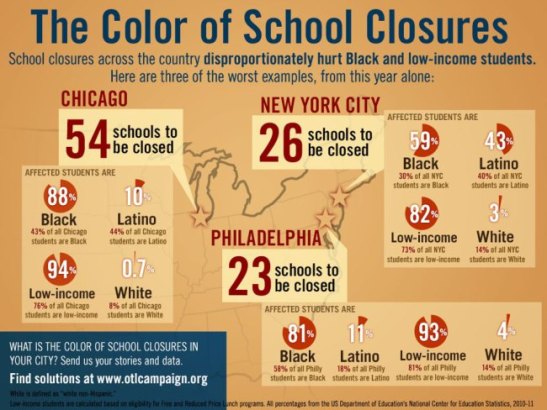
school closures
“Before I started Middle College I was lost, without it I would probably still be in the streets.”  Oliver Wilson, Graduate, currently studying computer technology at the City College of San Francisco.
Middle College is a small, alternative high school in West Seattle. People in the neighborhood still refer to the school by it’s old name, the Ida B. Wells School of Social Justice. The older name better explains the school’s focus, which is social justice and community engagement. The goal of Middle College High School is to give high school dropouts and other at-risk students a second change at earning a diploma.
Chris Otey is one of Middle College’s successes. This is his story:
One afternoon some people came to our class from KUOW to introduce the Radio Active program that teaches young people about the process of creating radio stories.  It sounded interesting so I signed up, attended some workshops and had the pleasure of creating my first radio story.  My subject was a friend of mine and fellow Middle College student, Kyra MacFarlane, who was willing to share her powerful story of her family’s struggle with poverty and homelessness.
During the interviewing process I came to realize that many people around our community and in our school face similar challenges.  Students who live in poverty struggle in our schools because it is nearly impossible to learn when you have no home or food to eat.  At Middle College High School at the High Point Center, students like Kyra get the support  they need to graduate becaues of the supportive, caring and small school environment.  At Middle College we are encouraged to dream big and see our education as part of the solution to the challenges many of us face.  For students like Kyra and many others who left the big schools looking for a challenging alternative educational experience, Middle College is the place to be.
Superintendent Nyland has decided to close Middle College High School at the end of this school year.
Why is Middle College targeted for closure? No one is really sure. The district cites low enrollment as the cause. From The West Seattle Blog:
The district seems to be blaming teachers for the enrollment trouble: “Many students enroll through word of mouth but this year we have had much fewer due to the poor climate at High Point this school year. Teachers have been unhappy with the schedule and have communicated their discontent to students.”
MCHS-HP teacher Alonzo Ybarra, who sent first word of the impending closure, has said that MCHS’s principal Cindy Nash “forcefully imposed an arbitrary schedule that severely diminished our abilities to deliver exciting and creative curriculum and instruction.”
Whatever the reason, it seems extreme to close a school that has benefited so many Join the Protest Against the Closure of West Seattle’s Middle College High School | Seattle Education: 


Politically-birthed Common Core Turns Five. Let’s Celebrate by Ripping It Apart. | deutsch29

Politically-birthed Common Core Turns Five. Let’s Celebrate by Ripping It Apart. | deutsch29:

Politically-birthed Common Core Turns Five. Let’s Celebrate by Ripping It Apart.


On June 6, 2015, Huffington Post education editor Rebecca Klein published a piece entitled, 5 of the Most Extreme Claims Made Against Common Core in the Last 5 Years. (Interestingly, Klein chose to publish her post under the category of “politics” rather than “education.”)
She apparently does so as some means of commemorating the fifth anniversary of Common Core completion.
Sure, Klein notes that not all opponents to Common Core promote extreme stances. However, by emphasizing the extremes and dismissing moderate arguments in a couple of statements, Klein’s post promotes the idea that Common Core is really sound, and those advancing the Five Fringe Arguments highlighted in her post constitute the “some criticism” responsible for making Common Core “a polarizing issue.”
Here is the heart of her Common Core sell:
The standards, which have been adopted in a majority of states, emphasize critical thinking over rote memorization, and aim to make students more college- and career-ready. A bipartisan group of education experts, governors and state school chiefs developed the standards, and the Obama administration incentivized states to adopt higher standards through its Race to the Top competition.
There are vocal opponents on both ends of the political spectrum. Their reasons vary: Some disagree with content of the standardized tests associated with Common Core, while others say the standards exemplify federal overreach. But some criticism — which has, over the years, turned Common Core into an acutely polarizing political issue — is far more extreme.
Let us launch right into exploring the above, shall we?
Klein’s first statement, “The standards, which have been adopted in a majority of states,” is already a problem. The statement glosses over the highly questionable circumstances associated with Common Core “adoption,” not the least of which is the fact that such “adoption” happened for 46 states and three territories a full year before Common Core existed– by June 2009. Furthermore, those doing the “adopting”– governors and state education superintendents– were the only two required to sign the Common Core Memorandum of Understanding (CCSS MOU), thereby committing their state education systems to that which had yet to be created– and which was created in a matter of months and published in a rush.
Lots of room for concern and distrust right there, and not just by Klein’s five featured extremists.
Next comes the Common Core as “emphasiz[ing] critical thinking over rote memorization.” As a critical thinker, I would like to read the empirical studies produced prior to Common Core adoption and that support exactly what the Common Core yields, not what those advertising it have told me it “emphasizes.”
No such empirical evidence exists. What does exist is the immediately-published, July 2010, Fordham Institute declaration of Common Core as The Answer despite the fact that even Fordham Institute did not grade Common Core as superior to all existing state standards. That did not stop Fordham Institute current president Michael Petrilli from trying to sell Common Core to states with standards that his organization rated as better than Common Core.
Another cause for public mistrust of Common Core and its promoters.
Back to Klein and her Common Core fifth anniversary post:
Klein continues with, “[the standards] emphasize critical thinking over rote memorization, and aim to make students more college- and career-ready,” a Politically-birthed Common Core Turns Five. Let’s Celebrate by Ripping It Apart. | deutsch29:

This Is What Happens When You Criticize Teach for America | The Nation

This Is What Happens When You Criticize Teach for America | The Nation:

This Is What Happens When You Criticize Teach for America

An internal memo reveals how TFA’s obsessive PR game covers up its lack of results in order to justify greater expansion.


Last year, Wendy Heller Chovnick, a former Teach For America manager, spoke out against her former organization in The Washington Post, decrying its “inability and unwillingness to honestly address valid criticism.” In recent years, such criticism has centered on Teach For America’s intimate involvement in the education privatization movement and its five-week training, two-year teaching model, which critics claim offers recruits a transformative rĆ©sumĆ©-boosting experience but burdens schools with disruptive turnover cycles.
In the interview, Chovnick referenced the extent to which Teach For America manufactured its public image, explaining, “Instead of engaging in real conversations with critics, and even supporters, about the weaknesses of Teach For America and where it falls short, Teach For America seemed to put a positive spin on everything. During my tenure on staff, we even got a national team, the communications team, whose job it was to get positive press out about Teach For America in our region and to help us quickly and swiftly address any negative stories, press or media.”
An internal media strategy memo, obtained by The Nation, confirms Chovnick’s concerns, detailing TFA’s intricate methodology for combating negative media attention, or what it calls “misinformation.” Given that TFA takes tens of millions of government dollars every year, such strategies are troubling. According to its last three years of available tax filings, Teach For America has spent nearly $3.5 million in advertising and promotion. As the strategy memo indicates, much of this promotion goes toward attacking journalists, including ones previously published in this magazine. The memo details the numerous steps TFA’s communications team took in order to counter Alexandra Hootnick’s recent piece for the The Nation, “Teachers Are Losing Their Jobs, but Teach For America Is Expanding. What’s Wrong With That?
According to the memo, Teach For America knew Hootnick’s piece was going to be critical, thanks to a source in the Department of Education, who had notified TFA of a Freedom of Information Act request she had made:
In the summer of 2012, alumna Alexandra Hootnick (Bay 2008) reached out directly to several people on staff, asking to speak as part of her work for her Columbia journalism school thesis. She said her topic was TFA’s expansion efforts through the lens of Seattle and our i3 grant. It quickly became clear she was unlikely to portray TFA in a positive light—we learned from the U.S. Department of Education she had made a large FOIA request—and that her thesis could become a media piece.
In a phone call with The Nation, Teach For America did not name its source in the Department of Education, but did say it came from a DOE program officer involved with TFA, due to their status as DOE grant recipients. TFA spokesperson Takirra Winfield added, “We are a grantee of the DOE, so we received notification of the FOIA request as a part of their standard operating procedure.” Notably, a review by the Nation indicated that none of the so-called “disinformation” cited in the TFA memo was actually incorrect.
Teach For America’s Counter-Information Strategy
Thanks to this notice from the Department of Education, TFA’s communications team was aware of Hootnick’s investigation a full year before she informed TFA that she was going to publish a This Is What Happens When You Criticize Teach for America | The Nation:

Sanders And Clinton Clash On Education Seeking AFT Nod

Sanders And Clinton Clash On Education Seeking AFT Nod:

Sanders And Clinton Clash On Education Seeking AFT Nod


Those of us who have spent substantial time as classroom teachers teachers know that when it comes to politicians talking education, as John Mellencamp put it, “it’s what you do and not what you say,” that matters. Paying lip service to “educational excellence” and “high standards” is like saying you love America and support the troops–necessary platitudes that do not clearly illuminate what a candidate will actually do once elected.  As the late Minnesota Senator Paul Wellstone put it,
“Making students accountable for test scores works well on a bumper sticker and it allows many politicians to look good by saying that they will not tolerate failure. But it represents a hollow promise. Far from improving education, high-stakes testing marks a major retreat from fairness, from accuracy, from quality, and from equity.”
This brings us to the current push by the Democratic Party’s candidates for President to gain the American Federation of Teachers (AFT) endorsement.  On an issue-by-issue basis, Hillary Clinton and Bernie Sanders are quite similar in their voting records. Both have voted against private and parochial school vouchers, both have consistently voted to maintain and increase federal funding for public education at the K-12 and university level, and both have received high marks from the National Education Association (NEA) for their voting records, 83% pro-teacher for Sanders and 82% for Clinton.
Since Clinton and Sanders have voted similarly in the past, we must look deeper into their current campaigns to see how they would individually govern on education issues. Hillary’s campaign just announced the creation of a Teacher PAC that will bring reformers and unions together ,” oversimplifying the education debate considerably since “reformer” can mean anything from supporting evaluating teachers on test scores, to charter schools, to private school vouchers, and since there is no such thing as the “union perspective” on improving education. This new Teacher PAC for Hillary also includes reference to not allowing any child to stay trapped in a failing school, which plays right into the hands of those who would replace traditional public schools with charters or private school vouchers. In the post Citizens United age, Presidential candidate Hillary Clinton might have to adjust her education policies to attract the dollars of “reformers” like Bill Gates and Mark Zuckerberg, while simultaneously using her history with the AFT to push for support from the teacher’s union.  Randi Weingarten, president of the AFT, has been a friend of Hillary’s for years going back to when Weingarten was President of the New York City teacher’s union and Hillary was a New York Senator.  Since Weingarten developed a reputation for being too chummy with billionaire mayor Michael Bloomberg and giving in on too many issues of importance to rank and file teachers –like seniority and ability to file grievances against unfair administrative practices–this is a worrisome proposition for teachers in the classroom.
Bernie Sanders, on the other hand, does not have to mince words since he is not seeking the approval of wealthy donors. One of Sanders’ key campaign issues is the rising cost of college tuition, and in Vermont he fought for universal pre-K. Sanders has also spoken out and voted for de-emphasizing standardized testing in No Child Left Behind and using federal programs to recruit more math and science teachers. However, both Sanders and Clinton have used similar rhetoric about educating our children as individuals and not just as little test takers. (In fact Barack Obama said the same when running in 2008, then did the opposite with Race to the Top when in the White House.)  
The main reason to be optimistic about how President Sanders would function on education, is that his campaign funds have always come from small individual donors and labor unions, not from large corporate or billionaire donors. Sanders has repeatedly said that he wants the United States to follow the Scandinavian political and economic model. Finland consistently ranks as the #1 school Sanders And Clinton Clash On Education Seeking AFT Nod:

Common Core Standards SBAC testing, the bully principal…and more | Seattle Education

Common Core Standards SBAC testing, the bully principal…and more | Seattle Education:

Common Core Standards SBAC testing, the bully principal…and more

the-different-types-of-bullying-8-638
Public school is based on the the principle of inclusion, not exclusion. Kids are accepted however they arrive through the front door. Different ethnic backgrounds, economic status, personal triumphs or challenges –everyone is on equal footing. Most importantly, serving the needs of each and every students is job one. Excluding children or using them to meet the personal objectives of the adults who run the school or district, violates the core mission of our public schools. That’s why we find two recent events at Denny Middle School so disturbing.
First, Jeff Clark, Principal of Denny International Middle School, made the controversial decision to deny kids –whose parents had opted them out of the SBAC–access to the school carnival. Principal Clark’s decision has provoked understandable outrage in the parent community. This story was first reported by Melissa Westbrook on Save Seattle Schools Community Forum, after a parent contacted her reporting the incident.
Follow up reporting included an explanation by Jeff Clark of his actions and a response by Director Marty McLaren, school board member for District 6, West Seattle.
From Principal Jeff Clark:
The 2015 My Best Performance Carnival at Denny International Middle School

In addition to many special activities throughout the year, for the past ten years, Denny has hosted a carnival at the end of the state testing period for those scholars who have given their best performance. The scholars’ effort is tracked on a form called the “My Best Performance Rubric,” a copy of which is located in their student planners. The rubric includes categories such as:

·        positive attitude
·        time management
·        reading instructions carefully
·        making an attempt on every task and persevering
·        resourcefulness
·        using resources and tools
·        written presentation

After each testing session, scholars fill out their assessment of how they performed in all these areas.

The rubric is then turned into their teacher for review. At the end of the testing period those Common Core Standards SBAC testing, the bully principal…and more | Seattle Education:


4LAKids - AALA: ACSA OPPOSES COLLECTIVE BARGAINING

4LAKids - some of the news that doesn't fit: AALA: ACSA OPPOSES COLLECTIVE BARGAINING:

AALA: ACSA OPPOSES COLLECTIVE BARGAINING


From the Associated Administrators Los Angeles (AALA) Weekly Update for June 8, 2015  ::  http://bit.ly/1EYHhWd

●● NOTE:
  •          The Association of California School Administrators (ASCA) was established in 1971. ACSA is the largest umbrella organization for school leaders in the nation, serving more than 14,500 school leaders.
  •          The Associated Administrators of Los Angeles (AALA) was formed in 1981 when elementary, secondary, supervisory and adult administrators joined forces to form a single association to represent all middle managers in the Los Angeles Unified School District. During the first ten years membership in AALA was voluntary. In 1991 AALA became the exclusive bargaining unit representing all certificated middle managers except confidential and personal service contract senior staff.
  • ·        ACSA is a statewide advocacy organization; AALA is a collective bargaining unit in LAUSD. The two are not affiliated, though many LAUSD administrators are members of both.

June 4, 2015  ::  ACSA, the Association of California School Administrators, has taken a position of opposing AB 575 (Senator Carol Liu-D) and SB 499 (Assemblyman Patrick O’Donnell-D) which are scheduled to be heard on the Senate or Assembly Floor no later than Friday, June 5. The identical bills are likely to be merged and will repeal the existing Stull Act of 1971 and establish a best practices teacher and school administrator evaluation system by July 1, 2018, that requires specific components, such as state and local formative and summative assessment data and observations. The new system would have to be negotiated with the local collective bargaining unit. The bills are a response by lawmakers to recent court rulings and public pressure to include student test scores in the evaluation process. While ACSA is strongly opposed to the legislation, neither CTA nor CFT have taken a position.

Under the bills, the teachers’ evaluation system would be based on the California Standards for the Teaching Profession and would include seven objectives on which they will be rated. The section of AB 575 that applies to administrators says that the evaluation system must be based on the California Professional Standards for Educational Leaders and includes these provisions for evaluation:

·         the success by which the administrator facilitates development and implementation of a vision for pupil learning, parent and community communication, advocating and supporting a safe, nurturing school culture that sustains a quality instructional program conducive to pupil learning and staff professional growth, providing ethical and professional leadership.
·          
·         the academic growth of pupils over time, based on multiple measures, which may include pupil work as well as pupil and school longitudinal data.
·         Requires the governing board of a school district to identify who will conduct the evaluation of each school administrator, as specified.
The bill also includes the provision that …certain elements …cannot be negotiated away including: frequency of evaluations; classroom observations from evaluators trained for the task; requiring districts to receive and consider input from parents, students, and community members into the development of the local evaluation process; requiring evidence of teachers’ contribution to students’ academic performance through multiple measures, including summative and formative assessments; requiring that teachers who are evaluated unsatisfactory participate in a district’s Peer Assistance and Review (PAR) program if it has one; and requiring that teachers in charter schools also be evaluated under the new best practices system.

Based on the above analysis of the bill provided by the Appropriations Committee, AB 575 seems to be a bill that administrators and teachers would support. We, at AALA, are disappointed that ACSA, an organization which represents school administrators, would advocate removing evaluations from the negotiating table and permit individual school districts to implement whatever type of evaluative system it desires. ACSA members have been sent an email encouraging them to send letters of opposition to their state representatives saying this legislation will harm students and that standards of acceptable performance should be determined by the governing board rather than as a 4LAKids - some of the news that doesn't fit: AALA: ACSA OPPOSES COLLECTIVE BARGAINING:

Perdido Street School: Zephyr Teachout: Angry New York Teachers Can Get Get More Formal Political Power By Running For Office

Perdido Street School: Zephyr Teachout: Angry New York Teachers Can Get Get More Formal Political Power By Running For Office:

Zephyr Teachout: Angry New York Teachers Can Get Get More Formal Political Power By Running For Office


Alan Chartock in the Daily Freeman: 


Cuomo is known and respected up to now as a take-no-prisoners tough guy, but his political antennae seem corrupted. His picking on the teachers in New York state is dumber than dumb. It appears that he fell in with a crowd of rich potential funders who are always yelling about “educational reform.” Maybe he wanted their money and he became a fierce charter school advocate and then adopted positions which then threatened the hell out of the teachers who are underpaid and overworked. Their tenure is one of the few things they do have going for them, and however Cuomo meant it, the teachers saw him as looking to evaluate them with an eye toward firing them. These are usually people who want nothing to do with Albany politics, but they sure got a wakeup call. I talk to them all the time and they are angrier than I have ever seen them.

Zephyr Teachout has an excellent idea how teachers can take that anger and do something productive with it:


Liberal activist Zephyr Teachout is touring New York starting tonight in Syracuse to try to recruit teachers and women to run for public office in New York.


Teachout, the Fordham Law School professor who ran against Gov. Andrew Cuomo in a Democratic primary last year, said the education policy battles at the state Capitol should spur teachers and parents to run for political office so their voice can be better heard.

“The focus is getting more people into the political process, and the focus here is on teachers and women,” Teachout said in an interview with Gannett’s Albany Bureau. “If there’s a central thrust, it’s educators and parents.”

Teachout, who lives in Manhattan, is partnering with the union-backed Working Families Party and the New York State United Teachers union on the effort.

She said the massive testing opt-out movement in New York in April, as well as protests to new teacher evaluations show that 
Perdido Street School: Zephyr Teachout: Angry New York Teachers Can Get Get More Formal Political Power By Running For Office:

Judging an Iceberg by the Tip Only: The Cumulative Effects of Opportunities for Students | the becoming radical

Judging an Iceberg by the Tip Only: The Cumulative Effects of Opportunities for Students | the becoming radical:

JUDGING AN ICEBERG BY THE TIP ONLY: THE CUMULATIVE EFFECTS OF OPPORTUNITIES FOR STUDENTS


“[M]ost of what poor people have in common has nothing to do with their culture or dispositions [laziness]. Instead, it has to do with what they experience, such as the bias and lack of access to basic needs” (p. 26).
Throughout the first several years as a high school English teacher in rural Upstate South Carolina (in my hometown high school, in fact), I believe I learned far more lessons than I taught.
In those first couple years, I had different ability levels of classes (yes, we tracked every grade with low, average, honors, and Advanced Placement) and multiple grade levels as well—resulting in my juggling as a beginning teacher 13 textbooks among my five courses. Several of the so-called “general” classes were at maximum capacity, 35 students, as well.
One of the most vivid and troubling lessons recurred year after year in my general senior English course: Students, in a burst of maturity accompanied by the realization that adulthood loomed, approached me about taking the SAT and applying to college.
General track students, typically, had been in courses for years specifically designed for students not applying for college; therefore, these students were destined to do poorly on the SAT (because of a combination of their inadequate coursework for many years and their socioeconomic status, mostly working-poor and working-class households) and have their belated motivation squashed.
Although not a popular response, I often replied with: “Well, first go back in time. And then, read, read, read.”
If possible, of course, that solution was and remains quite accurate, but my larger point was addressing the cumulative impact of life and educational experiences that students either have or miss—and that the quality and amount of those experiences are more strongly correlated with the coincidences of those students’ births than with the content of their character.
These students came rushing back to me this spring during my May Experience course on educational documentaries.
My university is a small selective liberal arts environment, and we have a relatively privileged and white student body—despite efforts shared by many universities to increase diversity. One of the unintended consequences of our May X program has been that athletes typically take these courses, and since our student-athletes are more racially diverse than our larger student body, my May X classes have usually been more racially and gender diverse than courses Judging an Iceberg by the Tip Only: The Cumulative Effects of Opportunities for Students | the becoming radical:

Dropout Nation » Wanted: Black Education Systems

Dropout Nation » Wanted: Black Education Systems:

Wanted: Black Education Systems


America’s traditional public education systems has failed the descendants of enslaved Africans. Only 16 percent read at grade level in middle school (and only 12 percent of male African-Americans do so). Just over half of male Black students graduate from high school in four years (as compared to more than three-quarters of male White students). 21 percent of young Black women graduate from college, but only 16 percent of young Black men (compared to 31 percent and 30 percent for White women and men, respectively). As a result of this failure of the public schools to educate Black children, lifetime earnings are reduced on average by over a million dollars, or a total of $5 trillion for this generation of the descendants of enslaved Africans as a whole.
geniuslogoThis $1 million individual reduction in lifetime earnings is a quantifiable, continuing, harm resulting from centuries of slavery and an additional 150 years of Jim Crow and its lingering effects. As such it can be taken as one component of the calculation of the figures for restitution.
While the average per student expenditure for Black students is less than $12,000, the amount spent on White students whose families are in the upper 20 percent of incomes can easily reach $30,000. Adding to that the amounts spent by those families on education activities outside of school hours—private lessons of various kinds, tutoring, educational travel—we can estimate the annual monetary educational disadvantage of Blacks students as at least $25,000. Given k-12 Black enrollment of seven million, the total annual shortfall is on the range of $175 billion.
If this $175 billion were available for the education of Black American children, how could it be used to eliminate the educational penalty for studying while Black?
One idea would be to utilize the existing legal framework underpinning the charter school movement (whose schools have been more-successful in improving the prospects of black children) to create a national charter school network for the American descendents of enslaved Africans. I call it the Black American Public School System. We already have such a system in higher education in the form of the nation’s historically black colleges and universities, many of whom still account for the vast majority of black collegians entering professions such as law and the sciences.
These schools would be funded in each locality by the usual local, state and federal contributions, supplemented by a National Black Educational Fund, capitalized with restitution contributions. The total per student expenditure would vary by locality, but would everywhere be sufficient at a minimum for universal pre-kindergarten; all-day, literacy-oriented, kindergarten; challenging, college-preparatory curriculum with after-school, Saturday and summer classes; highly effective teachers supported by on-going subject-area and pedagogical professional development; excellent facilities.
Use of advanced technology would enable geographically neutral delivery of resources, including administration, so that Black students in a small elementary school in the rural South would have educational resources equivalent to those of Black students in Northeastern and Far Western suburban Black American Public School System schools.
Graduates of the Black American Public Schools admitted to college would be provided with full tuition and living expenses. Others would receive support for job training, including apprenticeships.
Increases in Black high school and college graduation rates would result in higher Black annual and lifetime earnings, with consequent improvements in health, family and social life and childhood well-being in the Black community and increased contributions to governmental revenue at all levels. In this way, the education system, the deficiencies of which now drive the Black poverty cycle, would instead serve as a foundation for the prosperity of the Black community.Dropout Nation » Wanted: Black Education Systems:

CURMUDGUCATION: Arizona's Teacher Desert

CURMUDGUCATION: Arizona's Teacher Desert:

Arizona's Teacher Desert


This week in the New York Times, Fernando Santos and Motoko Rich took a look at the continuing teacher shortage in Arizona, where leaders continue to demonstrate that they understand neither education nor the free market forces that they claim to love. 

Arizona's history with reformster nonsense goes way back. Bill McCallum was a professor at the University of Arizona back when he became one of the co-authors of the Common Core. Arizona has long camped out at the bottom of most education lists-- spending, test results, you name it, they've sucked at it. When reformy governor Jan Brewer backed Tea Party fave Doug Ducey all the way to the capital, that was not good news for education. 

Ducey brought in reformsters Paul Pastorek, obliterator-in-chief of New Orleans schools, and Joel Klein, who never met a public school that he didn't want to shut down. Pastorek and Klein showed up to help promote the idea of a charter-choice non-public school system where children carrying tax dollars in their backpacks travel from school to school begging to be admitted. At that same event, Ducey (previous job: CEO of Cold Stone Creamery) declared a need for more positive view of Arizona:

"I believe that too many have fallen into a doom-and-gloom cycle where everything is wrong, where the cynic is winning, telling others that nothing is right," Ducey said. "I say it's time we shed an inferiority complex inside this state."

It's funny-- I would think that an acolyte of Competition and Free Market Forces would recognize that a good way to shed an inferiority complex would be to take steps to stop being inferior.

That has not always been the Arizona way. A year ago their legislature was seriously discussing a bill to shut educators up, barring them from "distributing electronic materials to influence the outcome of an election or to advocate support for or opposition to pending or proposed legislation." (It was shouted down in the 11th hour.) Arizona has also led the country in anti-Hispanic legislation,
CURMUDGUCATION: Arizona's Teacher Desert:


The Big Bad Dragon

There are those books you heard about and you thought, "Yeah, I should read that," but you were busy and didn't get around to it and after the initial publicity blast, you don't hear about it much again and so you never get back to it.

Well, I'm here to remind you about Yong Zhao's important book, Who's Afraid of the Big Bad Dragon?The book came out last fall and was reviewed by Diane Ravitch in the New York Review of Bookslast November. Her review is excellent and insightful and will provide you with one more set of reasons that you need to grab and read this book.

Zhao was born and raised in the Sichuan Province of China, coming to the US as a visiting scholar in 1992. He's now a professor at the University of Oregon in the Department of Educational Measurement, Policy and Leadership, as well as a senior fellow at the Mitchell Institute of Victoria Institute in Australia. He has also created a college English learning system widely used in China 

The Big Bad Dragon


The Transparent Testing Year

One of the dishonest things that schools do is to fold testing time into the rest of the year.

We get our "testing window" from the state and set the test prep elements of our year as we wish, and so testing appears to be going on while school is happening, suggesting that school and testing are related activities and also hiding from the public just how much time the state is using for the Big Standardized Test.

Imagine what would happen if we were honest about what is actually going on. Imagine this announcement from your state capital:

Next year, the school year will end on April 7. At that time, your local school district will issue report cards for the year. There will be a spring break, and then on April 14, students will report to school for the testing year. Schools will be given approximately two weeks to prepare for the test, and then test administration will begin. Students in non-testing grades will not need to report. At the conclusion of the testing year, students will be released for summer vacation. See you next fall!

There would be considerable advantages. For one, my high school ties itself in knots trying toaccommodate both testing and non-testing students, not to mention bouncing teachers back and 

The Transparent Testing Year

Ms. Katie's Ramblings: It's Time to Bring Charters Back Into the Public Fold

Ms. Katie's Ramblings: It's Time to Bring Charters Back Into the Public Fold:

It's Time to Bring Charters Back Into the Public Fold


Across the country, it is becoming ever clearer that the charter experiment has failed. Every glowing media story highlighting a charter "miracle" has been debunked. The so-called "success stories" are easily exposed to be examples of selectivity, school pushout, discrimination against students with significant special needs, behavioral challenges, or English Language Learners, obsessive test-prep focus, and oppressive "no excuses" discipline.

Charter school teachers in my city are organizing unions. Just this week, the teachers of the Urban Prep Charter Network voted for a union. I am so happy for my brothers and sisters who were being exploited, laboring in unacceptable working conditions, standing up for their students' right to a quality education. I applaud their courage in the face of massive pushback from slimy charter leaders. What they did was right for kids.

Charters, instead of providing quality alternatives by operating outside existing education laws and worker protections, have proven why many of those education laws and protection were passed in the first place.

The charter cheerleaders told us it was unions that were holding back innovation. Turns out, unions were all that were keeping even worse conditions from befalling our schools in the name of austerity-loving, greedy, and racist politicians and leaders. Without unions, charter teachers see how damaging having no protections can be. They work for lower pay, they have even less job security, they have no way to advocate for their students and the resources and time they need to teach well.

We were told charters would cut back on administrative costs. Instead, they duplicated and expanded useless, yet well-paid, administrators in our funding-starved system. Suddenly, instead of just one CEO in Chicago Public Schools, we have dozens, all making exorbitant 
Ms. Katie's Ramblings: It's Time to Bring Charters Back Into the Public Fold:

Surprise charter school loan program raises new questions

Surprise charter school loan program raises new questions:

Surprise charter school loan program raises new questions


In the final days of this year's legislative session, Republican lawmakers dropped into the massive state budget bill a provision giving charter schools access to $50 million in low-interest state loans.
The measure was a last-minute effort to appease Gov. Mike Pence, who had sought more funding for charter schools, and it received virtually no public scrutiny.
Now some critics — including the Senate's chief budget writer — are sounding an alarm about the new program, given the significant debt of many charter schools.
The main concern: Who will be on the hook if charter schools don't repay the loans?
"Some of these charter schools have some pretty enormous debt pictures right now," said Senate Appropriations Chairman Luke Kenley, R-Noblesville. "I don't think they have the ability to retire that debt. It's really a problem."
Pence dismissed the potential risk to taxpayers. He noted that the new law gives the state a security interest if charter schools use the loan money to build or purchase new facilities.
Charter school officials say the loan program is needed to put them on more equal footing with traditional public schools — and they argue that borrowing to construct new buildings is a better long-term financial deal than leasing.
But if history is any guide, Kenley has reason to worry.
In 2013, the state forgave and paid off more than $90 million in charter school loans. The move drew protests from traditional public schools whose loans were not forgiven and consequently charter schools were no longer given access to the loan money.
Kenley said Pence and House Speaker Brian Bosma plan to do the same thing again with the new loan program — an assertion that neither denied outright.
"It's always a possibility in the future," Bosma said.
Loan program part of compromise
The new program slipped into the budget during the waning hours of the legislative session in late April.
Throughout the session, Pence and Bosma had pushed for a $1,500-per-student grant for charter schools. The intent was to give them money for construction and other capital expenses that traditional public school districts receive through local property taxes.
But the proposal hit a snag in the Senate, where GOP lawmakers balked at the $20 million-a-year price tag.
Ultimately, they settled on a $500-per-student grant and the new loan program, which gives charter schools access to up to $50 million in loans from the state's common school fund.
The fund has about $170 million available — money that would normally be reserved for traditional public school loans for construction and technology purchases. Now, Surprise charter school loan program raises new questions: