Latest News and Comment from Education

Thursday, May 7, 2015

Jersey Jazzman: A Decade of Testing -- But Nothing's Changed

Jersey Jazzman: A Decade of Testing -- But Nothing's Changed:

A Decade of Testing -- But Nothing's Changed


 There are two things in eduction policy on which we should all agree:


- Poverty matters. The correlation between poverty and outcomes is indisputable, but that's only the beginning. We have more and more evidence of a causal link between economic disadvantage and student achievement. Children living in poverty are far less likely to have their developmental needs met, which affects their school work. There is even emerging evidence that poverty affects the development of the brain, and that the environmental stresses caused by poverty lead to hormonal changes that may affect academic outcomes.

- School funding matters. In the words of Bruce Baker:
On balance, it is safe to say that a sizeable and growing body of rigorous empirical literature validates that state school finance reforms can have substantive, positive effects on student outcomes, including reductions in outcome disparities or increases in overall outcome levels.[xi]
While some would like to put up a smokescreen and pretend that school funding is a secondary concern, the plain truth is that money does matter. You can't expect schools and teachers to be held accountable for their students' academic progress unless and until you provide those schools with the resources they need to realize that progress.

Now I understand that there are plenty of folks out there who will try to push back on these rather simple truths. But only the most intransigent won't admit that poverty doesn't have a profound affect on the lives of children, and that schools need adequate resources to do their jobs.

Are we all together on this? OK...

The latest argument for expanding our already expensive, intrusive, curriculum-narrowing testing regime is that somehow it is a civil right for children in disadvantage to take tests. Because without the vital data these tests provide, we'll never see the changes our society needs to make on behalf of children:

Our commitment to fair, unbiased, and accurate data collection and reporting resonates greatest in our work to improve education. The educational outcomes for the children we represent are unacceptable by almost every measurement. And we rely on the consistent, accurate, and reliable data provided by annual statewide assessments to advocate for better lives and outcomes for our children. These data are critical for understanding whether and where there is equal opportunity. [emphasis mine]
That's from the Leadership Conference's statement on behalf of eleven civil rights groups calling for the continuing use of standardized tests. I'd urge you to read the response to this statement from the Network for Public Education, including a ink to an extended essay by Jesse Hagopian. But let me add my own thoughts:

As these civil rights groups are no doubt aware, we have now had over a decade of - See more at: http://jerseyjazzman.blogspot.com/2015/05/a-decade-of-testing-but-nothings-changed.html

Mike Klonsky's SmallTalk Blog: Is Rauner threatening secession? Says Chicago gets too big a share of school funds.

Mike Klonsky's SmallTalk Blog: Is Rauner threatening secession? Says Chicago gets too big a share of school funds.:


Is Rauner threatening secession? Says Chicago gets too big a share of school funds.

Old Napa Valley Winery pals greet each other at Council meeting. 


I listened to Gov. Rauner's speech before the City Council yesterday and came away wondering why he even bothered. He had nothing of import to say and came off like an ignorant boob. With protesting unionists gathering outside the council chambers, Rauner skipped even a mention of his so-called right-to-work (for less) zones.


Well actually, he did make a couple of points. The first was laughable. He's pitting down-staters against Chicagoans and threatening secession (?) unless Chicago accepts his turn-around agenda and austerity program (massive cuts in education and social services).

"When I'm south of I-80 and I ask an audience what we need to do to turn Illinois around, you know what the number-one answer I get? The most frequent response is, 'secede from Chicago.' I'm not making that up. I'm not making that up."
Whenever a politician keeps repeating that he's "not making that up", I always suspect that he's making it up. But if he's not, it says more about Rauner's tiny base of Dixie-whistling, neo-confederates than anything else.


The second -- not so laughable -- was that Chicago schools are receiving much too big a share of state school funding. Yes, he's pitting downstate against Chicago on school funding too all while he's screwing school districts statewide.


Illinois consistently gets an "F"in evaluations of the fairness of its funding distribution between low- and high-poverty school districts. The state usually ranks third from last compared to other states, in its share of school funding . Most school funding comes from local Mike Klonsky's SmallTalk Blog: Is Rauner threatening secession? Says Chicago gets too big a share of school funds.:


Memorizers are the lowest achievers and other Common Core math surprises - The Hechinger Report

Memorizers are the lowest achievers and other Common Core math surprises - The Hechinger Report:

Memorizers are the lowest achievers and other Common Core math surprises


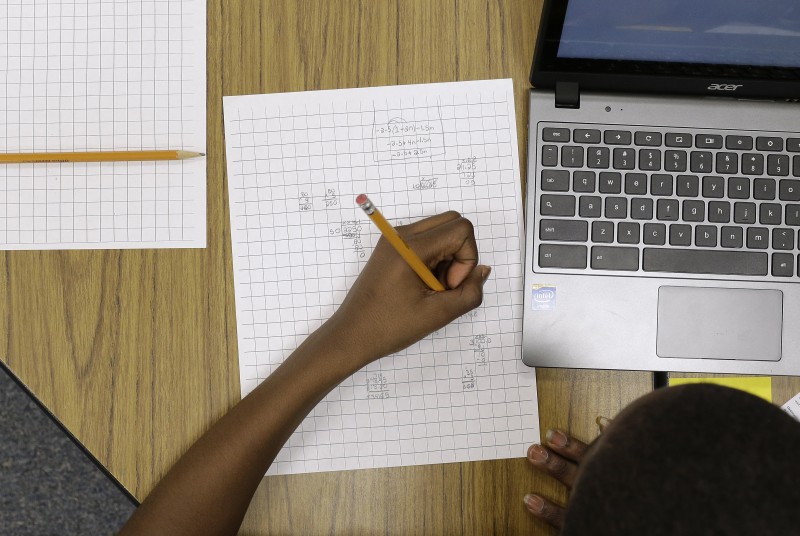
In this Feb. 12, 2015 photo, Yamarko Brown, age 12, works on math problems as part of a trial run of a new state assessment test at Annapolis Middle School in Annapolis, Md. The new test, which is scheduled to go into use March 2, 2015, is linked to the Common Core standards, which Maryland adopted in 2010 under the federal No Child Left Behind law, and serves as criteria for students in math and reading.
In this Feb. 12, 2015 photo, Yamarko Brown, age 12, works on math problems as part of a trial run of a new state assessment test at Annapolis Middle School in Annapolis, Md. The new test, which is scheduled to go into use March 2, 2015, is linked to the Common Core standards, which Maryland adopted in 2010 under the federal No Child Left Behind law, and serves as criteria for students in math and reading. AP Photo/Patrick Semansky


It ’s time to debunk the myths about who is good in math, and Common Core state standards move us toward this worthy goal. Mathematics and technology leaders support the standards because they are rooted in the new brain and learning sciences.

All children are different in their thinking, strength and interests. Mathematics classes of the past decade have valued one type of math learner, one who can memorize well and calculate fast.
Yet data from the 13 million students who took PISA tests showed that the lowest achieving students worldwide were those who used a memorization strategy – those who thought of math as a set of methods to remember and who approached math by trying to memorize steps. The highest achieving students were those who thought of math as a set of connected, big ideas.
The U.S. has more memorizers than most other countries in the world. Perhaps not surprisingly as math teachers, driven by narrow state standards and tests, have valued those students over all others, communicating to many other students along the way – often girls – that they do not belong in math class.
The fact that we have valued one type of learner and given others the idea they cannot do math is part of the reason for the widespread math failure and dislike in the U.S.
Brain science tells us that the students who are better memorizers do not have more math “ability” or potential but we continue to value the faster memorizers over those who think slowly, deeply and creatively – the students we need for our scientific and technological future. The past decade has produced a generation of students who are procedurally competent but cannot think their way out of a box. This is a problem.


Mathematics is a broad and multidimensional subject. Real mathematics is about inquiry, communication, connections, and visual ideas. We don’t need students to calculate quickly in math. We need students who can ask good questions, map out pathways, reason about complex solutions, set up models and communicate in different forms. All of these ways of working are encouraged by the Common Core.
Technology leaders are publically arguing that calculation is not math, and that math is a much broader subject. Conrad Wolfram, one of the leaders of one of the world’s most important mathematics companies, Wolfram-Alpha, urges schools to stop emphasizing calculating and focus instead on problem solving, modeling, thinking, and reasoning as these are the mathematical abilities that students need in the workplace and their high tech lives. This broad, multidimensional mathematics is the math that engages many more learners and puts them on a pathway to life long success.
Part of the problem in the U.S. is the desperation of many parents to advance their children in math, pushing them to higher levels of math faster and sooner, somehow believing that a resume packed with advanced math courses will guarantee their future. Bill Jacob, a mathematics professor at the University of California, Santa Barbara, speaks openly about the dangers of students being pushed to higher levels of mathematics too soon. “I know it is hard to persuade parents that their students shouldn’t race to get calculus, but I really wish they wouldn’t. Too much content and depth is left out when they do.” said Jacob, who is not alone in saying that he would rather have students in his university mathematics courses that have breadth in their mathematical experiences than any additional Advanced Placement courses. Experts in England are giving the same advice to parents of high achieving students. Geoff Smith, chairman of the British and International Math Olympiads warns that accelerating children through the system is a “disaster” and a “mistake”. He, like me, recommends that high achieving students explore the mathematics they are learning in depth, instead of rushing forward.
Mathematics is not a subject that requires fast thinking. Award winning mathematicians talk about their slow, deep thinking in math. Fields Medal winning mathematician Laurent Schwartz wrote in his autobiography that he felt stupid in school because he was one of the slowest thinkers in math. Eventually he realized that speed was not important – “What is important is to deeply understand things and their relations to each other.  This is where intelligence lies. The fact of being quick or slow isn’t really relevant.”
Some school districts, such as San Francisco Unified, are trying to slow down the math experience, requiring that advanced students go deeper rather than faster. Students still reach calculus but the pathway to calculus consists of deep understanding rather than procedures and memorization. This is an important move. There is no harm in students being introduced to higher-level mathematics earlier, as long as the mathematics is enjoyable and ideas can be explored deeply. Third graders can be fascinated by the notion of infinity, or the fourth dimension, but they do not need a race through procedural presentations of mathematics.
New brain science tells us that no one is born with a math gift or a math brain and that all students can achieve in math with the right teaching and messages. The classrooms that produce high achieving students are those in which students work on deep, rich mathematics through tasks that they can take to any level they want. No one is told what level they can reach and no one is held back by narrow questions that limit students’ mathematical development and creativity.
Many people across the U.S. have gross misconceptions about mathematics learning, thinking that mathematics is a narrow subject of memorization and speed and that people who do not calculate fast or memorize well are not ‘math people’. We need to change the conversations about mathematics, communicating to all children that they can learn. We also need to change the way math is taught, valuing the different ways of thinking that are so important to the subject. Mathematics, itself, needs this and although change is hard, it should be embraced.
We need to broaden mathematics and open the doors of mathematics to all students. When we do this we will see many more creative, energized young people equipped to think quantitatively about our ever-changing world. We all need this.
Jo Boaler is a professor of mathematics education at Stanford University, co-founder of www.youcubed.org, and author of What’s Math Got To Do With It: How Teachers and Parents can Transform Mathematics Learning and Inspire Success. (Penguin, 2015)
This story was produced by The Hechinger Report, a nonprofit, independent news organization focused on inequality and innovation in education. Read more about Common Core.

There's an Unexpected Downside to More Kids Getting Free Meals at School - Yahoo News

There's an Unexpected Downside to More Kids Getting Free Meals at School - Yahoo News:

There's an Unexpected Downside to More Kids Getting Free Meals at School


 At a time when more impoverished kids than ever are attending public schools, the idea seemed like a no-brainer: Eliminate the stigma those kids might feel when receiving government-subsidized breakfasts and lunches by offering free meals to all students, including their better-off peers.  

But like other well-intentioned policy shifts, “free meals for all” programs some districts have adopted are having unintended consequences that could hurt the very children the idea was designed to help.  
The blurred lines between economic classes in the cafeteria have made it harder to determine the number of students who receive free or reduced-priced meals—the primary statistic used to determine the level of poverty in a school or a district. Without that number, federal officials allocating billions of dollars in Title I funds, as well as education policy analysts and philanthropic foundations that want to help needy kids learn, won’t have accurate information to determine if a school needs the help.  
Jill Barshay, a columnist for education analysis website The Hechinger Report, wrote that “more than 2,000 school districts and more than 13,000 schools are serving more than 6.4 million students participating in the free-lunch-for-all program,” roughly 13 percent of the entire U.S. public school population. Yet because of the new guidelines, she wrote, “We don’t know how many of them are actually poor, and how many non-poor kids are now getting swept in with them.” 
The lack of an accurate gauge of a school’s poverty rate, she added, could skew federal Title I funding, typically used to provide classroom services and support for poor or struggling students. The U.S. Department of Education uses a formula based on the number of needy students to determine a school’s or a district’s eligibility; already, Barshay wrote, a number of school districts are scrambling to come up with a more accurate method for head counts, and the state of New York opted out of free-lunch-for-all programs to avoid the problem altogether.
 “Free and reduced-price lunch figures are an imprecise measure of poverty, but at least they capture children who are being raised in families that earn no more than 85 percent above the federal poverty line,” she wrote.  
Yet education analysts who study the link between poverty and classroom achievement say the free-lunch count should have been a guide at best, and impoverished students are usually undercounted.  
“When we work with schools, districts, states, and others, we’re always real careful” when calculating the poverty rate, says Kathleen Budge, an education professor at Boise State University and an author at the Association for Supervision and Curriculum Development, a Washington, D.C.–based education policy center.
“The number of kids who qualify [for free meals]—those are floor numbers,” says Budge, a veteran teacher and former principal who, with William Parrett, coauthored the book Turning High-Poverty Schools Into High-Performing Schools. 
Even before free-for-all meals, she says, some low-income parents refused to apply for help because of a no-handouts cultural philosophy—or, in the case of undocumented immigrants, because they didn’t want to risk getting caught. 
That’s despite the fact that Title I resources “come with the expectation they will be spent” to help the kids who most need it, says Parrett, director of Boise State’s Center for School Improvement & Policy Studies and a specialist in teaching at-risk and underserved children. “When carefully spent, [those dollars] can make a difference for kids,” adds Parrett. 
If the numbers are underreported, however, it could mean less money for programs that can address chronic classroom issues needy kids face: tutoring to close achievement gaps in reading and math, anti-truancy programs, speech or language therapists for special-needs students, college-readiness classes, and STEM extracurricular activities such as an after-school robot team. In some states, data gleaned from students enrolled in free or reduced meals programs help districts determine school boundaries; in others, it can have an impact on state and federal funding formulas. 
And most experts agree money matters: the higher the per-pupil funding, the more likely a student or school can meet or exceed academic achievement goals. 
Ultimately, Budge says, the good intention of offering free meals to schoolchildren is a symptom of a larger problem: There are more poor kids than ever before in American classrooms, which means they’re starting further behind and have more challenges than their wealthier peers. Fold in the general expectation that all kids can and will achieve if given a level playing field, and the problem becomes even more complex. 
“We’re a nation that uses the word—and you’ll probably find that word in the mission statements of [many] schools—we talk about ‘all kids,’ ” she says. “We have an expectation in this country that’s pretty resolute, that when we talk about kids we’re talking about all kids. But all kids are not equal in terms of their lives.” 
To level the playing field and give poor kids a good education, “we’ve gone from access to opportunity to outcomes," Budge adds. "I think that we’ve raised the ante on public schools; I’m not sure we’ve raised the support to achieve what we’re really asking them.”
Education leaders may talk a good game but, Budge says, “I don’t know if we’ll ever reach consensus on playing a good game.”There's an Unexpected Downside to More Kids Getting Free Meals at School - Yahoo News:

State board awards disputed test contract to ETS | EdSource

State board awards disputed test contract to ETS | EdSource:

State board awards disputed test contract to ETS


 The State Board of Education on Wednesday awarded the Educational Testing Service a three-year, $240 million contract to administer the state’s standardized tests, despite a competitor’s call for reopening a bidding process that it called flawed and “arbitrary.”

ETS has run the state’s testing system for 13 years and was the choice of the staff of the state Department of Education and two panels of reviewers. But Pearson School, the lowest of the three bidders with a $206 million bid, protested after the state board in March gave ETS tentative approval on the condition that ETS revise its bid to replicate aspects of Pearson’s plan involving teacher training. Board members called for the involvement, “to the greatest extent possible,” of teachers in scoring the next generation of tests, at no additional cost.
A series of recent breakdowns and technical snafus with online tests in other states (see herehere and here) underscore the importance of contracting with a reliable, experienced testing company. Along with providing the software to deliver the state’s tests, the contractor responds to problems from more than a thousand districts and charter schools, oversees test scoring and delivers the results to districts and schools.
The state was not required to take the lowest bid under the form of bidding that was used, and it had authority to negotiate contract changes with a preferred bidder. That’s what a team of negotiators did over three days last month, said Keric Ashley, state deputy superintendent of the District, School, and Innovation division of the Department of Education. The result was a number of changes that improved the contract, including better test security, a quicker reporting time of test results to districts, and parent guides in five languages, he told the state board. Based on Pearson’s approach, there also will be more extensive training and better hourly rates for scorers who are California teachers, he said.
But copying a significant part of another bidder’s proposal is “unprecedented in public procurements at virtually any level – federal or state,” wrote Douglas Kubach, president of Pearson School, a Minnesota-based division of Pearson, the world’s largest education publishing and consulting company, in a March 30 letter to the state board. Kubach called on the state board to begin the bidding again. Reviewers gave ETS a higher score, yet the state board instructed negotiators to adopt Pearson’s model – “unavoidably an admission (by the state board) that its scoring was significantly flawed,” he wrote.
ETS will continue to handle the administration and scoring of the new online tests, including the Smarter Balanced English language arts and math tests in the Common Core State Standards, which debuted this spring, and the yet-to-be developed Next Generation Science Standards. The tests feature more sophisticated performance tasks, requiring students to write essays and show their work. Individual scorers will grade these portions of the test.
Pearson’s proposal promised professional development for California teachers in these tasks through county offices of education. It said it would hire WestEd, the San Francisco-based nonprofit research and development organization that is developing Common Core and new science curricula, to lead the trainings. The proposal said it would increase the number of California teachers as test scorers by paying them $17 to $19 per hour.
Patricia Rucker, who works as a lobbyist for the California Teachers Association, called $20 per hour “insufficient” and predicted that fewer than half of the scorers will end up being teachers.
For this year’s initial Smarter Balanced tests, ETS is paying only $13 per hour to scorers. The state reports that only 10 percent of the scorers will be California educators, and not all of those will be certificated teachers.
In its revised bid, ETS said it will hold summer institutes and weekend trainings for teachers and would pay California certificated teachers $20 per hour to be trained in and score the tests. Ashley acknowledged that’s less than teachers earn per hour, but the primary benefit, he said, would be the knowledge that teachers would gain in both the end-of-the-year tests and the interim assessments that teachers would give during the year.
However, board member Patricia Rucker, who works as a lobbyist for the California Teachers Association, called $20 per hour “insufficient” and predicted that fewer than half of the scorers will end up being teachers. Teachers “carry the greatest burden to see that students are State board awards disputed test contract to ETS | EdSource:

CTU files labor complaint against school board - Chicago Tribune

CTU files labor complaint against school board - Chicago Tribune:

Chicago Teachers Union files labor complaint against school board


The Chicago Teachers Union has filed an unfair labor practice complaint accusing the city's school board of bad-faith bargaining and refusing to engage in mediation toward a new contract.

Union officials said little progress has been made over eight formal bargaining sessions and numerous informal meetings since November. The complaint filed Wednesday with the Illinois Educational Labor Relations Board follows the union's rejection earlier this week of the board's proposal that teachers take on a greater share of pension payments.

Jesse Ruiz, the district's interim chief, said CPS hadn't reviewed the complaint but looked forward to continuing contract talks.

As she did in the months before the 2012 teachers strike, CTU President Karen Lewis sought to make Mayor Rahm Emanuel the focus of the union's displeasure with talks to replace a contract that expires June 30. The union again accused the city of using the talks to get back at the CTU for its support of Jesus "Chuy" Garcia in the mayoral election.

"We feel this is reactionary and retaliatory," Lewis said at a news conference Wednesday. "I guess the fuzzy sweater's gone," she said, referring to Emanuel's wearing a sweater in campaign commercials to indicate a softer personality.

The district, which says it is wrestling with a $1.1 billion deficit weighted with pension payments, wants to save millions of dollars by having teachers pay more into their pension fund. The district wants to end a long-standing agreement that limits teacher paycheck deductions for pensions, the union said.

That CTU said the result would be a 7 percent cut in take-home pay for members. The union also says health care premiums could take another 3 percent under a district proposal.

"One of the reasons we're upset about this is despite the difficulty of the last negotiations, they never went so far as to suggest a 7 percent cut in teacher compensation," CTU Vice President Jesse Sharkey said. "This is a new low, and frankly one that we're fairly convinced that they're serious about."

CTU members covered by the contract are required to forward 9 percent of their pay to pensions but contribute 2 percent of their salaries. The district agreed in 1981 to indefinitely pick up the bulk of the union workers' tab — in addition to the pension contributions it already must pay — in exchange for lower pay raises.

According to district records, the 9 percent employee contribution totaled nearly $164 million in the 2014 fiscal year. CPS, according to its records, picked up about $127 million of that amount.

That same year, CPS paid $613 million for its own contributions to the pension fund.

The union said that under the district's proposal, a teacher who earns a base salary of roughly $70,000 would have to pay an additional $4,900 each year toward the pension fund. Under the current system, the teacher would have about $1,400 deducted annually for pension costs.

CPS officials say the district faces an upcoming pension payment totaling roughly $700 million.CTU files labor complaint against school board - Chicago Tribune:

Research and the pursuit of equity under ESEA | Brookings Institution

Research and the pursuit of equity under ESEA | Brookings Institution:

Research and the pursuit of equity under ESEA


Current drafts of the reauthorized Elementary and Secondary Education Act (ESEA) fall short of a commitment to use research to improve education. The bills—the “Student Success Act” in the House and the “Every Child Achieves Act” in the Senate—no doubt represent compromises and tradeoffs as any major legislation would. But who is arguing for less research and innovation in education?
Much of what is debated about No Child Left Behind is its accountability structure—annual tests, “annual yearly progress,” and the goal of moving every student to proficiency by 2014. But another important theme in NCLB was using “scientifically-based research.” Its steady drumbeat of “use research, use evidence, use scientific methods,” represented an embrace of education research and especially the practice of using causal methods to study program effectiveness. NCLB did not go as far as requiring research evidence as a basis for program funding, and in 2002 not much evidence would have met that standard. Related legislationthat year created the Institute of Education Sciences, which followed through on the vision of building and using evidence to improve education.
Evidence from studies showed that some of what had been thought did not prove to be true. For example, after-school programs did not improve outcomes; using education software to support teaching did not raise test scores; teacher professional development did not raise test scores; voucher programs did not raise test scores; a range of programs to promote social and emotional learning had little effect on outcomes. It seems like a list of negatives, but evidence is useful one way or the other. And, as Tom Kane has argued, more than 80 percent of clinical trials fail to show effectiveness. Why would education be different? And some things that were not known became evident: for example, parents and students attending charter schools were more satisfied with the schools but the schools themselvesranged widely in their effectiveness; math textbooks can affect math skills differently, and NCLB itself raised test scores.
Research is included in the current ESEA drafts, but to no greater extent than it was for NCLB, and in some ways, it’s to a lesser extent. The House bill substitutes a new term, “evidence based,” for NCLB’s “scientifically based.” The substitution seems innocuous, but could prove problematic because the bill does not further define “evidence.” (NCLB defined “scientifically based” in Title IX.) If a state conducts a survey and finds that many students participating in a program think it is effective, is that evidence the program is effective? Under some definitions, yes. Under others, not so much. Opinions about effects are not the same as measures of effects.
Adding a definition of evidence will clarify what meets it and what does not. There is language in the House bill that says programs that receive funding under Title II to prepare new teachers need to “reflect evidence-based research, or in the absence of a strong research base, reflect effective strategies in the field, that provide evidence that the program or activity will improve student academic achievement.” So, what are “effective strategies in the field?” How is it determined that they improve academic achievement? Would it not be “evidence-based research” that shows the practices led to improvement?
The House and Senate bills also call for evaluations. The Senate bill calls for a national evaluation of its new literacy program, an evaluation of a program that serves students in foster care, and a demonstration program of innovative assessment systems that states can pilot. That demonstration is likely to be evaluated so it is mentioned here. The House bill calls for an evaluation of the charter school program and the magnet schools program, neither of which is new. It would be the third evaluation of magnet schools.
Of course, ESEA does not have to be directive about what should be studied. It can set aside money that can be used for studies, and allow their topics and focus to emerge elsewhere. Both bills include the key clause that funds research and evaluation. It states that the Secretary of Education can set aside to use for evaluation up to 0.5 percent of funds for all except the first title. Using 2014 appropriations, the set-aside amount is roughly $35 million. IES also receives funding to carry out the National Assessment of Education Progress, to support state development of their data bases, and for other purposes such as studies of special education. The $33 million is to support studies that relate to ESEA.
This is not a lot of money for research, for three reasons. One is that research is a uniquely federal responsibility, not just for education but generally. Fiscal federalism assigns the federal government responsibility for research because states and localities have incentives to underinvest in research. Its costs accrue to them and its benefits accrue to everybody. When the federal government invests in research, costs and benefits align.
A second perspective for viewing the education-research investment as paltry is to compare it with the federal investment in the National Institutes of Health. In 2014, that investment was about $30 billion. It’s hard to argue that there is “too much” investment in health research. It’s vital to the nation’s population. But it’s also hard to argue that it is hundreds of times more important to invest in health research than education research for America’s low-income students. Education is vital to the nation’s population too. There is much more federal spending on health than on education, through the Medicare and Medicaid programs, particularly, but that is not a basis for why federal spending for health research is so much larger than education research. The federal role in supporting research is primary regardless of which level of government spends on services.
A third perspective on research funding also points to enlarging it. On its own, the K-12 public education system is static. It wants to do the same thing. Taxes flow in, students and teachers come to school in the morning, there are classes and graduation ceremonies and sports events, and it is repeated next year. The system wants to be in equilibrium, and when it is pushed out of equilibrium, it wants to get back to it.
For example, in the past decade, how states and districts evaluate the performance of their teachers has seen rapid changes. Many teachers are now being evaluated partly based on how their students score on tests. But has anything really changed? The new systems replaced previous systems believed to rate teachers too positively. Nearly all teachers were “effective.” After putting new systems in place, Rhode Island reported that 98 percent of its teachers were effective; Florida, 97 percent, New York, 96 percent. The system returned to where it was.
The point is not about teacher evaluation per se. It is that research has the potential to put energy into the system. What is thought to be best practice for teaching reading, or math, or any subject, might change if research shows that new methods improve on current methods. Or a program of social and emotional development might prove effective in reducing student behavior problems. Or an approach to teaching English to non-English speakers might prove effective in promoting their language acquisition and academic achievement. The list is nearly endless.
Of course, research needs to be conducted and disseminated, and its timeframes can seem slow to policymakers. But here is a margin for bringing innovation to a system that does not have much incentive to innovate. It seems at least as useful to push on this margin as it is to study how education is delivered in Finland and Singapore, which happened after those two countries had the top scores on the Programme for International Student Assessment. Their systems might have some attractive features, but generalizing them to a vast country with a heterogeneous population and a highly decentralized education system is problematic. (Tom Loveless has warned of the perils of “edu-tourism.”) 
America is entering a new phase in which the majority of its public school students are from low-income households. That’s about 25 million students. Suppose that for each of these students, ESEA set aside $10 a year—a dollar for each month they are in school—for federal research to improve education. That’s $250 million. It sounds like a lot of money, but the scale of the K-12 enterprise is vast and seemingly large numbers can be misleading. Comparing it to the more than $600 billion we are spending each year for K-12 education, it’s four-tenths of a percent. 
The draft ESEA legislation will be modified as it moves to the floor of the respective chambers and then to conference. Increasing funds for research could be done two ways. One would be simply to have the set-aside apply to all spending under the bill. It then would include Title I, which is larger than all the other titles combined. For the president’s 2015 budget request, the change would increase the amount set aside for research to $90 million. Or the set aside itself could be increased, to, say, three percent. It’s not getting to the one-dollar-a-month set-aside, but it’s something.
In the 13 years since NCLB was passed, we’ve seen more clearly that research is essential to improve education, just as clinical trials are essential to improve health care. A commitment to equity lies at the heart of ESEA, and spending $10 a year on research for each of America’s low-income students will help meet that commitment.Research and the pursuit of equity under ESEA | Brookings Institution:

Nanu Nanu: An Alien Evaluation | DCGEducator: Doing The Right Thing

Nanu Nanu: An Alien Evaluation | DCGEducator: Doing The Right Thing:

Nanu Nanu: An Alien Evaluation


article-2545353-006E028100000258-573_306x546


By Mork the Orkan


 I bet you didn’t think I was still around. I guess I “egged” you all on to believe I left Earth in 1982, but I have been here all these many years masquerading as a series of your loser presidential hopefuls. I thought I was rather funny as Michael Dukakis. The tank looked so much like a rove ranger on my native planet, Ork.

My apologies for being elected president in 2000. Who knew Chad could be so important. I thought it was a nation in Africa.
I have to admit I still actually read print newspapers like the New York Times. It makes me a bit anachronistic, but I like having multiple ways of accessing information. I was trained to learn foreign languages to save my life, so I can say I am multi-lingual, and now I can also say I am “multi-medial”.
The past few days I read three articles that taken together add to my frustration understanding of some issues I have noticed you attempting to deal with the past few years. Unlike many of you, I try to read pieces from all sides of the ideology spectrum so I have a wider range of ideas and facts to form my own opinions. I know to some humans (what I would label myself here, I suppose, if one must be labeled) that might be anathema, but it is what I was taught in Orkan schools.
Richard Atkinson and Saul Geyser’s The Big Problem With the New SAT, David Brooks’ What Is Your Purpose?, and Eduardo Porter’s What Debate On Inequality Is Missing and my observations of your society for the past 37 Earth years have led me to some rather dramatic conclusions.
Says Porter, “Over the last four decades the debate in Washington about poverty and inequality has been bogged down in a somewhat pointless, often surreal debate about the size of government and the amount spent on behalf of the poor.”
Says Brooks, “Public debate is now under moralized and over politicized. We have many shows (I guess TV?) where people argue about fiscal policy but not so many on how to find a vocation or how to measure the worth of your life. Intellectual prestige has drifted away from theologians, poets and philosophers and toward neuroscientists, economists, evolutionary biologists and big data analysts. These scholars have a lot of knowledge to bring, but they’re not in the business of offering wisdom on the ultimate questions.”
Practical wisdom should always rule knowledge, not the other way around.
Finally, says Atkinson and Geiser, “Norm-referenced” exams [are] designed primarily to rank students rather than measure what they actually know. Such exams compare students to other test takers, rather than measure their performance against a fixed standard. They are designed to produce a “bell curve” distribution among examinees, with most scoring in the middle and with sharply descending numbers at the top and bottom.”
“Shazbot.” Is that a test or a roller coaster?
“Test designers accomplish this, among other ways, by using plausible-sounding “distractors” to make multiple-choice items more difficult, requiring students to respond to a large number of items in a short space of time, and by dropping questions that too many students can answer correctly.”
That is “Namnulicy”. (Idiocy.)
Remember, I was sent here by the BIG GIANT HEAD to evaluate you. What did Nanu Nanu: An Alien Evaluation | DCGEducator: Doing The Right Thing: