Latest News and Comment from Education

Wednesday, February 18, 2015

Suspended: Inequality in School Discipline

Suspended: Inequality in School Discipline:


Suspended: Inequality in School Discipline


Part I of a News10 investigation that examines who is being discplined at school. Part II on Tuesday evening will explore the long-term consequences of these policies. News10/KXTV


Sacramento teenager Dwayne Powe Jr. got a suspension in eighth grade. He didn't get into a fight. He wasn't caught with drugs. He committed no crime.
"I actually was asking for a pencil," Powe said.
He was technically suspended for "willful defiance."
Powe said his class began an exercise and he asked to borrow a pencil from another student. That's when his teacher told Powe he was being disruptive and made him leave class. Powe tried explaining he had only asked for a pencil, but that only dug his hole deeper, he said.
"All I was doing was asking for a pencil, so I got suspended for two days for willful defiance," Powe explained. "Because I was just trying to ask for a pencil."
Nearly 200,000 California students who were suspended for willful defiance last year can relate to Powe's story.
What constitutes as willful defiance is somewhat vague, but it generally allows teachers to remove students from the classroom if their behavior is thought to be disruptive or defiant. It's the most common reason California students were suspended -- and students of color were overwhelmingly targeted.
But, there was a growing consensus that keeping kids out of the classroom for non-violent behavioral issues had done more harm than good, and students of color were paying the heaviest cost for this policy. The growing consensus includes state and local education officials.
"The research speaks very, very clearly that students of color don't engage in more egregious violations than any other student," California Department of Education Coordinated Student Support Division Director Gordon Jackson said. "So, there's something else at play -- and it could very well be those differences that I think are often represented in the fact that many of our teachers don't look like a lot of our students."
The California Department of Education (CDE) began collecting all sorts of data in 2011, including willful defiance suspensions. Jackson said the data confirmed what many suspected all along.
"Collecting the data just confirmed that there is a certain level of disproportionality, particularly in those areas that are subjective –- willful defiance, disturbance -– that there's a high preponderance of African-American and Latino or students of color that are suspended," Jackson explained.
However, policies built around a model called "restorative justice" or "restorative practices" looked promising according to early results, Jackson said. Rather than focus on punishment alone, restorative justice is about building student-teacher relationships and addressing at-risk behavior early in a student's development. It's also about realizing that learning doesn't happen in a vacuum, and issues such as health, family life and self-esteem also effect classroom success. Jackson said he learned these lessons first-hand as a teacher.
"I could not say at the end of the day that I was so overburdened because I tried to build a relationship with these students," Jackson said. "I think I would be more burdened if I was dealing with students who just wanted to throw things at me and didn't want to follow any direction, and I'm writing referrals and that's my day."
Although there were nearly 200,000 willful defiance suspensions last year in California, that's actually a sign of progress. Just two years ago that number was close to 350,000.
The CDE wanted local school districts to continue moving away from suspensions and towards restorative practices, but they can't force change. California is a local control state; which meant policy is implemented at the district level. State education officials can't impose their will, they can only nudge, prod and offer guidance.
"There are places in California, which I shall not name as you suggest, where I don't know if they're waiting for a written invitation, but they have not yet decided this is a hill that we have to climb," Jackson said.
What hasn't changed, however, is the disparity in the system, particularly for African-American students. They've accounted for roughly 20 percent of willful defiance suspensions each year since 2011, despite accounting for about 6 percent of student enrollment. White students also account for 20 percent of willful defiance suspensions, but they make up 25 percent of the student population. Those numbers were often even more skewed at the district level.

Willful Defiance Suspensions per School District

Public information from the California Department of Education shows the number of students that were suspended for willful defiance in the 2013-2014 school year. Click on each marker to see the number of suspensions and the school district's population.
Source: California Department of Education
Credit: Michael Bott and Maneeza Iqbal
"Some of my white friends, they think it's funny to a sense," Powe said. "But they don't realize what it's like just being automatically accused without even doing anything."
Though it may be tough for white students to put themselves in those shoes for a day, organizations like the Black Parallel School Board know the uphill battle students of color can face in school and have been working to end zero-tolerance disciplinary policies for years. They describe their primary mission as supporting the educational growth and achievement of black students.
"What's taking place in schools is basically an expression or reflection of what takes place in society," said Carl Pinkston, a community activist and member of the Black Parallel School Board. "And basically teachers, administrators and the entire educational system is reflective of that."
John Hunter, a sophomore at Kennedy High School, said he got caught in that system. Looking at Hunter, one may think he'd struggle to graze a basketball rim with his longest finger, let alone dunk the ball. But that's exactly what Hunter said landed him in a room for several periods with nothing to do while serving time for an in-school suspension.
"Oh yeah, I got hops," Hunter said.
Hunter said his freshman PE class was playing basketball and he dunked the ball, thinking nothing of it. But what came next surprised him.
"I mean, it's basketball, why would you not dunk the ball?" Hunter said. "So I dunked the ball and she just, she just wrote me up."
Hunter said he couldn't even do homework, just sit on a stool and stare at the wall.
The Sacramento Unified School District had low suspension numbers for a district of its size, but district administrators said they're still trying to reduce those numbers.
"I think sometimes suspensions become a catch-all because a teacher or site administrator just doesn't know what else to do," Sacramento City Unified School District Chief Communications Officer Gabe Ross said. "So, I think the work that we're doing in our schools and what we're continuing to work on is how do we provide those resources and tools so that there are other options so that we can keep kids in school. We know the surest way to ensure a kid doesn't get a good education is if they're not in class."
Last year, students within the district were suspended more than 800 times for willful defiance. African-American students accounted for more than half of those suspensions, despite making up only 17 percent of the student body. Ross acknowledges there's more work ahead.
"While the disproportionality still exists with boys of color, you see that our suspension counts in total are way down from a year ago," Ross said. "That's a great start. It doesn't address all our issues, but it's a step in the right direction."
Disproportionate suspension numbers were the norm, not the exception when it comes to local school districts. Data from the CDE showed district after district with diverse student populations target students of color far more than white students.
Lodi Unified School District had 17,000 fewer students than Sacramento City Unified, yet they handed out more than 2,300 willful defiance suspensions last year. The district had more than three times as many white students as black students, yet black students were suspended 564 times last year, compared to only 425 suspensions for white students.
Natomas Unified School District was another diverse school district, and the disparity was even more apparent. There were about the same number of white and black students, but only one of those groups seemed to get suspended for willful defiance. Last year, black students were suspended 119 times, but only nine white students were suspended.
"There is a disparity that exists," Natomas School District Director of Communications Jim Sanders said. "I don't think the data gives a simple answer to that. What we can tell you is that our system of discipline is colorblind. We can also tell you that our core belief is that where disparity exists it can and must be eliminated."
Sanders said he's optimistic those numbers will drop quickly as the district makes an effort to move towards restorative justice and away from suspensions. Many of the district's policies that focus on at-risk kids were in their infancy, but the early results looked good. If the first semester numbers hold true, Sanders said the district will see a 50 percent decrease in African-American suspensions this year.

Suspensions, Expulsions per School District by Race

Public information the California Department of Education shows the total Suspended: Inequality in School Discipline:


New Mexico lawmakers confirm Jeb Bush protƩgƩ as education secretary - The Washington Post

New Mexico lawmakers confirm Jeb Bush protƩgƩ as education secretary - The Washington Post:


New Mexico lawmakers confirm Jeb Bush protƩgƩ as education secretary


 February 17 at 1:13 PM  
The New Mexico Senate voted Monday to confirm Jeb Bush protĆ©gĆ© Hanna Skandera as the state’s secretary of public education, handing a defeat to Democrats and teacher unions in what had become a four-year political fight.
Monday’s vote means that Skandera can continue doing the job she has been doing in an acting capacity since 2011, when Gov. Susana Martinez (R) appointed her to the helm of the state’s Public Education Department. Skandera’s confirmation had stalled repeatedly as Democratic lawmakers challenged her qualifications and criticized the sweeping Bush-style changes she brought to the state’s K-12 schools.
Five Democrats crossed party lines to join all of the Senate’s Republicans in voting to confirm Skandera 22-19.
“I’m humbled and excited all at the same time,” Skandera said Monday, according to the Albuquerque Journal, which reported that Skandera vowed to “stay the course” on her policy agenda.
Skandera, who worked at the Florida department of education when Bush was governor of that state, has stirred controversy in New Mexico as she has worked to import Bush’s “Florida formula” for education: Installing an A-through-F school grading system, expanding charter schools and virtual schools and pushing for a requirement that third-graders pass a reading test before they can be promoted to fourth grade.
Skandera also introduced a new teacher evaluation system that is tightly linked to student test scores and that has drawn criticism from teachers and unions for being unfair and riddled with problems. The American Federation of Teachers filed a lawsuit on Friday to try to stop the evaluations.
Senate Democrats have long argued that Skandera is not legally fit for the state’s top education job, citing a provision in the New Mexico constitution that requires the secretary of education to be a “qualified, experienced educator.” Skandera has never been a teacher, though she has worked as an education policy advisor for years, including for the U.S. Department of Education during the George W. Bush administration and for former California Gov. Arnold Schwarzenegger.
“Ms. Skandera’s tenure has been characterized by divisive partisanship and a failure to listen with respect to teachers, parents and school districts,” Senate Majority Leader Michael S. Sanchez (D-Bernalillo & Valencia) said in a statement. “It’s a shame Governor Martinez refuses to give New Mexico a leader of public education who understands the needs of the classroom.”
Senate Republicans and state business leaders who supported Skandera said that New Mexico needs her aggressive approach to improve struggling public schools. New Mexico has long been one of the lowest-ranked states on many measures of academic performance, including graduation rates and national reading and math tests.

Philadelphia doesn't need more charter schools

Philadelphia doesn't need more charter schools:


Philadelphia doesn't need more charter schools


By Amy Brown and Anissa Weinraub

The problem of educational inequity and school failure is much bigger than teachers and schools: It has to do with access to health care, healthy food, steady employment and a reliable income, early-childhood education, and clean water and air, among other factors. Given this amalgamation of social issues, increasing the number of charter schools will not solve any of Philadelphia's problems.

In a just world, public schools would provide a free, excellent, equitable, and holistic educational environment for all children. In Philadelphia, it is more important that we use our resources to achieve this goal, rather than develop more charters to compete with public schools. Therefore, the School Reform Commission should not approve more charter schools at this time.

As former SRC member Joseph Dworetzky has noted, the district loses $5,500 per student for each transfer to a charter from public school, and $10,000 per student for each transfer from a parochial or independent school. At a time when the district is already operating with a severe budget deficit, it cannot risk losing more money or resources.

Data about the benefits of attending a charter vs. a traditional public school are inconclusive, as are data about charter transfer or dropout rates, according to a recent report by Public Citizens for Children and Youth (PCCY). Also, as to the organizations that have applied to open charters, PCCY reports that these groups' current charters do not reflect the demographics of traditional public schools - there are fewer minority, low-income, and English-language learners on their rosters.

Nationally, a recent Stanford study reported that in reading, 56 percent of students in charter schools showed no significant difference in academic growth between 2010 and 2011. And while 25 percent did significantly better, 19 percent did significantly worse. In math, 40 percent showed no difference compared with the scores of their counterparts in traditional public schools. Though 29 percent did significantly better, 31 percent did significantly worse.

Philadelphia is our nation's poorest big city, with at least 80 percent of our students classified as low-income. Given the


Students take over Newark Public Schools HQ calling for superintendent’s resignation #OccupyNPS

Students take over Newark Public Schools HQ calling for superintendent’s resignation | New York's PIX11 / WPIX-TV:

Students take over Newark Public Schools HQ calling for superintendent’s resignation


NEWARK (PIX11)– Dozens of students have occupied offices of Newark Public Schools Headquarters since Tuesday night, demanding the resignation of Superintendent Cami Anderson.
The sit-in started around 8:30 p.m. during a Newark Public Schools advisory board business meeting when the students went to the 8th floor where Cami Anderson’s and other administrators’ offices are.
It has been a long heated battle between students and administrators.
The young protesters say “One Newark” that was implemented last September does not work.
It includes relocating school communities, changing school leadership, expanding charter schools, and a controversial plan to have a lottery system to get placed in desired schools.
It’s not the first time the student has organized a sit-in.
Last year, Newark students forced a Newark Schools meeting to finish early and that last 17 hours.
Anderson was appointed by the state in 2011. Newark School District has been controlled by the state since 1995, but this protest is timed days before the deadline when the state has to decide if it will renew Anderson’s contrct in the state-operated district.
A spokeswoman for Newark Public Schools says the sit-in is “not the appropriate forum to engage in productive conversation.”
“Over the past several months, we’ve worked to engaged this group of students  and listen to their concerns,” Brittany Parmley, executive director of communications said. “Despite our best efforts to work together, they have repeatedly ignored district requests to meet and engage in a constructive dialogue.”
There are city leaders who have praised the superintendent saying that she has done a lot to get the district back on track, but it is also worth nothing that the teachers union also opposes the One Newark plan, saying it is untested and hurts neighborhood schools.Students take over Newark Public Schools HQ calling for superintendent’s resignation | New York's PIX11 / WPIX-TV:


Tuesday, February 17, 2015

Bipartisan Bill to Repeal Common Core is Proposed in Washington State - Living in Dialogue

Bipartisan Bill to Repeal Common Core is Proposed in Washington State - Living in Dialogue:


Bipartisan Bill to Repeal Common Core is Proposed in Washington State


 By David Spring and Elizabeth Hansen.

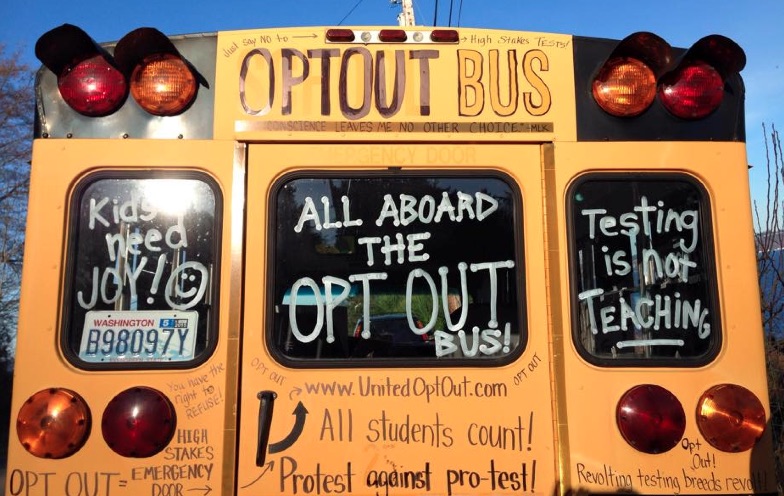
Yesterday, several hundred Washington parents, teachers and students rallied at the state capital in Olympia to protest high stakes tests. Some of the leaders of this rally later met with legislators ready to act to change the direction of the state educational system. We already see the result. At noon today, February 17, 2015, State Senator Maralyn Chase, a Democrat from Shoreline and State Senator Pam Roach, a Republican from Enumclaw, proposed Senate Bill 6030 in the Washington State Senate to repeal Common Core and SBAC and return to the prior Washington State Standards and Washington State test called the Measurement of Student Progress or MSP. 
Washington state is not only the home of Bill Gates and Common Core, it is also the home of the notorious S-BAC Common Core test – a high stakes high failure rate test that has already announced that it will label two out of every three children who take it this spring to be “failures.” Despite these obstacles, in May 2014, the Washington State Republican Party passed a resolution to repeal Common Core and the SBAC test. Then in January 2015, the Washington State Democratic Party became the first State Democratic Party in the nation to pass a resolution opposing Common Core. 
Cosponsoring this bill are Democratic Senators John McCoy from Marysville and Bob Hasegawa from Renton and Republican Senators Mark Miloscia from Federal Way, Mike Padden from Spokane and Brian Dansel from Republic. State Representative Elizabeth Scott announced that she will also file a Common Core repeal bill in the Washington State House of Representatives. 
 
Here is the text of the first part of the bill. The entire bill is available at this link: http://apps.leg.wa.gov/billinfo/summary.aspx?bill=6030&year=2015
SENATE BILL 6030
State of Washington 64th Legislature 2015 Regular Session 
By Senators Chase, Roach, McCoy, Hasegawa, Miloscia, Padden and Dansel. AN ACT Relating to assessments in public schools; amending RCW 28A.655.061, 28A.655.066, 28A.655.068, 28A.655.070, 28A.305.130, 28A.655.185, 28B.105.010, 28B.105.030, and 28B.105.060; amending 2013 2nd sp.s. c 22 s 1 (uncodified); adding a new section to chapter 28A.320 RCW; adding a new section to chapter 28A.655 RCW; adding new sections to chapter 28A.655 RCW; and declaring an emergency.
BE IT ENACTED BY THE LEGISLATURE OF THE STATE OF WASHINGTON: 
Sec. 1: 2013 2nd sp.s. c 22 s 1 (uncodified) is amended to read as follows: (1) Common core state standards have serious drawbacks including:
(a) Being copyrighted by a private trade group and therefore not subject to change or improvement as needed by Washington state legislators, teachers, and parents in the best interest of students in our state;
(b) Being developmentally inappropriate for students in elementary school;
(c) Missing numerous essential academic skills that were present in the prior Washington state essential academic learning requirements; and
Bipartisan Bill to Repeal Common Core is Proposed in Washington State - Living in Dialogue:

LIVE: Newark student activists 'occupy' district offices | NJ.com

LIVE: Newark student activists 'occupy' district offices | NJ.com:


LIVE: Newark student activists 'occupy' district offices

studentcampout.jpg


NEWARK — A handful of Newark youth have staged a sit-in of Newark Public Schools' headquarters in protest of Newark schools superintendent Cami Anderson's leadership.
The sit-in, organized by the Newark Student Union, started around 8:30 p.m. during a Newark Public Schools Advisory Board business meeting when the students ascended to the 8th floor where Anderson's and other administrators' offices are located, said activists and board members.
"We are asking for her resignation," Rutgers student and NSU co-founder Thais Marques. said in an phone interview. "We are going to stay until she resigns."
The activists, which are broadcasting their sit-in through live video, contend that Anderson has not engaged with students and parents about the district's controversial reforms.
The union is also opposed to the district's One Newark plan, which they argue is untested and hurts neighborhood schools.
"The 'One Newark plan is not what we want," Marques said.
In addition to the periodic live stream, the students have organized a twitter campaign to support the protest with the hashtag #OccupyNPS.

Embedded image permalink

It's not the first time the student group has organized a sit-in. Last May about a dozen student activists forced the Newark Public School Advisory Board to end its business meeting early this evening after staging a protest.
But this protest is timed days before the deadline when the state has to decide if it will renew Anderson's contract in the state-operated district.
Newark Student Union President Kristin Towkaniuk said the students plan to stay for the long haul.
"We refuse to move until Cami Anderson comes and faces us students," she said.
Newark public schools did not immediately respond to comment.


“My child is not college and career ready, because he is a CHILD.” | Reclaim Reform

“My child is not college and career ready, because he is a CHILD.” | Reclaim Reform:


“My child is not college and career ready, because he is a CHILD.”

When the governor and legislators in Indiana talk corporate education reform crazy talk, Cathy Fuentes-Rohwer knew how to respond during a rally at the State House. She is a mom who knows how to speak in real terms about her child and her child’s essence.
One line in particular stood out and caused quite a stir. In order to understand the laser focus of her remark, U.S. Secretary of Education Arne Duncan’s often repeated comment about the purpose of high stakes testing and Race to the Top needs repeating.
Arne Duncan 7 year olds
What was this mom’s honest remark in response to Duncan’s irrational expectation?
“My child is not college and career ready, because he is a CHILD.”
– Cathy Fuentes-Rohwer
cathy fuentes-rohwer
She has much more to say. Watch her deliver on this rally VIDEO posted via Facebook.
-
(By the way, Diane Ravitch recently posted a blog that refers to Duncan talk as “empty PR.” I respectfully disagree. Duncan’s magic-speak leads people to believe, with constant media repetition, that what he says is somehow viable. Crazy talk spoken as reality is “My child is not college and career ready, because he is a CHILD.” | Reclaim Reform:

The “Achievement Gap”: Banning the Language of Deficit | educarenow

The “Achievement Gap”: Banning the Language of Deficit | educarenow:


The “Achievement Gap”: Banning the Language of Deficit

George W. Bush famously pushed through NCLB with his hyperbolic rally against, “The soft bigotry of low expectations.”  His argument was that minority students were performing poorly, as measured by “the achievement gap,” because expectations for them were low, or “soft.”  His answer? To raise standards and test to hold schools accountable to these standards.
Time has predictably shown that Bush’s stance has only served to reinforce a racialized world dominated by Whiteness.  What standards are we asking students of color to rise to?  Standards determined by dominant culture that are reinforced through a biased testing system that rewards those who benefit from privilege, and continues to punish those who lack it.
I assume that Bush would argue that success is determined by this dominant culture, and thus, it is this culture that our students must learn to navigate in order to be what our culture deems “successful.”  (Though he probably would word it differently.)
If only it were so simple.
It seems that the game that determines the winners and losers against our standards of success is rigged.
In What’s Race Got To Do With It?, Wayne Au explains,
One of the key assumptions undergirding the use of standardized tests to measure, sort and rank students is the idea that these tests are measuring students objectively and accurately- for if the tests are objective, then they truly are assessing the individual  merits of students.  In turn the individual students who have worked the hardest and who have the most merit will rise to the top compared to their peers.
So far it kind of sounds like Bush was right, right?
Except he’s not.

Why Philly should reject charter school coercion :: Blogs :: The Naked City :: Philadelphia City Paper

Why Philly should reject charter school coercion :: Blogs :: The Naked City :: Philadelphia City Paper:


Why Philly should reject charter school coercion


 The Philadelphia School Partnership wants the School Reform Commission to accept $25 million in exchange for approving thousands of new charter school seats. It's a really bad deal that the School District of Philadelphia can't afford and the SRC should reject it.

On Wednesday, the SRC will vote on applications for dozens of new charter schools. The only reason they are entertaining the proposals is because the Republican-controlled state legislature is forcing them to: The provision was attached to legislation allowing Philadelphia to raise its own cigarette tax to fund schools.
The problem is that the new seats could cost the beleaguered District an enormous amount of money. That's in part because new charters draw students from private schools and in part because the District must pay for each new student who enrolls in a charter and also for the "stranded costs," including staffing and building costs, that they leave behind in traditional public schools.
It is gratifying that PSP acknowledges that there are costs, which it pegs at about $2,000 for each new student who enrolls in a charter. But the Boston Consulting Group, in a report for the District, put the cost at $7,000 per student.
That's a big difference, but as far the SRC's decision-making goes there should be no real distinction.
Either way, the District can't afford it. PSP is looking for as many as 15,000 new charter school seats to be approved. Using even their more conservative estimate, their cash wouldn't cover a first year of charter-school-expansion costs — let alone the costs that would accrue in following years.
The offer is classic PSP, a group backed by wealthy benefactors that has quickly become a powerful force in local education politics: It is superficially beneficent, but is in reality both misleading and coercive.
Let's start with "misleading," the coin of the realm in many public debates purportedly about "school reform." Most recently, PSP and other charter advocates have contended that there is a 40,000-student waiting list for charter schools. But the District has questioned that figure. PSP has refused to explain or substantiate it.
And then there's "coercive." PSP's offer is take it or leave it, a naked attempt to use private dollars to foist fiscally damaging policy changes on a cash-poor school system. This might be galling. But it is not surprising.
In 2013, City Paper revealed that PennCAN, a pro-charter and "reform" lobbying outfit that initially operated out of PSP's office, issued a secret report calling on then-Gov. Tom Corbett to use an orchestrated attack on the Philadelphia Federation of Teachers as an election-season ploy to distract voter attention from unpopular and draconian budget cuts.
Later that year, PSP reportedly lobbied Corbett to condition $45 million in federal aid to Philly schools on massive teachers' union concessions. Corbett only relented after City Paperrevealed that a sixth-grader had died of an apparent asthma attack after falling ill at a city school where, thanks to underfunding, no nurse was on duty.
Which brings us to the latest push for charter expansion. Last year, the state lawmakers finally approved a measure allowing Philly to raise its own cigarette tax. But they did so on the Why Philly should reject charter school coercion :: Blogs :: The Naked City :: Philadelphia City Paper: 

Q&A: Exit Interview With A Nationally Known School Leader : NPR Ed : NPR

Q&A: Exit Interview With A Nationally Known School Leader : NPR Ed : NPR:


Q&A: Exit Interview With A Nationally Known School Leader

Joshua Starr

Joshua Starr, a nationally prominent superintendent with the Montgomery County schools in Rockville, Md., this month was granted early release from his contract after 3 1/2 years.
Starr, 45, a father of three, is the former superintendent of the Stamford, Conn., schools and director of accountability for the New York City public schools. He is known as a bit of a maverick. As the head of the 154,000 student district in the Washington, D.C., suburbs, he gained notoriety in 2012 by calling for a three-year moratorium on standardized testing. And he's incorporated measures of student and employee engagement and well-being into school report cards.
But Starr lost the confidence of his board. Opinions differed as to why: because of his rising national profile, or stubborn achievement problems in the district; questions about the administrative handling of some school sex abuse cases, or a controversial debate over whether to change school start times. We caught up with him for an exit interview.
What are you most proud of from your time as superintendent?
Well, I'm proud of our results. Graduation rates are up across the board, and we've also narrowed the gap in graduation. SAT and AP scores continue to be high. I'm proud of that. We also reduced suspensions pretty significantly.
The second thing is the way that we've redefined what public education should look like, to include creative problem solving and social and emotional well-being to be as important as academic success.
We saw the biggest one-year increase in graduation rates at Wheaton High School, where we reframed what teaching and learning looks like by focusing on project-based learning.
How did you become convinced of the importance of these "squishier" concepts like creativity or even emotional well-being — that these are central to the mission of a public school?
I like to say the problem we are trying to solve in public education today is the democratization of information.
I ask teachers all the time, if you can Google it, why teach it? Because we have so much information today. How do you help kids navigate that? That's critical thinking and creative problem solving.
And when I talk to the business community, they always talk about the fact that they want kids who have good academics, of course, but more importantly they want kids who can solve problems and think critically.
And what about the social and emotional stuff?
When it comes to social and emotional well-being, we mean that kids should value and respect diversity, make healthy good personal decisions, and build resilience. We believe kids should be good people.
Hard work is the most important thing in life. That means learning from failure, setting goals, having a vision of your future, a sense of hope those things are really Q&A: Exit Interview With A Nationally Known School Leader : NPR Ed : NPR:

Policy kicking out students with low grades comes under scrutiny | 89.3 KPCC

Policy kicking out students with low grades comes under scrutiny | 89.3 KPCC:


Policy kicking out students with low grades comes under scrutiny


 To enroll in the Public Safety Academy in San Bernardino, students had to submit satisfactory scores from California standardized English and math tests and, to stay in, maintain a 2.0 grade point average.

Both policies violate state law because the academy is a public charter school, according to lawyers with the American Civil Liberties Union.
“Charter schools are exempt from most laws in the Education Code, but the laws that apply say they have to admit all students,” said ACLU lawyer Jessica Price, and they must “serve all students who wish to attend.”
The admission policies of the school, which prepares students for public safety careers such as police work, are found in the student handbook. Efforts to dismiss students with low grades were evident in school documents obtained by the ACLU.
The school did not immediately respond when asked how many students had been dismissed since its founding in 2000. But in 2013, the school said it sent letters to families of 23 students whose grade-point average had fallen below 2.0 for one semester. The letters advised students to enroll in another school and turn in their books.
However, after the ACLU brought the violation to the school's attention, those letters were rescinded, according to Principal Jennifer Stickel.
The school “wants all of its students to succeed academically so they can graduate from high school and build a bright future. To that end, PSA has in place many supports to assist students who are struggling academically,” Stickel wrote in a December 2014 letter to the ACLU.
“It is important to note that PSA does not expel students for unsatisfactory academics. This means that students removed and remanded to their home school district for failure to make academic improvement may immediately enroll in another public school, with no delay in their education,” Stickel wrote.
Soon after that correspondence, both sides met and the school agreed to remove the minimum grade and Policy kicking out students with low grades comes under scrutiny | 89.3 KPCC:

Petrilli’s Common Core “North Star” for Atheistic, “Choice” Moms | deutsch29

Petrilli’s Common Core “North Star” for Atheistic, “Choice” Moms | deutsch29:


Petrilli’s Common Core “North Star” for Atheistic, “Choice” Moms


Fordham Institute President Michael Petrilli sells the Common Core State Standards (CCSS) for a living.
Petrilli has a bachelors degree in political science. He is not a teacher. He is a guy who landed on the soft fluffery of a think tank living.
He has testified in CCSS’ favor before lawmakers in TennesseeWisconsinOhioIndianaMissouri, and Arkansas.
His Fordham Institute associate, Kathleen Porter-Magee, testified in their favor in Wisconsin, and Fordham Institute founder Chester Finn has testified in their favor in Michigan.
Fordham Institute even has a webpage, Common Core Watch, which might be more accurately named, Common Core Defense and Promotion.
The bottom line for Fordham Institute is that it views itself as standards-grading experts. In their formal testimony in favor of CCSS, their “evidence” centers on their own skewed standards-grading “findings.” And even there, Fordham Institute did not “grade” CCSS as superior to all state standards. Nevertheless, Fordham Institute adamantly sells CCSS as though CCSS has been empirically tested and proven to deliver on some miracle promise of American Global Competitiveness brought about by nothing more than “standards sameness”– or, as Fordham Institute gravy trainBill Gates pushes, the “unleashing” of “powerful market forces” to produce “an large base of customers eager to buy products.”
Petrilli’s testimony in Indiana is particularly telling. I have cited it before.
In true Fordham Institute form, Petrilli urges Indiana to keep CCSS– even though Fordham Institute did not “grade” CCSS as “superior” to Indiana state standards:
First, you have already invested time and money into implementing the new standards. They have momentum. Calling for a do-over would waste the millions of man hours already invested — and potentially cost the state of Indiana more money than proceeding with the Common Core.
Second, it’s not clear that returning to your old standards would put Indiana on a path toward higher student achievement. For while you had some of the best standards in the country for over a decade, you also had one of the worst student achievement records on the National Assessment of Educational Progress. Indiana was a classic case of good standards not actually having an impact in the classroom. You need a different way forward.
Third, if you decide to opt out of the Common Core, you will be opting Indiana’s teachers and students out of an opportunity to participate in the incredible wave of innovation that these standards are unleashing. It’s as if the whole world is moving to smart phones and tablets while you’re sticking with a rotary. [Emphasis added.]
Sure, says Petrilli, Indiana had great standards, “some of the best in the country,” but Petrilli’s Common Core “North Star” for Atheistic, “Choice” Moms | deutsch29: