Latest News and Comment from Education

Saturday, January 10, 2015

UNITED OPT OUT: The Movement to End Corporate Education Reform - United Opt Out National serves as a focused point of unyielding resistance to corporate ed. reform. We demand an equitably funded, democratically based, anti-racist, desegregated public school system for all Americans

UNITED OPT OUT: The Movement to End Corporate Education Reform - United Opt Out National serves as a focused point of unyielding resistance to corporate ed. reform. We demand an equitably funded, democratically based, anti-racist, desegregated public school system for all Americans that prepares students to exercise compassionate and critical decision making with civic virtue.:


UNITED OPT OUT: THE MOVEMENT TO END CORPORATE EDUCATION REFORM INFO [AT] UNITEDOPTOUT [DOT] COM

0

Time to Disrupt the “Disrupters”!!!

Post by Ceresta Smith Disruption! Teachers and support staffs are not typically characterized as people that engage in disruption.  By nature we strive to keep our classrooms and our academic intuitions running smoothly, as...
madeloni0

Stand Up for Action with Barbara Madeloni

  Barbara Madeloni says : “The accountability regime has done too much damage for too long. Under the pretense of reform and civil rights, corporatists have exploited our children, undermined public schools as sites...

Want your kids to opt out of standardized tests? The Constitution may be with you. - The Washington Post

Want your kids to opt out of standardized tests? The Constitution may be with you. - The Washington Post:


Want your kids to opt out of standardized tests? The Constitution may be with you.

 January 9
Anya Kamenetz writes about education for NPR. This essay is adapted from her book“The Test: Why Our Schools Are Obsessed With Standardized Testing — but You Don’t Have to Be.”
When Jeanette Deutermann’s older son began third grade, he started crying and begging not to go to school. He developed stomachaches that a doctor said were stress-related. Deutermann, a stay-at-home mom in Nassau County, Long Island, was mystified. “In kindergarten, first, second grade, he wasn’t a kid who was like, ‘Please let me go to school,’ ” she recalled. “But he didn’t have issues.”
She eventually realized what was stressing him out: the advent in third grade of high-stakes standardized testing. On top of state-mandated annual exams, her school and district had imposed many more diagnostic, benchmark and practice tests. For Deutermann, the last straw came in February 2013, during her son’s fourth-grade year, when he brought home a notice that he’d been “selected” for something called “Sunrise Academy.” Based on their scores on the NWEA, a benchmark test, some fourth-graders — gifted as well as struggling kids — were asked to come in at 7:30 a.m. two mornings a week to prep for the state exam. “For me it was a total red flag,” Deutermann recalled. “I start asking: ‘What happens if he doesn’t do well? Will he be put on a lower track? What is the consequence?’ ” She was told the test would measure the school’s performance, not her son’s.
But Deutermann had had enough. So she founded a Facebook group, Long Island Opt-out Info, that February and started organizing other parents. The next spring, nearly 30,000 Long Island students skipped state-mandated tests — one of the biggest protests in what has become a national movement.
Parents and teachers across the country — determined to reclaim local control and opposed to market-based reforms, school closures and cutbacks — are losing their patience with standardized tests. Designed to assess students and hold teachers, schools, districts and states accountable for their performance, high-stakes exams have come to define education for many kids. The Council of Chief State School Officers has reported that, on average, students take 113 such tests between pre-kindergarten and 12th grade. Even President Obama has spoken in favor of cutting back.
The new national resistance holds that these exams do not provide useful or timely information; that they are unfair to minorities and otherdisadvantaged groups; and that tests and prep are crowding out arts, science, social studies and 21st-century skills. Officials are pushing back. Yet parents are finding constitutional arguments to support their approach, and in many cases they’re winning.
There are no hard numbers. But starting in 2013, changes to teacher evaluations related to Race to the Top, a federal incentive program, as well as the adoption of the Common Core standards, triggered a new wave of opt-out protests and boycotts led by parent groups and teachers unions. A reported 60,000 students opted out across New York state last year. Organizers in Denver and Chicago also recruited many defectors during the 2014 testing season, and protests made news in Kansas, Oklahoma, Maryland, Massachusetts, New Jersey, New Mexico and Pennsylvania. Bob Schaeffer of FairTest, an anti-testing group, calls the movement “unprecedented.”
This controversy goes back at least to the 19th century. In “Testing Wars in the Public Schools: A Forgotten History,” historian William J. Reese tells the story of what happened in 1845 in Boston, when reformers, led by the legendary Horace Mann, gave a very difficult surprise essay test to public Want your kids to opt out of standardized tests? The Constitution may be with you. - The Washington Post:

Chart of the Day: Vaccinate Your Kids! | Mother Jones

Chart of the Day: Vaccinate Your Kids! | Mother Jones:


Chart of the Day: Vaccinate Your Kids!

| Sat Jan. 10, 2015 2:02 PM EST
Via the LA Times from a few months ago, here's the rise in "personal belief" exemptions from state-mandated vaccinations among kindergartners in California:
And here's where it's happening:
In Los Angeles County, the rise in personal belief exemptions is most prominent in wealthy coastal and mountain communities, The Timesanalysis shows. The more than 150 schools with exemption rates of 8% or higher for at least one vaccine were located in census tracts where the incomes averaged $94,500 — nearly 60% higher than the county median.
....At Santa Cruz Montessori in the small coastal community of Aptos, about 7% of kindergartners in 2007 got belief exemptions. Last fall, that rate was 22.6%. Principal Kathy Rideout said the school has tried different approaches to encourage parents to immunize children. They asked a doctor to talk with fellow parents. They produced handouts emphasizing the importance of immunizations and asked parents seeking belief exemptions to get counseling from a healthcare practitioner. A state law that went into effect this year makes this a requirement. But none of it made much difference, Rideout said.
...."We have schools in California where the percent of children who exercise the personal belief exemption is well above 50%," said Dr. Gil Chavez, deputy director of the California Department of Public Health's Center 
Chart of the Day: Vaccinate Your Kids! | Mother Jones:

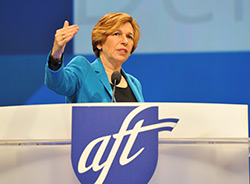
AFT’s Weingarten on Her Priorities for ESEA Reauthorization

AFT - American Federation of Teachers - A Union of Professionals:


AFT’s Weingarten on Her Priorities for ESEA Reauthorization


WASHINGTON— Statement from American Federation of Teachers President Randi Weingarten on her hopes for the reauthorization of the Elementary and Secondary Education Act. For an overview of the AFT’s policy priorities on the ESEA reauthorization, please click here.


"Fifty years ago, the Elementary and Secondary Education Act was signed by President Lyndon B. Johnson as part of the War on Poverty. It sought, as all federal policy regarding education should, to provide equal access to a high-quality education for all kids.


"Today, as Congress is gearing up to reauthorize ESEA, it is time to return to the law's moral and legal roots as a vehicle to ensure civil rights and equal opportunity for all children, particularly those most at risk. The factors that have undermined that goal—inequity, and the fixation on high-stakes tests that has eclipsed all other learning and accountability measures—must be fixed. To that end, we must expand the law with support for big ideas, such as community schools and wraparound services; project-based learning; service internships; and individual plans for over-age students, under-credited students and those who are not reading at grade level by third grade. These ideas will help address the fact that two-thirds of what affects student achievement occurs outside the classroom.


"Let's face it: Any law that doesn't address our biggest challenges—funding inequity, segregation, the effects of poverty—will fail to make the sweeping transformation our kids and our schools need. We're ready and willing to work with Congress; the White House; civil rights, education, business, community and civic organizations; parents; students; educators; and anyone else, to ensure that the reauthorization of ESEA moves us closer to the goal of reclaiming the promise of public education for each and every child."


AFT’s Weingarten on Her Priorities for ESEA Reauthorization

Friday, January 9, 2015

Dissent from Obama Plan to Make Community College Free | Diane Ravitch's blog

Dissent from Obama Plan to Make Community College Free | Diane Ravitch's blog:


Dissent from Obama Plan to Make Community College Free