Latest News and Comment from Education

Sunday, January 4, 2015

30 Most Controversial Education Practices in U. S. History

30 Most Controversial Education Practices in U. S. History:


30 Most Controversial Education Practices in U. S. History

by Deborah Medwin
With the adaptation of Common Core standards by the majority of U.S. states, scrutiny of educational practices has rarely been tighter. Educators, parents, students and taxpayers are focused on the state of education across the nation, and the media now reports on such educational intricacies as curriculum planning and literacy standards. The ensuing controversy over the value of the Common Core reveals not only America’s passion for education, but also its historical tendency to both embrace and reject deviations from what might be considered an educational norm.
From racial integration to MOOCs, there have been experiments in education. Teaching methods vary depending upon the intent and style of the instructor, the time period, fashionable techniques, and school, state, or federal impositions, but since the formal adaptation of tax-supported public school (in the 17th century) in the U.S., these institutions of learning and teaching have consistently weathered controversy. Top Education Degrees has examined some of the most surprising, provocative, or revolutionary educational practices and compiled a list of the 30 most controversial.

Method for Selection

The nature of a controversy is a dispute that is prolonged, impassioned, and often public in nature. Top Education Degrees began by defining controversy in education based on one or more of the following four guidelines:
1. A subjective social or religious issue that uniquely affects education
Issues like gun control, sex ed, prayer, creation v. evolution and spanking in schools are, for the most part, matters of personal opinion. Implementation of rules regarding such issues may be based on legal precedent or pressure from political, administrative or parental authority, but when opposing perspectives among interested parties converge, controversy is inevitable.
2. A deviation from traditional methods
Educational practices, teaching methods, and curriculum vary from school to school; nevertheless, in most public schools in the U.S., there exists a basic concept of education. Children are required by law to attend an educational institution whose responsibility is to impart knowledge and understanding of the traditional subjects: mathematics, English, social studies, and sciences. A certain level of non-traditional teaching style and subject emphasis is generally tolerated or desired, of course, but when non-standard educational movements become broad, such as flipped schools, MOOCs, or homeschooling, or threaten to affect traditional schools, like same sex schools or integration of students with special needs, controversy ensues.
3. A potential “corruption” or harming of students
Education is intended to provide knowledge, skills, and discipline; educated students are prepared for careers, personal fulfillment, inter-personal relations, and general life navigation. Sometimes, however, a school or instructor distorts those objectives, intentionally or not, and physically or ethically obstructs the goals of education. The controversy lies in the perspective: to some, educational research which depends upon real classroom conduct is progressive or necessary, while to others, emotionally or intellectually manipulating students or grades amounts to exploitative human experimentation.
4. Shown to be historically, scientifically, or socially incorrect
From a more historical standpoint, some of the controversial practices included in this list are no longer legal or fashionable, but are nevertheless prime examples of contentious topics in education. It is precisely because of the controversy that practices like racial segregation have been challenged, disproven, and abolished, but in some cases, despite evidence to the contrary, questionable educational practices persist.

# 30 Blue Eyes/Brown Eyes: Third Grade Discrimination

In 1968, while the U.S. was in the throes of the civil rights movement, Jane Elliot, a Riceville, Iowa, third grade teacher, questioned her all-white class about racial discrimination, and wondered whether they knew what it felt like to be treated badly because of the color of one’s skin. Concluding that empathy could best be achieved through experience, Elliott instructed her class to implement a new way of thinking: that brown eyed people were superior to blue eyed students, and the two groups should not mingle. Brown eyed students were given extra recess and academic praise, while blue eyed students were isolated and ridiculed. The following day, Elliot reversed the hierarchy, and blue eyed students became the privileged group. In just a short time, the superior set became mean and exclusive, while the lower group was plagued by academic underperformance and depressive thoughts. Elliott discussed the children’s actions and feelings, and ended the lesson by explaining its point: that just as the color of a person’s eyes shouldn’t affect their treatment, neither should the color of their skin.
While Elliott’s methods have become well known and widely used (they have inspired training videosused around the world used to help employers educate staff and instill basic workplace guidelines about racial tolerance), they have nevertheless provoked some controversy. How wide a role does a public school play in the social and moral guidance of its students? What are the ethical implications of subjecting a student to emotional discomfort for the sake of instilling personal and social 30 Most Controversial Education Practices in U. S. History:

Suspensions and Expulsions in the US Public Schools—what does that 3.3 million really mean? | Crazy Normal - the Classroom ExposĆ©

Suspensions and Expulsions in the US Public Schools—what does that 3.3 million really mean? | Crazy Normal - the Classroom ExposĆ©:


Suspensions and Expulsions in the US Public Schools—what does that 3.3 million really mean?


02JAN
In 2006, the U.S. public schools suspended students 3.3 million times. Note that I did not say 3.3 million students, because that might be misleading as you will see if you keep reading.
There is currently a group in the United States demanding that teachers and schools be restricted when it comes to suspending children from classrooms and schools. It would be interesting to know who is funding this issue and pushing it. Is it Arne Duncan who is the Secretary of the federal Department of Education or is it Bill Gates who is funding the push for Common Core standardized testing with $5 – $7 billion—test results that will be used to rank and fire teachers in addition to close public schools and turn our children over to corporations to teach even if parents don’t want that?
Corporate education reformers love throwing around numbers like 3.3 million, because that will make the public schools look really bad, and big numbers tossed out like that look so impressive to people who are easy to fool.
I decided to dig deeper to understand what that number really means.
In this post, we will explore what is behind the suspension and expulsion rates in the United States, because the public schools have been criticized for suspending too many students. Some critics have even alleged that the ratio of Black children being suspended is a sign of racism. I disagree, but you will have to make up your own mind after you look at all the numbers and in this post there are a lot of numbers to wrap your critical thinking around. The following chart provides a powerful and revealing comparison and I’m interested in your conclusions from this data.
Chart for Suspensions and Expulsions in the US Public Schools by Race
Heritage.org says “Seventy-one percent of poor families with children are headed by single parents, mostly single mothers. Compared to children raised in an intact family, children raised in single-parent homes are more likely to have emotional and behavioral problems; be physically abused; smoke, drink, and use drugs; be aggressive; engage in violent, delinquent, and criminal behavior; have poor school performance; and drop out of high school.” The Heritage Foundation reports that in the United States, marriage drops the probability of child poverty by 82 percent.
In 2006, there were 53.8 million children in the k – 12 public schools, and there were 3.3 million suspensions representing 6.1% of the total number of students. That means almost 94% (or more) of the children did not earn a suspension. Census.gov
When 6.1% of the total students are suspended from public schools—or less as you will see—is that cause for Suspensions and Expulsions in the US Public Schools—what does that 3.3 million really mean? | Crazy Normal - the Classroom ExposĆ©:

Will the Media Help Destroy Public Education? - Living in Dialogue

Will the Media Help Destroy Public Education? - Living in Dialogue:


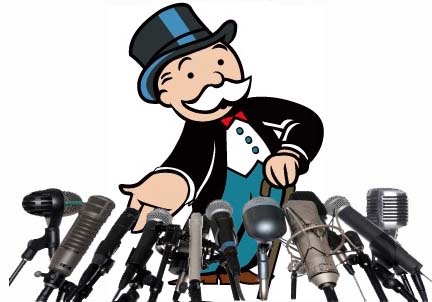
Will the Media Help Destroy Public Education? 


 By Paul Horton.

Why have those defending public education had such an uphill fight in crafting a compelling counter to the mainstream message that “public education is broken”? How can we break through this monotonous monopoly of thinking with an alternative message?
As Noam Chomsky points out, the mainstream political discourse in America is largely shaped by media outlets under complete corporate control.
Who are the players here? Over the past two decades, as the internet has transformed communication, a circle of Silicon Valley billionaires have achieved great influence. Their outlook tends to be Libertarian, and finds much in common with neoliberals when it comes to education policy. These nouveau tech billionaires have found common cause with hedge fund managers and banking industry insiders, who also hold tremendous power.
According to Robert McChesney,
…much of the wealth generated by the Internet has been funneled into a small number of hands….[T]he Internet has produced monopolistic titans like Google, Apple, Amazon, Facebook, e-Bay, Microsoft, Intel, Cisco, Oracle, and Qualcomm….In combination, these firms have almost unlimited power in Washington, and the only time they face any regulatory threat is when the giants find themselves on opposite sides of an issue….Academics trip over one another as they sing the praises of digital titans,
…but [T]he Internet brings one of the core contradictions of capitalism to the fore—what is good and rational for those who control the economy is bad and irrational for society as a whole. (Blowing the Roof Off the Twenty-First Century, 228-9)
The most important fact in American politics today is the Citizens United decision. With this, the hand of the Democratic Party was forced: in order to win major elections the party must accept major campaign funding from the Silicon Valley right libertarians, neoliberals and their financiers on Wall Street. For neoliberal Democrats who are forced to lick the Nikes of their major funders, the privatization of education has become the price they pay to get the dollars needed to win elections.
The Obama Administration’s education policies are the equivalent of doing dog tricks or “dancing” for someone who is holding a gun.
So what role does the media play in this dance?
Although things have improved slightly in the print media in 2014, almost all major print editorial pages are controlled by publishers who are whole hog on privatization and charters: NYT and Chicago Tribune and theTribune network are leading the bandwagon and heavily influenced by Bloomberg, Broad, and Murdoch. TheChicago Sun-Times editorial page is completely compromised by the political pressure exerted by publishers friendly to governor-elect Bruce Rauner who supports privatization of education. The New Republic is dead, succumbing to Silicon Valley neoliberal libertarianism.
The ProgressiveThe Nation (the country’s oldest journal of political and cultural opinion), Salon, Valerie Strauss of the Washington Post most often include stories and voices of teachers in print; while PoliticoThe Huffington Post, AlternetTruthout, and Common Dreams are open to teacher voices that call attention to a counter narrative.
Diane RavitchAnthony Cody, Jon Pelto’s Education Blogger’s Network, Cynthia Liu’s K12 News Network,Tim Slekar’s Busted Pencils site, Dr. James Miller’s War Report, and the Network for Public Education, an organization formed to counter the neoliberal Democrats for Education Reform, have all worked to build online grassroots communities opposed to right libertarian and neoliberal public education disruption-destruction. Peter Greene has been relentlessly spot-on, taking Mr. Gates-Duncan-Petrilli on every day. The work of blogger-authors Mercedes Schneider and Jeff Bryant has been exemplary in reaching a broader audience at Huffington Post and Salon. Edushyster (Jennifer Berkshire) brings a deft humorous touch to her articles and interviews. Dozens of local bloggers around the country like Mike and Fred Klonsky in Chicago, The Jose Vilson in New York, and Julian Vasquez-Heilig’s Cloaking Inequity blog have been relentless, but Will the Media Help Destroy Public Education? - Living in Dialogue:

Every inch won should lead us to demand more | Notes on a Theory...

Every inch won should lead us to demand more | Notes on a Theory...:


Every inch won should lead us to demand more


One of the most important concepts for understanding politics is quiescence. The great political scientist Murray Edelman placed the production of quiescence and arousal at the center of his approach to politics.
Government affects behavior chiefly by shaping the cognitions of large numbers of people in ambiguous situations. It helps create their beliefs about what is proper; their perceptions about what is fact; and their expectations of what is to come. In the shaping of expectations of the future the cues from government often encounter few qualifying or competing cues from other sources; and this function of political activity is therefore an especially potent influence upon behavior.
To make this point is to deny or seriously qualify what may be the most widely held assumption about political interactions: that political arousal and quiescence depend upon how much of that they want from government people get. Political actions chiefly arouse of satisfy people not by granting or withholding their stable demands, but rather by changing the demands and the expectations. (Emphasis in the original. Politics as Symbolic Action.)
For Edelman, the key to understanding politics is the ways the demands made by the public are managed, not how they are fulfilled. Often this is done through the use of symbols.For example, think about how in response to the Fight for 15 protests, Democrats have embraced a $10.10 minimum wage, including voting on it in the Senate, even though it has zero chance of making it even through that body. This has included the president imposing it on federal contractors, with the caveat that it would only apply to new contracts (making his earlier feet dragging consequential). Similarly we see states like Maryland enact $10.10 but limit its scope and extend the timeline for when the full new minimum should be imposed. The long timeline will make pushing for additional raises more difficult, although not impossible. In Seattle, where activists have successfully pushed the 15 dollar number onto the agenda, the mayor’s proposal has all sorts of loop holes, even as he claims to be leading the 15 dollar cause. The top number is the symbol, while the details are used to limit its impact.
Or think of the USA Freedom Act, winding its way through Congress right now. It originated as a challenge to mass surveillance written by some of the strongest congressional critics of the National Security State, who were emboldened by the disclosures by Edward Snowden. Such unauthorized disclosures are one of the only ways to challenge government secrecy designed to ensure people “encounter few qualifying or competing cues from other [non-official] sources.” But along the way it has been modified in ways that either water it down or make things worse, leading some of its original supporters to turn against it. Unsurprisingly, even the original bill didn’t go very far in challenging the spying Leviathan.
The inclination to declare premature victory seems to me a common affliction, as evidenced by the responses to the election of Barack Obama, Elizabeth Warren and Bill De Blasio. Another example is the victory laps taken in response to a small number of members of Congress embracing ideas like Social Security expansion or postal banking. Celebrating steps along the way is essential, but too often it seems like the first steps are treated as evidence of a changed game
People love the idea of winning without a fight. You see that in the hope of many Democrats that the Republicans will be so extreme that voters will reject them without Democrats having to take a stand on anything. You see it in their insistence that demographic changes will lead to the demise of the Republican Party, despite the fact that those demographics are malleable and a product of politics. You see it when people offer charts and stats alone as if bare facts ever convinced anyone of anything, or their efforts to argue in favor of (mildly) liberal ends from conservative starting points. You see it in the efforts to avoid taking stances that conservatives will oppose (as if they won’t move to oppose what ever previously reasonable position liberals take.) You see it in the simultaneous claim that the ACA is a great success and a frustration its opponents are still pushing back.
I love the idea of winning a fight. I love it because our opponents are wrong and deserve to be beaten. I love it because winning begets winning. I love it because, as Frederick Douglass taught us, “If there is no struggle, there is no progress. Those who profess to favor freedom and yet deprecate agitation are men who want crops without plowing up the ground; they want rain without thunder and lightning. They want the ocean without the awful roar of its many waters.” I love it because we have so, so far to go to begin to approximate our ideals. I love it because I love it.
I’m convinced that part of winning–really winning–means making bold demands. It means not letting what seems immediately possible limit our horizons. Realism is essential, but part of being realistic is understanding that things change and big demands lead to big change. I’m convinced of the importance of Every inch won should lead us to demand more | Notes on a Theory...:

Saturday, January 3, 2015

Over-testing our kids is not the answer — it’s the problem - Salon.com

Over-testing our kids is not the answer — it’s the problem - Salon.com:


Over-testing our kids is not the answer — it’s the problem

In the era of No Child Left Behind and Common Core, we've forgotten about the learning and development that matter


Over-testing our kids is not the answer -- it's the problem(Credit: wavebreakmedia via Shutterstock)


“I’m writing a book about school testing.”
“Thank goodness. It’s about time.”
That’s the conversation I’ve been having again and again recently. As an education writer for the past twelve years and as a parent talking to other parents, I’ve seen how high-stakes standardized tests are stunting children’s spirits, adding stress to family life, demoralizing teachers, undermining schools, paralyzing the education debate, and gutting our country’s future competitiveness.
The way much of school is organized around these tests makes little sense for young humans developmentally. Nor does it square with what the world needs.
My husband edited together a two-minute time-lapse video of our daughter learning, over several months, to walk: standing up on wobbly legs, waving her hands with a “Woop!” crashing back down on her rear end, toddling a few steps into our outstretched arms, and, finally, crossing a room. It’s pretty irresistible, if I do say so myself.
Parenting my daughter in the first years of her life has been a master class on human development. She is so driven to explore her environment and to express herself, to communicate with, please, and sometimes resist the people around her. She doesn’t just walk—she walks toward something. She doesn’t just speak—she speaks to someone. Mental, physical, emotional, and social milestones are all intertwined.
In the first year or four, children are hardly ever bored, unless they’re hemmed in by “Nos.” They stay in the proverbial state of flow, right on the edge of their abilities. Provided they get the emotional refueling they need to feel secure, they are always reaching for the next milestone, stumbling, teetering, and getting up again.
All the experts are constantly reminding parents that infants develop on their own timetables. The overall trajectory of growth and progress is more important than any particular snapshot in time. Furthermore, early learning is as much about creative expression and social engagement as it is about parroting any memorized patterns, like letters or numbers. Good preschools are little Paris salons—full of art, music, movement, rivalries, friendships, love, and, above all, imagination. They are also highly concerned with the practical matters of life, such as the use of forks, buttons, faucets. Folding laundry and washing dishes can be just as absorbing for toddlers as reading books and singing songs.


Yet just a few years later, when kids enter school, we start to limit our consideration of learning and development to a single hand-eye-brain circuit, forgetting the rest of the body, mind, and soul. It’s math and reading skills, history and science facts that kids are tested and graded on. Emotional, social, moral, spiritual, creative, and physical development all become marginal, extracurricular, or remedial pursuits. And we suddenly expect children to start developing skills on a predetermined timetable, one that is now basically legislated on a federal level. This is what is called rigor and highOver-testing our kids is not the answer — it’s the problem - Salon.com: 

Friday, January 2, 2015

The plot to overhaul No Child Left Behind - Maggie Severns - POLITICO

The plot to overhaul No Child Left Behind - Maggie Severns - POLITICO:


The plot to overhaul No Child Left Behind

The Republican plan could dramatically roll back the federal role in education.


Sen. Lamar Alexander is pictured. | Getty


Republicans are hatching an ambitious plan to rewrite No Child Left Behind this year — one that could end up dramatically rolling back the federal role in education and trigger national blowouts over standardized tests and teacher training.
NCLB cleared Congress in 2002 with massive bipartisan support but has since become a political catastrophe: The law’s strategy for prodding and shaming schools into improvement proved deeply flawed over time, and its unintended failures have eclipsed its bright spots. Today, NCLB is despised by some parents who blame it for schools “teaching to the test,” protested by some on the left for promoting education reform and reviled by Republicans in Congress who say the law represents aggressive federal overreach.
Story Continued Below
Now Sen. Lamar Alexander of Tennessee and Rep. John Kline of Minnesota, who will lead the Senate and House education committees, are planning to push an overhaul of NCLB at a moment when backlash in the states has reached an all-time high, opening up new political windows to strip the federal role out of education.
The push to rewrite the country’s main K-12 education law will be “all about Congress taking a red pen and deleting” language, said Mike Petrilli, president of the conservative Thomas B. Fordham Institute and a former Education Department staffer.
Alexander spent December huddling with lawmakers, including Sen. Patty Murray of Washington, the committee’s forthcoming ranking member, to begin hammering out a strategy for a bill that could clear the Senate’s 60-vote threshold. He’s said he wants a bill on the president’s desk before summer.
The president may be hard-pressed to veto even a very conservative bill, though the administration has signaled in the past it will take a hard line when it comes to preserving annual tests and other provisions that focus on equal access to education in NCLB. The Obama administration ushered in what has been labeled a dismantling of the law by giving states huge leeway on some of its key provisions, but the so-called waiver policy is unpopular in the states in no small part because it helped encourage the proliferation of the Common Core standards.
Lobbyists swarmed Capitol Hill in December to sway lawmakers’ positions in chaotic education debates over how often to test students and what role — if any — school vouchers should have in the law. These debates are set to erupt in January, though some groups have put themselves ahead of the curve: The National Education Association, the country’s largest teacher’s union, has been pushing to roll back testing requirements for years and is seizing on recent anti-testing sentiment in the states to make a fresh case for getting rid of annual tests


Read more: http://www.politico.com/story/2015/01/the-plot-to-overhaul-no-child-left-behind-113857.html#ixzz3NgfKH5pp

RIP: Mario Cuomo - Keynote Address at the 1984 Democratic National Convention

American Rhetoric: Mario Cuomo - Keynote Address at the 1984 Democratic National Convention:


Mario Matthew Cuomo
1984 Democratic National Convention Keynote Address
delivered 16 July 1984, San Francisco, CA


 Purchase Entire Video of Address at EVG


[AUTHENTICITY CERTIFIED: Text version below transcribed directly from audio. (2)]
Thank you very much.
On behalf of the great Empire State and the whole family of New York, let me thank you for the great privilege of being able to address this convention. Please allow me to skip the stories and the poetry and the temptation to deal in nice but vague rhetoric. Let me instead use this valuable opportunity to deal immediately with the questions that should determine this election and that we all know are vital to the American people.
Ten days ago, President Reagan admitted that although some people in this country seemed to be doing well nowadays, others were unhappy, even worried, about themselves, their families, and their futures. The President said that he didn't understand that fear. He said, "Why, this country is a shining city on a hill." And the President is right. In many ways we are a shining city on a hill.
But the hard truth is that not everyone is sharing in this city's splendor and glory. A shining city is perhaps all the President sees from the portico of the White House and the veranda of his ranch, where everyone seems to be doing well. But there's another city; there's another part to the shining the city; the part where some people can't pay their mortgages, and most young people can't afford one; where students can't afford the education they need, and middle-class parents watch the dreams they hold for their children evaporate.
In this part of the city there are more poor than ever, more families in trouble, more and more people who need help but can't find it. Even worse: There are elderly people who tremble in the basements of the houses there. And there are people who sleep in the city streets, in the gutter, where the glitter doesn't show. There are ghettos where thousands of young people, without a job or an education, give their lives away to drug dealers every day. There is despair, Mr. President, in the faces that you don't see, in the places that you don't visit in your shining city.
In fact, Mr. President, this is a nation -- Mr. President you ought to know that this nation is more a "Tale of Two Cities" than it is just a "Shining City on a Hill."
Maybe, maybe, Mr. President, if you visited some more places; maybe if you went to Appalachia where some people still live in sheds; maybe if you went to Lackawanna where thousands of unemployed steel workers wonder why we subsidized foreign steel. Maybe -- Maybe, Mr. President, if you stopped in at a shelter in Chicago and spoke to the homeless there; maybe, Mr. President, if you asked a woman who had been denied the help she needed to feed her children because you said you needed the money for a tax break for a millionaire or for a missile we couldn't afford to use.
Maybe -- Maybe, Mr. President. But I'm afraid not. Because the truth is, ladies and gentlemen, that this is how we were warned it would be. President Reagan told us from the very beginning that he believed in a kind of social Darwinism. Survival of the fittest. "Government can't do everything," we were told, so it should settle for taking care of the strong and hope that economic ambition and charity will do the rest. Make the rich richer, and what falls from the table will be enough for the middle class and those who are trying desperately to work their way into the middle class.
You know, the Republicans called it "trickle-down" when Hoover tried it. Now they call it "supply side." But it's the same shining city for those relative few who are lucky enough to live in its good neighborhoods. But for the people who are excluded, for the people who are locked out, all they can do is stare from a distance at that city's glimmering towers.
It's an old story. It's as old as our history. The difference between Democrats and Republicans has always been measured in courage and confidence. The Republicans -- The Republicans believe that the wagon train will not make it to the frontier unless some of the old, some of the young, some of the weak are left behind by the side of the trail. "The strong" -- "The strong," they tell us, "will inherit the land."
We Democrats believe in something else. We democrats believe that we can make it all the way with the whole family intact, and we have more than once. Ever since Franklin Roosevelt lifted himself from his wheelchair to lift this nation from its knees -- wagon train after wagon train -- to new frontiers of education, housing, peace; the whole family aboard, constantly reaching out to extend and enlarge that family; lifting them up into the wagon on the way; blacks and Hispanics, and people of every ethnic group, and native Americans -- all those struggling to build their families and claim some small share of America. For nearly 50 years we carried them all to new levels of comfort, and security, and dignity, even affluence. And remember this, some of us in this room today are here only because this nation had that kind of confidence. And it would be wrong to forget that.
So, here we are at this convention to remind ourselves where we come from and to claim the future for ourselves and for our children. Today our great Democratic Party, which has saved this nation from depression, from fascism, from racism, from corruption, is called upon to do it again -- this time to save the nation from confusion and division, from the threat of eventual fiscal disaster, and most of all from the fear of a nuclear holocaust.
That's not going to be easy. Mo Udall is exactly right -- it won't be easy. And in order to succeed, we must answer our opponent's polished and appealing rhetoric with a more telling reasonableness and rationality.
We must win this case on the merits. We must get the American public to look past the glitter, beyond the showmanship to the reality, the hard substance of things. And we'll do it not so much with speeches that sound good as with speeches that are good and sound; not so much with speeches that will bring people to their feet as with speeches that will bring people to their senses. We must make -- We must make the American people hear our "Tale of Two Cities." We must convince them that we don't have to settle for two cities, that we can have one city, indivisible, shining for all of its people.
Now, we will have no chance to do that if what comes out of this convention is a babel of arguing voices. If that's what's heard throughout the campaign, dissident sounds from all sides, we will have no chance to tell our message. To succeed we will have to surrender some small parts of our individual interests, to build a platform that we can all stand on, at once, and comfortably -- proudly singing out. We need -- We need a platform we can all agree to so that we can sing out the truth for the nation to hear, in chorus, its logic so clear and commanding that no slick Madison Avenue commercial, no amount of geniality, no martial music will be able to muffle the sound of the truth.
And we Democrats must unite. We Democrats must unite so that the entire nation can unite, because surely the Republicans won't bring this country together. Their policies divide the nation into the lucky and the left-out, into the royalty and the rabble. The Republicans are willing to treat that division as victory. They would cut this nation in half, into those temporarily better off and those worse off than before, and they would call that division recovery.
Now, we should not -- we should not be embarrassed or dismayed or chagrined if the process of unifying is difficult, even wrenching at times. Remember that, unlike any other Party, we embrace men and women of every color, every creed, every orientation, every economic class. In our family are gathered everyone from the abject poor of Essex County in New York, to the enlightened affluent of the gold coasts at both ends of the nation. And in between is the heart of our constituency -- the middle class, the people not rich enough to be worry-free, but not poor enough to be on welfare; the middle class -- those people who work for a living because they have to, not because some psychiatrist told them it was a convenient way to fill the interval between birth and eternity. White collar and blue collar. Young professionals. Men and women in small business desperate for the capital and contracts that they need to prove their worth.
We speak for the minorities who have not yet entered the mainstream. We speak for ethnics who want to add their culture to the magnificent mosaic that is America. We speak -- We speak for women who are indignant that this nation refuses to etch into its governmental commandments the simple rule "thou shalt not sin against equality," a rule so simple --
I was going to say, and I perhaps dare not but I will. It's a commandment so simple it can be spelled in three letters: E.R.A.
We speak -- We speak for young people demanding an education and a future. We speak for senior citizens. We speak for senior citizens who are terrorized by the idea that their only security, their Social Security, is being threatened. We speak for millions of reasoning people fighting to preserve our environment from greed and from stupidity. And we speak for reasonable people who are fighting to preserve our very existence from a macho intransigence that refuses to make intelligent attempts to discuss the possibility of nuclear holocaust with our enemy. They refuse. They refuse, because they believe we can pile missiles so high that they will pierce the clouds and the sight of them will frighten our enemies into submission.
Now we're proud of this diversity as Democrats. We're grateful for it. We don't have to manufacture it the way the Republicans will next month in Dallas, by propping up mannequin delegates on the convention floor. But we, while we're proud of this diversity, we pay a price for it. The different people that we represent have different points of view. And sometimes they compete and even debate, and even argue. That's what our primaries were all about. But now the primaries are over and it is time, when we pick our candidates and our platform here, to lock arms and move into this campaign together.
If you need any more inspiration to put some small part of your own difference aside to create this consensus, then all you need to do is to reflect on what the Republican policy of divide and cajole has done to this land since 1980. Now the President has asked the American people to judge him on whether or not he's fulfilled the promises he made four years ago. I believe, as Democrats, we ought to accept that challenge. And just for a moment let us consider what he has said and what he's done.
Inflation -- Inflation is down since 1980, but not because of the supply-side miracle promised to us by the President. Inflation was reduced the old-fashioned way: with a recession, the worst since 1932. Now how did we -- We could have brought inflation down that way. How did he do it? 55,000 bankruptcies; two years of massive unemployment; 200,000 farmers and ranchers forced off the land; more homeless -- more homeless than at any time since the Great Depression in 1932; more hungry, in this world of enormous affluence, the United States of America, more hungry; more poor, most of them women. And -- And he paid one other thing, a nearly 200 billion dollar deficit threatening our future.
Now, we must make the American people understand this deficit because they don't. The President's deficit is a direct and dramatic repudiation of his promise in 1980 to balance the budget by 1983. How large is it? The deficit is the largest in the history of the universe. It -- President Carter's last budget had a deficit less than one-third of this deficit. It is a deficit that, according to the President's own fiscal adviser, may grow to as much 300 billion dollars a year for "as far as the eye can see." And, ladies and gentlemen, it is a debt so large -- that is almost one-half of the money we collect from the personal income tax each year goes just to pay the interest. It is a mortgage on our children's future that can be paid only in pain and that could bring this nation to its knees.
Now don't take my word for it -- I'm a Democrat. Ask the Republican investment bankers on Wall Street what they think the chances of this recovery being permanent are. You see, if they're not too embarrassed to tell you the truth, they'll say that they're appalled and frightened by the President's deficit. Ask them what they think of our economy, now that it's been driven by the distorted value of the dollar back to its colonial condition. Now we're exporting agricultural products and importing manufactured ones. Ask those Republican investment bankers what they expect the rate of interest to be a year from now. And ask them -- if they dare tell you the truth -- you'll learn from them, what they predict for the inflation rate a year from now, because of the deficit.
Now, how important is this question of the deficit. Think about it practically: What chance would the Republican candidate have had in 1980 if he had told the American people that he intended to pay for his so-called economic recovery with bankruptcies, unemployment, more homeless, more hungry, and the largest government debt known to humankind? If he had told the voters in 1980 that truth, would American voters have signed the loan certificate for him on Election Day? Of course not! That was an election won under false pretenses. It was won with smoke and mirrors and illusions. And that's the kind of recovery we have now as well.
But what about foreign policy? They said that they would make us and the whole world safer. They say they have. By creating the largest defense budget in history, one that even they now admit is excessive -- by escalating to a frenzy the nuclear arms race; by incendiary rhetoric; by refusing to discuss peace with our enemies; by the loss of 279 young Americans in Lebanon in pursuit of a plan and a policy that no one can find or describe.
We give money to Latin American governments that murder nuns, and then we lie about it. We have been less than zealous in support of our only real friend -- it seems to me, in the Middle East -- the one democracy there, our flesh and blood ally, the state of Israel. Our -- Our policy -- Our foreign policy drifts with no real direction, other than an hysterical commitment to an arms race that leads nowhere -- if we're lucky. And if we're not, it could lead us into bankruptcy or war.
Of course we must have a strong defense! Of course Democrats are for a strong defense. Of course Democrats believe that there are times that we must stand and fight. And we have. Thousands of us have paid for freedom with our lives. But always -- when this country has been at its best -- our purposes were clear. Now they're not. Now our allies are as confused as our enemies. Now we have no real commitment to our friends or to our ideals -- not to human rights, not to the refuseniks, not to Sakharov, not to Bishop Tutu and the others struggling for freedom in South Africa.
We -- We have in the last few years spent more than we can afford. We have pounded our chests and made bold speeches. But we lost 279 young Americans in Lebanon and we live behind sand bags in Washington. How can anyone say that we are safer, stronger, or better?
That -- That is the Republican record. That its disastrous quality is not more fully understood by the American people I can only attribute to the President's amiability and the failure by some to separate the salesman from the product.
And, now -- now -- now it's up to us. Now it's up to you and to me to make the case to America. And to remind Americans that if they are not happy with all that the President has done so far, they should consider how much worse it will be if he is left to his radical proclivities for another four years unrestrained. Unrestrained.
Now, if -- if July -- if July brings back Ann Gorsuch Burford -- what can we expect of December? Where would -- Where would another four years take us? Where would four years more take us? How much larger will the deficit be? How much deeper the cuts in programs for the struggling middle class and the poor to limit that deficit? How high will the interest rates be? How much more acid rain killing our forests and fouling our lakes?
And, ladies and gentlemen, please think of this -- the nation must think of this: What kind of Supreme Court will we have?
Please. [beckons audience to settle down]
We -- We must ask ourselves what kind of court and country will be fashioned by the man who believes in having government mandate people's religion and morality; the man who believes that trees pollute the environment; the man that believes that -- that the laws against discrimination against people go too far; a man who threatens Social Security and Medicaid and help for the disabled. How high will we pile the missiles? How much deeper will the gulf be between us and our enemies? And, ladies and gentlemen, will four years more make meaner the spirit of the American people? This election will measure the record of the past four years. But more than that, it will answer the question of what kind of people we want to be.
We Democrats still have a dream. We still believe in this nation's future. And this is our answer to the question. This is our credo:
We believe in only the government we need, but we insist on all the government we need.
We believe in a government that is characterized by fairness and reasonableness, a reasonableness that goes beyond labels, that doesn't distort or promise to do things that we know we can't do.
We believe in a government strong enough to use words like "love" and "compassion" and smart enough to convert our noblest aspirations into practical realities.
We believe in encouraging the talented, but we believe that while survival of the fittest may be a good working description of the process of evolution, a government of humans should elevate itself to a higher order.
We -- Our -- Our government -- Our government should be able to rise to the level where it can fill the gaps that are left by chance or by a wisdom we don't fully understand. We would rather have laws written by the patron of this great city, the man called the "world's most sincere Democrat," St. Francis of Assisi, than laws written by Darwin.
We believe -- We believe as Democrats, that a society as blessed as ours, the most affluent democracy in the world's history, one that can spend trillions on instruments of destruction, ought to be able to help the middle class in its struggle, ought to be able to find work for all who can do it, room at the table, shelter for the homeless, care for the elderly and infirm, and hope for the destitute. And we proclaim as loudly as we can the utter insanity of nuclear proliferation and the need for a nuclear freeze, if only to affirm the simple truth that peace is better than war because life is better than death.
We believe in firm -- We believe in firm but fair law and order.
We believe proudly in the union movement.
We believe in a -- We believe -- We believe in privacy for people, openness by government.
We believe in civil rights, and we believe in human rights.
We believe in a single -- We believe in a single fundamental idea that describes better than most textbooks and any speech that I could write what a proper government should be: the idea of family, mutuality, the sharing of benefits and burdens for the good of all, feeling one another's pain, sharing one another's blessings -- reasonably, honestly, fairly, without respect to race, or sex, or geography, or political affiliation.
We believe we must be the family of America, recognizing that at the heart of the matter we are bound one to another, that the problems of a retired school teacher in Duluth are our problems; that the future of the child -- that the future of the child in Buffalo is our future; that the struggle of a disabled man in Boston to survive and live decently is our struggle; that the hunger of a woman in Little Rock is our hunger; that the failure anywhere to provide what reasonably we might, to avoid pain, is our failure.
Now for 50 years -- for 50 years we Democrats created a better future for our children, using traditional Democratic principles as a fixed beacon, giving us direction and purpose, but constantly innovating, adapting to new realities: Roosevelt's alphabet programs; Truman'sNATO and the GI Bill of Rights; Kennedy's intelligent tax incentives and the Alliance for ProgressJohnson's civil rights; Carter's human rights and the nearly miraculous Camp David Peace Accord.
Democrats did it -- Democrats did it and Democrats can do it again. We can build a future that deals with our deficit. Remember this, that 50 years of progress under our principles never cost us what the last four years of stagnation have. And we can deal with the deficit intelligently, by shared sacrifice, with all parts of the nation's family contributing, building partnerships with the private sector, providing a sound defense without depriving ourselves of what we need to feed our children and care for our people. We can have a future that provides for all the young of the present, by marrying common sense and compassion.
We know we can, because we did it for nearly 50 years before 1980. And we can do it again, if we do not forget -- if we do not forget that this entire nation has profited by these progressive principles; that they helped lift up generations to the middle class and higher; that they gave us a chance to work, to go to college, to raise a family, to own a house, to be secure in our old age and, before that, to reach heights that our own parents would not have dared dream of.
That struggle to live with dignity is the real story of the shining city. And it's a story, ladies and gentlemen, that I didn't read in a book, or learn in a classroom. I saw it and lived it, like many of you. I watched a small man with thick calluses on both his hands work 15 and 16 hours a day. I saw him once literally bleed from the bottoms of his feet, a man who came here uneducated, alone, unable to speak the language, who taught me all I needed to know about faith and hard work by the simple eloquence of his example. I learned about our kind of democracy from my father. And I learned about our obligation to each other from him and from my mother. They asked only for a chance to work and to make the world better for their children, and they -- they asked to be protected in those moments when they would not be able to protect themselves. This nation and this nation's government did that for them.
And that they were able to build a family and live in dignity and see one of their children go from behind their little grocery store in South Jamaica on the other side of the tracks where he was born, to occupy the highest seat, in the greatest State, in the greatest nation, in the only world we would know, is an ineffably beautiful tribute to the democratic process.
And -- And ladies and gentlemen, on January 20, 1985, it will happen again -- only on a much, much grander scale. We will have a new President of the United States, a Democrat born not to the blood of kings but to the blood of pioneers and immigrants. And we will have America's first woman Vice President, the child of immigrants, and she -- she -- she will open with one magnificent stroke, a whole new frontier for the United States.
Now, it will happen. It will happen if we make it happen; if you and I make it happen. And I ask you now, ladies and gentlemen, brothers and sisters, for the good of all of us, for the love of this great nation, for the family of America, for the love of God: Please, make this nation remember how futures are built.
Thank you and God bless you.

Marie Corfield: 2014 Education Recap: The Good, The Bad, The 'Reformy'

Marie Corfield: 2014 Education Recap: The Good, The Bad, The 'Reformy':


2014 Education Recap: The Good, The Bad, The 'Reformy'


Happy New Year!


In my humble opinion 2014 was a watershed year for public education. While there were plenty of knuckle-headed 'reform' policies and decisions, there were also some big wins, a lot of small victories and the beginnings of a shift in public opinionSo, let's take a walk down memory lane and look back on the good, the bad and the 'reformy'. 

'The bad' and 'reformy'

While there have been many horror stories from around the country, these had me scratching my head more than most:
  • Stanford's CREDO Director, Dr. Margaret Raymond says the free market approach doesn't work in public education. Raymond made this statement at a conference in which she spoke about CREDO's latest study. Blogger, professor and attorney Stephen Dyer reported that, "Considering that the pro-market reform Thomas B. Fordham Foundation paid for this study and Raymond works at the Hoover Institution at Stanford — a free market bastion, I was frankly floored, as were most of the folks at my table."
  • One Newark. Because sending 4 kids from the same family to 4 different schools around the city, often without school district-provided transportation, and sometimes through dangerous neighborhoods is a really, really good idea. And that's just the beginning of this hot mess.
  • Arne Duncan's latest: he wants college teacher programs to be accountable for their students' students' outcomes. No, I am not kidding.
  • The York, PA public school district becomes the next 'Post-Katrina New Orleans' school district.
  • The rise of Campbell Brown. Because America needs another non-educator talking head with a lot of secret money behind her pushing through policies that will ultimately damage public education, which leads us to...
  • The Vergara decision. Money, power and influence deal a huge blow to teacher tenure and open the floodgates for similar litigation nationwide. Brown is leading the charge in New York State. California Gov. Jerry Brown is appealing the ruling.

The really, really good!


This week The Network for Public Education published its Top Ten "Why We Will Win" Stories of 2014, and what an inspiring list it is! There are actually 11 items on the list—how could any one of them be left off? Be sure to check out the full description of each at the NPE website.