Latest News and Comment from Education

Wednesday, August 20, 2014

UPDATE: Time to say something controversial: What else is new? ‪#‎Dueprocess‬ must be done right. | DCGEducator: Doing The Right Thing

Time to say something controversial: What else is new? ‪#‎Dueprocess‬ must be done right. | DCGEducator: Doing The Right Thing:


This bears repeating: ” I Am The Seed She Planted”
William Wordsworth wrote in his famous poem, The Rainbow, “The child is the father of the man.” We could just as easily say, “The student is the father of the teacher.” Just as human traits are established while young, so are teacher traits. All I ever needed to learn about who I am as a human and as a teacher, I learned, not in kindergarten, but in second grade. Truth be told, I don’t remember mu

Time to say something controversial: What else is new? ‪#‎Dueprocess‬ must be done right.

q3967974
I have been giving this Tenure – Due Process issue a lot of thought lately. Like anything else worth doing, it is worth doing well. How we supervise and develop better teachers and even how we get rid of bad ones has to be done the right way for the right reasons. 
We all have to be ok with the fact that due process can, and maybe should more often, find someone duly criminal or that he or she needs to be removed from their job because of incompetence or just plain laziness. What if due process means assuring that? 
Are we ok with that? I am, as long as every person and every case is judged individually and fairly. There are lots of teachers I know who, like me, who wish their supervisors were more qualified and had the “cojones” to do due process on those who make our profession look bad.
The pride we have in our schools means we all work hard to get better at what we do. Those who can’t or won’t (and we know there are too many of those) put in the time and effort become a huge problem for everyone, especially our students.
I had my share of colleagues, teachers and supervisors both, who ranged from absolutely incredible at their jobs to absolutely awful. I had principals and assistant principals / department chairs who knew great teaching from lousy and worked with people to improve their skills. However, if those teachers didn’t knew enough to understand that they brought our department, school, and staff down several notches, they had to be brought to justice.
Principals must be principled. The following story is from my book, Doing The Right Thing: A Teacher Speaks:
“Adlai Stevenson’s first principal Leonard Littwin scared people, but Lenny knew teaching. He was blunt and direct. He sat in the back of classrooms, watching and taking notes. He was a master social studies teacher before he became an administrator. His goal, which he filtered down to his department chairs, was to develop as many talented teachers as possible. Mostly, he succeeded. Many succeeded to pass on what they learned, including me. What he told me, he must have shared with hundreds of teachers over the years. He asked three essential questions: 
• What do you want your students to know, understand, do, and communicate by the end of your class? 
• How are you going to assess those? 
• What do you want them buzzing about as they leave, so that they want more tomorrow?
With those questions as our focus, we discussed how projected outcomes, goals, and objectives are to be achieved and measured using authentic assessments (essay writing, projects of all sorts, and even multiple-choice and short-answer questions).”
But for those who couldn’t pass muster, life was different. Lenny played no favorites or harbored no grudges. He had one goal and one goal only, and that was to make you a better teacher. Tenured or not, he would come to classes with that goal in mind. We all have to get better.
If you couldn’t, didn’t, or worse yet, didn’t try… other “opportunities” would be offered. Perhaps a transfer to another school? No? Ok, then you choose more observations and conferences? These weren’t to harass but to encourage growth. But I guess that depends on one’s perspective. Most of these “lesser qualified” teachers left on their own accord, to other schools they found more comfortable, but many of us felt bad for the students in Time to say something controversial: What else is new? ‪#‎Dueprocess‬ must be done right. | DCGEducator: Doing The Right Thing:

The Education Economy: America's Next Big Thing


The Education Economy: America's Next Big Thing

The Education Economy: America's Next Big Thing

How integrating the country's educational system, employers, and job creators can reshape -- and reignite -- the American economy

by Brandon Busteed

Though the economy and education have long been topics of top concern to Americans, we haven't worked to create strong linkages between the two. They are more like two castles with a large moat between them. Yet there is nothing more important we can do as a country than to build the world's most effective educonomy -- that is, seamlessly integrate our educational system, our employers, and our job creators. Unless we get education and the economy working together more effectively, America will relinquish its role as leader of the free world.

Political consultant James Carville's famous quip "It's the economy, stupid" changed a presidential election. It's quite possible that "It's the educonomy, stupid" will change and shape not just politics but all leadership for the next decade to come. Here's why.

Over the past year, Gallup has conducted various studies looking at the linkages between education and long-term success in life and work. We've polled representative samples of the general population in America, parents of fifth- through 12th-graders, and business leaders. And we've interviewed teachers, superintendents, college presidents, principals, college graduates, young Americans aged 18-34, and students in grades five through 12. All told, we collected the voices of close to 1 million Americans on this subject in the past year alone. And what we've learned is alarming.

Engagement is on the decline
  • Student engagement in school drops precipitously from fifth grade through 12th grade. About three quarters of elementary school kids (76%) are engaged in school, while only 44% of high school kids are engaged. The longer students stay in school, the less engaged they become. If we were doing this right, the trend would be going in the opposite direction.
  • About seven in 10 K-12 teachers are not engaged in their work (69%). And teachers are dead last among all professions Gallup studied in saying their opinions count at work and their supervisors create an open and trusting environment. We also found that teacher engagement is the most important driver of student engagement. We'll never improve student engagement until we boost teachers' workplace engagement first.
Job preparedness is questionable
  • About four in 10 students in grades five through 12 (43%) say they plan to start their own business, yet only 7% currently have an internship or job in a real organization where they can apply that energy. News flash: Schools and colleges don't have jobs and internships -- employers do. If we don't get schools and businesses working together to give students these opportunities, everyone will lose.
  • Only 14% of Americans say they are confident that college graduates are well-prepared for success in the workplace. And business leaders are even more skeptical, with only 11% saying that college graduates are well-prepared for success at work. Yet despite this, 96% of chief academic officers of colleges and universities are either somewhat or very confident that they are preparing college students for success in the workplace. It's hard to imagine a gap -- or moat -- bigger than that.
  • Among young Americans, we found that those who worked on a long-term project that took several classes to complete and used what [they] were learning about to develop solutions to real problems in [their] community or the world in their last year of school were twice as likely to have higher work quality compared with those lacking these experiences. Yet only 17% said they had these experiences.
It's about getting a job, not a degree
  • Among college graduates, those who had an internship or job where they applied what they were learning in the classroom, worked on projects that took a semester or more to complete, and were actively involved in The Education Economy: America's Next Big Thing:

Tony Wagner's The Global Achievement Gap Is More Relevant than Ever | John Thompson

Tony Wagner's The Global Achievement Gap Is More Relevant than Ever | John Thompson:


Tony Wagner's The Global Achievement Gap Is More Relevant than Ever


When checking out Amanda Ripley's The Smartest Kids in the World, which argues that American education is falling dangerously behind other nations, I stumbled across Tony Wagner's six-year-old The Global Achievement Gap. Wagner begins with a frightening anecdote - the type that could drive today's frenzied assault on teachers.
A world renowned molecular scientist sent two sons to a Cambridge, Massachusetts school. One had a great experience, being inspired by an awesome teacher who used project-based learning and taught hands-on science. The other son had a "totally different" experience. His teacher offered none of the "fun stuff." That teacher's test prep approach to instruction drove the love of learning out of class.
Today, such an anecdote could prompt more calls to fire bad teachers. But, both of the classes in Wagner's story had the same teacher! The difference was the increased pressure to conform to test-driven accountability had driven excellent teaching from the classroom.
I don't have the expertise to answer the question of whether we have an overall crisis in public education, as opposed to the question of whether it is mostly high-challenge schools that are failing. Ripley and Wagner make a good case, however, that our schools do not teach critical thinking in an engaging manner.
I'm more impressed with Wagner's methodology. He summarized international PISA data, for instance, in order to estimate where students of different nations stand in terms of access to instruction that emphasizes critical and creative thinking. More importantly, Wagner had conducted "walk throughs" of classrooms across the nation. He and his guests, including staff for the Gates Foundation, invariably were disappointed by the lack of engaging instruction.
Today, the discussion about paths to better teaching usually lead to more rigorous Tony Wagner's The Global Achievement Gap Is More Relevant than Ever | John Thompson:

4LAKids - some of the news that doesn't fit 8-20-14

4LAKids - some of the news that doesn't fit:


Norwalk/La Mirada Usd Superintendent Ruth Perez Named Lausd Deputy Supe For Instruction
Dr. Ruth Perez accepts Deputy Superintendent position with Los Angeles Unified School District. By Randy Economy | Hews Media Group-Community News http://bit.ly/1waJf7R Dr. Ruth Perez, the popular Superintendent of Schools for the Norwalk-La Mirada Unified School District has accepted the position of Deputy Superintendent with the Los Angeles Unified School District, Hews Media Group-Community


COUNTY OFFICE OF ED WITHHOLDS APPROVAL OF LAUSD LCAP, Questions spending on low-income, English learner and foster students
By Louis Freedberg | ED SOURCE TODAY | http://bit.ly/1tpNtD4 August 19, 2014 |  updated at 11:30 a.m.  ::  The Los Angeles County Office of Education is withholding approval of the Local Control and Accountability Plan drawn up by the Los Angeles Unified School District pending clarification of the $700 million the school district says it spent last year on low-income students, English learners


4LAKids - some of the news that doesn't fit 8-19-14
4LAKids - some of the news that doesn't fit: The MiSiS CriSiS: WHEN IS ACCOUNTABILITY GOOD FOR THE GANDER?  Written by red queen in la in LAUSD, from her blog | http://bit.ly/1pXYPOk Monday Aug 18, 2014  ::  …and isn’t that Buck supposed to have been stopping somewhere? Somewhere other than at the kids’ feet? This past week, the first back in school for LAUSD kids, has seen an absolutely ridiculou


8-20-14 LA School Report - What's Really Going on Inside LAUSD

LA School Report - What's Really Going on Inside LAUSD (Los Angeles Unified School District):


Thousands of CA students don’t make it to the 9th grade
Thousands of CA students don’t make it to the 9th grade Via KPCC | by Sarah Butrymowicz Devon Sanford’s mother was diagnosed with pancreatic cancer when he was in the eighth grade. After barely finishing at Henry Clay Middle School in South Los Angeles, he never enrolled in high school. He spent what should have been his freshman year caring for his mother and waiting for police to show up asking

ACT scores show CA seniors ready for college, at least to start
ACT scores show CA seniors ready for college, at least to start California high school seniors have a better shot at getting through the first year of college than students from most other states, according to ACT’s 2014 Condition of College and Career Readiness report, which was released today. But many of them will still be entering a world of academic pain. While students state-wide performed a

Ridley-Thomas nominating Johnson to county board seat
Ridley-Thomas nominating Johnson to county board seat Mark Ridley-Thomas (left), Alex Johnson Barely a week after losing to George McKenna for an LA Unified School District board seat, Alex Johnson is eying another board seat. His boss, LA County Supervisor Mark Ridley-Thomas, has nominated him to fill a soon-to-be vacant seat on the LA County Board of Education, a body that hears appeals of dispu

Morning Read: Deasy urges respect for 1st Amendment
Morning Read: Deasy urges respect for 1st Amendment L.A. Unified principals given guidance on student free speech rights As unrest continues in Ferguson, Mo. and, to a degree in Los Angeles, after the fatal police shootings of unarmed black men in those cities, Los Angeles schools chief John Deasy asked principals Tuesday to be vigilant in their efforts to provide an environment for students to ex
8-19-14 LA School Report - What's Really Going on Inside LAUSD
LA School Report - What's Really Going on Inside LAUSD (Los Angeles Unified School District): Morning Read: LAUSD’s computer system problems persistMorning Read: LAUSD’s computer system problems persist Los Angeles Unified works to fix new computer system Although Los Angeles Unified teachers were told Monday they could use a scaled-back version, the district’s new computer system continues to be


8-20-14 Wait What? - Jonathan Pelto: Gubernatorial Candidate and A Really Nice Guy

Wait What?:


 Wait What?


Malloy promises to “stay the course” on education reform!

It turns out that it took less than 24 hours for Governor Dannel “Dan” Malloy to make it clear that Education Commissioner Stefan Pryor’s departure IS NOT a sign that Connecticut’s anti-teacher, pro-corporate education reform Democratic governor is going to use a second term to do a better job representing the concerns of teachers, students, […] The post Malloy promises to “stay the course” on edu


8-18-14 Wait What? - Jonathan Pelto: Gubernatorial Candidate and A Really Nice Guy
Wait What?:   Wait What? Pelto/Murphy 2014 Stefan Pryor Not Serving a 2nd Term as State Ed ChiefFrom the Hartford Courant; Stefan Pryor, the controversial state education commissioner, will leave his post and is “actively seeking new professional opportunities,” according to Gov. Dannel P. Malloy’s office. Pryor informed the governor Monday that he will not serve a second term. “Having served for


Americans Wary of Federal Influence on Public Schools

Americans Wary of Federal Influence on Public Schools:


Americans Wary of Federal Influence on Public Schools

Prefer local school boards over federal government, 56% to 15%

by Valerie J. Calderon


WASHINGTON, D.C. -- Americans' trust in U.S. leaders has slipped amid partisan gridlock that has led to federal government inaction on pressing issues at home and abroad. Americans' weak confidence in the federal government extends to issues surrounding public education.


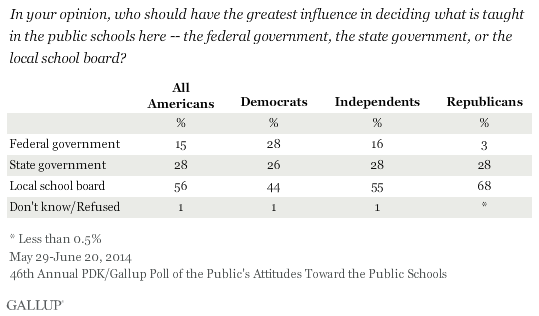
When asked to reflect on who should have the greatest influence on what is taught in the public schools, Americans prefer local school boards over the federal government by a wide margin, 56% to 15%. Twenty-eight percent believe state government should have the greatest say on curriculum.
In your opinion, who should have the greatest influence in deciding what is taught in the public schools here -- the federal government, the state government, or the local school board? 2014 PDK/Gallup poll
While about nine times as many Democrats as Republicans say the federal government should have the greatest influence, the local school board is still the most popular choice among Democrats.
These findings are from the 46th Annual PDK/Gallup Poll of the Public's Attitudes Toward the Public Schools. Results are based on a Gallup Panel telephone study of 1,001 adults, aged 18 and older, conducted from May 29-June 20, 2014.
Majority of Americans Oppose Common Core to Guide Teaching
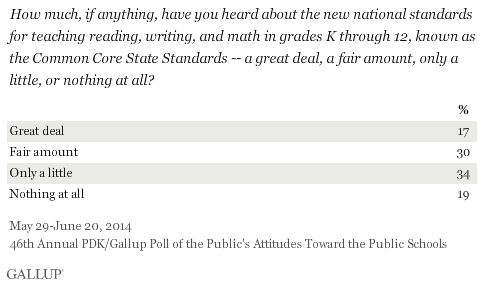
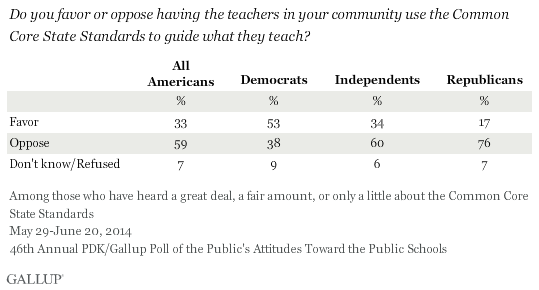
Common Core is one of the dominant topics in American public education this decade. About eight in 10 Americans say they have heard at least a little about the Common Core State Standards. Of those, the majority oppose using the standards in their community to guide teaching. Those who report they know "a great deal" about the Common Core are somewhat less likely to favor them (24%) than those who only know a little (39%).
How much, if anything, have you heard about the new national standards for teaching reading, writing, and math in grades K through 12, known as the Common Core State Standards -- a great deal, a fair amount, only a little, or nothing at all? 2014 PDK/Gallup poll
Majority opposition to the use of the Common Core State Standards to guide instruction persists across age, income, and education levels, but opinion diverges by political affiliation. Republicans who have heard of Common Core are twice as likely as Democrats to oppose use of the standards to guide teaching.
Do you favor or oppose having the teachers in your community use the Common Core State Standards to guide what they teach? 2014 PDK/Gallup poll
Results from the Gallup Daily tracking survey earlier this year show that 52% of public school parents who had heard at least a little about the Common Core Standards were somewhat or very positive about them. The PDK/Gallup poll item is somewhat more specific, but results show that only about one in three (32%) public school parents favor having teachers in their community use the Common Core Standards to guide what they teach.
Common Core Limits Teachers, Opponents Say
Respondents who oppose having the teachers in their community use the Common Core were given four reasons they might oppose them. About two-thirds (65%) say a very important reason is that it will limit the flexibility teachers have to teach what they think is best.
Though the Common Core State Standards were developed by the National Governors Association, it is possible that Americans associate the initiative with the federal government because of support from the Department of Education and President Barack Obama. Despite declining trust in federal agencies and Americans Wary of Federal Influence on Public Schools:


The strategic campaign needed to save public education — in nine steps - The Washington Post

The strategic campaign needed to save public education — in nine steps - The Washington Post:


The strategic campaign needed to save public education — in nine steps


 Leaders of the school standardized test-based reform’ movement have been very smart about using public relations and intentional messaging to their benefit, something their critics have failed to do. Arthur H. Camins, director of the Center for Innovation in Engineering and Science Education at the Stevens Institute of Technology in Hoboken, N.J., discusses where supporters of equitable, democratic and respectful education need to go — and how to get there.  The ideas expressed in this article are his alone and do not represent Stevens Institute. His other writing can be found at www.arthurcamins.com.


By Arthur Camins
Over the last several decades, a concerted negative public relations effort has tainted the idea of government as a mechanism to serve the common good. Investment in and the credibility of the institution of democratically governed public schools have been under sustained attack, while education inequity has increased. As a result, much needed sustained systemic improvement has been thwarted. The launch of Democrats for Public Education on August 19 is an encouraging counter-development. However, they will not be successful without an independent strategic, values-driven, public communications campaign to support the struggle for respectful, equitable, democratic education. Without a public movement even the most courageous politicians cannot make a difference.
Intentional messaging comes naturally to the private sector. For example, American Express has a memorable tag line in one of its commercial spots:This is what membership is. This is what membership does. Thirty seconds of images and voice-over capture a compelling value – personal security, a clear need – thwarting Internet and credit card fraud, followed by an easily understood solution, and then the clever tag line.
Through use of values resonant imagery and language current education reformers have successfully framed the debate about education improvement and persuaded the public to permit, if not agree with, its favored policies:  improvement through market competition and high-stakes testing. However, messaging need not connote the apparent disingenuousness of persuading people to purchase or agree to something they may not need or want. As George Lakoff argued persuasively in Don’t Think of an Elephant: Know Your Values and Frame the Debate, whoever controls language usage also control the parameters of the solutions that get considered. Value-framing language matters.
For example, instead of the short-term, test-score success imagery of the Obama administration’s Race to the Top school funding competition, we need the long-term success imagery of preparation for future learning.Instead of the individual teacher-blaming imagery of accountability, we need the mutual-responsibility imagery of working together for success for all. Instead of the competitive, individual success imagery of choice, we need the mutual success imagery of community.
 A successful campaign for respectful, equitable, democratic education starts with values and is followed by solutions.
Start With Values
 Gaining support depends upon intentional framing. The starting point is expressing core values that have resonance with the public. Three values statements frame a positive public education agenda:
Children deserve respect: We need an education system that ensures that all students are known, valued and respected by adults and peers.
Children deserve equity: We need an education system that ensures that allstudents develop their talents and expertise to be successful in work, life and citizenship.
Children deserve democracy: We need an education system that is governed by democracy and engages students so they learn how to participate in a democracy.
This is what education is.   This is what education does.
These are not new values to discussion about education, but to be clear the United States has only tinkered with them. They have never fully driven what is regularly done. We need to resist assaults on these values, but that is not enough. To gain public support we need imagery-rich, compelling presentations that connect to specific solutions.

Follow With Solutions
 The values of respect, equity and democracy give morally compelling direction to what we must do and what we must stop doing. This includes:
1)      Teach for future learning: It is certain that our children will function as adults in a world substantially different from the one in which they were born. Therefore, while knowing what is now known is vital, learning how to learn must be the primary goal. Therefore, we must abandon test performance as a teaching goal and instead embrace learning from error and iterative improvement. Let’s also move away from teaching to get correct answers and toward answering personally and socially meaningful questions. Example: In our WaterBotics middle- and high school-aged engineering curriculum, students design and build underwater robots that simulate rescuing a drowning swimmer and cleaning up and oil spill. While doing so, students learn how science concepts such as force and motion inform engineering design.
2)      Teach for living together: Human decency, increasing diversity in the United States and globalization all demand that students develop the knowledge, attitudes and values to interact successfully, live and work across difference. Example: In The Choices Program, while students learn about human agency in resolving historical and current political conflicts, they also wrestle with real ethical and moral choices and engage in discussion with those who see things differently. Not only do students need to learn about living together, they also need to practice living together. Therefore, we need to stop policies that exacerbate ethnic, racial and socio-economic isolation and instead promote school, housing and workplace integration.
3)      Teach for engagement: Students only learn when they are cognitively and emotionally engaged. We do not know what will capture the attention and fascination of each child. Therefore, we need to teach to ignite the varied passions of learners. We need to back away from the exclusive focus on reading and mathematics assessment success and instead engage students in a broad curriculum that includes science and engineering, social science and the arts. In addition, we need to establish classrooms that support not just academic learning but also social and emotional learning. Example: In the Responsive Classroom curriculum students learn how to resolve personal conflicts productively, so that classroom culture supports their learning.
4)      Teach for confidence: Let’s abandon the outdated fixed mindset that genes and family circumstance determine intelligence. Let’s abandon the all too transparent mechanisms that sort children by perceived ability. These ideas undermine effort and persistence, which are the real drivers of new learning and expertise development. Let’s finally fully support students with special needs and English language learners, rather than imagining they can reach their potential through assessment demands. Our capacities and inclinations are the result of complex interactions between genetics and environmental conditions. Let’s embrace growing up healthy and create supportive learning environments. Let’s build students’ confidence by teaching for a growth mindset. Example: In the Brainologycurriculum students learn that intentional effort to “growing their brain” can help them get smarter and develop expertise.
5)      Ensure readiness to learn: The conditions of children’s lives outside of school –  in their homes and their communities — have profound impact on their ability to learn in classrooms. We can make those conditions better, but as a society, we have not made this a priority. That is an unconscionable choice that undermines learning and children’s success. We need to start by providing “wrap around” economic, social, and emotional support services for children and their families. Other countries do it. We can too.
6)      Ensure equitable funding: We need to ensure that the resources for effective education are equitably distributed and not a function of local or parent wealth. We need to stop funding education through local property taxes. With some recognition of geographic variance in school operating costs, equity must be guaranteed at the state and national level.
7)      Ensure Democracy: School boards, like other elected bodies, do not always make well-informed decisions in the best interest of every child. Sometimes conflicts interfere with efficiency. However, the antidote to flawed democracy is better democracy, not rule by self-appointed experts or authoritarianism. A positive step to ensure democracy is to eliminate the growing influence of money in election campaigns.
8)      Grow teaching expertise: Teaching is at least as complex as other professions, encompassing disciplinary knowledge and knowledge of learning disciplines, understanding of the developmental, psychological and social dimensions of learning, and norms and of profession interaction, conduct and growth. We need to stop promoting quick, cheap alternative teacher training models. We need to stop promoting technology as an alternative to hiring sufficient numbers of talented teachers and paying them attractive salaries. For example, the Teaching Works program emphasizes that teachers are not born. They are taught and gain expertise over time. We need to start investing more in programs that emphasize in-place training, apprenticeship and mentorship. Like other countries, we need to build collaborative learning time into teachers’ workday to promote continuous professional growth.
9)      Balance direction and autonomy: People learn and gain expertise when they get a little direction and guidance about what to learn and how to improve, but also autonomy. In education, no direction results in chaos and lack of social cohesion. Lack of professional autonomy through fear and over-prescription of either content or methods is stultifying and breeds subservience and resistance. We need balance.
This is what education is. This is what education does.
Valerie Strauss covers education and runs The Answer Sheet blog.The strategic campaign needed to save public education — in nine steps - The Washington Post:

Back to School? In These States, Be Prepared to Get Spanked | TakePart

Back to School? In These States, Be Prepared to Get Spanked | TakePart:


Back to School? In These States, Be Prepared to Get Spanked

Though proven ineffective and sometimes harmful, corporal punishment is legal in much of the U.S.


 Put an end to hitting children in school.
Add that to the list, along with immigration reform, student loan reform, and spending authorization, of things Congress failed to do when it went on vacation earlier this month.
As a result, as kids return to school this month and next, in 19 states they will face the possibility of corporal punishment at the hands of teachers or school officials. That's despite the introduction by Rep. Carolyn McCarthy, D-N.Y., in Congress on June 26 of a bill that would outlaw the practice.
Despite decades of research indicating corporal punishment is not only ineffective but produces kids who are more badly behaved, many Americans view spanking as a reasonable and necessary disciplinary tool. In February, a Kansas state lawmaker proposed legislation that would have provided a sound legal framework for the practice.
Moreover, corporal punishment in schools—as with punishment the criminal justice system metes out—falls more heavily on minorities. Data from the Department of Education shows that nonwhite children bear the brunt of U.S. schools' violent disciplinary measures. While African American students make up approximately 17 percent of the national student population, they account for 36 percent of all students who receive physical punishment at school.
McCarthy hopes to end the practice.
“As a mother and a grandmother, [I find] the statistics are alarming,” she said after introducing the bill. “There is nothing positive or productive about corporal punishment, and it should be discouraged everywhere.”
McCarthy’s current effort is her third and final attempt to pass theEnding Corporal Punishment in Schools Act, as she plans to retire at the end of this term. This time she has tweaked the measure to offer a carrot-and-stick approach. Instead of banning the practice outright, the law would attach it to funding: Schools are free to implement corporal discipline but would lose some federal support for doing that. The same tactic was instrumental in persuading states to increase the drinking age from 18 to 21 in the 1980s. 
In McCarthy's prior efforts, the bill has stalled because of lack of awareness, an aide to the congresswoman said. Much of her work since has therefore been focused on educating other members about this issue.
We now have enough research to conclude that spanking is ineffective at best and harmful to children at worst
— Elizabeth Gershoff, associate professor of human development and family sciences, University of Texas at Austin
Stalwart supporters of the measure include the ACLU and the Center for Effective Discipline, a nonprofit that advocates against corporal punishment.
“If you bring the wooden paddle schools use to hit children into an airport or a courthouse, security will stop you and identify it as a weapon,” said Deb Sendek, program director at the Center for Effective Discipline. “Hitting one child is hitting one too many.”


Russ on Reading: The Trouble with Frank Bruni

Russ on Reading: The Trouble with Frank Bruni:


The Trouble with Frank Bruni

Frank Bruni is capable of writing insightful critiques of New York’s great restaurants. When he writes about education he can only offer us fast food.

Former New York Times food writer and current columnist, Frank Bruni had an op-ed piece in the New York Times entitled The Trouble with Tenure. In the article, Bruni quotes extensively from Mike Johnston, the former Teach for America temp teacher and public school principal, who is currently a Colorado State Senator from Denver and the author of Colorado’s 2010 law abolishing tenure. Bruni also quotes noted educational authority Whoopi Goldberg in the piece.

The gist of the Johnston/Bruni argument is that principals need the flexibility to “hire for talent and release for talent” so that they can form a team with the “same vision.” And that tenure provides no incentive to improve practice and provides no accountability for student outcomes. Johnston/Bruni continues, “We want a tenure system that actually means something, that’s a badge of honor you wear as one of the best practitioners in the field and not just because you’re breathing.”

I would call Johnston’s take on tenure the typical viewpoint of a bad principal. For you see it is the principal who issues and denies a teacher tenure. It is silly to blame teachers or teacher unions for tenure abuse, when the granting of Russ on Reading: The Trouble with Frank Bruni: