Boycott the Hyatt Regency O’Hare. “If elected I won’t go.”

I just filled out my form to run as a delegate to the 2011 IEA RA.
It takes place in March at

I just filled out my form to run as a delegate to the 2011 IEA RA.
It takes place in March at


Tuition at four-year public universities rose again this year, outpacing inflation, according to a report released Thursday by The College Board. Federal aid to states and students softens the bite.
College students interact between classes on the campus of Louisiana State University in Baton Rouge, Louisiana, in this 2009 file photo.
Mary Knox Merrill/The Christian Science Monitor


Tuition at public college and universities continued its steep upward climb this year, rising an average of nearly 8 percent at four-year institutions.
Thanks to federal stimulus funds to the states and a massive influx of federal student aid, students’ wallets didn’t feel such a huge pinch. But the recession is taking its toll.
It’s harder for families to find the means to pay for college, of course. But it’s also becoming increasingly difficult in hard-hit states for campuses to shield students from the effects of budget cuts – everything from bigger classes to the elimination of
If you only read one summary of the current crisis in higher education in Britain this week, make it this one.

Dear Diary,
Well, here I am again, back for the 2014/2015 school year with my fifth graders at P.S. 912. That’s P.S. for Public School, dearest diary. Maybe only half of NYC’s primary schools are still public, but those of us who are left are holding the fort pretty well, thank you. No thanks to our “shadow chancellor” Eva Moskowitz, though; I hear she’ll be up to fifty-two Apple Success charters before the year’s out. Look out, Newark!
Speaking of thank you’s! I met with Principal X two weeks before school started (on the sly, heh heh) to talk about the coming year. Now that President Obama’s 2011 Readiness for College and Work (RCW) Act
Dozens of Jefferson Township High School students attended the Board of Education meeting on Oct. 25 to voice strong support for Kirsten Smith, an English teacher currently suspended with pay. Smith has been accused of violating ethics policy on district testing, a charge she flatly denies. At the meeting, Smith spoke and defended her integrity and vowed to fight for her job while speaker after speaker praised her abilities.

"Ms. Smith is a fine teacher, one who goes above and beyond for her students," said 2007 Jefferson High School graduate Caitlin Signorello. "She wants to be here teaching students, she deserves to be here. Let her teach." Signorello was the first of dozens of students who voiced similar comments. Many were irate at the suspension; many were visibly emotional.
Student Abigail
The good news for President Barack Obama’s college completion agenda: college enrollments are up from last year. And the good news for students: even as increases in the cost of college continue to outpace inflation, students are actually paying less to attend college now (when financial aid is taken into account) than they were a year ago.
“Trends in College Pricing 2010” and “Trends in Student Aid 2010,” both released today by the College Board’s Advocacy and Policy Center, track data about college cost and financial aid going back to the 1980s. The key findings?
(This post was also featured in La Plaza)
The producer of Waiting for Superman says he didn’t mean to imply that all Charter Schools were better than all Public Schools. He failed. That’s exactly what he seems to be saying.
But public school teachers and support staff are used to politicians and pundits ignoring their voices. Why would a movie director who needed a simple story of good guys and bad guys be any different?
If only he had asked us, “Show me something that works,” we could have shown him a story worth telling. There are so many Clark Kent heroes who are specifically focused on immigrant communities and the success of Latino and

 Fighting school bullying should be everyone's business, whether that bullying is based on gender, race, religion, sexual orientation, gender identity, or more. And that's exactly what the Vallejo Unified School District in California was trying to do, by expanding their anti-bullying curriculum to include a video entitled "Let's Get Real," which deals with racial differences, perceived sexual orientation, disabilities, religious differences, sexual harassment and more inside America's schools.
Sounds reasonable, right? After all, the video has won multiple awards from entities like the American Library Association, the Parents' Choice Foundation, the International Family Film Festival, and more.
But some parents in the school district have blown a gasket that the video was shown in the classroom, going
A high-profile documentary shortchanges the education debate
I sobbed alongside my graduate students as we watched the ending of Waiting for Superman, the heat-seeking documentary that has garnered rave reviews and generated an uncommon level of discussion about public education in America. We all wept—the young men, too—despite our awareness that the filmmakers had manipulated us with misleading and lopsided arguments.
The emotional power of Superman swayed even our famously unflappable President Obama, who hinted at some tearing up of his own when he told the Today show that the film’s ending was “heartbreaking.” What else could it be? Five impossibly adorable children from D.C., New York City, and California pin their futures on a lottery ball tumbling their way, winning or losing them a spot in a coveted charter school.
 In one scene, Anthony, a fifth-grader from D.C., stares at a note card on his lap with his name and number on it. At the public lottery in the school gymnasium, every other name is called—but never his. The camera lingers on his little hands; he flicks the card, as if that might conjure a different fate. It’s unbearable to contemplate his helplessness, the injustice of his rejection, and the profound consequences for the rest of his life.
This is psychological torture no child should have to endure. And from that metaphorical moment, Oscar-winning director
Post submitted by Richard Nisbett, author of "Think Big, Bigger . . . and Smaller" (November 2010EL) and distinguished university professor at the University of Michigan, Ann Arbor.
No Child Left Behind dictated that race and class differences in academic achievement be eliminated by 2014. Surely the U.S. Congress should have known that such a goal was not achievable. Even if the schools were to do a spectacular job of improving education for minorities and the poor, eliminating the gaps would be possible only if substantial progress were made in changing home, neighborhood, and peer factors. Children's academic abilities may be tied as closely to these factors as to anything that goes on in school.
Fortunately, we know there is a lot that can be done to reduce the gaps that occur before children even start school. There are now effective home visitation programs teaching parents how to engage their children in intellectually stimulating talk and activities. There are also effective early childhood education programs; these emphasize intellectual growth, last at least one-half a day five days a week, and are much more
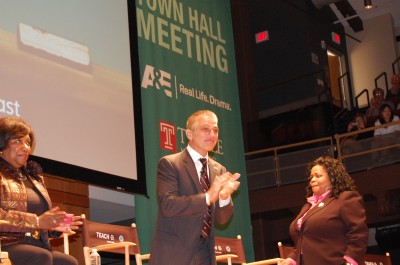
Danza reveals the wisdom of teaching under Duncan
This celebrity foolishness in education press releases is and has been crazy. Question for Mr. Duncan: How does having Tony Danza with you say anything about your commitment todiversifying teaching on a national level? How can you speak to the joys of teaching when you’ve never taught, Mr. Duncan?
“Addressing hundreds of high school and college students at Temple University, Duncan stressed the need to replace an estimated 1 million teachers expected to retire in the next few years.
He also emphasized the need to diversify the nation’s teaching ranks, noting that about 45 percent of American students are nonwhite while only 14 percent of teachers are in that demographic. Black men make up less than 2 percent of teachers in the United States.
‘We want our teachers to reflect the extraordinary diversity of this nation’s youth,” Duncan said.”
Let’s let the talking point sink in a bit while we deal with the reality of Duncan’s national policy on teacher recruitment. If anything should be a firm indicator of where Duncan stands on both
In education debates, especially these days, there is endless talk about spending – how to spend money, what programs to cut, and how to increase the bang-to-buck ratio. This is not surprising: In 2007-08 (the last year for which national U.S. Census data are available), we spent almost $600 billion. That’s quite a figure, and we all have an interest in spending that money wisely.
What is sometimes surprising is how little we hear about how we get that money. Of course, we all know that our tax dollars fund our public schools, and most of us know that state and local revenue is the primary source of this funding (about 90 percent; on average, about half state and half local). Less commonly-known, however, is who pays these bills – who bears the largest share of the tax burden, relative to their income? At the federal level, taxation is largely progressive, which means that, on the whole, higher-income families pay a larger percentage of their earned income to the federal government than lower-income families. This is, very simply, due to the fact that higher income brackets are taxed at higher rates.
But when it comes to state and local taxes, the picture is different. The poorest families pay far more of their
