Latest News and Comment from Education

Showing posts with label TESTING CONTACT TRACING. Show all posts

Tuesday, March 30, 2021

'Boogers down': Biden’s bid to reopen schools may hinge on ‘pooled’ testing - POLITICO

'Boogers down': Biden’s bid to reopen schools may hinge on ‘pooled’ testing - POLITICO
'Boogers down': Biden’s bid to reopen schools may hinge on ‘pooled’ testing
The process is meant to limit the spread of a potential outbreak while minimizing the costs of the frequent large-scale testing needed to keep the disease in check.


A growing number of the nation’s school districts are experimenting with a Covid-19 testing regime they hope will get millions of children back into their classroom — if they can keep up with the price tag.

The Biden administration’s $1.9 trillion Covid relief law is steering $10 billion toward developing a national school coronavirus testing strategy as its latest bid to reopen schools. That plan is still in flux but some attention has turned to the practice of “pooled” testing that uses a collection of swabs from a fixed group of kids attending classes together. The process is meant to limit the spread of a potential outbreak while minimizing the costs of the frequent large-scale testing needed to keep the disease in check. Pooled testing can extend testing capacity by testing groups of samples at once rather than each person individually. If a pool sample comes back positive, each individual in the pool is then tested.

Massachusetts is the only state to deploy a broad pooled testing program made available to all of its students and staff — about 1 million K-12 children and educators — to reopen this spring. For the first six weeks, the Bay State expects to spend somewhere between $15 million and $30 million doing pooled testing for about half of its more than 1,800 public schools that have opted in. When the state-funded program ends April 30, school districts will be able to funnel money in from the latest round of federal relief. A Rockefeller Foundation-funded study by Mathematica and RAND Corporation of early pooled-testing results found weekly testing of all students, teachers and staff can reduce in-school infections by an estimated 50 percent.

Similarly, in Maryland, Baltimore City Public Schools has put $5.7 million dollars from the federal stimulus toward launching its own program. Montgomery County Public Schools, the largest district in the state, is spending $5 million to kickstart one. CONTINUE READING: 'Boogers down': Biden’s bid to reopen schools may hinge on ‘pooled’ testing - POLITICO

Thursday, March 11, 2021

Rapid COVID Testing to Facilitate School Reopening - Year 2021 (CA Dept of Education)

Rapid COVID Testing to Facilitate School Reopening - Year 2021 (CA Dept of Education)
State Superintendent Tony Thurmond Underscores How Rapid COVID Testing Can Facilitate Safe Reopening of Schools


SACRAMENTO—State Superintendent of Public Instruction Tony Thurmond hosted a statewide webinar today with health experts and educators that addressed the use of rapid COVID-19 testing as a tool to safely resume in-person learning on school campuses.

“I strongly believe that while we wait for a full vaccine roll-out, we also need to be moving toward a strategy for the deployment of rapid COVID testing that is cost-effective for schools,” Thurmond said. “This is one tool in our tool box—but an important one. Rapid COVID testing is a game-changer. With mounting data that students are suffering from mental health issues and learning disruptions, rapid testing is a real help for districts looking for ways to get students safely back into classrooms.”

During the presentation, Thurmond shared how the use of BinaxNOW COVID-19 Cards, which provide test results in 15 minutes at a cost of $5 per test, will be used at the California Department of Education's (CDE) three State Special Schools to safely return students to in-person instruction.

Along with Superintendent Thurmond, other individuals who presented at today’s webinar were:

  • Dr. Charity Dean, Public Health Physician and past Co-Chair of the Governor’s Testing Task Force, who provided an overview of the BinaxNOW COVID-19 test and stressed the effectiveness of the tests.
  • Dr. Tony Iton, Senior Vice President of Healthy Communities at the California Endowment, who provided an overview of the rapid test pilot program that is currently underway with 11 school districts.
  • Roy Mendiola, Superintendent of the McSwain Union Elementary School District, who reported on his district’s positive experience using the rapid tests through the pilot program.
  • Lisa Constancio, Deputy Superintendent of Public Instruction at the CDE, who addressed funding sources available to school districts for rapid testing.

Ensuring schools can access regular testing has been at the forefront of Thurmond’s agenda since last fall. He has been in close contact with Governor Gavin Newsom and lawmakers to include those resources in the signing of AB 86, which provides $2 billion for schools to return to in-person learning by April 1.

Following the presentations, a question-and-answer session covered such topics as test accuracy and false positives, school eligibility for the tests, and student privacy. The entire event can be viewed on the CDE Facebook pageExternal link opens in new window or tab..

School districts can find more information on funding sources for the COVID tests on the CDE CARES Act Funding web page. For questions on rapid COVID testing or the webinar, email RapidTesting@cde.ca.gov.

# # # #

Tony Thurmond — State Superintendent of Public Instruction
Communications Division, Room 5602, 916-319-0818, Fax 916-319-0100


Monday, January 25, 2021

Reopen schools with COVID testing, teacher vaccines: Shah & Weingarten

Reopen schools with COVID testing, teacher vaccines: Shah & Weingarten
With robust testing, we can open schools this spring before the vaccine is widely available
We have spent months studying this problem and finding solutions. We know how to minimize risks enough for everyone to trust being back in a classroom.


Since the COVID-19 pandemic began, too many of America’s 51 million public school students have lost out. While educators and school staff have been Herculean, remote learning is not a substitute for in-school instruction: Up to 30% of students lack reliable Internet access in this country. As a result, too many elementary and middle school students are falling behind; absences are up and academic performance is down.

Even worse than the impact on learning, without a school’s support and services, more children are going hungry, are socially isolated and are suffering abuse or neglect at home. With each week out of school, the social and emotional costs increase, especially for low-income and minority kids.

The latest COVID-19 surge is a clear cause for concern, and it must be addressed before schools reopen for in-person instruction. Despite the devastating rise in cases, there is some good news when it comes to children and schools, particularly young children.

Data from the United States and abroad suggest that because of strong mitigation measures, schools are some of the safest places in a community, particularly with testing in place. Widespread, regular testing remains critical to school reopening, and combined with the right steps and federal support — even before the new vaccines are widely available — the nation’s more than 98,000 public schools could be open soon, getting students back to in-person learning. 

Testing and teacher vaccines CONTINUE READING: Reopen schools with COVID testing, teacher vaccines: Shah & Weingarten


Monday, December 7, 2020

How to Return to Campus Safely: Test, Then Test Again - The New York Times

How to Return to Campus Safely: Test, Then Test Again - The New York Times
How to Return to Campus Safely: Test, Then Test Again
Some colleges are using lessons from the fall to bring back more students in spring


This is the Coronavirus Schools Briefing, a guide to the seismic changes in U.S. education that are taking place during the pandemic. Sign up here to get this newsletter in your inbox.

The fall semester has been hell for most colleges — canceled classes, dorm closures, outbreaks and deaths. No one wants a repeat.

But the failures and rare successes of the semester might help universities prepare for next year. Many schools plan to bring more students back for the spring semester, even though coronavirus cases in their communities continue to rise.

In part, that’s a financial consideration: Students paying room and board are crucial for strained budgets. But it also reflects schools’ confidence that they have learned how to handle the pandemic.

A picture of successful campus containment has emerged: Maintain social distancing. Contact trace assiduously. Put more faith in students by calibrating restrictions properly.


The most important piece of the puzzle seems to be aggressive testing. Many colleges that ran their own testing programs successfully kept cases low; those that didn’t often became hot spots.

New England, home to many American colleges, could have had a disastrous semester. But colleges prioritized testing, with many joining a partnership with the Broad Institute, and kept cases low. In Vermont and Massachusetts, college presidents and officials credited aggressive testing regimens with low positivity rates on CONTINUE READING: How to Return to Campus Safely: Test, Then Test Again - The New York Times

Saturday, November 28, 2020

Contact Tracing Does NOT Prove Schools Are Safe During a Pandemic | gadflyonthewallblog

Contact Tracing Does NOT Prove Schools Are Safe During a Pandemic | gadflyonthewallblog
Contact Tracing Does NOT Prove Schools Are Safe During a Pandemic


“No close contacts were identified within the school district.”

That’s what it says on today’s email from my district reporting that two elementary staff and one student tested positive for COVID-19.

That’s what it said on Tuesday’s email about a different elementary staff member testing positive.

And the email from last Sunday about two elementary staff, and last Monday about a middle school staff member, and the one from Nov. 19 about an entire Kindergarten class and its teachers being quarantined.

Actually, that last email said the outbreak was limited to the Kindergarten class and teachers – that no close contacts were identified beyond its doors, in the building or the wider district as a whole.

However, considering that at least five more elementary teachers and another student tested positive later, I’m not sure I believe it.

All of which prompts the question – how accurate is contact tracing?

How Contact Tracing Works CONTINUE READING: Contact Tracing Does NOT Prove Schools Are Safe During a Pandemic | gadflyonthewallblog


Sunday, November 15, 2020

NYC Educator: NYC School COVID Testing Is a Scam

NYC Educator: NYC School COVID Testing Is a Scam
NYC School COVID Testing Is a Scam


We can argue about how effective testing plans are. Should we do it weekly? Every other week? Monthly? Which percentage do we need to test at a time? Should we vary depending on the rate of positivity? These are all valid concerns. I'm not an expert or a medical professional, and I'd defer to the opinions of those who are. 

Everything I hear, though, tells me that however we answer the above, things are far from kosher in the Big Apple. Mayor de Blasio and Chancellor Carranza are constantly paying valuable lip service to just how much they care about the safety of students and staff. Carranza writes us flowery letters saying how much he cares about us even as he tries to pick a billion dollars from our collective pocket. Meanwhile, I can only suppose we aren't supposed to pay attention to actual conditions on this astral plane.

It's my understanding, from multiple sources now, that those who do the testing have numbers they need to hit. I'm not sure exactly how they arrive at these numbers, but once they reach whatever their quotas happen to be, they are gone. That's fine. If we have a hundred people and they need to do 20% a week, they therefore need to test 20 people a week. 

In fact, in our school, they initially favored coming in on Fridays. There are very few people in our building on Fridays. That's a day we reach out to students with special needs or issues, and the pool of students and staff in our building is by no means representative. It took them weeks to remedy that, though it should've been one simple conversation. While that may be representative of their lack of competence, that's not even the main CONTINUE READING: NYC Educator: NYC School COVID Testing Is a Scam

Saturday, October 10, 2020

Our First Student Tests Positive for COVID-19 | deutsch29: Mercedes Schneider's Blog

Our First Student Tests Positive for COVID-19 | deutsch29: Mercedes Schneider's Blog

Our First Student Tests Positive for COVID-19


We made it longer than I thought we would.
Our first day with students was September 08, 2020. One month later, on October 09, 2020, my Louisiana high school had its first case of a student testing positive for coronavirus.
I appreciate the way in which the situation was handled. Our administration did not leave the issue to ferment in rumors. Instead, faculty received an email about a robocall sent to us and one to parents informing that a student (identity not released) tested positive for the virus, and that a local health agency has been informed and is guiding the process of contact tracing, which involves identifying students and faculty who were within six feet of the infected student for more than 15 minutes and instituting 14 days of quarantine for those individuals in order to combat potential spreading of the virus on our campus.
Such tracing is enabled by classroom seating charts that teachers are required to provide to admin for this very purpose. (The email also reminded faculty of the importance of keeping accurate attendance and updating seating charts.)
I also appreciate that having approximately half of the student body on campus enables individuals to maintain social distancing; that masks are mandatory (and that most individuals wear their masks consistently and correctly), and CONTINUE READING: Our First Student Tests Positive for COVID-19 | deutsch29: Mercedes Schneider's Blog

Wednesday, October 7, 2020

NYC Educator: If You Like the DOE, You'll Love Trump

NYC Educator: If You Like the DOE, You'll Love Trump

If You Like the DOE, You'll Love Trump


So the DOE now says that testing isn't, you know, mandatory for students, but that those who decline, "may be required to learn remotely" if they don't receive enough forms. Of course, that defeats the entire purpose of the testing program, as random samples are not self-selected. Also, that's absolutely not the agreement they made with UFT. UFT will now have to waste time and energy enforcing yet another agreement the DOE made but doesn't care to understand.

Anyway, if you like agreements that work like that, you need to vote for President Trump. He's out there saying there will be no relief bill until after he's re-elected. I'm old enough to remember 2016, when he said he would release his tax returns if he were elected. I remember him saying Mexico would pay for the wall. I remember him saying he had a great health plan that would protect those with pre-existing conditions. It turned out his plan was for everyone to get sick and die ASAP. 

In fact, he's still saying he has a plan. Meanwhile, 210,000 Americans are dead because he's failed to make a national plan to deal with COVID. Originally, he decided not to bother because it looked to his thugs like it would only affect blue states. That's us, of course. We didn't vote for him so we can all go to hell. I guess if you're sufficiently racist or xenophobic, Trump's willingness to give a wink and a nod and say that's fine is kind of comforting. 

Of course if you're a teacher, there are other reasons not to vote for Trump. Trump is a big supporter of so-called right to work, and if you aren't persuaded of that you need only look at the Janus case, which overturned Abood nationally and made union membership optional. After all, why should you pay dues when suckers like me will do it for you? Why shouldn't you enjoy benefits that the rest of us pay for? That's the Trump way. Who do you think pays for all those golf trips he takes? 

Here's the thing, though--when Abood was in force, individual states could opt out via "right to work." This weakened union and made it difficult for working people to organize. Less union means lower pay and fewer benefits for working Americans. That's precisely what CONTINUE READING: NYC Educator: If You Like the DOE, You'll Love Trump

Wednesday, September 23, 2020

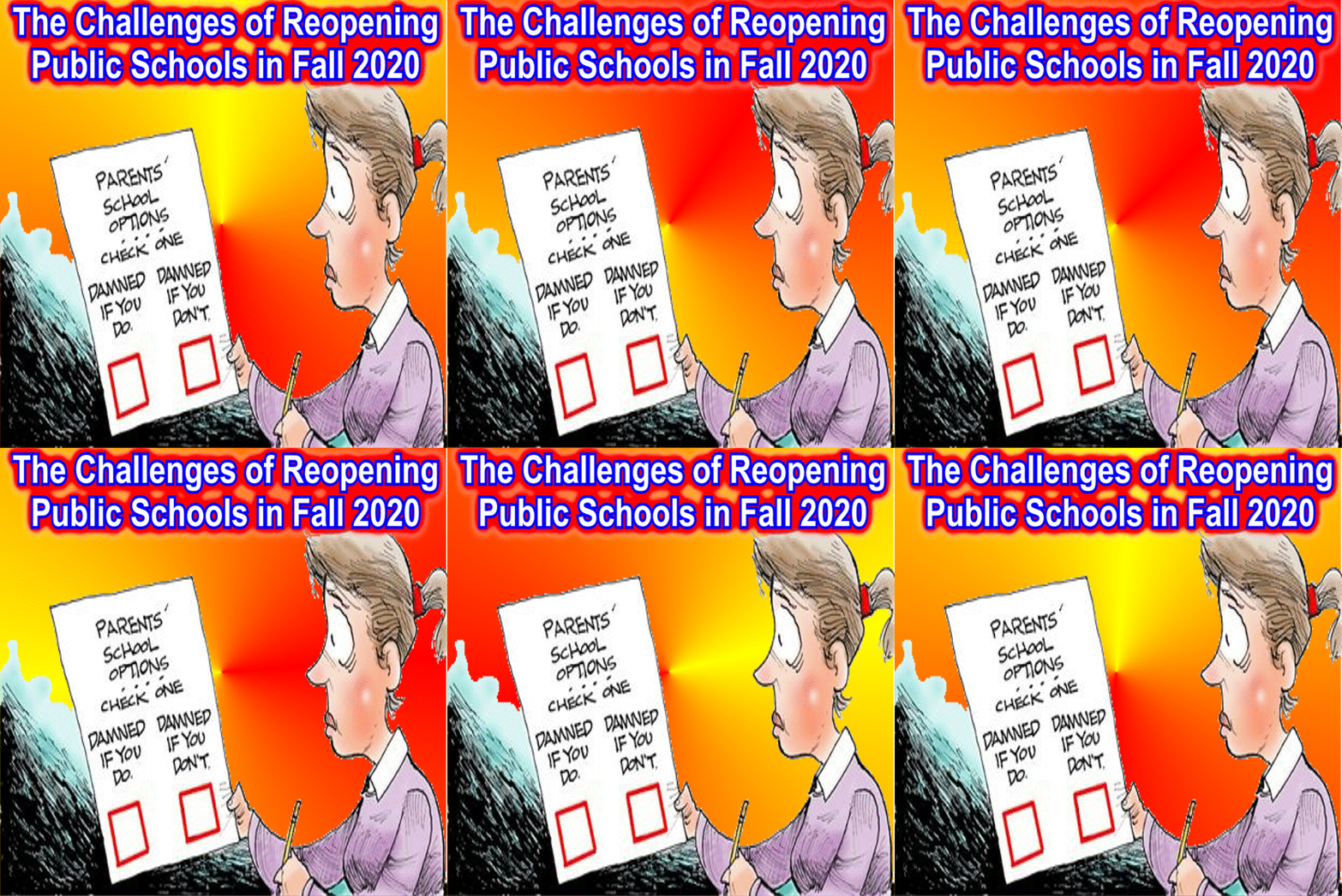
The Challenges of Reopening Public Schools in Fall 2020 | janresseger

The Challenges of Reopening Public Schools in Fall 2020 | janresseger

The Challenges of Reopening Public Schools in Fall 2020


It’s hard to get a handle on how reopening public schools this autumn is going across the United States. A lot of blame and anger is floating around—for botched plans on the one hand and COVID-19 outbreaks on the other. Nobody endorses full-time remote learning, but it seems to be the reality in most places, especially in the nation’s biggest school districts where school operations on a huge scale complicate the best intentions of the people trying to work it all out.
On Monday to examine trends across the country, the NY Times published a major analysis including charts and maps of several states. The conclusion: “Schools are not islands, and so it was inevitable that when students and teachers returned this fall to classrooms, coronavirus cases would follow them. But more than a month after the first school districts welcomed students back for in-person instruction, it is nearly impossible to tally a precise figure of how many cases have been identified in schools.”
Just as the Trump administration has failed to institute national COVID-19 testing and contact tracing across the states, the Trump administration also failed, during many months before schools were scheduled to reopen this fall, to convene health and education experts with state school superintendents, local superintendents, principals and school teachers to listen to their concerns and plan for contingencies.  While the states are, through the mandates of their own constitutions, themselves responsible for providing “a thorough and efficient system of common schools” (the language in several of the state constitutions), some effort at least to coordinate school opening plans with broader testing and contact tracing would have made things smoother. The NY Times reports that there has been no systematic collection of data and in many places no reporting of data: “In an effort to better account for virus cases in Kindergarten through 12th grade, The New York Times set out to collect data from state and local health and education agencies and through directly surveying school districts in eight states. Our goal was to understand, as well as possible, how prevalent the virus was in CONTINUE READING: The Challenges of Reopening Public Schools in Fall 2020 | janresseger

Monday, September 7, 2020

Why Does Trump Hate COVID Testing But Love Standardized Testing? | gadflyonthewallblog

Why Does Trump Hate COVID Testing But Love Standardized Testing? | gadflyonthewallblog

Why Does Trump Hate COVID Testing But Love Standardized Testing?


When it comes to COVID-19, Donald Trump sure hates testing.
But when it comes to public schools, his administration simply adores standardized testing.
Why the discrepancy?
Why is testing for a virus during a global pandemic bad, but giving students a multiple choice test during the chaos caused by that pandemic somehow good?
When it comes to the Coronavirus, Trump has made his position clear.
In a June 15 tweet, Trump wrote that testing “makes us look bad.”
Five days later at his infamous campaign rally in Tulsa, he said he had asked his “people” to “slow the testing down, please.”
At one of his White House press briefings, he said, “When you test, you create cases.”
In his infamous Fox News interview with Chris Wallace, he seemed to be saying that the U.S. had just as many new cases now as it did in May. However, since there were fewer tests done in May and more are being done now, it only appears that the CONTINUE READING: Why Does Trump Hate COVID Testing But Love Standardized Testing? | gadflyonthewallblog

Monday, August 17, 2020

Can Los Angeles Schools Test 700,000 Students and 75,000 Employees? That’s the Plan - The New York Times

Can Los Angeles Schools Test 700,000 Students and 75,000 Employees? That’s the Plan - The New York Times

Can Los Angeles Schools Test 700,000 Students and 75,000 Employees? That’s the Plan
Classes will start remotely. But the nation’s second-largest school district has perhaps the most ambitious plan to test students and employees for the coronavirus.


Amid public alarm over the inadequacy of coronavirus testing across the nation, Los Angeles schools on Monday will begin a sweeping program to test hundreds of thousands of students and teachers as the nation’s second-largest school district goes back to school — online.
The program, which will be rolled out over the next few months by the Los Angeles Unified School District, will administer tests to nearly 700,000 students and 75,000 employees as the district awaits permission from public health authorities to resume in-person instruction, said Austin Beutner, the district’s superintendent.
It appears to be the most ambitious testing initiative so far among major public school districts, most of which are also starting school remotely but have yet to announce detailed testing plans.
New York City, where the virus has been under control, is the only major school district in the country planning to welcome students back into classrooms part time this fall. The city is asking all staff members to be tested before school starts on Sept 10 and has said it will provide expedited results.

Staff members should be tested regularly throughout the school year, New York City has said. It is not yet clear how often students will be tested or whether the city will take random samples from the 1.1 million children at its 1,800 public schools.
Mr. Beutner said that Los Angeles’s program, developed over the past four months, would begin this week, well before schools are expected to let students into classrooms, and that it would augment — and probably far exceed — existing testing efforts run by the city and county of Los Angeles. CONTINUE READING: Can Los Angeles Schools Test 700,000 Students and 75,000 Employees? That’s the Plan - The New York Times

Tuesday, August 11, 2020

Indiana Education Head On Reopening Schools: Contact Tracing Is A 'Beast'

 Indiana Education Head On Reopening Schools: Contact Tracing Is A 'Beast' | 89.3 KPCC

Indiana Education Head On Reopening Schools: Contact Tracing Is A 'Beast'


In Indiana, school has started up for many students — or will in the next week. It's one of a majority of states where local districts will make most of the decisions about what school will look like this year.

Many districts across the state are bringing students back in person but are also offering online learning for those nervous about returning. Schools have already recorded positive coronavirus cases since reopening and had to adjust their plans, including shutting down temporarily.

In-person or online, staggered schedules and hybrid models, different criteria for when to open and when to shut back down — plans are changing "nonstop, which is frustrating for everybody involved," says Jennifer McCormick, who heads the Indiana Department of Education.

For students and staff who attend in person, and their families, contact tracing is key to keeping coronavirus cases down, public health experts say.

But McCormick tells NPR that that in particular has been one of the biggest challenges.

"That contact tracing is a beast," she tells Steve Inskeep on Morning Edition. "And in order to manage that and have the people to do it is really hard. And then on the CONTINUE READING:  Indiana Education Head On Reopening Schools: Contact Tracing Is A 'Beast' | 89.3 KPCC

Wednesday, August 5, 2020

Contact tracing is hard – harder if you don’t know how high school works | JD2718

Contact tracing is hard – harder if you don’t know how high school works | JD2718

Contact tracing is hard – harder if you don’t know how high school works


The NYC DoE wrote this about contact tracing:
Tracing: In the event of a confirmed COVID-19 case in a school, NYC Test + Trace and NYC Health will investigate to determine close contacts within the school. All students and teachers in the classroom with the confirmed case are assumed close contacts and will be instructed to self-quarantine for 14 days since their last exposure to that case. In older grades where students may travel between classes, this applies to all classes that the confirmed case was in.
In older grades where students may travel between classes, this applies to all classes that the confirmed case was in.
Help me out here. “all classes that the confirmed case was in” – what do they mean? The rooms? Did they mean to say “all students who shared a class with the person with a confirmed case?” + “all teachers who taught that person?”
Why am I convinced that no one working on the NYCDoE plans has ever been to a high school?
Contact tracing is hard – harder if you don’t know how high school works | JD2718

Friday, July 31, 2020

Mike Klonsky's Blog: The kind of testing we need

Mike Klonsky's Blog: The kind of testing we need

The kind of testing we need


I went and got tested at one of the many free, drive-through, city-run, partnership testing centers. How great to be in a city where tests are free and available to all. Thanks, Mayor Lightfoot, for your leadership on this front and for making sure that the city has enough test kits.  

It was an easy process -- mouth swab instead of nasal poke -- without a doctor's prescription. The last point is important since so many people lack health insurance and can't afford to see a doctor. If there was ever a case to be made for Medicare For All, this horrific pandemic makes the case.

The best part was getting my negative (no COVID) test results back within 48 hours. The private clinics and testing sites offered 5-7 day returns.

You will rarely hear me say this, but Bill Gates is right on this one. Most U.S. coronavirus tests are a “complete waste” because it takes so long to get results in time for people to self-isolate once they find out they have the virus. 

It's borderline criminal... that both presidential candidates, as well as the leadership of our CONTINUE READING: Mike Klonsky's Blog: The kind of testing we need

Thursday, June 11, 2020

Pandemic-Stricken Schools Tell Senate They Need Help to Reopen - The New York Times

Pandemic-Stricken Schools Tell Senate They Need Help to Reopen - The New York Times

Pandemic-Stricken Schools Tell Senate They Need Help to Reopen
The Senate Education Committee held a hearing on returning to “normalcy” this fall, but education leaders said they were struggling with budget cuts and demands to meet health guidelines.


WASHINGTON — Without a large federal investment in the nation’s public school system, districts hit hard by the coronavirus will struggle to meet the needs of their pupils this fall as they try to reopen their doors, educators told a Senate panel on Wednesday.
In testimony before the Senate Health, Education, Labor and Pensions Committee, education leaders from around the country said budget challenges were among their chief concerns as they drafted plans to resume in-person classes. That is particularly true for students who have borne the brunt of the economic, educational and racial injustices that have been exacerbated by the pandemic.
Across the country, school leaders are beginning to roll out plans to welcome more than 50 million students back, which include procuring 50 million masks; flooding schools with nurses, aides and counselors; and staggering schedules to minimize class size. But the high-dollar demands to meet public health guidelines and make up for setbacks that have disproportionately affected low-income students, students of color and those with disabilities could cripple their budgets.
“At a time when our kids and our communities need us most, we are having to make massive cuts,” Susana Cordova, the superintendent of Denver Public Schools, told senators. Additional funding would be essential, she said: “We must double down for those who have been most impacted by the Covid crisis if we are to deliver on the promise of education to create a more equitable society.” CONTINUE READING: Pandemic-Stricken Schools Tell Senate They Need Help to Reopen - The New York Times

Monday, June 8, 2020

Will Congress Provide Fiscal Relief to Public Schools at an Austerity, Subsistence, or Investment Level? | janresseger

Will Congress Provide Fiscal Relief to Public Schools at an Austerity, Subsistence, or Investment Level? | janresseger

Will Congress Provide Fiscal Relief to Public Schools at an Austerity, Subsistence, or Investment Level?


In a NY Times column last week, David Brooks responded to the tragic police killing of George Floyd, a handcuffed black man, and the massive protests responding to the evident racism and inequality that underpin our society: “This moment is about police brutality, but it’s not only about police brutality. The word I keep hearing is ‘exhausted.’ People are exhausted by and fed up with the enduring wealth disparities between white and black, with the health disparities that leave black people more vulnerable to Covid-19, with the centuries-long disparities in violence and the threat of violence, with daily indignities on African-Americans and stains that linger on our nation decade after decade. The killing of George Floyd happened in a context—and that context is racial disparity. Racial disparity doesn’t make for gripping YouTube videos. It doesn’t spark mass protests because it’s not an event; it’s just the daily condition of our lives. It’s just a condition that people in affluent Manhattan live in one universe and people a few miles away in the Bronx live in a different universe. It’s just a condition that many black families send their kids to struggling inner-city schools while white families move to the suburbs and put on black T-shirts every few years to protest racial injustice.”
Brooks correctly identifies the problem: Structural inequality, segregation, and racism permeate our society.  But when it comes to a solution, Brooks looks to individuals, grants to neighborhood groups, and social entrepreneurship. Despite that injustice always involves systemic problems and that justice requires eliminating disparities in the system itself, Brooks suggests national service programs for young people, an endowment for civic architecture, Moving to Opportunity Grants, and even the Betsy DeVos solution, education savings account school vouchers for private education services (with the money coming out of public school CONTINUE READING: Will Congress Provide Fiscal Relief to Public Schools at an Austerity, Subsistence, or Investment Level? | janresseger

Saturday, June 6, 2020

Upcoming Webinar: Stronger Together: A Guidebook for the Safe Reopening of California’s Public Schools - Letters (CA Dept of Education)

Release of Guidance Document and Upcoming Webinar - Letters (CA Dept of Education)

Stronger Together: A Guidebook for the Safe Reopening of California’s Public Schools


Dear Education Leaders and Stakeholders:

Release of Guidance Document and Upcoming Webinar

I am proud to announce that on Monday, June 8, the California Department of Education (CDE) will release our guidance document, “Stronger Together: A Guidebook for the Safe Reopening of California’s Public Schools.” We look forward to offering this guidance as a “how to” as you work with your local public health experts and school communities to navigate next steps and implement the recommendations we have provided.
We want to ensure you have the support you need as you review this guidance next week. You are invited to a special webinar to coincide with the release. In this webinar, CDE team members will walk through our document’s key tools and recommendations as well as answer your questions. Here is how to participate:
What: Webinar for local educational agency (LEA) leaders
When: 10 to 11 a.m., Monday, June 8
Register: This is an invitation-only webinar, and space is limited. A Zoom registration link will be provided later today.
We want to provide you with a partial view of what you can expect to find in the guidance document. The guidance will include some items we discussed at the all-LEA meeting we hosted on May 21, 2020, and that we have been discussing publicly and at stakeholder meetings over the course of the last few weeks. For example, the guidance document will include the following recommendations:
  • Face coverings: Students and staff should wear face coverings during all educational activities (at school or on a bus).
  • Physical distancing: Students and staff should engage in physical distancing (at least six feet of spacing between seats and in hallways and on buses) at all times.
  • Symptom screening: School districts should identify staff who can take temperatures for students and staff before they enter the campus.
CDE has heard from many LEAs that they may plan to provide some form of in-person instruction and distance learning. Our document will also provide in-depth considerations for designing high-quality and equitable instructional practices for all learners while arranging students and staff in the many new ways that will be needed in order to facilitate physical distancing guidelines.
We recognize that there are fiscal implications for schools to reopen safely with these physical distancing guidelines in place. LEAs will need steady revenue (for staffing and personal protective equipment)on which to rely and flexibility on instructional minutes. We are advocating for and have engaged in dialogue with the Governor’s Office, the Department of Finance, the Legislature, and educational stakeholders regarding the resources necessary to reopen safely with physical distancing measures in place.
Thank you for all you are doing to support the health, safety, and academic success of our students. I look forward to the next steps of our work together to implement this guidance safely.
Sincerely,
Tony Thurmond
State Superintendent of Public Instruction
Release of Guidance Document and Upcoming Webinar - Letters (CA Dept of Education)