Latest News and Comment from Education

Showing posts with label VENTILATION. Show all posts

Thursday, April 22, 2021

NANCY BAILEY: Will America Invest in Public School Buildings, Finally?

Will America Invest in Public School Buildings, Finally?


How will the Biden administration manage a public school facelift? Is $100 billion enough? Will communities see a windfall of funding dedicated to this purpose? Will corporate partnerships help? Will Americans see it as an equity issue?

Covid-19 showed Americans the importance of public schools, but they still might not understand the crumbling conditions found in many of those buildings. How many teachers and students face substandard classrooms?

Epidemiologists and pediatricians continue to speak about classroom mitigation strategies like they’re easy, while teachers frantically describe sealed windows or classrooms with no windows. Overcrowded classrooms make safe instruction unthinkable. Lousy HVAC systems in schools became a national disgrace.

America’s schools have been allowed to deteriorate for years. Even newer school buildings have depreciated due to deferred maintenance. Powerful people want students to prove they can do well on tests, but they don’t consider how the conditions CONTINUE READING: Will America Invest in Public School Buildings, Finally?

Sunday, March 7, 2021

School Buildings are Reopening but Where’s the Data? – Parents United for Public Education

School Buildings are Reopening but Where’s the Data? – Parents United for Public Education
School Buildings are Reopening but Where’s the Data?


The first 53 school buildings are reopening tomorrow for children for the first time in almost a year, despite ongoing concerns about the amount of information and up to date data that is not publicly available for parents to review. Reports on social media of filthy and mold-covered vents and classrooms show that many of the conditions of reopening have not been met.

We’re glad that the Philadelphia Federation of Teachers has provided public information about their “vetting” process, such as this excerpt that shows the criteria used to “clear” classrooms and schools for occupancy by students:

Screenshot of PFT document outlining procedures for “clearing” rooms for re-occupancy with added annotation. Source link: https://www.pft.org/sites/default/files/reoccupancyprocedure.pdf

However, we have not seen clear, up to date evidence that the PFT’s requirements CONTINUE READING: School Buildings are Reopening but Where’s the Data? – Parents United for Public Education

Monday, February 15, 2021

COVID Reopening and Building Safety Questions – Parents United for Public Education

COVID Reopening and Building Safety Questions – Parents United for Public Education
COVID Reopening and Building Safety Questions


During our recent set of webinars about Philadelphia schools’ facility conditions and safety, we had the opportunity to share information and hear questions from many caregivers and educators. (View a video of the Facebook Live recording of the webinar.)

Folks continue to be very concerned about long-term issues such as lead, asbestos, mold, and water quality, while also facing many unanswered immediate questions about safety precautions for reopening buildings in the midst of COVID-19.

Unfortunately, while we were able to gather many of these questions, we ultimately cannot answer most of them. They should be answered, but by district leadership, in public.

We’ve compiled a list below that summarizes the questions that were asked during our webinars. We encourage caregivers to reach out to city council and the school board to continue pushing for answers. It is critical that parent voices are heard!

In addition, please sign up to testify at the City Council hearing “Safely Reopening Schools” on 2/17/21 by emailing Nick.Spiva@phila.gov or calling 215-686-3420. You can also share your questions and concerns about the district’s current hybrid re-opening plan with Councilperson Gym via this form. 

The questions below are lightly edited for clarity and to combine/ remove duplicate topics. They were submitted via the Q&A function during the webinars and do not necessarily reflect the questions or priorities of Parents United as an organization.

Questions About General Facility Safety CONTINUE READING: COVID Reopening and Building Safety Questions – Parents United for Public Education

Sunday, February 7, 2021

Open Letter to Dr. Hite Regarding School District Facility Issues + Parents United Response to the SDP Reopening Plan – Parents United for Public Education

Open Letter to Dr. Hite Regarding School District Facility Issues – Parents United for Public Education
Open Letter to Dr. Hite Regarding School District Facility Issues


Dr. William Hite
Superintendent, School District of Philadelphia

2/20/2020

Dr. Hite:

We, Parents United for Public Education, are deeply concerned with multiple aspects of the facility issues notification process, clean up procedures, and lack of parental involvement in the district’s latest school closures. There is a continued lack of transparency around how hazards are identified, and the procedures for and outcomes of the testing that deems that threats have been cleared. We have spoken with parents in the affected schools about the information given to them by the facility managers and they have expressed similar concerns.

As members in the Philly Healthy Schools Initiative coalition, we are attempting to work with your staff to develop effective information sharing, communication, transparency, and stakeholder involvement. We are aware that there is a great deal of poor communication and miscommunication between the district staff and the school communities. There are also noted inconsistencies between the individual environmental inspectors who are tasked with identifying “imminent hazards.”

In addition, there is a general lack of forethought and planning for how to answer logical questions and provide information regarding the health and welfare of individuals in the school communities impacted by these closures or remediation work. As we have seen over and over again in person and in reporting on these issues, the front line district officials are not adequately able to inform parents and teachers about the level of exposure or any potential medical follow up CONTINUE READING: Open Letter to Dr. Hite Regarding School District Facility Issues – Parents United for Public Education


We, like so many, are spending a lot of our time thinking about reopening schools safely. We are still trying to process last week’s Board of Education meeting in which over a hundred parents, students, and staff spoke about the need for a consciously safe return to education, only to be met with what appeared to be a coordinated plan to dismiss their concerns and delay Board action. There are clearly significant questions about the district’s ability to provide an adequate education and minimize COVID-19 exposure risk.

Parents and students have reason to be leery of the district’s reopening plan; the district’s trust problem with its stakeholders is not new. The School District of Philadelphia has a history of decision-making that ignores the input of families and educators while putting students and educators at risk. It is not hyperbole to say that people have died and will die due to the conditions in our schools.

In 2011, due to draconian cuts in state funding, our district shuttered libraries and after school programs and eliminated thousands of essential positions including school nurses. We were told then to make do with less. We were told that high CONTINUE READING: Parents United Response to the SDP Reopening Plan

VIDEO: Sacramento City Unified Air Cleaner Controversy – CBS Sacramento

Sacramento City Unified Air Cleaner Controversy – CBS Sacramento
Sacramento City Unified Air Cleaner Controversy


The Sacramento City Teachers Association claims hundreds of air purifiers have been removed from classrooms for testing after the district spent millions on the machines.


Thursday, December 10, 2020

Ventilation is the key to helping students, staff and families stay safe - SF PUBLIC SCHOOL MOM

Ventilation is the key to helping students, staff and families stay safe - SF PUBLIC SCHOOL MOM
Ventilation is the key to helping students, staff and families stay safe


Thoughts on SFUSD’s Return Safely to School Together Plan

Last night district staff shared a plan for bringing students back to schools for in-person learning. Click the following links to see the proposed plan and presentation. (When the conversation becomes available via SFGovTV I will post it as well below.)

Click the image above to read the draft plan presented to the Board.

In reviewing the presentation, I made a request at the meeting for the plan to incorporate several revisions focused on increasing student and staff safety in returning to schools in the following areas: ventilation, masking and family agreements in following preventative measures, and testing availability.

Anyone who watched our hours-long discussion on school reopening last night knows each topic is deserving of its own lengthy discussion. In the interest of educating the public, I wanted to share my recommendations and our Board’s incorporated input into the final plan which we will approve next week.

Ventilation is the key to preventing the spread of Covid-19

I believe SFUSD’s ventilation plans must address air exchange rates ensure all classrooms meet health and safety recommendations recommended by health experts. (The World Health Organization recommends six times per hour,  and the SF Department of Public Health shared a recommendation of four times per hour at the last Joint Select Meeting on Friday, November 13, 2020. See my discussion with SF Department of Public Health staff starting at 58:05.) CONTINUE READING: Ventilation is the key to helping students, staff and families stay safe - SF PUBLIC SCHOOL MOM

Wednesday, November 25, 2020

The importance of clean air in classrooms—during the pandemic and beyond - Brookings

The importance of clean air in classrooms—during the pandemic and beyond


The COVID-19 pandemic has brought about an increased focus on public health, particularly in school settings. From social distancing to testing regimes, education leaders are making serious changes to ensure that schools are safe for students, staff, and teachers. As the school experience continues to be reinvented, research points to an overlooked but potentially critical factor when thinking about reopening: air quality. While we have known for some time about the negative effects of air pollution on child health, recent evidence indicates that pollution also has detrimental effects on student learning. In turn, these relationships suggest the potential for some highly cost-effective interventions to raise student performance—and keep kids safer during the pandemic.

EVIDENCE ON THE EFFECTS OF POLLUTION ON COGNITION

To date, most research has linked pollution to student learning using variation in outdoor air pollution. Researchers (see here and here) have documented significant declines in test scores when students take tests on days with high levels of particulate pollution. Another study compared students attending schools downwind relative to upwind of highways and found that increased air pollution from being downwind lowered test scores and raised behavioral incidents and absences. Similarly, in a recent working paper, a co-author and I use year-to-year variation in power production combined with wind direction to show that pollution from coal-fired power plants lower students’ test scores. CONTINUE READING: The importance of clean air in classrooms—during the pandemic and beyond

Monday, November 9, 2020

What a Lovely Day | JD2718

What a Lovely Day | JD2718
What a Lovely Day


The sun is shining. People are in good moods, for obvious reason. The leaves are still on the trees, but in an array of greens, yellows, oranges, reds…

When we go to school tomorrow (many of us) the windows will be open, allowing the lovely New York City air to fill our rooms, replacing the air we exhale…

If someone is spreading the virus, it gets into the air, attached to droplets and aerosols and all those technical things that really just mean “floating bits of virus.” Now, just because it is present, that doesn’t mean you get sick. That depends, at least partly, on how much is present, and how long it hangs around.

That’s where the lovely weather comes in. Open your windows, and a small difference between pressure inside and outside will move the air. The more times each hour you get a fresh batch of outside air replacing the air you and your students have exhaled, the safer you are.

You are also on the safer side if the number of people in the room with you is low. I hear that only a quarter of NYC students are physically attending school – the majority are learning on-line. And even those quarter – they don’t come every day. They might come every other, or every third, or less. That puts our schools daily somewhere under 10% of capacity – which is pretty good for limiting the spread of the virus.

You can also filter the air. Not really “you” – the school can. But the filters would need to be HEPA or CONTINUE READING: What a Lovely Day | JD2718

Friday, November 6, 2020

Chicago Public Schools to Reopen After Installing Air Purifiers | Diane Ravitch's blog

Chicago Public Schools to Reopen After Installing Air Purifiers | Diane Ravitch's blog
Chicago Public Schools to Reopen After Installing Air Purifiers


Chicago Public Schools are ready to open, according to officials.

CHICAGO — Chicago Public Schools said classrooms are ready for students and teachers to safely return Wednesday after the district installed air purifiers and took other measures to prevent the spread of COVID-19.

Last month, the Chicago Teachers Union said neither teachers nor students should return to class because school buildings are old and not designed to sufficiently ventilate and purify air during a pandemic.

CPS said it addressed those concerns by spending $8.5 million to put a HEPA air purifier in every classroom. District officials said the 20,000 purifiers are capable of removing “99.9% of ultrafine particles,” including airborne mold, bacteria and viruses like COVID-19. 

Additionally, CPS officials said the district implemented CONTINUE  READING: Chicago Public Schools to Reopen After Installing Air Purifiers | Diane Ravitch's blog

Sunday, October 18, 2020

Schools and the Pandemic Recession | Larry Cuban on School Reform and Classroom Practice

Schools and the Pandemic Recession | Larry Cuban on School Reform and Classroom Practice

Schools and the Pandemic Recession


As a tempered optimist about the power of schools to shape the lives of both adults and children, this post, I confess, will depress readers. Stop reading if you already feel blue during the pandemic.
I have no upbeat news. For schools, as for the rest of the economy, the news is downbeat. Uncertainty continues to surround any prevention and treatment of Covid-19. The lack of any coherent guidelines for opening schools and proper ways of dealing with the stubborn virus from the President and U.S. Secretary of Education is shocking in its negligence of an institution critical to the nation’s future.
Of even greater importance is that the President and Congress have yet to agree on a stimulus package to reduce unemployment and rescue small and medium-sized businesses from permanent closure. And with the election weeks away, chances of another federally funded trillion dollar-plus infusion into the economy, including schools is, well, dim. Already states–the primary funder of public schools across the nation’s 13,000-plus districts–have begun to either CONTINUE READING: Schools and the Pandemic Recession | Larry Cuban on School Reform and Classroom Practice

Wednesday, October 14, 2020

CURMUDGUCATION: Orphaned Education, Forgotten Children

CURMUDGUCATION: Orphaned Education, Forgotten Children

Orphaned Education, Forgotten Children


These are depressing times. Let me tell you why I'm bummed, but first, let me tell you a story.

Almost a decade ago, I was the local union president during a contentious contract negotiation that became a strike. That was probably the lowest part of my teaching career. If you've taught for more than a year or two, you know, somewhere back in the back of your mind, that a lot of people are not really pulling for you, don't really respect the work you do, don't think you should get all uppity about wanting good wages, good working conditions, some sort of say in how the work is done. 

You know all that, but you put your head down, focus on the work, the students, the people out there who respect and value the work you're doing. There are plenty of them, sure enough. But those others. You know they're out there, in many cases in positions of power, but like I said--you keep your head down. But during the strike, I couldn't ignore them. They stopped me on the street, called me at home. I had to look right into that dark maw, and it was deeply disheartening. 

I feel like we're back there again. Seven months of this pandemess, and I think we've become numb, used to just how much education and children is NOT part of the ongoing concerns before us at the moment. On the one hand, it's not news--public education has been a political orphan for at least thirty or forty years. Go ahead--name a prominent political figure who's known for being a champion of public education. Name a Secretary of Education who did their utmost to stand up for public CONTINUE READING: CURMUDGUCATION: Orphaned Education, Forgotten Children

Wednesday, September 23, 2020

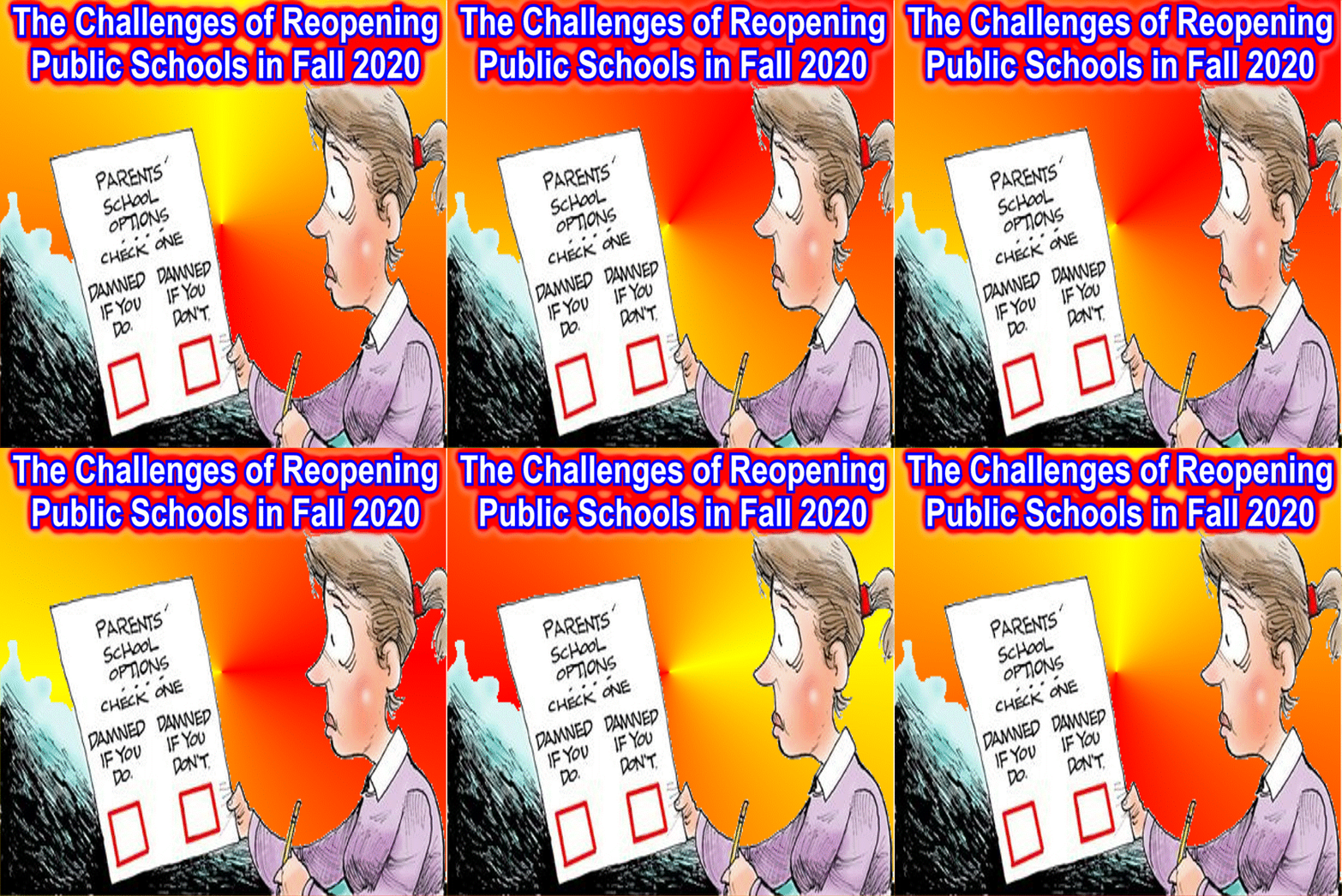
The Challenges of Reopening Public Schools in Fall 2020 | janresseger

The Challenges of Reopening Public Schools in Fall 2020 | janresseger

The Challenges of Reopening Public Schools in Fall 2020


It’s hard to get a handle on how reopening public schools this autumn is going across the United States. A lot of blame and anger is floating around—for botched plans on the one hand and COVID-19 outbreaks on the other. Nobody endorses full-time remote learning, but it seems to be the reality in most places, especially in the nation’s biggest school districts where school operations on a huge scale complicate the best intentions of the people trying to work it all out.
On Monday to examine trends across the country, the NY Times published a major analysis including charts and maps of several states. The conclusion: “Schools are not islands, and so it was inevitable that when students and teachers returned this fall to classrooms, coronavirus cases would follow them. But more than a month after the first school districts welcomed students back for in-person instruction, it is nearly impossible to tally a precise figure of how many cases have been identified in schools.”
Just as the Trump administration has failed to institute national COVID-19 testing and contact tracing across the states, the Trump administration also failed, during many months before schools were scheduled to reopen this fall, to convene health and education experts with state school superintendents, local superintendents, principals and school teachers to listen to their concerns and plan for contingencies.  While the states are, through the mandates of their own constitutions, themselves responsible for providing “a thorough and efficient system of common schools” (the language in several of the state constitutions), some effort at least to coordinate school opening plans with broader testing and contact tracing would have made things smoother. The NY Times reports that there has been no systematic collection of data and in many places no reporting of data: “In an effort to better account for virus cases in Kindergarten through 12th grade, The New York Times set out to collect data from state and local health and education agencies and through directly surveying school districts in eight states. Our goal was to understand, as well as possible, how prevalent the virus was in CONTINUE READING: The Challenges of Reopening Public Schools in Fall 2020 | janresseger

Monday, September 21, 2020

More on Ventilation | JD2718

More on Ventilation | JD2718

More on Ventilation


I met a ventilation expert Thursday, and another Saturday

Expert I

I brought a ventilation expert to my school. Thursday. He, and his student, and me, the principal, and a member of my consultation committee walked through a whole bunch of spaces. They brought instruments to measure airflow, not streamers or toilet paper. They measured, observed, took notes. And they made recommendations for needed repairs, for filter inspection cycles. And they made recommendations for occupancy once MERV-13 filters are installed, and them made recommendations for occupancy before MERV-13 are installed. (Differences involved position of occupants, opening windows and doors, spaces to leave empty, where to position purifiers, etc). Based on these recommendations we feel far better.
Also, they explained some of the science. That also helps. I learned about vents and returns, and CFM and humidity and temperature, and air exchanges, and even about crack calculations. They talked about pressure differences, which reminded me of discussions of potential and voltage in high school physics. I was curious about how the air actually moved, and the expert described the shape of the flow, and where actual boundaries formed. His student quietly told me that he wished there was a way to make the air temporarily visible, so we could actually watch the movement.
That reminded me of a project I proposed decades ago. I was in my second year of high school physics, and after studying some simple wave patterns on drumheads with some neat ideas about visualizing them, we talked briefly about fluid flow (It’s complicated). I thought I might visualize some simple kinds of flow, and we discussed taking a small tank and using crystal of a magnesium salt that would CONTINUE READING: More on Ventilation | JD2718

Tuesday, September 15, 2020

Opinion | Cynthia Nixon: The Coronavirus Has Laid Bare New York's Public School Inequities - The New York Times

Opinion | Cynthia Nixon: The Coronavirus Has Laid Bare New York's Public School Inequities - The New York Times

In Two Phone Calls, I Learned Just Who Counts in New York
My TV show is a very safe place to work. My son’s school — well, it might check air circulation with a yardstick and toilet paper.


This summer, I participated in two back-to-back phone calls about resuming some semblance of normal life in New York City — which for me means resuming work on a television show and sending my 9-year-old son, Max, back to school.
The differences in these phone calls could not have been starker, and taught me a great deal about in whom and what we invest in the era of Covid-19.
On the call related to my show, I heard about the many tours the industrial hygienist had taken of the set and about the renovation of some of our work spaces to be Covid-safe. Out of an abundance of caution, even some spaces that looked fairly healthy had been eliminated.
I also heard about how the crew and production staff would be divided into strict pods; they would be tested before they started work and then tested one to three times a week. Actors, who need to remove their masks, would be tested every day. Anyone coming to New York from out of state would need to quarantine for two weeks before being allowed on set.

Air purifiers have been purchased, filtration systems have been upgraded, and an entire department has been created solely to deal with safety protocols and testing. And Covid-upgraded vans and shuttles, along with extra parking lots, were available to ensure that everyone had safe transport to work.
The second call was a meeting of the parents association at my son’s public school. I heard that teachers and administrators could choose to be tested for Covid before the school year began, and that people entering the school could decide whether they wanted their temperature taken. CONTINUE READING: Opinion | Cynthia Nixon: The Coronavirus Has Laid Bare New York's Public School Inequities - The New York Times


Saturday, September 12, 2020

Remember to Look Beyond the Crisis of the Day | JD2718

Remember to Look Beyond the Crisis of the Day | JD2718

Remember to Look Beyond the Crisis of the Day


New York City public schools have been open for staff for two, three, now four days. And we have been busy dealing with problems.
Our immediate focus was drawn to personal protective equipment (PPE) and associated cleaning supplies (disinfectant spray, wipes, sanitizer). That seems to be solved? Maybe. Took some schools (Hi there!) two days to get deliveries; many are still incomplete. But most “stuff” is in most places. There are still issues. In some schools principals are refusing to distribute sanitizer, wipes, and gloves. Various parts of deliveries were short. But for the most part, “stuff” has arrived.
And then there was a storm over ventilation. Trust me, we will hear more about that topic. We are looking at a whole bunch of half-measures, many of which will no longer suffice on September 21 when kids arrive. Interior offices are a ventilation nightmare. (Stay out, if you can, unless you have been promised safety, in writing). And what spaces are safe, under what conditions, without HEPA or MERV13+ filters? And ventilation all goes to hell when the heating season starts. It is the height of irresponsibility to open schools in September, hoping that you will think of a plan for November. Who knows, and is remaining silent?
And now? Three COVID-19 cases in school so far. Nope. Six cases. Nope. Eight cases. Actually, sixteen so far. And this was just day three. There will be a flurry of concerned news stories. Except perhaps the NY Times, whose ace reporter thinks cases will happen and we should get over it, when she is not retweeting CONTINUE READING: Remember to Look Beyond the Crisis of the Day | JD2718

Tuesday, September 8, 2020

Ventilation? Ventilation! | JD2718

Ventilation? Ventilation! | JD2718

Ventilation? Ventilation!


I need to vent. So do our schools.
But how do we know if the ventilation in our schools is adequate?
Bad ventilation is always an issue. During “good” times people claim bad air in buildings affects their health. But this is about COVID-19. What defects in ventilation put our students, and ourselves, at risk of the virus being spread?
If we were just talking about students, we have until September 21 to answer those questions. But we are not talking about just students.
Tomorrow, September 8, staff are due to report to buildings. In some schools that will be two dozen adults. In some schools that will be several hundred. The numbers are small enough that we can successfully maintain social distancing. We will have PPE, or if we don’t, the UFT has established a useful PPE protocol:
No PPE?
Talk with the principal.
Members wait outside.
Call UFT Hotline 212-701-9677.

But where is the Ventilation Protocol?

[                      this space left blank – but why?                   ]
My main point today is this: The UFT has provided us a PPE protocol, but not a Ventilation Protocol. We should do our best to apply the PPE protocol to ventilation as well. I’ll come back to this. But if there are CONTINUE READING: Ventilation? Ventilation! | JD2718