Latest News and Comment from Education

Showing posts with label BUDGET CUTS. Show all posts

Monday, May 10, 2021

School spending matters - American Economic Association

American Economic Association
School spending matters


Plunging home prices and massive job losses are often mentioned in discussions of the Great Recession, but the effects of the recession stretched far beyond the housing and job markets.

Public schools were hit hard as well.

paper in the American Economic Journal: Economic Policy examines the impacts of state spending cuts on the educational outcomes for students in K–12 public schools. Authors C. Kirabo JacksonCora Wigger, and Heyu Xiong found lasting ill-effects on test scores and college enrollment, particularly in states where schools rely more heavily on state aid.  


Figure 4 from Jackson et al. (2021)


Figure 4 from their paper shows the effect that the recession had on per-pupil K–12 spending in thousands (2015 dollars), test scores (NAEP), and college-going rates by states’ reliance on state revenue. The lines with the diamond markers represent the per-year effect on schools that had an above-average reliance on state revenue. The dashed lines are the linear fit that shows the smoothed pattern pre- and post-recession, and the shaded areas are 95 percent confidence intervals of the individual year effects.

Prior to the Great Recession, outcomes in public schools that relied more heavily on state revenue sources were on a trajectory similar to schools in states that were less reliant. But that changed when the economy nose-dived in 2007. Reductions in per-pupil spending in those states most reliant on state aid during the Great Recession (top left panel) coincided with declines in NAEP scores (top right) and college-going rates (lower left). 

The bottom right panel shows the impact on test score gaps by district-level poverty in states where public schools were heavily reliant on state revenues. While there was little evidence of a pre-existing trend prior to 2007, the slope turned downward in the years following the recession. 

The findings highlight the consequences of shifting the responsibility for funding public education toward state budgets and how sustained spending cuts can impact educational equity.

“Do School Spending Cuts Matter? Evidence from The Great Recession” appears in the May 2021 issue of the American Economic Journal: Economic Policy

Wednesday, March 31, 2021

How Students Pay for Corporate Tax Abatements | Diane Ravitch's blog

How Students Pay for Corporate Tax Abatements | Diane Ravitch's blog
How Students Pay for Corporate Tax Abatements


Good Jobs First entered the national scene when it produced documentation that the CARES Act was being used to funnel billions of dollars to private schools and charter schools. The charter schools were double-dipping, first taking money allotted to public schools, then getting millions more from the Paycheck Protection Program, which excluded public schools.

Now, Good Jobs First has released a new report, showing that students are paying for corporate tax breaks.

Abating Our Future:


How Students Pay for Corporate Tax Breaks
Executive Summary


Public school students in the U.S. suffered poorer schools—and local and state taxpayers paid higher taxes—in 2019 due to corporate tax breaks. Thanks to a new government accounting rule, we are able to prove that economic development tax abatements given to corporations cost public school districts at least $2.37 billion in forgone revenue in 2019. That is $273 million — or 13 percent— higher than two years before.


Across the country, 97 school districts lost more than $5 million each; 149 districts lost more than $1,000 per CONTINUE READING: 
How Students Pay for Corporate Tax Abatements | Diane Ravitch's blog

Tuesday, March 2, 2021

NYC Public School Parents: Council Members Dromm and Treyger urge Congress to make sure while funding schools, NYS and NYC can't pull back their support at the same time

NYC Public School Parents: Council Members Dromm and Treyger urge Congress to make sure while funding schools, NYS and NYC can't pull back their support at the same time
Council Members Dromm and Treyger urge Congress to make sure while funding schools, NYS and NYC can't pull back their support at the same time


See the letter below, sent late last week from Council Members Danny Dromm and Mark Treyger, chairs of the Council Finance and Education Committees to New York Senators and our Congressional delegation, urging them to provide the additional funding our schools will need next fall to reopen safely and well, with the enhanced in-person support that students will require to recover from the huge losses they've suffered this year.

The letter also points out that the federal aid should be structured so that the state cannot simply cut education funding in the same amount as the additional aid districts receive from the federal government, as Governor Cuomo did last year with his "pandemic adjustment", cutting NYC's aid by nearly a billion dollars.

 As the Education Law Center and AQE point out in a new analysis, Cuomo threatened to do this again in his new Executive Budget, by slashing state aid by over half of the $3.85 billion in federal emergency relief funds in the previous funding passed by Congress, the Coronavirus Response and Relief Supplemental Appropriations (CRRSA) Act, funding that was meant to respond to the ongoing impacts of COVID-19, not to plug holes in state education budgets. 

At the same time, CM Dromm and CM Treyger also urged the Congress to make sure the city doesn't use these funds by withdrawing its support for schools as well:

" At the same time, include rigorous maintenance of effort provisions in the law, so that the city does not cut back on its own funding, as it is threatening to do with significant CONTINUE READING: NYC Public School Parents: Council Members Dromm and Treyger urge Congress to make sure while funding schools, NYS and NYC can't pull back their support at the same time

Friday, February 19, 2021

School Funding Since 2008: $600 Billion LOST! | Diane Ravitch's blog

School Funding Since 2008: $600 Billion LOST! | Diane Ravitch's blog
School Funding Since 2008: $600 Billion LOST!


The Education Law Center has developed an excellent presentation on the shortchanging of public education in the years since 20008. The great majority of states did not keep up with the costs of educating their children. Only a handful did: Wyoming, Alaska, Illinois, Connecticut. The rest saw a sharp drop in their effort to fund the education of their children.

The two absolutely worst states, as judged by their failed effort to fund their schools, were Arizona and Florida, followed by Michigan. It is not coincidence that these are states that have put their efforts into choice, as a substitute for funding.

The report from ELC begins:

In the decade following the Great Recession, students across the U.S. lost nearly $600 billion from the states’ disinvestment in their public schools. Data from 2008-2018 show that, if states had simply maintained their fiscal effort in PK-12 education at pre-Recession levels, public schools would have had over half a trillion dollars CONTINUE READING: School Funding Since 2008: $600 Billion LOST! | Diane Ravitch's blog

Wednesday, February 17, 2021

How school funding can help repair the legacy of segregation - Vox

How school funding can help repair the legacy of segregation - Vox
How school funding can help repair the legacy of segregation
America’s schools spend less money on Black students. Closing the gap is key to equality


The  walls at the high school Leanne Nunes attended in the Bronx were painted a color she likes to call “penitentiary beige.”

The cafeteria, located in the basement, had no windows. About half of her classrooms didn’t have windows, either. “It felt kind of jail-like,” Nunes, now a first-year student at Howard University, told Vox. “It felt like the building itself was trying to keep you in.”

And the lack of resources went beyond the physical space. Laptops for students were often old or broken. Students struggled to get access to the classes they wanted. For example, the school could only afford to offer art or music in a single year, not both. “You’d have to pick,” Nunes said, “and by ‘you’d have to pick,’ I mean the school made the decision for you.”

Looking back, she said, “there were a lot of opportunities where I think young people could have been learning or engaging with content better, but they didn’t really have the chance to.”

What Nunes experienced isn’t out of the ordinary — it’s the norm around the country. While affluent school districts can afford to offer students everything from the latest technology to a range of advanced classes, schools in lower-income areas often struggle to provide the basic necessities. That gap has become a chasm during the Covid-19 pandemic, when something like a cafeteria with no windows becomes a very real health hazard.

And because of the legacy of housing discrimination, especially against Black Americans, the poorest schools in the country disproportionately serve Black students and other students of color. “Since genocide and enslavement built the country, there have been intentional systems put in place to bar, particularly, Black children from quality public schools,” Khalilah Harris, acting vice president for K-12 education policy at the Center for American Progress, told Vox.

Nationwide, majority-nonwhite districts get $23 billion less in funding every year than CONTINUE READING: How school funding can help repair the legacy of segregation - Vox

Tuesday, February 16, 2021

Choosing Democracy: $225 Million In New Revenue: 10 Facts About the SCUSD Budget

Choosing Democracy: $225 Million In New Revenue: 10 Facts About the SCUSD Budget
$225 MILLION IN NEW REVENUE
10 FACTS ABOUT THE SCUSD BUDGET


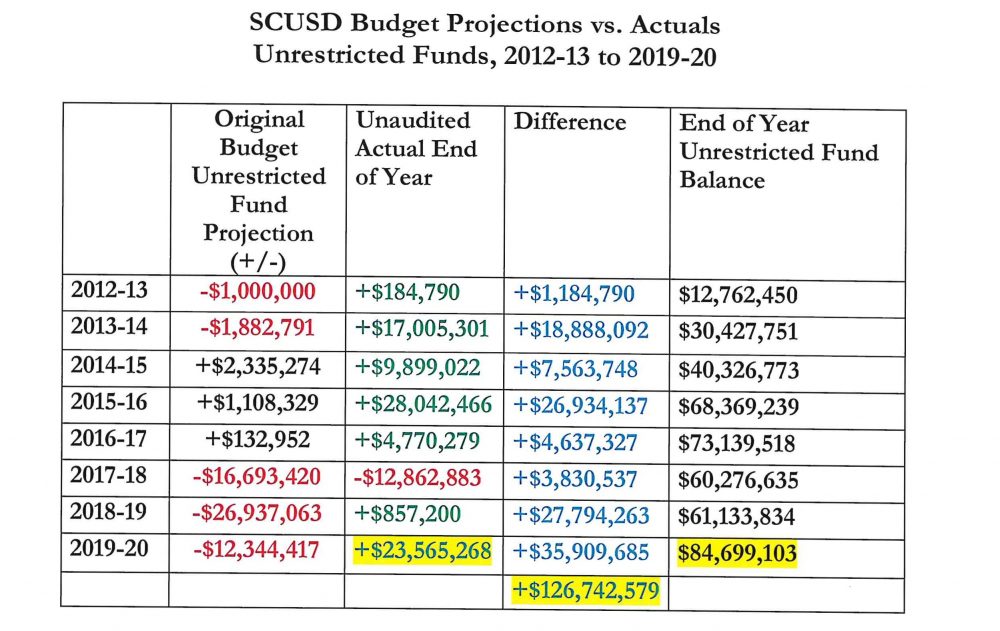
Fact # 1:  Since the 2012-2013 school year, the District has run a surplus every year except one:  2017-18 (2012-13 to 2018-19 Projections 2012-13 to 2018-19 Actuals).  The District was told by the Sacramento County Office of Education it needed to make budget cuts to offset the costs of our contract settlement. Instead Superintendent Aguilar went on a spending spree including $6 million to cash out the vacation of the District’s top administrators.

Fact #2:  In March 2019, the Sacramento City Unified School Board passed resolution No. 3060 “On Fiscal Solvency Plan to Save Our Schools” which included the following:

“District Superintendent, Jorge Aguilar, has agreed to forgo any salary increase allowed under his Employment Agreement until the District receives either a qualified or positive certification as defined in Education Code section 42131, subdivision (a)(1).”

The District still has not had a budget that has received “either a qualified or positive certification as defined in Education Code section 42131, subdivision (a) (1)” and yet Superintendent Aguilar has taken a $34,126 increase in his total compensation.

Fact #3:  The District has the largest reserve fund in its history:  $93 million.  That’s 8 times higher than the 2% reserve required by the state.

Fact #4:  Since the District’s budget was rejected for the first time in August 2018, the first time an SCUSD budget was rejected in its entire history, the SCUSD reserve has INCREASED by than $23 million. (Ending Fund Balance 2018-19 vs Ending Fund Balance 2019-20).

Fact #5:  At its current $89 million (down from the original budget of $101.3 million) the SCUSD budget currently includes $70 million in books and supplies, more than it traditionally spends in this category.  Chief Business Officer Rose Ramos has acknowledged that these extra tens of millions of dollars are parked in books and supplies until the District figures out how to spend the dollars.

Fact #6:  The District, in a transaction approved by the previous school board on the consent agenda on November 5, 2020 and by the Sacramento County Office of Education (SCOE), went forward with the $6 million purchase of unproven portable air filtration units, even after SCTA recommended that the District seek advice from scientific experts.  Since then, the units had to be taken out of classrooms when SCTA and SEIU raised health and safety concerns and demanded their removal.

Fact #7:  The District is receiving $124 million in new revenue from the federal government as a result of two COVID relief packages (here and here).  This does not include the millions more expected to come from the new Biden administration.

Fact #8:  Governor Newsom’s California State Budget, which calls for the highest K-12 spending in California history, will result in $100 million or more in new revenue for SCUSD.

Fact #9:  Even with Chief Business Officer Rose Ramos’ overly conservative calculations, based on the Governor’s January budget, the District should present a POSITIVELY CERTIFIED Second Interim Budget for board approval in March.

Fact #10:  For the District to cut any services to students or to demand $20 million in shifting health care costs onto staff resulting in cuts to take-home pay by as much as 34.6%, or over $17,000 per year, is unconscionable.


Tuesday, February 2, 2021

Republicans Want to Slash Funding for Schools in COVID Relief Bill | Diane Ravitch's blog

Republicans Want to Slash Funding for Schools in COVID Relief Bill | Diane Ravitch's blog
Republicans Want to Slash Funding for Schools in COVID Relief Bill


Politico reports that Republicans have come up with a “compromise” COVID relief bill that slashes funding for schools. President Biden has proposed a $1.9 trillion relief bill, that includes $170 billion for schools. Republicans have offered a COVID relief bill of $600 billion with a dramatic cut for schools, reducing the school aid to $20 billion. In the previous COVID relief (the CARES Act), charter schools, private schools, and religious schools received far more funding per-pupil than public schools. Republicans want public schools to reopen without the resources to reopen safely.

SENATE GOP PLAN WOULD SLASH BIDEN’S REQUEST FOR SCHOOL FUNDING: A group of 10 Republican senators is set to unveil the details today of a $600 billion counterproposal to Biden’s $1.9 trillion relief plan, and Biden plans to hear them out. White House press secretary Jen Psaki announced on Sunday evening that Biden had invited the group to the White House early this week. Her statement also touted the “substantial investment in fighting COIVD and reopening schools” in the administration’s original proposal. 

— The GOP lawmakers, led by Sen. Susan Collins (R-Maine), requested the meeting to make the case for a bipartisan deal — even as Democratic congressional CONTINUE READING: Republicans Want to Slash Funding for Schools in COVID Relief Bill | Diane Ravitch's blog

Monday, February 1, 2021

Education Law Center Exposes Collapse of States’ Investment in Public Schools Since 2008 | janresseger

Education Law Center Exposes Collapse of States’ Investment in Public Schools Since 2008 | janresseger
Education Law Center Exposes Collapse of States’ Investment in Public Schools Since 2008


One of the ways we attribute meaning to what we see is through stories.  Here is the story of my school district. We are among the top districts in Ohio in the local school property taxes we have voted.  But our district was forced to cut teachers and programs this year, and the teachers almost went on strike because of threatened cuts to their health care benefits despite that, in November, we passed yet another local school property tax operating levy. When my children were in elementary school in the 1980s and early 1990s, each school had a nurse and each school had a certified librarian, but now schools share nurses and the libraries are staffed by aides. Looking at this situation from a purely local point of view, many people in my community interpret these facts in a way that blames the district for mismanagement or salaries that are too high, or both.

But a new report from The Education Law Center insists that citizens must expand their understanding of funding public schools beyond the local story: “The political dynamics in state capitols have profound implications for the level and distribution of school funding. Nationally, state sources (mainly sales and income tax) provide 47%, and local sources (overwhelmingly from property taxes) provide 45% of the revenue to support public schools. The federal government contributes the remaining 8%. When state governments allow tax revenues to decline or remain stagnant, public schools, which states are legally obligated to maintain and support, pay the price. Elementary and secondary education on average accounts for 36% of states’ general fund spending, the most of any state government services.”

The Education Law Center’s new report, $600 Billion Lost: State Disinvestment in Education Following the Great Recession, sets the financial crisis in my school district and a mass of other school districts in a much clearer context. The Education Law Center blames state policy over more than a decade as the primary cause of our dilemma. I already had some understanding of the current fiscal problems for the nation’s public schools because, for years, I have been reading reports on this topic from the Center on Budget and Policy Priorities (see this example).  But the new report is short, up to date, readable, and extremely important for CONTINUE READING: Education Law Center Exposes Collapse of States’ Investment in Public Schools Since 2008 | janresseger

Friday, January 15, 2021

Will Public School Budget Cuts Boost Charter Movement? - LA Progressive

Will Public School Budget Cuts Boost Charter Movement? - LA Progressive
Will Public School Budget Cuts Boost Charter Movement?
The Charter Schools Movement Sees Public Schools Preparing for Deep Funding Cuts as a Growth Opportunity


Apromotional message on the website of the Minnesota Math and Science Academy (MMSA), a K-12 charter school in Saint Paul, Minnesota, boasts that since the school was founded in 2014, it has been “growing exponentially.”

In the span of just a few years, the school has built up significant enrollment numbers. Currently, more than 500 kids attend MMSA, according to the school’s website—where the school appears eager to take on even more students, with a bright green banner inviting parents to “Enroll Now” and complete an online form.

The school’s determination to expand has landed it before the Saint Paul City Council. In an effort to add more kids, MMSA has asked city council members to approve its request for $15 million in tax-exempt conduit bonds, as a means to help the school pay for construction costs associated with its growth, according to reporting by the Saint Paul Pioneer Press.

At a city council meeting in November, MMSA received preliminary approval for the conduit bond request on a 5-2 vote. At the same meetingHope Community Academy—another rapidly growing Saint Paul charter school—requested and received initial approval for $23 million in conduit bonds from the city.

Desperate parents and a new funding mechanism boost school privatization schemes across the country.

Hope Community Academy’s request was formally approved at a December city council meeting, while a decision on MMSA’s bond application has not yet been made.

All of this comes on the heels of another conduit CONTINUE READING: Will Public School Budget Cuts Boost Charter Movement? - LA Progressive


Friday, November 20, 2020

Education Matters: Area veteran teachers brace for pay cuts (draft)

Education Matters: Area veteran teachers brace for pay cuts (draft)
Area veteran teachers brace for pay cuts (draft)


While brand new teachers in St. Johns county get a six thousand dollar raise, veteran teachers, if they got the best and brightest bonus or school recognition money, are about to get a pay cut. Coming soon to Clay and Duval Counties.  

People who have dedicated their lives to the children of the area are about to either lose money or not see any notable pay raise. Welcome to Florida 

From News4Jax,

“It’s an unfair bill for veteran teachers. Although the people at the lower end of the pay salary scale will be moved up, veteran teachers are going to get a much lesser raise,” St. Johns Education Association Chief Negotiator Justin Vogel said.

https://www.news4jax.com/news/local/2020/11/18/st-johns-county-school-district-union-agree-to-6500-raise-for-new-teachers/

The article talks about a two percent raise for veteran teachers. For me, that would be about a thousand CONTINUE READING: Education Matters: Area veteran teachers brace for pay cuts (draft)


Wednesday, November 18, 2020

Choosing Democracy: SCUSD Ends 2019-20 with $23 million surplus, reserve fund grows to $93 million

Choosing Democracy: SCUSD Ends 2019-20 with $23 million surplus, reserve fund grows to $93 million
SCUSD ENDS 2019-20 WITH $23 MILLION SURPLUS, RESERVE FUND GROWS TO $93 MILLION


Sac City Unified Budget - A Message from Superintendent Aguilar - Sacramento City Unified School District - https://www.scusd.edu/e-connections-post/sac-city-unified-budget-message-superintendent-aguilar on @officialscusd


In 2012-13, the State of California introduced a new way of financing K-12 education with the introduction of the Local Control Funding Formula (LCFF).  It was implemented beginning in the 2013-14 school year.

A look at the budget projections of the Sacramento City Unified School District (SCUSD) one year prior to the implementation of LCFF, and the seven years since, demonstrates SCUSD’s a clear and consistent pattern of grossly inaccurate budget projections.

In California, school districts are required by law to submit three budgets during a fiscal year.  The Original Budget is submitted in July, the First Interim Budget in December, and the Second Interim Budget in March.  At the conclusion of the year, a districts actual performance is released in September as its “Unaudited Actuals.”  Chart 1 looks at the SCUSD Original, July 1, budgets for 2012-13 and compares them to Unaudited Actuals for that same year.

School districts of the size of SCUSD are also required a minimum Unrestricted Cash Balance Reserve of 2% of its expenditures.  For 2019-20, the 2% represented $11.9 million.

It is worth noting, that in the last eight years, SCUSD ended with a deficit only in 2017-18.  Ironically, in December of that same year, the Sacramento County Office of Education strongly advised District administrators to reduce expenses by $15.7 million during the remainder of that school year.  SCUSD ignored the SCOE recommendation, and instead actually increased its unbudgeted unrestricted fund spending including on the following:

  • A $6 million vacation buyout for top administrators;
  • The introduction of a poorly planned and administered Summer School Program;
  • The additional of 18 unbudgeted administrative positions;

This led to SCOE rejecting the SCUSD 2018-19 budget, the first time in SCOE’s history a Sacramento County school district has had its budget rejected.  Since then, SCOE has rejected three additional SCUSD budgets.

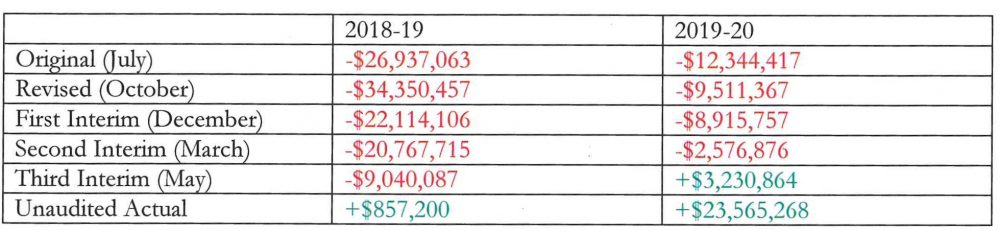
Chart 2 looks at the inaccuracy of SCUSD budget projections for the last two school years—even with a SCOE-appointed Fiscal Advisor helping to administer SCUSD finances—since SCOE first rejected the SCUSD budget.  Because SCUSD budget was rejected, it is required to submit a Third Interim Budget in May.

Throughout 2018-19, SCUSD claimed to be on the brink of insolvency.  It ended the year with a unrestricted fund surplus.  Again in 2019-20, SCUSD still claimed to be on the brink of insolvency and projected a $12 million deficit for the year.  With six weeks remaining in the fiscal year, the District now projects a $3.2 million surplus—a $15.5 million turnaround, which might be noteworthy except that it is consistent with the District’s budgeting practices for at least the last eight years.

2019-20 was even more extreme.  SCUSD started the fiscal year projected a $12.3 million deficit.  It ended the year with a $23.6 million surplus, a difference of $35.9 million. SCUSD’s unrestricted reserve fund now is $84,699,103 and its total unrestricted/unrestricted reserve fund is $93,048,611, the highest in SCUSD history.  It is worth noting that SCUSD’s Third Interim Budget which was released in May 2020 with fewer than six weeks remaining in the fiscal year underestimated the District end of the year surplus by over $20 million.


Sunday, November 8, 2020

Weathering the storm: School funding in the COVID-19 era - kappanonline.org

Weathering the storm: School funding in the COVID-19 era - kappanonline.org
Weathering the storm: School funding in the COVID-19 era


Bruce D. Baker, Mark Weber, and Drew Atchison

As COVID-19 takes a toll on education budgets, federal and state leaders should take specific steps to minimize the damage done to high-poverty schools.


Recent research into the economics of education leads to the inescapable conclusion that if we want our public schools to serve all children well, then we must provide them with equitable and adequate funding. Viewed across several decades, school and district spending data from across the United States reveal a clear pattern: When budgets have increased, students have seen significant gains in achievement and a range of other desirable outcomes (Jackson, 2018). Conversely, when school funding has been cut, student performance has suffered; and the deeper those cuts have been — consider, for example, the sharp budgetary declines during the Great Recession of 2007-2009 — the worse the student outcomes (Jackson, Wigger, & Xiong, 2018; Shores & Steinberg, 2017). Simply put, money matters 

Due to the COVID-19 pandemic, public schools will likely experience even greater revenue losses in the coming years than they did during the Great Recession. Further, it appears that safely reopening schools in the fall of 2020 will itself be costly. In districts where school buildings are open, much smaller class sizes will be required to meet social distancing guidelines and contain the spread of the coronavirus; this, in turn, will require hiring additional personnel, finding new classroom space, and perhaps creating staggered schedules. It will mean more instructional hours for teachers, more staff hours spent cleaning and sanitizing facilities, and more complicated bus routes. Schools will have to budget for additional time and effort from maintenance and operations staff, food service workers, and other support positions. Nursing and other medical services — already inadequate in many schools (Willgerodt, Brock, & Maughan, 2018) — will need to be improved. And, to ensure equitable internet access when distance learning is required, districts will have to redouble their investments in broadband and portable computers. Finally, since learning losses due to this spring’s school closures CONTINUE READING: Weathering the storm: School funding in the COVID-19 era - kappanonline.org


Monday, October 26, 2020

Longstanding State Tax Freeze and New Voucher Explosion Create Overwhelming Financial Problems for Ohio School Districts | janresseger

Longstanding State Tax Freeze and New Voucher Explosion Create Overwhelming Financial Problems for Ohio School Districts | janresseger
Longstanding State Tax Freeze and New Voucher Explosion Create Overwhelming Financial Problems for Ohio School Districts


The Presidential election has torn the country apart this fall, but in my community, the local school operating levy on next week’s ballot has caused almost as much rancor. One problem is a 40-year-old property tax freeze law that keeps all Ohio school districts repeatedly begging for money. But the explosive expansion of school vouchers has compounded the problem.

Like many other parents in my community, I developed a deep personal interest in the tangled, arcane and seemingly boring subject of school finance back in the days, 35 years ago, when my children were enrolled in the Cleveland Heights-University Heights public schools, the school district where my husband and I continue to reside. As a mom, I noticed that every time our community voted down a school operating levy—even if we finally passed it on the second or third try—our schools were forced to ratchet down services. Class sizes got bigger. The school nurses began to cover several buildings and were in any one school only one day per week. The inspiring and gifted certified school librarians who created exciting school-wide reading programs were replaced by aides and volunteers who were well meaning but not the same.

Next Tuesday in Cleveland Heights and University Heights, there are two primary issues voters ought to keep in mind as we go to the polls to try to prevent the schools that serve our community’s children from falling into fiscal catastrophe. These structural problems have CONTINUE READING: Longstanding State Tax Freeze and New Voucher Explosion Create Overwhelming Financial Problems for Ohio School Districts | janresseger