Latest News and Comment from Education

Showing posts with label FUNDING. Show all posts

Wednesday, May 19, 2021

Education Research Report: U.S. Spending on Public Schools in 2019 Highest Since 2008

Education Research Report: U.S. Spending on Public Schools in 2019 Highest Since 2008
U.S. Spending on Public Schools in 2019 Highest Since 2008


K-12 School Spending Up 4.7% in 2019 From Previous Year


The nation spent $752.3 billion on its 48 million children in public schools in fiscal year 2019, a 4.7% increase from the previous year and the most per pupil in more than a decade.

Instructional salaries, the largest expenditure within current spending, totaled $239.9 billion in fiscal year 2019 or 31.9% of total expenditures for public elementary-secondary education.

The Census Bureau’s Annual Survey of School System Finances tables released todayshow per pupil current spending for elementary and secondary public education (pre-K through 12th grade) for all 50 states and the District of Columbia increased 5.0% to $13,187 in FY 2019 from $12,559 in FY 2018 — the largest increase since 2008.

Breaking Down School Spending

Total expenditures for elementary and secondary education include FY 2019 “current” spending, capital outlay expenditures, interest on debt and payments to other governments.

Current spending, which made up $652.3 billion or 86.7% of total expenditures in FY 2019, consists of expenses for day-to-day activities, including teachers’ salaries and benefits and most other school system daily expenses.

Capital outlay, another portion of total expenditures that includes construction, large equipment expenses and improvements to existing structures, totaled $76.3 billion or 10.1% of total expenditures.

Instructional salaries, the largest expenditure within current spending, totaled $239.9 billion in fiscal year 2019 or 31.9% of total expenditures for public elementary-secondary education.

Total expenditure increased by 4.7% while total revenue increased by 4.5% from fiscal year 2018.

Where School Funding Comes From

In FY 2019, state governments contributed the largest share of funding to public school systems: $350.9 billion or 46.7%.

Local sources of revenue were the next largest at $342.9 billion or 45.6%, and the federal government contributed the least, $57.9 billion or 7.7%.

The 2019 Annual Survey of School System Finances includes data on revenues, expenditures, debt and assets (cash and security holdings) of elementary and secondary public school systems.

Please note that the data released today were collected before the COVID-19 pandemic took hold in the United States. A preliminary report on 2020 fiscal year school finances data is scheduled to be released this fall.


Full report

Tuesday, May 18, 2021

CURMUDGUCATION: PA: The Special Ed Funding Triple Whammy

CURMUDGUCATION: PA: The Special Ed Funding Triple Whammy
PA: The Special Ed Funding Triple Whammy


Are you ready for the best explainer yet for the screwed-up state of Pennsylvania's charter funding when it comes to special ed students?  

Here at the Institute, we're fans of the work of Research for Action. The Philly based research group is meticulously independent and well-conceived and executed. We're previously looked at their work on test-based (poverty-punishing) assessment, the failure of cyber-charters, and the astonishing PA gap between students and teachers of color.

Now they've produced a video outlining the troubles with Pennsylvania's formula for funding special ed in charter schools. 

This matters because right now Governor Tom Wolf is trying to fix this, and charter school advocates are screaming that the governor is trying to cut their funding. That's technically a true, but in spirit, it's a lie. PA's charter schools continue to CONTINUE READING: CURMUDGUCATION: PA: The Special Ed Funding Triple Whammy

Saturday, May 15, 2021

April Showers – Tennessee Education Report

April Showers – Tennessee Education Report
APRIL SHOWERS


Erik Schelzig in the Tennessee Journal’s On the Hill blog notes that Tennessee’s April revenues were $600 million more than the budgeted estimate.

Go ahead, read that again. In one month, the state collected $600 million more than planned.

Here’s more from Schelzig:

Tennessee’s general fund revenue collections were nearly $600 million above estimates in April, bringing the state’s surplus to $1.9 billion through the first nine months of the budget year.

So, with three months left in the fiscal year, the state is nearly $2 billion ahead of where it planned to be. Even if the surpluses drop off, the state is well on its way to a surplus significantly in excess of $2 billion.

To put this in perspective, the state is $1.7 billion behind where it should be in terms of funding public schools according to a bipartisan legislative commission.

For further perspective, the April surplus alone is three times what Gov. Bill Lee CONTINUE READING: April Showers – Tennessee Education Report

Wednesday, May 12, 2021

Public schools deserve your support. I know. I attend one. - cleveland com

Public schools deserve your support. I know. I attend one. - cleveland.com
Public schools deserve your support. I know. I attend one


As a student at a reputedly failing school, I will say emphatically that our public schools deserve support. As we look to determine the future of education, we must take a step back and decide what we want out of the system. There is more to education than an ill-conceived system of state testing. Public education exists to instill republican virtues in our people. We need this now more than ever.

Public schools have been branded as failing and stripped of funding by bizarre school-choice schemes. If a man has a broken leg, you don’t get him walking again by breaking the other leg. EdChoice, under the pretense of rescuing students from failing schools, has instead defunded those same schools rather than supporting vouchers directly. Our lawmakers must consider: If we focused instead on making meaningful improvements to the public education system which has served our state so well, would there be a need for EdChoice?

Visit Cleveland Heights High School. It is not failing. Nor is it perfect, for the vouchers have made sure of that. It is time that America rediscovers its republican virtues, the source of our strength, and the schools which gave them to us.

Kenji Sakaie,

Public schools deserve your support. I know. I attend one. - cleveland.com

Tuesday, May 11, 2021

Shanker Blog: The Great Divergence In State Education Spending | National Education Policy Center

Shanker Blog: The Great Divergence In State Education Spending | National Education Policy Center
Shanker Blog: The Great Divergence In State Education Spending


When we talk about K-12 education spending inequality, we're usually talking about differences in resources between high- and low-poverty districts within states. But spending levels also vary between states, and that too matters for overall spending inequality in the U.S. How has this changed over the past 25 years? In other words, does K-12 spending vary more between states than it did a quarter century ago?

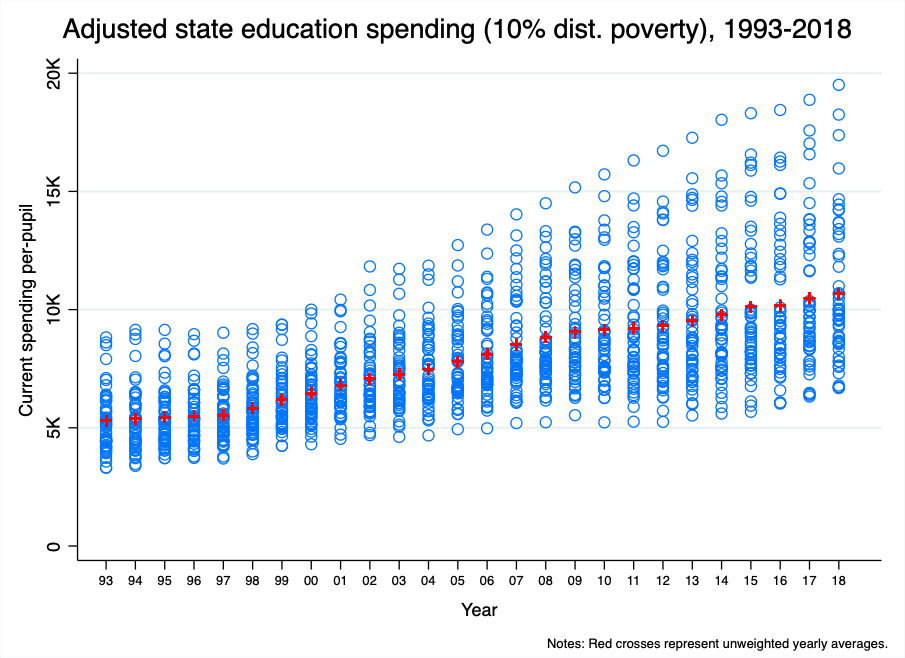
Let’s take a look at one simple way to visualize this trend. In the graph below, each blue circle is a state, and there one set of 51 states (including D.C.) for each year between 1993 and 2018 (the horizontal axis). On the vertical axis is total current spending in each state, predicted for a district in each state with a 10 percent Census child poverty rate (the graph is very similar regardless of poverty level). These spending levels also control for regional wage variation, district size, and population density, all of which affect the “value of the education dollar.” This allows for a better comparison between states (e.g., it costs more, on average, to hire teachers in Connecticut than in Alabama). The red plus signs within each year represent the unweighted average spending level across all states. These data are from the School Finance Indicators Database.

Our focus here is on the “spread” of states (blue circles) within each column (i.e., within each year). A larger spread, of course, represents greater variation (and, roughly speaking, more interstate inequality). The trend over time is a bit striking.

Throughout most of the 1990s and the first half of the 2000s, all but a small handful of states were clustered within the $3,000 to $8,000 range, a spread of about $5,000 per-pupil. Now, to be clear, this is a big span (particularly in these earlier years, when spending was lower), and it represents substantial interstate variation in spending. Even controlling for factors that affect costs, such as poverty and regional wage variation, some states spend a lot more than others.

Starting in the mid-2000s, however, a group of about 5-10 states start to break away from the CONTINUE READING: Shanker Blog: The Great Divergence In State Education Spending | National Education Policy Center

Monday, May 10, 2021

School spending matters - American Economic Association

American Economic Association
School spending matters


Plunging home prices and massive job losses are often mentioned in discussions of the Great Recession, but the effects of the recession stretched far beyond the housing and job markets.

Public schools were hit hard as well.

paper in the American Economic Journal: Economic Policy examines the impacts of state spending cuts on the educational outcomes for students in K–12 public schools. Authors C. Kirabo JacksonCora Wigger, and Heyu Xiong found lasting ill-effects on test scores and college enrollment, particularly in states where schools rely more heavily on state aid.  


Figure 4 from Jackson et al. (2021)


Figure 4 from their paper shows the effect that the recession had on per-pupil K–12 spending in thousands (2015 dollars), test scores (NAEP), and college-going rates by states’ reliance on state revenue. The lines with the diamond markers represent the per-year effect on schools that had an above-average reliance on state revenue. The dashed lines are the linear fit that shows the smoothed pattern pre- and post-recession, and the shaded areas are 95 percent confidence intervals of the individual year effects.

Prior to the Great Recession, outcomes in public schools that relied more heavily on state revenue sources were on a trajectory similar to schools in states that were less reliant. But that changed when the economy nose-dived in 2007. Reductions in per-pupil spending in those states most reliant on state aid during the Great Recession (top left panel) coincided with declines in NAEP scores (top right) and college-going rates (lower left). 

The bottom right panel shows the impact on test score gaps by district-level poverty in states where public schools were heavily reliant on state revenues. While there was little evidence of a pre-existing trend prior to 2007, the slope turned downward in the years following the recession. 

The findings highlight the consequences of shifting the responsibility for funding public education toward state budgets and how sustained spending cuts can impact educational equity.

“Do School Spending Cuts Matter? Evidence from The Great Recession” appears in the May 2021 issue of the American Economic Journal: Economic Policy

Friday, May 7, 2021

Ohio Legislature Heats Up Controversy by Making New Public School Funding Plan and Method of Funding School Vouchers All Part of the Budget | janresseger

Ohio Legislature Heats Up Controversy by Making New Public School Funding Plan and Method of Funding School Vouchers All Part of the Budget | janresseger
Ohio Legislature Heats Up Controversy by Making New Public School Funding Plan and Method of Funding School Vouchers All Part of the Budget


This week in my school district in Cleveland Heights-University Heights, Ohio, parents and public school supporters are going through a quiet ritual. People have been scrambling to write and submit legislative testimony. Some people are submitting written testimony; others are driving two and a half hours to Columbus, sitting in the hearing room and driving home in the dark. The Ohio Senate Primary and Secondary Education Committee is holding hearings on the state’s next biennial budget and considering a new—desperately needed—school funding plan that has now been folded into the budget bill, which must be passed by June 30.

What is happening is a big deal.  Last fall, a new $2 billion school funding plan was passed by the Ohio House by a vote of 87-9, but the Ohio Senate let the bill die at the end of the session. Now that plan has been folded into the state budget. The House has already passed the budget—including the Fair School Funding Plan—but the Senate is just now holding hearings. If you read some of the testimony being submitted, you might imagine what’s going on in Ohio would get coverage in the state’s big newspapers, but most of them have been bought out by Gannett-Gatehouse Media or Advance Media, companies that have reduced the number of reporters.  Right now not enough people are paying attention to a debate about whether the Legislature will repair the services our state is currently failing to provide for 1.6 million students in Ohio’s 610 public school districts at the same time the state continues to expand school vouchers at public schools’ expense.

I am going to share some of my own testimony and the testimony from others who are members of the Heights Coalition for Public Education. You can find copies of each of these documents in the Ohio Senate Education Committee’s document archive for May 4, 5, and 6.  I will date each reference.

My own testimony (May 6) summarizes the issues at stake in this particular Ohio budget CONTINUE READING: Ohio Legislature Heats Up Controversy by Making New Public School Funding Plan and Method of Funding School Vouchers All Part of the Budget | janresseger

Friday, April 30, 2021

New Statewide Campaign Pressures Ohio Senate to Pass School Funding Reform in FY22-23 State Budget | janresseger

New Statewide Campaign Pressures Ohio Senate to Pass School Funding Reform in FY22-23 State Budget | janresseger
New Statewide Campaign Pressures Ohio Senate to Pass School Funding Reform in FY22-23 State Budget


On Wednesday, four key organizations announced ALL in for Ohio Kids, a statewide campaign to demand that the Ohio Senate will pass a major a new school funding formula as part of the FY 2022-23 state budget.

The new coalition brings together four organizations: the Ohio Education Association and the Ohio Federation of Teachers, representing public school teachers; the Ohio Organizing Collaborative, pulling together public school parents and community members; and Policy Matters Ohio, adding the weight of complex policy expertise.

A new school funding plan, developed over several years, was passed on April 21st by the Ohio House of Representatives as part of the FY 2022-2023 state budget and submitted to the Ohio Senate. The Ohio Legislature must, by law, come up with a compromise by June 30.

With Ohio’s Republican supermajority House and Senate, you might suppose that members of the Ohio Senate would simply affirm the proposal forwarded by their colleagues in the House. You would be wrong. While the plan was originally sponsored by and developed under the guidance of House Speaker Bob Cupp and passed by the Ohio House in a stand alone bill in December by a vote of 87-9, the Senate Finance Committee Chairman Matt Dolan refused to bring the House bill forward for a vote by the full Senate. Therefore, the bill died at the end of the FY 20-21 legislative session.

The New All In for Ohio Kids Campaign and Policy Matters’ Wendy Patton Release Major Report

Outlining Ohio’s urgent need for the Fair School Funding Plan, Policy Matters’ state fiscal expert Wendy Patton released a position paper as part of the launch of the All in for Ohio Kids Campaign: “For many years Ohio lawmakers have provided neither sufficient nor fair CONTINUE READING: New Statewide Campaign Pressures Ohio Senate to Pass School Funding Reform in FY22-23 State Budget | janresseger

Thursday, April 29, 2021

League of Women Voters Calls for Action on School Funding – Tennessee Education Report

League of Women Voters Calls for Action on School Funding – Tennessee Education Report
LEAGUE OF WOMEN VOTERS CALLS FOR ACTION ON SCHOOL FUNDING


In an action alert email, the League of Women Voters encouraged members and supporters to push Gov. Bill Lee and the General Assembly to make significant new investments in public education.

Here’s the text of that email:

Tennessee continues to neglect its public schools.  The state consistently ranks as one of the bottom five for public school funding. During the current legislative session, numerous bills have been introduced by members from both sides of the aisle to provide additional funds for some of our public schools’ urgent needs. Among those needs are adequately funding school counselors, social workers, school nurses, and staff to support state-mandated intervention programs.  None of these bills have passed yet.

This is the time to invest in our schools and our children. With a current budget CONTINUE READING: 
League of Women Voters Calls for Action on School Funding – Tennessee Education Report

Will NYC Create a Thoughtful and Effective Plan for the Billions of Education Dollars or Waste on Mindless Testing and Remediation? | Ed In The Apple

Will NYC Create a Thoughtful and Effective Plan for the Billions of Education Dollars or Waste on Mindless Testing and Remediation? | Ed In The Apple
Will NYC Create a Thoughtful and Effective Plan for the Billions of Education Dollars or Waste on Mindless Testing and Remediation?


I was biking up Third Avenue in May, no cars as far as I could see, New York City was a ghost town. The pandemic was rampant, subways and buses empty, the cities revenue stream had ended …. Days turned into weeks, weeks into months.

Would the city go bankrupt?  (Read here)

Were we facing another 1975?  Widespread teacher layoffs? (Read here)

Candidate Biden becomes President Biden, the assault on the Congress fails and the Biden Rescue Plan becomes law.

Half of New York City is vaccinated and the number of vaccinated New Yorkers continues to grow.

The New York State legislature passes a budget that fully funds education, the fight over Foundation Aid is over.

Mayor de Blasio releases his Executive Budget, which he calls his Recovery Budget – worthwhile watching here.  The City Council has to approve the budget, the Council and the Mayor will negotiate and likely approve by mid-June.

The NYS Education Department has to submit a plan specifying how the Rescue Plan dollars will be utilized in the state. The Plan is due June 7th, see the Fact CONTINUE READING: Will NYC Create a Thoughtful and Effective Plan for the Billions of Education Dollars or Waste on Mindless Testing and Remediation? | Ed In The Apple

Monday, April 26, 2021

We're Not Even At Equality Yet | The Jose Vilson #BLM #BLACKLIVESMATTER #BLACKMINDSMATTER

We're Not Even At Equality Yet | The Jose Vilson
WE’RE NOT EVEN AT EQUALITY YET


A jury of Derek Chauvin’s “peers” found him guilty on all counts of murder: unintentional second-degree murder, third-degree murder, and second-degree manslaughter. Millions reacted to this conviction in their homes, in the streets, on social media, on their own, in the company of others, or perhaps not at all. As the judge read the charges, perhaps many reacted with a sense of excitement, but folks in my circles reacted with a sense of relief and exasperation. George Floyd isn’t back so we’ll never get justice, but accountability was crucial here. Surely, this trial and the conviction would send a signal to the world that we’d find some form of accountability for these agents of the state whenever they performed as judge, jury, and executioner on a person’s life.

Then we found out that a police officer killed Ma’Khia Bryant only 800 miles away from when the conviction came down a short time after.

Therein lies the structural and deeply personal part of this conversation we need to keep having in America. Too many of us believe that simply changing the faces and phenotypes of the people entrusted to keep the social contract is enough. Too few of us see the ruse. In my heart of hearts, I do believe that much of the work we must do to make a better world rest in us doing so collectively, regardless and because of these differences that stratify us. However, the persistent lies and obfuscation we see play out in front of us lead me to believe we need a more urgent conversation than incremental solutions. Concurrently, words like CONTINUE READING: We're Not Even At Equality Yet | The Jose Vilson

Friday, April 23, 2021

Education Department Announces State Allocations of $800 Million in American Rescue Plan Funds to Support Students Experiencing Homelessness | U.S. Department of Education

Education Department Announces State Allocations of $800 Million in American Rescue Plan Funds to Support Students Experiencing Homelessness | U.S. Department of Education
Education Department Announces State Allocations of $800 Million in American Rescue Plan Funds to Support Students Experiencing Homelessness


The U.S. Department of Education (ED) announced today plans to distribute $800 million to help support the needs of students experiencing homelessness under the American Rescue Plan Elementary and Secondary School Emergency Relief – Homeless Children and Youth (ARP-HCY) fund. ED announced the state allocations for the $800 million total allocated in the American Rescue Plan and will distribute $200 million in funding on Monday.

Alongside the announcement, the Department issued a letter to Chief State School Officers underscoring the urgent need to use this funding to identify homeless children and youth, provide wraparound services in light of the impact of the COVID-19 pandemic, and provide assistance to enable homeless children and youth to attend school and participate fully in school activities, including in-person instruction this spring and upcoming summer learning and enrichment programs. The remaining funds will be allocated to states as soon as June.

"The pandemic made the inequities in our education system even worse, especially for students experiencing homelessness," said U.S. Secretary of Education Miguel Cardona. "As districts and schools return to in-person learning, we must act with urgency to provide all students, including students experiencing homelessness, equitable access to high-quality learning environments and the resources to help meet their basic needs which schools often provide."

The Department's letter to Chief State School Officers provides additional information and recommendations to support states and school districts in putting these resources to work to support students experiencing homelessness, particularly for student groups who have been historically underserved.

On Friday, April 23, 2021, at 4:15 p.m. ET, Secretary Cardona will lead a roundtable discussion with students who have experienced homelessness, centering the conversation on lived experiences and critical federal investments. Secretary Cardona will be joined by U.S. Sen.  Patty Murray (WA), Chair of the Senate Committee on Health, Education, Labor and Pensions (HELP) and U.S. Sen. Joe Manchin (WV). Together, they will learn about the individual background of each student and discuss how American Rescue Plan funds can support students experiencing homelessness. Members of the press who wish to cover the event may RSVP by emailing press@ed.gov.

Today's announcement received praise from Members of Congress from both sides of aisle:

"This past year has been so difficult for every student, parent and educator across the country—but what students experiencing homelessness have gone through is unthinkable. The first thing we told people during this pandemic was to 'stay home.' But so many students don't have a safe place to call home, access to internet, devices, or critical services that students have relied on to learn during this pandemic," said U.S. Sen. Patty Murray (WA), Chair of the Senate Committee on Health, Education, Labor and Pensions (HELP). "We fought hard to make sure the American Rescue Plan includes dedicated funding for students experiencing homelessness, and that the Department of Education is acting quickly to get these resources to our communities. I'll keep fighting to make sure students experiencing homelessness not only get enrolled in school, but also get the kind of support and stability they need so they can learn and grow in the classroom."

"The COVID-19 pandemic has created additional burdens for everyone but especially our students currently experiencing homelessness," said U.S. Sen. Joe Manchin (WV). "I am pleased Secretary Cardona is moving quickly to get the first round of the $800 million I successfully fought to include in the American Rescue Plan to school systems so they can identify and assist homeless students in their schools. If we can't find these students, we can't provide the essential support and services they need. I won't stop fighting to put a roof over every student's head and ensure they have the tools to succeed. I look forward to continue working with my bipartisan colleagues as well as Secretary Cardona to help every student thrive."

"It is significant that every single one of my colleagues recognized the importance of supporting homeless youth and children by unanimously agreeing to my amendment twice on the Senate floor earlier this year," said U.S. Sen. Lisa Murkowski (AK). "I thank President Biden and Secretary Cardona for working with me and my colleagues to get this funding out the door as quickly and effectively as possible. By releasing this first round of funding, we can start to provide much-needed relief to the most vulnerable - homeless youth and children. I appreciate that Secretary Cardona has invited a young Alaskan to participate in a roundtable discussion with students who have experienced homelessness. This young Alaskan, who has persevered and is now thriving, will be a strong voice for so many other young people throughout our country."  

"Arizona youth experiencing, or at risk of homelessness, deserve safe and stable shelter, especially during the pandemic. I'm proud of our work across the aisle ensuring the COVID-relief law included our bipartisan Emergency Family Stabilization Fund, helping protect Arizona families and children from housing insecurity and keeping kids connected to their school work," said U.S. Sen. Kyrsten Sinema (AZ).

Specific state allocations are listed below:

State

Total ARP Homeless Allocation

ARP Homeless I (April allocation)

ALABAMA

13,232,539

3,308,135

ALASKA

2,349,723

587,431

ARIZONA

16,914,124

4,228,531

ARKANSAS

8,209,311

2,052,328

CALIFORNIA

98,709,231

24,677,307

COLORADO

7,640,075

1,910,019

CONNECTICUT

7,244,365

1,811,091

DELAWARE

2,690,527

672,632

DISTRICT OF COLUMBIA

2,530,583

632,646

FLORIDA

46,104,268

11,526,067

GEORGIA

27,835,648

6,958,912

HAWAII

2,700,973

675,243

IDAHO

2,881,855

720,464

ILLINOIS

33,112,868

8,278,217

INDIANA

13,066,572

3,266,643

IOWA

5,073,494

1,268,374

KANSAS

5,440,776

1,360,194

KENTUCKY

13,656,376

3,414,094

LOUISIANA

17,067,174

4,266,793

MAINE

2,694,256

673,564

MARYLAND

12,780,987

3,195,247

MASSACHUSETTS

11,988,315

2,997,079

MICHIGAN

24,366,891

6,091,723

MINNESOTA

8,650,935

2,162,734

MISSISSIPPI

10,659,014

2,664,754

MISSOURI

12,816,310

3,204,078

MONTANA

2,502,430

625,607

NEBRASKA

3,575,993

893,998

NEVADA

7,022,161

1,755,540

NEW HAMPSHIRE

2,295,973

573,993

NEW JERSEY

18,109,524

4,527,381

NEW MEXICO

6,413,341

1,603,335

NEW YORK

58,881,309

14,720,327

NORTH CAROLINA

23,576,625

5,894,156

NORTH DAKOTA

1,999,661

499,915

OHIO

29,294,425

7,323,606

OKLAHOMA

9,783,762

2,445,941

OREGON

7,343,336

1,835,834

PENNSYLVANIA

32,732,708

8,183,177

PUERTO RICO

19,428,481

4,857,120

RHODE ISLAND

2,718,574

679,643

SOUTH CAROLINA

13,835,064

3,458,766

SOUTH DAKOTA

2,502,430

625,607

TENNESSEE

16,295,356

4,073,839

TEXAS

81,348,380

20,337,095

UTAH

4,032,024

1,008,006

VERMONT

1,867,977

466,994

VIRGINIA

13,818,290

3,454,572

WASHINGTON

12,134,870

3,033,718

WEST VIRGINIA

4,987,694

1,246,924

WISCONSIN

10,092,963

2,523,241

WYOMING

1,989,459

497,365

National Activities

1,000,000


TOTALS

800,000,000

199,750,000