Latest News and Comment from Education

Showing posts with label TEST. Show all posts

Thursday, May 6, 2021

Education Matters: DCPS's testing shenanigans

Education Matters: DCPS's testing shenanigans
DCPS's testing shenanigans


A lot of schools are doing a new testing regimen. In years past, an entire class would test all at once, but now higher achievers are testing first and lower performers sometime after. My initial thought was the district is trying to pull a fast one. The district knows kids talk, so the thought is maybe some could pass on some info to their peers, that and teachers just want to be helpful too. Now I don't see any teacher saying the answer to 26 is C, but if they see a subject on the test that could be covered a little more before the lower performing group took the test, that would be okay too. That's what I initially thought anyways.

Then somebody pointed out that it was being done so the lower performing kids could get more instruction. I can rationalize that, okay, sure why not. The district isn't some evil despot with plots within plots but maybe not so fast.

However, now I am learning that many of the "lower kids" aren't getting extra instruction because their teachers are proctoring the tests. A friend at the district pointed some more things out to me the district probably hasn't considered because "it seems like they look at every kid like they are dollar signs and test scores" instead of, well, instead of them being kids.  

Isn't it going to be a kick in the pants when some kids realize they are the lower performers as they take the tests after their peers? Many of these kids experience test weariness; that is, there are diminishing returns CONTINUE READING: Education Matters: DCPS's testing shenanigans

Wednesday, February 3, 2021

U.S. Secretary of Education Miguel Cardona’s First Big Test | janresseger

U.S. Secretary of Education Miguel Cardona’s First Big Test | janresseger
U.S. Secretary of Education Miguel Cardona’s First Big Test


Miguel Cardona’s confirmation hearing as President Biden’s nominee for U.S. Secretary of Education is scheduled for this morning at 10 AM in the U.S. Senate Education Committee.  Assuming Cardona is confirmed by the committee and subsequently on the floor of the U.S. Senate, his first big test as Education Secretary will be his decision about what to do about federally mandated high-stakes student testing in this COVID-19 school year.

A groundswell of opposition to student testing continues to grow. On Saturday, the Washington Post‘s Valerie Strauss reported that educators across the states are asking Cardona “to give states permission not to give students federally mandated standardized tests this spring.”  Last year Trump’s education secretary Betsy DeVos cancelled the testing right after schools shut down nationwide due to the onset of the coronavirus pandemic.

Earlier last week, Strauss reported: “This is the second straight year that states are asking for waivers… This week, the U.S. Education Department sent a letter to chief state school officers saying the February 1 deadline for seeking a waiver was being extended though it didn’t set a new deadline. It promised states that it would soon provide details on CONTINUE READING: U.S. Secretary of Education Miguel Cardona’s First Big Test | janresseger

Sunday, December 13, 2020

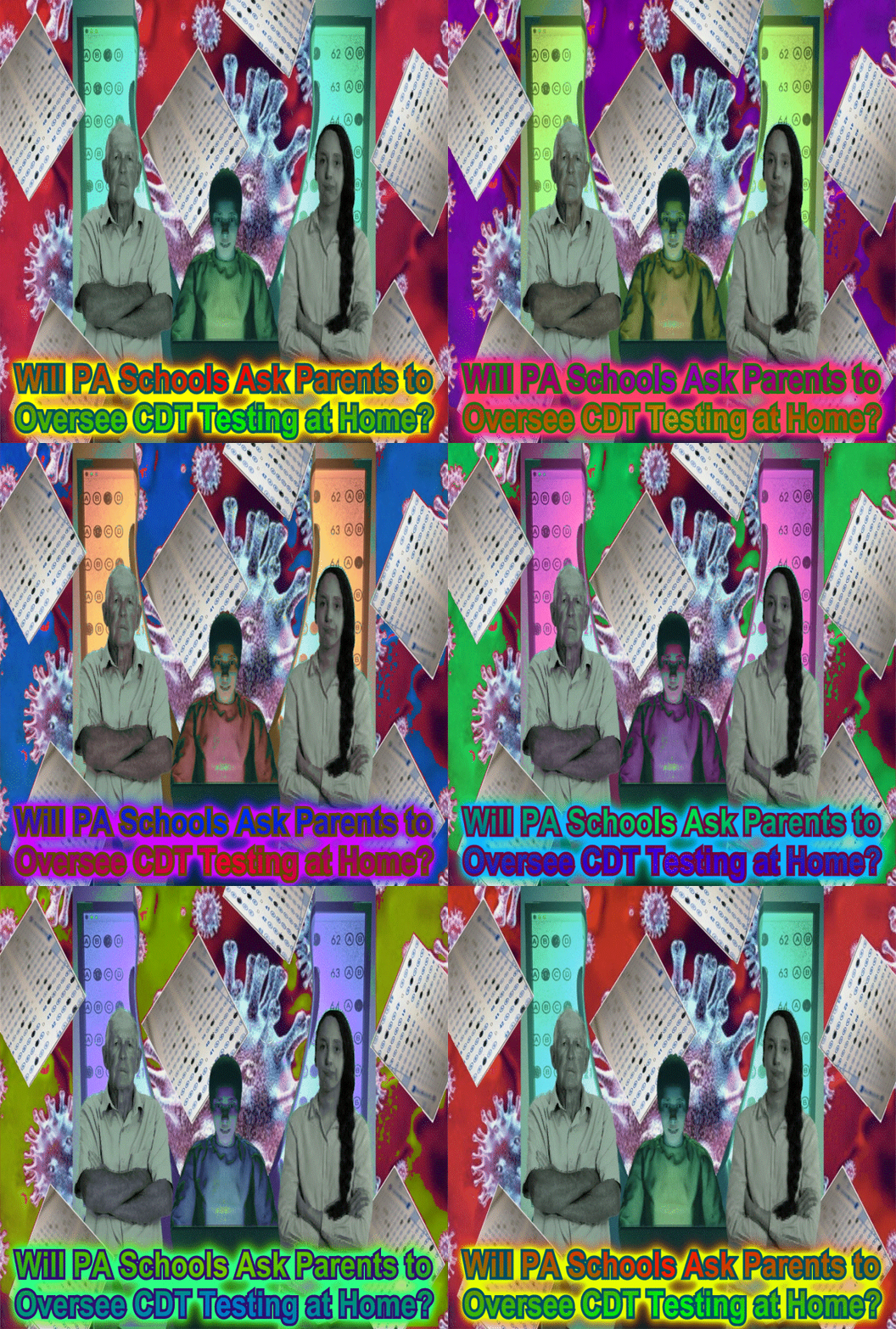
Will PA Schools Ask Parents to Oversee CDT Testing at Home? | gadflyonthewallblog

Will PA Schools Ask Parents to Oversee CDT Testing at Home? | gadflyonthewallblog
Will PA Schools Ask Parents to Oversee CDT Testing at Home?


Should parents be asked to administer on-line tests to their own children at home?

Back in May someone at Data Recognition Corporation (DRC) had an idea.

Since a global pandemic had shuttered classrooms, no children were being forced to take the multi-billion dollar testing company’s products.

Federally mandated assessments like the Pennsylvania System of School Assessments (PSSA) and Keystone Exams – which are made by DRC – were cancelled.

And local districts weren’t even making students take assessments like the Classroom Diagnostic Tools (CDT) – an optional test to determine if kids were ready to take the mandatory tests.

If someone at DRC didn’t act quickly, the Commonwealth might ask for a refund on the $1.3 billion it spent on standardized testing in the last eight years.

 The Minnesota-based DRC, a division of CTB McGraw-Hill, wasn’t about CONTINUE READING: Will PA Schools Ask Parents to Oversee CDT Testing at Home? | gadflyonthewallblog


Monday, December 7, 2020

How to Return to Campus Safely: Test, Then Test Again - The New York Times

How to Return to Campus Safely: Test, Then Test Again - The New York Times
How to Return to Campus Safely: Test, Then Test Again
Some colleges are using lessons from the fall to bring back more students in spring


This is the Coronavirus Schools Briefing, a guide to the seismic changes in U.S. education that are taking place during the pandemic. Sign up here to get this newsletter in your inbox.

The fall semester has been hell for most colleges — canceled classes, dorm closures, outbreaks and deaths. No one wants a repeat.

But the failures and rare successes of the semester might help universities prepare for next year. Many schools plan to bring more students back for the spring semester, even though coronavirus cases in their communities continue to rise.

In part, that’s a financial consideration: Students paying room and board are crucial for strained budgets. But it also reflects schools’ confidence that they have learned how to handle the pandemic.

A picture of successful campus containment has emerged: Maintain social distancing. Contact trace assiduously. Put more faith in students by calibrating restrictions properly.


The most important piece of the puzzle seems to be aggressive testing. Many colleges that ran their own testing programs successfully kept cases low; those that didn’t often became hot spots.

New England, home to many American colleges, could have had a disastrous semester. But colleges prioritized testing, with many joining a partnership with the Broad Institute, and kept cases low. In Vermont and Massachusetts, college presidents and officials credited aggressive testing regimens with low positivity rates on CONTINUE READING: How to Return to Campus Safely: Test, Then Test Again - The New York Times

Tuesday, December 1, 2020

NAEP 2021 Has Been Canceled. State Tests Should Also Be Canceled. | Diane Ravitch's blog

NAEP 2021 Has Been Canceled. State Tests Should Also Be Canceled. | Diane Ravitch's blog
NAEP 2021 Has Been Canceled. State Tests Should Also Be Canceled.


The accountability hawks have decided that NAEP testing must be canceled this spring because of the pandemic, but the burdensome, useless, meaningless annual testing of every single student from grades 3-8 should not be disrupted. Betsy DeVos proposed canceling NAEP, and the director of the National Center for Education Statistics complied. There will be no NAEP 2021.

This is backwards.

If we want to understand the impact of the coronavirus on American students, NAEP testing should go forward. NAEP—the National Assessment of Educational Progress—has been administered to scientific samples of American students since the late 1960s. Since 1992, it has provided state-by-state comparisons. It disaggregates scores by race, gender, income, English language status, disability status, and other criteria. It measures achievement gaps among whites, blacks, Hispanics, and Asians. It supplies the same valuable information for a score of urban district that volunteer to be tested. No stakes are attached to NAEP results.

In short, NAEP is the ideal gauge for measuring the CONTINUE READING: NAEP 2021 Has Been Canceled. State Tests Should Also Be Canceled. | Diane Ravitch's blog

Saturday, November 28, 2020

CURMUDGUCATION: No, There Really Doesn't Need To Be A Big Spring Test In 2021

CURMUDGUCATION: No, There Really Doesn't Need To Be A Big Spring Test In 2021
No, There Really Doesn't Need To Be A Big Spring Test In 2021


Many folks fear that schools will not trot out the Big Standardized Tests this spring, that neither the pony nor the dog will be called on to perform. Among those people, you can count Chester E. Finn, Jr., Big Boss Emeritus of the Fordham Institution and former player in the U.S. ed department; nowadays he serves the Hoover Institution (ever a source of reliable and not-at-all misleading info) as a senior fellow. 

Finn popped up in the Washington Post this week to make his case that we just really so much need the BS Tests this year. I remain unconvinced. In all fairness, as regular readers know, I'm not convinced that we need them ever, but especially not this year. But let's hear Finn out.

He notes that this will be one of the first calls the Biden administration will have to make (though hours after Finn's argument went live, Betsy DeVos called to postpone the NAEP aka "the nation's report card" for a year). Finn also admits that cancelling last year's BS Tests made sense, but only because students weren't in school so they couldn't take the tests. 

But don’t think for a moment that such diversions of the student data stream are without cost. The results from those state assessments are the main source of information about school performance and about pupil learning in the core subjects of the K-12 curriculum. The results also indicate whether America’s appalling CONTINUE READING: CURMUDGUCATION: No, There Really Doesn't Need To Be A Big Spring Test In 2021

Wednesday, November 25, 2020

NYC Public School Parents: Gov. Cuomo: please call off the SHSAT, absolutely critical especially during a pandemic.

NYC Public School Parents: Gov. Cuomo: please call off the SHSAT, absolutely critical especially during a pandemic.
Gov. Cuomo: please call off the SHSAT, absolutely critical especially during a pandemic.


The letter below was sent to Gov. Cuomo on Monday via his webform; feel free to send your own thoughts on the matter.  

November 23, 2020

Dear Governor Cuomo, 

We, the undersigned organizations and individuals, write to request the issuance of an Executive Order to suspend the Specialized High Schools Admissions Test (SHSAT) for the specialized high schools in New York City. 

The Hecht-Calandra Act requires that admissions to the specialized high schools be solely and exclusively determined by scores on the SHSAT, which is administered by the NYC Department of Education usually in late October/ early November every year.  Nearly 30,000 students take the SHSAT for approximately 5,000 seats across 8 specialized high schools. The test is administered on campus at these schools.  Obviously this year with the pandemic and particularly now with the increasing infection rates, in-person testing is infeasible and the DOE has not announced how it plans to administer the test. 

The Mayor hinted at offering the SHSAT online at the weekly radio address last week. However, not every student has access to an adequate device or reliable internet connectivity, making the online option discriminatory. In addition to the inequitable access to the digital platform, many of our students are traumatized by the pandemic, having lost loved ones to the disease, facing a new economic reality resulting from parental job loss, or living with the anxiety of a parent who is an essential worker. These traumas disproportionately affect historically marginalized students.

Because the Mayor does not have the power to change the admissions to the specialized high schools, we call upon you to issue an Executive Order suspending the SHSAT this year and allowing the Chancellor of the NYC DOE to develop an alternative method of admissions to the specialized high schools. And given that our estimate of the costs for test administration is approximately $3 Million per year, suspending the SHSAT is also prudent in the face of the fiscal crisis.  We believe this is the only equitable path forward.  

Sincerely, 

Organizations

Alliance for Quality Education

Class Size Matters

Coalition for Asian American Children & Families (CACF)

Community Education Council District 14

Community Education Council District 16

Community Inclusion & Development Alliance

Education Council Consortium

EduColor

El Puente

Families for Real Equity in Education (FREE)

IntegrateNYC

Masa

MORE-UFT (Movement of Rank and File Educators)

NYC Kids PAC

NYC Opt Opt

S.E.E.D.S., Inc. <www.seedswork.org>

Teens Take Charge


Sunday, November 15, 2020

NYC Educator: NYC School COVID Testing Is a Scam

NYC Educator: NYC School COVID Testing Is a Scam
NYC School COVID Testing Is a Scam


We can argue about how effective testing plans are. Should we do it weekly? Every other week? Monthly? Which percentage do we need to test at a time? Should we vary depending on the rate of positivity? These are all valid concerns. I'm not an expert or a medical professional, and I'd defer to the opinions of those who are. 

Everything I hear, though, tells me that however we answer the above, things are far from kosher in the Big Apple. Mayor de Blasio and Chancellor Carranza are constantly paying valuable lip service to just how much they care about the safety of students and staff. Carranza writes us flowery letters saying how much he cares about us even as he tries to pick a billion dollars from our collective pocket. Meanwhile, I can only suppose we aren't supposed to pay attention to actual conditions on this astral plane.

It's my understanding, from multiple sources now, that those who do the testing have numbers they need to hit. I'm not sure exactly how they arrive at these numbers, but once they reach whatever their quotas happen to be, they are gone. That's fine. If we have a hundred people and they need to do 20% a week, they therefore need to test 20 people a week. 

In fact, in our school, they initially favored coming in on Fridays. There are very few people in our building on Fridays. That's a day we reach out to students with special needs or issues, and the pool of students and staff in our building is by no means representative. It took them weeks to remedy that, though it should've been one simple conversation. While that may be representative of their lack of competence, that's not even the main CONTINUE READING: NYC Educator: NYC School COVID Testing Is a Scam

Saturday, October 31, 2020

BETTER WAYS TO SPEND OUR TIME – Dad Gone Wild

BETTER WAYS TO SPEND OUR TIME – Dad Gone Wild
BETTER WAYS TO SPEND OUR TIME


“Sometimes I wonder if we’re livin’ in the same land.
Why do you wanna be my friend
when I feel like a juggler
running out of hands?”
― Elvis Costello

Throughout the ongoing pandemic, the one thing that has remained consistent is our endless belief that if we just ignore reality and recreate things the way they used to be, everything will be fine. As if by sheer will we can negate the impact of the coronavirus.

Case in point, MAP testing. We do it at the beginning of the year every year so by damn we are going to do it this year. For 3 weeks in August, and a week in September, MNPS had its principals running around chasing students down to administer a test nobody really wanted to take. They were charged with this challenge despite repeated warnings from parents and teachers about its lack of usefulness.

Two months later, district leadership is admitting that parents and teachers were right, the most valid data points we have are those supplied by teachers at the individual level.

To mitigate criticism, MNPS Executive Director Paul Changas at this week’s board meeting touted that NWEA wasn’t charging us for the assessment. Ah, but please don’t fall into the trap of thinking that just because MNPS is not delivering any cash to NWEA that there is no cost. Au contraire.

There was a huge cost to the district due to the decision to participate in MAP this year. A cost in both time and resources. Principals were forced to spend large amounts of precious time locating CONTINUE READING: BETTER WAYS TO SPEND OUR TIME – Dad Gone Wild

Monday, October 19, 2020

It’s the Right Time to Stop the Overdose of Standardized Testing | Teacher in a strange land

It’s the Right Time to Stop the Overdose of Standardized Testing | Teacher in a strange land
It’s the Right Time to Stop the Overdose of Standardized Testing


A bit of personal history: I live in the first state to launch statewide standardized assessments, back in 1969-70. Every single one of the 32+ years I taught, in every school, at least some of my Michigan students were taking state-sponsored standardized tests. Honestly, I didn’t think about it much.

In the 1970s, we had the MEAP test for 4th, 7th and 10th grades—two to three days’ worth of testing blocks, in the fall. Teachers understood they were tests of basic skills, and the best strategy was simply reviewing traditional concepts. A couple of times, one of the elementary schools in the district where I taught had a 100% pass rate. Because, on the MEAPs, students either did well enough to meet the grade-level benchmark, or they didn’t.

Schools with low pass rates got more money. The state legislature thought more intensive instruction would help children whose critical skills were weak. For the rest, well—the annual check-up was over.

Those were the days.

What this means is that Michigan stands as the first state to have 50 years of testing data, from a wide array of tests. We had state-created tests, aligned with state-crafted standards. For a while, all our juniors took the ACT, whether they were college-bound CONTINUE READING: It’s the Right Time to Stop the Overdose of Standardized Testing | Teacher in a strange land

Monday, October 12, 2020

Bob Shepherd: The Hoax of Standardized Testing | Diane Ravitch's blog

Bob Shepherd: The Hoax of Standardized Testing | Diane Ravitch's blog

Bob Shepherd: The Hoax of Standardized Testing


Bob Shepherd is an editor, author, and recently retired teacher in Florida. He worked for many years as a developer of curriculum and assessments. He posted this comment here.
Combating Standardized Testing Derangement Syndrome (STDs)
The dirty secret of the standardized testing industry is the breathtakingly low quality of the tests themselves. I worked in the educational publishing industry at very high levels for more than twenty years. I have produced materials for all the major standardized test publishers, and I know from experience that quality control processes in that industry have dropped to such low levels that the tests, these days, are typically extraordinarily sloppy and neither reliable nor valid. They typically have not been subjected to anything like the standardization procedures used, in the past, with intelligence tests, the Iowa Test of Basic Skills, and so on. The mathematics tests are marginally better than are the tests in ELA, US History, and Science, but they are not great. The tests in English Language Arts are truly appalling. A few comments:
The state and national standardized tests in ELA are invalid.
First, much of attainment in ELA consists of world CONTINUE READING: Bob Shepherd: The Hoax of Standardized Testing | Diane Ravitch's blog

Saturday, October 10, 2020

Our First Student Tests Positive for COVID-19 | deutsch29: Mercedes Schneider's Blog

Our First Student Tests Positive for COVID-19 | deutsch29: Mercedes Schneider's Blog

Our First Student Tests Positive for COVID-19


We made it longer than I thought we would.
Our first day with students was September 08, 2020. One month later, on October 09, 2020, my Louisiana high school had its first case of a student testing positive for coronavirus.
I appreciate the way in which the situation was handled. Our administration did not leave the issue to ferment in rumors. Instead, faculty received an email about a robocall sent to us and one to parents informing that a student (identity not released) tested positive for the virus, and that a local health agency has been informed and is guiding the process of contact tracing, which involves identifying students and faculty who were within six feet of the infected student for more than 15 minutes and instituting 14 days of quarantine for those individuals in order to combat potential spreading of the virus on our campus.
Such tracing is enabled by classroom seating charts that teachers are required to provide to admin for this very purpose. (The email also reminded faculty of the importance of keeping accurate attendance and updating seating charts.)
I also appreciate that having approximately half of the student body on campus enables individuals to maintain social distancing; that masks are mandatory (and that most individuals wear their masks consistently and correctly), and CONTINUE READING: Our First Student Tests Positive for COVID-19 | deutsch29: Mercedes Schneider's Blog

Monday, September 28, 2020

Whatever Happened to Authentic assessment? | Larry Cuban on School Reform and Classroom Practice

Whatever Happened to Authentic assessment? | Larry Cuban on School Reform and Classroom Practice

Whatever Happened to Authentic assessment?


No Child Left Behind drove a stake into its heart. OK, that is a bit dramatic but the standards, tests, and accountability movement that began in the early 1980s, picking up speed in the 1990s, then accelerating to warp drive with the passage of NCLB brushed aside this Progressive instructional reform called “authentic assessment.”* Pick your metaphor but, save for scattered teachers across America who began teaching during the height of “authentic assessment,” few new superintendents, novice principals, and rookie teachers, much less reform-minded parents have ever heard of this Progressive way of assessing student learning.
Where and When Did Authentic Assessment Originate?
In the 1980s following A Nation at Risk report state policymakers rushed to raise curriculum standards and increase school and district accountability. One outcome of these cascading reforms across the country was a sharp increase in students taking required standardized tests. By the late-1980s and early 1990s, Progressives of the day such as Deborah MeierGrant WigginsFred NewmannLinda Darling Hammond, and Ted Sizer sought to make schooling more CONTINUE READING: Whatever Happened to Authentic assessment? | Larry Cuban on School Reform and Classroom Practice

Thursday, September 24, 2020

CAA for Science Item Content Specifications - California Assessment of Student Performance and Progress (CAASPP) System (CA Dept of Education)

CAA for Science Item Content Specifications - California Assessment of Student Performance and Progress (CAASPP) System (CA Dept of Education)

CAA for Science Item Content Specifications
Item content specifications describe how CAA for Science items are developed to assess the alternate standards derived from the California Next Generation Science Standards (CA NGSS).


The California Alternate Assessment (CAA) for Science item content specifications provide details on each assessed alternate standard (i.e., Science Connector) and are derived from the CA NGSS. The Science Connectors align with the needs of students with the most significant cognitive disabilities and serve as a basis for the assessment. Due to the structure of the CAA for Science (i.e., embedded performance tasks only), these item content specifications are a subset of the complete set of Science Connectors. The complete set can be found in the Preliminary Science Core Content Connectors and Essential Understandings(DOCX) document. More information about the design of the CAA for Science can be found in the CAA for Science Blueprint(DOCX) document.
Educators can use the item content specifications to gain a better understanding of the assessment targets (i.e., focal knowledge, skills, and abilities [FKSAs]—which describe what students should know and be able to do in science—and the essential understandings [EUs]—which are the basic key ideas or concepts students should know in science). In addition, educators can use these item content specifications, along with the 2016 Science Framework for California Public Schools, as resources for developing items for interim, benchmark, and summative assessments for classroom use. The item content specifications are not intended to guide instruction.

Background

The item content specifications, based on the Science Connectors, are used to develop the CAA for Science embedded performance tasks. These item content specifications provide item writers with the details on each assessed Science Connector by providing assessment targets, possible phenomena, and any relevant Environmental Principles and Concepts associated with the Science Connector.
The grade five CAA for Science performance tasks draw on Science Connectors from grades three through five and include the foundational concepts that are addressed in kindergarten through grade two. The grade eight performance tasks draw on Science Connectors from grades six through eight, and the high school performance tasks draw on Science Connectors from grades nine through twelve.
One CAA for Science item content specification was written for each of the 83 Science Connectors (i.e., 23 for grade five; 28 for grade eight; and 33 for high school) that will be assessed on the CAA for Science over a five-year period. The item content specifications will be updated annually on the basis of input from California educators.
Grade Five Assessment
There are 23 Science Connectors that may be assessed on the CAA for Science for grade five; these item content specifications are presented individually and by content areas.
GradeEarth and Space Sciences (ESS)Life Sciences (LS)Physical Sciences (PS)Engineering, Technology, and Application of Science (ETS)
3
Not applicable3‑LS1‑1(DOCX)
3‑LS2‑1(DOCX)
3‑LS3‑1(DOCX)
3‑LS4‑2(DOCX)
3-PS2-1(DOCX)3-5-ETS1-1(DOCX)
3-5-ETS1-2(DOCX)
3-5-ETS1-3(DOCX)
4
4‑LS1‑1(DOCX)4‑PS3‑2(DOCX)
4‑PS3‑3(DOCX)
4‑PS4‑2(DOCX)
Not applicable
5
5‑ESS1‑2(DOCX)
5‑ESS2‑1(DOCX)
5‑ESS2‑2(DOCX)
5‑ESS3‑1(DOCX)
5‑LS2‑1(DOCX)5‑PS1‑1(DOCX)
5‑PS1‑2(DOCX)
5‑PS1‑3(DOCX)
Not applicable


Middle School (MS) Assessment
There are 28 Science Connectors that may be assessed on the CAA for Science for grade eight; these item content specifications are presented individually and by content areas.
GradeESSLSPSETS
MS
MS‑LS1‑1(DOCX)MS‑LS1‑2(DOCX)MS‑LS1‑7(DOCX) MS‑LS1‑8(DOCX)MS‑LS2‑1(DOCX)MS‑LS2‑2(DOCX)MS‑LS2‑3(DOCX)MS‑LS2‑4(DOCX)MS‑LS3‑2(DOCX)
MS‑LS4‑6(DOCX)
MS‑PS1‑2(DOCX)MS‑PS1‑6(DOCX)MS‑PS2‑1(DOCX)MS‑PS2‑2(DOCX)MS‑PS3‑2(DOCX)MS‑PS3‑3(DOCX)MS‑PS4‑2(DOCX)MS-ETS1-1(DOCX)MS‑ETS1-2(DOCX)
MS‑ETS1‑3(DOCX)
MS‑ETS1‑4(DOCX)


High School (HS) Assessment
There are 32 Science Connectors that may be assessed on the CAA for Science for high school; these item content specifications are presented individually and by content areas.
GradeESSLSPSETS
HS
HS‑ESS1‑1(DOCX)
HS‑ESS1‑4(DOCX)
HS‑ESS1‑5(DOCX)
HS‑ESS2‑2(DOCX)
HS‑ESS2‑3(DOCX)
HS‑ESS2‑5(DOCX)
HS‑ESS3-1(DOCX)
HS‑ESS3‑3(DOCX)
HS‑ESS3‑6(DOCX)
HS‑LS1‑2(DOCX)HS‑LS1‑4(DOCX) HS‑LS1‑6(DOCX)
HS-LS2-2(DOCX)HS‑LS2‑4(DOCX)HS‑LS2‑8(DOCX)HS‑LS3‑2(DOCX)
HS-LS4-3(DOCX)
HS‑LS4‑6(DOCX)
HS‑PS1‑1(DOCX)HS‑PS1‑4(DOCX)HS‑PS1‑8(DOCX)
HS-PS2-1(DOCX)HS‑PS2‑3(DOCX)HS‑PS2‑6(DOCX)HS‑PS3‑4(DOCX)HS‑PS3‑5(DOCX)HS‑PS4‑3(DOCX)HS‑PS4‑5(DOCX)
HS-ETS1-1(DOCX)
HS‑ETS1‑2(DOCX)HS‑ETS1‑3(DOCX)
HS‑ETS1‑4(DOCX)


Appendix
Questions:   California Assessment of Student Performance and Progress | caaspp@cde.ca.gov | 916-445-8765
Last Reviewed: Thursday, September 24, 2020


CAA for Science Item Content Specifications - California Assessment of Student Performance and Progress (CAASPP) System (CA Dept of Education)