Compulsory Dyslexia Screening: A Trojan Horse To Advance Data Collection For Predatory Pay For Success Deals in Pre-K and Early Literacy
I put together a presentation to warn California educators, parents, and elected officials about Boston Consulting Group’s ties to compulsory dyslexia screening legislation. See the consulting firm’s July 2020 white paper, The Economic Impact of Dyslexia in California. This is the cost-offset analysis that will be used to justify future data extraction schemes. BCG was behind the closure of 23 schools in Philadelphia in 2013. That event launched my personal journey into researching human capital finance. This article I wrote in 2018, Silicon Valley: A Laboratory of Smart Surveillance and Privatization, provides useful background on impact investing in the Bay Area. Pay particular attention to the parties involved with the Strong Start and Big Lift pay for success deals (pre-k and early literacy). The latter effort is backed by the San Mateo County Office of Education one of the funders of the UCSF dyslexia risk screening tool AppRise, which has ties via Curious Learning to global ed-tech investors and defense / neuroscience interests. CONTINUE READING: Compulsory Dyslexia Screening: A Trojan Horse To Advance Data Collection For Predatory Pay For Success Deals in Pre-K and Early Literacy – Wrench in the Gears
New Data Highlight Disparities In Students Learning In Person
The U.S. Education Department has released the first in a series of school surveys intended to provide a national view of learning during the pandemic. It reveals that the percentage of students who are still attending school virtually may be higher than previously understood.
As of January and early February of this year, 44% of elementary students and 48% of middle school students in the survey remained fully remote. And the survey found large differences by race: 69% of Asian, 58% of Black and 57% of Hispanic fourth graders were learning entirely remotely, while just 27% of White students were.
Conversely, nearly half of white fourth-graders were learning full-time in person, compared with just 15% of Asian, 28% of Black and 33% of Hispanic fourth-graders. The remainder had hybrid schedules.
This disparity may be partly driven by where students live. City schools, the survey found, are less likely than rural schools to offer full-time, in-person classes. Full-time, in-person schooling dominated in the South and the Midwest, and was much less common in the West and Northeast.
The racial and ethnic gaps may also be driven in part by which families are choosing to stay remote, even where some in-person learning is offered. Three out of 4 districts around the country were offering some in-person learning as of January, the CONTINUE READING: New Data Highlight Disparities In Students Learning In Person | 89.3 KPCC
Yesterday the Atlantic published an exceptionally helpful piece in the Science section by Robinson Meyer and Alexis C. Madrigal that offers some excellent explanation of why the nation has dropped the data ball for this pandemic. It's a good read from that perspective. But for education folks, there's more.
In the body of the article, Meyer and Madrigal share some observations about data, and the problems with data-driven anything; these points are important, and should be emblazoned on the office door of every data-driven follow-the-science policy maker and administrator in the country.
1. All data are created; data never simply exist.
Before March 2020, the country had no shortage of pandemic-preparation plans. Many stressed the importance of data-driven decision making. Yet these plans largely assumed that detailed and reliable data would simply … exist. They were less concerned with how those data would actually be made.
Here come the data
Data have to come from somewhere. They have to be created, and then they have to be interpreted. Anyone who assumes that the data are good simply because they exist--well, that's a terrible assumption. Every step pf the data-creation chain, from the testing instrument, to scoring, to score conversion, to interpretation of the score--all of that should be questioned and examined and then questioned again.
But in our high stakes testing era, that has not happened (nor is it happening now). When the state says, "22% of your students are below basic in reading non-fiction," that's not a figure that descended from heaven in a burning memo. It's a number that was created, and everyone ought to be asking how it was created. Starting with a CONTINUE READING: CURMUDGUCATION: The Trouble With Data
is sponsored by our friends at the The Student Data Privacy Project. Their goal is to highlight the shortcomings of FERPA with regard to protecting student privacy. They state, “We would love to have parents in all 50 states send a letter to their District requesting their child’s data.” You can click on their website here to request their FERPA template letter. When you send your letter to your district, please copy us, info@studentprivacymatters.org on your emails to your district.
2. It’s time we KNOW what data these edtech apps are collecting and how they are being used.
We at the Parent Coalition for Student Privacy launched our own App Survey in January, for Data Privacy Day 2021. We are researching which edtech apps schools are asking students to use and whether they are sufficiently protective of children’s privacy. You can take our App Survey here.
Please let us know what online apps and programs your district or school is using, and check to see if they have been transparent about their privacy policies. Your name and district will be kept confidential. Thank you to the MANY parents and educators who have already completed this App Survey. Please continue to share and we will let you know the results soon. If you have any questions or concerns, please feel free to email us at info@studentprivacymatters.org
Today, NCES released the Digest of Education Statistics, a comprehensive statistical reference for all levels of education in the United States. Topics include educational attainment, finances, federal funds for education, libraries, and international comparisons. The Digest also includes data on the number of schools, colleges, teachers, students, and graduates.
Key findings include the following:
Total public elementary and secondary school enrollment was projected to reach 56.3 million in 2019. About 50.6 million of these students were enrolled in public elementary and secondary schools and 5.7 million were enrolled in private elementary and secondary schools.
Between 2000 and 2018, the status dropout rate declined from 10.9 to 5.7 percent.* During this period, the status dropout rate for Black 16- to 24-year-olds declined from 13.1 to 5.8 percent and the rate for Hispanic 16- to 24-year-olds declined from 27.8 to 9.0 percent.
Fall enrollment in degree-granting postsecondary institutions was 3 percent higher in 2018 (19.6 million) than in 2008 (19.1 million). However, enrollment decreased by 7 percent between 2010 (21.0 million) and 2018.
From fall 1976 to fall 2018, the percentage of Hispanic students rose from 4 to 20 percent of all U.S. residents enrolled in degree-granting postsecondary institutions, the percentage of Black students rose from 10 to 13 percent, and the percentage of Asian/Pacific Islander students rose from 2 to 7 percent. During the same period, the percentage of White students fell from 84 to 55 percent.
Among 25- to 29-year-olds, the percentage who had completed at least high school increased from 89 to 94 percent between 2009 and 2019, and the percentage who had completed a bachelor’s or higher degree increased from 31 to 39 percent.
*The status dropout rate is the percentage of 16- to 24-year-olds who have not completed high school and are not enrolled in school.
Big Data on Learning Loss Is Not the Point: Teachers Know How to Use Formative Assessments to Guide Their Work with Each Child
Recently on the news, I heard an education researcher discussing the importance of using standardized tests to measure something called “learning loss” across racial, ethnic, and regional groups of children during the pandemic.
Like so many others, this so-called expert made the for case for reinstating—this spring during the pandemic—the standardized testing prescribed by the federal government in No Child Left Behind (NCLB) and the Every Student Succeeds Act (ESSA). Ignoring the impossibility of collecting valid and reliable data and the impracticality of even of trying to administer the tests when some students are learning online and others attending in-person classrooms, this person pretended Miguel Cardona, the new education secretary, can merely require the tests and they will happen. She implied that the mandated tests in two subjects, basic language arts and math, will inform teaching once students come back to school even though we know that teachers do not receive scores for months and the data they receive will not contain information about the particular questions students get right or wrong. And she didn’t mention that even if a teacher did know exactly how a student marked any particular multiple choice answer, it would tell the teacher nothing about that student’s thinking.
Then this specialist who wanted to measure “learning loss” reinforced the notion that the collection of national data would enable the federal government and the states to invest in the schools where children are farthest behind. Advocates for standardized testing this spring often justify the need for testing during the pandemic as a way to drive investment in schools, as though investing in schools where children are farther behind has ever been the result of CONTINUE READING: Big Data on Learning Loss Is Not the Point: Teachers Know How to Use Formative Assessments to Guide Their Work with Each Child | janresseger
It has become a cruel joke. Shut everything down! Stay home! Cancel the holidays! Close everything! But open schools!
Dr. Anthony Fauci, the U.S. government’s top infectious diseases expert, told Americans to stay home throughout the holiday season, avoid groups, wash hands, wear masks, and stay socially distanced. There’s a horrific death count in case you harbor doubts.
But there’s a gap between what Dr. Fauci and the medical community recommend to the public and what he and they think is A-O.K. for America’s schoolchildren and teachers. Remember back in July when Dr. Fauci told teachers they would be a part of a learning curve experiment.
USING DATA AND RESEARCH TO UNLEARN CHAIT’S FALSE OPINION ABOUT CHARTER SCHOOLS
In this blog I respond to Chait’s grossly unfounded opinions in the New York Magazine article entitled Unlearning an Answer with data, peer reviewed research and by highlighting the work of scholars who have conducted extensive research about charter schools. I will also recognize when the predominance of the research supports his opinions.
Political support for Charters is waning among Democrats Chait writes that “political support among Democrats has collapsed.” Chait is right on this point, it’s true political support amongst Democrats has dropped. In a recent meeting I was shown internal polling from the last election that indicates this fact. I also saw in the same data that Republicans are bigger fans of vouchers than they are of charters. The memory of Betsy DeVos and Donald Trump’s unwavering support for charters will probably have a longstanding and poisonous political legacy for Democratic party support of charter schools. Also, this past year, I met with legislative staffs on the Hill and they relayed that previously increased federal funding for charters had been a requirement for Republicans in the budget but in recent years they have had other priorities besides charters— such as vouchers.
Charter Schools do not deliver extraordinary results— in fact on average their results are quite limited. Contrary to Chait’s argument, as an academic, I can assuredly tell you that “education researchers” HAVE NOT been shocked by charter schools gains— I think unimpressed is probably a better word. Check out this extensive list of more than 30 National Education Policy Center “top experts” whose peer reviewed research findings are largely contrary to Chait’s grandiose claims about school choice. Also, Chait cited studies produced by The Center for Research on Education Outcomes (CREDO) located at the conservative Hoover Institution. CREDO studies are not peer reviewed. But Chait and charter school supporters point to CREDO’s 2015 urban charter study to say that African American and Latino students have more success in charter schools. Leaving aside the integrity of the study for a moment, what CONTINUE READING: Using DATA and RESEARCH to Unlearn Chait’s False Opinion about Charter Schools | Cloaking Inequity
COVID AND SCHOOLS: THE DATA AND SCIENCE THEN AND NOW
Early on in the pandemic the thinking was that masks were not necessary. In fact, there is a video circulating online that shows Dr Anthony Fauci, director of the National Institute of Allergy and Infectious Diseases (NIAID) at the National Institutes of Health (NIH), saying “there’s no reason to be walking around with a mask.” Fauci’s remarks were made on March 8, 2020 and do not represent his current stance or the national conversation about the importance of face coverings nor the updated guidance issued by the Centers for Disease Control and Prevention (CDC). That was then, this is now.
The virus spreads in schools — but schools are rarely superspreaders
School outbreaks typically come from the community — not vice versa
Children transmit the virus — but not how adults do
For months, the common conversation in the media and research was that schools were not heavily documented sites for Covid or superspreading events. But I kept hearing anecdotally from the field that the situation was different. A friend that works in a Texas school district was infected in a public school by another teacher. The friend relayed that the teachers were rapidly getting sick in her school, but the students were not showing symptoms. This is not the only Texas superspreader event that flew under the radar. The Texas State Board of Education hosted their own superspreader event when they were forced to meet in person by Board leadership to make a political point. The argument made was if the State Board of Education couldn’t meet in person, why would school districts across the state of Texas agree to do so? While I am not an epidemiologist, anecdotally, this information seems quite problematic compared to the public discourse about school reopening. The AAMC article did include an important caveat and/or hedging.
The early data suggest that schools can reopen safely under certain conditions, but the analyses come with follow-up questions and multiple caveats — the most basic of which is some form of, “That’s what we know so far.” “We’re nine to 10 months into a brand-new disease,” cautions Helen Bristow, MPH, program manager of Duke’s ABC Science Collaborative, which guides schools on COVID-19 safety. “We’re regularly learning something we didn’t know before.”
That was then and this is now.
So what is the latest? The Guardian reported on January 2, 2021 that Symptomless cases in schools could be key driver in spread of Covid-19. Please read that again. They report that “Up to 70% of schoolchildren infected with coronavirus may not know they have it until after a positive test result.” Please read that again. In my own experience, I have heard many stories of people testing negative and then not soon after testing positive and/or having symptoms. Has this “negative” test situation happened to your friends and family too? This is now being borne out in the broader data.
A key factor in the spread of Covid-19 in schools is symptomless cases. Most scientists believe that between 30% and 40% of adults do not display any Covid symptoms on the day of testing, even if they have been infected. For children, however, this figure is higher. “It is probably more like 50% for those in secondary school while for boys and girls in primary school, around 70% may not be displaying symptoms even though they have picked up the virus,” says Professor Martin Hibberd of the London School of Hygiene and Tropical Medicine.
The Guardian
We don’t know what we don’t know. Proponents of immediate school reopening often point to contact tracing and testing. However, in the United States the number of cases has rapidly overwhelmed contact tracing and testing. It’s hard to argue that testing and contact tracing is currently adequate for K-12 schools.
The US Department of Education has absolutely failed in its responsibility to track the spread of Covid in higher education and K-12. LITERALLY FAILED. Besty DeVos said it was not her job. In the absence of leadership from Betsy DeVos and the US Department of Education, the free press of our nation have stepped into that glaring gap. The COVID Monitor is a US News database that tracks coronavirus cases in K-12 schools. They’ve shown there had been nearly 250,000 student and staff cases across the United States since Aug. 1— and that data doesn’t include the massive December surge. Read that again. 250,000. While those have been tied to schools, we also know that more than 1 million children have been diagnosed with COVID-19 in the United States.
The most distressing part of this pandemic is the death. Every time I have been forwarded an article by a reader of Cloaking Inequity about the death of an educator, I have posted it on my Twitter to make point. Educators are being infected with Covid and they are dying.
Inaccurate, unprovenclaims have filled the data gap, aiming to assuage anxieties about reopening schools for in-person classes, with seemingly little regard for the potential impacts the virus may have on the students, staff and communities affected by such choices. With uncertainties about the long-term effects of infection on an individual’s health, the evidence of children being asymptomatic spreaders and the increase in pediatric cases recently, public pleas for closing schools have grown.
In guidance from the Centers for Disease Control and Prevention, schools are called a “potential source of COVID-19 outbreaks, due to the number of individuals intermingling in close proximity for extended periods of time.”
It makes sense when you think about it. Stuff a bunch of people into a confined space for eight hours a day and the likelihood of catching the virus increases.
And internationally, data indicates how quickly schools may become superspreaders.
In Israel, for example, many schools closed due to COVID-19 outbreaks only two weeks after the country fully reopened classrooms. Districts in Georgia and Mississippi experienced similar scenarios when they started school in August.
A recent study from the United Kingdom in November also showed a decline in cases in every age group except, apparently, among school-aged children and teens.
US News
Yes, internationally, they have already figured out in the public consciousness that schools are platforms for superspreading. It is very clear that Covid has taken advantage of some of American’s most challenging traits— denial and hubris— in the debate about reopening schools.
So what does the national data reported in early December by US News tell us about the situation with communities, schools, and Covid?
Their analysis of their national data shows that the high school student case rate (13 per 1,000 students enrolled for in-person classes) is nearly three times that of elementary school students (4.4 per 1,000).
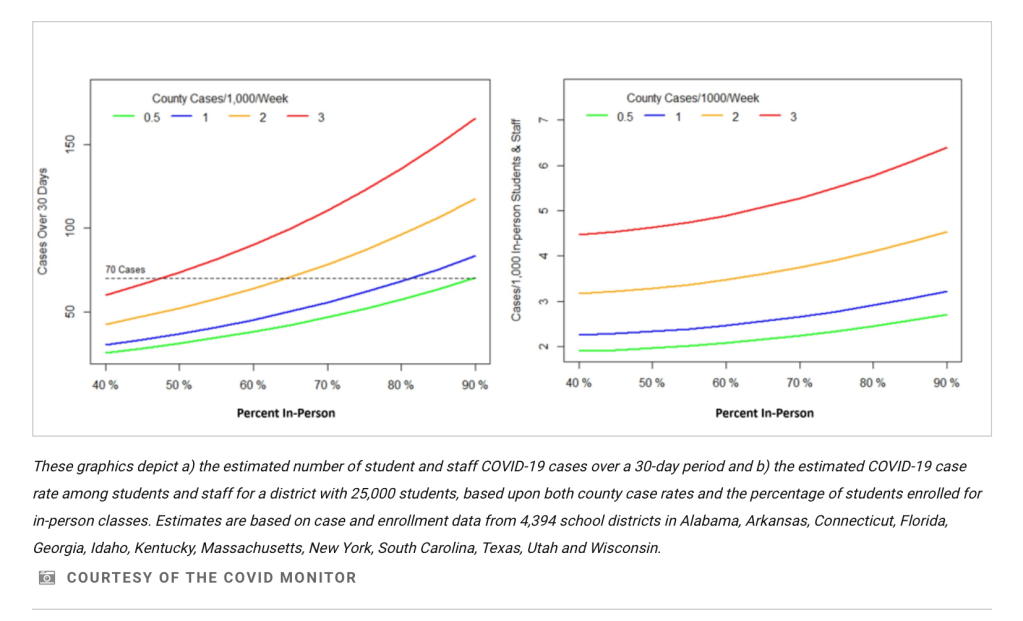
They observed that the higher the community case rate, the higher the school district case rate, as depicted in the graphic below.
They found that case rates for school districts are often much higher than case rates in the community. Meanwhile, within their data, a recent review of school district case rates based on total enrollment showed that less than 3% of all districts reporting two or more cases met a lowest-risk, case-rate threshold advised by the CDC for communities.
They also show that the percentage of students enrolled for in-person classes directly impacts the case rate in school districts. A recent study based on their data found school districts can reduce COVID-19 case rates by about 40% by reducing the in-person class size by 50%.
Based on data from Florida, their data show that school districts without mask mandates have an average case rate (12.1 per 1,000) nearly twice as high as those with mask mandates (6.9 per 1,000).
Do you come away from this independent national data thinking that schools are safe to reopen under current circumstances and do not contribute to the spread of the virus?
Also, there is worrisome new data. @DrEricDing say “new B117 Covid variant is not only more infectious, it’s potentially more infectious in children 0-9 (+24%) and 10-19 (+14%), and less among 60-79, compared to common strains. More sobering—the R estimate is much higher.” See more at this thread h/t to LH.
Arguments about social and mental well-being of students due to online learning have been made by experts in various fields. However, now that we have data, research and experience strongly indicates we need to prioritize the health of communities in the midst of a worldwide pandemic. We must do this until ALL states prioritize the vaccination of educators and provide the financial and strategic resources to reopen safely. States should immediately prioritize this goal so that we can both address the social and mental well-being of students as well as protect the health of the nation.
We’ve seen how problematic and absent leadership has led to less than a quarter of Covid vaccines (as of right now) being used for vaccinations in Florida, Texas and other states. Yet many states are insisting and placing enormous political and financial pressure on school to reopen. It’s a severe and gross failure of leadership to allow vaccines to sit on shelves and at the same time demand educators reopen schools. I have been impressed by the leadership in Kentucky prioritizing educators for inoculation as a high priority group so that schools can reopen more safely. Furthermore, absent inoculating all educators and providing the financial and strategic resources for districts to reopen schools safely (i.e. PPE, smaller class sizes etc.) for students and families, President-elect Joe Biden’s promise to open all schools in the first 100 days is a problem and a national disaster waiting to happen. I am sure President-Elect Joe Biden is aware that Secretary of Education-Designate Cardona pressured schools to reopen in Connecticut throughout 2019. So, considering the current knowledge in the data and science, it is my hope that Biden and Cardona get it right on school reopening in the upcoming months, otherwise history and voters won’t be kind.
Please Facebook Like, Tweet, etc below and/or reblog to share this discussion with others.
Website Created by Gates Foundation Leaves Open Personal Data of Hundreds of Thousands of Students
The Financial Times reported a major data breach of personally identifiable student data on a website funded by the Gates Foundation. Bill Gates, as we know, is a data aficionado. Several years ago, he created an ill-fated project called InBloom with the intent of gathering the personal data of millions of students. Fortunately it was killed off by parent activists Leonie Haimson and Rachel Stickland, who created the Parent Coalition for Student Privacy. The “cloud” is not secure.
California Department of Education Releases 2019-20 Data on Use of
Restraints and Seclusions on Students
2019-20 High School Graduation and Dropout Rates - Year 2020 (CA Dept of Education) -https://www.cde.ca.gov/nr/ne/yr20/yr20rel101.asp
SACRAMENTO—The California Department of Education (CDE) today released
data on the number of instances in which schools used restraints and
seclusions on students, the first year of data under a state law that
requires schools to track and report such instances to the CDE.
The 2019–20 school year was the first that required local educational
agencies (LEAs) to track and report to the CDE the use of restraints and
seclusions with students receiving both general education and special
education to the CDE under AB 2657. The data provides a starting point for the state to identify important
trends and target support to school leaders.
“Publicly reporting this data is an important first step toward improving
transparency and accountability by bringing potential issues to the
surface,” Thurmond said. “Now that we have this data, the CDE can use this
information as a starting point to begin having deeper, critical
conversations with school system leaders.”
The legislation, which became effective January 1, 2019, only allows for
schools to use restraints or seclusions “to control behavior that poses a
clear and present danger of serious physical harm to the pupil or others
that cannot be immediately prevented by a response that is less
restrictive” and prohibits the use of restraints or seclusions for the
purpose of coercion, discipline, convenience, or retaliation.”
The law uses the following definitions:
Mechanical Restraint: Use of a device or equipment to restrict a pupil’s freedom of
movement.
Physical Restraint: A personal restriction that immobilizes or reduces the ability of
a pupil to move his or her torso, arms, legs, or head freely. (This
definition does not include temporary touching or holding of the hand,
wrist, arm, shoulder, or back for the purpose of inducing a student who
is acting out to walk to a safe location.)
Seclusion: The involuntary confinement of a pupil alone in a room or area
from which the pupil is physically prevented from leaving.
State law requires the CDE to report restraint and seclusion data at the
LEA-level (county offices of education, school districts, and charter
schools) and to disaggregate by race/ethnicity and gender. While not
required by law, the CDE is also reporting separately for students
attending non-public schools (NPS), the most restrictive placement for
children with disabilities with the highest support needs. State law
excludes restraints used by law enforcement.
A full breakdown of the first year of reporting this data under AB 2657
can be found below in Table 1.
Future years of reporting will provide a fuller picture of the use of
restraints and seclusions in schools. Beyond the public reporting
requirement in AB 2657, the CDE Special Education Division will use this
data in its mandated monitoring activities to ensure that students with
disabilities are receiving a Free and Appropriate Public Education in the
Least Restrictive Environment.