Latest News and Comment from Education

Showing posts with label STUDENT PRIVACY. Show all posts

Tuesday, April 20, 2021

Student privacy HB256 – Fred Klonsky

Student privacy. HB256 – Fred Klonsky
STUDENT PRIVACY HB256


Update.

Hi Fred! 
Thank you for posting about the edTPA videotaping bill. It was HB256, but that bill disappeared with the end of lame duck session. 
So, the current incarnation is SB808-SFA1. (= the language is in an education shell bell that’s being amended.)
People can put in a witness slip at this linkas a proponent of SFA1 for the hearing scheduled for tomorrow at 2pm.
It still has the same chief sponsor in the Senate, Laura Murphy (D-Park Ridge); she is a big advocate for protections for domestic violence victims, which is why she took on this bill. 
It doesn’t have an equivalent bill in the House, but with any luck it should move over there as SB808.
Best,
Cassie
Support HB256, Rep. Will Guzzardi and Sen. Laura Murphy

Senate Chief Co-Sponsors: Iris Martinez, Bill Cunningham. Senate Co-Sponsors: Craig Wilcox, Dale Righter, Julie Morrison, Robert Peters, Robert Martwick.

House Co-Sponsors: Steven Reick, Mary E. Flowers, Tony McCombie, Sue Scherer, Linda Chapa LaVia, Katie Stuart, Michael Halpin, Robyn Gabel, Yehiel M. Kalish, Jonathan Carroll and John Connor.

Student teachers in Illinois must videotape themselves and their students to pass CONTINUE READING: Student privacy. HB256 – Fred Klonsky

Friday, January 15, 2021

Hack Education: Behaviorism, Surveillance, and (School) Work | National Education Policy Center

Hack Education: Behaviorism, Surveillance, and (School) Work | National Education Policy Center
Hack Education: Behaviorism, Surveillance, and (School) Work


I was a speaker today at the #AgainstSurveillance teach-in, a fundraiser for Ian Linkletter who is being sued by the online test-proctoring software company Proctorio.

I am very pleased but also really outraged to be here today to help raise money for Ian Linkletter's defense and, more broadly, to help raise awareness about the dangers of ed-tech surveillance. It's nice to be part of an event where everyone is on the same page — politically, pedagogically — and I needn't be the sole person saying "hey wait, folks. This ed-tech stuff is, at best, snake oil and, at worst, fascist." 

The challenge, on the other hand, is to not simply repeat the things that Sava, Maha, Benjamin, Chris, and Jesse have already said. I am lucky that these five are not just colleagues but dear friends, and the love and support they have shown me and the solidarity that all of you show today give me great hope that we can build better educational practices and that we aren't stuck with snake oil or fascism. 

I will say this, even if it's been stated and restated a dozen or more times today: test proctoring is exploitative and extractive. It is harmful to all students, but particularly to those who are already disadvantaged by our institutions. To adopt test proctoring software is to maintain a pedagogical practice based on mistrust, surveillance, and punishment. To adopt test proctoring software is to enrich an unethical industry. To adopt Proctorio in particular is to align oneself with a company that has repeatedly demonstrated that it sees students, teachers, and staff as CONTINUE READING: Hack Education: Behaviorism, Surveillance, and (School) Work | National Education Policy Center

Thursday, January 14, 2021

Washington Privacy Act, SB5062, does not go far enough to protect consumers or students | Parent Coalition for Student Privacy

Washington Privacy Act, SB5062, does not go far enough to protect consumers or students | Parent Coalition for Student Privacy
WASHINGTON PRIVACY ACT, SB5062, DOES NOT GO FAR ENOUGH TO PROTECT CONSUMERS OR STUDENTS


On January 14, 2021, the Washington state legislature will hold a hearing on a privacy bill, The Washington Privacy Act, SB 5062 which is weak and does not fully protect consumers’ right to privacy: 

  • SB5062 does nothing to better protect educational, teacher, or student data. 
  • SB5062 does not apply to state or local government agencies.
  • SB5062 has many limitations and exemptions that allow the selling of user data or its use for marketing purposes: 
    • SB5062  allows corporations and other third parties to sell your data or use it for marketing purposes UNLESS you  expressly opt out.
    • If you do opt out, companies can charge you a higher price for their services.
  • Even then, consumers  can only “opt out” of the collection and use of personal data for certain purposes.” 
    • Instead, companies should be required to get prior consent or “opt in” for any disclosure of your personal data, including its use for marketing or sale. 
  • Finally, SB5062 does not allow people to hold companies accountable for violating their privacy rights by suing, if they’ve violated the law or your decision to opt out.

 We agree with this Seattle Times op-ed: Washington needs a privacy law that protects people, not corporations. Oppose CONTINUE READING: Washington Privacy Act, SB5062, does not go far enough to protect consumers or students | Parent Coalition for Student Privacy

Thursday, December 31, 2020

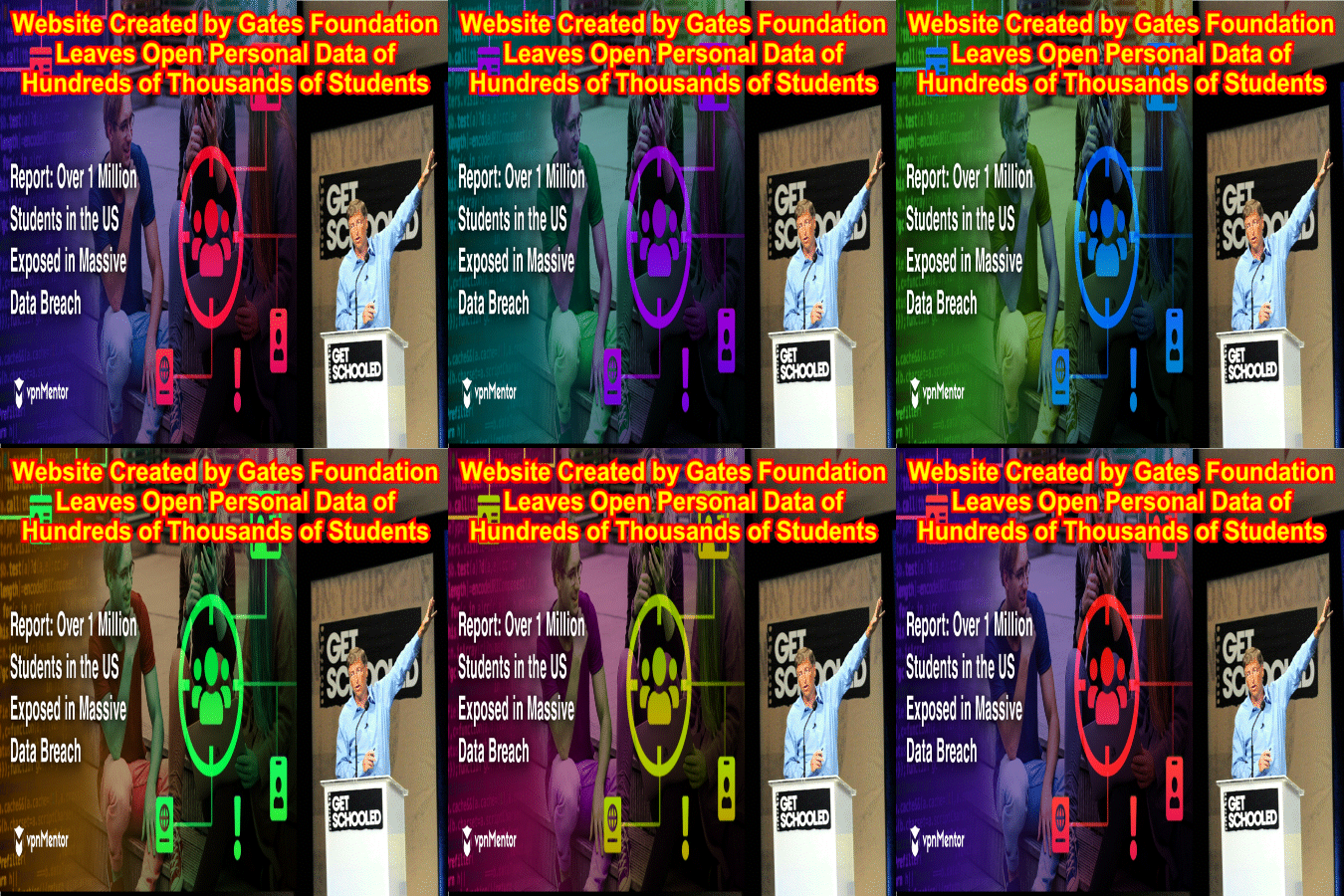
Website Created by Gates Foundation Leaves Open Personal Data of Hundreds of Thousands of Students | Diane Ravitch's blog

Website Created by Gates Foundation Leaves Open Personal Data of Hundreds of Thousands of Students | Diane Ravitch's blog
Website Created by Gates Foundation Leaves Open Personal Data of Hundreds of Thousands of Students


The Financial Times reported a major data breach of personally identifiable student data on a website funded by the Gates Foundation. Bill Gates, as we know, is a data aficionado. Several years ago, he created an ill-fated project called InBloom with the intent of gathering the personal data of millions of students. Fortunately it was killed off by parent activists Leonie Haimson and Rachel Stickland, who created the Parent Coalition for Student Privacy. The “cloud” is not secure.

The personal details of hundreds of thousands of US students were exposed to hackers after a database was left unsecured by Get Schooled, an education charity set up by the Bill & Melinda Gates Foundation and Viacom. Get Schooled was set up a decade ago to help students CONTINUE READING: Website Created by Gates Foundation Leaves Open Personal Data of Hundreds of Thousands of Students | Diane Ravitch's blog


Monday, December 21, 2020

Online proctoring services pose privacy concerns for remote learning - Vox

Online proctoring services pose privacy concerns for remote learning - Vox
How teachers [sic] are sacrificing student privacy to stop cheating
Surveillance software for remote learning is drawing criticism from privacy advocates and lawmakers.


As the fall semester began at the University of Nevada, Reno, psychology professor Mark Lescroart faced an increasingly common dilemma for teachers: How to prevent his newly remote students from cheating on the quizzes and exams he’d designed to be taken in class with supervision.

“I have been uncomfortable with the idea that cheating is pretty easy when you’re online,” Lescroart told Recode in October.

One possible solution his university provided was Proctorio, an online proctoring service that uses machine learning. But Lescroart didn’t like the prospect of third-party software recording and analyzing his students in their homes. Ultimately, he decided that violating their privacy was worse than leaving a potential cheater uncaught.

But many teachers around the country have come to a different conclusion. As online education has become the norm in the Covid-19 pandemic, they’ve opted to use services like Proctorio. The services have ignited controversy, too. Privacy advocates hate them, and students have protested, starting petitions and accusing the services of being invasive, discriminatory, and inaccurate.

In December, the Electronic Privacy Information Center (EPIC) accused five online test proctoring services, including Proctorio, of unfair and deceptive trade practices in a complaint filed with the Office of the Attorney General of the District of Columbia. EPIC also informed the five companies that it is preparing to file a lawsuit unless they change their practices. Several US senators have also recently written to the companies producing these tools to request more information about privacy, bias, and accessibility concerns raised by their tools.

Some educators have spoken out against this tech or, like Lescroart, have opted not to use it. But for the most part, the schools that use the software haven’t budged, citing the importance of maintaining academic integrity.

“All these things are kind of predicated on a relationship where academic dishonesty is CONTINUE READING: Online proctoring services pose privacy concerns for remote learning - Vox

Friday, December 18, 2020

How students should be protected from surveillance during remote learning | Parent Coalition for Student Privacy

How students should be protected from surveillance during remote learning | Parent Coalition for Student Privacy
HOW STUDENTS SHOULD BE PROTECTED FROM SURVEILLANCE DURING REMOTE LEARNING


December 2020

Endorsed by Access Living, ACLU of Illinois, Brighton Park Neighborhood Council, Chicago Lawyers’ Committee for Civil Rights, Children’s Screen Time Action Network, Civitas ChildLaw Center, Hartlieb & Horste, LLC, Illinois Families for Public Schools, Parent Coalition for Student Privacy, Raise Your Hand for Illinois Public EducationDownloadable as a Full document | or a one-page Summary

Many US public schools have been operating remotely since March, either full-time or part-time as a result of the Covid pandemic.  And with infection rates steeply increasing in the US, the timing of any return to fully in-person schooling remains uncertain.

The use of technology was widespread even before this spring. Now its use is nearly universal. But tech use should not impinge on students’ right to privacy and access to schooling.

In a recent national survey, 60% of educators said students would face negative consequences for having cameras off.   However, students should never be forced to choose between maintaining their privacy and receiving an education .  Moreover, surveillance does not equal safety.

Surveillance can be especially stressful for disadvantaged students, CONTINUE READING: How students should be protected from surveillance during remote learning | Parent Coalition for Student Privacy

Friday, December 11, 2020

Liability, Thy Name Is Google Meet | deutsch29: Mercedes Schneider's Blog

Liability, Thy Name Is Google Meet | deutsch29: Mercedes Schneider's Blog
Liability, Thy Name Is Google Meet


In order to educate students in quarantine, our school district is now using the video conferencing tool, Google Meet, which is part of the Google Classroom portfolio of online education products.

Google Meet has been billed as “a game changer.”

Indeed.

The idea of viewing the interior of my students’ homes while teaching them using Google Meet immediately brings to mind one word:

Liability.

In requiring teachers to use video conferencing for quarantined students, my school district has extended the classroom of all of its teachers into students’ homes. We can see into those homes as we conference. It makes me uncomfortable because I do not want to witness something I might be held legally responsible to report even as I feel I am invading student privacy via my official, school presence viewing that private space.

What if I see drugs or drug paraphenalia laying on a table?

What if I witness what appears to be the planning or execution of some other illegal activity?

What if I view or hear evidence of abuse or neglect?

What is my professional liability for  CONTINUE READING: Liability, Thy Name Is Google Meet | deutsch29: Mercedes Schneider's Blog

Thursday, November 26, 2020

CURMUDGUCATION: FL: Big Brother Is Watching Your Child

CURMUDGUCATION: FL: Big Brother Is Watching Your Child
FL: Big Brother Is Watching Your Child


Eyebrows shot up around the country this week as the Tampa Bay Times reported on how the Pasco County Sheriff's Office keeps a secret list of "at-risk" kids who could “fall into a life of crime." Creating the list involves the office collecting and factoring a whole bunch of different you-probably-thought-they-were-confidential records, including records from the school district and from the state's Department of Children and Families. 

"We have an agreement with the Sheriff's Office," the superintendent said in an interview with the Times. "The agreement requires them to use (the data) for official law enforcement purposes. I have to assume that's exactly what they are using it for."

Low grades? Absenteeism? Violence in the home? You may well be flagged as a possible future criminal. The Sheriff's Office has a whole manual. And a list, with 420 names on it. And none of the families connected to the names knows a thing about it. This is not a targeted search, where someone is concerned about Pat McStudent; this is a blanket sweep of the entire list of records from the various institutions.

Mark Lieberman at EdWeek did some checking to see if this practice is illegal (if you're old enough, you may remember when FERPA protected students from this kind of thing). The answer seems to be CONTINUE READING: CURMUDGUCATION: FL: Big Brother Is Watching Your Child


Wednesday, November 18, 2020

NYC Educator: Showing Faces (or Not) in Remote Instruction

NYC Educator: Showing Faces (or Not) in Remote Instruction
Showing Faces (or Not) in Remote Instruction


This year, our school has asked students to show their faces during remote instruction. This is a large improvement for those of us out here doing the work. Some say this is an intrusion on student privacy. There are workarounds, though, for students uncomfortable with showing their faces or homes. Students can use virtual backgrounds, and many do. For now at least, they're also free to come to our building and use school computers.

Some of my students don't show their entire faces. Some show only their foreheads. Others show half or less of their profiles. While I'd prefer to see their entire faces, I'm good with their preferences. At least I know they're there. It's difficult, of course, to get to know students you can't see. If they are available, and if they respond to questions, I can settle for whatever they're comfortable with.

It was very difficult last year looking at all avatars. You never know what students are doing, or not doing, while they're hiding. Are they listening to you? Are they playing video games? Sleeping? Having a wild party in their home? Without even inviting you? Your guess is as good as mine. Last year, when we didn't ask students to turn on cameras, virtually none of them showed their faces. You'd ask a question and  likely as not get nothing back.Why bother doing anything once your computer is turned on?

This was very disconcerting to me. In my physical classroom, I walk around everywhere, startling students who are lost in space. I'll suddenly raise my voice to a ridiculous level while passing a student whose head is down. I'll intentionally trip over something and draw a sleepy kid's attention along with that of everyone else. I'll essentially say or do anything to get kids on track.

Of course, when students don't show their faces, I have no option. I'm the teacher just sitting at the teacher CONTINUE READING: NYC Educator: Showing Faces (or Not) in Remote Instruction

Saturday, November 14, 2020

Deadlines for in-person schooling, class size reporting, and questions about DOE’s protection of student data | Class Size Matters

Deadlines for in-person schooling, class size reporting, and questions about DOE’s protection of student data | Class Size Matters | A clearinghouse for information on class size & the proven benefits of smaller classes
Deadlines for in-person schooling, class size reporting, and questions about DOE’s protection of student data


Dear Friends,

1/ Today, Thursday Nov. 12 at 6:30 PM, I’ll be speaking at an online forum hosted by Brooklyn for Peace about how the COVID-19 pandemic has widened the inequities that already exist within our public school system. You can find more information about this forum and sign up to attend here.

2/ The DOE deadline for parents to opt for in-person learning for their kids is Sunday Nov. 15; you can do that here. Meanwhile, the city’s infection rate is creeping up and was 2.5% yesterday. Even though the random testing shows the infection rate inside schools is only about .18%, the Mayor has said all schools will be closed when the citywide rate rises to 3%.

While de Blasio has insisted that this may will be your only chance to opt-into in person learning for your child, more recently the Chancellor said that there indeed may be more opportunities later this year. As I said in this article, it is highly unfair and irrational to close off the possibility of parents opting in later in the year, especially as there may be a vaccine available as soon as April.

3/ Nov. 15 is also the legal deadline for the DOE to report class sizes by school and grade level. Much thanks to CM Mark Treyger, who wrote a letter to the Chancellor urging him to make the deadline, and to report separately class sizes of in-person classes vs remote classes, especially as many parents and students have reported that the latter can be as large as sixty, eighty students or more. Chalkbeat wrote an article about the importance of disaggregated data, and I blogged about this issue here.

4/ We are also very concerned about the privacy of student data, especially as DOE has hurriedly acquired at least 100 ed tech programs and has told schools that they “must have a shared, inclusive and digital curriculum in all core subject areas”. And yet many of the publicly available privacy policies of these products do not comply with state law, as they allow for the commercialization or sale of student data, or do not sufficiently protect it from breaches. See the letter sent by Sen. Brad Hoylman to the Chancellor, asking that the DOE post all the contractual Parent Bill of Rights agreements with these vendors, to ensure that student privacy is rigorously protected. The DOE has failed to post any of them so far, even though this is also required by the state law. Chalkbeat reported on this non-compliance with the law on the part of the DOE, and I provided more detail about our concerns here.

If you haven’t already, please respond to our parent/teacher/student survey to let us know which online apps your children have been assigned; you can also check the privacy grades of some of the products that we know DOE is encouraging schools to use.

Thanks as always for your help,

Leonie


Thursday, November 12, 2020

A Privacy Blueprint for Biden | Parent Coalition for Student Privacy

A Privacy Blueprint for Biden | Parent Coalition for Student Privacy
A PRIVACY BLUEPRINT FOR BIDEN


Privacy And Digital Rights For All

The weakening of The Family Educational Rights and Privacy Act (FERPA) and the Covid19 rush to usher in virtual learning and edtech in place of in-person learning, have created a perfect storm for student data collection and tracking. Students are increasingly subjected to edtech data collection, profiling, and surveillance as a condition of attending a public school. We call on the next administration to protect children and begin implementing these important recommendations within the first 100 days of office.

Leading privacy and civil rights advocates recently called on the next U.S. administration to make protecting digital privacy a top priority. The press release signed by Campaign for a Commercial-Free Childhood, Center for Digital Democracy, Color of Change, Consumer Action, Consumer Federation of America, Electronic Privacy Information Center, Privacy Rights Clearinghouse, Parent Coalition for Student Privacy, Public Citizen, and U.S. PIRG states:

“The Biden administration and the next Congress should make protecting digital privacy a top priority, and 10 leading privacy, civil rights and consumer organizations today released a memo of recommendations for executive actions on Day One, actions during the first 100 days and legislation.

“The United States is facing an unprecedented privacy and data justice crisis,” the blueprint memo reads. “We live in a world of constant data collection where companies track our every CONTINUE READING: A Privacy Blueprint for Biden | Parent Coalition for Student Privacy

Saturday, October 24, 2020

NYC Public School Parents: Do you know where your child's personal data is? Please fill out our survey on your school's use of digital apps -

NYC Public School Parents: Do you know where your child's personal data is? Please fill out our survey on your school's use of digital apps -
Do you know where your child's personal data is?
Please fill out our survey on your school's use of digital apps


Class Size Matters, NY Allies for Public Education, and the Parent Coalition for Student Privacy would like to know which online apps or programs are being employed by schools throughout New York state, and whether they are sufficiently protective of children's privacy. We are asking parents and teachers to take our survey here, to let us know what apps or programs your schools are using.

Since the pandemic hit, districts across New York State have purchased many commercially-produced online apps and digital programs to implement remote learning. Even before last spring, schools had been using a large number of programs, many of which collect and use personal student information. In NYC alone, more than 75 commercially available online programs have been acquired for teachers to assign to their students, and "The DOE has informed schools that for SY 2020-21, they must have a shared, inclusive and digital curriculum in all core subject areas," according to the UFT.

Many of these digital apps collect and use personal student data in ways we do not understand. In some cases, the publicly available privacy policies of these vendors are NOT sufficiently protective and do not comply with the NY state student privacy law, Education Law 2D, which was passed in 2014.  

Among other things, this law and its regulations adopted in Jan. 2020 require that every contract with a vendor with access to personal student data must have a separate Parent Bill of Rights [PBOR], which specifies how the data will be protected and how parents can access the data and challenge it if necessary.

Each of these separate Parent Bill of Rights are supposed to be posted on the district website, along with other important information, including your district’s overall data privacy protection policy, and how you can contact the district data privacy officer in charge of ensuring these protections. Links to the Education Law 2D, the regulations, and a summary of some of the other most important provisions are here.

Please take a few minutes to fill out our online survey to let us know what online apps and/or digital programs are being used in your schools, and whether the district has provided the necessary information about the ways in which that data is being protected from breach and abuse.

Thanks!

Leonie Haimson, Class Size Matters and Parent Coalition for Student Privacy

Lisa Rudley and Jeanette Deutermann, NY State Allies for Public Education


Friday, October 16, 2020

NY State Student Privacy Regulations Summary and Excerpts | Parent Coalition for Student Privacy

NY State Student Privacy Regulations Summary and Excerpts | Parent Coalition for Student Privacy

NY STATE STUDENT PRIVACY REGULATIONS SUMMARY AND EXCERPTS


As the new school year has started this fall, schools across the country are heavily relying on virtual and blended learning to instruct children. To facilitate this remote learning, many schools are using apps and programs developed and operated by third-parties. New York State regulations create requirements and restrictions for the contracts between school districts and app developers/operators regarding data privacy and usage. Below are a summary and excerpts of these regulations for parents to stay informed on whether school districts are complying and protecting students properly.
NY State Student Privacy Regulations Summary and Excerpts | Parent Coalition for Student Privacy


Tuesday, September 8, 2020

Top 10 back-to-school student privacy tips and resources for parents | Parent Coalition for Student Privacy

Top 10 back-to-school student privacy tips and resources for parents | Parent Coalition for Student Privacy

TOP 10 BACK-TO-SCHOOL STUDENT PRIVACY TIPS AND RESOURCES FOR PARENTS


It’s back-to-school time for many K-12 students,  which will mean for many students remote online learning, or some type of hybrid, combining in-person with screen-based instruction.   We’ve gotten lots of questions from parents and educators concerned about the opportunity for expanded student data collection and disclosure in this new regime.
Here’s a checklist of resources and tips to help protect your students’ privacy:
  1. Opt-out of Directory Information.  Schools can share Directory Information about students with third parties — without parental or student consentunless you opt-out.   FERPA,  the Family Educational Rights and Privacy Act, requires schools to notify you of your right to opt-out of Directory Information, at the beginning of the school year. (FERPA is a privacy law that applies to any educational institution that receives federal funding, which includes all public schools and many private educational institutions as well.)  See our sample Directory opt-out form and resources  here and see World Privacy Forum’s video, flyer,  more information and opt-out form here Or use this school district’s Directory opt-out form as a template to also opt-out of online recorded or video conference learning.  Why does this matter?  What can be shared without your consent, via Directory Information? .According to the US Department of EducationDirectory Information can include, but is not *limited to: CONTINUE READING: Top 10 back-to-school student privacy tips and resources for parents | Parent Coalition for Student Privacy