Sunday, May 9, 2021

CATCH UP WITH CURMUDGUCATION + ICYMI: Mother's Day Edition (5/9)

CURMUDGUCATION: ICYMI: Mother's Day Edition (5/9)


Mother's Day Edition 

Honestly, it has been kind of a rough week here, and it's not getting better any time soon. So whatever else you do today, make sure you hug a loved one and let them know you care. Time is relentless and remorseless. Humans do not have to be. Here's some reading from the week.

Teacher Evaluations (Hammers and Nails)

Blue  Cereal Education with a story of what teacher evaluation looks like in the field, and why sorting everything into hammers and nails is a problem of its own.

The Great (Unemployed and Underpaid) Transformation

Nancy Flanagan takes a look at what has changed, and why we're not going back to "normal."

A state legislator is howling indoctrination because my 7th graders are learning the ocean is polluted

One of the new anti-indoctrination policy ideas now making the rounds is to force teachers to post their lesson plans and materials (the better for folks to catch educators in their indoctrinatin' ways). Justin Parmenter inadvertently became a poster boy for that initiative in North Carolina. He tells eth story at Notes from the Chalkboard.


At the Washington Post, an overview of the current right wing freakout over CRT (or at least what they imagine CRT must be). Pair this with the next piece on the list.


Michelle Goldberg at the New York Times suggests that the right needs something to get the based fired up, and since Joe Biden won't fill the bill, let's get excited about all that pub lic school indoctrinatin' going on.


Jan Resseger looks at the potential effects of Biden's big AFP proposal.


Thomas Ultican takes a look a new book about diversity research and considers teacher voice in policy ideas.


If you're puzzled by the story of how Seth Andrew managed to take a pile of money from the charter he founded, the indispensable Mercedes Schneider clarifies how it was all done. 


The Centner Academy hit the news when it announced that it would fire teacher4s for getting vaccinated. That turns out to be just the tip of the crazy iceberg. The New York Times went digging.


At Salon, Thomas Nail considers why artificial intelligence research may have wandered down the wrong road.


Kate Crawford at the Atlantic explains why all those programs claiming they can read student emotion are actually bunk.


At the very least. Chuck Goldenberg at EdWeek explains.


McSweeney offers a perfect true/sad/funny chaser for Teacher Appreciation Week. 


Accountability Whiplash
It's one of the little inconsistencies in the reformster movement. Some will point at charts showing that spending on public education has increased steadily (in constant dollars) and ask, "What have we gotten for it?" There are answers to that question, including but not limited to A) more education for special ed students previously warehoused in some back room, B) better funding for previously
Teaching Legacies
It's easy as a teacher-- particularly if you've taught in a single school for a lot of your career-- to think of your legacy being in the building or in some program that you created or nurtured. But that's not it. As you approach retirement, you may notice (if you haven't already) that no matter how ever-present and plugged in you may be, no matter how many invaluable extras you provide, once you
Khan Academy Expanding To Littles
The pandemic has been very, very good to Sal Khan, and he's ready to grab the big sticky ball and run with it. He recently did an interview with Emily Tate for EdSurge, and it's all just as discouraging as you would expect. Khan opens with a few thought about pandemic life in the Bay Area: “Obviously, some aspects have been suboptimal for everybody,” he says, acknowledging that his family has bee
ICYMI: What? May Already? Edition (5/2)
That whole April thing seemed to slide by quickly. What could come next? I'll remind you (as I haven't in a while) that sharing is your power as a reader, and that if any of these really speak to you, the best gift you can give the writer of your favorite piece is more readers. Share. I'm a Chicago princi

NANCY BAILEY: The Loss That Matters This Mother’s Day

The Loss That Matters This Mother’s Day


The loss important to understand this year, the most critical loss, is not learning loss. It involves the loss many children are facing after losing a mom or dad to Covid-19. Or it could be a grandma or grandpa, a beloved aunt or uncle, or sister or brother, even a friend.

On this Mother’s Day, how many children are grieving the loss of their mother? On Father’s Day, how many will be missing their dad?

We’re told that between 37,000 and 43,000 children in the United States have lost at least one parent to COVID-19. According to the University of Southern California, this is a 20% increase in parental loss over a typical year.

A loss will affect how students look at school, how they take tests, and how they recapture a sense of normalcy as school buildings reopen and they gather once again in person if they are not already in the school building. School and life for them will never be the same.

Parental loss due to Covid-19 has been found more in the black community. Children are called Covid Orphans.

Children may be troubled simply due to the fear and anguish caused by the strangeness CONTINUE READING: The Loss That Matters This Mother’s Day

Barbed Wire (from "Have To" History) | Blue Cereal Education

Barbed Wire (from "Have To" History) | Blue Cereal Education
Barbed Wire (from "Have To" History)


Stuff You Don't Really Want To Know (But For Some Reason Have To) About... Barbed Wire

Three Big Things:

1. Barbed wire became the fencing of choice in the west after the Civil War. It was relatively cheap, withstood a wide range of conditions, and held back the biggest, most stubborn livestock.

2. Barbed wire favored homesteaders moving west, who tended to be small farmers. It threatened, and eventually helped destroy, the mythical “open range” and cowboy culture.

3. Barbed wire is rarely asked about specifically in history standards; it’s central to a wide variety of stuff that is, however.

Introduction

Kansas Barbed Wire MuseumThere are barbed wire museums in nearly a dozen different states. That’s right – museums devoted exclusively (or at least primarily) to the origins and impact of pokey wires in all its many varieties. The Oklahoma Cowboy Museum boasts over 8,000 varieties of prickly steel yarn, while the Devil’s Rope Museum in McLean, Texas, promises “everything you want to know about barbed wire and fencing tools.” There are several collections in and around DeKalb, Illinois, the birthplace of barbed wire, but it’s the Kansas Barbed Wire Museum which makes the grandest claims and boasts the most extensive curated exploration of this marvelous innovation.

It’s fencing. Made of wire. What’s the big deal?

Expansion, Technology, and Conflict

American history is largely a tale of expansion. Many of our best conflicts have resulted (at least in part) from our eternal need to expand and renovate. As CONTINUE READING: Barbed Wire (from "Have To" History) | Blue Cereal Education

Moms Have Borne the Brunt of Pandemic Turmoil at Work and at Home – Mother Jones

Moms Have Borne the Brunt of Pandemic Turmoil at Work and at Home – Mother Jones
Moms Have Borne the Brunt of Pandemic Turmoil at Work and at Home
A Mother’s Day labor force check-in: It’s getting a bit better. It’s still bad.


Let our journalists help you make sense of the noise: Subscribe to the Mother Jones Daily newsletter and get a recap of news that matters.

On this Mother’s Day, let’s remember the pandemic’s dire impact on American moms, who have shouldered the burden at work and at home.

In April 2020, the coronavirus’s impact on working mothers was disproportionately acute. In the United States, the number of mothers both working and living with school-aged children fell 22 percent from the previous April, a sharper decline than among fathers, the New York Times reported. The 10 million mothers not working meant that one third of moms with school-age children in the US were unemployed, a Census survey noted in March. Single mothers have been hit especially hard, with the sharpest decline in labor force participation and the slowest recovery.

The flip side of this decline is the disproportionate share of childcare at home mothers are handling themselves. And working moms are more likely than working dads to say they face challenges in the office due to balancing work and family responsibilities, according to the Pew Research Center. CONTINUE READING: Moms Have Borne the Brunt of Pandemic Turmoil at Work and at Home – Mother Jones

Charter Lobby Backs Leading Candidates for NYC Mayor | Diane Ravitch's blog

Charter Lobby Backs Leading Candidates for NYC Mayor | Diane Ravitch's blog
Charter Lobby Backs Leading Candidates for NYC Mayor


The executive director of StudentsFirstNY, Jenny Sedlis, has taken a leave of absence from her job to manage a fundraising PAC for Eric Adams, one of the leading candidates for mayor. The election is this November.

Sedlis previously was the lead spokesperson for Success Academy, Eva Moskowitz’s charter chain.

The new entity plans to run digital and TV ads supporting Adams’ candidacy, without being beholden to the strict spending limits imposed by the city’s Campaign Finance Board. Ahead of Sedlis establishing the PAC with the Board of Elections, StudentsFirstNY released a poll showing Adams closing the gap with frontrunner Andrew Yang. A poll published yesterday showed Adams in the lead.

Sedlis has not begun raising money yet, but the group is hoping to secure $6 million — matching the stated aim of political consultant Lis Smith in her fundraising effort for Andrew Yang, Adams’ chief rival in the race…

“New York City’s comeback starts with Eric Adams as CONTINUE READING: Charter Lobby Backs Leading Candidates for NYC Mayor | Diane Ravitch's blog

Black Student Struggle: 2021 Study Exposes the Gap - LA Progressive

Black Student Struggle: 2021 Study Exposes the Gap - LA Progressive
Black Student Struggle: 2021 Study Exposes the Gap


For more than a year health experts, researchers and sociologists have loudly proclaimed the obvious: The COVID-19 pandemic has unequally affected people and communities of color in the United States, causing disproportionately higher rates of infection and death. It’s a conclusion so clear that the Centers for Disease Control and Prevention dedicates part of its website to this reality.

“Racism is a serious public health threat that directly affects the well-being of millions of Americans,” CDC director Dr. Rochelle Walensky said in a statement distributed by the agency last month. “As a result, it affects the health of our entire nation.”

Equally obvious, though, is that the pandemic’s ravages are illuminating problems of inequity that already were long in existence. It’s the urgency of the fight against disease that has given those problems a new currency. And long after COVID-19 is no longer a subject of daily conversation, the issues will remain.

A new report from the University of California, Los Angeles, brings this notion into close focus. Produced by UCLA’s Center for the Transformation of Schools, the report makes it clear that the consistent underperformance of Black public school students in the L.A. area is directly tied to economics, environmental and living conditions, a lack of strategic planning by school districts and administrators, and the same structural inequities that beset other areas of life.

“Much of what we saw prior to the pandemic has only been exacerbated,” Dr. Stanley Johnson Jr., CONTINUE READING: Black Student Struggle: 2021 Study Exposes the Gap - LA Progressive

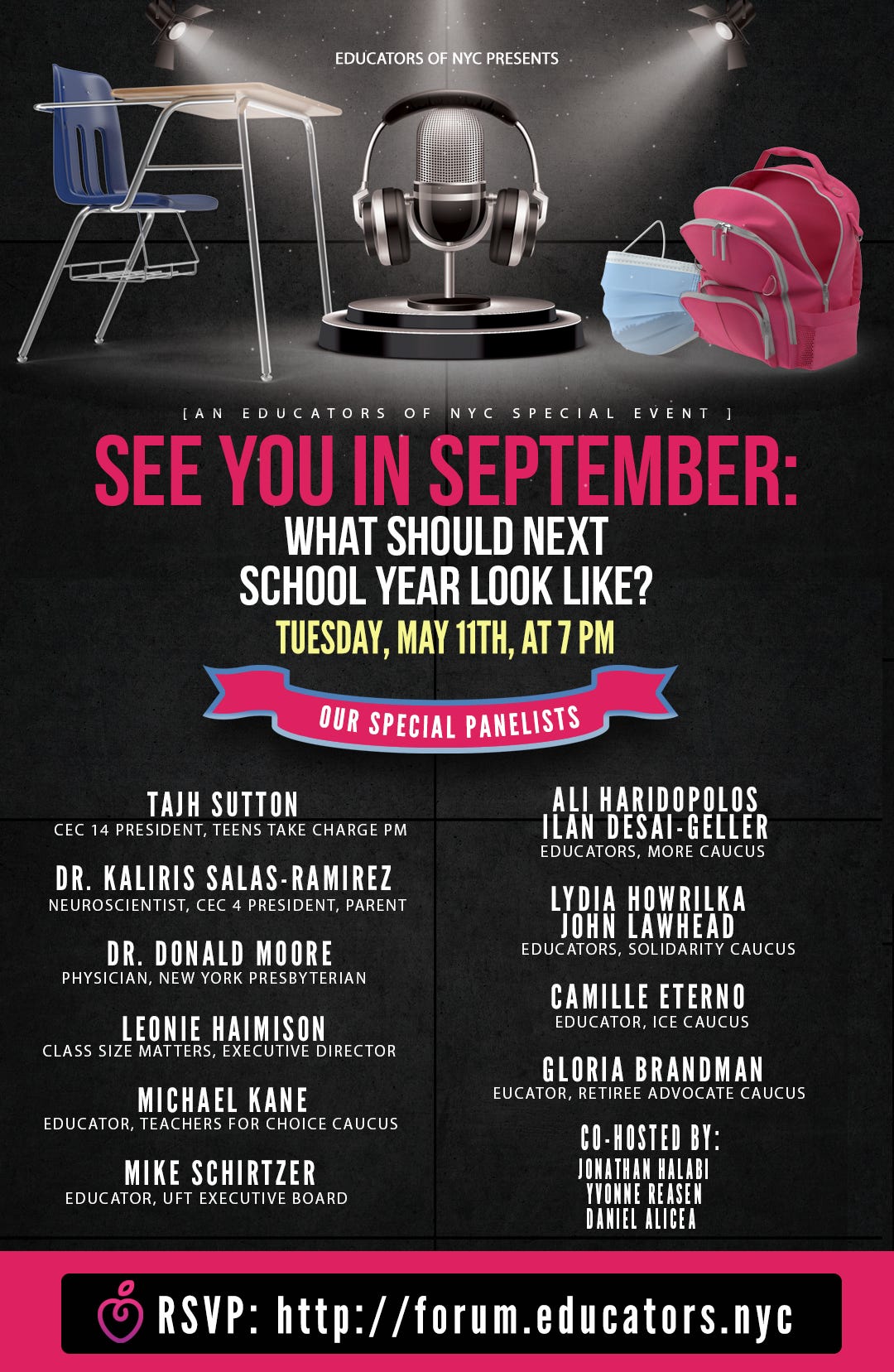
Ed Notes Online: What Should Next School Year Look Like? - An Educators of NYC Presentation - Zoom Tuesday May 11, 7PM

Ed Notes Online: What Should Next School Year Look Like? - An Educators of NYC Presentation - Zoom Tuesday May 11, 7PM
What Should Next School Year Look Like? - An Educators of NYC Presentation - Zoom Tuesday May 11, 7PM


This is the kind of conversation the UFT should be having.

Special Education Far Rockaway teacher Daniel Alicea, the major organizer at EONYC, is doing the kind of work the UFT should be doing, following up on EONYC's enormously successful monthly Zooms on Tuesday with probably the most important issue we face:  

What Should Next School Year Look Like?

The  link to sign up. He has  assembled a fantastic panel:

Panelists Set for EONYC May Forum: What Should Next School Year Look Like?

Our stakeholder panelists include parents, education activists, educators, and leaders from our various teacher caucuses We are just days away from our May 11th online forum where we will gather with expert panelists that include parents, education activists, educators, and leaders from our various teacher caucuses. We hope to also be able to lean on the expertise of a local medical doctor, as well.

As this school year of hybrid learning in a pandemic winds down, we as educators and stakeholders have begun to reflect and formulate questions about what the next school year should look like. At Tuesday evening’s event, we hope to share our collective thoughts, ideas, and demands for what should be prioritized in the upcoming school year.

Please join our next Educators of NYC monthly meetup, on Tuesday, May 11th, at 7 PM, as we discuss: WHAT SHOULD NEXT YEAR'S SCHOOL REOPENING LOOK LIKE IN A COVID WORLD?

 https://educatorsofnyc.substack.com/p/panelists-set-for-eonyc-may-forum

------

Last month EONYC held a panel that included reps from every caucus and interest group in the UFT, including Unity Caucus and attracted hundreds to a webinar discussion of the UFT Mayoral Endorsement process,  which is basically 3 people in a room.  

The video of this event which dove deep into UFT policy is worth seeing: https://youtu.be/Xc-JGK5Zrew

Eterno pointed to how important these type of open discussions have been in his ad for the April event.

Everyone guesses the UFT will endorse Scott Stringer with some believing Maya Wiley has a chance to be second. Is this the right decision? Is the UFT top-down endorsement process fair?If you are looking for a real discussion on the mayor's race and the Union's involvement, you will most likely be out of luck at the DA as it will more than likely be tightly controlled by Mulgrew.

This was a day before the UFT special DA where they did endorse Stringer but did not choose Wiley or anyone as a second choice. I wrote about the Stringer story a few days ago: UFT Sticks with Stringer.

Here's more from EONYC:

Please join our next Educators of NYC monthly meetup, on Tuesday, May 11th, at 7 PM, as we discuss: WHAT SHOULD NEXT YEAR'S SCHOOL REOPENING LOOK LIKE IN A COVID WORLD?

We are just a day away from our May 11th online forum where we will gather with expert panelists that include parents, education activists, educators, and leaders from our various teacher caucuses. We hope to also be able to lean on the expertise of a local medical doctor, as well.
 
As this school year of hybrid learning in a pandemic winds down, we as educators and stakeholders have begun to reflect and formulate questions about what the next school year should look like. At Tuesday evening’s event, we hope to share our collective thoughts, ideas, and demands for what should be prioritized in the upcoming school year.
RSVP now!!! ... as our slots to participate will go quickly.

RSVP at: http://forum.educators.nyc

We, also, encourage you to take the pre-forum survey here if you haven’t and you can also view the preliminary results. Almost 4k individuals have responded already: http://educators.nyc/maysurvey
Lastly, if you have registered we will send you a Zoom link as the forum event approaches.
The forum event will also be live-streamed via Facebook Live our public Facebook page and private page.
Please share this with those in your education networks and circles.

No-show high school students reject COVID reopening rules - Los Angeles Times

No-show high school students reject COVID reopening rules - Los Angeles Times
California high schoolers are saying no thanks to reopened campuses and are staying home


During the first week of in-person learning at Panorama High School, drama teacher Patricia Francisco stood in the mini-theater talking on Zoom to her acting class. Two stage lights brightened her face as she spoke to her camera. Students were logging in from home, or from classrooms scattered around campus. Most appeared as black boxes on her screen.

“You guys who are on campus — I’m so proud of you for being here,” she said. “Those of you who are at home — we can succeed in any environment that we are ending up in.”

Except for her voice, the room was silent. Only three students were physically in the class — and they weren’t paying attention to her as they attended other online classes while wearing noise-canceling headphones. Returning to school in Los Angeles Unified, the nation’s second-largest school district, means sitting in one classroom all day, two or three days a week, with little intermingling or movement.

This “Zoom in a room” option for in-person schooling — the format for high school in Los Angeles and San Francisco — has failed to draw back the vast majority of students. Although official attendance data have not yet been released, a survey of L.A. Unified parents indicated that about 17% of high school students would come back to campus.

L.A. Unified is hardly alone in struggling to persuade high school students to return — or in offering a lean reopening experience.

A few large districts, including Santa Ana Unified and San Bernardino Unified, have not broadly reopened campuses, including for high school students. But most of California’s largest districts are providing a patchwork of reopening approaches based on how local school boards weighed risks and benefits and how they met demands from teacher unions over back-to-campus working conditions. One big district, Corona-Norco Unified, has more than 75% of its students back. In others, it’s closer to 20% with more limited schedules.

Despite detailed planning, the majority of secondary school students in California’s largest districts will end their year much like it began — fully online, according to state data. For many, it will mean 17 or 18 months away from classrooms.

Statewide, about 84% of secondary school students have the option to return to their CONTINUE READING: No-show high school students reject COVID reopening rules - Los Angeles Times

EdAction in Congress May 9, 2021 - Education Votes

EdAction in Congress May 9, 2021 - Education Votes
EdAction in Congress May 9, 2021


President Biden and Vice President Harris have advocated for students and educators since day one.

We all want our students—Black and white, Native and newcomer, Hispanic and Asian alike—to attend safe and just public schools and higher education campuses that help them pursue their dreams and fulfill their true potential. Due to the activism of educators around the country, in the first 100 days of the Biden administration, we have seen historic investments in students and public schools along with action to make America stronger, safer, and healthier for all. President Biden and Vice President Kamala Harris have improved the lives of our students and families. And the work is just beginning. Read more.

For the People Act gives power to the people

The For the People Act (S.1), our nation’s first comprehensive democracy reform bill in decades, is expected to receive its first vote by a Senate committee this week. The House in March passed the companion bill (H.R. 1). Both take several steps to protect and expand voting rights, strengthen oversight of voting, and ensure ethical government.

More than 360 bills have been introduced in 47 states that would making voting more difficult. They include measures that would shorten the time for absentee and/or early voting, require voters show an ID at the polls, and purge voter rolls. Georgia’s legislature, for instance, passed a law making it a crime to give water or food to voters, who must often wait in long lines, within 150 feet of a polling place or within 25 feet of any voter in line.

The For the People Act would automatically register voters across America and restore voting rights to those who have completed felony sentences, among other steps. It would modernize our voting system, expose dark money in politics, and require presidential candidates to disclose their tax returns. Take Action.


NEA members speak out on loan forgiveness and COVID 19’s impact on students with disabilities

NEA members met with Secretary of Education Miguel Cardona on the Public Service Loan Forgiveness (PSLF) program and testified before a House subcommittee about COVID-19’s impact on students with disabilities last week.

On May 7, Sean Manes, a New Jersey elementary music teacher, and James Stewart, a Maryland high school science teacher, participated in a roundtable with Cardona to share their experiences with the PSLF program.

Manes became eligible for PSLF in 2019, but didn’t receive it until 2020. His loan servicer was missing nearly four years of qualifying payments. NEA’s Office of General Counsel assisted Manes in successfully arguing that he had actually exceeded the requirement for loan payments. He received loan forgiveness and was refunded the extra payments.

Stewart already had a master’s degree in science and a teaching certificate, but wanted to continue his education to be the best teacher possible, and to set an example for his students. He borrowed $90,000 to finance a doctoral degree and today, his debt is in the six figures. Although he doesn’t regret his career or educational choices, he wishes he’d had a better understanding of the loans before he took them on.

Danielle M. Kovach, a third-grade self-contained learning and language disabilities from New Jersey, testified (virtually) on May 6 before the House Early Childhood, Elementary, and Secondary Education Subcommittee. Kovach described the challenges of the abrupt switch to virtual learning and her concerns about the long-term implications of the pandemic on her student. She thanked Congress for the COVID-relief packages that have helped schools and students weather the pandemic and asked that Congress fulfill its commitment to fund the Individuals with Disabilities Education Act (IDEA) at 40 percent of the excess cost. Take Action.


Cheers

Sens. Cory Booker (D-NJ) and John Cornyn (R-TX) introduced the Food and Nutrition Education in Schools Act, which would provide federal funding for projects that educate students about healthy food practices.

Sens. Sherrod Brown (D-OH) and Susan Collins (R-ME) and Reps. Sam Graves (R-MO) and Emanuel Cleaver (D-MO) introduced, respectively, Senate Resolution 198 and House Resolution 362 honoring Teacher Appreciation Week 2021.

Reps. Jamaal Bowman (D-NY) and Marc Pocan (D-WI) led a letter to the House Appropriations Committee calling for a reduction of funding for the federal Charter Schools Program and increased oversight and accountability for the program.

Sens. Tim Kaine (D-VA) and Kirsten Gillibrand (D-NY) and Rep. John P. Sarbanes (D-MD) led a letter to Secretary of Education Miguel Cardona urging him to use administrative flexibilities granted during national emergencies to fix the Public Service Loan Forgiveness (PSLF) program.


Maurice Cunningham: Who Got Suckered? Secretary Cardona or Readers of The74? | Diane Ravitch's blog

Maurice Cunningham: Who Got Suckered? Secretary Cardona or Readers of The74? | Diane Ravitch's blog
Maurice Cunningham: Who Got Suckered? Secretary Cardona or Readers of The74?


Maurice Cunningham is a professor of political science at the University of Massachusetts. His specialty is following the gobs of money poured into “education reform.” His exposes of Dark Money in the 2016 charter expansion referendum was a crucial element in turning the public against the referendum (you can read more about him in his blogs and in my book Slaying Goliath.)

In this post, published here for the first time, Professor Cunningham writes about the innocence or naรฏvetรฉ of Secretary of Education Miguel Cardona, who met with a billionaire astroturf group and thought he was reaching out to ordinary parents and families.

Cunningham writes:

Who Got Suckered, Secretary Cardona or Readers of The74?

“The Pro-privatization education blog The74 recently published To Rebuild Trust with Families, Ed. Dept. Seeks Input from Outspoken Parents Group. The story purports to be about how Department of Education Secretary Miguel Cardona “seeks” the advice of parents and thus turns to the National Parents Union. But the CONTINUE READING: Maurice Cunningham: Who Got Suckered? Secretary Cardona or Readers of The74? | Diane Ravitch's blog

Education Matters: If Greene said being gay was a choice and they were going to burn in hell people would flip their lids. However when other education leaders say it, it gets barely a blip.

Education Matters: If Greene said being gay was a choice and they were going to burn in hell people would flip their lids. However when other education leaders say it, it gets barely a blip.
If Greene said being gay was a choice and they were going to burn in hell people would flip their lids. However when other education leaders say it, it gets barely a blip.


 Senator Kelli Stargel when pushing the transphobic sports bill across the finishing line said being gay was a choice and received zero backlash for her remarks. Erika Donalds among a heap of other bat sh*t crazy remarks said gay people don't have to burn in hell, it's a choice, and DCPS rewarded her with a second charter school. How is this acceptable?


She later apologized, sort of. 


I am not sure if she was admitting she was wrong or chastising people who kind of agreed with her witch, monster bigot comment. CONTINUE READING: Education Matters: If Greene said being gay was a choice and they were going to burn in hell people would flip their lids. However when other education leaders say it, it gets barely a blip.

Seattle Schools Community Forum: Reopening School Buildings

Seattle Schools Community Forum: Reopening School Buildings
Reopening School Buildings


I am interested in your thoughts about school building reopenings.

1) How has it been for your child to be back in their school buildings, even in a limited way?

2) Do you see safety protocols being enforced?

3) Do expect/want school buildings to be fully reopened on a regular school schedule in the fall?

Here’s an article from The Atlantic that says that right now, some of the concern over COVID appears to be performative, either thru habit or fear or both. 

https://www.theatlantic.com/politics/archive/2021/05/liberals-covid-19-science-denial-lockdown/618780/

Alex Goldstein, a progressive PR consultant who was a senior adviser to Representative Ayanna Pressley’s 2018 campaign, told me. “Either you believe that you have a responsibility to take action to protect a person you don’t know OR you believe you have no responsibility to anybody who isn’t in your immediate family.”

My take is the former because I choose to live in a society. On a day-to-day basis, sure, my family comes first for me. But we do live in a society.

 I don’t have a problem being outdoors and not wearing a mask (and by that I CONTINUE READING: Seattle Schools Community Forum: Reopening School Buildings