Latest News and Comment from Education

Showing posts with label BLACK STUDENTS. Show all posts

Sunday, May 9, 2021

Black Student Struggle: 2021 Study Exposes the Gap - LA Progressive

Black Student Struggle: 2021 Study Exposes the Gap - LA Progressive
Black Student Struggle: 2021 Study Exposes the Gap


For more than a year health experts, researchers and sociologists have loudly proclaimed the obvious: The COVID-19 pandemic has unequally affected people and communities of color in the United States, causing disproportionately higher rates of infection and death. It’s a conclusion so clear that the Centers for Disease Control and Prevention dedicates part of its website to this reality.

“Racism is a serious public health threat that directly affects the well-being of millions of Americans,” CDC director Dr. Rochelle Walensky said in a statement distributed by the agency last month. “As a result, it affects the health of our entire nation.”

Equally obvious, though, is that the pandemic’s ravages are illuminating problems of inequity that already were long in existence. It’s the urgency of the fight against disease that has given those problems a new currency. And long after COVID-19 is no longer a subject of daily conversation, the issues will remain.

A new report from the University of California, Los Angeles, brings this notion into close focus. Produced by UCLA’s Center for the Transformation of Schools, the report makes it clear that the consistent underperformance of Black public school students in the L.A. area is directly tied to economics, environmental and living conditions, a lack of strategic planning by school districts and administrators, and the same structural inequities that beset other areas of life.

“Much of what we saw prior to the pandemic has only been exacerbated,” Dr. Stanley Johnson Jr., CONTINUE READING: Black Student Struggle: 2021 Study Exposes the Gap - LA Progressive

Saturday, April 3, 2021

What Exactly Does "A Return To Normal" Mean To Black Children? - Philly's 7th Ward

What Exactly Does "A Return To Normal" Mean To Black Children? - Philly's 7th Ward
WHAT EXACTLY DOES “A RETURN TO NORMAL” MEAN TO BLACK CHILDREN?


Certainly, the masses of Americans are ready to return to “normal.”

By normal I mean a return to engaging in all the activities and indulgences of life. An unavoidable truth is that for “normal” to return – activities that serve one or both functions of generating income and/or entertaining – young people must return to school.

The Coronavirus pandemic is obviously why we’re far from normal, but is normal our preferred destination?

For many Black students, normal wasn’t all that great. Actually, normal was downright oppressive at times. Public schooling has a long history of racism. Black children are over-policed, continue to endure de facto segregation, taught culturally irrelevant and non-identity affirming content by majority white teachers, while attending schools subject to inequitable funding.

Now, throw in the mix that we remain in the midst of a global pandemic that has killed more Americans than anywhere else; a pandemic that disproportionately kills Black people, and it’s no wonder why Black students, and their parents, are in no rush to return to in-person school, as opposed to white parents.

And yet, governors on both sides of the aisle are calling for schools to open; CONTINUE READING: What Exactly Does "A Return To Normal" Mean To Black Children? - Philly's 7th Ward

Friday, March 26, 2021

More than $1 billion for 56 Black charter graduates!? | Cloaking Inequity

More than $1 billion for 56 Black charter graduates!? | Cloaking Inequity
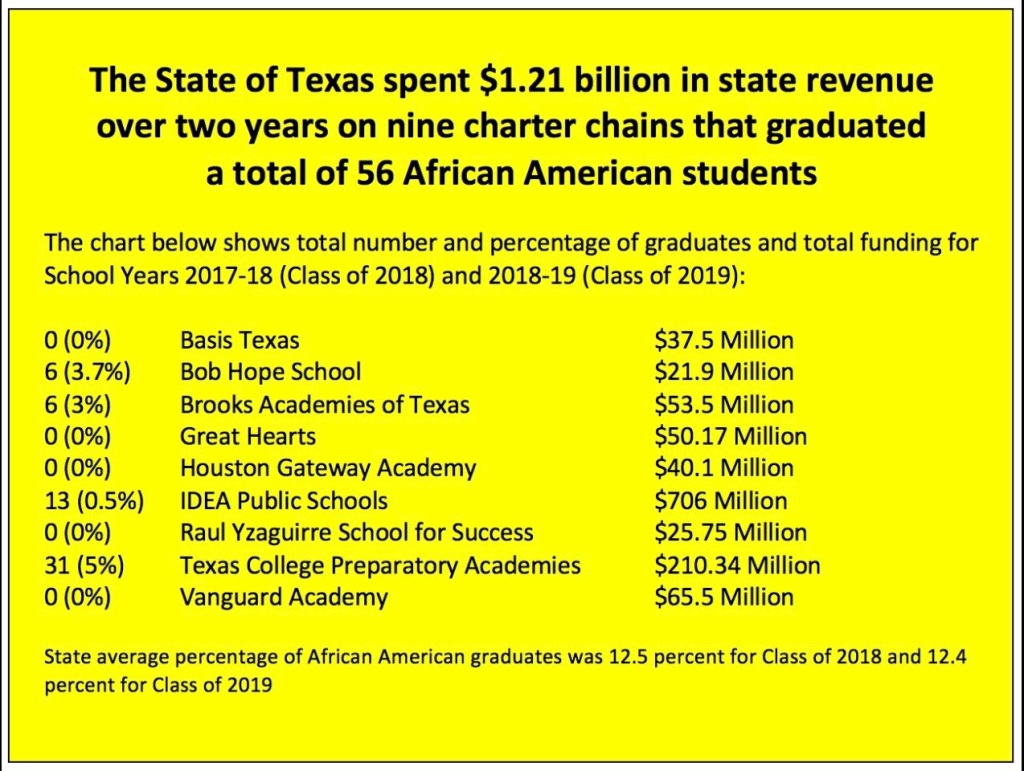
MORE THAN $1 BILLION FOR 56 BLACK CHARTER GRADUATES!?


I think this table is very self explanatory. Feel free to spread widely. H/t to my source that passed this along. Stop saying these large charter chains are about Black students. Just stop.

See also the post NEW: DOES THE AFRICAN AMERICAN NEED SEPARATE CHARTER SCHOOLS?

Please Facebook Like, Tweet, etc below and/or reblog to share this discussion with others.

Check out and follow my YouTube channel here.

Twitter: @ProfessorJVH

Click here for Vitae.

Photo credit: IDEA public schools (but no credit because they don’t actually graduate Black students despite their optics and rhetoric)


Monday, March 15, 2021

Black Reconstruction 2.0 Begins With Great Schools For Black Children - Philly's 7th Ward

Black Reconstruction 2.0 Begins With Great Schools For Black Children - Philly's 7th Ward
BLACK RECONSTRUCTION 2.0 BEGINS WITH GREAT SCHOOLS FOR BLACK CHILDREN


One morning during my junior year of high school, I remember my homeroom teacher saying to me in a dismissive tone that Malcolm X was a bad person. I am unsure how we got on the topic of figures in Black history, but I mentioned his name and that was the response.

That evening, I told my mom. After her phone conference with my grandmother, which was customary whenever something happened, she decided to call the school the next day. As per her rules, I called my mom when I got home from school the next day and I asked if she had spoken to my teacher. In her best Clair Huxtable cadence, she said that she did and that she promptly laid her out.

My mom then said, “It’s a shame that I had to do that. I thought that was a good school.”

The idea of a “good school” and/or a “good education” is subjective at best; such phrases are often ambiguous and open to interpretation.

I can’t help but think that a reason my father’s parents migrated from Attapulgus, Georgia to Camden, New Jersey was to find good schools and a good education for all of their CONTINUE READING: Black Reconstruction 2.0 Begins With Great Schools For Black Children - Philly's 7th Ward

Sunday, March 14, 2021

Should the Black Lives Matter Agenda Be Taught at School? - The Atlantic

Should the Black Lives Matter Agenda Be Taught at School? - The Atlantic
What Happens When a Slogan Becomes the Curriculum


Last month, a public-school district that serves mostly elementary and middle-school students in Evanston, Illinois, held its third annual Black Lives Matter at School Week of Action—using a curriculum, created in collaboration with Black Lives Matter activists and the local teachers’ union, that introduces children as young as 4 and 5 to some of America’s most complex and controversial subjects. For example, parents of kindergartners in District 65 were asked to spend time at home discussing a book on race that teachers had read aloud to their children.

Not My Idea: A Book About Whiteness, by Anastasia Higginbotham, begins with a white mother turning off a television set to prevent her little daughter from seeing footage of a white policeman shooting a Black man. “You don’t need to worry about this,” the mother says. “You’re safe. Understand? Our family is kind to everyone. We don’t see color.” The book corrects the mother: “Deep down, we all know color matters,” it states. “Skin color makes a difference in how the world sees you and in how you see the world … It makes a difference in how much trouble seems to find you or let you be.” The book teaches that the truth about “your own people, your own family” can be painful. Next to an illustration of the mother locking her car door and grasping her wallet while driving in a neighborhood where Black children are standing on the street, the narrator notes, “Even people you love might behave in ways that show they think they are the good ones.” Later, the little girl castigates her mother for trying to hide the police shooting and other racism. “Why didn’t anyone teach me real history?” she yells. “I do see color … You can’t hide what’s right in front of me. I know that what that police officer did was wrong!”

The book instructs a young white reader that she doesn’t need to “defend” racism, and it presents her with a stark decision. An illustration depicts a devil holding a “contract binding you to whiteness.” It reads:

You get:

✓stolen land

✓stolen riches

✓special favors†

WHITENESS gets:

✓to mess endlessly with the lives of your friends, neighbors, loved ones, and all fellow humans of COLOR

✓your soul

Sign below:

_____________

†Land, riches, and favors may be revoked at any time, for any reason.

In Evanston, parents are asked to quiz their kids on whiteness and give them approachable examples of “how whiteness shows up in school or in the community.” In its focus on “whiteness” and its invitation to readers to challenge racism by interrogating and rejecting it, the worldview of Not My Idea is similar to that of Robin DiAngelo’s White Fragility, now a staple of diversity-and-inclusion programs and anti-racism training. Not My Idea is also a jarringly CONTINUE READING: Should the Black Lives Matter Agenda Be Taught at School? - The Atlantic

Friday, March 12, 2021

(Re)Building The Black Teacher Pipeline Is A Component Of Educational Justice - Philly's 7th Ward

(Re)Building The Black Teacher Pipeline Is A Component Of Educational Justice - Philly's 7th Ward
(RE)BUILDING THE BLACK TEACHER PIPELINE IS A COMPONENT OF EDUCATIONAL JUSTICE


Across the entire United States, there aren’t nearly enough Black teachers inside classrooms. 

According to the National Center for Education Statistics, less than 7% of teachers nationwide are Black; only 1.5% of teachers are Black men. That is a problem because Black teachers are a force for equity for all students, especially the Black students who have been historically marginalized. 

Students of all backgrounds who miss out on Black teachers lack exposure to their content knowledge and pedagogical praxis, which is often influenced by their desire to support all students, particularly students they see themselves in. In addition, a 2016 study showed that students perceived Black teachers more favorably than white teachers. When students say that, they are telling us something about the quality of learning and support they are receiving from Black teachers.

BLACK TEACHERS SUPPORT THE ACADEMIC ACHIEVEMENT OF ALL STUDENTS, AND BLACK STUDENTS IN PARTICULAR.

Moreover, Black teachers support the academic achievement of all students, and Black students in particular. Black students who have had at least one Black teacher are more likely to graduate from high school, attend college and are less likely to drop out of school. Black students are also less likely to receive exclusionary discipline at the hands of a Black teacher. 

According to the same 2016 study, students perceived Black teachers (more than their White peers) to hold students to high academic standards, to support their efforts, to help them organize content and to explain ideas CONTINUE READING: (Re)Building The Black Teacher Pipeline Is A Component Of Educational Justice - Philly's 7th Ward

Thursday, February 4, 2021

Black & Smart: Stop Using Black Children as an Excuse to Open Your Schools | National Education Policy Center

Black & Smart: Stop Using Black Children as an Excuse to Open Your Schools | National Education Policy Center
Black & Smart: Stop Using Black Children as an Excuse to Open Your Schools


It’s been a while since I’ve written a blog. The Corona Virus has forced me to address so many things virtually, that the last thing I’ve had the energy for was sitting down in front of the computer for yet another thing. I didn’t even want to think about an Op-Ed. However, the current chatter about returning to schools has me thinking about how Black children are once again being used to serve the needs of Whites. This is not a new slight-of- hand—claim something serves the needs of “the least of these” but in reality, the rich continue to get richer.

The current conversation regarding re-opening school is all about how closed schools are hurting the most vulnerable students—Black students, Latinx students, English Language Learners, poor students, and students with disabilities. But, in truth the parents clamoring the most about opening schools are the parents of the most privileged children. They are concerned that their children’s resumes are being tarnished by missing all of this school. They are comparing their children’s progress with that of their private school peers who they perceive to be moving ahead of them. They are concerned that their kids’ inability to participate in varsity sports and athletics may be hurting their scholarship chances. They are recognizing that having their kids at home and having to plan for each and every hour of their school day or perhaps having to sit beside them and assist with their virtual learning does not help one climb the corporate ladder. Actually, none of these reasons for wanting schools to be opened is a bad one. Just say that’s why you want schools to open!

Don’t pretend you have some deep conviction to the education of Black children. If that’s your motivation, where was it last year when school was in session? Weren’t Black children struggling then? Weren’t they over identified for special education placement? Weren’t they more likely to be suspended and expelled? Weren’t they least likely to be placed in honors or Advanced CONTINUE READING: Black & Smart: Stop Using Black Children as an Excuse to Open Your Schools | National Education Policy Center

Monday, February 1, 2021

Put Your Community on the #BlackLivesMatterAtSchool Week of Action Movement Map! – I AM AN EDUCATOR #BLM #BLACKLIVESMATTER #BLACKHISTORYMONTH

Put Your Community on the #BlackLivesMatterAtSchool Week of Action Movement Map! – I AM AN EDUCATOR
Put Your Community on the #BlackLivesMatterAtSchool Week of Action Movement Map!


Click on this link to register your community as participating in the Black Lives Matter at School Week of Action.

Happy Black Lives Matter at School Week of Action!

Seattle, Philadelphia, New York City, New Jersey, Portland, Los Angeles, Chicago, Milwaukee, Boston, Iowa, Baltimore, Washington, D.C.… These are just a few of the scores of cities and communities across the country where educators, students and community organizations have participated in Black Lives Matter at School Week of Action events. Throughout the week, many thousands of educators will be wearing shirts to school that say, “Black Lives Matter at School” and will teach lessons about structural racism, intersectional Black identities, and Black history in cities all across the country.

Are you teaching a lesson related to the Black Lives Matter Global Network principals? Are your students engaging in the BLM at School creative challenge? Are you organizing a rally, speak out, student talent showcase? Whatever you are doing to be part of the Week of Action, we want to know about it and we hope that you put your community on the BLM at Schools movement map! Click on the link and register your community as participating.

Thank you!

If Schools Don’t Overhaul Discipline, ‘Teachers Will Still Be Calling The Police On Our Black Students’ | HuffPost #BLM #BLACKLIVESMATTER #BLACKHISTORYMONTH

If Schools Don’t Overhaul Discipline, ‘Teachers Will Still Be Calling The Police On Our Black Students’ | HuffPost
If Schools Don’t Overhaul Discipline, ‘Teachers Will Still Be Calling The Police On Our Black Students’
As districts across the country cut their school resource officers, advocates warn it won’t be enough to end overly harsh discipline of Black students.


Shyra Adams vividly remembers the days after the death of Tony Robinson, an unarmed Black teenager killed in 2015 by police in her hometown of Madison, Wisconsin. 

Angry and distraught over the injustice, Adams, then a high school sophomore, staged a walkout with hundreds of other students, who filled the state Capitol to protest Robinson’s death. She joined weekly protests and helped organize sit-ins at her school. Then, she cried quietly in class as she watched the Dane County district attorney announce on TV that no charges would be filed against the officer who shot and killed Robinson.

“It felt kind of hopeless at that point,” Adams, now 21, said. 

But this summer, after five years of testifying at nearly every Madison school board meeting about the importance of removing police from schools, Adams found herself crying for a different reason. This time, she said, the tears came from her renewed hope that fighting for young people of color could lead to change. In June, she and other members of the Freedom Youth Squad, a group of Black and Southeast Asian activists, gathered to watch the Madison school board’s unanimous vote to cancel its contract with municipal police and remove all officers stationed at its high schools.

“A lot of people in different states were winning, but I thought, ‘In Madison? No way. They’ve been ignoring us for years,’” Adams said. “But that’s changing now. We finally got CONTINUE READING: If Schools Don’t Overhaul Discipline, ‘Teachers Will Still Be Calling The Police On Our Black Students’ | HuffPost

Fighting The Power: Black History Month And Beyond - Philly's 7th Ward #BLM #BLACKLIVESMATTER #BLACKHISTORYMONTH

Fighting The Power: Black History Month And Beyond - Philly's 7th Ward
FIGHTING THE POWER: BLACK HISTORY MONTH AND BEYOND


*Mic check* (Ahem).

Educators: are you aware that next month is Black History Month? Have you asked your students, specifically your Black students, what they’d like to see and/or do for Black History Month? Or, do you plan on doing the least; that is reading brief bios of famous Black people during morning announcements, putting posters on the walls of the school and/or hosting a pot luck with staff, students and families – whereby Black people are in charge of cooking the food (doing the work as usual)?

This year, Black History Month will take place on the backdrop of an insurrection, which was an attempt at installing white rule and erasing the will of a multiracial/multicultural electorate – led by the activism of Black women.

While the events of January 6, 2021 were tragic and traumatizing, educators have an opportunity to provide students quality learning opportunities that infuse Black history into their content — whereby teaching Black history isn’t fitting a square peg in a round hole.

As educators, we have a unique opportunity to connect the dots between the history of violent white mobs that terrorize the country based on lies (which, essentially is what racism is based on) to the fight for Black liberation. In short, we can fight the power – right in their classrooms.

To put it in context for educators, “the power” is made up of politicians who denounce the truth of the 1619 Project in favor of a whitewashed history that conveniently omits the starring role white supremacy played in our nation’s CONTINUE READING: Fighting The Power: Black History Month And Beyond - Philly's 7th Ward

Wednesday, December 23, 2020

Stop Using Black Children as an Excuse to Open Your Schools | Black&Smart

Stop Using Black Children as an Excuse to Open Your Schools | Black&Smart
STOP USING BLACK CHILDREN AS AN EXCUSE TO OPEN YOUR SCHOOLS


It’s been a while since I’ve written a blog. The Corona Virus has forced me to address so many things virtually, that the last thing I’ve had the energy for was sitting down in front of the computer for yet another thing. I didn’t even want to think about an Op-Ed. However, the current chatter about returning to schools has me thinking about how Black children are once again being used to serve the needs of Whites. This is not a new slight-of- hand—claim something serves the needs of “the least of these” but in reality, the rich continue to get richer.

The current conversation regarding re-opening school is all about how closed schools are hurting the most vulnerable students—Black students, Latinx students, English Language Learners, poor students, and students with disabilities. But, in truth the parents clamoring the most about opening schools are the parents of the most privileged children. They are concerned that their children’s resumes are being tarnished by missing all of this school. They are comparing their children’s progress with that of their private school peers who they perceive to be moving ahead of them. They are concerned that their kids’ inability to participate in varsity sports and athletics may be hurting their scholarship chances. They are recognizing that having their kids at home and having to plan for each and every hour of their school day or perhaps having to sit beside them and assist with their virtual learning does not help one climb the corporate ladder. Actually, none of these reasons for wanting schools to be opened is a bad one. Just say that’s why you want schools to open!

Don’t pretend you have some deep conviction to the education of Black children. If that’s your motivation, where was it last year when school was in session? Weren’t Black children struggling then? Weren’t they over identified for special education CONTINUE READING: Stop Using Black Children as an Excuse to Open Your Schools | Black&Smart

Tuesday, December 1, 2020

‘Black Lives Matter at School’ — a new book on anti-racist work in education - The Washington Post

‘Black Lives Matter at School’ — a new book on anti-racist work in education - The Washington Post
'Black Lives Matter at School’ — a new book on anti-racist work in education


To the Black children of the future who will one day all be taught the epic story of how Black people finally got free, and who will grow up knowing that their lives matter at school — and everywhere else.

That’s the dedication to a new book, “Black Lives Matter at School: An Uprising for Educational Justice,” which springs from a movement that started several years ago to resist racism and imbue anti-racism in school curriculums as well as educational practices and policies.

The book — edited by educators and activists Denisha Jones and Jesse Hagopian — is a collection of essays, interviews, poems, lessons and more from educators, students and parents who have become involved with the movement. It discusses the movement’s four demands: ending zero-tolerance discipline and implementing restorative justice; hiring more Black teachers; mandating Black history and ethnic studies in K-12 curriculum; and funding counselors and not police officers in schools.

The movement — connected to but not directly linked to the Black Lives Matter movement — sponsors an annual event called Black Lives Matter at School Week in early February, with the aim of teaching students about Black identity and history, restorative justice and related issues. Thousands of people took part in schools across the country in each of the past two years, according to the organizers, and it has been supported by school boards, unions and other organizations, as well as public officials.

The book is a follow-up to the 2018 “Teaching for Black Lives,” a collection of writings that help educators humanize Black people in curriculum, teaching and policy and connect lessons to young people’s lives.

On Wednesday, Hagopian and Jones will launch the book they co-edited during an online discussion of anti-racist education with Brian Jones. You can tune in to the conversation by getting tickets here.

Hagopian, who teaches ethnic studies at Seattle’s Garfield High School, is a member of the national Black Lives Matter at School steering committee and an editor for Rethinking Schools magazine. Denisha Jones is also on the steering committee and is director of the Art of Teaching, a graduate teacher education program at Sarah Lawrence College. Brian Jones is associate director of education at the Schomburg Center for Research in Black Culture and writes about Black education history and politics. CONTINUE READING: ‘Black Lives Matter at School’ — a new book on anti-racist work in education - The Washington Post

Monday, November 30, 2020

Helping Black Students Shine

Helping Black Students Shine


by Ernie McCray

Lately I’ve been thinking of Black kids, Black students, specifically. Thinking of all the teachable moments out in the universe that I would call on to help them shine if I were in the classroom during these times.

And the first thought that came to mind is I would turn them on to what it means to be Black at this very time.

We’d talk about what we’d all just seen this past NBA season, superstars flying through the air slamming monstrous dunks and shooting rainbow 3’s with “Black Lives Matter” sewn into their jerseys.

We’d talk about the significance embedded in a Black woman taking on the role of Vice-president of the United States, the first of her gender to serve in such a capacity.

We’d talk about how Black voters showed up in large numbers, essentially rescuing a drowning democracy.

All to get them to look at themselves and think of how and where they fit in the scheme of things.

And I’d dive right in there with them as a co-learner, for sure, as we, in our studies, embrace our Blackness and continue the process of overcoming the systemic anti-Blackness colonialism that has plagued our journey for centuries.

I can see us looking into how expressions like “Eeenie meenie miney mo” or call “a spade a spade” or the “black sheep of the family” got popularized; how Black music came to be seen as “urban,” in reference to “thug life” in so many White people’s eyes.

I’d want to know if they had ever been told how “articulate” they are just because they speak grammatically?

We’d wade in the water of other cultures to get more of a sense of who we are, seeing that Native people CONTINUE READING: Helping Black Students Shine

Tuesday, November 24, 2020

ANDRE PERRY: Black students: Don’t let white efforts at miseducation deny your legacy

Black students: Don’t let white efforts at miseducation deny your legacy
 Dear Black students: Don’t let white efforts at miseducation deny your legacy
‘The upholders of white supremacy have always tried to control us by obstructing our path to the schoolhouse through law, propaganda and duplicity. They are doing it again.’


Dear Black students,

The last seven months have presented you with a whirlwind of challenges that undoubtedly disrupted your schooling: The coronavirus pandemic, police killings of unarmed Black people, uprisings for racial justice, Western wildfires and a contentious presidential election in which efforts to disenfranchise voters in Black-majority cities have been bold and deliberate. You have to make sense of misinformation campaigns by politicians who think saying “fake news” will make their lies go away.

With all the distractions and attacks, it may sometimes be difficult to recall our legacy. For generations, we have fought for freedom and freedom’s antecedent, a quality education. Always, the upholders of white supremacy have tried to control us by obstructing our path to the schoolhouse through law, propaganda and duplicity. Now, they are doing it again.

Quoting his owner in his book, Life of an American Slavethe abolitionist Frederick Douglass wrote, “[I]f you teach that nigger (speaking of myself) how to read, there would be no keeping him. It would forever unfit him to be a slave.” Douglass knew that an undereducated populace will be controlled. What we witnessed during this election was evidence that miseducation doesn’t just allow the continued control of Black people. The 57 percent of white people who cast their ballot for Donald Trump — who has yet to accept the truth and concede the election — represents a white achievement gap that marks a generation unfit for the workforce, college and democracy.

Even if half of America chooses ignorance, we should not. CONTINUE READING: Black students: Don’t let white efforts at miseducation deny your legacy