Maurice Cunningham: Who Got Suckered? Secretary Cardona or Readers of The74?
Maurice Cunningham is a professor of political science at the University of Massachusetts. His specialty is following the gobs of money poured into “education reform.” His exposes of Dark Money in the 2016 charter expansion referendum was a crucial element in turning the public against the referendum (you can read more about him in his blogs and in my book Slaying Goliath.)
In this post, published here for the first time, Professor Cunningham writes about the innocence or naïveté of Secretary of Education Miguel Cardona, who met with a billionaire astroturf group and thought he was reaching out to ordinary parents and families.
Cunningham writes:
Who Got Suckered, Secretary Cardona or Readers of The74?
How Does Forbes Select Its “30 Under 30,” Who Are Considered Leaders in Education?
This is a fascinating paper published in the peer-reviewed Education Policy Analysis and Archives in 2018. It explores the question of how Forbes magazine selects the “edu-preneurs” who are recognized as education leaders. It is quite a plum to receive this recognition, as it supposedly confers recognition on those young people who are “the best hope for revolutionizing and reforming education.” This recognition sets them apart as “experts,” despite their youth and meager experience.
The authors are T. Jameson Brewer, Nicholas D. Hartlep, and Ian M. Scott.
They see this selection process as a means of advancing privatization and the market-orientation of education, given the composition of the judges and the winners.
The marketization of public education in the era of neoliberalism elevates buzzwords like “innovation,” “investments,” “return on investments,” and “technology integration.” Moreover, within the context of education and schooling, the professional status of educators is challenged in an effort to exalt the logic and norms of the CONTINUE READING: How Does Forbes Select Its “30 Under 30,” Who Are Considered Leaders in Education? | Diane Ravitch's blog
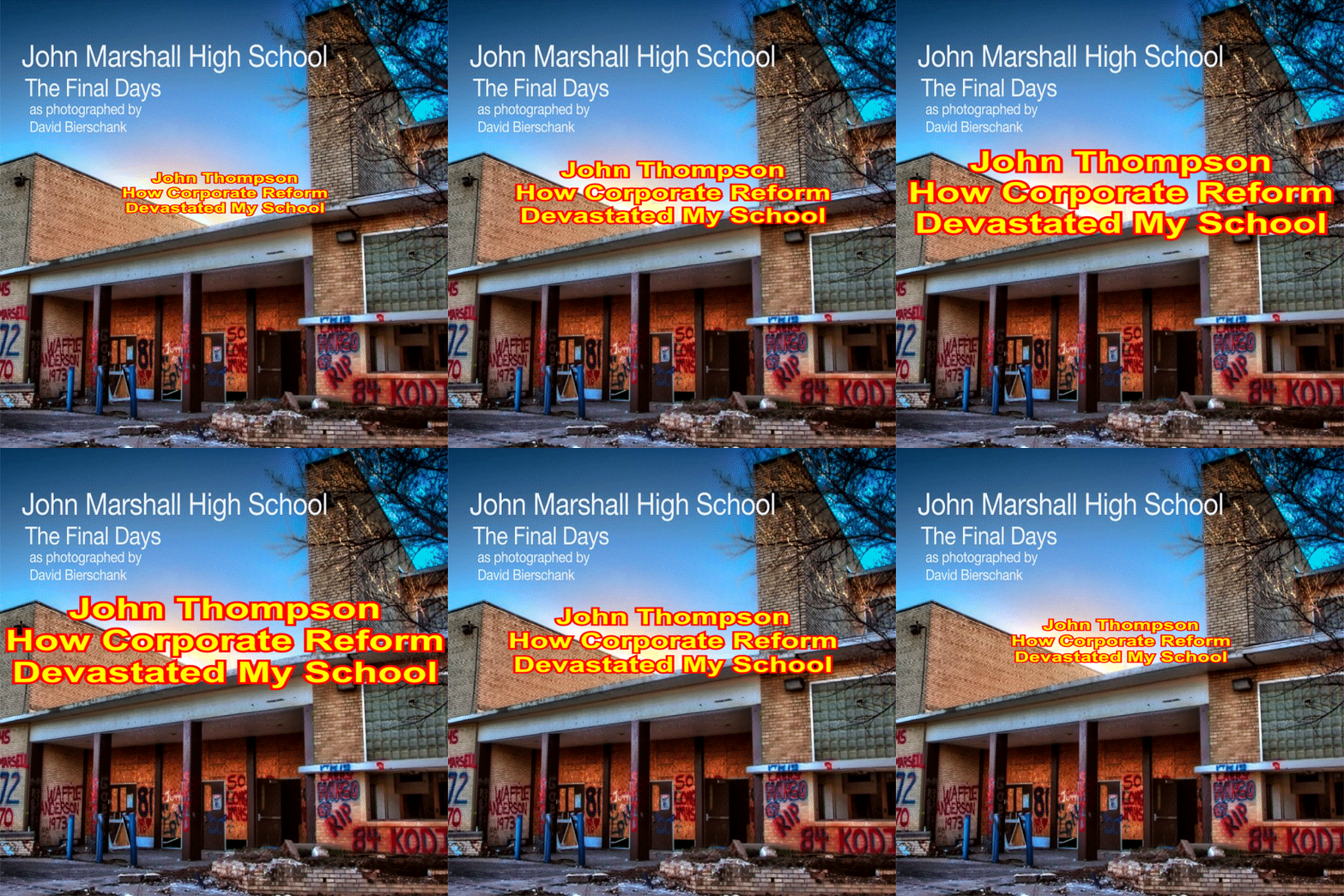
John Thompson: How Corporate Reform Devastated My School
John Thompson is an historian and a retired teacher in Oklahoma. He wrote this piece for the blog at my request.
In 2006, our John Marshall High School was enduring the worst of the five months-long, extreme meltdowns I witnessed in 18 years with the Oklahoma City Public Schools. Many days, I’d see the anarchy and the blood-splattered halls, and ask if I was dreaming. One thing that kept me sane was the discovery of education blogs, above all Deborah Meier’s and Diane Ravitch’s conversations in Bridging Differences. In a prescient example of the wisdom which grew out of their “animated conversation,” they agreed:
That a central, abiding function of public education is to educate the citizens who will preserve the essential balances of power that democracy requires, as well as to support a sufficient level of social and economic equality, without which democracy cannot long be sustained. We agreed that the ends of education–its purposes, and the trade-offs that real life requires–must be openly debated and continuously re-examined.
Bob Braun Explains the Opposition to Billionaire-Funded “Reform”
Bob Braun was an education reporter for 50 years. After he retired from the New Jersey Star-Ledger, he began blogging and paid close and critical attention to the state takeover of Newark. This column, posted in 2014, is as timely now as it was when it first appeared.
Let’s get this straight. Those of us opposed to the structural changes to public education embraced by crusaders ranging from the billionaire Koch brothers and the Walton Family Foundation to Bill Clinton and Barack Obama—along with Governor Chris Christie and Microsoft founder Bill Gates—are not opposed to the reform of public schools. We oppose their destruction.
We do not oppose making schools more accountable, equitable and effective—but we do oppose wrecking a 200-year-old institution—public education—that is still successful in New Jersey.
Should we give a cheer that the Indiana Senate eased up on the offensive expansion of vouchers that the Indiana House passed in its 2021 Budget bill?
THE HOUSE VERSION
The House version gave nearly 40% of all new education money to the less than 5% of the state’s students in the form of increased voucher spending, including money for unaccountable ESAs (educational savings accounts).
It also provided an increase in voucher availability to a family of four making nearly $150,000 a year. This House plan was not the “save poor children” voucher plan that Mitch Daniels proposed ten years ago. It very definitely expanded voucher money for wealthier students.
It’s probably good that Indiana Republicans are no longer trying to pretend that their voucher program is so that “poor kids can escape from terrible schools.” Instead they’re all but admitting that public schools don’t interest them. Privatization is the goal no matter what that pesky state constitution says. At least now they’re being honest about it.
Gary Rubinstein is well known to readers of this blog, as I have posted almost all of his blogs. He is a career high school math teacher in the New York City public schools. I met Gary about ten years ago, when I had made a complete turnaround in my views about testing and choice. I was working on an article about “miracle schools” that fudged their data and discovered that Gary was an expert on reviewing school-level data and exposing frauds. He helped me write an article (“Waiting for a Miracle School”) that appeared in the New York Times in 2011, and he has continued to be a friend ever since. Gary’s analytical skills have been invaluable in fighting off idiotic “reforms,” like evaluating teachers by their students’ test scores (known as VAM). In his multiple posts on that subject, he showed its many flaws. For example, an elementary teacher might get a high score in reading and a low score in math, posing the dilemma of whether the district could fire her in one subject while CONTINUE READING: Gary Rubinstein: Why I Left the “Reform” Movement | Diane Ravitch's blog
FLORINA RODOV: I BELIEVED THE CHARTER SCHOOL MYTH — UNTIL I LEARNED ABOUT THE REALITY AND WHO WAS BEHIND
I fell for the charter school hype. I agreed with former President Obama’s education secretary Arne Duncan who advocated for “school choice.” I trusted the research that said charters “close [the] achievement gap” for Black and Latino students. When I saw “Waiting for ‘Superman,’” I rooted for the kids in the documentary to escape their failing public schools by snagging spots at charter schools. And though I encountered very few bad teachers in my four years teaching and 12 years learning at public schools, I never questioned why Time published stories about “Rotten Apple” teachers being swept out of classrooms by wealthy education “reformers.”
I believed the hype so much that in 2012, knowing almost nothing about charter schools and having no administrative experience, I joined a friend in submitting a half-baked petition to the Los Angeles Unified School District (LAUSD) with the intention of starting our own charter school. When LAUSD denied it, we presented it to the Culver City Unified School District, which also, rightfully, rejected it.
Still intrigued by charters, in 2016 I interviewed for an English teacher position with a woman I’ll call Ellen Peters, the principal and co-founder of Savior Academy, a charter school serving grades six through 12. (The names of the school, administrators and students have been changed for this story.) Her assertion that the close bond between students and staff made it feel “like a family” inspired me to sign a non-union contract on the spot, though the school had recently lost its co-founder Cathy Reynolds (name changed), who stepped down from the board, and several teachers, who resigned.
But the chasm between the hype and reality became evident to me immediately upon starting work. There were high attrition rates of students and teachers. Over the summer, more than half the faculty resigned and were replaced by new teachers. About three-quarters of the students hadn’t returned either, and though new kids had registered, the enrollment wasn’t CONTINUE READING: Florina Rodov: I Believed the Charter School Myth — Until I Learned About the Reality and Who Was Behind It | Ed Politics
In mid-December 2019, on the eve of the the plague that changed our lives, the New York Times reported under the headline "I Just Isn't Working":
The performance of American teenagers in reading and math has been stagnant since 2000, accordion to the latest results of a rigorous international exam, despite a decades-long efforts to raise standards and help students compete with peers across the globe.
Here is most of the cruel failings of American public education, all packed into a single lede: high stakes standardized testing, the blind assumption that curricular standardization is a good thing, the corrosive notion of competition amongst children, and the narrow, narrow, narrow focus on reading a math. Yet even here, where the journalist has apparently bought into all the make-believe theories of the corporate education dilettante "reformers," their efforts have been a disastrous failure, even when measured by their own precious measuring tool: the standardized test. For decades now, through No Child Left Behind, Race to the Top, the Common Core, and Every Student Succeeds, those responsible for education policy at every level have turned our schools into test score coal CONTINUE READING: Teacher Tom: Opt Out!
Introducing 8 to 3, a newsletter for parents about kids, school and education
A new chapter is opening for families of school-age children and teenagers. Campuses throughout California are finally opening after a year of coronavirus-forced closures — and for parents who have navigated distance learning alongside their children, their connection to education has been rewired.
Newsletter
The perils of parenting through a pandemic
What’s going on with school? What do kids need? Get 8 to 3, a newsletter dedicated to the questions that keep California families up at night.
You may occasionally receive promotional content from the Los Angeles Times.
The shared frustrations, struggles, empathy and resilience between parent and child has reshaped engagement in schooling. With a new newsletter called 8 to 3, The Times aims to be a part of the back-in-school life of parents and guardians as we recover from a year like no other and move forward.
We begin this endeavor painfully aware of how the pandemic has upended education and exposed the depth of inequities families face. Our foremost mission is to help navigate new challenges with powerful storytelling, useful guides, vital data and personal stories — whether on campus in a classroom or in front of a laptop in the living room. The Times’ coverage of COVID-19-era schooling places considerable attention on systemic inequities, which we will continue to explore in depth.
The newsletter, sent every Monday evening, is written by Sonja Sharp and edited by Mitchell Landsberg, with support from Education Editor Stephanie Chavez and education reporters Nina Agrawal, Howard Blume, Paloma Esquivel, Melissa Gomez, Laura Newberry and Teresa Watanabe.
A veteran journalist, Sharp joined the education team during the pandemic to cover the crisis in early childhood education and day care. She will draw on her experience as a reporter, the mother of a 5-year-old and a kindergarten-through-UC-Berkeley graduate of California public schools to help readers navigate everything from daily struggles of parenting school-age children to coping with thorny policy issues.
The name of the newsletter refers to the traditional school day — but we know that education never really stops, and that parents, above all, are their children’s primary teachers. We are ready to answer your questions, aiming to give you insight into both emerging and ongoing issues while offering a forum for dialogue. And we will also point readers to the best stories in California education, both our own and those from other publications.
Schooling these days is already overwhelming, but we are here to help. We hope you will add 8 to 3 to your reading list. Sign up here or on our newsletters page.
For the past ten years public education has been under assault by the self-proclaimed education ‘reformers.’ Strong personalities like Michelle Rhee, Joel Klein, Michael Bloomberg, Jeb Bush, Chris Christie, Corey Booker, and others led the movement that gave us Race To The Top, Race To The Top waivers, and the Every Child Succeeds Act.
They got a chance to experiment with their ideas subjecting kids and neighborhoods around the country to school closures, charter schools, and state test madness. After a few years they declared that their experiments were working, they pointed to a few schools that seemingly proved that if you replace unionized teachers who are not scared of being fired with non-unionized teachers who are scared of being fired, you will close the achievement gap measured by standardized test scores. But the successes were mostly false — charter schools were shedding 75% of their students in order to get a so-called 100% college acceptance rate. Other schools were practicing abusive discipline practices that forced out many of the most difficult to teach students. There was even a fiasco called the Tennessee Achievement School District which promised to take over schools in the bottom 5% and move them to the top 25% within five years. Ten years later exactly none of the schools made it out of the bottom 10%.
Evidence In Education: Is Supply Meeting Teachers' Demand
In today’s public schools, teachers and administrators are constantly pressured to implement new reforms and initiatives, most of which claim to be research- or science-based. Schools are often viewed as the recipients of new policies and new knowledge generated by research. In So Much Reform, So Little Change, Charles Payne states “Best Practice discourse lends itself to decontextualized thinking, reducing the problem of urban schooling to a cognitive one: if only our teachers and principals knew how to do it in the Big City...we should spend some time thinking with school people about what those reasons might be rather than just issuing more exhortations from on high” (p. 63). Including educators in the conversation is crucial for a successful rollout of any evidence-based intervention. Additionally, in order to best support our teachers, it is imperative we develop a system for them to have access to evidence-informed practices that are contextualized and can be tailored to their varying needs.
While there are many problems with the “research to practice” approach, one barrier is that schools are frequently not given enough training, resources, and support to make sense of educational research. Educators need evidence, innovation, and new approaches; after all, much of their job is to constantly adapt their ways of teaching to meet the unique and changing needs of their students. But right now, too many educators are doing this work without the necessary tools to be successful. In this post I would like to sketch out a tool that could improve access to and applicability of research. By access, I refer not only to the ability of finding and downloading journal articles and other sources, but also to having the knowledge to discern questionable research. According to Paula J. Stanovich and Keith E. Stanovich (2003), a failure to discern good and bad research can cause teachers to try new methods that are not strongly supported by peer-reviewed research. Applicability refers to the extent to which research has practical implications for teachers.
FLASH BACK: How Education Reform Ate the Democratic Party
The Democrats and DeVos have more in common than they’d care to admit
IN A FACEBOOK POST THIS SUMMER, hedge fund billionaire Daniel Loeb took aim at the highest ranking Black woman in the New York legislator, Andrea Stewart-Cousins. “[H]ypocrites like Stewart-Cousins who pay fealty to powerful union thugs and bosses,” wrote Loeb, “do more damage to people of color than anyone who has ever donned a hood.” The rant, which had the exquisite misfortune of appearing just days before the actual KKK took to the streets of Charlottesville to menace nonwhite people and their allies, struck a familiar Loeb theme. In a previous post he implored his peer to take up the fight against the teachers union: “the biggest single force standing in the way of quality education and an organization that has done more to perpetuate poverty and discrimination against people of color than the KKK.”
It would be easy to dismiss all this frothing as just Loeb being Loeb. This is, after all, the same crusader for justice who once lambasted a CEO for his imperial lifestyle, not an easy charge to level from a ten-thousand-square-foot penthouse. But the NYC financier is not just any hedge fund billionaire. As the chair of the board of Success Academy, New York’s largest network of charter schools, he is a leading force within the nexus of big money and self-proclaimed school “reformers” within the Democratic party. While Loeb doesn’t limit his donations to Dems (as his profile on the married-but-looking dating site, Ashley Madison, indicated, he is not one to be tied down), he exerts the kind of outsized influence that $3.2 billion in net worth reliably commands these days.
There’s another reason why we can’t dismiss Loeb’s view that teachers unions promote income inequality and serve as a barrier to progress of any sort as just another crackpot rich-bro outburst. That’s because it’s now a key policy plank of responsible elite opinion almost everywhere. Flip back to The Economist—the bible of savvy, entrepreneurial-minded social criticism—circa 2012, and you’ll find Loeb’s screed rendered in assured magazine prose, minus the overt racist incitements. To wit: “no Wall Street financier has done as much damage to American social mobility as the teachers’ unions have.”
Bill Gates Invites You to Learn About “The State of Education”
Let’s just say it upfront. If you wanted to know more about “The State of Education,” and how to “rebuild a more equitable system,” the last person you would ask is a billionaire. Right? Specifically Bill Gates, who has spent billions over the past 20 years promoting high-stakes testing, charter schools, merit pay, value-added measurement of teachers, the Common Core, test-based accountability, and every failed reform I can think of. The media think he is the world’s leading expert on everything, but we know from experience with his crackpot theories and ideas that none of them has made education better, and all of them have demoralized teachers and harmed students and public schools. What hubris to have foisted one failed idea after another and then to convene a summit on how to fix the mess you made, probably by doing the same failed things you already sponsored.
So how can we build a “more equitable system”? Well, one way would be to have higher taxes for people in Bill Gates’ economic bracket. He lives in a state with no income tax. That’s not fair. He should pay his fair share–to his local community, to the state, and to the federal government. So should every other billionaire. I don’t CONTINUE READING: Bill Gates Invites You to Learn About “The State of Education” | Diane Ravitch's blog
To fix education, Biden must not only undo Trump’s legacy but reverse two
decades of a disastrous ‘reform’ movement
President Joe Biden will have his work cut out in repairing the damage done
to U.S. education caused by Donald Trump and his one-time Secretary of
Education, Betsy DeVos. But Biden and his Secretary of Education nominee,
Miguel Cardona, must also reverse at least twenty years of federal education
policy, starting over with measures that allow teachers to teach and
children to learn without fear of federal sanctions.
Since the enactment of George W. Bush’s No Child Left Behind (NCLB) Act in
2002, the nation’s public schools have been required to administer
standardized tests in reading and mathematics to every student in grades three
through eight, a practice unknown in any high-performing nation. These tests have high stakes for
students (who might fail to be promoted), teachers (who might be fired if
their students’ test scores don’t rise), and schools (which might be closed if
test scores don’t go up).
In addition, three successive presidential administrations—Bush, Obama, and
Trump—have pressured school districts to accept privately managed charter
schools. Educators and parents have tried to fend off a powerful and well-funded privatization movement that promotes privately managed charter
schools and vouchers as the cure for low test scores (which they are not).
This so-called reform movement has paid little attention to the need for
adequate and equitable resources.
U.S. education began a long slide into an abyss of testing and privatization
in 1983, when the administration of Ronald Reagan issued a sensationalized report called “A Nation at Risk.” The
report asserted that U.S. education was experiencing a “rising tide of mediocrity”
and blamed the public schools for the loss of industries to Japan, South
Korea, and Germany. The report relied on cherry-picked data to create a
false sense of crisis that demanded solutions.
Governors across the nation met with business leaders and decided that
education was too important to leave to educators. What was needed, instead,
was corporate thinking. And the remedies they came up with were standards CONTINUE READING:
The Education Development Center and The Urban Collaborative
By Thomas Ultican 2/22/2021
A North Carolina resident asked “what do you know about the Urban Collaborative?” She was concerned about a company providing free airfare to school leaders in her child’s district; airfare to meetings in far-off cities. She wondered, “What is their motive? Is it more about money and power than special education?”
The Urban Special Education Leadership Collaborative was founded by Dr. David Riley, Educational Co-Chair of the Summer Institute on Critical Issues in Urban Special Education at the Harvard Graduate School of Education. Riley was the Executive Director of the Collaborative until he succumbed to cancer May 2, 2016. The Collaborative is a national network of education administrators responsible for youth with disabilities in urban school districts. It is a national version of the Massachusetts Urban Project, a state-wide network that Dr. Riley founded in 1979. In 1994, The Education Development Center (EDC) expanded the Urban Collaborative into a national organization.
An October 1, 2019 announcement from Arizona State University stated:
“The Urban Collaborative has a rich history of collaboration with school districts — more than 100 in 25 states — committed to leading inclusive and equitable education. It has resources, sponsors and partners, consultants and data-driven review processes, and annual meetings of education leaders from the nation’s largest urban school districts.”
“This fall, the Urban Collaborative joins Arizona State University’s Mary Lou Fulton Teachers College [MLFTC]. It was formerly an initiative of the nonprofit Education Development Center.
“Lauren Katzman, Urban Collaborative executive director, joins MLFTC as associate research professor.”