Latest News and Comment from Education

Showing posts with label PRIVATIZATION. Show all posts

Thursday, March 16, 2023

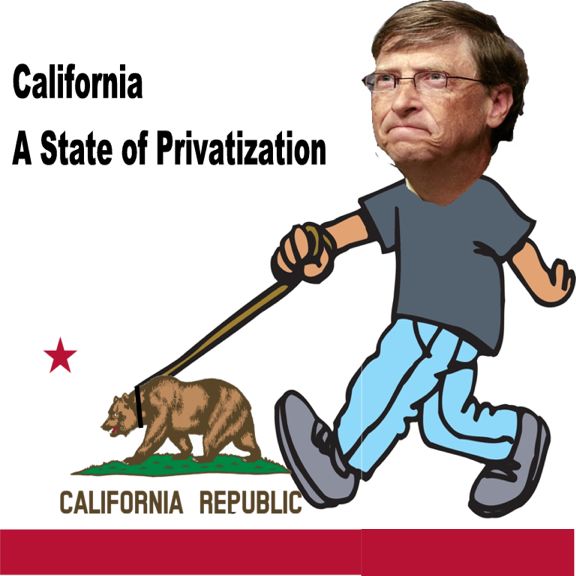
CALIFORNIA: A STATE OF PRIVATIZATION


The level of privatization in California since the 1980s can be difficult to measure precisely, as it can refer to a range of different policies and practices across various sectors of the economy. However, some examples of significant privatization efforts in California since the 1980s include:

  • Privatization of Prisons: In the 1980s, California began to contract with private companies to operate prisons. By the early 2000s, roughly 10% of the state's prison population was housed in privately-operated facilities.
  • Privatization of Utilities: In the late 1990s, California deregulated its electricity market and allowed private companies to compete with the state's utilities. This led to a number of problems, including rolling blackouts and soaring energy prices, and the state eventually re-regulated the market.
  • Privatization of Transportation: In recent years, California has increasingly turned to public-private partnerships to fund and operate transportation infrastructure, such as toll roads and express lanes.
  • Privatization of Education: California has also seen an increase in the number of charter schools, which are publicly funded but privately operated.

Overall, while California has experienced some privatization efforts in various sectors since the 1980s, the extent and impact of these policies vary widely and can be debated.

Does Privatization Serve the Public Interest?

The answer to whether privatization serves the public interest is not straightforward, as it depends on the specific circumstances and goals of the privatization effort. In some cases, privatization can lead to increased efficiency, cost savings, and innovation, which can ultimately benefit the public. For example, contracting out certain government services to private companies can often be more cost-effective and efficient than providing those services directly.

However, in other cases, privatization can have negative consequences for the public. For example, privatizing certain essential public services, such as healthcare or education, can lead to increased costs, reduced access for low-income and marginalized communities, and lower quality services. Additionally, privatization can lead to a loss of accountability and transparency, as private companies are not subject to the same public scrutiny and oversight as government agencies.

Ultimately, whether privatization serves the public interest depends on the specific context and goals of the policy. Policymakers must carefully weigh the potential benefits and drawbacks of privatization in each case, and ensure that any privatization efforts are transparent, accountable, and equitable.

There are several arguments against privatization, including:

  1. Decreased Access and Affordability: Privatization can result in reduced access to services and goods for those who cannot afford them. Private companies are driven by profit, so they may not provide services to areas that are not profitable, leaving these areas underserved or with no service at all.

  2. Quality of Services: Private companies may cut corners to increase profits, leading to reduced quality of services. Privatization can result in a focus on short-term gains rather than long-term investments in the quality of service.

  3. Loss of Control: Privatization can result in the loss of control of public services or assets by the government, which may lead to less transparency and accountability. Private companies may not have the same level of transparency and accountability as government agencies, which can result in corruption, fraud, or misuse of public resources.

  4. Job Loss: Privatization can lead to job loss for public sector workers. Private companies may not retain the same number of workers, or they may employ workers at lower wages, resulting in a loss of jobs or lower wages for those who previously had secure employment.

  5. Monopoly and Market Power: Privatization can result in the creation of monopolies or oligopolies, where a few large companies control a significant share of the market. This can lead to higher prices, reduced competition, and decreased innovation.

  6. Social Justice: Privatization can be seen as unfair to low-income communities who rely on public services, as they may not be able to afford the higher costs of private services. This can lead to a further widening of the gap between the rich and poor, resulting in social injustice.

Overall, the argument against privatization is that it can result in decreased access and affordability, reduced quality of services, loss of control, job loss, monopoly and market power, and social injustice.

at least this is what chatgpt thinks :)


Wednesday, May 26, 2021

CURMUDGUCATION: What Privatization Actually Means

CURMUDGUCATION: What Privatization Actually Means
What Privatization Actually Means


When we talk about the privatization of education, the conversation is almost always about the privatization of the vendors. Publicly owned and operated schools replaced by privately owned and operated charter and private schools, plus a dizzying web of real estate developers, charter management organizations, other support businesses. Even the extreme form, where education is unbundled and can be provided piece by piece--a nice prospect for those who balk at operating an entire school, but can imagine making a buck selling math tutoring.

This vision also includes a privatization of oversight. Let the parents vote with their feet. Let free market forces handle the issue of "quality." Make it easier for vendors to have access to the market and make a buck; let the market sort out winners and losers.

How far do some of these folks want to go? Here's Jeremy Kaufman, voice of the Libertarian Free State outfit, being blunt on Twitter.


All of this privatized profiteering can well be a feature of reformster policies (they never, ever, call it privatization), but to stop here is to miss a critical part of the picture.

The education privatization movement is also about privatizing "consumption" of  education.

In a public system, education is "consumed" by the public. All of the public, together, collectively. Hence the system of everyone  CONTINUE READING: CURMUDGUCATION: What Privatization Actually Means

Monday, May 24, 2021

School Privatizers Attack a Central Institution of American Democracy | janresseger

School Privatizers Attack a Central Institution of American Democracy | janresseger
School Privatizers Attack a Central Institution of American Democracy


Introducing a column by the Network for Public Education’s Carol Burris on the explosion this year of legislation across the 50 state legislatures to expand school privatization, the Washington Post‘s Valerie Strauss begins: “While many Americans see 2021 as the year that may bring back something close to normalcy after the coronavirus pandemic, it has instead been declared the ‘Year of School Choice’ by the American Federation for Children, an organization that promotes alternatives to public education and that was once headed by Betsy DeVos. Anyone who twas thinking that the departure of DeVos as U.S. education secretary would stem the movement to privatize public education should think again. In numerous states, legislatures have proposed or are considering legislation to expand alternatives to the public schools that educate most American schoolchildren, often using public funding to pay for private and religious school.”

In the piece that follows, Carol Burris examines the contention by Paul Petersen, the Harvard government professor who Burris reminds us is “a longtime cheerleader for market-based school reforms,” and Jeanne Allen who runs the Center for Education Reform, and who, “has never been shy in her hostility toward unions and traditional public schools,” that the legislatures considering school choice are doing so because parents are angry that public schools shut down during the pandemic.

Burris demonstrates that Petersen and Allen are wrong.  The states most active in promoting privatization are instead places where legislatures have tipped toward Republican majorities and in some cases Republican supermajorities.  And they are states where well-funded CONTINUE READING: School Privatizers Attack a Central Institution of American Democracy | janresseger

Saturday, May 22, 2021

The movement to privatize public schools marches on during coronavirus pandemic - Network For Public Education

The movement to privatize public schools marches on during coronavirus pandemic - Network For Public Education
The movement to privatize public schools marches on during coronavirus pandemic


Legislatures in 35 states have proposed bills to enact or expand voucher programs or charter schools. A few have passed; others have failed. Still others are sitting on governors’ desks or are stalled in the state’s House or Senate. Several are obvious attempts to please right-wing donors with no chance of moving out of committee. So far, eight states have enacted one or more bills.

A flurry of proposed school privatization legislation appearing on state dockets has been the pattern for several years. What is different this year is their success, albeit limited. In prior years, few, if any, reached the finish line. So what is different about 2021?

You can read the rest of Carol’s post in The Answer Sheet here


Thursday, May 20, 2021

The movement to privatize public schools marches on during covid-19 pandemic - The Washington Post

The movement to privatize public schools marches on during covid-19 pandemic - The Washington Post
The movement to privatize public schools marches on during covid-19 pandemic


While many Americans see 2021 as the year that may bring back something close to normalcy after the covid-19 pandemic, it has instead been declared the “Year of School Choice” by the American Federation for Children, an organization that promotes alternatives to public education and that was once headed by Betsy DeVos.

Anyone who was thinking that the departure of DeVos as U.S. education secretary would stem the movement to privatize public education should think again.

In numerous states, legislatures have proposed or are considering legislation to expand alternatives to the public schools that educate most American schoolchildren, often using public funding to pay for private and religious school.

This post looks at some of the latest state actions. It was written by Carol Burris, a former prizewinning principal in New York and now executive director of the nonprofit advocacy group the Network for Public Education, which opposes charter schools and the privatization of public education.

By Carol Burris

Legislatures in 35 states have proposed bills to enact or expand voucher programs or charter schools. A few have passed; others have failed. Still others are sitting on governors’ desks or are stalled in the state’s House or Senate. Several are obvious attempts to please right-wing donors with no chance of moving out of committee. So far, eight states have enacted one or more bills. CONTINUE READING: The movement to privatize public schools marches on during covid-19 pandemic - The Washington Post

Wednesday, May 19, 2021

CURMUDGUCATION: PA: One District (Mostly) For Sale

CURMUDGUCATION: PA: One District (Mostly) For Sale
PA: One District (Mostly) For Sale


Chester Upland is a district that has struggled with issues and money and racism for decades; they are the history of every problem facing public education in the last century, right up to and including the gutting of a public education system by privatizing charter operators. Poorer and Blacker than all surrounding districts, they have suffered through one damn thing after another.

Chester Upland School District has been under the state's thumb via a declaration of financial collapse for about a decade. The court has been in charge of the district, and has okayed the idea of letting the charters that have drained the districts of resources go ahead and buy up the last of the bits.

It's hard to track everything that has happened because so little of it has happened in public view, but three charter organizations have now submitted plans for partial charter takeover of the district's schools.

The three proposals were pitched at a meeting that was presented in person and on line, and critics of the plan were not impressed. 

Harris indicated Thursday’s presentation was designed to communicate Friendship’s philosophy CONTINUE READING: CURMUDGUCATION: PA: One District (Mostly) For Sale

Friday, May 14, 2021

CURMUDGUCATION: More Koch Ed Privatization

CURMUDGUCATION: More Koch Ed Privatization
More Koch Ed Privatization


The Koch Network is getting with the times and launching an edu-reform substack. Yay.

The substack is co-hosted by Lisa Snell, director of K-12 education policy for Stand Together, aka the Charles Koch Institute. Previously she spent 23 years as Director of Education at the Reason Foundation. Her co-host is Adam Peshek, who is part of the same Kochtopus, having arrived Jeb Bush's ExcelinEd (formerly FEE). Peshek also works at Yes, Every Kid, a rebranding of some standard reform ideas

Their new platform is called "Learning Everywhere," and so far, they're playing all the hits. "Time to scrap the factory approach to education" is the first... issue? ...post? What are we going to call these substack things?  The subheading is "Individualization, not standardization, empowers learners to thrive," which kind of captures one of the odd whiplashes in the reform movement; I'm betting that while he was at ExcelinEd, Peshek spent a lot of time advocating for the Common Core standards, the one-size-fits-all standardization that Jeb Bush backed right into a conservative buzzsaw. But standardization is no longer where it's at.

The piece starts out with an unintentionally apt story about the Air Force's discovery of the problem with averages. In the early 1950s, the Air Force was having problems with pilots who had trouble flying--turns out that a cockpit built to "average" specs doesn't actually fit anyone, so they changed their approach to cockpit seat design (you can thank this development for the adjustable seat in your car). 

This is meant to be a story about how individualization is the key to everything, and I think it works, but I want to point out that while the Air CONTINUE READING: CURMUDGUCATION: More Koch Ed Privatization

Wednesday, May 12, 2021

Public schools deserve your support. I know. I attend one. - cleveland com

Public schools deserve your support. I know. I attend one. - cleveland.com
Public schools deserve your support. I know. I attend one


As a student at a reputedly failing school, I will say emphatically that our public schools deserve support. As we look to determine the future of education, we must take a step back and decide what we want out of the system. There is more to education than an ill-conceived system of state testing. Public education exists to instill republican virtues in our people. We need this now more than ever.

Public schools have been branded as failing and stripped of funding by bizarre school-choice schemes. If a man has a broken leg, you don’t get him walking again by breaking the other leg. EdChoice, under the pretense of rescuing students from failing schools, has instead defunded those same schools rather than supporting vouchers directly. Our lawmakers must consider: If we focused instead on making meaningful improvements to the public education system which has served our state so well, would there be a need for EdChoice?

Visit Cleveland Heights High School. It is not failing. Nor is it perfect, for the vouchers have made sure of that. It is time that America rediscovers its republican virtues, the source of our strength, and the schools which gave them to us.

Kenji Sakaie,

Public schools deserve your support. I know. I attend one. - cleveland.com

Tuesday, May 11, 2021

A Warning on Privatization – Tennessee Education Report

A Warning on Privatization – Tennessee Education Report
A WARNING ON PRIVATIZATION


This article originally appeared in The Progressive.

In 2012, Tennessee’s began a scheme known as the Achievement School District, or ASD. The goal was simple and bold: Take a handful of schools in the bottom 5 percent of student achievement, according to state test scores, and move those schools into the top 25 percent in student achievement in just five years.

This miraculous shift, officials claimed, would be accomplished by placing schools under a new state agency, which would then determine an intervention strategy that might include turning a standard public school over to a charter operator. Any school anywhere in the state would be eligible, so long as it was on the “priority schools” list. As a whole, the schools would be governed by their own “district,” complete with a superintendent who reported directly to the commissioner of education.

Tennessee’s commissioner of education at the time, Kevin Huffman, hired charter operator Chris Barbic to run the new district. Barbic’s arrival coincided with the takeover of a first cohort of schools by the ASD, along with the unveiling of his plan to generate the expected turnaround.

So what was that plan, exactly? 

Well, of course, it was to turn all the priority schools over to charter operators. After all, Barbic reasoned, other charter school leaders would know just what to do with entire schools from urban districts with high levels of entrenched poverty.

But the charter school plan had another, more sinister impact. Tennessee’s charter CONTINUE READING: A Warning on Privatization – Tennessee Education Report

Monday, May 10, 2021

Welcome to the Charter Party – Tennessee Education Report

Welcome to the Charter Party – Tennessee Education Report
WELCOME TO THE CHARTER PARTY


On Friday afternoon before Mother’s Day weekend and just after the Tennessee General Assembly had adjourned, the Tennessee Department of Education announced 15 grants for charter school applicants – including grants for charter applications in several districts that do not currently authorize any charter schools – Rutherford County, Montgomery County, Millington Municipal, Fayette County, and Williamson County. The grants would allow applicants to plan and design their applications, and the applicants could ultimately bypass local school districts and receive charter authorization from Gov. Lee’s “Super Charter Commission.” The grants could also result in usurping the authority of elected school boards in Shelby, Hamilton, and Davidson counties.

Here’s more from a TNDOE press release:

Today, the Tennessee Department of Education announced that 15 applicants have been awarded subgrants under the Charter School Expansion Grant. These funds are intended to support sponsors throughout the planning, design, application, and potential launch of new charter schools in the state.

These subgrants will fund up to 8,800 new high-quality charter school seats that, subject to authorizer approval, will be available to students in five districts that CONTINUE READING: Welcome to the Charter Party – Tennessee Education Report

Support Illinois SB 808. Oppose edTPA and teacher prep privatization. Is the IEA really lobbying against this bill? – Fred Klonsky

Support Illinois SB 808. Oppose edTPA and teacher prep privatization. Is the IEA really lobbying against this bill? – Fred Klonsky
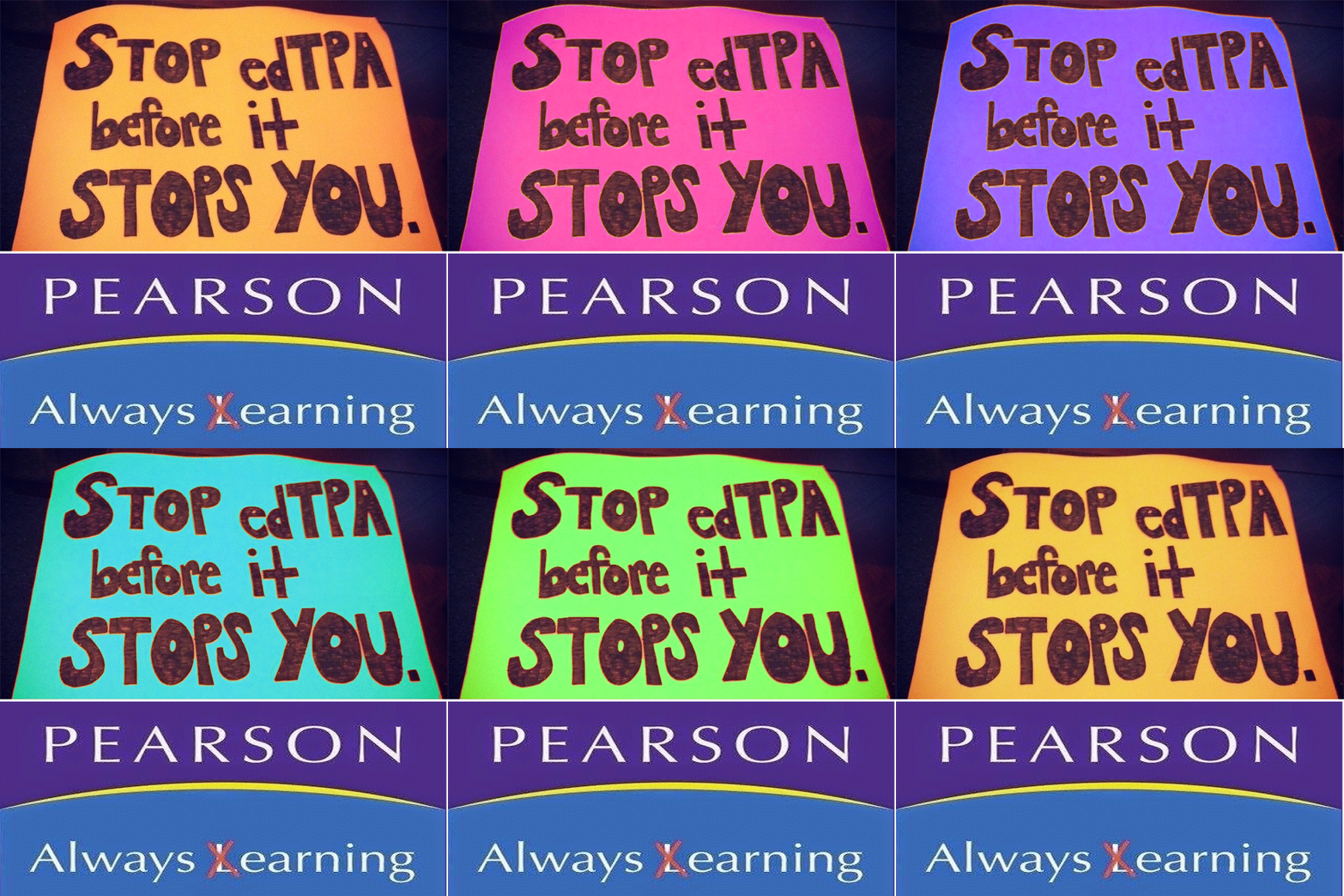
SUPPORT ILLINOIS SB 808. OPPOSE EDTPA AND TEACHER PREP PRIVATIZATION. IS THE IEA REALLY LOBBYING AGAINST THIS BILL?


Senate Bill 808 has passed the Illinois Senate and has gone on to the House where State Representative Will Guzzardi from my 39th district is the chief House sponsor.

It appears that SB 808, which would end the video taping and the violation of student privacy rights has the support of most legislators.

House Ed Committee members are Sue Scherer, Fred Crespo, Thomas Morrison*, Avery Bourne, Eva Dina Delgado, Anne Moeller, Delia Ramirez, Joe Sosnowski*.

*Republicans who have CONTINUE READING: Support Illinois SB 808. Oppose edTPA and teacher prep privatization. Is the IEA really lobbying against this bill? – Fred Klonsky

Sunday, May 9, 2021

Charter Lobby Backs Leading Candidates for NYC Mayor | Diane Ravitch's blog

Charter Lobby Backs Leading Candidates for NYC Mayor | Diane Ravitch's blog
Charter Lobby Backs Leading Candidates for NYC Mayor


The executive director of StudentsFirstNY, Jenny Sedlis, has taken a leave of absence from her job to manage a fundraising PAC for Eric Adams, one of the leading candidates for mayor. The election is this November.

Sedlis previously was the lead spokesperson for Success Academy, Eva Moskowitz’s charter chain.

The new entity plans to run digital and TV ads supporting Adams’ candidacy, without being beholden to the strict spending limits imposed by the city’s Campaign Finance Board. Ahead of Sedlis establishing the PAC with the Board of Elections, StudentsFirstNY released a poll showing Adams closing the gap with frontrunner Andrew Yang. A poll published yesterday showed Adams in the lead.

Sedlis has not begun raising money yet, but the group is hoping to secure $6 million — matching the stated aim of political consultant Lis Smith in her fundraising effort for Andrew Yang, Adams’ chief rival in the race…

“New York City’s comeback starts with Eric Adams as CONTINUE READING: Charter Lobby Backs Leading Candidates for NYC Mayor | Diane Ravitch's blog

Thursday, April 29, 2021

Toolkit: School Privatization Explained - Network For Public Education

Toolkit: School Privatization Explained - Network For Public Education
Toolkit: School Privatization Explained


The Network for Public Education Toolkit: School Privatization Explained was first created in 2017 to alert the general public regarding the various forms that privatization takes and the consequences associated with each. We’ve updated the toolkit to ensure the information is up-to-date. This toolkit presents evidence of what we already know about charters, vouchers and other forms of privatization. It is organized around key questions, providing answers in clear language to the questions we at NPE are most often asked.

Each dropdown below contains a link to a pdf that we hope you will read, share and download.

Charter Schools


Tuesday, April 27, 2021

Missouri Times: Stop the Demolition of Public Schools: They Belong to the Public | Diane Ravitch's blog

Missouri Times: Stop the Demolition of Public Schools: They Belong to the Public | Diane Ravitch's blog
Missouri Times: Stop the Demolition of Public Schools: They Belong to the Public


The Misssouri Times is a generally right of center newspaper, But it believes in the promise of public schools and recognizes that the latest push for charters and vouchers is rank privatization funded by wealthy elites. After thirty years of pouring billions into charters and vouchers, there is no reason to believe that privatized schools produce better outcomes. We know they don’t.

Opinion: Public Schools are Public Goods

BY TERESA MITHEN DANIELEY ON APRIL 26, 2021

As the parent of three children enrolled in St. LouisPublic Schools, I am deeply dismayed that so many in the Missouri House — including some Democrats — voted in favor of HB 137, which will shift up to $17 million dollars a year from traditional public schools (specifically SLPS) to charter schools, which will not be required to provide the same services as public schools. We must make sure that HB 137 dies in the Senate.

I am also deeply concerned about the statewide ramifications of SB 55, an omnibus bill with many different privatizing provisions — including the Empowerment Scholarship Account (ESA) Program (aka vouchers), Charter School Funding modifications, establishing a Charter School Revolving Commission Fund to fund new charters, and changing provisions CONTINUE READING: Missouri Times: Stop the Demolition of Public Schools: They Belong to the Public | Diane Ravitch's blog