Latest News and Comment from Education

Monday, June 8, 2020

A Big Education Ape Brief History of Police in Education News #BlackLivesMatter #BlackLivesMatterAtSchool #CounselorsNotCops!

Big Education Ape


Big Education Ape A brief History of Police in Education News


Big Education Ape: We Came to Learn: A Call to Action for Police-Free Schools - Advancement Project - Advancement Project - https://bigeducationape.blogspot.com/2018/09/we-came-to-learn-call-to-action-for.html

Big Education Ape: empathyeducates – “To This Mayor [Rahm], Black and Brown Lives Do Not Matter” #DumpRahm - https://bigeducationape.blogspot.com/2015/04/empathyeducates-to-this-mayor-rahm.html

Big Education Ape: Teaching teens about police contact before confrontation :: SI&A Cabinet Report - https://bigeducationape.blogspot.com/2016/10/teaching-teens-about-police-contact.html

Image result for Teaching teens about police contact before confrontation

Big Education Ape: If competition is good for education, how about the police? - https://bigeducationape.blogspot.com/2015/05/if-competition-is-good-for-education.html

Big Education Ape: Geofeedia Touted Surveillance Of Students To Sell Services To Police - https://bigeducationape.blogspot.com/2018/09/geofeedia-touted-surveillance-of.html

Big Education Ape: DHS/Police Are Paying School Kids To Spy On Classmates | PopularResistance.Org - https://bigeducationape.blogspot.com/2015/11/dhspolice-are-paying-school-kids-to-spy.html

Big Education Ape: Coalition calls for end of police presence in schools | Center for Public Integrity - https://bigeducationape.blogspot.com/2016/09/coalition-calls-for-end-of-police.html

Big Education Ape: ‘Education’ in a Police State – In California Alone, Schools Call the Cops Every 2.6 Seconds | Alternet - https://bigeducationape.blogspot.com/2015/11/education-in-police-state-in-california.html


Big Education Ape: Teaching about race, racism and police violence: Resources for educators and parents - The Washington Post - https://bigeducationape.blogspot.com/2016/07/teaching-about-race-racism-and-police.html
police animated GIF

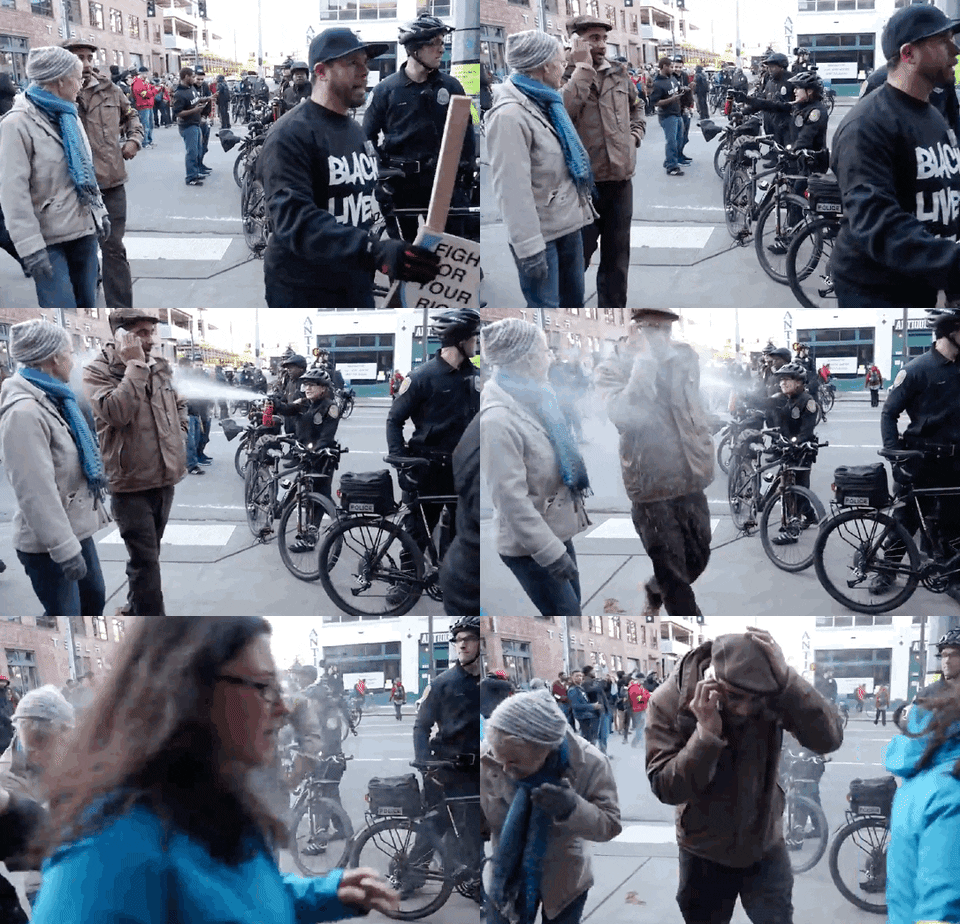
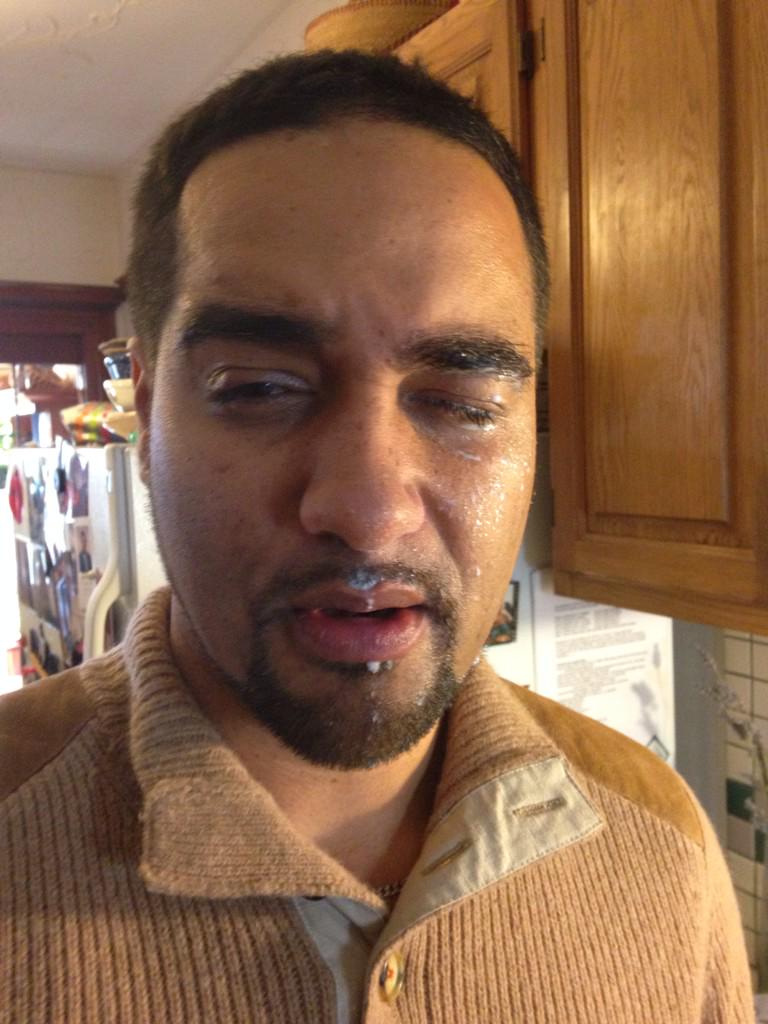
Big Education Ape: Seattle police pepper sprayed a teacher who was walking and talking to his mom - https://bigeducationape.blogspot.com/2015/01/seattle-police-pepper-sprayed-teacher.html

Big Education Ape: Seattle Police Chief Defends Officer Who Assulted Me With pepper spray | I AM AN EDUCATOR - https://bigeducationape.blogspot.com/2015/10/seattle-police-chief-defends-officer.html

Big Education Ape: Seattle Police Assault Outspoken Teacher. Get Away With It. As Usual. | HorsesAss.Org - https://bigeducationape.blogspot.com/2015/01/seattle-police-assault-outspoken.html
View image on Twitter

Big Education Ape: Teaching About Policing and Race in America | Alan Singer - https://bigeducationape.blogspot.com/2015/03/teaching-about-policing-and-race-in.html


Big Education Ape: Tevlin: Plot twists in case of Minneapolis drama teacher's arrest - StarTribune.com - https://bigeducationape.blogspot.com/2016/06/tevlin-plot-twists-in-case-of.html

Big Education Ape: New Bill Would Have Teachers Diagnose Psychological Issues in Children and Report them to Police | The Free Thought Project - https://bigeducationape.blogspot.com/2015/03/new-bill-would-have-teachers-diagnose.html

Big Education Ape: A response to the Boston Police Union Attack on Black Lives Matter at School: “This is a movement for equity, inclusion, and the uplifting of Black students” – Black Lives Matter At School - https://bigeducationape.blogspot.com/2020/02/a-response-to-boston-police-union.html

Big Education Ape: Protesters file excessive force claim against Oakland Unified | EdSource - https://bigeducationape.blogspot.com/2019/11/protesters-file-excessive-force-claim.html


Big Education Ape: #CounselorsNotCops: Black Girl at Pennsylvania high school brutalized i
by a school police officer; Black Lives Matter At School rallies around the country


https://bigeducationape.blogspot.com/2019/02/counselorsnotcops-black-girl-at.html

Big Education Ape: When California schools call cops for small infractions it disproportionately hurts minority students, civil rights study finds - LA Times - https://bigeducationape.blogspot.com/2016/10/when-california-schools-call-cops-for.html

Big Education Ape: Resisting Good/Bad Teacher/Police Frame and Confronting Systemic Flaws in Education, Law Enforcement | the becoming radical - https://bigeducationape.blogspot.com/2015/11/resisting-goodbad-teacherpolice-frame.html

Big Education Ape: First Marylin Zuniga – Now Art and Humanities Classes – Cops Calling the Shots in Discourse at NJ Public Schools - https://bigeducationape.blogspot.com/2015/06/first-marylin-zuniga-now-art-and.html

Big Education Ape: You're Nobody 'Till Somebody Kills You: Baltimore, Freddie Gray and the Problem of History | Yohuru Williams - https://bigeducationape.blogspot.com/2015/04/youre-nobody-till-somebody-kills-you.html


Revisiting Predictions On Technology in Classrooms | Larry Cuban on School Reform and Classroom Practice

Revisiting Predictions On Technology in Classrooms | Larry Cuban on School Reform and Classroom Practice

Revisiting Predictions On Technology in Classrooms


My record on predictions is abysmal. If I get half of the forecasts I make correct, I puff out my chest. Yet humans are wired to speculate about the future, particularly when times are uncertain. Considering the coronavirus pandemic of 2020, nearly everything has become uncertain about the next year and for sure, the next five years. So like most Americans I take a deep breath and try to look around the corner before I exhale.
But I am not going to make any predictions about the effects of Covid-19 (tune in later because I am, well, hard-wired to predict). for this post, I look back on predictions I made a decade ago amid the surge of technology spilling over U.S. classrooms. Here is what I wrote in 2010 looking ahead to 2020.
I just read a list of high-tech tools that have become obsolete in the past decade (e.g., floppies, fax machines). I used many of these myself and remember junking them, saying to myself: hey, these were highly touted, I bought the second- or third-generation version and now I am dumping them (of course, in an ecologically correct manner). Still the number of high-tech machines and applications that hit their expiration date so quickly stunned me.
Then I read another list of high-tech predictions for 2020 that was equally entertaining about the future of schools, well, not schools as we know them in December 2010. This list posted by a high-tech enthusiast who yearns for a paperless society and totally customized instruction with smaller, greener schools tickled me because while I do agree with some of the items, others are, CONTINUE READING: Revisiting Predictions On Technology in Classrooms | Larry Cuban on School Reform and Classroom Practice

Video: Watch Bill Gates Defend His Decision to Fund the Common Core | Diane Ravitch's blog

Video: Watch Bill Gates Defend His Decision to Fund the Common Core | Diane Ravitch's blog

Video: Watch Bill Gates Defend His Decision to Fund the Common Core


Layton wrote a comprehensive account of how the Common Core was funded single-handed by Gates. Gates engineered a “swift revolution,” a near coup, by subsidizing and promulgating the Common Core State Standards (CCSS), with cheerleading by Secretary of Education Arne Duncan.
CCSS may have been the biggest policy disaster in the history of U.S. education. States and districts spent billions of dollars to implement new standards, new tests, new teacher training, new software, new textbooks, new professional development, all in pursuit of illusory standardization.
The U.S. Department of Education paid $360 million for two consortia to develop tests (PARCC and the Smarter Balanced Consortium). The consortia started life with almost every state but most have now dropped out. Gates paid for everything else. By some estimates, he invested as much as $2 billion subsidizing the writing, development, evaluation, and promotion of CCSS.
The Common Core was adopted by almost every state because states had to adopt common standards if they CONTINUE READING: Video: Watch Bill Gates Defend His Decision to Fund the Common Core | Diane Ravitch's blog

Russ on Reading: Instruction for the Vulnerable Reader: Vocabulary

Russ on Reading: Instruction for the Vulnerable Reader: Vocabulary

Instruction for the Vulnerable Reader: Vocabulary


Previous posts in this series on quality instruction for vulnerable readers have addressed word work and spelling. this post will address vocabulary. I have addressed the topic of vocabulary in a number of posts over the years. There are three key things I think we need to keep in mind when helping vulnerable readers build on their vocabulary.

1. Always work to build vocabulary from a conceptual base; that is, vocabulary is best learned through connections with already established concepts that children possess. If we want children to understand the concept of domestic animal, it is best to work to expand the knowledge they already have about pets.

2. Children need many meaningful encounters with a word before they own it. CONTINUE READING: 
Russ on Reading: Instruction for the Vulnerable Reader: Vocabulary


Stronger Together - Health Services & School Nursing DON'T MISS THE NEWS CONF. FACEBOOK.COM/CAEducation 11:15 am pdt

Stronger Together - Health Services & School Nursing (CA Dept of Education)

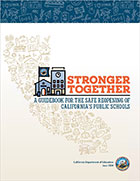
Stronger Together


A Guidebook for the Safe Reopening of California's Public Schools


This guidance was created through the statewide reopening schools task force that fostered a collaborative process for our educators and stakeholders to lend their important voices. Also informed by the technical assistance and advice of many health and safety organizations including the Centers for Disease Control, California Department of Public Health, California Division of Occupational Safety and Health, the intent of this document is to be a guide for the local discussion on safely reopening schools.

Single Document Version

Stronger Together Guidebook Coverpage


Web Version

Table of Contents

Questions:   California Department of Education | COVID19@cde.ca.gov

Stronger Together - Health Services & School Nursing (CA Dept of Education)


Schools and Communities First Earn a Ballot Spot - LA Progressive

Schools and Communities First Earn a Ballot Spot - LA Progressive

Schools and Communities First Earn a Ballot Spot


Back in April, backers of Schools and Communities First submitted a record-breaking 1.7 million signatures to the Secretary of State to qualify the funding measure for the fall ballot. While the state had to verify the signatures, less than 1 million were needed so it was all-but-certain the measure would earn its ballot spot.
And over the weekend, the state made it official. Schools and Communities First will be on the ballot.
“With the steep cuts in our county budget we’ll be faced with really difficult decisions that will jeopardize people’s access to these critically needed services,” writes Los Angeles County Supervisor Sheilia Kuehl.

The State of California estimates that Schools and Communities First would raise an estimated $8-$12.5 billion a year for education, public health and other local infrastructure by changing the state constitution and raising property taxes on California’s largest businesses.

“I was supportive very early on of Schools & Communities First before the COVID-19 pandemic, but now this initiative is needed more than ever, because we simply can’t afford these corporate tax loopholes that have gone on for decades.”
The State of California estimates that Schools and Communities First would raise an estimated $8-$12.5 billion a year for education, public health and other local infrastructure by changing the state constitution and raising property taxes on California’s largest businesses.
If passed, the measure would raise money by repealing a portion of the iconic “Proposition 13”, a 1978 ballot initiative that changed how property taxes are collected and led to the slow steady retreat of California’s fiscal support for public education.
The landmark Proposition 13 initiative overhauled how the state taxes property, capping property tax increases at no more than 2% each year on homes, businesses and farmland. Properties were to be reassessed only when sold.
The impact on California’s schools was stark. When Proposition 13 was first passed, California’s public schools were a national model, bolstered by some of the most impressive per-student funding in the country. Today, the exact amount spent per student is somewhat in question, CONTINUE READING: Schools and Communities First Earn a Ballot Spot - LA Progressive

Covid-19's Devastating Impact on Our Children - LA Progressive

Covid-19's Devastating Impact on Our Children - LA Progressive

Covid-19’s Devastating Impact on Our Children


Interviews with Five Educational Professionals

Ihad the privilege of asking five educational professionals to give their perspectives on the current pandemic by providing their thoughts, concerns, and advice. Most are retired teachers. Their insights come from many years of experience within the Los Angeles school district. Some of these educational professionals have over 30 years or more teaching in the Los Angeles Unified School District.
What are we facing? According to Human Rights Watch, there are over 3.1 billion students out of school worldwide. And 55 million American children are out of school. School budgets are already underfunded and are now facing more difficult funding choices. Thousands of students are involved in home studies or on-line curriculum learning in a district where 80% of the Los Angeles students are living in poverty and do not have this in-home luxury. School districts are desperately trying to develop plans for reopening schools in a safe manner. Much of the current crisis is due to the impact of the coronavirus. Additional pressure will be placed on our public schools because the state budget is now in a crisis.

What are your concerns around the Covid-19 given the severe impact this pandemic has had on our educational system?

Austin Beutner, superintendent of the Los Angeles Unified School District, in a Los Angeles Times article wrote that there are three things that need to be accomplished to prevent this health crisis from becoming a crisis in education:
  • The need to secure adequate funding.
  • The need to invest in making sure all students continue to have internet access.
  • The need for continuing community support.
Will this be enough to save our students, provide confidence to our parents, and maintain our public school district? We need to wait to see but hopefully, this waiting period won’t devastate our students and schools.
My question to them: What are your concerns around the COVID-19 given the severe impact this pandemic has had on our educational system? Especially on Latino students and the impact facing our children’s quality of education. These written responses to my query have been lightly edited for clarity and length.

Isela Galdamez is a 1st Grade Teacher at Huntington Park Elementary CONTINUE READING: Covid-19's Devastating Impact on Our Children - LA Progressive

Asian-Americans for Black Lives - SF PUBLIC SCHOOL MOM

Asian-Americans for Black Lives - SF PUBLIC SCHOOL MOM

Asian-Americans for Black Lives


Being a friend means standing up for folks, even when they aren’t in the room. Because it’s Best Friends Day, I decided to share a post written by one of my very best friends, Tula Jeng. I’m deeply grateful for her voice, her friendship, and her unwavering advocacy in service of Black liberation.
Thank you Tula Jeng for being one of my closest friends. For always, always listening without judgment (or tone-policing me), and for speaking up, even in high school. Your allyship and friendship mean so, so much to me. 💕💕💕💕💕

Asian Americans MUST Show up and speak up for Black lives

“To my Asian American friends: we MUST show up and speak up for Black lives. We MUST talk to our family about anti-Black racism. Silence and complacency only continues to perpetuate white supremacy.

[Click through the photo’s in Tula’s IG post above to see more Asian American voices who support the #BlackLivesMatter movement.]
Remember, the model minority myth was created by mainstream (read: white) media in the ‘60s and weaponized by white politicians to drive a wedge between Asian Americans and Black Americans during the civil rights movement. The image of the “hard-working, quiet, and assimilated” Asian became a convenient way to deny the demands of Black Americans. The model minority myth continues today. We must dismantle it if we are committed to racial justice.
I hope when we remember Vincent Chin, who was beaten to death by two white autoworkers in 1982, that we also remember George Floyd, Ahmaud Abery, Tony McDade, Breonna Taylor, Philando Castile, Alton Sterling, Charleena Lyles, Terence Crutcher, Stephon Clark, Tamir Rice, Sandra Bland, Michael Brown, Eric Garner, Trayvon Martin, and many other Black men, women, people, and children who were killed by white nationalists and racist police. #SayTheirNames.
At one of the #JusticeForGeorgeFloyd protests this weekend, I carried an “Asians for Black Lives” sign created by Kayaya’an Mendoza In addition to Kayaya’an powerful art, I will share with you his powerful words:
“As we witness the Black community once again get brutally attacked, murdered & targeted by the State & those that benefit from State violence (looking at you Amy Cooper) we must commit to not be silent bystanders.
Kayaya’an Mendoza
During a time when our own community is facing rampant anti-Asian violence, some of us may choose to go insular. In the hopes that if we don’t make noise, it will pass over us. What we need to understand is that this wh*te violence against our communities is intentional & interconnected.
If we Asian Americans want this country to be a safe space for us it needs to be safe for everyone. This complicity and colluding to white supremacy and CONTINUE READING: Asian-Americans for Black Lives - SF PUBLIC SCHOOL MOM

Rich schools get richer new school spending analysis shows

Rich schools get richer new school spending analysis shows

Rich schools get richer
School spending analysis finds widening gap between top 1% and the rest of us

n his 2013 book, “Capital in the Twenty-First Century,” French economist Thomas Pikkety made a provocative argument about rising income inequality and the growing importance of disparities in wealth. He suggested that the world was returning to a sort of 19th century dynastic capitalism where the rich, with their inherited wealth, and the poor masses were growing ever farther apart. Pikkety’s follow-up book, “Capital and Ideology,” published in English in March 2020, argued that inequality trends are turbocharged in our current period of “hypercapitalism.” 
There are consequences for education, too. A new analysis of school funding by a Pennsylvania State University researcher finds that the highest spending school districts are investing even more in their public schools, from kindergarten through high school. The school funding gap between a top 1 percent and an average-spending school district at the 50th percentile widened by 32 percent between 2000 and 2015, the study calculated. These top 1 percent districts were already funding their schools at much higher levels in 2000 but then increased annual school funding at a faster rate than everyone else. 
“The people who can and wish to spend more are running away with it,” said Bruce Baker, a school finance expert at Rutgers Graduate School of Education. “This is what educated people with fewer fiscal constraints want for their own children. Those communities clearly set a higher bar and increase that bar at a faster rate over time.”
The May 2020 study didn’t identify the roughly 1,300 districts at the top, which educate fewer than 500,000 of the nation’s children, but characterized them as mostly wealthy, white suburbs. They are not necessarily the wealthiest zip codes in the United States or where the CONTINUE READING: Rich schools get richer new school spending analysis shows

Will Congress Provide Fiscal Relief to Public Schools at an Austerity, Subsistence, or Investment Level? | janresseger

Will Congress Provide Fiscal Relief to Public Schools at an Austerity, Subsistence, or Investment Level? | janresseger

Will Congress Provide Fiscal Relief to Public Schools at an Austerity, Subsistence, or Investment Level?


In a NY Times column last week, David Brooks responded to the tragic police killing of George Floyd, a handcuffed black man, and the massive protests responding to the evident racism and inequality that underpin our society: “This moment is about police brutality, but it’s not only about police brutality. The word I keep hearing is ‘exhausted.’ People are exhausted by and fed up with the enduring wealth disparities between white and black, with the health disparities that leave black people more vulnerable to Covid-19, with the centuries-long disparities in violence and the threat of violence, with daily indignities on African-Americans and stains that linger on our nation decade after decade. The killing of George Floyd happened in a context—and that context is racial disparity. Racial disparity doesn’t make for gripping YouTube videos. It doesn’t spark mass protests because it’s not an event; it’s just the daily condition of our lives. It’s just a condition that people in affluent Manhattan live in one universe and people a few miles away in the Bronx live in a different universe. It’s just a condition that many black families send their kids to struggling inner-city schools while white families move to the suburbs and put on black T-shirts every few years to protest racial injustice.”
Brooks correctly identifies the problem: Structural inequality, segregation, and racism permeate our society.  But when it comes to a solution, Brooks looks to individuals, grants to neighborhood groups, and social entrepreneurship. Despite that injustice always involves systemic problems and that justice requires eliminating disparities in the system itself, Brooks suggests national service programs for young people, an endowment for civic architecture, Moving to Opportunity Grants, and even the Betsy DeVos solution, education savings account school vouchers for private education services (with the money coming out of public school CONTINUE READING: Will Congress Provide Fiscal Relief to Public Schools at an Austerity, Subsistence, or Investment Level? | janresseger

Report: Schools Need a Federal Bailout in Order to Reopen | Education News | US News

Report: Schools Need a Federal Bailout in Order to Reopen | Education News | US News

Report: No Way to Reopen Schools Safely Without Federal Bailout
A new cost estimate from school superintendents shows reopening following CDC guidelines is cost-prohibitive


IN ORDER TO ADHERE TO the Centers for Disease Control and Prevention safety recommendations for reopening, school districts will be forced to spend nearly $2 million per district that they hadn't budgeted for – a cost so prohibitive that some are now scrapping plans for in-person classes entirely this fall.
"There are some saying, 'It's early, but I have to tell you, I don't see how we could possibly open without additional funds,'" Daniel Domenech, executive director of AASA, the School Superintendents Association, says. "It's becoming an overwhelming problem and many districts are considering returning to distance learning."
The cost analysis from the superintendents organization and the Association of School Business Officials International shows that in some cases school districts can expect to spend an additional $490 per student in order to cover costs associated with purchasing hand sanitizer, disinfectant wipes and other cleaning supplies, gloves, masks and other personal protective equipment, hiring additional custodial staff and nurses, and more. The additional expenses for an average school district of about 3,700 students total $1.8 million.
"The $1.8 million is for an average school district," Domenech says. "When you escalate to large urban school districts the numbers are impossible in order to adhere to CDC guidelines."
The estimate comes amid statewide budget cuts that have already or are likely to put a 10% to 25% dent in school budgets for the upcoming academic year, with some cuts as high as 35% already expected for the 2021-22 school year.
Los Angeles Unified School District and five other large urban districts in California have already notified Gov. Gavin Newsom that a projected $7 billion budget cut would dash all hopes of opening in time for the fall semester.
"It's impossible to do," Domenech says. "It's becoming an overwhelming problem."
The biggest ticket items associated with reopening in line with CDC guidance include hiring additional school personnel: A 3,700-student school district should expect to spend an additional $448,000 to hire more custodial staff to keep up with frequent cleaning recommendations, an additional $400,000 to ensure one nurse for each school and an additional $384,000 to hire one aide per school bus to screen student temperatures before they board.
Also cost prohibitive is the additional $169,000 to resume before- and after-school child care with proper social distancing and cleaning protocols, as well as the additional $148,000 to provide disposable masks for the estimated 30% of students who won't bring them from home.
The biggest concern of most school superintendents as they plan for how to reopen safely is the cost, as well as the logistics, associated with running buses at 25% capacity to comply with recommended social distancing guidelines. And the cost analysis from the associations deems it nearly impossible because it is cost-prohibitive.
"Bus fleets would need to quadruple in size to safely transport 100% of students under COVID-19 circumstances, which is financially unfeasible for districts," the analysis reads.
Shane Hotchkiss, the superintendent of Bermudian Springs School District in York Springs, CONTINUE READING: Report: Schools Need a Federal Bailout in Order to Reopen | Education News | US News