Latest News and Comment from Education

Showing posts with label MICHIGAN EDUCATION. Show all posts

Wednesday, February 24, 2021

Parents & school administrators agree: Michigan Republicans are holding children hostage for political power | Eclectablog

Parents & school administrators agree: Michigan Republicans are holding children hostage for political power | Eclectablog
Parents & school administrators agree: Michigan Republicans are holding children hostage for political power


Nearly two months ago, the federal government made billions of dollars in COVID-19 relief funds available to the states. Michigan is in line for over $5 billion in relief funding, including $2.1 billion to re-open schools in our state. However, so far, none of that money has been allocated and, if its not used by the end of March, we will forfeit it. The only reason the money has not been accepted is because Republicans will not agree to accept it until Governor Gretchen Whitmer cedes her authority to keep our state safe and allows local school districts to decide for themselves when and how to reopen schools. The condition they are putting on the acceptance of over two billion dollars is nothing short of a power play to maintain their gerrymandered control over our state.

This morning, a group of parents from around the state held a press conference demanding that Republican legislators stop using the lives of their children as a bargaining chip in the quest to diminish Governor Whitmer. Tinu Roland, a parent in the Detroit Charter School District, was blunt: “People like [State Representative] Thomas Albert think it’s okay to play games with our children,” she said. “It feels like our kids are in a different pandemic than he is.” Rep. Albert, a Republican from Lowell, is the Chair of the House Appropriations Committee. In addition to his demand that Gov. Whitmer relinquish her authority to protect all Michiganders, he refuses to release all of the funding from the federal government at once, instead making the funds available only on a quarterly basis. “If the governor performs in that time period, then we’ll continue on with the next installment,” he told The Detroit News.

Dallas Flippen, a parent and pastor with a child in the Jackson Public School system, pointed out CONTINUE READING: Parents & school administrators agree: Michigan Republicans are holding children hostage for political power | Eclectablog

Thursday, October 29, 2020

COVID19 Rips Through Michigan K-12 Schools - PopularResistance.Org

COVID19 Rips Through Michigan K-12 Schools - PopularResistance.Org
COVID19 RIPS THROUGH MICHIGAN K-12 SCHOOLS


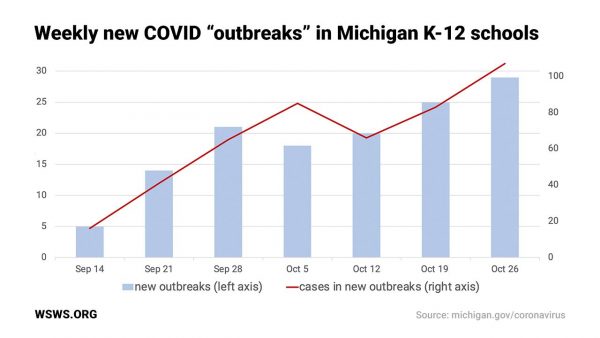
The spread of COVID-19 through Michigan’s K-12 schools is rapidly accelerating, with the number of new outbreaks rising for the third week in a row, according to data released by the state yesterday. Last week, there were 29 separate outbreaks affecting 107 students, teachers and school workers, making it the most infectious week in Michigan since the school year began.

The 29 new outbreaks last week are in addition to 70 other “ongoing” outbreaks, defined as outbreaks that have been reported more than a week ago, but which have at least one new associated case in the last 28 days. Altogether, the 99 total ongoing outbreaks have led to 482 reported cases of COVID-19 among students, teachers and staff. Family members and other community members not employed by schools are not counted.

It must also be pointed out that Michigan defines an “outbreak” at school as “two (2) or more COVID-19 cases who may have shared exposure on school CONTINUE READING: COVID19 Rips Through Michigan K-12 Schools - PopularResistance.Org

Education Research Report: Education Equity in Michigan

Education Research Report: Education Equity in Michigan
Education Equity in Michigan


The Michigan Civil Rights Commission has released a 62-page report describing inequities in Michigan’s K-12 education system and detailing specific recommendations for action that policy makers and educators can implement to make achieving educational equity a priority in all Michigan schools.

The report is the culmination of a series of public hearings and a year-long examination of disparities in K-12 education in Michigan. From May 2018 through the end of March 2019, the Commission held five public hearings around the state and heard from dozens of subject matter experts, school administrators, teachers, parents and students on the ways Michigan is falling short in its obligation to effectively educate all its children.

“This Commission believes that an adequate education is the key to unlocking a lifetime of opportunities and also is a basic civil right,” said Stacie Clayton, Chair of the Michigan Civil Rights Commission. “We learned during our education hearings that not all children receive the kind of education they deserve as their birthright. We urge policy makers, educators and other stakeholders across the state to view this report as a roadmap they can follow to help schools achieve educational equity and give all Michigan children – regardless of household income, race, residency or ability -- the education they need to lead productive and fulfilling lives.”

The Commission became increasingly concerned about educational disparities in 2016 during their examination of the racial implications in the causes of, and response to, the Flint water crisis. What they learned during these hearings led directly to their decision in 2018 to launch an exploration of inequity in Michigan’s education system.

Through the hearing process, Commissioners became increasingly aware that the effectiveness of public school systems is directly determined by the racial and economic makeup of the community. They also found that instead of a cohesive, statewide education system, Michigan is made up of independent systems that operate differently and are resourced in a variety of ways, leading to disparities between high-performing districts and those considered “failing.”

Specific obstacles identified to equity in education include:

  • Lack of access to early childhood education
  • Varying degrees of parental involvement
  • Funding based on declining enrollment that leaves schools grossly underfunded
  • Food insecurity
  • Lack of specialized instruction, after school and summer school programs
  • Lack of qualified, experienced minority teachers

To achieve equity, the report says public school systems must recognize differences and distribute resources based on an understanding of how differences impact equitable access. They must also implement strategies to break down biases and barriers to equity, including:

  • Educating on implicit biases
  • Developing racially conscious strategies for school integration
  • Changing per-student funding and Proposal A
  • Eliminating competition between schools
  • Increasing teacher pay
  • Eliminating legacy debt
  • Increasing special education opportunities and funding

The report concludes with a list of recommendations for action, starting with the expansion of the Council for Government and Education on Equity and Inclusion, an MDCR-led initiative, to include representatives of the Michigan Department of Education, and establish the Council as the entity responsible for implementing and overseeing the following additional recommendations:

  • Develop a Statewide Educational Equity Plan to enhance policies and accountability.
  • Ensure that all data collected by government entities be disaggregated by race and ethnicity.
  • Encourage schools to create local equity plans and contribute information and resources to support equitable practices.
  • Provide year-round cultural competency/race and equity education and coaching.
  • Increase internet access for students and families.
  • Support a quality teacher training program, encouraging diversity in teaching roles and student enrollment.
  • Encourage the placement of affordable public housing only in school districts that are educationally successful and can support new students who have additional needs.
  • Recognize the overlapping roles that housing discrimination, employment discrimination, environmental racism and other racial disparities play in perpetuating educational inequity.
  • Create a multicultural, student-led component of the Council for Government and Education on Equity and Inclusion to engage students and parents/guardians on the local level.

Education Research Report: Education Equity in Michigan

Saturday, October 10, 2020

Wendy Lecker: Michigan’s inadequate funding of schools a lesson for CT

 Wendy Lecker: Michigan’s inadequate funding of schools a lesson for CT

Wendy Lecker: Michigan’s inadequate funding of schools a lesson for CT


Michigan is the home state of U.S. Secretary of Education Betsy DeVos. Before she was appointed by President Donald Trump, DeVos wielded her influence and wealth there to push and expand unregulated charters. “School choice” is one of the policies that opponents of adequate public school funding claim can improve education without spending more money. They also tout increased accountability. These two policies are often sold using the civil rights language, promising equal opportunity for all.

A new report by the Michigan Civil Rights Commission (“MCRC”), Education Equity in Michigan, demonstrates how underfunding public schools, while relying on choice and increased accountability, has undermined equity and quality in public education across that state. The report is the result of a year of hearings throughout Michigan, where the commission heard from residents as well as subject matter experts.

MCRC notes the persistent underfunding of Michigan public schools, particularly for students with additional needs. In 1993, in an attempt to reduce funding inequity among school districts, Michigan shifted from a system reliant on local property taxes to one relying primarily on state revenue sources. However, the state neglected funding adequacy. Since 1993, Michigan’s school funding revenue steadily declined. A 2019 study found Michigan ranked last in the nation in total education revenue growth and 48th out of 50 in per pupil revenue growth. A key problem is inadequate funding of students living in poverty, English Language Learners, and students with disabilities. The disparity in resources between affluent and poor districts is matched by a disparity in educational outcomes, especially among the most underserved students.

Compounding Michigan’s inadequate state funding is a “money follows the child” system where funds leave with students as they move from public school to charter to Public School Academies — three different systems competing for the same limited pot of state education funds. The report notes that the state “provides taxpayer money to charter schools without CONTINUE READING:  Wendy Lecker: Michigan’s inadequate funding of schools a lesson for CT