Latest News and Comment from Education

Showing posts with label LOCAL CONTROL. Show all posts

Thursday, March 25, 2021

CURMUDGUCATION: Covid, Learning Loss, and Katrina 2.0

CURMUDGUCATION: Covid, Learning Loss, and Katrina 2.0
Covid, Learning Loss, and Katrina 2.0


Well, here we go.

Here's Morgan Polikoff in the Los Angles Times, explaining that we are in a terrible mess, that educational attainment, or at least test scores (as measured by another testing manufacturer) are dropping, that the mental health of children in the nation is a mess. And hurray for the Biden relief plan, which throws a pile of money at all these education. But. But but but. Our educational structures can't handle this, Polikoff argues. Too many districts with boards and parent groups and teacher unions and families and students and they just aren't up to "identifying what works and then providing it equitably to students and families." 

What does he think has to happen?

This is where state and national leaders simply must step in. They need to provide clear and specific guidance on the best ways to spend American Rescue Plan dollars to address the negative impacts of the pandemic on children and families. They must not leave decisions to local actors — burdening them with the task of figuring out what works and implementing it.

Local control is a bad thing, and it needs to be swept aside, as witnessed by the data we have so far.

Polikoff asserts that three things are needed going forward in this state-controlled education universe. And number one is measurement--academic tests, social and emotional well-being tests. And they should go on for years "so we can follow our progress well beyond the end of the pandemic." Oh, and the "measurement plans should be carefully constructed to ensure the results are directly CONTINUE READING: CURMUDGUCATION: Covid, Learning Loss, and Katrina 2.0

Saturday, October 31, 2020

New data lays bare school funding disparities -- within districts, too

New data lays bare school funding disparities -- within districts, too
New data: Even within the same district some wealthy schools get millions more than poor ones
We’ve long known about spending disparities from one district to another; new federally mandated data lays bare within-district inequities, too


At Ronald D. O’Neal Elementary School, in Elgin, Illinois, none of the third graders could read and write at grade level according to state tests in 2019. Nearly 90 percent of the school population is considered low-income and nearly three-quarters are labeled English learners, meaning that the state language arts test assesses their reading and writing ability in a language they’re still trying to learn.

Just nine miles away sits Centennial Elementary School, where 73 percent of third graders met grade-level standards on that same test. A fifth of Centennial’s student body is considered low-income, and 17 percent get extra supports as they learn English.

The state has celebrated Centennial for “exemplary academic performance.” It designates O’Neal as a school in need of targeted assistance. But despite its low performance and its students’ needs, O’Neal received $9,094 per student in 2019 in state and local funding compared to Centennial’s $10,559. If O’Neal had received Centennial’s per-pupil funding, it would have meant an extra $789,905 in its budget: Money that could have covered more — or more experienced — teachers, social workers or home-school liaisons, or paid for new programs to address students’ academic and nonacademic needs.

While wealthier school districts routinely spend significantly more money to run their public schools, the disparity between Centennial and O’Neal can’t be attributed to the relative wealth in their communities. Both schools are part of a single district, U-46, Illinois’ second largest.

Kids who need more support to overcome barriers to academic achievement are routinely shortchanged. U-46 was one of 53 districts across the United States that spent a statistically significant amount less state and local money on high-poverty schools than on lower-poverty schools, according to a new Hechinger Report analysis of how districts disburse funding. In another 263 districts, the level of spending on each school had little to no connection to the number of students in poverty, despite the higher needs often present in low-income schools. It’s the first CONTINUE READING: New data lays bare school funding disparities -- within districts, too

Monday, August 17, 2020

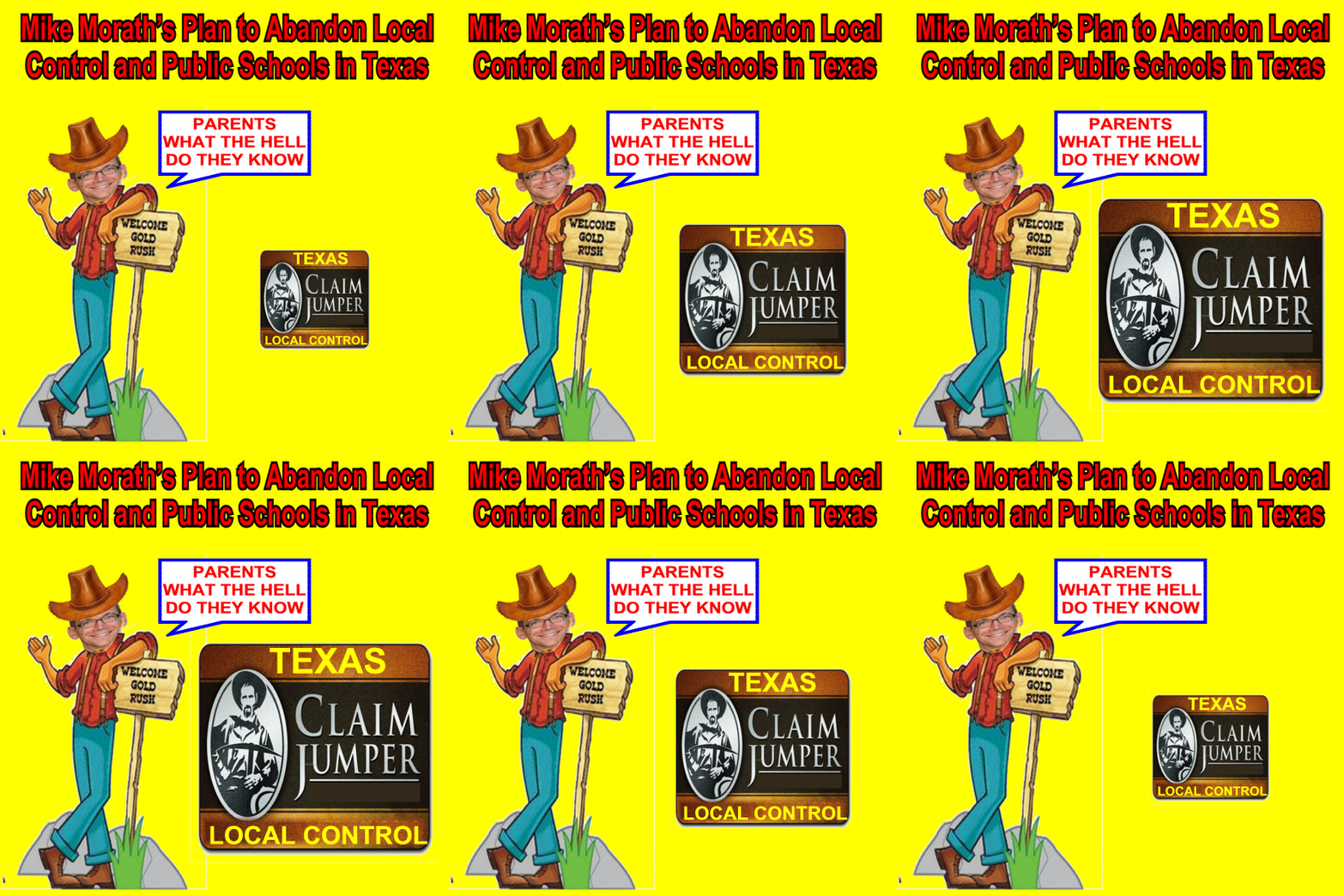
Anette Carlisle: Mike Morath’s Plan to Abandon Local Control and Public Schools in Texas | Diane Ravitch's blog

Anette Carlisle: Mike Morath’s Plan to Abandon Local Control and Public Schools in Texas | Diane Ravitch's blog

Anette Carlisle: Mike Morath’s Plan to Abandon Local Control and Public Schools in Texas


Anette Carlisle, public education advocate in Texas, describes how State Commissioner Mike Morath, a non-educator, bought into the anti-democratic strategy of killing local school boards and privatizing public schools. He swallowed whole the disruption program of the Center for Reinventing Public Education, one of the Gates-funded think tanks that call for the abandonment of public schools.
Despite a full decade of failure, phony “reformers” claim that education will improve if private corporations and entrepreneurs take over from elected school boards. It hasn’t worked anywhere, and it won’t work in Texas.
Carlisle writes:
Texas has chosen to abandon our local public schools, locally elected school boards, superintendents and our 5.4 million schoolchildren in favor of a “my way or the highway” single system directive by Texas Education Agency Commissioner Mike Morath. That’s why I’m standing up to say, “Whoa! Hold your horses, please, Mr. Commissioner.”
It’s an effort that’s been building for years, right under our noses. People said, “Surely not,” but here we are.

Saturday, July 25, 2020

A patchwork of reopening plans for schools in the fall

A patchwork of reopening plans for schools in the fall

Local control of schools leads to a patchwork of reopening plans
Experts say flexibility is needed to reopen schools safely this fall, but some argue giving schools a wide berth will cause problems.


On a Thursday evening in mid-July, Superintendent Miskia Davis stuck to a careful script as she presented the Sunflower County Consolidated School District’s reopening plan to an audience of hundreds of parents on Facebook. The district’s school board had approved a hybrid model in which some students will spend the day learning on campus while their peers learn remotely at home, before the groups rotate later in the week.
Davis was in a difficult position. Just next door, the Leland School District was leaning toward keeping schooling fully remote until at least October. Thirty-minutes down the road, the Cleveland School District was planning to bring kids back to school buildings full time. In a stream of comments, parents grilled Davis about how in the world schools could require young children to wear masks with no exceptions. Others worried whether learning in person was safe at all.
“This isn’t going to work! My baby has a weak immune system and I know he’s not going to keep on a mask,” wrote one commenter.
30 (or more) — Number of cases of the coronavirus per 100,000 residents in several Mississippi districts that are planning to reopen for in-person teaching next month
Davis tried to offer reassurance through an extended nautical metaphor. She displayed a picture of boats being tossed at sea and asked families to notice the boats’ different sizes and colors, and the different direction each vessel was headed. The boats represented school districts, she said. The CONTINUE READING: A patchwork of reopening plans for schools in the fall