Latest News and Comment from Education

Showing posts with label SEGREGATION. Show all posts

Wednesday, May 19, 2021

What Does Educational Equity Mean? | janresseger #BLM #BLACKLIVESMATTER

What Does Educational Equity Mean? | janresseger
What Does Educational Equity Mean?


Monday, May 17, 2021, marked the 67th anniversary of the U.S. Supreme Court decision in Brown v. Board of Education, which banned racially segregated schools and unequal access to education. Over more than two decades, NAACP attorneys Charles Hamilton Houston and Thurgood Marshall built up a series of court precedents leading to the 1954 decision in Brown, which declared that educational opportunity, “where the state has undertaken to provide it, is a right which must be made available to all on equal terms.” However, two-thirds of a century later in most places in the United States racial separation and inequity remain the conditions of our children at school.

Among advocates for educational equality, there has, for decades, been an ongoing conversation about the definition of equity. Iris Rotberg, a professor of education policy at George Washington University, recently published a column in which she quotes Thurgood Marshall’s definition all those years ago:  “We sit… not to resolve disputes over educational theory but to enforce our Constitution… I believe the question of education quality must be deemed to be an objective one that looks at what the state provides its children, not what the children are able to do with what they receive.”

Rotberg interprets Marshall’s words: “The government’s responsibility, therefore, is to ensure equal opportunity, not to debate its link to student achievement.”  She is interpreting Marshall’s definition of justice to mean equality of educational inputs and not a comparison of test score outcomes.  She is advocating that states be held accountable for equalizing CONTINUE READING: What Does Educational Equity Mean? | janresseger

A Scholarly Masterpiece: William Frantz Public School | tultican #BLM #BLACKLIVESMATTER

A Scholarly Masterpiece: William Frantz Public School | tultican
A Scholarly Masterpiece: William Frantz Public School


By Thomas Ultican 4/18/2021

My wonderful friend from New Orleans, Mercedes Schneider, said of this meticulously researched book, “Intense, captivating, and horrible in its reality, William Frantz Public School is a story overdue for the telling – a must read for those seeking to understand New Orleans’ history and the lingering impact of White racial superiority upon the Black community and city infrastructure.” I concur. It is a captivating read.

At its 1938 founding, speakers proclaimed the new William Frantz Public School (WFPS) a “protection for democracy” and a “fortification against encroachment of those terrible ‘isms.’” (WFPS page 3)

However, racism did not just encroach; it dominated. WFPS was built to be a White students only school. Sitting on the border between the all white Florida neighborhood and the all Black Desire neighborhood, WFPS only served the White families. Worse still; the authors report,

“The Orleans Parish School Board built no schools between 1941 and 1951. As a result, existing neighborhood schools throughout the city faced overcrowding. The problem was particularly acute in Desire. Due to the severe overcrowding, many Black children attended school for only a fraction of the time as their White peers living in the Florida neighborhood.” (WFPS 9)

With the Brown versus the Board of education decision in 1954, the Supreme Court declared racial segregation as a school enrollment policy unconstitutional. Louisiana segregationists quickly coalesced to become leaders of their state’s CONTINUE READING: A Scholarly Masterpiece: William Frantz Public School | tultican

Monday, May 17, 2021

Historian: Segregation Persists Because Whites Opposed Any and All Efforts to Advance Desegregation | Diane Ravitch's blog

Historian: Segregation Persists Because Whites Opposed Any and All Efforts to Advance Desegregation | Diane Ravitch's blog
Historian: Segregation Persists Because Whites Opposed Any and All Efforts to Advance Desegregation


Today’s is the anniversary of the Brown v. Board of Education of 1954. Much has changed. Barack Obama was elected President twice. But much has not changed. The desegregation of schools that once seemed inevitable stalled, inhibited by white flight from urban districts and housing desegregation.

Historian Matthew D. Lassiter of the University of Michigan argues in this opinion piece in the Washington Post that desegregation failed because of white resistance and pusillanimous federal courts, which turned against desegregation as Republican presidents added conservative justices to the Supreme Court.

Fifty years ago today, the Supreme Court issued the landmark decision of Swann v. Charlotte-Mecklenburg, the most far-reaching school desegregation case since Brown v. Board of Education in 1954. The Swann ruling upheld a lower court-imposed plan to integrate the public schools of metropolitan Charlotte through two-way busing between the segregated White suburbs and the all-Black central city neighborhoods.

During the next few years, busing helped transform the CONTINUE READING: Historian: Segregation Persists Because Whites Opposed Any and All Efforts to Advance Desegregation | Diane Ravitch's blog

Sunday, May 16, 2021

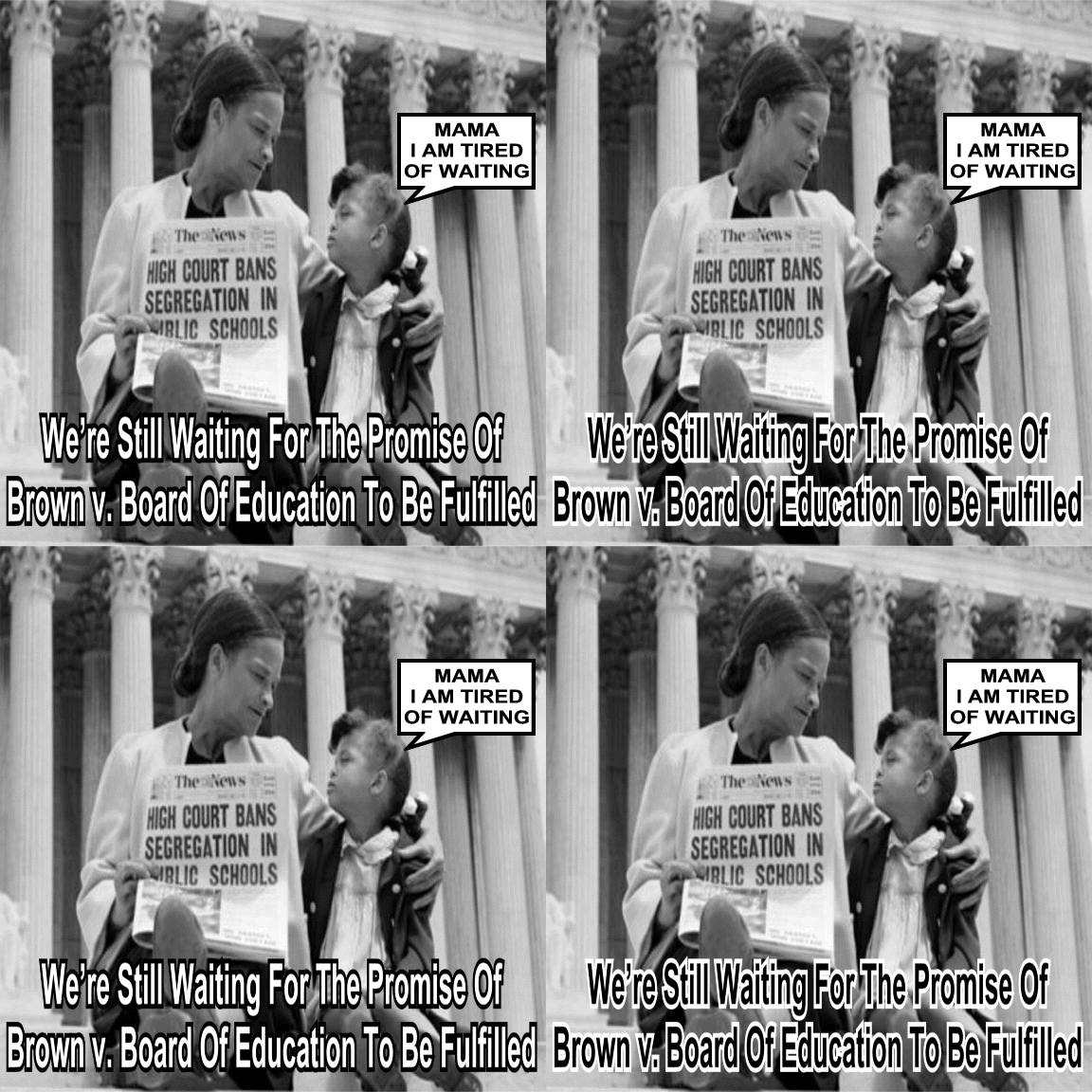
We're Still Waiting For The Promise Of Brown v. Board Of Education To Be Fulfilled | HuffPost

We're Still Waiting For The Promise Of Brown v. Board Of Education To Be Fulfilled | HuffPost
We’re Still Waiting For The Promise Of Brown v. Board Of Education To Be Fulfilled
“When the Supreme Court’s decision finally etched itself upon the country, the social stuff of that imprinting behaved in ways other than intended.”


Our house had a cottonwood tree in the backyard. In the excruciating Texas summer, it bloomed and cotton flew around the house like a summer snow. It caked over the window screens and blocked the wind from coming into the house.

Some of our neighbors had water cooler fans that blew out a cool mist. It made the whole house feel like a swamp and made everyone in the house feel like they were trying to breathe underwater. I hated those fans and was grateful we couldn’t afford one.

We were poor, but not in the ways that mattered. No one went hungry. No one was homeless. There were no drugs. No gangs and no neighborhood blight. The front door to our house was never locked. And everybody owned the home they lived in. My parents purchased our home in the 1950s, and it was a significant accomplishment for them.

When I enrolled in elementary school, all of my teachers were Black and they preached excellence like a well-rehearsed Sunday sermon. By the time I began middle school, in sixth grade, I was a track star, held first chair in the band and was among the top five grade earners.

But all of that changed in 1974, when I was in seventh grade. As part of the mandate issued by the U.S. Supreme Court in the landmark case Brown v. Board of Education of Topeka, Kansas, my classmates and I were among the first group of Dallas students to CONTINUE READING: We're Still Waiting For The Promise Of Brown v. Board Of Education To Be Fulfilled | HuffPost


Thursday, May 13, 2021

Shawgi Tell: Segregated Unaccountable Charter Schools | Dissident Voice

Segregated Unaccountable Charter Schools | Dissident Voice
Segregated Unaccountable Charter Schools


Anyone who has carefully followed charter school news and analysis in recent years knows that privately-operated charter schools are not only segregated but actually increase segregation in the sphere of education. It has become common knowledge that charter schools are notorious for consistently under-enrolling English Language Learners, students with disabilities, homeless students, and other groups of students. Even though they are ostensibly public and “open to all,” most charter schools do not serve all students, let alone equally. Privatized education has never paved the way for all students to have an education.

But even when non-profit and for-profit charter schools are publicly exposed, cited, and rebuked for discriminatory enrollment practices, they are usually allowed to operate with impunity and to continue to siphon enormous sums of money from public schools that accept all students at all times. Many are frustrated by this persistent lack of accountability by schools that constantly claim to not only be accountable but to be more accountable than the public schools they continually drain large sums of money from. The public does not want to fund schools that frequently cherry pick students. Publicness is about inclusivity, not exclusivity. Public means for the common good, for everyone. To claim that you are a public entity while acting like a private entity is CONTINUE READING: Segregated Unaccountable Charter Schools | Dissident Voice

Wednesday, April 28, 2021

Minnesota: Elites Propose Constitutional Amendment to Enable Segregated Schools | Diane Ravitch's blog

Minnesota: Elites Propose Constitutional Amendment to Enable Segregated Schools | Diane Ravitch's blog
Minnesota: Elites Propose Constitutional Amendment to Enable Segregated Schools


Minnesota was the first state to pass a charter law in 1991. As blogger Sarah Lahm wrote in the Progressive in 2019, the new charters were exempt from most state regulations, including desegregation. A number of its charters are segregated by race and ethnicity, intentionally so, because the charter industry believes that segregation is culturally affirming. This situation led to a lawsuit to assure the rights of children of color in the state.

So now leading figures in the state charter lobby want to pass an amendment to the state constitution that would make segregated schools acceptable, while adding that school quality would be determined by standardized tests.

Blogger Rob Levine explains:

The Page Amendment is best understood if you recognize these foundations’ overall public education strategies. For 30 years the Minneapolis Foundation and its allies have been creating, funding, and persuading the CONTINUE READING: Minnesota: Elites Propose Constitutional Amendment to Enable Segregated Schools | Diane Ravitch's blog

Saturday, April 3, 2021

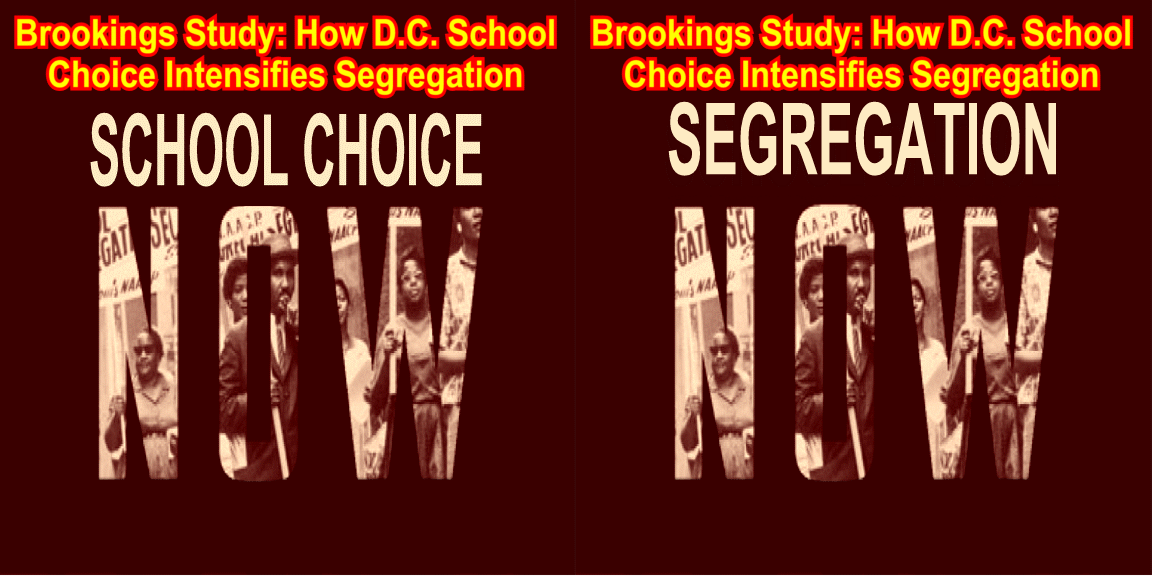
Brookings Study: How D.C. School Choice Intensifies Segregation | Diane Ravitch's blog

Brookings Study: How D.C. School Choice Intensifies Segregation | Diane Ravitch's blog
Brookings Study: How D.C. School Choice Intensifies Segregation


The Brookings Institution published a study of the D.C. school system, which is almost evenly divided between public schools and charter schools. It was written by three scholars: Vanessa Williamson, Brookings Institution; Jackson Gode, Brookings Institution; and Hao Sun, Gallaudet University. The title of their study is “We All Want What’s Best for Our Kids.” Their findings are based on close reading of an online parent forum called “DC Urban Moms,” where school choice is an important topic.

What they found is not surprising. Choice intensifies and facilitates racial and socioeconomic segregation. This is the same phenomenon that has been documented in choice programs everywhere. The most advantaged parents master the system and get their children into what is perceived as the “best schools.” The “best schools” are those that have the most advantaged students.

The study begins:

Public education in the District includes a system of traditional public schools and a system of public 8
charter schools; in 2018–19, these schools served over 90,000 students at 182 schools. The city is highly diverse, as is the incoming school-age population. Among children under five, 48 percent are Black, 27 percent are white non-Hispanic, and 17 percent are Hispanic.9 54 percent of the city’s public school students are in CONTINUE READING: 
Brookings Study: How D.C. School Choice Intensifies Segregation | Diane Ravitch's blog

Thursday, March 18, 2021

Bruce D. Baker and Robert Cotto Jr.: The underfunding of Latinx-serving school districts  - kappanonline org

The underfunding of Latinx-serving school districts  - kappanonline.org
The underfunding of Latinx-serving school districts 


An analysis of spending in U.S. public schools reveals dozens of districts — many with large Latinx enrollments — that are underfunded compared to other districts in their region, even though they serve children with much greater needs.  

When analyzing questions of fairness in local education spending, it’s important to understand that the value of the education dollar is relative. It doesn’t just matter how much money, in total, a school district spends but also how that figure compares to spending in nearby districts. After all, schools in the same area must compete with each other for employees. The district that spends $15,000 per pupil will have a harder time hiring and retaining the area’s highest-quality teachers and staff than will the neighboring district that spends $20,000. Moreover, each dollar will go further in districts that serve relatively affluent students than in those that serve large numbers of students from low-income backgrounds, who tend to need more (and more expensive) services. 

Several years ago, one of us (Bruce Baker) set out to identify public school districts that face this kind of competitive disadvantage — more specifically, districts where the students face greater needs than in surrounding districts (i.e., child poverty is more than 20% higher) but where per-pupil spending is less than 90% of the region’s average.  

At the time, a number of national reports had just been published comparing the overall fairness of states’ school finance systems (Baker & Corcoran, 2012; Baker, Sciarra, & Farrie, 2014). But studies were also beginning to show a lot of variation within states. Even in those states that appeared to have relatively well-funded and equitable school finance systems, some districts were being left out. And that raised the question: Did those districts have something in common?  

The answer turned out to be yes. Those districts where students’ needs were greater but the schools were relatively under-resourced were disproportionately located in smaller cities that served high CONTINUE READING:  The underfunding of Latinx-serving school districts  - kappanonline.org

Monday, March 15, 2021

Segregation factories, pt. 3: how to shop in a Jeb Crow voucher marketplace built to cheat and grift and harm your child - Public Enemy Number 1

Segregation factories, pt. 3: how to shop in a Jeb Crow voucher marketplace built to cheat and grift and harm your child - Public Enemy Number 1
Segregation factories, pt. 3: how to shop in a Jeb Crow voucher marketplace built to cheat and grift and harm your child
Grift inflation is coming. Know your voucher grifters now to avoid them in the ESA future. Also regulate voucher schools like banks so public schools don't have to be the FDIC of education.


The smartest way to shop for a voucher school is not to shop for one at all. There are very very few worth buying. This is why the education savings account (ESA) concept is doomed as anything but grift.

When Kelli Stargel dismantles your educational Publix this legislative session and gives you a dollar store debit card for educational groceries instead, it doesn’t mean the dollar store gets anything better on its shelves. The dollar store doesn’t have the capital or product development systems that Publix has built over decades. The dollar store doesn’t have supermarket capacity.

There is almost nothing worth buying today in the ESA dollar store; and there will be almost nothing worth buying in the future.

Opaque grift inflation is coming; I have a tool to help

Testing and mass 3rd grade retention and forced busing away from neighborhood-turned-magnet-or-charter schools will keep driving vulnerable kids away from the capital of public schools (and eroding education capital and capacity for everyone, including the rich).

And the same group of grifter garbage voucher providers will just take more money from you, the taxpayers, to cheat and harm and segregate the socially, economically, CONTINUE READING: Segregation factories, pt. 3: how to shop in a Jeb Crow voucher marketplace built to cheat and grift and harm your child - Public Enemy Number 1

Wednesday, March 3, 2021

Naima Coster’s “What’s Mine and Yours” Complicates the School Segregation Story | Bitch Media

Naima Coster’s “What’s Mine and Yours” Complicates the School Segregation Story | Bitch Media
“What’s Mine and Yours” Complicates the School Segregation Story


It has been more than 60 years since Brown v. Board of Education legally desegregated U.S. schools, but schools are as segregated now as they’ve ever been. In 2014, Nikole Hannah-Jones, then a reporter for ProPublica, opened many people’s eyes when she chronicled how the segregation embedded in Ferguson, Missouri’s school system contributed to the untimely murder of Michael Brown Jr. in 2014. Since then, Hannah-Jones and other education reporters have blown the lid off the idea that U.S. schools treat all students equally and that they follow a system of meritocracy. EdBuild, a public school-focused nonprofit, released a study in 2019 that found that schools systems primarily serving children of color typically receive $23 billion less in funding than those that serve white children—this has a rippling effect that can determine the trajectory of each child’s life. “You can tell these dollars make a difference,” Rebecca Sibilia, CEO of EdBuild, told the New York Times in 2019. “Walk into a rural nonwhite community. Walk into an urban nonwhite school district. You can see what that means in terms of how much that has added up over time.”

It’s not only funding—or a lack thereof—that keeps students from receiving the education they deserve. There’s also a concerted effort in wealthier communities to create enclaves that purposely exclude children from poorer communities, the majority of whom are children of color. The same EdBuild study found that more than 50 percent of children in the United States are in segregated districts where more than 75 percent of their classmates are either white or nonwhite, depending on where they live—and wealthy parents, many of whom are white, fight tooth-and-nail to keep it that way. That’s how we’ve gotten to the point where nearly one-fifth of public schools in the United States have close to no students of color. (These are the same schools that hoard more than their fair share of resources.) Our schools are still separate and unequal, an idea that is central to Naima Coster’s second novel, What’s Mine and Yours, which focuses on two parents, Lacey May and Jade, and their children, Noelle and Gee, respectively, as their school begins an integration program that ignites tensions.

On the surface, Jade and Lacey May have a lot in common: Both women are working-class parents in North CONTINUE READING: Naima Coster’s “What’s Mine and Yours” Complicates the School Segregation Story | Bitch Media

Tuesday, March 2, 2021

Six Dr. Seuss books to stop being published over ‘hurtful and wrong’ racial portrayals - Raw Story - Celebrating 16 Years of Independent Journalism

Six Dr. Seuss books to stop being published over ‘hurtful and wrong’ racial portrayals - Raw Story - Celebrating 16 Years of Independent Journalism
Six Dr. Seuss books to stop being published over ‘hurtful and wrong’ racial portrayals


Six Dr. Seuss books are being retired after decades of criticism over racist imagery in the illustrated children’s stories. Dr. Seuss Enterprises, the organization that carries on the author’s legacy, announced Tuesday that it will stop publishing and licensing “And to Think That I Saw It on Mulberry Street,” “If I Ran the Zoo,” “McElligot’s Pool,” “On Beyond Zebra!,” “Scrambled Eggs Super!” and “The Cat’s Quizzer.” “These books portray people in ways that are hurtful and wrong,” the organization said in a statement Tuesday morning, adding that the decision was made last year with a panel of e...

Read More Six Dr. Seuss books to stop being published over ‘hurtful and wrong’ racial portrayals - Raw Story - Celebrating 16 Years of Independent Journalism


Wednesday, February 17, 2021

How school funding can help repair the legacy of segregation - Vox

How school funding can help repair the legacy of segregation - Vox
How school funding can help repair the legacy of segregation
America’s schools spend less money on Black students. Closing the gap is key to equality


The  walls at the high school Leanne Nunes attended in the Bronx were painted a color she likes to call “penitentiary beige.”

The cafeteria, located in the basement, had no windows. About half of her classrooms didn’t have windows, either. “It felt kind of jail-like,” Nunes, now a first-year student at Howard University, told Vox. “It felt like the building itself was trying to keep you in.”

And the lack of resources went beyond the physical space. Laptops for students were often old or broken. Students struggled to get access to the classes they wanted. For example, the school could only afford to offer art or music in a single year, not both. “You’d have to pick,” Nunes said, “and by ‘you’d have to pick,’ I mean the school made the decision for you.”

Looking back, she said, “there were a lot of opportunities where I think young people could have been learning or engaging with content better, but they didn’t really have the chance to.”

What Nunes experienced isn’t out of the ordinary — it’s the norm around the country. While affluent school districts can afford to offer students everything from the latest technology to a range of advanced classes, schools in lower-income areas often struggle to provide the basic necessities. That gap has become a chasm during the Covid-19 pandemic, when something like a cafeteria with no windows becomes a very real health hazard.

And because of the legacy of housing discrimination, especially against Black Americans, the poorest schools in the country disproportionately serve Black students and other students of color. “Since genocide and enslavement built the country, there have been intentional systems put in place to bar, particularly, Black children from quality public schools,” Khalilah Harris, acting vice president for K-12 education policy at the Center for American Progress, told Vox.

Nationwide, majority-nonwhite districts get $23 billion less in funding every year than CONTINUE READING: How school funding can help repair the legacy of segregation - Vox

Saturday, January 30, 2021

‘School choice’ is a dog whistle for resegregation

‘School choice’ is a dog whistle for resegregation


Congratulations to Cindy Marten. San Diego Unified School District’s superintendent has been tapped to become the next deputy U.S. education secretary.

Under Marten, San Diego Unified was one of two large urban districts nationwide in 2019 to outperform average test scores for fourth- and eighth-graders. The district’s Black and Latino students also graduated at higher rates than the state average.

Meanwhile, Iowa is headed in the other direction. Like, really far in the other direction.

Republican Gov. Kim Reynolds has proposed a bevy of so-called “school choice” reforms to the state’s education system.

What you’d expect is included. Private school vouchers. More funding for privately operated charter schools.

But most striking is a change that would allow students to transfer out of schools that have a voluntary or court-ordered diversity plan.

Higher-income families (read: well-to-do white families) would be able to remove their kids from schools that educate predominantly lower-income students (read: Black and immigrant families in cities like Des Moines).

In other words, the resegregation of public schools.

No wonder so many right-wing politicians and pundits are gung-ho about vouchers and charter schools. As historian Steve Suitts has documented, “school choice” rhetoric and policies harken back to the racist segregationists of the mid-twentieth century.

Like former Alabama Gov. George Wallace, who coordinated with the Ku Klux Klan while cloaking his CONTINUE READING: ‘School choice’ is a dog whistle for resegregation

Friday, January 22, 2021

Cancel the Gifted and Talented Test Now, Not Next Year

Cancel the Gifted and Talented Test Now, Not Next Year


Last week, Mayor de Blasio and Schools Chancellor Carranza announced that they will administer the controversial and problematic test for admissions to “gifted and talented” classes this spring, for perhaps a final year. Then: 

“We will spend the next year engaging communities around what kind of programming they would like to see that is more inclusive, enriching, and truly supports the needs of academically advanced and diversely talented students at a more appropriate age… We will also engage communities around how best to integrate enriched learning opportunities to more students, so that every student – regardless of a label or a class that they are in – can access rigorous learning that is tailored to their needs and fosters their creativity, passion, and strengths.” 

Yet the question arises as to why they will continue to give these exams to children as young as four years old at all. They are exams that few respected researchers believe are either valid or reliable. Why not end the practice now, especially given the risks and considerable cost of administering this test during a pandemic? 

We have posted many critiques of New York City's gifted program over the years on our NYC Public School Parents blog, including this one by esteemed education leader Debbie Meier in 2007, when Chancellor Joel Klein first instituted a standardized, high-stakes testing process for admissions to these classes in the CONTINUE READING: Cancel the Gifted and Talented Test Now, Not Next Year

Tuesday, January 19, 2021

William Franz Public School: A Must-Read for Those Who Think They Know New Orleans | deutsch29: Mercedes Schneider's Blog

William Franz Public School: A Must-Read for Those Who Think They Know New Orleans | deutsch29: Mercedes Schneider's Blog
William Franz Public School: A Must-Read for Those Who Think They Know New Orleans


Anyone purporting to understand the challenges of K12 education in New Orleans absent knowledge of the disgraceful, entrenched history of Black oppression and White superiority in the city (and enabled by the layering of racist attitudes at the state level in multiple states) is only interfering with any genuine effort to address the problem.

It is convenient for would-be education reformers to begin their discussions with New Orleans public school test scores prior to Hurricane Katrina in 2005, or to issues with the Orleans Parish School Board prior to the storm, but such discussions only reveal the ignorance (willful or not) of the speaker.

Consider this a call to education, namely, to self-educate about New Orleans and the generations of intentional disenfranchisement of the Black community by entitled Whites.

To that end, I know of no book better to begin such self-education than William Franz Public School: A Story of Race, Resistance, Resiliency, and Recovery in New Orleans. In their primarily-archival investigation centered on a single school, William Franz Public School, authors Connie Shaffer, Meg White, and Martha Graham Viator pack an incredible amount of history in this 300-page, eye-opening, historical treasure.

Many might remember Willam Franz Public School as the once-all-White elementary school in the national spotlight when first-grader Ruby Bridges became the first Black student to enroll in November 1960. However, Shaffer et al. do not stop with November 1960. Indeed, they do not start with November 1960, and they do not stop with a narrow history of the CONTINUE READING: William Franz Public School: A Must-Read for Those Who Think They Know New Orleans | deutsch29: Mercedes Schneider's Blog

Saturday, January 2, 2021

From IQ tests and sperm banks to "The Queen’s Gambit": a history of gifted children | Salon.com

From IQ tests and sperm banks to "The Queen’s Gambit": a history of gifted children | Salon.com
From IQ tests and sperm banks to "The Queen’s Gambit": a history of gifted children
While identifying gifted children has helped some receive needed attention, it has sent us down a dangerous path


In Netflix hit "The Queen's Gambit," we see young orphan Beth Harmon discover her talent for competitive chess. During a game played in the orphanage basement, Harmon's chess tutor, the janitor, tells the nine-year-old: "To tell you the truth of it, child, you're astounding" — contrasting her youth and naivety to her seemingly inherent gift.

The series ends with Harmon as a young woman, competing in chess competitions at the highest level. The executive producer of the series, William Horberg, has said that they're unlikely to make a second series. "Maybe we can just let the audience imagine what comes next," he told Town and Country magazine.

My research looks into the question of "what next?" for so-called child geniuses like Beth Harmon, and how the "gifted" label affects their lives.

Growing up gifted

Interest in measuring the intelligence of children grew during the 20th century. The first IQ tests were developed in the early 1900s, looking to identify children in need of educational support. Later evaluations used IQ testing but also hormonal levels, patterns of sleep, metabolism, blood markers or genetics to try to understand and quantify "intelligence". CONTINUE READING: From IQ tests and sperm banks to "The Queen’s Gambit": a history of gifted children | Salon.com

Steve Hinnefeld: Indiana Legislators Preparing to Expand Failed Voucher Program | Diane Ravitch's blog

Steve Hinnefeld: Indiana Legislators Preparing to Expand Failed Voucher Program | Diane Ravitch's blog
Indiana Legislators Preparing to Expand Failed Voucher Program


Steve Hinnefeld warns that Republican legislators in Indiana are laying the groundwork to expand the state’s failed voucher program. The research on vouchers in many states has been consistent: Students who use vouchers fall behind their peers in public schools. Those who continue to push vouchers are either ideologues, religious zealots, or paid to do so. We know that they don’t help students. Increasingly the students who take vouchers already attend religious schools or planned to, and they are getting public money to pay private tuition.

Indiana legislators like to fund failure.

Don’t be surprised if lawmakers try to expand Indiana’s already generous private school voucher program in 2021. They’re signaling their intention with the issues surveys they send to constituents.

At least eight House Republicans include this question in their surveys, which are posted on their internet sites: “Do you support increasing the income eligibility for Indiana’s CONTINUE READING: Steve Hinnefeld: Indiana Legislators Preparing to Expand Failed Voucher Program | Diane Ravitch's blog