Latest News and Comment from Education

Showing posts with label GREED. Show all posts

Thursday, April 15, 2021

Revisiting California's Battle of Hastings - LA Progressive

Revisiting California's Battle of Hastings - LA Progressive
Revisiting California’s Battle of Hastings


Courtesy of re:publica/flickr.

The 2005 Sacking of the Netflix CEO as State Education Board Chief Looks Different Now

After long days supervising my children in their struggles with the miseries of distance learning and hybrid school, I try to relax by watching Netflix. As I do, I often find myself thinking about a state legislative hearing from 2005, and how different California education might be if it had gone differently.

The hearing, in a committee of the State Senate, was supposed to be routine. I, an L.A. Times reporter at the time, didn’t even bother to cover it. The subject was reappointment of the president of the State Board of Education. The president, Reed Hastings, was thought to be a shoo-in.

After all, Hastings, a tech entrepreneur and Democratic donor from Santa Cruz, had put together a successful ballot measure to make it easier to pass school bonds, launching a new era of school construction statewide after decades of neglect. He’d supported the state’s accountability system for schools, and backed the establishment of public charter schools in disadvantaged neighborhoods. Hastings also had bipartisan support—he’d been appointed four years earlier by a Democrat, Gov. Gray Davis, and was nominated for re-appointment by Gov. Arnold Schwarzenegger, a Republican.

But the hearing went sideways. Some education groups didn’t like charter schools, or his blunt interest in transforming education systems. Hastings himself suggested that he was felled by CONTINUE READING: Revisiting California's Battle of Hastings - LA Progressive


Tuesday, April 13, 2021

CURMUDGUCATION: When Bill Gates Shows You Who He Is...

CURMUDGUCATION: When Bill Gates Shows You Who He Is...
When Bill Gates Shows You Who He Is...


This recent article from the New Republic is a bit of a slog if you have not become a student of the various attempts to create covid vaccines, treatments, etc. But it hinges on two factors that matter a great deal in education-- intellectual property and Bill Gates.

It comes, coincidentally, right around the 68th anniversary of Jonas Salk's creation of the polio vaccine, a hugely valuable piece of intellectual property that Salk famously gave away. "There is no patent. Could you patent the sun?" Salk said. It seems like an obvious approach, both because Salk's work depended on tons of money contributed by folks and because a public health problem would seem to call for a public solution. 

As Alexander Zaitchik reports it (and I'll now summarize), that was how the covid response story started, almost. Early in 2020, there was talk of open science, pooled resources, no-profit approaches. The world needed a solution, and quickly, and the barriers of intellectual property ownership shouldn't stand in the way. 

That lasted till about April. Gates became involved, touting a public-private "charity" with IP rights and monopoly medicine respected and Gates in charge. Some folks warned that there could be a dual crisis of supply and access. But--

Gates not only dismissed these warnings but actively sought to undermine all challenges to his authority and the Accelerator’s intellectual property–based charity agenda.

“Early on, there was space for Gates to have a major impact in favor of open models,” says Manuel CONTINUE READING: 
CURMUDGUCATION: When Bill Gates Shows You Who He Is...

Tuesday, March 23, 2021

Betsy DeVos Raked In Vast Outside Income As Education Secretary | HuffPost

Betsy DeVos Raked In Vast Outside Income As Education Secretary | HuffPost
Betsy DeVos Raked In Vast Outside Income As Education Secretary
The billionaire Trump Cabinet member reaped nine figures during her four years in office, a watchdog group revealed.


Billionaire Betsy DeVos fattened her fortune considerably from various business interests during her four-year run as education secretary under former President Donald Trump.

DeVos, who is reportedly worth more than $2 billion, reported outside earnings from dividends, interest and rents of at least $225 million and “potentially well over $414 million” during her time in the Cabinet role, according to an analysis of her financial disclosures by watchdog group Citizens for Responsibility and Ethics in Washington.

“It is impossible to know the exact amount because DeVos’s income is reported in broad ranges, but we do know for a fact that she made nine figures during her four years in office,” the group, known as CREW, said in a statement Monday.

At the most modest end of her reported income, DeVos would have raked in more than $158,000 each day of her 1,422 days in the position. That works out to more than $6,500 per hour.

At the most modest end of her reported income, DeVos would have raked in more than $158,000 each day of her 1,422 days in the position. That works out to more than $6,500 per hour.

DeVos, who pledged to donate her government salary to charity, resigned from her job after the U.S. Capitol riot on Jan. 6. She cited Trump’s divisive rhetoric as an “inflection point.”

Critics, however, said DeVos’ condemnation of the then-president was too little, too late.

Last month, CREW reported that Ivanka Trump and Jared Kushner earned between $172 million and $640 million in outside income during their time in the Trump administration.

Friday, March 19, 2021

New Report Exposes Rip-Off of Tax Dollars by For-Profit Charter Management Companies | janresseger

New Report Exposes Rip-Off of Tax Dollars by For-Profit Charter Management Companies | janresseger
New Report Exposes Rip-Off of Tax Dollars by For-Profit Charter Management Companies


On Wednesday, the Network for Public Education released Chartered for Profit: The Hidden World of Charter Schools Operated for Financial Gain, a ground-breaking new report on what has become an old, old problem.

Charter schools have now been around since the early 1990s, and here in Ohio, at least, soon after David Brennan, Ohio’s school choice guy, helped Governor George Voinovich get the Cleveland Voucher Program going, Brennan switched his own business over to launching charter schools. He immediately realized that running for-profit charter schools would be far more lucrative. In 1998, Brennan launched White Hat Management, his for-profit charter management company.  He and his company helped launch charter schools and even choose board members to oversee them—to ensure that his company profited at public expense.  His network included the Hope Academy elementary schools and Life Skills Academy high schools, all of which White Hat managed under sweeps contracts, by which the schools turned over to White Hat more than 95 percent of their state funding, without any transparent reporting about spending for staff and equipment or the profits Brennan was raking off the top.

David Brennan died in 2018, but his for-profit empire did not die. The Network for Public Education’s new report shows how another entrepreneur acquired Brennan’s charter empire and expanded it. The new report also examines the operation of for-profit education management organizations across many states and explains why they are a serious threat: “We are in a time when our public schools are struggling to provide all children with the services they deserve during a national pandemic… Now more than ever, it is imperative that every tax dollar be directed to delivering those services. It is time to end chartering for profit CONTINUE READING: New Report Exposes Rip-Off of Tax Dollars by For-Profit Charter Management Companies | janresseger

Sunday, February 14, 2021

This Teacher Worked for K12 Inc. and Now Regrets It | Diane Ravitch's blog

This Teacher Worked for K12 Inc. and Now Regrets It | Diane Ravitch's blog
This Teacher Worked for K12 Inc. and Now Regrets It


I have been writing for many years about the low quality “education” that virtual charter schools provide their students. They make fabulous promises in their marketing materials, but the results for their schools are awful. Their students have low test scores, low graduation rates, and high attrition rates. Their teachers often have huge classes. Study after study has demonstrated that those who attend these virtual charters get a very poor quality education. One CREDO study found that it was equivalent to not going to school at all. K12 Inc. is fabulously profitable, but not for its students.

A teacher responded to this post by writing the following comment on this blog:

Indeed, “It IS worth pondering why and how the Democratic Party abandoned its longstanding belief in equitable, well-resourced public schools as a common good.” As a newly credentialed secondary school teacher in California, my first (and, to date, last) full-time “public school” employment occurred at CA Virtual Academies, a subsidiary of K12, inc. (now a.k.a. Stride).

Little did I know when I began that the challenges of CONTINUE READING: This Teacher Worked for K12 Inc. and Now Regrets It | Diane Ravitch's blog

Tuesday, February 9, 2021

CURMUDGUCATION: PA: A Reminder That Charter Schools Are Businesses

CURMUDGUCATION: PA: A Reminder That Charter Schools Are Businesses
PA: A Reminder That Charter Schools Are Businesses


Who do you suppose might have said the following:

During the last few years, we’ve created a complete business ecosystem at The Waterfront. This strategic purchase was the natural next step as we continue to expand our operations.

A: A classroom teacher
B: A building principal
C: A corporate VP in charge of mergers and acquisitions
D: The CEO of a cyber charter school

The answer is D, and the speaker is Thomas LongeneckerLongenecker is the CEO (former COO) and president of Commonwealth Charter Academy (CCA); he's also an adjunct professor of school finance and school law at Wilkes University, a PA university that specializes in online degrees. Before all that, he was business chief at two different school districts. His LinkedIn profile has a 13-year gap between his college graduation with a BA in business and his first school district job. 

CCA was launched in 2003 and has become the biggest cyber charter in PA. Their website leans heavily on the "It's free!" angle. They used to be called Commonwealth Connections Academy until 2016, and the website under that name is still live. Because--the name change coincided with the dropping of Connections Academy LLC as their education  program provider, but Connections Academy remains one of the Pearson cyber school brands still busily working the ed biz. Commonwealth Connections, owned by Pearson, at one point employed a guy named Mickey Revenaugh as a lobbyist; Revenaugh was also the corporate chair of the ALEC education task force. It gets confusing--CCA's 2017 990  shows them contracting with Pearson for $24 million worth of learning management platforms; that's less than half of the $54 million they spent in 2016, but it's not like they completely cut the cord. And previous year's costs for Commonwealth Connections to run CCA were in the $21 million range. 

Tracking personnel is tricky-- Longenecker's LinkedIn profile has him becoming CEO in 2019, but the previous CEO (Maurice Flurie) didn't leave the post till July of 2020. Flurie previously turned up CONTINUE READING: CURMUDGUCATION: PA: A Reminder That Charter Schools Are Businesses


Friday, January 15, 2021

Will Public School Budget Cuts Boost Charter Movement? - LA Progressive

Will Public School Budget Cuts Boost Charter Movement? - LA Progressive
Will Public School Budget Cuts Boost Charter Movement?
The Charter Schools Movement Sees Public Schools Preparing for Deep Funding Cuts as a Growth Opportunity


Apromotional message on the website of the Minnesota Math and Science Academy (MMSA), a K-12 charter school in Saint Paul, Minnesota, boasts that since the school was founded in 2014, it has been “growing exponentially.”

In the span of just a few years, the school has built up significant enrollment numbers. Currently, more than 500 kids attend MMSA, according to the school’s website—where the school appears eager to take on even more students, with a bright green banner inviting parents to “Enroll Now” and complete an online form.

The school’s determination to expand has landed it before the Saint Paul City Council. In an effort to add more kids, MMSA has asked city council members to approve its request for $15 million in tax-exempt conduit bonds, as a means to help the school pay for construction costs associated with its growth, according to reporting by the Saint Paul Pioneer Press.

At a city council meeting in November, MMSA received preliminary approval for the conduit bond request on a 5-2 vote. At the same meetingHope Community Academy—another rapidly growing Saint Paul charter school—requested and received initial approval for $23 million in conduit bonds from the city.

Desperate parents and a new funding mechanism boost school privatization schemes across the country.

Hope Community Academy’s request was formally approved at a December city council meeting, while a decision on MMSA’s bond application has not yet been made.

All of this comes on the heels of another conduit CONTINUE READING: Will Public School Budget Cuts Boost Charter Movement? - LA Progressive


Wednesday, January 13, 2021

A 50-State Analysis of PPP Funding of Charter Schools, Religious Schools, and Private Schools | Diane Ravitch's blog

A 50-State Analysis of PPP Funding of Charter Schools, Religious Schools, and Private Schools | Diane Ravitch's blog
A 50-State Analysis of PPP Funding of Charter Schools, Religious Schools, and Private Schools


Good Jobs First has studied the distribution of COVID relief funds in depth. It created a site called COVID Stimulus Watch. It published an article about the depth of corruption in the Trump administration, which distributed COVID relief funds.

In this post, the researchers at Good Jobs First reveal the federal funding in the Paycheck Protection Program for all 50 states, distributed to charter schools, religious schools, and private schools.

As you review the funding for your own state, please bear in mind that public schools received an average of $134,500 each. Also, public schools were not allowed to apply for PPP funding. Charter schools were, however, allowed to get a portion of the public school funding and then to apply for PPP funding as if they were small businesses.

Check out your own state. You will find that elite private schools with high tuition and large endowments received grants that often were millions of dollars.


Tuesday, January 5, 2021

St. Louis: Privatizers and Assorted Billionaires Pick Over Bones of Public School System | Diane Ravitch's blog

St. Louis: Privatizers and Assorted Billionaires Pick Over Bones of Public School System | Diane Ravitch's blog
St. Louis: Privatizers and Assorted Billionaires Pick Over Bones of Public School System


Tracee Miller, a member of the St. Louis Board of Education, writes that she was shocked and dismayed to discover that a proposal to raise taxes for early childhood education was actually a disguised effort to divert more public money to charter schools. The truth leaked out:

Emails exposed via public records requests revealed that not only did the proposal lack specificity around fund distribution, but also that the funds could be redirected to economic projects unrelated to ECE. These articles also named local individuals and organizations affiliated with the deceit, illustrating the depth and breadth of political corruption connected with one ballot measure. Only it isn’t just one ballot measure.

The individuals peddling their agenda under the guise of education equity will continue to steer public dollars toward private programs and gain political capital unless we decide that public education is too important to jeopardize for the sake of private gain. We will all be complicit in the perpetuation of inequity if we choose to let this continue when we know the reality. I feel compelled to ensure, to the extent that I am capable, that CONTINUE READING: St. Louis: Privatizers and Assorted Billionaires Pick Over Bones of Public School System | Diane Ravitch's blog

Delay, dismantle, resist: DeVos leaves a legacy like no other Education secretary - POLITICO

Delay, dismantle, resist: DeVos leaves a legacy like no other Education secretary - POLITICO
Delay, dismantle, resist: DeVos leaves a legacy like no other Education secretary
Betsy DeVos relentlessly promoted school choice and ended many Obama-era rules. She shares few similarities with her likely successor, Connecticut state education chief Miguel Cardona.


Betsy DeVos will soon step down from her perch as Education secretary, ending her four-year run as the most polarizing person to have led the department.

The Michigan billionaire, education philanthropist and staunch supporter of school choice will be remembered as a Cabinet secretary who successfully delayed and dismantled Obama-era rules at all levels of education. Her nomination to the Education Department’s top office in 2016 attracted more opposition than almost any other nominee and confrontations with public education advocates persisted throughout her term, especially during the coronavirus crisis, when she aggressively pushed for schools to reopen.

If confirmed, the next Education Secretary will be a departure from DeVos. Connecticut Education Commissioner Miguel Cardona is a longtime educator who won unions' support to be the nation's next top education official, even though they have at times sparred with their state chief.

Like DeVos, Cardona pressed for schools to remain open for in-person lessons during the pandemic, but ultimately left the decision up to local decision-makers and issued statewide rules about masks and other precautions for schools.

DeVos has won favor on the right with swipes at teachers unions as anti-student and by speaking out against federal bureaucracy and overreach.

"Be the resistance," DeVos told her agency's career staff on how they should approach the incoming Biden administration, urging them to put students first as she said she always has, according to a recording of her remarks obtained by POLITICO. In a letter to Congress on Monday, DeVos noted her time in her post is finite and encouraged urged lawmakers to reject much of Biden’s CONTINUE READING: Delay, dismantle, resist: DeVos leaves a legacy like no other Education secretary - POLITICO

Should Private and Religious Schools Receive COVID Funds Meant to Save Small Businesses? | Diane Ravitch's blog

Should Private and Religious Schools Receive COVID Funds Meant to Save Small Businesses? | Diane Ravitch's blog
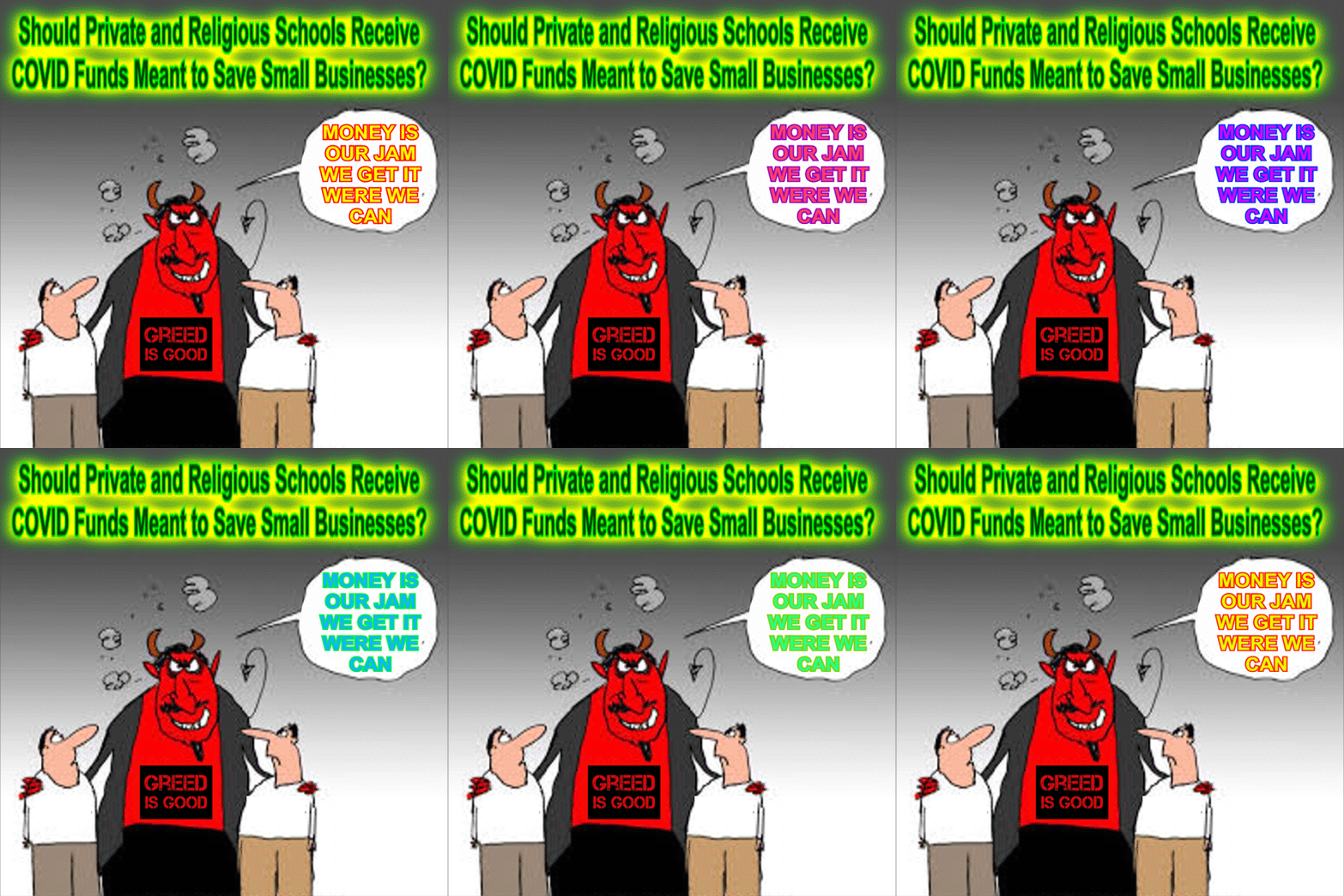
Should Private and Religious Schools Receive COVID Funds Meant to Save Small Businesses?


Last spring, when the pandemic began crippling the economy, Congress passed the $2.2 trillion CARES Act (Coronavirus Aid, Relief, and Economic Security Act). It was a rare moment of bipartisan action. Included in the act was the Paycheck Protection Program, which offered $660 billion to help small businesses weather an economic catastrophe in which many would be forced to close their doors and lay off their employees. The PPP would enable these businesses to pay their employees and survive the pandemic.

However, in the inevitable lobbying, someone added nonprofits to the list of organizations eligible to receive government aid under the PPP.

The PPP grants are called loans, but they are forgivable if used for payroll, rent, heating, and other expenses. It’s unlikely that any will be repaid.

Public schools were not eligible to apply for PPP, because they received a fund of $13.2 billion, which they were required to share with charter schools. Charter schools, however, were eligible to apply for PPP as “nonprofits,” meaning they could double dip into both funds. Over 1,200 charter schools got very generous CONTINUE READING: Should Private and Religious Schools Receive COVID Funds Meant to Save Small Businesses? | Diane Ravitch's blog

Saturday, January 2, 2021

Nevada: Charter Schools Cashed in on PPP Money | Diane Ravitch's blog

Nevada: Charter Schools Cashed in on PPP Money | Diane Ravitch's blog
Nevada: Charter Schools Cashed in on PPP Money


Last spring, you may recall, the CARES Act included $13.2 billion for public and charter schools. In addition, $660 billion was allocated to the Paycheck Protection Program (PPP) for small businesses and nonprofits that were struggling to survive due to the pandemic. Public schools were not allowed to apply for PPP. However, many charter schools learned through their lobbyists that they could apply for PPP. In other words, they double-dipped. They took the $134,500 or so that was available in the initial allotment for each public school. Then they went to the PPP and took another bite, which was far bigger than the funding allowed to public schools.

Which raises the interesting question: Are charter schools “public schools” or are they small businesses or private nonprofits? After all, public schools were not allowed to ask for PPP money, but over a thousand charter schools struck gold.

Nevada has a reputation for some of the worst charter CONTINUE READING: Nevada: Charter Schools Cashed in on PPP Money | Diane Ravitch's blog


Thursday, December 24, 2020

Diane Ravitch: The Dark History of School Choice | by Diane Ravitch | The New York Review of Books

The Dark History of School Choice | by Diane Ravitch | The New York Review of Books
The Dark History of School Choice
How an argument for segregated schools became a rallying cry for privatizing public education.


During her tenure as secretary of education, Betsy DeVos repeatedly asked Congress to allocate billions of dollars for vouchers for religious and private schools. She was repeatedly rebuffed. Even Republican members of Congress were unwilling to use the federal education budget to pay for vouchers. After all, most of their constituents’ children attend public schools.

After the pandemic struck, DeVos tried again. Late last March, Congress passed a $2.2 trillion relief bill called the Coronavirus Aid, Relief, and Economic Security (CARES) Act, which allocated $13.2 billion for K–12 education. Congress expected that the money would be shared, as federal education funds typically are, among the nation’s nearly 100,000 public and 7,000 charter schools, as well as private schools based on the number of low-income students they enroll. DeVos instead directed states to share the money allotted to public schools with private and religious schools that enrolled middle-income and affluent students. The NAACP and several states responded with lawsuits, arguing that her order was illegal. Three federal judges in different parts of the country ruled against DeVos, and she backed down.

But the Trump administration found another way to enrich charter and private schools. The Paycheck Protection Program (PPP), also part of the CARES Act, was supposed to rescue small businesses. Lobbyists for the charter industry, however, encouraged charter schools to apply as nonprofits, thus double-dipping into both the public school and PPP funds (public schools were ineligible for PPP funding). Private and religious schools also qualified for PPP funds as nonprofits. Therefore, through a bill supposed to aid small businesses at risk of bankruptcy, thousands of charter, private, and religious schools received an average of about $855,000 each, compared to about $134,500 per public school through CARES. Religious schools of every denomination, elite private schools, and more than one thousand charter schools received anywhere from $150,000 to $10 million each according to a database compiled by a website called COVID Stimulus Watch. Antelope Valley Learning Academy, a charter school in California, received $7.8 million. The for-profit Academia Corporation charter school chain won $28.6 million. Buckingham Browne & Nichols, an elite private school in CONTINUE READING: The Dark History of School Choice | by Diane Ravitch | The New York Review of Books

Tuesday, December 22, 2020

Laura Chapman: Charters in Ohio Shaking the PPP Money Tree | Diane Ravitch's blog

Laura Chapman: Charters in Ohio Shaking the PPP Money Tree | Diane Ravitch's blog
Laura Chapman: Charters in Ohio Shaking the PPP Money Tree


Our reader Laura Chapman lives in Ohio. She contacted NPE Execurive Director Carol Burris to find out which Ohio charter schools asked for and received money from the Paycheck Protection Program, even though they already received funding allotted to public schools; even though they lost no income, unlike the hundreds of thousands of small businesses that were closed by the pandemic and had NO income; even though public schools were not alllowed to apply for PPP funds. Under the CARES Act, the average public school received an average of $134,500. Charter schools for their share of that money, plus qualified to double dip into the PPP funds,, thanks to their skilled lobbyists.

Chapman writes:

Diane, You beat me to it. I found the headline this morning: “Charter’s PPP loan called into question. School gave shareholder company a $10M bonus.” That report from Craig Harris of the Arizona Republic (Dec 19, 2020) referred to Primavera, an online charter school based in Chandler. “The school received “a PPP loan of nearly $2.2 million, the largest forgivable loan among the 132 Arizona charter schools that obtained them. https://cdn.newseum.org/dfp/pdf19/AZ_AR.pdf

This scam is about to be repeated if more PPP money is allocated for so-called public charter schools now reinvented as small businesses.

I have been looking at the first round of Paycheck CONTINUE READING: Laura Chapman: Charters in Ohio Shaking the PPP Money Tree | Diane Ravitch's blog

Sunday, December 20, 2020

Arizona Charters Hit Jackpot with Federal Paycheck Protection Program | Diane Ravitch's blog

Arizona Charters Hit Jackpot with Federal Paycheck Protection Program | Diane Ravitch's blog
Arizona Charters Hit Jackpot with Federal Paycheck Protection Program


The federal CARES Act included the Paycheck Protection Program to help struggling small businesses and nonprofits survive the pandemic. Lobbyists for the charter industry slipped in a provision enabling charter schools to apply for PPP funding, even though they experienced no financial losses. Charter schools got a share of the $13.2 billion allotted to the nation’s early 100,000 public schools. The average public school received about $135,000 to meet the expenses of the pandemic. On the advice of their lobbyists, some 1200 charters also sought and won PPP funding. Thus charters drew funding from two sources; public schools were not eligible for PPP funding. Charters that applied for PPP funding won six times as much federal money as public schools.

The Arizona Republic reported that the Primavera online charter school in Arizona won a sizable “loan” (1% interest, forgivable), at the same time that its owner took CONTINUE READING: Arizona Charters Hit Jackpot with Federal Paycheck Protection Program | Diane Ravitch's blog

Wednesday, December 16, 2020

Carol Burris: How Charter Schools Cashed in on the Paycheck Protection Program | Diane Ravitch's blog

Carol Burris: How Charter Schools Cashed in on the Paycheck Protection Program | Diane Ravitch's blog
Carol Burris: How Charter Schools Cashed in on the Paycheck Protection Program


Dr. Carol Burris is the executive director of the Network for Public Education, a nonpartisan nonprofit organization that works to strengthen and improve public schools. Nearly 400,000 people in every state support its activities. Burris was a teacher and an award-winning principal in New York State.

This summer, the Network for Public Education reported that charter schools had received between one and two billion dollars in Paycheck Protection Program (PPP) Small Business Administration loans. In most cases, these low-interest loans will not have to be paid back, resulting in a windfall for recipients. 

PPP amounts were initially reported in ranges and excluded any grantees that received below $150,000. Thanks to reporters’ persistence, however, we now know the exact amount and the smaller grantees who received PPP.

We matched the amounts with our previously identified group of charter schools and charter chain recipients. In total, those charters received an astounding $1,279,455,958. You can find a complete list of the charter schools and what they got here.

In addition to schools, charter support and advocacy CONTINUE READING: Carol Burris: How Charter Schools Cashed in on the Paycheck Protection Program | Diane Ravitch's blog