Latest News and Comment from Education

Tuesday, February 9, 2021

Emma Tai: Karen Lewis Taught Us to Believe That We Could Win | Diane Ravitch's blog

Emma Tai: Karen Lewis Taught Us to Believe That We Could Win | Diane Ravitch's blog
Emma Tai: Karen Lewis Taught Us to Believe That We Could Win


Emma Tai is executive director of United Working Families of Chicago. She describes in Jacobin the powerful lesson that she learned from Karen Lewis.

She writes:

At a time of austerity and teacher demonization, Chicago Teachers Union president Karen Lewis — whose death at age sixty-seven was announced today — dared to believe that educators and the working class as a whole could fight back and win...

The 2012 strike put tens of thousands of people in the streets of Chicago. At a time of austerity and widespread demonization of teachers, both in Chicago and around the country, the CTU walked off the job insisting that we deserved, and could actually win, schools and a city that served Chicago’s working class. The strike put black, Latinx, and working-class people, and a workforce that is overwhelmingly women, in the streets by the tens of thousands against a neoliberal mayor, Rahm Emanuel, to say that the schools and city belonged to us. Astonishingly, they won.

That strike changed the political landscape of Chicago and the whole country, touching off a wave of teachers’ strikes that continue to this day and that have CONTINUE READING: Emma Tai: Karen Lewis Taught Us to Believe That We Could Win | Diane Ravitch's blog

CURMUDGUCATION: PA: A Reminder That Charter Schools Are Businesses

CURMUDGUCATION: PA: A Reminder That Charter Schools Are Businesses
PA: A Reminder That Charter Schools Are Businesses


Who do you suppose might have said the following:

During the last few years, we’ve created a complete business ecosystem at The Waterfront. This strategic purchase was the natural next step as we continue to expand our operations.

A: A classroom teacher
B: A building principal
C: A corporate VP in charge of mergers and acquisitions
D: The CEO of a cyber charter school

The answer is D, and the speaker is Thomas LongeneckerLongenecker is the CEO (former COO) and president of Commonwealth Charter Academy (CCA); he's also an adjunct professor of school finance and school law at Wilkes University, a PA university that specializes in online degrees. Before all that, he was business chief at two different school districts. His LinkedIn profile has a 13-year gap between his college graduation with a BA in business and his first school district job. 

CCA was launched in 2003 and has become the biggest cyber charter in PA. Their website leans heavily on the "It's free!" angle. They used to be called Commonwealth Connections Academy until 2016, and the website under that name is still live. Because--the name change coincided with the dropping of Connections Academy LLC as their education  program provider, but Connections Academy remains one of the Pearson cyber school brands still busily working the ed biz. Commonwealth Connections, owned by Pearson, at one point employed a guy named Mickey Revenaugh as a lobbyist; Revenaugh was also the corporate chair of the ALEC education task force. It gets confusing--CCA's 2017 990  shows them contracting with Pearson for $24 million worth of learning management platforms; that's less than half of the $54 million they spent in 2016, but it's not like they completely cut the cord. And previous year's costs for Commonwealth Connections to run CCA were in the $21 million range. 

Tracking personnel is tricky-- Longenecker's LinkedIn profile has him becoming CEO in 2019, but the previous CEO (Maurice Flurie) didn't leave the post till July of 2020. Flurie previously turned up CONTINUE READING: CURMUDGUCATION: PA: A Reminder That Charter Schools Are Businesses


Teaching WandaVision: A Textset on Pastiche – radical eyes for equity

Teaching WandaVision: A Textset on Pastiche – radical eyes for equity
Teaching WandaVision: A Textset on Pastiche


Early in the semester of my first-year writing seminar, we consider and reconsider openings in essays, an interrogation of students’ experiences with the mechanical “introduction” with the obligatory thesis sentence.

We examine, for example, several Beginnings from Barabara Kingsolver’s essays in High Tide in Tucson and Small Wonder. Two essay beginnings reveal the complexity of student awareness about genre, writing forms, and language/text conventions.

Kingsolver’s “Creation Stories” opens with “June is the cruelest month in Tucson, especially when it lasts until the end of July.” Students always struggle with tone (missing the exaggeration and humor), and completely miss the allusion the T.S. Eliot’s “The Wasteland” (a work itself rich with allusion and historically situated).

I have them consider that their dominant experiences with literary texts in school have been deadly serious, both the texts they have read and the approach taken to those texts (analyzing for deeply serious meaning). Then, I stress the problems with referential texts, such as the use of allusion, since the author is expecting the readers/audience to have the background knowledge needed to recognize the reference and its significance to the texts being addressed.

“Once upon a time, a passing stranger sent me into exile,” Kingsolver begins in her “Jabberwocky.” Immediately, students identify this reference to fairy tales, CONTINUE READING: Teaching WandaVision: A Textset on Pastiche – radical eyes for equity

Rest in Power, Karen Lewis | Schott Foundation for Public Education

Rest in Power, Karen Lewis | Schott Foundation for Public Education
Rest in Power, Karen Lewis


Today we learned that Karen Lewis — educator, organizer, and pathbreaking labor leader — has passed away. She leaves us with a legacy of unwavering commitment to children, public education, and racial justice.

After teaching chemistry for 22 years, Lewis was elected president of the Chicago Teachers Union (CTU) along with fellow members of Caucus of Rank and File Educators (CORE). This new leadership within CTU brought a fighting spirit, an activist orientation, and an expansive framework that placed racial justice at the heart of their work within a still-deeply segregated city.

This shift of power within the union set the stage for the historic and successful Chicago teacher's strike in 2012. The strike was remarkable not only because teachers there hadn’t struck since the 1980s, but because the union laid the important coalitional groundwork to bring community partners into discussion and cooperation. That coalition strategy is widely understood as the key to the strike’s success: because educators, students, parents, and community groups worked together, city officials couldn’t pit them against each other. Much of the inspiring educator activism across the country over the past eight years, including the wildcat educator strikes on 2018-2019, can be linked to the positive example of the 2012 strike.

Bridging together different sectors of the broad education justice movement is at the heart of what the Schott Foundation does. We highlighted the important cross-sector movement work of CTU under Karen Lewis in our 2018 report Keeping Students First: Building Community Labor Partnerships for Strong Schools.

We were also lucky to have Karen Lewis speak on our 2017 webinar When Community and Labor Join Forces: Parent, Student and Teacher Partnerships:

In recounting her time organizing in CTU, Lewis said, "You have to go where people are. You can't just say 'oh, come to our meeting...' You build the movement by finding common ground. And that's what I think we were able to do."

May we continue to gather in her strength, courage and conviction.


pic.twitter.com/X73B8POAdE

— ChicagoTeachersUnion (@CTULocal1) February 8, 2021

Pitiful – UNDERWHELMING - YARBRO CALLS FOR BEP UPDATE - Tennessee Education Report

Pitiful – Tennessee Education Report
PITIFUL


That’s how Tennessee Education Association (TEA) President Beth Brown described the state of education funding in Tennessee.

The Chattanooga Times-Free Press reports on Brown’s remarks, which come just as Gov. Bill Lee prepares to deliver his State of the State address tonight.

Brown notes:

“Our funding is so low the only neighboring state we beat is Mississippi,” wrote Brown, a Grundy County teacher. “To meet Kentucky’s per student investment, the state would need $2.6 billion; to match Arkansas, the increase would be $860 million; and to be on par with Alabama would require $560 million this year alone.”

Brown’s criticism of the state’s poor track record of investment is noteworthy as the state now sits on a $3.1 billion surplus due to better than expected revenue flow during the COVID-19 pandemic.

While Brown says the state can do more, the Tennessee House Republican Caucus is CONTINUE READING: Pitiful – Tennessee Education Report


Gov. Bill Lee delivered his State of the State address tonight and surprising exactly no one, he failed to make bold new investments in public education in spite of a record surplus in excess of $3 billion.

Instead, Lee proposed continuing to “fully fund” the wholly inadequate BEP formula to the tune of an additional $71 million and add $120 million to the teacher compensation component of the BEP. That’s essentially a 4% increase in the BEP allocation NOT a 4% raise in actual teacher compensation.

To be clear, the state needs $1.7 billion to adequately fund the BEP and Lee is proposing adding $71 million. If you add the teacher compensation element to this, you get $191 million. Or, roughly 10 percent of what is actually needed.

Here’s what Tennessee Education Association President Beth Brown had to say regarding Lee’s proposal:

Gov. Lee’s proposed increases for public education is not enough to meet current needs and falls far short of what was possible with record state revenue surpluses and collections. Tennessee ranks 46th in the nation on funding per pupil, only ahead of  CONTINUE READING: UNDERWHELMING


ollowing Gov. Bill Lee’s disappointing State of the State address during which he revealed a status quo budget when it comes to public schools, state Sen. Jeff Yarbro of Nashville called on the Lee Administration to use the opportunity of a huge budget surplus to update the BEP.

Yarbro is right, of course. The BEP woefully underfunds Tennessee schools. Back in 2014, the BEP Review Committee highlighted a long list of needs.

Since then, the problem has only gotten worse.

MORE on the BEP   CONTINUE READING:  YARBRO CALLS FOR BEP UPDATE

Charlotte Hawkins Brown, Black Educator Hall of Fame Member + WHEN WILL BLACK LIVES MATTER IN SCHOOL? - Philly's 7th Ward #BLM #BLACKLIVESMATTER #BLACKHISTORYMONTH

Charlotte Hawkins Brown, Black Educator Hall of Fame Member - Philly's 7th Ward
CHARLOTTE HAWKINS BROWN, BLACK EDUCATOR HALL OF FAME MEMBER


E’ry day this month, the Center for Black Educator Development, in partnership with Phillys7thWard.org, will highlight a Black Educator Hall of Famer.

But, don’t forget, e’ry month is Black History MonthFebruary is just the Blackest.

Today, our featured Black Educator is Charlotte Hawkins Brown.

The work of eduactivist, Charlotte Hawkins Brown, personifies Black excellence in education. Born in North Carolina in 1883, Brown was educated in Cambridge, Massachusetts, where she with her parents moved to escape the Jim Crow south. While in school, Brown was known as a brilliant student. After high school, she enrolled in the Salem Normal School to enter a career in teaching.

Encouraged by the Women’s Division of the American Missionary Association, Brown returned to North Carolina to educate Black children upon her graduation. When she arrived, she found a school with conditions unlike anything she experienced in Cambridge. The school was in such bad shape that the American Missionary Association closed the school down. However, she was not deterred.

Encouraged by local Black people and after hearing about Lucy Craft Laney’s work in a lecture, Brown, at the age of 18, moved back to North Carolina and CONTINUE READING: Charlotte Hawkins Brown, Black Educator Hall of Fame Member - Philly's 7th Ward

WHEN WILL BLACK LIVES MATTER IN SCHOOL?


In September of 1915, historian Dr. Carter G. Woodson co-founded the Association for the Study of Negro Life and History (ASNLH). ASNLH was dedicated to researching and highlighting the achievements of Black people in American and all peoples of African descent. To that end, ASNLH, under the direction Dr. Woodson, established Negro History Week to promote and celebrate the long history of accomplishments of Black people in America.

Thanks to the freedom fighters throughout the Civil Rights Movement, Negro History Week evolved into Black History Month because of a growing awareness among Black people of Black identity and the freedom fighters of the Civil Rights Movement and, in 1976, it was recognized by President Ford.

There has been a growing debate as to the usefulness or necessity of Black History Month. When engaging in these debates, I am reminded of the words of Dr. Woodson, who said of Negro History Week (which became Black History Month):

In 2016, a group of educators, parents and activists in Seattle, Washington organized a week of activities for racial justice in schools with the goal of teaching students about systemic racism, Black history and the Black CONTINUE READING: WHEN WILL BLACK LIVES MATTER IN SCHOOL?

In the Absence of COVID Safety Plans, Teachers Are Resigning and Retiring Early

In the Absence of COVID Safety Plans, Teachers Are Resigning and Retiring Early


This should have been Cheryl Dubberly’s 40th year as a music teacher, but in August 2020, she resigned from her position with the Duval County Board of Education in Jacksonville, Florida.

“It was dreadful to think about continuing,” Dubberly told Truthout. “I would not have been able to stay safe because I was responsible for teaching music to the entire school — 500 to 600 kids.” The job, she says, required her to go from classroom to classroom even though the Centers for Disease Control and Prevention warned that singing with others can spread COVID-19.

“The job was not worth my life,” she says.

Like Dubberly, Christine Vehar, also a music teacher, left her position in the metro Atlanta area this fall. She had taught for just three and a half years. “When the schools closed in March, I had a great remote teaching experience,” she says. “The students were very engaged and despite some initial disorganization, it worked well, and I ended up loving teaching from home.” But when Vehar’s district decided to move to a hybrid schedule in October — holding in-person classes from 7:15 am to 2:15 pm four days a week, with Wednesdays as a remote teaching and learning day — she resigned.

The reason was fear of catching and spreading the virus.

“My mom is 63, and she lives with me,” Vehar told Truthout. “She is a three-time cancer survivor and an amputee with a compromised immune system, so there was absolutely no way for me to give her the care she deserves and continue to teach in-person.”

fall 2020 survey conducted by the National Education Association (NEA) confirms that neither Dubberly nor Vehar are unusual. “Teachers with less than 10 years in are leaving the profession,” NEA President Becky Pringle told Truthout. “And 40 percent of mid-range teachers — CONTINUE READING: In the Absence of COVID Safety Plans, Teachers Are Resigning and Retiring Early

Remembering a dinner with Karen and Coach John. – Fred Klonsky

Remembering a dinner with Karen and Coach John. – Fred Klonsky
REMEMBERING A DINNER WITH KAREN AND COACH JOHN.

Singing back-up with Karen Lewis at my 2012 retirement party. “Take a load off, Fanny.”


There will be and should be plenty of those who will talk about the union leader, Karen Lewis, who died yesterday at the young age of 67.

I remember one memorable evening in New Orleans.

Anne and I were there on a brief holiday.

My cell phone notifications went off and it was a message from Karen Lewis

“I see on Facebook you’re in town. I’m down here for an AFT meeting and I need to get out of here. I need a break. What if you find a place for dinner and meet up with me and John?”

“Sure thing,” I texted back.

I booked a table for four at the Upperline, out of the French Quarter and a block CONTINUE READING: Remembering a dinner with Karen and Coach John. – Fred Klonsky

Teacher Tom: Leaving Our Children Illiterate in Body and Spirit

Teacher Tom: Leaving Our Children Illiterate in Body and Spirit
Leaving Our Children Illiterate in Body and Spirit


I prioritize reading books. Growing up, our daughter got to know me as a father who read books in the morning and in the afternoon. My wife and daughter are book readers as well. Our homes have always had book-lined walls. I also read a lot as a young boy. I remember keeping a stack of the books I'd completed at the foot of my bed as if they were trophies. I obsessively read every Hardy Boys Mystery, then every one of the books of Oz. Sometimes I would just hold those books in my hands and meditate on the memory of the experience of reading it. I read fiction for pleasure, but among the side effects is a sense that I'm getting to know other human beings from the inside out, rather than the more distant outside in way of getting to know characters in a play or a movie. I read non-fiction to excite my thoughts, but among the side effects is a sense that I'm a part of the great conversation that humans have been having since there have been humans.

It may sound like I'm boasting, at least a little. I mean, reading books is generally held up as one of the few worthy, perhaps even noble, past times. Smart people read books, educated people read books, if only more people would read CONTINUE READING: Teacher Tom: Leaving Our Children Illiterate in Body and Spirit

Karen Lewis 1953 – 2021 | JD2718

Karen Lewis 1953 – 2021 | JD2718
Karen Lewis 1953 – 2021


This is not an obituary. I could not do her justice. But one summer I flew to Chicago then on to Minneapolis, and while in Chicago I spoke (indirectly) to Karen, and in Minneapolis I met her, and it makes a little story. Here’s how I told it, the evening after the one and only time I met Karen Lewis.

AFT Convention 2016 – Meeting the President

JULY 21, 2016 PM31 12:40 PM

Not that one. Obama’s not here in Minneapolis. And not the next one – she left. And not the AFT President. I’ve met Randi many times before, argued with her, agreed with her, e-mailed, etc. And not Mulgrew, we’ve met.

This is the story of how I met the President of AFT Local 1, the Chicago Federation of Teachers, Karen Lewis.

OK, so I could have walked up to her and said hello, but my story is a little more convoluted.

Four days ago, before the AFT Convention, I was in Chicago, debating Fred Klonsky. Actually, I was staying with Fred and Anne. But little debates broke out. Yankees vs Cubs. Hillary vs Jill.

But our strangest debate was about the relative importance of Belief vs Acts in Judaism. Both Fred and I have tenuous links, not enough to claim expertise. Anne suggested we ask Karen. So we did. Fred texted her a series of questions. Each of which she answered with a question. Quite appropriate, we thought.

So I’m off to Minneapolis and Fred says I have to meet Karen. The first day I look a little for her, but don’t really know where to look. I don’t find her. Fred CONTINUE READING: Karen Lewis 1953 – 2021 | JD2718


Hoping for a Stronger Focus on Public Education in 2021 and Beyond | Truth in American Education

Hoping for a Stronger Focus on Public Education in 2021 and Beyond | Truth in American Education
Hoping for a Stronger Focus on Public Education in 2021 and Beyond


We need a Secretary of Education who has classroom teaching experience beyond grade 5 and has administered a middle or high school for at least a couple of years or so.  This experience gives teaching faculty a chance to understand and tell us a little bit about a candidate’s supervisory style. No need for a particular ethnicity or race or gender.  We’ve tried using all these sociocultural criteria, especially in our major cities.  But no criterion has worked for most kids.  

Are recent nation-wide riots, looting, and arson all in large part expressions of our frustration with and rage at seemingly failed or ineffective educational institutions?  We haven’t tried yet to make other institutions or agencies for public health or safety responsible for educating the nation’s children.  We need to try, because it is clear that public educational facilities are no longer capable of educating our young or producing productive citizens.

There are several questions we should ask ourselves to try to understand the basis for the many waves of rioting in our major cities in recent years, most recently Portland, Oregon.  

  1. Why haven’t our educational institutions found effective remedial strategies for low-achieving students by now—over 50 years after the first federal grants to low-income schools and communities in ESEA in 1965?
  2. Do schools in undeveloped or under-developed countries produce similar or lower levels of performance on the TIMSS, PIRLS, and PISA tests given to comparable children of low-income parents in this country on these tests? These have been the chief international tests available for our states to participate in.     
  3. What are the average scores for each demographic group in countries with many non-dominant population groups as in the USA, Australia, Canada, and Singapore?

Maybe education researchers have looked at the wrong things or not asked the right questions, such as:

  1. How much reading or other homework have teachers assigned their students in K-12?
  2. How many parents check the time their children go to bed every night and how much they read or practice every day?
  3. Why have pre-schools on average, or after-school programs extending school teaching hours, failed to create equity among demographic groups in the K-12 school population? 
  4. Why has the use of literary texts and curriculum-aligned textbooks whose subject matter and vocabulary have been reduced in difficulty (such as in recent Afrocentric curricula like 1619 ) failed to boost minority scores?

Who could be recommended for Secretary of Education?  Perhaps all parents would agree that such a CONTINUE READING: Hoping for a Stronger Focus on Public Education in 2021 and Beyond | Truth in American Education


DOWN AT THE FACULTY LOUNGE – Dad Gone Wild

DOWN AT THE FACULTY LOUNGE – Dad Gone Wild
DOWN AT THE FACULTY LOUNGE

“Id Faciam

What I hate I love. Ask the crucified hand that holds
the nail that now is driven into itself, why.”
― Catullus


The phone rang this morning, It was my pal Slatsky, “Come on down to the Faculty Lounge and grab lunch with me.”

When I got there, Slats was sitting at the bar with an empty shot glass and a half-filled beer in front of him. I raised my eyebrows and motioned to the bartender for soda water.

Slatsky looked at me with his hands out, palms up, “Come on give me a break. Been a hard week.”

I chuckled ironically, as I slipped into my seat. In front of my pal was a folded newspaper, displaying an article by Meghan Mangrum about teachers traveling for miles to get COVID-19 vaccines.

“You see this crap”, he said to me while taping the article with his forefinger, “What the hell?”

I just shook my head and said, “It’s crazy man. I got no words.”

“I tell you what the deal is, it’s teachers, once again, doing what they always do, covering up for our inadequacies. Think about it. Don’t devote enough resources to classrooms, what do teachers do? They go into their own pockets to make up the difference. Put too many responsibilities on, make it impossible to do it all in a day, and they’ll just come in on the weekend for free? A kid needs someone to talk to at 9 at night, and nobody is available, who takes the call? A teacher!”

He had obviously been thinking about this for a while.

“It’s always left up to teachers to fix. Whatever the case. If there is a shortfall, it’s made up by teachers. Teachers rarely complain, because if they do, people jump on them for putting CONTINUE READING: DOWN AT THE FACULTY LOUNGE – Dad Gone Wild

The Network for Public Education Mourns the Loss of Karen Lewis - Network For Public Education

The Network for Public Education Mourns the Loss of Karen Lewis - Network For Public Education
The Network for Public Education Mourns the Loss of Karen Lewis


Friends of public education have lost a true friend and hero with the passing of the Chicago Teachers Union’s leader, Karen Lewis. 

Our President Diane Ravitch was her admirer and dear friend. This morning she wrote on her blog.

“It is with immense sadness that I share with you the news that the brilliant, charismatic Karen Lewis has died. As the Chicago Teachers Union leader, she led the union to strike for “the schools our children deserve.” She understood that the union had to organize families and communities, not just their members. She fearlessly confronted the powerful. She was considering a run against Rahm Emanuel for mayor of Chicago when she learned she had an aggressive brain tumor. 

Karen and her devoted husband John were dear personal friends. I saw them when I was in Chicago a year ago. 

All of us who care about children and their schools will miss her dynamic leadership. 

Every time teachers strike for better education for children, they should remember this tireless, inspiring woman, our friend, Karen Lewis.”

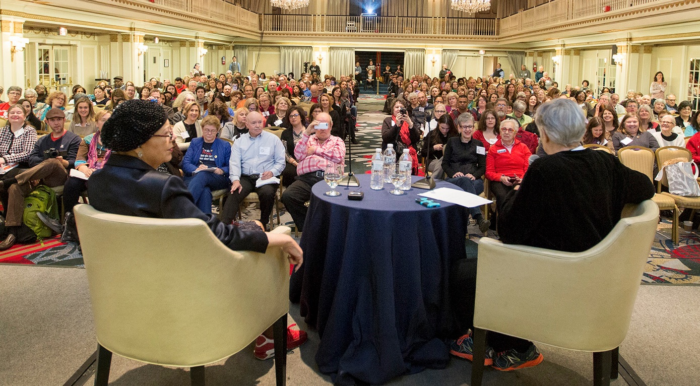
To watch a video of Diane and Karen in conversation at the 2015 NPE Conference in Chicago, click the image below.

Network for Public Education National Conference: Diane Ravitch in Conversation with Karen Lewis from Schoolhouse Live on Vimeo.

Network for Public Education Action board member Jitu Brown is the leader of Journey for Justice, a grassroots organization dedicated to racial and education justice. A Chicago resident, he put his own life on the line when he led the hunger strike to keep a neighborhood high school open.   

Upon hearing of Karen’s passing, Jitu said, Karen was brilliant, visionary and despite her Ivy League education, grounded in a core Black politic that demanded we are treated with dignity and respect. She had courage, soul and swag! Make no mistake, she was an electrical force for justice that reignited the labor movement. She will be missed but never forgotten.”

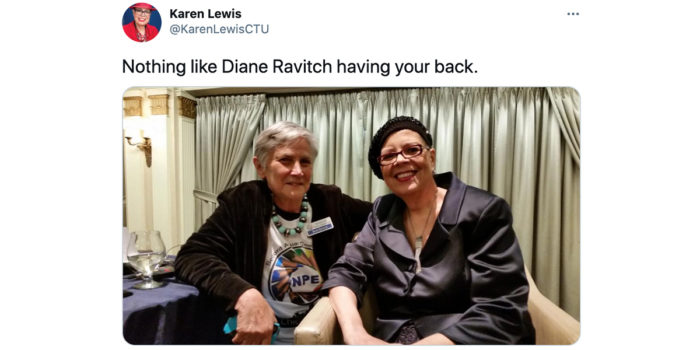
Below is a wonderful picture of Diane and Karen that Karen tweeted from our Chicago Conference in 2015. Even though she was quite ill, she was there at our conference to cheer us on.

Karen was a remarkable woman and an early supporter of the Network for Public Education. Although we are relieved that she is now beyond suffering and at peace, we are deeply saddened by the loss of this faithful friend of public education. 

Our deep condolences go out to Karen’s family, who generously shared her with the world. Karen was a model of courage, dignity, and integrity for all of us.

The Network for Public Education Mourns the Loss of Karen Lewis - Network For Public Education