Thursday, October 15, 2020

A VERY BUSY DAY Larry Ferlazzo's Websites of the Day... The latest news and resources in education since 2007

Larry Ferlazzo's Websites of the Day... | The latest news and resources in education since 2007


A VERY BUSY DAY
Larry Ferlazzo's Websites of the Day...
The latest news and resources in education since 2007


Big Education Ape: THIS WEEK IN EDUCATION Larry Ferlazzo's Websites of the Day... The latest news and resources in education since 2007 - http://bigeducationape.blogspot.com/2020/10/this-week-in-education-larry-ferlazzos_10.html


The Best Online Learning Games To Play During Distance Learning – Share Your Additions!
cuncon / Pixabay I have a lot of posts about learning games – both online and in the physical classroom. And I have quite a few about dealing with virtual learning . This one is a combination that will list the online games I’m using the most with my English Language Learner students in my English and History classes (feel free to add your own!): Pictionary with Whiteboard.fi is always a winner.
Statistic Of The Day: Eight Million More People In US Fall Into Poverty Since May
8 Million Have Slipped Into Poverty Since May as Federal Aid Has Dried Up is a depressing NY Times article today. Economic stress has been found to have a huge negative effect on student academic achievement (see The Best Places To Learn What Impact A Teacher (& Outside Factors) Have On Student Achievement ). One of many reasons it has that kind of impact is the stress on “cognitive” or “mental”
Everything You Wanted To Know About Instructional Strategies But Were Afraid To Ask
Wokandapix / Pixabay I have over 2,100 frequently revised and updated “Best” lists on just about every subject imaginable, and you can find them listed three different ways in three different places (see Three Accessible Ways To Search For & Find My “Best” Lists ). I’m starting to publish a series where each day I will highlight the “Best” lists in a separate category. Today, it’s on Instructiona
NPR Launches Its Annual Podcast Contest For Middle & High School Students
TheAngryTeddy / Pixabay NPR has announced its third annual podcast challenge for middle and high school students. Whether or not you want to encourage your students to participate, one great thing about the contest is that they provide excellent resources for teachers (and students) who want to include podcasting in any lessons. This year, they’ve also added a contest specifically for college stu
StoryCorps Launches Annual “Great Thanksgiving Listen”
Every year since StoryCorps began it in 2015 , I’ve shared about their project, The Great Thanksgiving Listen: The Great Thanksgiving Listen is a national movement that empowers young people—and people of all ages—to create an oral history of the contemporary United States by recording an interview with an elder, mentor, friend, or someone they admire. You can learn all about it here , as well as
All End-Of-Year “Best” Lists For 2020 In One Place!
I’ve begun posting my end-of-the-year “Best” lists for 2020, and will be adding links to each one in this post. There should be close to thirty by the time I’m done! You can see all the mid-year lists at ALL 2020 MID-YEAR “BEST” LISTS IN ONE PLACE! and all previous annual lists at All My “Annual” Best List Collections. Here’s what I’ve shared so far this year: THE BEST THIRTY-FIVE WEB 2.0 APPLICA
Video: “13 Centuries of Spoken English, in Two Minutes and Twenty Seconds”
990609 / Pixabay I’m adding this new video to The Best Videos Documenting The History Of The English Language :
Thursday’s Must-Read Articles About School Reopening
mohamed_hassan / Pixabay Here are new additions to THE BEST POSTS PREDICTING WHAT SCHOOLS WILL LOOK LIKE IN THE FALL : Teachers unions in 3 large Sacramento districts want schools closed until at least January is from The Sacramento Bee. As Covid-19 Closes Schools, the 

Larry Ferlazzo's Websites of the Day... | The latest news and resources in education since 2007

Wednesday, October 14, 2020

WHO IS FUNDING SACRAMENTO BEE'S ATTACKS ON TEACHERS - EDUCATION LAB

McClatchy tries nonprofit funding for education coverage - Digiday

McClatchy tries nonprofit funding for education coverage


In a bid to keep subscriber growth going, McClatchy is turning to issues-based reporting, aided by community nonprofits.
In late September, the local news publisher announced the launch of the Education Lab, a four-person team that will cover education in the San Joaquin Valley out of the bureau of The Fresno Bee. The Lab, which McClatchy developed after soliciting input from dozens of local community members and multiple local nonprofits, will be supported for its first year by a collection of nonprofits including the Central Valley Community Foundation, with discussions underway for funding a second. The Central Valley Community Foundation will not have any say or control over what the Lab’s reporters publish. The stories produced by the Education Lab will be shared with local groups as well as local news organizations, in Spanish as well as in English.
The Central Valley Community Foundation will be watching the kinds of outcomes that the Education Lab’s reporting is able to drive. But the larger strategic goal for McClatchy is to drive digital subscriptions. In its most recent quarterly earnings, McClatchy reported having over 185,000 digital-only subscribers, up more than 51% year over year. The news publisher reported a net loss of $17.5 million over that same period, against revenues of $178.7 million.
“By delivering focused reporting and community engagement, we feel like the value we’re bringing will lead to an increase in digital subscription support,” said Lauren Gustus, the regional editor of McClatchy’s California, Idaho and Washington news operations. While some of the Lab’s reporting will be behind the Bee’s paywall, not all of it will; much of it will be shared with community and news organizations, who do not operate paywalls. “We think more people are going to want to support The Bee because the Education Lab reporting will matter to them,” Gustus said.
While the Education Lab is still coming together — its reporting team is still being hired — McClatchy believes the model, originally pioneered by The Seattle Times in 2013, is replicable. The news publisher is engaged in conversations with local community groups and organizations in more than eight different markets around the country, with an eye toward launching more labs by year’s end and more next year.
“It’s no secret that most legacy news organizations have been challenged,” Gustus said. “If fact-based journalism is in peril, which I believe it is, we have to think pretty radically about how we serve our communities.”
“We know digital-only subscription growth is key, and we know if we do more of the work local communities want, in theory we should find more of that support in the digital subscription space,” Gustus said. “This is meant to be a bridge to sustainability and not necessarily the establishment of a nonprofit news operation.”
As declining print advertising has battered local news publishers, there has been a substantial increase in institutional support for local journalism over the past decade; Gustus said that institutional giving to local news has quadrupled over the past 10 years.
At the other end of the spectrum, a number of news publishers have found success getting their readers to pay for specific reporting projects. The Guardian, for example, discovered that its American audience was willing to pay for investigative series focused on topics such as the environment.
As that money’s pooled in, there has been some scholarship around the effects that nonprofit donations or involvement have had on reporting. Though many see the opportunities for conflict as not too different from the challenges that publishers face with advertisers.
“It’s very rare that you’d see a philanthropist come in and fund something like what McClatchy is doing and say, ‘Here are the stories you need to write,’” said Matt Skibinski, a reader revenue analyst at the Lenfest Institute. “With philanthropies, you have the same kind of implicit concerns [as advertising]. But as long as the independence is maintained, publishers remain interested.”


Sacramento CA Area Education News | The Sacramento Bee - https://www.sacbee.com/news/local/education/
About Education Lab | The Seattle Times - https://www.seattletimes.com/?p=9830232 on @seattletimes
Journalism
Grantmaking
New Funding, Models and Partnerships


Fresno Bee launches Education Lab to cover school issues, news | The Fresno Bee - https://www.fresnobee.com/news/local/education-lab/article235201142.html on FresnoBee
McClatchy's Sac Bee launching donor-supported reporter team - Sacramento Business Journal - https://www.bizjournals.com/sacramento/news/2019/11/14/sacramento-bee-to-launch-donor-supported-reporting.html on @Sacbiz


DO WE HAVE THE CORRECT PRIORITIES? – Dad Gone Wild

DO WE HAVE THE CORRECT PRIORITIES? – Dad Gone Wild

DO WE HAVE THE CORRECT PRIORITIES?


“Every story has at least a little truth in it. Every story comes from somewhere.”― J.J. Abrams
This morning I drove to Wal-mart around 7:45 to get coffee. There is a rapid COVID-19 testing site in a building at the front of the Wal-mart parking lot. At its door was a line that stretched around the building. I’m guessing it was roughly 60 people.
60 people that had shown up before 8 AM to be tested for a virus that many are acting as if it is in remission.
60 people during a week that has already delivered too much devastating news.
On Monday, MNPS school board member Dr. Nabaa-McKinney lost her sister-in-law to COVID. On Tuesday, JT Moore’s principal Gary Hughes lost his mother and Nashville lost one of its most colorful long-time citizens in Jimmy Lweis to COVID-19. Those are numbers that I’m not comfortable with.
I’ve known Jimmy Lewis for about 30 years, and he was representative of a Nashville that is quickly disappearing. Some may think Nashville is better for the passing of these old white men that played by their own rules and bent the world to their will, and maybe they are right, but that won’t stop me from mourning their departure.
Jimmy may not have always been on the right side of the law, but he unfailingly kind to me and many others. He and those of his generation lived by a code that included taking care of your fellow man, and they adhered to it religiously. In the days when my drinking was at its most chronic, that CONTINUE READING: DO WE HAVE THE CORRECT PRIORITIES? – Dad Gone Wild

“Welcome Back, Teach” (Jessyca Mathews) | Larry Cuban on School Reform and Classroom Practice

“Welcome Back, Teach” (Jessyca Mathews) | Larry Cuban on School Reform and Classroom Practice

“Welcome Back, Teach” (Jessyca Mathews)


Mathews is an English Teacher at Carman-Ainsworth High School in Flint, Michigan. Her story appeared in the Washington Post’s online article, October 6, 2020. She is one of nine teachers the newspaper asked to report on their experiences in returning to remote and in-person instruction during the pandemic.
The massive rumbles of thunder surprise me from my sleep. With heart racing, I turn over to look at the time. It’s only 4:30 a.m. I could try to sleep for another hour and a half, but my mind has other plans. As I sit up and look out the window, I gaze at the dark, mysterious sky.
I am exhausted, but I must start my day because it is time for the inevitable. I must report to the Factory today.
I begin a ritual that would soon be my daily routine. I take a hot shower. Brush my teeth. Put on ChapStick. Find clothing with many pockets. Display makeup just on my eyes. The mask will cover the rest of my face.
I investigate my survival bag to make sure I have the required items: hand CONTINUE READING: “Welcome Back, Teach” (Jessyca Mathews) | Larry Cuban on School Reform and Classroom Practice

Selling Charter School Class Size as “Innovative Medical Experimentation” During Covid-19

Selling Charter School Class Size as “Innovative Medical Experimentation” During Covid-19

Selling Charter School Class Size as “Innovative Medical Experimentation” During Covid-19


Efforts to destroy public schooling in America have not disappeared during the pandemic. While Education Secretary Betsy DeVos displays her hatred for public education, especially with Fairfax County public school teachers, DC Charter Schools are advertising innovations during the pandemic.  They’re promoting smaller class sizes as innovative medical experimentation. Their innovations, however, are not ingenious.
While most of Washington’s 52,000 public school kids are dealing with computer screens and Zoom rooms in a remote learning environment, about a dozen charter schools have essentially chosen to become medical-educational experiments, offering in-person instruction for select groups of students.
Smaller and more nimble than the D.C. Public Schools system, the charters have been able to adapt and modify practices on the fly, trading information and pushing the limits of pandemic-era education.
“This is our attempt to redesign school. Our size is our best asset.”
Meanwhile, in Baltimore, a public school teacher interviewed in a CNN report mentions that she’s teaching 42 third-graders remotely.  She’s uncomplaining, smiling, and forging forward positively.
It’s wrong to showcase charter schools as innovative due to class size when public CONTINUE READING: Selling Charter School Class Size as “Innovative Medical Experimentation” During Covid-19

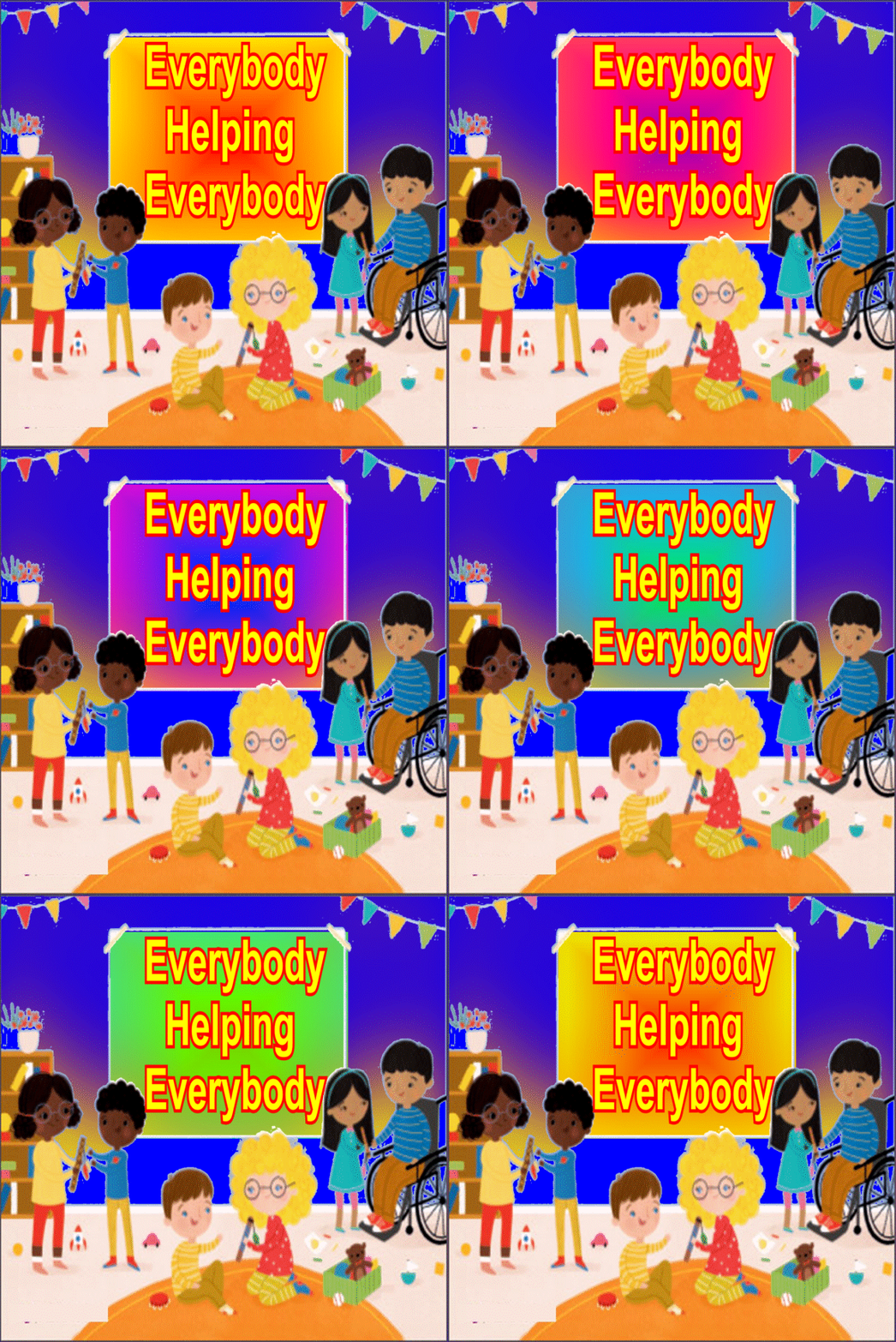
Teacher Tom: Everybody Helping Everybody

Teacher Tom: Everybody Helping Everybody

Everybody Helping Everybody


We were playing with our classroom "catapults," crude ping pong ball shooting devices that are not really catapults at all, but act like them with the help of rubber bands, which I built in my garage one summer. They are always extremely popular play items and because I'd only made six of them, they are always short in supply with occasional conflicts erupting as the kids figure out how to share them. At the beginning of the morning, I'd supplied a couple dozen balls, but the available supply had now dwindled to a handful, the rest having been "lost" under the classroom furniture.

"Teacher Tom, all the balls are gone," announced on boy who was carrying a catapult possessively not wanting to give it up.

"Not all of them," I answered, "But there were a lot more earlier."

"They're all under there," he said, pointing at the gap between some cabinetry and the floor.

I nodded.

"We have to get them out."

I agreed.

"I tried to reach them, but they're too far. You try it, Teacher CONTINUE READING: Teacher Tom: Everybody Helping Everybody

Board sets termination hearing on Epic authorization

Board sets termination hearing on Epic authorization

Board sets termination hearing on Epic authorization


The Statewide Virtual Charter School Board approved a motion today to enter the process for terminating their charter authorization contract with Epic One-on-One Charter Schools owing to alleged violations.
“As a society, it is essential that we provide a healthy mix of    educational opportunities to support all types of students and all types of life circumstances. Online charter schools must continue to be one of those choices,” SVCSB Chairman John Harrington said during the meeting. “That is why it’s important that we work hard to safeguard our online schools and educational resources. One way to protect them is to insist that schools respect their obligations and conduct themselves with integrity. This responsibility starts with a commitment from a school’s board of directors and extends to it’s superintendent, staff and third-party vendors. This standard applies to every Oklahoma public school, including our six online public charter schools.”
While Rose State College is the authorizers for the Epic Blended school, Epic One-on-One has been under the oversight of SVCSB since April 2014. The charter was last renewed on July 2018. Charter authorizers are allowed to retain up to 5 percent of state aid received from the State Department of Education, with a remainder of the funds being transferred to the charter schools.
According to the Epic audit released by the State Auditor & Inspector’s Office on Oct. 1, SCVSB also has the responsibility of maintaining oversight and evaluation of the charter CONTINUE READING: Board sets termination hearing on Epic authorization

Ohio: Who Pays for Vouchers? | Diane Ravitch's blog

Ohio: Who Pays for Vouchers? | Diane Ravitch's blog

Ohio: Who Pays for Vouchers?


Bill Phillis, founder of the Ohio Coalition for Equity and Adequacy of School Funding explains here where the funding comes from for vouchers: public schools pay from their budgets. The cost this year is nearly $350 million, deducted from the public schools that enroll nearly 90% of the state’s children. A study funded by the conservative Thomas B. Fordham Institute showed that vouchers are ineffective and that children who use them fall behind their peers in public schools. Yet the Legislature wants to increase the funding for vouchers. Why invest in failure?
Deductions from school districts to voucher schools increased from $42,355,792 in FY 2008 to $349,304,605 in FY 2021
In 13 years, voucher deductions have increased each year except for FY 2011 to FY 2012 wherein there was a decrease of 9%. The percentage increase during the period from FY 2008 to FY 2020 has fluctuated between 7.2% and 86%. See the table below: CONTINUE READING: Ohio: Who Pays for Vouchers? | Diane Ravitch's blog